The Nine Types of Personality Explained

The Enneagram of Personality isn't about slapping a label on yourself and calling it a day. Think of it as a dynamic map of your inner world, a guide to understanding the nine types of personality that shape how we all see and interact with life. Each of the nine types operates from a totally distinct worldview, with its own unique set of motivations, fears, and internal logic driving everything it does.
Your Guide to the Nine Personality Types
Ever scratch your head, wondering why you shut down under stress while your best friend gears up for a fight? Or why some people seem to thrive in the spotlight while you’d rather observe from the sidelines? The Enneagram offers a powerful lens to see these patterns, illuminating the subconscious drivers that are secretly running the show.
It’s less about what you do and way more about why you do it. Imagine nine different travel guides for the journey of life—each with its own starting point, a different destination in mind, and a completely unique set of bumps and detours along the way. Getting to know these nine perspectives is a game-changer, not just for self-awareness, but for every relationship you have.
The Power of Motivation
Here’s where the Enneagram really shines. Unlike personality tests that just catalog your traits and behaviors, the Enneagram digs deeper to unearth the core motivation behind your actions. This is the secret sauce that makes it so profound.
It helps you untangle questions like:
• Are you helping others because you genuinely crave connection ( • Type 2 • ) or because you're terrified of conflict ( • Type 9 • )?
• Do you hustle to look successful to others ( • Type 3 • ) or to feel safe and prepared for anything ( • Type 6 • )?
• Do you pull away to recharge your mental batteries ( • Type 5 • ) or to dive deep into your own emotional world ( • Type 4 • )?
To get a quick feel for the nine types, here's a simple cheat sheet that breaks down their essential drivers. Think of it as a first glance at the different "whys" that make people tick.
A Quick Guide to the Nine Personality Types
| Type | Nickname | Core Desire | Core Fear |
|---|---|---|---|
| 1 | The Perfectionist | To be good, to have integrity | Being corrupt, evil, or defective |
| 2 | The Helper | To be loved and wanted | Being unwanted or unworthy of love |
| 3 | The Achiever | To be valuable and worthwhile | Being worthless or without value |
| 4 | The Individualist | To find their identity | Having no identity or significance |
| 5 | The Investigator | To be capable and competent | Being helpless, incapable, or invaded |
| 6 | The Loyalist | To have security and support | Being without support or guidance |
| 7 | The Enthusiast | To be satisfied and content | Being deprived and in pain |
| 8 | The Challenger | To protect themselves, be in control | Being controlled or harmed by others |
| 9 | The Peacemaker | To have inner stability, peace of mind | Loss, separation, and fragmentation |
This table is just the starting point, of course. Each of these types has a rich, complex inner world waiting to be explored.
The Enneagram doesn’t put you in a box. It shows you the box you're already in and gives you the tools to get out. It’s a powerful path for personal development, moving you from unconscious patterns to conscious choices.
First brought into the modern world by pioneers like Oscar Ichazo and Claudio Naranjo, the Enneagram has become a go-to model for everyone from business leaders to spiritual seekers. While it’s prized more for the personal insight it delivers than for academic validation, its power is in its practical application.
This framework isn't just about finding your number. It’s about starting a journey of genuine self-compassion and understanding. By exploring these nine types of personality , you’ll unlock entirely new ways of relating to yourself and the people who matter most. You can dive deeper into the fundamentals in our detailed guide on what is the Enneagram .
Meet the Heart Center: Types 2, 3, and 4
Let's dive into the emotional core of the Enneagram—the Heart Center, home to Types Two, Three, and Four. If you ever find yourself processing the world through feelings, relationships, and how you're perceived, you might feel right at home here.
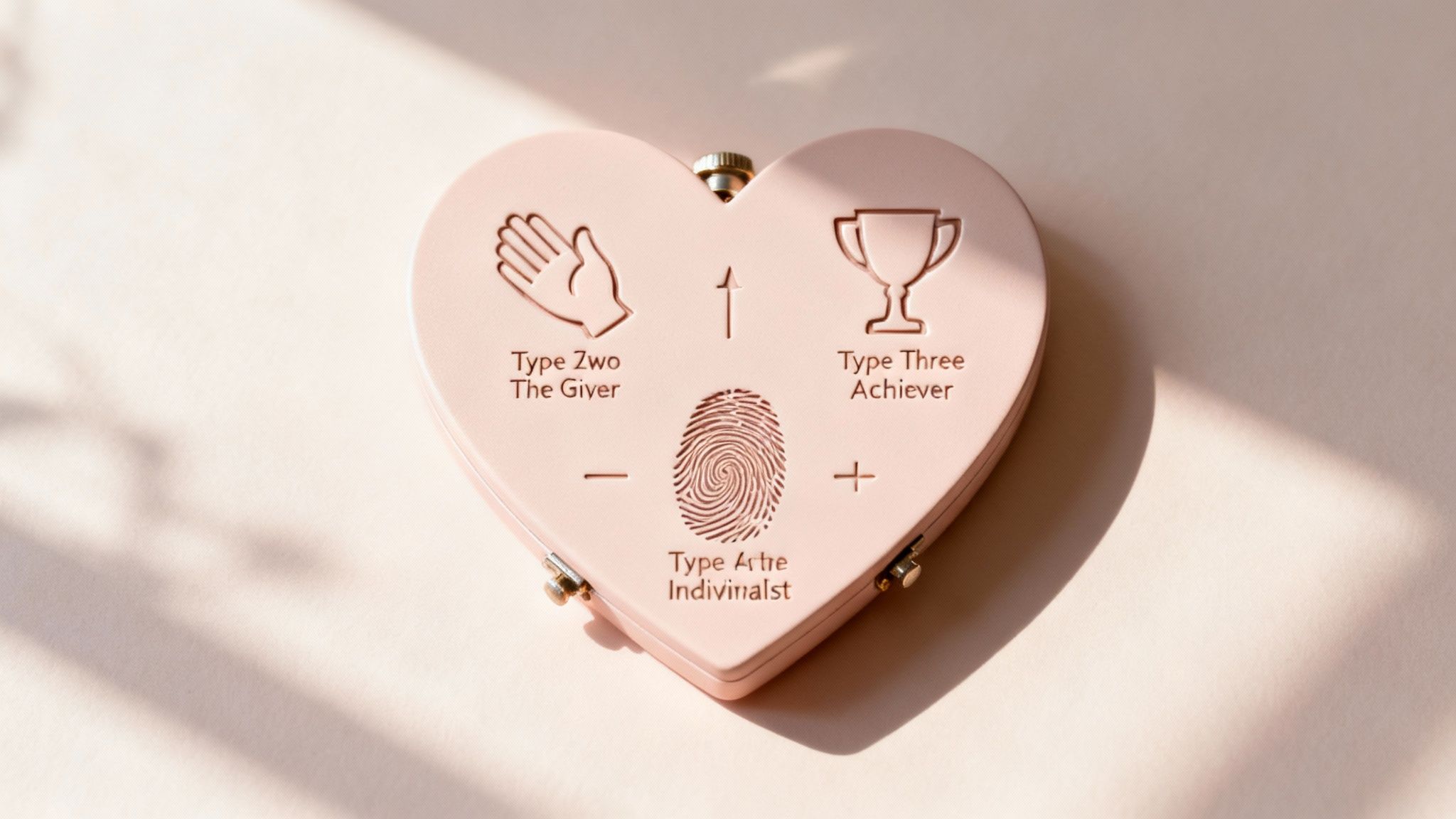
These three of the nine types of personality are all wrestling with the same big question, whether they realize it or not: "Who am I?" But here’s the catch—they tend to look for the answer outside of themselves. This external focus creates a deep, underlying struggle with shame, the nagging feeling that they're somehow fundamentally flawed or unworthy of being loved just as they are.
Type Two: The Helper/Giver
First up, meet the warm, caring Type Two, often called "The Giver" or "The Helper." Twos are the friends who bring you soup when you're sick before you've even texted them you have a sniffle. They have an almost psychic ability to sense what others need.
This drive comes from a core desire to be loved and wanted, and their biggest nightmare is being seen as disposable or unworthy of love. To make sure that never happens, they often operate from a subconscious script: "To get love, I must make myself indispensable." While this can be a beautiful gift, it often leads them to ignore their own needs, which can bubble up as resentment when their constant giving isn't appreciated.
A healthy “Two” gives love freely, with no strings attached. An unhealthy Two's "help" can feel more like a transaction, designed to make you dependent on them so they’ll never be left alone.
Want to go deeper? We've got a full exploration of the Enneagram Type 2 Helper waiting for you.
Type Three: The Achiever
Next, we have the charismatic and ambitious Type Three, "The Achiever." These are the chameleons of the Enneagram, driven by a powerful need to feel valuable and worthwhile. Their greatest fear? Being exposed as a worthless failure.
“Threes” learn a crucial lesson early in life: success earns you praise. So, they begin to fuse their identity with their accomplishments. They are masters at reading a room and morphing into whatever version of "successful" is needed to win admiration. The downside is that this constant shape-shifting can leave them feeling disconnected from who they truly are beneath the polished image.
• Core Motivation: • To be valuable and held in high esteem.
• Where Their Mind Goes: • Tasks, goals, and making sure their successful image is rock-solid.
• The Path to Growth: • Shifting their inner belief from "I am what I do" to "I am loved for who I am."
Type Four: The Individualist
And finally, we arrive at Type Four, "The Individualist." Fours are the sensitive, creative, and deeply authentic souls of the Enneagram. They are on a lifelong quest to discover their unique identity and significance, terrified of being ordinary, flawed, or having no personal story to tell.
Fours feel everything with incredible intensity. They often carry a sense of melancholy, a feeling that something essential is missing inside them. This creates a perpetual state of longing for what they don't have, which can lead them to find beauty in sadness and art in tragedy. They live in a rich, complex inner world, constantly searching for the depth and meaning they feel is missing from everyday life.
This focus on the emotional world is the defining trait of the Heart-Centered types. Interestingly, data from other personality systems like the MBTI echoes this. One study found that 59.8% of people identified as Feeling (F) types, compared to just 40.2% as Thinking (T) types. It seems we humans have a natural lean towards processing life through our hearts.
Ultimately, the Heart Triad is on a journey to build an identity that feels worthy of love. Their work is to learn that true validation doesn't come from the applause of others, but from the quiet, steady acceptance found within themselves.
Understanding the Head-Centered Types 5, 6, and 7
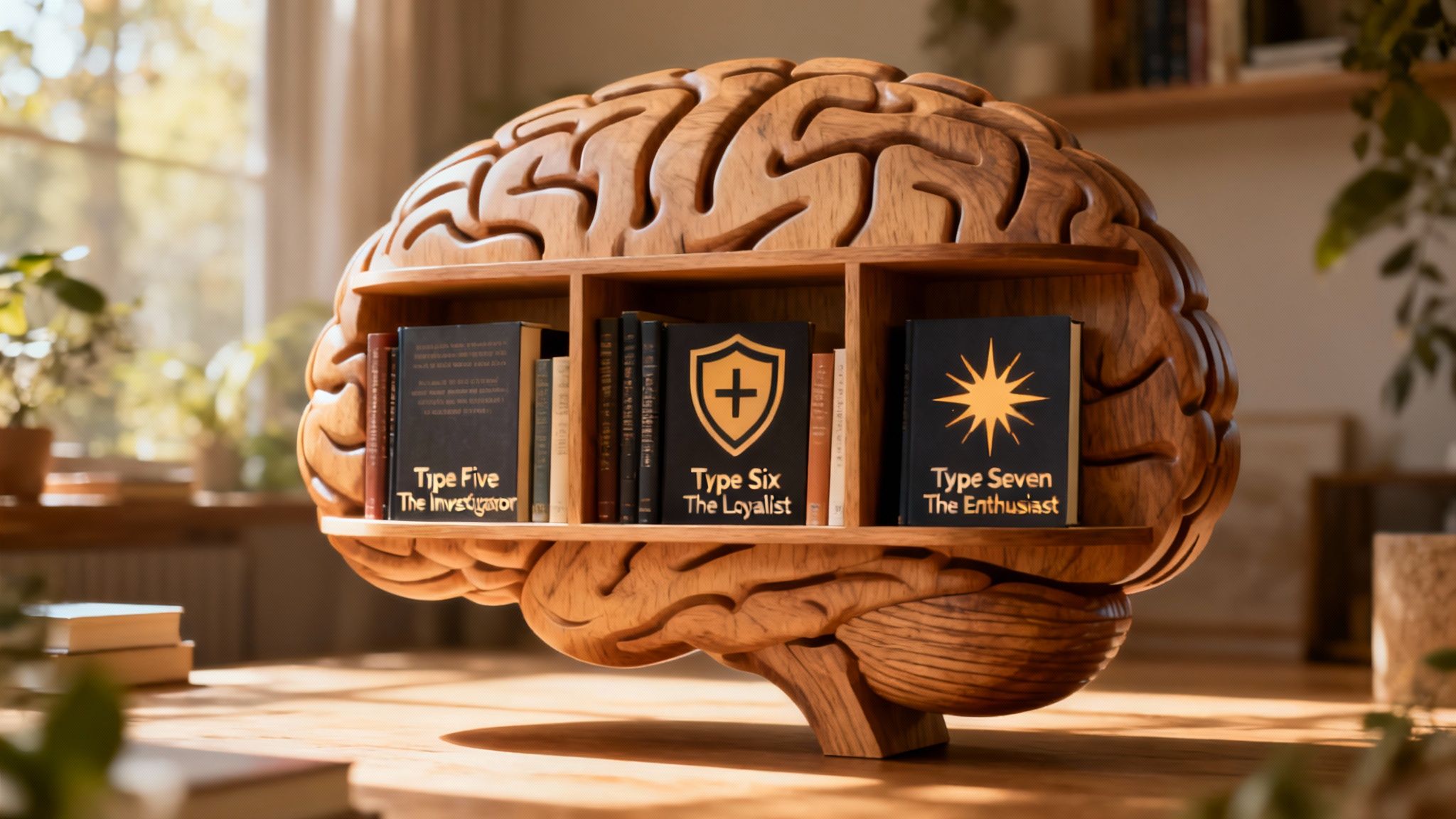
Alright, let's leave the realm of emotions and step into the Enneagram's intellectual command center. Welcome to the Head Triad, home to Types Five, Six, and Seven. All three of these incredible nine types of personality are wired to manage fear and carve out a sense of security in a world that feels, well, a little chaotic.
While the Heart types are busy asking "Who am I?", the Head types are preoccupied with a different question: "How can I be safe?" Their primary tool for navigating life's anxieties is the mind. They think, they plan, they analyze. It’s a brilliant strategy, but each type’s approach to dealing with their core fear is both a superpower and a potential pitfall.
Type Five: The Investigator
Picture a lone scholar tucked away in a sprawling, private library, surrounded by towers of books. That’s a pretty good glimpse into the inner world of a Type Five, aptly nicknamed "The Investigator." Of all the nine types, Fives are the most withdrawn, driven by a powerful need to feel capable and competent. Their absolute biggest fear? Being useless, helpless, or just plain overwhelmed by the demands of the world.
To keep that fear at bay, they retreat into the fortress of their minds and begin hoarding their most prized possession: knowledge. Their logic is simple: if I can understand everything, I can prepare for anything. This makes them profoundly perceptive, wonderfully objective, and insightful observers of life. The catch is that they guard their energy like a dragon guards its gold, convinced that interacting with others will drain their finite reserves. This can sometimes make them seem detached, distant, or aloof.
For a Five, the world is a fascinating puzzle to be solved from a safe distance. Their intellectual sanctuary is both their greatest strength and their potential prison, shielding them from intrusion but also from genuine connection.
Type Six: The Loyalist
Next on our tour is Type Six, "The Loyalist," the undisputed master of the worst-case scenario. The core motivation for a Six is the need for security, stability, and support. Their deep-seated fear is being left without guidance or a safety net, which creates a constant, humming undercurrent of anxiety they’re always trying to soothe.
To build that sense of safety, Sixes are constantly scanning the horizon for potential threats, questioning authorities, and poking holes in plans. They are the ultimate troubleshooters, blessed with an uncanny ability to spot problems long before anyone else. This makes them some of the most responsible, dedicated, and committed people you’ll ever meet. But inside, their minds can feel like a whirlwind of "what ifs."
The real journey for a Six is learning to trust their own inner compass instead of constantly searching for certainty in the outside world, whether that's a person, a belief system, or a rigid set of rules.
Type Seven: The Enthusiast
And finally, we meet the life of the party, the vibrant and ever-optimistic Type Seven, "The Enthusiast." Sevens are fueled by a fundamental need to be satisfied and content. Their greatest fear is being trapped—trapped in boredom, trapped in routine, and especially trapped in emotional pain. Their strategy for dealing with this is delightfully straightforward: keep moving and stay busy.
Think of a Seven as someone at an all-you-can-eat buffet who is determined to sample every single dish. They are future-focused visionaries who see a world brimming with exciting possibilities and grand adventures. Their minds are brilliant idea-generating machines, constantly cooking up new plans to keep any feelings of emptiness or discomfort far, far away.
The growth path for a Seven is a profound one. It involves discovering that true, lasting joy isn't found by endlessly running from pain, but by learning to embrace the full, rich spectrum of life—the stillness, the satisfaction, and everything in between.
Each of these Head-Centered types has a unique recipe for feeling secure:
• Fives • feel safe when they have enough • knowledge • and personal resources.
• Sixes • feel safe when they have a • reliable support system • to count on.
• Sevens • feel safe when they have • enough exciting options • and plans for the future.
The ultimate challenge for all three is to shift from a life governed by mental gymnastics to one that is more grounded in the present moment. By learning to face their fears head-on, they can discover the kind of deep, unshakable security that no amount of thinking, planning, or escaping can ever truly provide.
Meeting the Body-Centered Types 8, 9, and 1
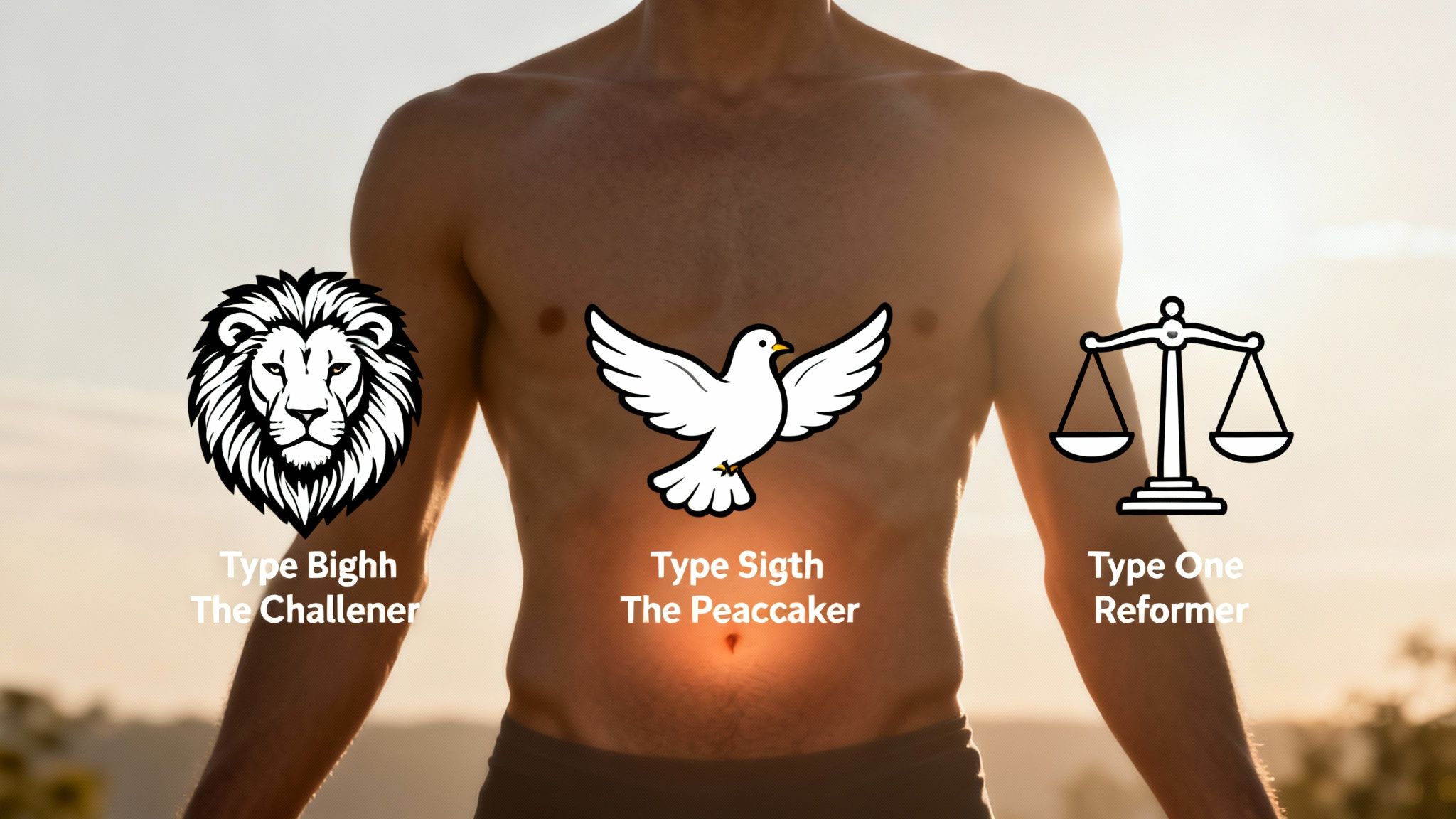
Alright, let's dive into our final group: the Body Center. This is where we find Types Eight, Nine, and One—personalities that experience the world through a powerful, physical, gut-level instinct.
Unlike the image-conscious Heart types or the fear-driven Head types, this trio is all about control and making their presence felt. Their whole world is oriented around asserting their place in it. The common emotional thread tying them together? Anger. One explodes with it, one runs from it, and one tries to bottle it up.
Type Eight: The Challenger
You’ll know when a Type Eight walks into the room. "The Challenger" brings an undeniable energy of intensity, confidence, and a take-charge attitude. Eights are the powerhouses of the Enneagram, fundamentally driven by a need to protect themselves and be the masters of their own destiny.
Their biggest fear is being controlled or hurt by anyone, and they will not stand for it. To make sure that never happens, they build an imposing exterior, using their powerful will to manage their environment and fiercely defend those they care about. They are direct, decisive, and have a built-in justice meter, often stepping up to champion the underdog.
Eights see the world as a tough place where only the strong survive. Their default setting is to meet every challenge head-on with force, viewing vulnerability as a dangerous liability that's just an open invitation for betrayal.
But that protective armor can be heavy, and it often keeps people at arm's length. The real growth for an Eight comes when they learn to trust enough to lower their defenses, discovering that true strength isn't just about power—it's also about having the courage to be vulnerable.
Type Nine: The Peacemaker
Next up is the easygoing, agreeable Type Nine, "The Peacemaker." If there's a conflict to be had, the Nine wants no part of it. They are motivated by a profound need for inner calm and outer harmony, and their greatest fear is loss and separation. They'll do just about anything to keep the peace.
To maintain that sense of tranquility, Nines have this incredible superpower: they can see every single side of an issue and effortlessly merge with what others want. This makes them wonderfully supportive, patient, and natural mediators who can calm any storm. The catch? In their quest to avoid rocking the boat, they often fall asleep to their own needs, opinions, and desires.
It's pretty interesting how culture can play into all of this. While no single type dominates globally, some studies suggest that in places like Ireland, the percentage of Type Nines is higher than average. You can dig into some of these fascinating personality type distributions to see how our environment can nudge these innate tendencies.
• Core Motivation: • To keep things peaceful, inside and out.
• Gut Reaction: • To numb out their own anger and desires to keep from making waves.
• The Path to Growth: • Learning to wake up to their own voice, realizing that their presence matters, and it's okay to take up space.
Type One: The Reformer
Last but not least, we have Type One, "The Reformer," a personality steered by an unwavering internal compass of right and wrong. Ones are principled, driven, and disciplined, motivated by a deep desire to be good, live with integrity, and improve the world around them.
Their core fear is being seen as corrupt, bad, or morally flawed. This fear powers a relentless inner critic—a voice that’s always on, pointing out what’s wrong and demanding they do better. This drive for perfection can make them incredibly ethical and hardworking, but it can also lead to rigidity, judgment, and a constant, nagging feeling that they'll never be good enough.
Even though they're in the anger triad, Ones rarely blow up. Instead, they see anger as a "bad" emotion and push it down. That repressed energy doesn't just disappear, though. It tends to leak out as simmering resentment, frustration, and sharp criticism—both of themselves and of others who fail to meet their impossibly high standards. Their journey is all about learning self-acceptance, quieting that inner critic, and finding beauty in the messy imperfection of being human.
So, How Do You Figure Out Your Real Enneagram Type?
If you've been reading through the descriptions of the nine types of personality and find yourself thinking, "Well, that sounds like me... but wait, so does that one," then congratulations! You're doing it right. Pinpointing your Enneagram type isn't a simple pop quiz; it's more like an archaeological dig into your own soul.
The real trick is to look past what you do and ask why you do it. For instance, both a Type Two and a Type Nine might drop everything to help a friend move. But their core reasons are worlds apart. The Two is driven by an inner need to be loved and indispensable, while the Nine is all about keeping the peace and avoiding any hint of conflict. That little "why" is the whole game.
What Are You Running From? Follow The Fear.
Want a shortcut? Look at what scares you the most. At its heart, the Enneagram is a map of our core fears. Each type has a deep, underlying fear it has spent a lifetime trying to avoid, like an emotional live wire we instinctively know not to touch.
Take a moment and be honest with yourself. Which of these hits a little too close to home?
• A deep fear of being • corrupt, defective, or just plain "bad"? • You might be a • Type One • .
• A gut-wrenching fear of being • unwanted or unlovable? • Take a closer look at • Type Two • .
• A nagging fear of being • worthless or without any inherent value? • This is the engine of a • Type Three • .
• The existential dread of having • no unique identity or personal significance? • Classic • Type Four • territory.
• A fear of being • useless, helpless, or incompetent? • This points directly to • Type Five • .
• The fear of being • without support, security, or guidance? • A hallmark of the loyal • Type Six • .
• A desperate fear of being • trapped in pain or deprivation? • This is the core driver of a • Type Seven • .
• A powerful fear of being • controlled or harmed by others? • The unmistakable signature of a • Type Eight • .
• The quiet fear of • loss, separation, or fragmentation? • You're likely looking at • Type Nine • .
This is the kind of stuff we don't always like to admit, even to ourselves. It’s the shadow that follows us around, shaping our decisions without us even realizing it.
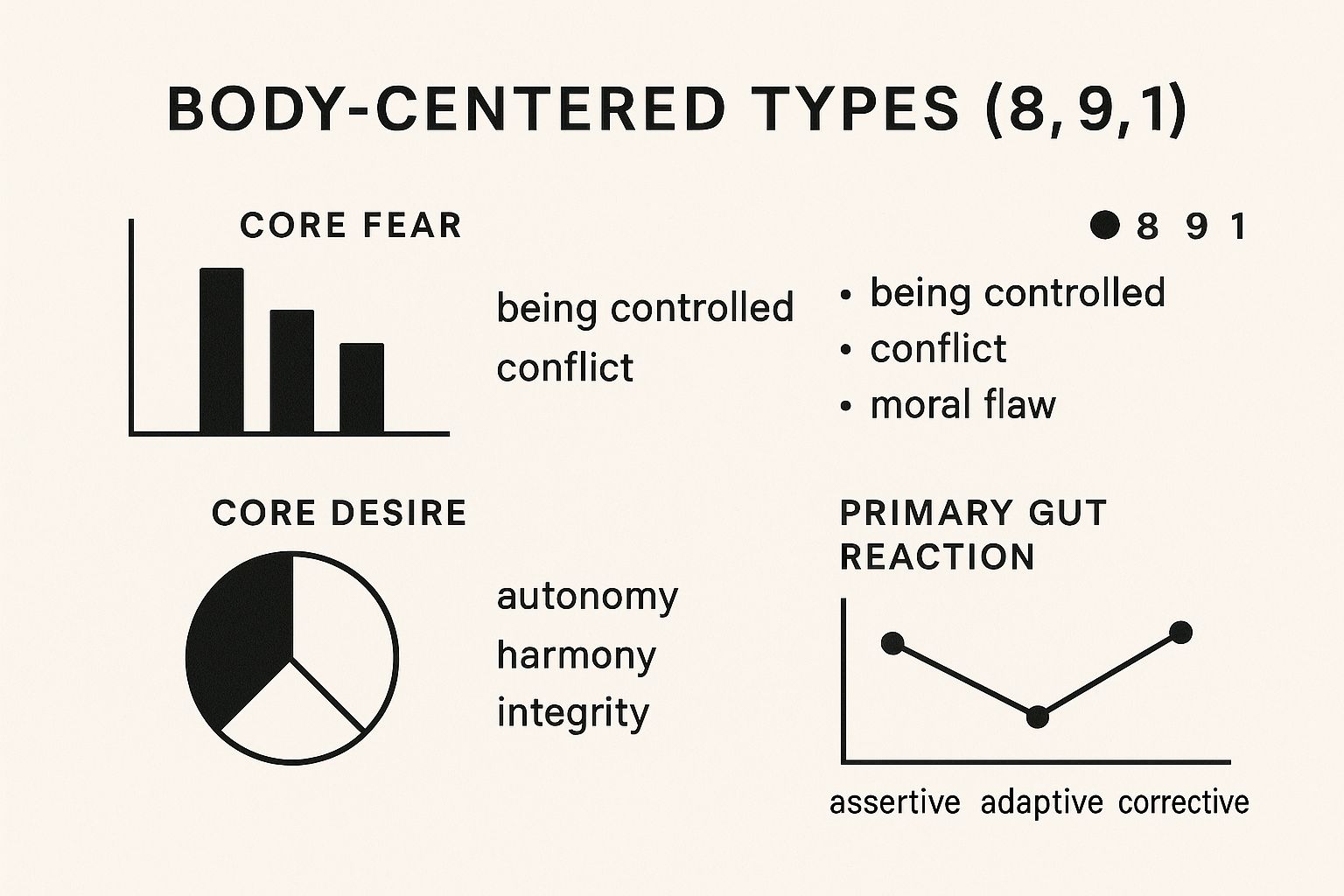
As you can see, even types that are grouped together—like the Body-Centered types (8, 9, 1)—use completely different strategies based on their instinctual drive. One asserts control, one merges to keep the peace, and one tries to perfect everything. Different fears, different playbooks.
Spice It Up With Your Wings
Okay, so you think you've found your number. The next step is to explore your Wings . These are simply the two numbers on either side of your main type on the Enneagram symbol. A Type Nine, for instance, has an Eight-Wing and a One-Wing.
Think of it like this: your main type is the core flavor of your personality—the vanilla ice cream, if you will. Your Wings are the toppings that make it uniquely yours. Most of us lean more heavily on one Wing, which creates a distinct blend. A 9w8 (a Nine with a strong Eight-Wing) will be more assertive and gutsy. A 9w1 (a Nine with a One-Wing) will be more principled and idealistic. This is exactly why two people of the same type can seem so different on the surface.
Why You Keep Mistyping Yourself (And Why That’s Okay)
It’s incredibly common to get stuck between two or three types. Don’t sweat it! This confusion is actually a fantastic part of the process because it forces you to dig deeper into your motivations.
Here's a look at some of the most common personality doppelgangers and how to tell them apart.
Common Mistyping Pairs and How to Tell Them Apart
| Type Pair | Why They Get Confused | The Key Differentiator (Core Motivation) |
|---|---|---|
| Two vs. Nine | Both are incredibly helpful, supportive, and can put others' needs first. | Twos help to feel needed and loved. Nines help to avoid conflict and maintain harmony. |
| Four vs. Six | Both can be highly emotional, reactive, and experience a lot of anxiety. | Fours focus on their internal world of feelings. Sixes focus on the external world of potential threats. |
| Three vs. Eight | Both are ambitious, confident, assertive, and natural leaders. | Threes are driven to project a successful image. Eights are driven to be in control of their own destiny. |
| Five vs. One | Both are rational thinkers who can detach from their emotions to be objective. | Fives seek knowledge to feel competent. Ones seek knowledge to be correct and good. |
Ultimately, it’s about finding the narrative that fits your life's patterns best.
The Enneagram isn't about slapping a label on yourself. It's about finding the story you’ve been living subconsciously your whole life. It’s the lens that, once you look through it, suddenly makes everything click into place, especially how you act under pressure.
Finding your type is a journey of self-awareness, not a race to a finish line. If you'd like a more guided path, this step-by-step guide for beginners on finding your Enneagram type is a fantastic resource. Remember, understanding your type is just the first step; the real magic happens when you grasp the dynamic nature of confidence and personality and start using these insights to grow. Just stay curious, be kind to yourself, and enjoy the discovery.
Putting Your Enneagram Knowledge into Action
Alright, so you've figured out your Enneagram number. That's fantastic! But discovering your type is like being handed a map—it's not the destination. The real journey starts now, using that map to navigate your way to a more integrated, healthier version of you.
This isn't about trying to become a different person. It's about expanding your repertoire. Think of it like this: each of the nine types of personality has a built-in "growth hack" baked right into the system. We all have a number we slide into when we're stressed, but there's also one we can consciously move toward to grow.

Your Personal Growth Blueprint
The best way to think about this is like borrowing a superpower from a friend when you need it most. Imagine a super-organized, perfectionistic Type One who is feeling burnt out. Their growth path points them toward the healthy, fun-loving Type Seven. By tapping into that Seven energy, they can learn to let go, enjoy the moment, and see life as an adventure, not just a to-do list.
That dynamic shift is where the magic of the Enneagram really happens. It’s about catching yourself in your old loops and deliberately choosing a new response. This kind of self-awareness is a game-changer, helping you overcome social anxiety and build confidence and forge more authentic relationships.
Here’s a quick cheat sheet for each type's growth arrow:
• Type 1 (The Reformer) → Type 7: • Learns to chill out, be spontaneous, and find joy in what • is • , not just what • could be • .
• Type 2 (The Helper) → Type 4: • Looks inward to finally ask, "What do • I • need?" and discovers a rich inner world that's all their own.
• Type 3 (The Achiever) → Type 6: • Shifts from "what looks good" to "what feels right," finding value in genuine commitment and collaboration.
• Type 4 (The Individualist) → Type 1: • Becomes wonderfully disciplined, taking their brilliant ideas and making them a reality in the world.
The point isn't to become your growth number. It's about borrowing its best traits to become a more balanced, resourceful version of yourself.
Continuing the Journey
This isn't always a straight line—some days you'll nail it, others you'll slip back into old habits. But every time you consciously choose your growth path, you're rewiring your brain for the better.
Let's look at the rest of the types:
• Type 5 (The Investigator) → Type 8: • Gets out of their head and into their body, acting decisively and trusting their gut instincts in the real world.
• Type 6 (The Loyalist) → Type 9: • Finds a quiet confidence and inner peace, learning to trust their own judgment without second-guessing every move.
• Type 7 (The Enthusiast) → Type 5: • Discovers the deep satisfaction that comes from focus, slowing down to appreciate the richness of the present.
• Type 8 (The Challenger) → Type 2: • Taps into their softer side, learning that true strength includes vulnerability, compassion, and gentle protection.
• Type 9 (The Peacemaker) → Type 3: • Steps into the spotlight, owning their ambitions and realizing their presence and goals truly matter.
Putting these ideas into practice is how you turn a cool personality theory into a life that feels more vibrant, authentic, and completely you .
Got Questions About Personality Types? Let's Talk.
Diving into the world of the nine personality types always stirs up some great questions. It’s a pretty deep rabbit hole, and figuring out the details is all part of the journey. Let's clear up a few things people often wonder about.
So, Can My Enneagram Type Change Over Time?
Short answer? Nope. Your core Enneagram type is pretty much set for life. Think of it like the basic programming you came into the world with, driven by a core fear and motivation that’s been with you since childhood.
But that doesn't mean you're stuck. Far from it! You're constantly moving—becoming healthier (or unhealthier) within your type, leaning into your wings, and even borrowing the best traits from your connecting points on the Enneagram symbol. So while your number stays the same, how you show up in the world absolutely can, and should, change as you grow.
Is The Enneagram, You Know, Legit Science?
Let’s be real: you won't find the Enneagram in the same academic textbooks as models like the Big Five personality traits. It hasn't gone through the rigorous peer-reviewed research to be considered "scientifically validated," and many academic psychologists would probably label it a pseudoscience.
But here's the thing: that doesn't mean it isn't incredibly useful. Millions of people, coaches, and even companies swear by it. Its magic isn't in scientific validation but in its uncanny ability to get to the why behind what we do. It offers a unique and powerful roadmap for personal growth that other systems just don't touch.
It's totally normal to see a bit of yourself in a few different types, especially when you're just starting out. That's because we all contain pieces of all nine types. The real trick is to find the one that hits you in the gut—the one that explains the fundamental motivation that’s been the driving force for most of your life.
If you’re stuck between a few types, try reading about their core fears or what they look like when they're really struggling. That's often where people have that uncomfortable "aha!" moment that finally points to their true number.
Ready to figure out the "why" that makes you tick and kickstart your own growth journey? Take the free, in-depth personality assessment at Enneagram Universe and get a personalized report that shines a light on your unique path. Find your type today at Enneagram Universe .