Identifying Leadership Potential Before It Has a Title: Key Signs to Watch

Spotting real leadership potential is less about finding the loudest voice in the room and more about noticing the quiet connectors and problem-solvers who make things happen. It’s about looking past fancy titles and impressive resumes to see the core behaviors that signal a true ability to influence, motivate, and guide.
Think about it: when a project hits a snag, who steps up? It's rarely the person who just points fingers. The real future leader is the one who digs in, rallies the team, and starts architecting a solution. For example, when a software update unexpectedly crashes a client's system, the potential leader isn't just filing a bug report; they are on the phone with the client, coordinating with the tech team, and communicating progress until the issue is resolved.
Look Beyond the Obvious Leadership Traits
Let’s be honest, seniority and technical chops are terrible predictors of leadership success. They’re easy to spot, sure, but they don’t tell you who will keep their cool when the pressure is on or who can inspire a team to do their best work.
True leadership potential often works behind the scenes. It's found in the person who builds consensus when no one is watching, not the one who always commands the spotlight.

So, where should you focus your attention instead? On the unsung heroes. These are the people who consistently show up with leadership DNA, even without the formal title. They’re the ones who:
• Build bridges between siloed departments to drag a project over the finish line. For example, a marketing specialist might proactively schedule meetings with the sales team to align messaging, even though it's not officially part of their job.
• Aren't afraid to ask the tough, insightful questions everyone else is thinking. In a project kickoff, this could be the person who asks, "Have we considered how this will impact customer support?"
• Stay optimistic and resilient when things inevitably go sideways. When a major client walks away, they are the ones saying, "This is tough, but what can we learn from this to make our next pitch stronger?"
Spotting the Unsung Heroes
Mastering the art of spotting potential means tuning your radar to these subtle but powerful signals.
Picture the software engineer who doesn't just fix a bug but takes the extra time to document the solution so the whole team learns from it. That’s ownership . Or the marketing coordinator who voluntarily mentors the new intern, patiently showing them the ropes without being asked. That’s influence in action .
The real test of leadership isn't managing success; it's navigating failure. Observe who steps up with solutions instead of blame when a project veers off course. Those are your future leaders.
These everyday actions reveal a capacity for leadership that you’ll never find on a resume. This is exactly why so many wonder how good hires sometimes fall short once they're on the job; their paper qualifications didn't reflect their real-world behaviors. It’s time to stop looking for who is already leading and start seeing who has the raw talent to become a phenomenal leader.
To make this easier, here's a quick cheat sheet for spotting these hidden gems.
Key Indicators of Leadership Potential
| Indicator | What It Looks Like in Practice | Common Misconception |
|---|---|---|
| Accountability | Takes ownership of mistakes and focuses on solutions, not blame. For example, saying, "I miscalculated the timeline; here's my plan to get us back on track." | They never make mistakes. |
| Influence | People naturally seek their advice and input, even without formal authority. For example, the go-to person for feedback on a presentation. | They are the most talkative or charismatic. |
| Resilience | Bounces back from setbacks with a positive, problem-solving attitude. After a failed product launch, they're the first to analyze the data and suggest improvements. | They are unemotional or never show stress. |
| Strategic Thinking | Connects daily tasks to bigger company goals and asks "why." For example, they might ask, "How does this social media campaign support our Q3 revenue goal?" | They only focus on "big picture" ideas. |
This table isn't exhaustive, but it's a fantastic starting point for shifting your perspective from the obvious to the impactful.
Investing in the Right People
Smart organizations are catching on. Companies are pouring serious money into finding and nurturing people with these fundamental abilities. The leadership development industry is now worth an estimated $366 billion worldwide , and a huge chunk of that is dedicated to assessment tools designed to uncover this exact kind of potential.
This massive investment signals a crucial shift in thinking: businesses are finally realizing that the best leaders aren't always the most obvious candidates. They're the ones with a rock-solid foundation of self-awareness and the behavioral strengths to back it up.
How to Spot Potential in Everyday Work
Leadership potential isn't something that magically appears during a formal performance review. It’s on full display every single day—in the chaos of a project launch, the tension of a difficult client call, or the quiet collaboration between colleagues. Your workplace is basically a living laboratory for observing talent in its natural habitat.
Forget the generic checklists. Spotting real leadership potential is about becoming a keen observer of human behavior, especially when things go sideways. When a project timeline cracks or unexpected problems pop up, that's when you see who's really got the goods.

This means you need to shift your focus. Instead of just tracking whether tasks are getting done, start gathering behavioral evidence. Pay attention to the language people use and the actions they take when there's no script to follow.
The Problem-Solver vs. The Blamer
Picture this: a critical deadline is missed. The team’s reaction is an absolute goldmine of information. In my experience, most people fall into one of two camps.
The blamer’s first instinct is to find an external reason for the failure. You’ll hear things like, "Well, marketing didn't get us the assets on time," or "That wasn't my responsibility." It's all about deflecting ownership.
The problem-solver, on the other hand, sees the exact same mess and asks, " Okay, this happened. How can we fix this right now? " They're all about solutions, focusing their energy on moving forward instead of getting stuck in the past. That, right there, is a hallmark of leadership.
Think about a junior account manager handling scathing client feedback on a new campaign. The potential leader doesn't just forward the email with a shrug. They pull the team into a quick huddle, absorb the criticism without getting defensive, and present a revised plan to the client. They own the outcome, even if they weren't the only ones who dropped the ball.
Observing Initiative and Influence
Another dead giveaway is proactive initiative. True leaders don't just sit around waiting to be told what to do; they see a gap, and they fill it.
This doesn't have to be some grand, heroic gesture. It’s often the small things:
• Mentoring without an assignment: • An experienced analyst takes a new hire under their wing, showing them undocumented processes and making them feel like part of the crew.
• Fixing a broken system: • A project manager gets so fed up with a clunky reporting process that they spend a weekend building a streamlined dashboard that saves everyone hours.
• Connecting the dots: • That quiet engineer notices two teams are unknowingly working on similar problems, so they set up a meeting to get them talking and sharing resources.
Leadership is action, not a title. The person who voluntarily organizes the team's messy shared drive is showing more leadership potential than the executive who just complains about it.
These actions show a commitment to the team's collective success, not just their own to-do list. This is the kind of informal influence that tells you someone is ready for more responsibility.
Decoding Workplace Communication
Finally, just listen. The words people choose in meetings and daily chats reveal their entire mindset. Pay attention to who elevates the conversation and who drags it down.
Here’s a quick look at how passive language stacks up against leadership-oriented language:
| Passive Language (Signals Passivity) | Leadership Language (Signals Ownership) |
|---|---|
| "I'll try to get that done." | "I will have that done by 3 PM." |
| "Someone should really fix this." | "I'll take the lead on fixing this." |
| "That's just how we've always done it." | "What if we tried a new approach?" |
Someone who consistently uses the phrases on the right is actively shaping their environment. They’re demonstrating accountability and a forward-thinking mindset. These aren't just people doing a job; they're looking for ways to make the whole operation better. By tuning into these everyday behaviors, you can build a much more accurate, evidence-based picture of who is truly ready to lead.
Using Conversations to Uncover Hidden Strengths
Watching people in their natural habitat is a good start, but the real insights come when you sit down and talk. Your regular one-on-one meetings are an absolute goldmine for spotting leadership potential; you just have to know how to dig. It's time to ditch the surface-level status updates and start asking questions that reveal what truly drives someone.
The whole point is to get past the hypotheticals. Anyone can spin a good yarn about what they would do in a tight spot. But someone with real leadership DNA can tell you exactly what they did do when things got real.
From “What If?” to “What Happened?”
To get a true measure of how someone thinks and acts under pressure, you’ve got to ground your questions in their actual, lived experience. This is what separates a fluffy, theoretical interview from a powerful diagnostic conversation. It’s about evidence, not imagination.
So, stop asking questions like, "How would you handle a difficult team member?" It’s a nice thought exercise, but it’s useless.
Instead, flip the script to uncover real-world behavior: "Tell me about a time you had to work with a colleague you found challenging. What was the situation, and what specific steps did you take?"
Here are a few of my go-to, behavior-based questions that really get people talking:
• "Describe a moment you noticed a process was broken and slowing the team down. What did you do about it?"
• "Walk me through a time you disagreed with a team decision. How did you handle it, and what was the outcome?"
• "Tell me about a project that failed. What was your role, and what did you learn from the experience?"
These questions aren't about finding a "right" answer. They're designed to open the door to a story—a story that will reveal that person’s character, problem-solving chops, and sense of accountability.
Decoding What They're Really Saying
Asking the right questions is only half the battle. The real skill is learning to interpret the answers. As they share their stories, you need to listen for the subtle clues about their mindset and emotional intelligence. High EQ is non-negotiable for great leaders, and these conversations are your best chance to see it in action. For anyone looking to level up here, it's essential to learn how to increase EQ as a starting point.
Pay close attention to the pronouns they use. Do they say "we" when talking about team wins but "they" when discussing failures? That's a red flag. Real leaders share the credit and own the blame. For example, a leader would say, "We missed the mark on that campaign," not "The creative team didn't deliver."
The most revealing answer isn't the one about the perfect, flawless victory. It's the one where someone can honestly break down a mistake, tell you what they learned, and explain exactly how they used that lesson later on.
That right there is the magic combination of self-awareness and a growth mindset. If they don't have those two things, they're not ready for leadership. Period.
Look for the Unprompted Fixers
One of the most powerful signs of leadership potential is a history of proactive problem-solving. These are the people who don’t just do their job; they’re constantly scanning for ways to make the whole system better.
Let’s play this out with a real-world example. You ask, "Tell me about a time you went above and beyond your defined role."
• A Standard Answer: • "I stayed late to help the team meet a tight deadline." (That's great, but it's reactive.)
• A Leadership Answer: • "I noticed our new hires were completely lost with the onboarding docs—they were scattered across three different platforms. I took it upon myself to consolidate everything into a single, easy-to-use guide. I showed it to HR, and now it's the standard for all new team members."
See the difference? The first person is a good, dependable employee. The second is a potential leader. They didn't wait to be asked; they saw a problem, came up with a solution, and took ownership to make it happen. By turning your check-ins into these kinds of diagnostic conversations, you’re no longer just getting a status report—you're actively scouting for the next generation of leaders in your organization.
Using the Enneagram for Deeper Insights
So, you've seen what your people can do . But do you have any idea why they do it? This is where the real magic happens. If you genuinely want to spot and nurture leadership potential, you've got to look under the hood at the core motivations driving their behavior.
Think of it this way: just watching someone's actions is like watching a movie on mute. You can follow the plot, sure, but you're missing all the nuance—the dialogue, the score, the emotional context. The Enneagram basically turns the sound back on. It’s a roadmap to someone's inner world of fears, desires, and what gets them out of bed in the morning.
It's crucial to remember the Enneagram isn't about slapping a label on someone and stuffing them into a box. It’s a dynamic framework for understanding how they’re wired. Once you know why someone hesitates or why they charge ahead, you can stop seeing their quirks as flaws. Instead, you can see them for what they are: powerful starting points for growth.
From Strengths to Superpowers
Every single Enneagram type comes with a built-in set of strengths that, when polished, can become legitimate leadership superpowers. The trick is spotting these natural gifts and putting people in situations where they can actually use them.
Let's make this real. Say you have a brilliant engineer who is meticulous, reliable, and produces flawless work. But the mere thought of leading the weekly team meeting makes them break out in a cold sweat. Old-school management would just write them off—"not leadership material."
But what if you knew they were a Type Five (The Investigator) ? Fives are driven by a deep need to feel competent and an equally deep fear of looking foolish. Their reluctance to speak up isn't a sign of weakness; it's a desire to be absolutely certain they have their facts straight before opening their mouth.
That’s not a weakness—it’s a huge asset in disguise! Instead of trying to force them into a role that feels unnatural, like a spontaneous public speaking gig, play to their strengths. Ask them to lead a deep-dive technical review where their expertise is the star of the show.
Uncovering these strengths is all about asking the right questions, decoding the patterns you observe, and diagnosing what’s really going on inside.
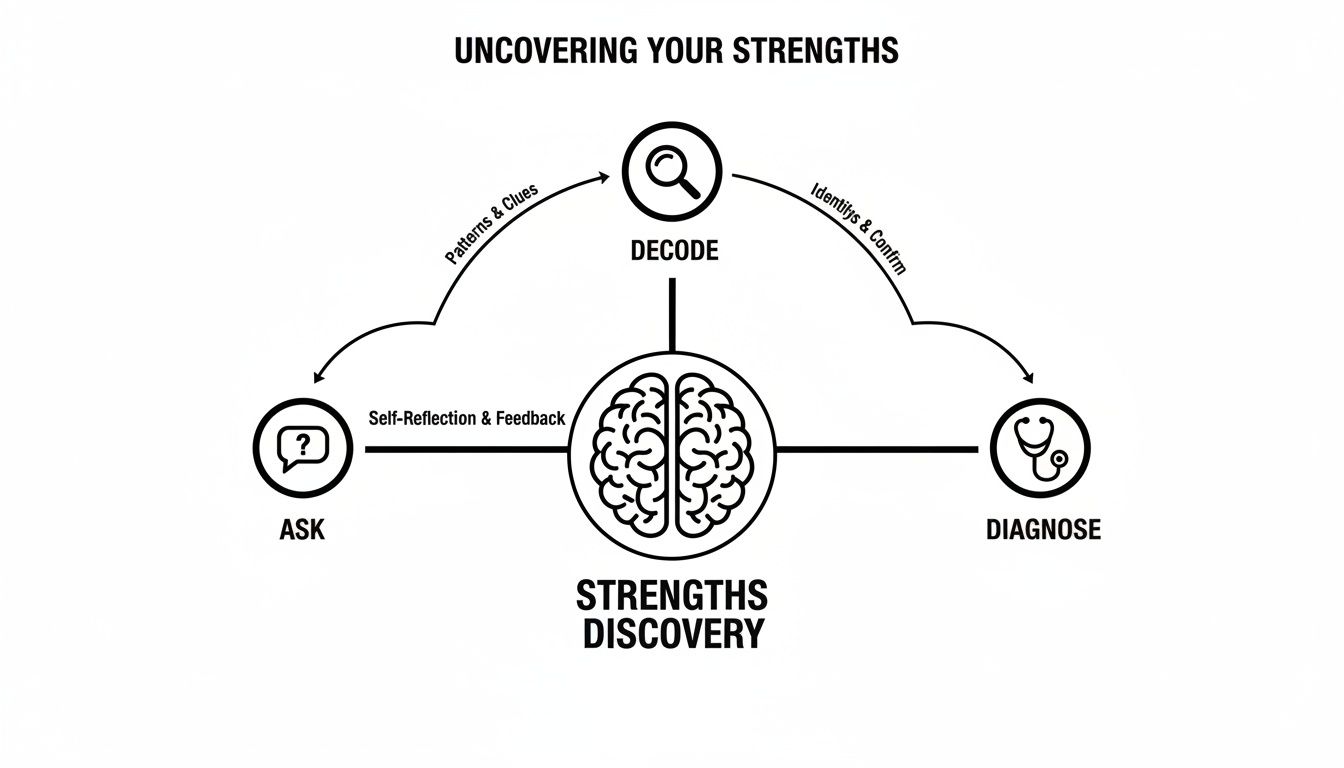
As you can see, spotting true potential is more than just surface-level observation. It’s a thoughtful process of understanding what makes an individual tick.
Turning Derailers into Development Opportunities
Of course, every strength has a shadow side. The very same drives that fuel a person’s potential can also become massive derailers if they're not self-aware. The Enneagram is like a cheat sheet for spotting these potential blind spots before they cause trouble.
A few examples I’ve seen time and again:
• The highly ambitious • Type Three (The Achiever) • makes a fantastic, goal-crushing leader. Their potential derailer? They can get so focused on the • appearance • of success that they steamroll their team, leading to burnout.
• The fun-loving • Type Seven (The Enthusiast) • is a genius at brainstorming and boosting morale. Their kryptonite? A deep-seated aversion to boredom and grunt work can cause them to drop the ball on critical follow-through.
• The principled • Type One (The Reformer) • has an unbelievable eye for quality and detail. The risk? Their powerful inner critic can make them overly critical of others, accidentally shutting down creativity and new ideas.
The goal isn't to change someone's Enneagram type—you can't. The goal is to arm them with the self-awareness to manage their natural tendencies, lean into what makes them great, and keep their blind spots in check.
This emphasis on self-awareness is exactly why the Enneagram has blown up in professional settings. A 2022 global survey of organizations using the tool found that 67% cited leadership development as a primary application. It’s clear that more and more companies are seeing self-awareness as a non-negotiable for anyone stepping into a leadership role.
To give you a better idea, here's a quick look at how this plays out across the different types.
Enneagram Types Leadership Potential Snapshot
| Enneagram Type | Natural Leadership Strength | Potential Growth Area |
|---|---|---|
| Type 1: The Reformer | Upholding high standards; principled and fair decision-making | Learning to be more flexible and less critical of self and others |
| Type 2: The Helper | Building strong relationships; intuitively sensing team needs | Setting boundaries; not over-investing in being liked by everyone |
| Type 3: The Achiever | Driving for results; inspiring and motivating teams to win | Cultivating authenticity; valuing process and people over pure optics |
| Type 4: The Individualist | Bringing unique perspective and deep empathy | Managing emotional volatility; communicating ideas more pragmatically |
| Type 5: The Investigator | Objective, calm analysis; providing well-researched insights | Engaging more actively with the team; sharing knowledge proactively |
| Type 6: The Loyalist | Building cohesive teams; anticipating risks and problems | Developing more trust in their own judgment and taking initiative |
| Type 7: The Enthusiast | Visionary thinking; keeping energy and morale high | Committing to follow-through; embracing necessary but tedious tasks |
| Type 8: The Challenger | Decisive action; protecting and empowering their people | Moderating intensity; learning to listen and show vulnerability |
| Type 9: The Peacemaker | Fostering consensus and harmony; seeing all points of view | Being more assertive; addressing conflict directly instead of avoiding it |
This table is just a starting point, of course. The real power comes from integrating these insights into personalized growth plans. You stop managing an employee and start coaching an individual, helping them become the most effective leader they can be.
If you want to go even deeper, our guide on the Enneagram at work is packed with more examples and strategies you can use right away.
The Leadership Potential That's Easy to Miss
Leadership potential doesn't always look like the person talking the most in the meeting. Types 4, 5, and 9 in particular tend to get passed over, not because the potential isn't there, but because it doesn't announce itself:
• Type 4s • often bring exactly the kind of authentic, values-driven leadership teams say they want — but if their contributions come through writing or one-on-one conversations rather than group settings, they're easy to underestimate.
• Type 5s • frequently have the clearest read on a complex problem in the room — they just won't offer it unprompted in a fast-moving discussion. Ask them directly, and often the sharpest insight of the meeting shows up.
• Type 9s • tend to be the person quietly holding a team together — the one everyone trusts, the one who defuses tension without taking credit for it. That's leadership; it just doesn't look like the loudest voice in the room.
If your leadership pipeline only rewards people who speak up first, you're systematically missing a third of the Enneagram. Worth asking directly, in a one-on-one: "what would you do differently here if it were your call?" — you'll often be surprised by what's been sitting there unspoken.
Building a Personalized Growth Roadmap
Spotting leadership potential is like finding a gold vein—it's exciting, but pretty useless until you actually start mining. The real work kicks in after you’ve identified someone with the right stuff. This is where you shift from just watching to actively coaching, turning your insights into a concrete, personalized development roadmap that actually goes somewhere.
This isn’t about sending someone to a generic leadership seminar or tossing them a book and hoping for the best. It’s about co-creating a hands-on journey that turns their raw potential into proven skill. You have to build a bridge between where they are now and where they could be, using real-world challenges as the building blocks.

From Vague Goals to Tangible Missions
The biggest mistake I see managers make is setting fuzzy, uninspired development goals. A target like "improve your presentation skills" is a death sentence for motivation. Why? It's impossible to measure and feels completely disconnected from the daily grind. It's just corporate jargon, not a mission.
To make it real, you have to frame development within the context of their actual job. Instead of that vague goal, the plan becomes: " Lead the client-facing portion of our next three project demos. "
See the difference? It’s specific, measurable, and gives them a real-world stage to practice on. This simple shift transforms development from a boring checklist item into a series of strategic challenges.
Here’s what this looks like in action:
• Instead of: • "Be more strategic."
• Try this: • "Draft the initial project brief for our Q4 product launch. I want to see a competitive analysis and potential risks, and you'll present it to the leadership team."
• Instead of: • "Work on your conflict resolution skills."
• Try this: • "You're going to facilitate the next project retrospective. Your job is to make sure every team member’s feedback is heard and to walk away with a list of actionable improvements."
These aren't just tasks; they're high-leverage experiences designed to stretch their capabilities in a safe but meaningful way.
Weaving in Enneagram Insights for a Custom Fit
Now, this is where your Enneagram insights become a true game-changer. Knowing someone's core motivations allows you to design stretch assignments that directly target their biggest growth areas—and in a way that actually resonates with their personality.
Let’s say you’ve identified a high-potential Type Nine (The Peacemaker) on your team. Nines are fantastic at creating harmony but often shy away from necessary conflict, which can totally stall their leadership journey. Their mission? Facilitate a high-stakes negotiation between two departments with competing priorities. This assignment pushes them directly into their growth zone. It forces them to manage tension and advocate for a clear outcome, rather than just keeping everyone happy.
Or what about a detail-oriented Type One (The Reformer) ? Their commitment to quality is a massive asset, but they can struggle with delegation, fearing that others won't meet their sky-high standards. A perfect growth assignment for them would be to give them full ownership of a project, but require them to delegate at least 50% of the tasks. Their primary role then shifts to supporting the team and, most importantly, trusting the outcome.
This level of personalization is absolutely critical. For individuals looking to get a jump on this, resources like self-assessment quizzes for unveiling potential can be a fantastic starting point for this self-discovery. When you know yourself, you can build a better roadmap.
The Power of Self-Awareness in Leadership
Ultimately, this whole process is about fostering deep self-awareness. Frameworks like the Enneagram aren't meant to be rigid boxes to stuff people into. They excel at sparking the kind of introspection that is the very foundation of great leadership. To help your team get on the same page, consider how an Enneagram Test For Business: A Guide To Team Growth can provide a common language for these important development discussions.
By tailoring growth opportunities to an individual's unique psychological wiring, you stop treating leadership development as a one-size-fits-all program. You turn it into what it should be: a dynamic, engaging, and deeply personal journey of growth.
Unpacking the Nuances: Common Questions on Spotting Future Leaders
Even with a solid game plan, trying to spot leadership potential in the wild brings up some tricky questions. Theory is one thing, but when you're looking at your own people, things get a lot more personal. Let’s dive into some of the most common head-scratchers managers run into and get you some straight-up, practical answers.
The Rockstar Performer vs. The Real Leader
This is the big one. How do you tell the difference between a top-tier individual contributor and someone who actually has the goods to lead? It's a classic conundrum.
Your star performer is often a master of their domain—the engineer who can solve any bug, the salesperson who consistently shatters their quota. Their world revolves around personal excellence and knocking their own tasks out of the park. Their value is what they can do.
A potential leader, on the other hand, is a force multiplier. Their influence ripples out and lifts up everyone around them. You see it in the little things. They're the ones who, without being asked, will sit with a struggling junior colleague or share a new process that makes life easier for the whole team. Their focus shifts from "my success" to "our success."
Think of it this way: The superstar performer helps you win a single game. The potential leader builds a team that can win the championship. One adds value; the other multiplies it.
The Single Biggest Mistake You Can Make
So, what’s the most common trap managers fall into when trying to identify leaders? It's surprisingly simple: confusing confidence with competence.
We're all wired to notice charisma. The person who speaks up first in every meeting, who always has a quick opinion, often gets tagged as "leadership material." But that's a dangerous mental shortcut. Being outspoken is a personality trait, not a leadership skill.
Often, the real potential is hiding in plain sight with your quiet, steady performers. These are the folks who lead with their actions, not their volume. They consistently deliver, earn the trust of their peers through reliability, and own their mistakes without pointing fingers. Don't let the loudest person in the room drown out the one who is quietly building bridges and getting the real work done.
Can You
Grow
a Leader from Scratch?
What about that promising employee who just doesn't seem like a "natural" leader? Can you actually develop those skills in them? Absolutely, but there's a huge catch: they have to want it. You can't drag someone into leadership. The ambition has to come from them.
If that internal drive is there, however, you can work wonders. Leadership isn't some mystical gift bestowed upon a chosen few; it's a collection of skills that can be taught, practiced, and mastered. The trick is to start small.
• Pick one thing. • Don't throw the whole leadership playbook at them. Start with a single, manageable skill, like taking full ownership of a small, low-risk project from start to finish.
• Be their coach. • Give them specific, in-the-moment feedback. Instead of a generic "good job," try something like, "The way you navigated that tough question from the finance team was really impressive."
• Give them reps. • Leadership is a muscle. The more you use it, the stronger it gets. Create consistent, low-stakes opportunities for them to practice.
• Make them reflect. • After a project, sit down and ask, "What went really well? What would you do differently next time?" This simple exercise builds the self-awareness that is the bedrock of great leadership.
By taking this patient, supportive approach, you can help a motivated employee build the skills and confidence to step up. It’s proof that most of the best leaders out there are made, not born.
Ready to uncover the hidden leadership potential on your team? Start with the deep, personalized insights from Enneagram Universe . Our scientifically validated assessment provides the roadmap you need to understand core motivations and build a stronger, more self-aware organization. Discover your team's Enneagram Types today with our Enneagram Test .