A Deep Dive into Personality Type Four, “The Individualist”

Meet Personality Type Four: The Individualist. This is the type driven by a profound, lifelong need to understand who they are and what makes them significant. Fours are the introspective, creative, and emotionally honest souls of the Enneagram, often feeling like they're on the outside looking in. This deep-seated motivation colors their entire world, sending them on a quest for meaning and authentic self-expression.
Unveiling the Enneagram Type Four
Ever felt like you were born with a secret language only you understand? Or that a crucial piece of you was missing, and you had to spend your life finding it? If so, you've just peeked into the rich, beautifully complex inner world of the Enneagram Type Four.
Being a Four isn't just a label; it's an ongoing, artistic journey to discover and express a truly authentic self. Think of an artist in a sunny American studio trying to mix a color that no one has ever seen before—that's the Four's mission. Their life is painted in the vibrant hues of deep emotion, a powerful imagination, and a relentless search for what feels real and true.

This powerful drive for uniqueness is the engine that runs a Four’s life. They aren’t satisfied with the ordinary or the conventional. Instead, they’re drawn to the beautiful, the melancholic, and the profound. This makes them incredibly empathetic and creative, able to see the world through a lens others often miss. For example, a Type Four might be the only person at a party who notices a friend's subtle sadness, immediately understanding the unspoken emotion.
The flip side? It can also make them feel fundamentally misunderstood. To really get a Four is to appreciate their constant inner dance between feeling uniquely special and painfully different.
The Core Drivers of the Individualist
At the very heart of every Enneagram type, there are a few core motivations that shape everything they do and see. For the Four, this internal landscape is defined by a powerful desire and an equally powerful fear. These two forces act like magnetic poles for their personality, pulling on everything from their relationships to their career choices.
The Enneagram system is a fantastic map for exploring these deeper patterns. If you're new to the concept, you can learn more about what is the Enneagram in our detailed guide.
You could say a Four's entire life is an attempt to reconcile these two opposing forces. Their journey is about learning to find their self-worth not in being different, but in simply being authentically themselves.
"The core struggle for a Type Four is to find a stable sense of identity. They often feel like they are assembling themselves from the emotional and aesthetic fragments they find beautiful in the world, hoping to create a masterpiece that is uniquely their own."
A Quick Glance at Personality Type Four
To really start building our understanding, let's lay out the essential components that make a Four tick. This table gives you a snapshot of their inner world, summarizing the fundamental characteristics that set The Individualist apart.
Type Four at a Glance: The Individualist
| Characteristic | Description for Type Four |
|---|---|
| Core Desire | To find their identity and personal significance. Fours want to create a life that is a true and unique expression of who they are. |
| Core Fear | Of having no identity or personal significance. Their deepest fear is being ordinary, flawed, or emotionally abandoned. |
| Basic Proposition | "I am what is unique and authentic about me." They believe their worth is tied to their ability to be special and different. |
| Driving Motivation | The need to express their individuality, create beauty, and surround themselves with things that reflect their inner emotional state. |
| Key Temperament | Romantic, introspective, and expressive. They often have a rich inner fantasy life and a flair for the dramatic. |
This gives you a solid starting point for recognizing the unique flavor and focus of the Enneagram Four. From here, we can dive even deeper into their world.
The Inner World of a Type Four
To really get a feel for a personality type four , you have to take a dive into their inner world. And let me tell you, it's not just a mind—it's a whole landscape. Think rich, complex, and yeah, often a little turbulent. Fours are wired with a psychological engine that’s always on the hunt for meaning and significance.
Their core mission in life? To figure out who they truly are and then express that to the world. It's a deep, almost primal need to be seen as special, different, and authentic to their very soul. This isn't just about being quirky for the sake of it; it's a profound drive to build a life that feels like a true reflection of what’s inside.

But every powerful desire comes with an equally powerful fear. For Fours, the absolute nightmare is the thought of being ordinary, insignificant, or fundamentally flawed. The idea of being just another face in the crowd is genuinely terrifying, and this tension is the source of the classic Four internal conflicts.
A Story of Identity and Art
Let's paint a picture. Meet Alex, a musician in Chicago. He spends his nights perched on rooftops, guitar in hand, pouring his heart into songs. His music is a unique blend of folk melancholy and indie rock—a sound he feels is entirely, uniquely his .
But then, a mainstream band drops a song with a chord progression that sounds vaguely similar. For Alex, it's a gut punch. He feels a wave of despair, like his specialness has been stolen. This is the quintessential Four dilemma: that burning need to be one-of-a-kind slamming up against the fear that, deep down, he's just another musician.
This push-and-pull dynamic isn't just about his music; it's woven into the fabric of his being. He feels most alive when he's plumbing the depths of his emotions, but that very sensitivity can make him feel isolated from a world that seems to prize fitting in over standing out.
The Landscape of Melancholy and Longing
One of the defining features of a Four's inner world is a natural pull toward melancholy. They have a knack for noticing what’s missing, a constant sense of longing for something just out of reach. This isn't simple pessimism; it’s more like a form of romantic idealism.
You'll often see Fours fall into these emotional patterns:
• Idealizing the Past or Future: • They might look back at an old relationship through rose-colored glasses, conveniently forgetting all the messy parts. For instance, a Four might pine for an ex-partner from five years ago, remembering only the poetic moments and ignoring the practical reasons they broke up.
• Focusing on What's Absent: • Even in a moment of pure joy, a Four might be the one to feel a pang of sadness for the one friend who couldn't make it, or fixate on the tiny detail that would have made the experience "perfect."
• A Gravitational Pull to the Tragic: • Fours often see the beauty in sadness. They're drawn to art, music, and stories that explore the deeper, sometimes more painful, sides of being human. A practical example is a Four choosing to watch a somber, critically-acclaimed foreign film over a lighthearted blockbuster comedy.
This emotional setup is a real double-edged sword. On one hand, it fuels their incredible creativity and empathy, letting them connect with others on a profound level. On the other hand, if they're not careful, it can pull them into a spiral of envy or self-pity. Fours are constantly wrestling with their identity, often feeling like a square peg in a world full of round holes. For anyone navigating the challenge of how to find their true self when everyone else defines them , learning to own your story is a game-changer.
This constant search for self is not self-indulgence. It is a genuine, lifelong quest to understand their unique place in the world and to create a life that faithfully expresses the beauty and tragedy they feel so intensely inside.
Ultimately, the inner world of a personality type four is a place of incredible depth and sensitivity. Their journey is about learning to find their significance not by being different from everyone else, but by being fully and authentically themselves, right here in the present.
How Common Is Enneagram Type 4?
If you’re a Type Four, you’ve probably spent most of your life feeling like an outsider looking in. The entire identity of the Individualist is wrapped up in a deep-seated feeling of being different, unique, and maybe just a little bit misunderstood. So, it might feel like a cosmic joke to find out that, statistically, you're not so alone after all.
It's a strange paradox, isn't it? Your core belief that you're one-of-a-kind is challenged by hard data showing you're part of a massive global community. This doesn't make your experience any less valid; it just adds another fascinating, complex layer to what it means to be a Four.
The numbers tell a surprising story. In just about every large-scale personality survey, Enneagram Type Four ranks way up there in prevalence. For example, a massive 2022 study of over 54,000 people revealed that Type Fours made up a whopping 15% of all respondents. That put them in third place, right behind Type Nine ( 16.2% ) and Type Six ( 16.1% ). While Fours feel fundamentally distinct, this data suggests their brand of emotional depth and introspection is a widely shared human experience. You can dive into more juicy details in the full research about these Enneagram findings.
So, Why Are Fours All Over These Surveys?
If the whole point of being a Four is feeling special and unique, why do so many people land on this type? The answer probably has more to do with the kind of people who are drawn to personality tests in the first place. Fours are naturally wired to look inward and are driven by an insatiable need to figure themselves out.
This makes them the perfect audience for a tool like the Enneagram.
• The Never-Ending Quest for Self: • Fours are on a lifelong mission of self-discovery. A detailed personality assessment is like a treasure map to their own soul, giving them the language to articulate the complex feelings they live with every day.
• A Deep Need for Validation: • Constantly feeling misunderstood is exhausting. An assessment that essentially says, "Hey, you're not broken, and others feel this way too," can be a profound relief—even if it bumps up against their desire to be totally original.
• An Allergy to the Superficial: • Fours have zero interest in shallow explanations for anything, least of all themselves. They are naturally pulled toward systems like the Enneagram that embrace nuance, depth, and complexity.
Basically, the high numbers don't necessarily mean 15% of the world's population are Fours. It's more likely that Fours are just way more interested in taking the tests that measure personality. It’s a classic self-selection bias: the people most driven to seek are the ones who get found.
A Closer Look at the Wings
Things get even more interesting when you start looking at the wings. Your wing is the type next to yours on the Enneagram circle that adds a distinct flavor to your core personality. For Fours, that means we're looking at the influence of Type Three (The Achiever) and Type Five (The Investigator).
When we look at the data, we see a pretty even split, but with a slight edge for the more socially engaged 4w3.
Data from over 28,000 self-identified Type Fours shows a clear breakdown: roughly 55% identify as 4w3 (The Aristocrat) and 45% identify as 4w5 (The Bohemian).
This split plays out perfectly in the real world. Think of the 4w3 as the Los Angeles-based actor who channels their desire for significance into winning roles and crafting a polished, successful image for the world. Then you have the 4w5, maybe a poet living in Portland, who expresses their uniqueness through quiet, intellectual explorations and a more withdrawn, unconventional lifestyle.
Both are Fours at their core, but their wings determine how they express that core drive. The stats simply show that the ambitious, image-conscious pull of the Three wing is just a bit more common than the deep-diving, cerebral pull of the Five wing.
Getting to Know Your Wings and Instincts
Being a Type Four is never as simple as just being a Four. Your core Enneagram type is like the main theme of a song—it’s the melody that defines you. But the real magic, the richness and complexity, comes from the harmony. In the Enneagram, these harmonies are called wings .
Your wing is one of the two types right next to your core number on the Enneagram circle. For a Type Four, that means you'll lean toward either a Type Three wing (making you a 4w3) or a Type Five wing (a 4w5). This doesn't change what fundamentally drives you, but it dramatically colors how you show up in the world.
The split between the two wings is surprisingly close, with the ambitious 4w3 being just a bit more common.
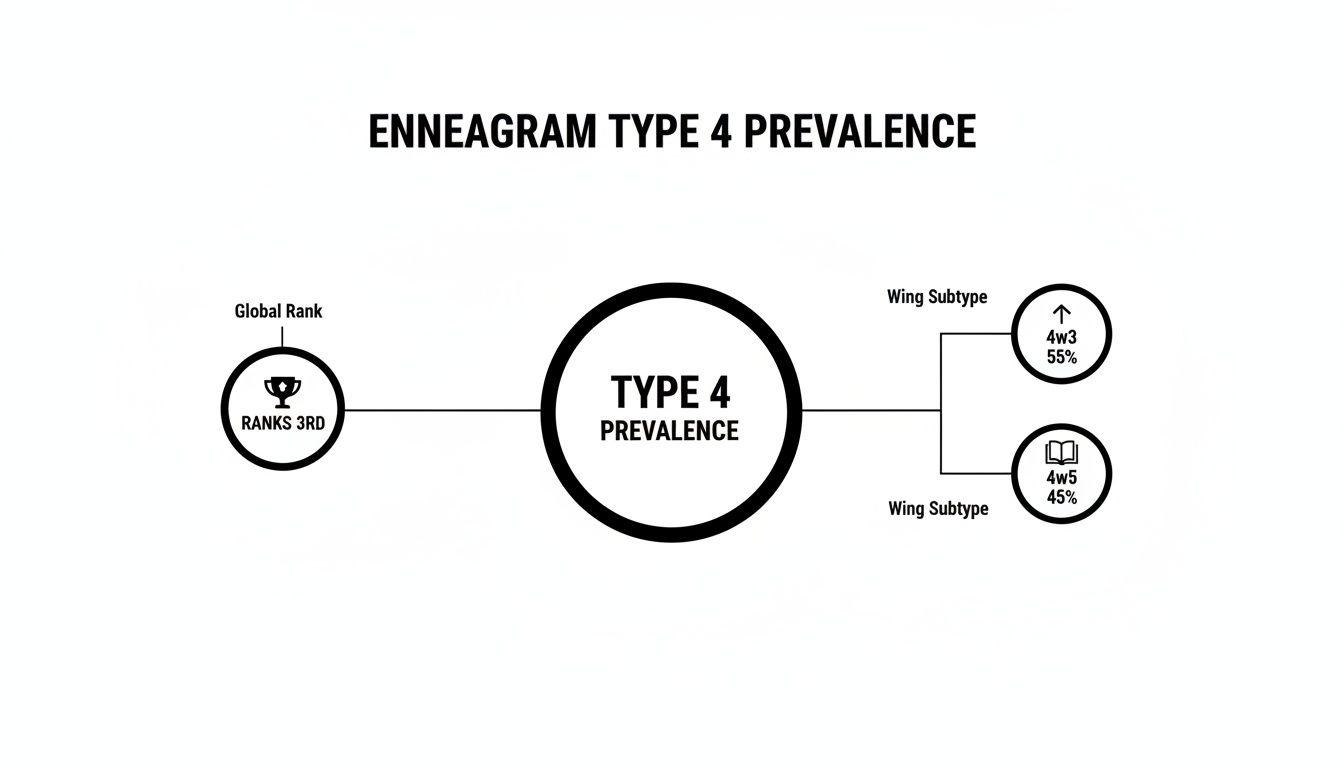
This nearly 50/50 divide shows that the Four's deep need to be unique gets channeled through two very different, yet almost equally popular, avenues.
The 4w3: The Aristocrat
What happens when you mix the deep, individualistic soul of a Four with the polished, ambitious drive of a Three? You get the 4w3, nicknamed "The Aristocrat." This is a Four who wants to express their unique vision in a way that is also successful, admired, and seen.
They don't just want to be special; they want the world to recognize and applaud their specialness.
Think of a visionary fashion designer from New York. The art is deeply personal, a raw expression of their inner world—that’s the Four. But the Three wing is what drive them to get that collection on the runway, featured in Vogue, and worn by celebrities. They are just as invested in the public reception as they are in the authenticity of the design. This blend of authenticity and ambition is explored more in our complete guide to the Enneagram 4w3 .
This wing creates a fascinating push-pull between staying true to oneself and achieving conventional success. They’re often more energetic, competitive, and socially engaged than their 4w5 cousins.
The 4w5: The Bohemian
Now, let's take that same Four and mix it with the quiet, intellectual, and observant nature of a Five. This gives us the 4w5, often called "The Bohemian." These Fours aren't nearly as concerned with what the outside world thinks. Their focus is turned inward, exploring the strange, complex, and often shadowy corners of their own minds.
Picture a poet who lives in a secluded cabin in the mountains of Vermont, spending years perfecting a single collection of poems. Their Five wing craves deep knowledge and understanding, which they then filter through their Four's rich emotional landscape. They have zero interest in book tours or bestseller lists. For the 4w5, the act of creation is the reward.
This type is more withdrawn and unconventional. They build their identity on intellectual depth and a unique, often minimalist, perspective rather than on applause from the outside world.
Comparing the Two Wings of Personality Type Four
To make the distinction clearer, let's look at how these two wings play out side-by-side. The core Four motivation is the same, but the expression is worlds apart.
| Trait | 4w3 (The Aristocrat) | 4w5 (The Bohemian) |
|---|---|---|
| Primary Goal | To express uniqueness and achieve success. | To express uniqueness and understand the world. |
| Social Style | More extroverted, charming, and image-conscious. | More introverted, withdrawn, and unconventional. |
| Focus | External: How their identity is perceived. | Internal: The depth and meaning of their identity. |
| Creative Process | Polished, professional, and audience-aware. | Raw, esoteric, and intensely personal. |
| Fear | Failing to be both unique and successful. | Being overwhelmed by the world or their own emotions. |
In short, a 4w3 wants to create a unique masterpiece and hang it in a famous museum for everyone to admire. A 4w5 wants to create a unique masterpiece and hide it in a secret attic, knowing its profound meaning is theirs alone.
The Three Instinctual Variants
If wings are the harmony, instinctual variants are the rhythm. These three primal drives direct where a Four’s energy and search for identity will be most focused.
• Self-Preservation (SP) Four: • This “Four” channels their need for uniqueness into their physical world. They are the aesthetes, creating a perfectly curated home, style, and lifestyle. A practical example is an SP Four who painstakingly designs their apartment to be a perfect reflection of their personality, from the vintage furniture to the color-coded bookshelf.
• Social (SO) Four: • The Social Four is most aware of their "differentness" in group settings. They often feel like they're on the outside looking in. To connect, they can lean into their sense of shame or suffering, using it as a way to garner empathy and find their place in the community. For example, at a dinner party, an SO Four might share a deeply personal and vulnerable story to create an immediate, intense bond with others.
• One-to-One (SX) Four: • This is the most intense and fiery Four. Their entire quest for identity is poured into their close relationships. They crave deep, all-consuming connection and are not afraid to be emotionally demanding, sometimes creating a cycle of pulling people close and then pushing them away to protect their fragile sense of self.
Interestingly, these nuanced personality traits often show up in other personality systems. For instance, Enneagram Type 4 frequently correlates with 16-Personalities types like the INFP. It's common for INFPs, ENFPs (who make up 8.1% of people), and ESFPs ( 8.5% ) to identify as Type 4s, as they all share that deep emotional core and a powerful drive for authentic self-expression.
The Path to a Healthy, Thriving Four
Let's get one thing straight: the growth journey for an Enneagram Type Four isn't about becoming less emotional. That's like asking a fish to get less wet. Instead, it's about learning to surf those deep emotional waves, turning that incredible depth into a source of creativity, connection, and real strength.
Growth for a Four means stepping out of the wistful fog of what could be or what's missing and planting your feet firmly in the rich, vibrant soil of what is . It’s the journey from being a reactor to your own melancholy to becoming a proactive creator of your own life.
This path is all about embracing the beautiful, messy, ordinary moments of life. It’s about finding a sense of stability right here, right now. The big revelation? Your uniqueness doesn't come from being different or misunderstood; it comes from the simple, profound act of being authentically you . A healthy Four finally realizes their sensitivity isn't a bug, it's a feature—a superpower for empathy and breathtaking artistic expression.
From Unhealthy to Healthy: A Four's Transformation
The Enneagram’s health levels give us a roadmap for this transformation. Down in the unhealthy zones, a Four can feel trapped in a vicious cycle of self-pity and envy. They retreat from a world they're convinced will never truly "get" them, often becoming emotionally volatile and pushing away the very people they long to connect with.
But as they start moving toward health, something shifts. Fours begin to find a little bit of breathing room around their big emotions. They learn to observe their feelings without being totally consumed by them. This newfound objectivity allows them to engage with the world more consistently, channeling their rich inner landscape into tangible, creative work that actually helps people (including themselves).
A genuinely healthy Enneagram Type Four is a gift to everyone around them. They are self-aware, deeply compassionate, and exquisitely attuned to the beauty in the world. They use their profound understanding of the human condition to create, inspire, and heal, living a life that feels both incredibly meaningful and wonderfully real.
Meet Chloe: The Designer Who Found Her Groove
Let's make this real. Picture Chloe, a talented graphic designer based in Austin. For years, she was stuck. She’d spend hours scrolling through other designers' portfolios, and that familiar, gut-wrenching pang of envy and inadequacy would hit her like a ton of bricks. The feeling would completely paralyze her, leaving her creatively blocked and convinced her own work was hopelessly derivative.
Chloe’s turning point wasn't some grand epiphany. It was a simple realization: her envy wasn't a verdict on her lack of talent, but a compass pointing directly toward what she admired and desired for herself.
So, she started a new practice. The moment she felt that green-eyed monster creeping in, she’d slam her laptop shut, grab her sketchbook, and pour that raw, intense emotion onto the page.
This small shift changed everything. Instead of withdrawing into a shame spiral, she started treating her feelings like a creative partner. Her work became more authentic, more vibrant—infused with the very emotional depth she once saw as her greatest weakness. Chloe learned to stop looking for inspiration in what others were doing and started finding it in the completely unique way she saw the world.
Actionable Strategies for Growth
The road to health for a Four is paved with small, consistent habits that pull you back to the present and build a foundation of gratitude. Think of these as anchors that keep you steady when the winds of melancholy start to blow.
• Practice Grounded Gratitude • Instead of a generic list, get sensory with it. Don't just write "I'm grateful for my morning coffee." Go deeper: "I'm grateful for the warmth of this ceramic mug in my hands, the rich, dark smell, and the comforting quiet of this moment." This yanks you out of your head and into your body.
• Create Without an Audience • The pressure to create something "profound" or "unique" can be utterly crushing. Set aside time each week to create just for you. Doodle in a notebook you'll never show anyone. Write a terrible poem. Pluck at a guitar with no intention of recording it. This is about reconnecting with the pure joy of creation, free from the fear of judgment.
• Find Beauty in the Mundane • Give yourself a tiny mission each day: find one beautiful, overlooked thing on your commute or even just on a walk to the mailbox. Maybe it’s the weirdly beautiful pattern of a crack in the sidewalk or the way the afternoon light filters through a dusty window. This simple practice trains your brain to look for the beauty that’s already here, not what’s missing.
"For the Type Four, growth is the slow, beautiful process of realizing that their significance was never in question. It is found not in being exceptional, but in the courageous act of being fully, unapologetically present in their own life."
For Fours who often feel like they're spinning their wheels, understanding why you feel stuck in life and how to move forward can offer some really powerful and clarifying insights on the journey.
It's also fascinating to see how these personality patterns play out on a global scale. Culturally, the Enneagram Type 4 vibe is strong in nations that celebrate artistry and individualism, like France. The culture often embodies the Four's passion and emotional honesty, but it can also mirror the challenges, like a tendency toward moodiness or finding comfort in indulgence. You can dive deeper into this by exploring the Enneagram and country culture .
Questions Everyone Asks About Type Fours
Stepping into the world of the Enneagram Four can feel a bit like cracking open a beautiful, complicated novel. It’s only natural to have a few questions. So, let’s clear the air, bust some myths, and get straight to the heart of the Enneagram's resident Individualist.
Think of this as your personal FAQ for the soul of a Four. Whether you are one or just love one, these answers should help illuminate what makes them tick.
So, Are All Fours Angsty Artists?
This is easily the biggest misunderstanding about Type Fours. While it's true that you'll find a lot of Fours in traditional creative fields, their "art" is so much bigger than just a canvas or a song. At their core, a Four is driven to express a unique, authentic identity.
Their real art is the act of making their inner world tangible.
• Think of the • innovative entrepreneur • in Silicon Valley who builds a business from a deeply personal, almost stubborn vision. That's a Four expressing themselves.
• Or the • passionate scientist • at a U.S. university who chases an unconventional theory simply because it • feels • true in their gut. Also a Four in their element.
• Even a • chef in New York • who crafts original dishes that tell a story is channeling that same powerful drive for authentic creation.
The medium is secondary. The mission is what matters: to create something personal, meaningful, and undeniably them .
How Can I Support the Type Four in My Life?
Here’s the secret: supporting a Four isn't about fixing their problems or forcing them to be cheerful. It's about creating a safe harbor where they can be their messy, authentic, emotionally complex selves without judgment. The single most important thing you can do is validate their feelings, even if you can’t fully wrap your head around them.
Try to steer clear of phrases like "you're being too sensitive" or "just look on the bright side." To a Four, that feels like you're invalidating their entire reality. Instead, just listen. For example, if a Four friend is upset about a minor social slight, instead of saying "It's no big deal," try saying "That sounds like it really hurt. I can see why you'd feel that way." This acknowledgment is a powerful gift.
What Are the Biggest Relationship Hurdles for a Type Four?
For the personality type four , relationships can be a beautiful but tricky dance. They crave a deep, soul-to-soul connection more than anything, yet they have a nagging fear of being swallowed up by a partnership and losing their unique identity. This creates a classic "push-pull" dynamic.
They might pull a partner in close, sharing their deepest secrets, only to suddenly push them away if they feel misunderstood or emotionally crowded. Fours also have a knack for idealizing what’s just out of reach, which can make it tough for them to fully appreciate the wonderful person standing right in front of them. The big growth edge for Fours in love is learning to voice their emotional needs directly, instead of expecting their partner to be a mind reader.
The real win for a Four is finding that sweet spot between profound connection and personal freedom, finally realizing that true intimacy doesn't erase their identity—it amplifies it.
What Are the Best Careers for a Type Four?
The best jobs for Fours are the ones that feed their soul's need for meaning, creativity, and authentic expression. They tend to wilt in sterile, impersonal corporate settings where they can't leave their personal mark on their work.
Many Fours find their groove in roles like:
• Artist, writer, or musician
• Therapist, counselor, or coach
• Graphic or interior designer
• Humanitarian or non-profit work
Ultimately, any career that lets them bring a unique vision to life and feel like their contribution is both personal and significant can be a perfect match. A practical example could be a Four thriving as a landscape architect, where they can blend artistic vision with environmental purpose, creating beautiful spaces that are uniquely their own. The key is finding a profession that sees their emotional depth and originality as assets.
Ready to uncover your own unique personality blueprint? The Enneagram Universe assessment goes beyond surface-level traits to reveal your core motivations, fears, and paths to growth. Start your journey of self-discovery for free .