INTJ and ENFJ: The Ultimate Compatibility Guide

You’re probably here because you know an INTJ and ENFJ pair that makes no sense on paper and total sense in real life.
One of them edits the shared vacation spreadsheet at 11:48 p.m. because the museum route is inefficient. The other rewrites the dinner plan because “your cousin just went through a breakup and really needs a lively restaurant.” One is trying to build a better system. The other is trying to build a better atmosphere. Both are convinced they’re being reasonable.
That’s the charm of INTJ and ENFJ . They often feel instantly intrigued by each other, then promptly discover they are speaking two different dialects of “care.”
An Unlikely Pair: The INTJ and ENFJ Dynamic
A weekend trip is where this pairing reveals itself fast.
The INTJ has tabs open for flights, weather, transit times, backup plans, and one restaurant selected because it minimizes travel dead time. The ENFJ is reading the group chat, noticing who sounds tired, who wants “something special,” and whether the whole thing will feel memorable or weirdly rushed. The INTJ asks, “Why are we changing the itinerary?” The ENFJ asks, “Why are you acting like people are luggage?”
They are both trying to save the trip.

This is why the pair feels so magnetic. The INTJ often admires the ENFJ’s social intelligence, warmth, and ability to move a whole room without sounding manipulative. The ENFJ often admires the INTJ’s strategic mind, calm under pressure, and talent for seeing the hidden structure inside a problem. Each can do something the other finds impressive, useful, and occasionally mildly infuriating.
Why Does This Pairing Get So Much Attention?
Part of the fascination comes from rarity. INTJ makes up about 2.1% of the population, and ENFJ about 2.5% , according to Personality Max population data . So when these two types find each other, it can feel a bit like two unusual species recognizing a familiar signal in the wild.
That rarity also feeds the mythology around them. People sometimes call this a “golden pair,” which is catchy but incomplete. It’s not golden because they magically agree. It’s golden because they can create a striking blend of vision plus humanity if they learn how to translate each other.
What Confuses People Most?
Readers often get stuck on a false question: “Are INTJ and ENFJ too different?” A better question is, “Are their differences complementary or combustible in this particular moment?”
Sometimes the answer is complementary. The ENFJ gets people on board. The INTJ makes sure the plan isn’t built out of glitter and wishful thinking. Sometimes the answer is combustible. The ENFJ hears bluntness as rejection. The INTJ hears emotional urgency as noise.
That push and pull is the whole story. It’s also where growth happens.
Decoding the INTJ and ENFJ Minds
If the first section was the movie trailer, this is the wiring diagram.
A lot of confusion about INTJ and ENFJ disappears once you stop thinking in stereotypes and start thinking in cognitive functions . In plain English, cognitive functions are the mental tools each type tends to reach for first. Some are natural and polished. Others are clumsy, overused under stress, or oddly invisible until life forces them into view.
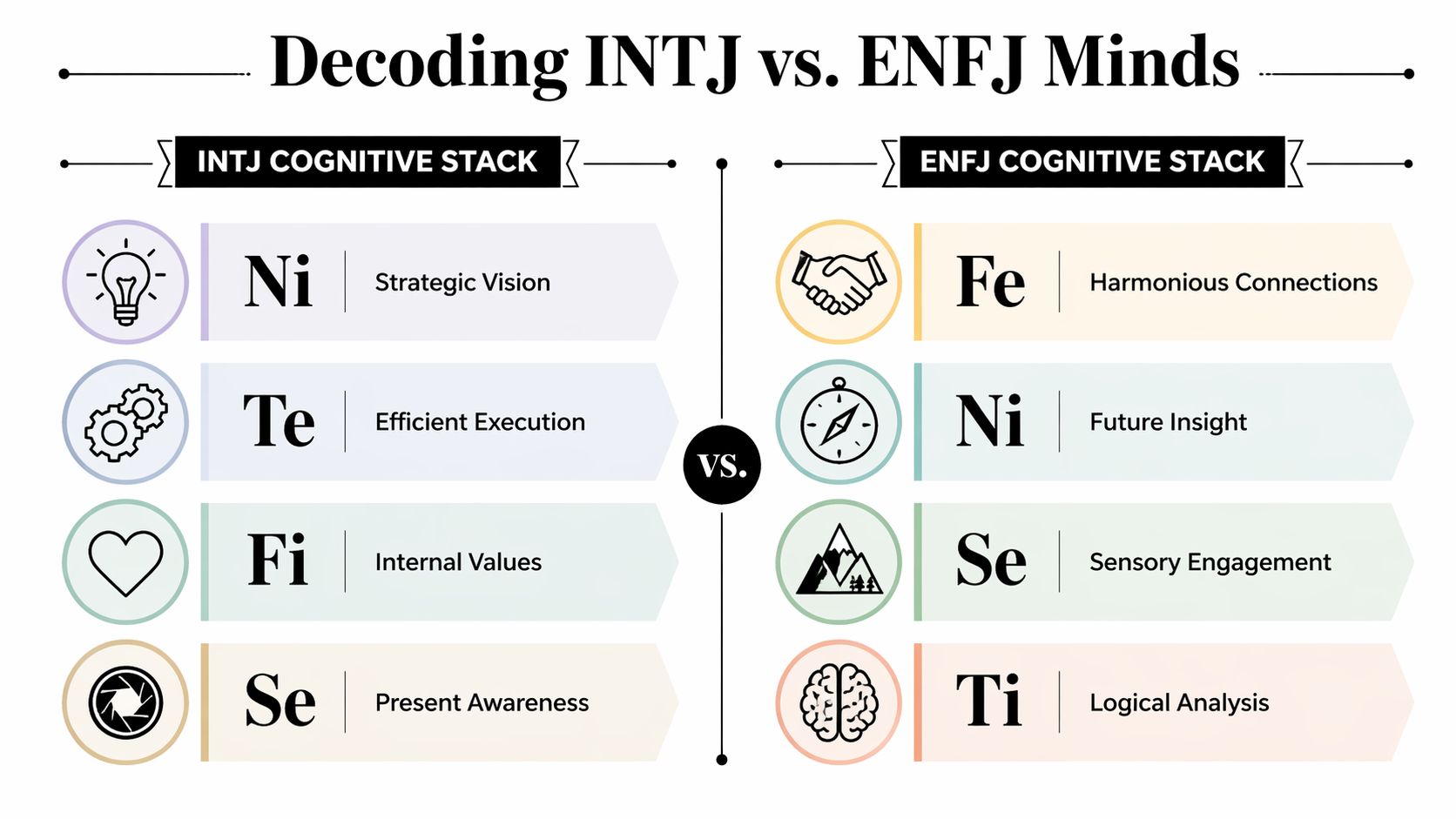
Here’s the shared secret that makes this pair click so fast. ENFJ and INTJ both use Introverted Intuition, or Ni, in their top two functions , which helps them connect through abstract patterns, future possibilities, and strategic problem-solving, as described in Psychology Junkie’s discussion of NJ types .
The INTJ Toolkit
Think of the INTJ stack as a small elite planning committee.
• Ni as Hero: • This is the strategist. It scans for patterns, predicts outcomes, and quietly builds a long-range model of reality. An INTJ may look like they’re staring into space. Often they’re ten steps ahead, mentally test-driving five different futures.
• Te as Parent: • This is the operations manager. It asks, “What works? What’s efficient? What’s the clearest route from A to B?” Te likes evidence, structure, timelines, and decisions that can be implemented.
• Fi as Child: • This one surprises people. INTJs do have values and feelings, but they often keep them private and distilled. Fi says, “This matters to me,” but it doesn’t always explain itself out loud.
• Se as Inferior: • This is present-moment sensory engagement. At their best, INTJs can become sharply observant and adaptable. Under stress, they may either ignore physical reality or suddenly overindulge in it. That’s how a normally restrained person ends up doom-ordering expensive gadgets at midnight.
The ENFJ toolkit
The ENFJ stack feels more like a gifted host running an ambitious community project.
Where Do They Instantly Recognize Each Other?
INTJ and ENFJ often bond over conversations that leave other people blinking politely.
They both like talking about patterns, motives, long-range possibilities, systems, and meaning. Give them a late-night conversation about why a team keeps repeating the same mistake, what a relationship is becoming, or where culture is headed, and they can talk for hours.
Where Do They Misread Each Other?
Their decision tools are different. The INTJ leans on Te , which sounds like efficiency, directness, and external logic. The ENFJ leads with Fe , which sounds like tact, morale, and relational awareness.
That difference creates classic mix-ups:
• INTJ mistake: • “I’m being helpful by being precise.”
• ENFJ hears: • “You care more about being right than being kind.”
• ENFJ mistake: • “I’m being considerate by softening the message.”
• INTJ hears: • “You’re avoiding the actual issue.”
Neither one is necessarily wrong. They’re just solving for different variables.
Worlds Apart or Two Sides of the Same Coin?
At a glance, INTJ and ENFJ can look like a boardroom strategist accidentally paired with a beloved student council president. One speaks in bullet points. The other speaks in emotional weather reports and future vision. Yet both are usually aiming at improvement.
That’s why this pairing can feel less like opposites and more like two people reaching for the same mountain from different sides .
INTJ vs ENFJ At a Glance
| Aspect | INTJ (The Architect) | ENFJ (The Protagonist) |
|---|---|---|
| Core focus | Strategy, systems, long-term efficiency | People, harmony, shared growth |
| Communication style | Direct, concise, solution-first | Warm, encouraging, audience-aware |
| Decision filter | “Does this make sense?” | “How will this affect people?” |
| Blind spot | Can sound colder than intended | Can soften too much or over-accommodate |
| Under stress | Becomes sharper, more withdrawn, more controlling of systems | Becomes more emotionally reactive, more controlling of relationships |
| Gift to the pair | Clarity, structure, foresight | Connection, motivation, cohesion |
If you like comparing personality systems side by side, Enneagram vs MBTI is useful because it separates outward style from deeper motivation.
The Same Project, Two Very Different Speeches
Say both are reviewing a coworker’s presentation.
The content is similar. The emotional texture is not.
The INTJ often assumes that wrapping feedback in extra cushioning wastes time and muddies the point. The ENFJ often assumes that delivery is part of the point because people rarely hear a message clearly when they feel embarrassed or shut down.
Why Each Style Can Look Suspicious to the Other
The ENFJ may privately wonder, “Why are you acting like emotions are a software bug?”
The INTJ may privately wonder, “Why are you treating clarity like a hostage negotiation?”
Both reactions are understandable. Both are also incomplete.
What do INTJs value?
• Truth over comfort: • If something is broken, name it.
• Competence over performance: • Don’t tell me it feels collaborative if the plan won’t work.
• Consistency over mood: • A decision should still make sense tomorrow.
What do ENFJs value?
• Trust as infrastructure: • People don’t follow plans when they feel dismissed.
• Tone as information: • How you say it tells others whether they are safe with you.
• Morale as strategy: • Teams fall apart long before the spreadsheet notices.
They’re More Alike Than They Seem
Both types are usually purposeful. Neither enjoys drifting for long. Both often care about growth, quality, and becoming better versions of themselves. They just package those goals differently.
An INTJ may pursue excellence by refining systems. An ENFJ may pursue excellence by elevating people. One says, “Fix the architecture.” The other says, “Fix the atmosphere.” Healthy pairs learn that most lasting problems involve both.
The INTJ and ENFJ Relationship Guide
The phrase “good match” fits this duo, but only if you understand what good means here. It doesn’t mean effortless. It means high potential when both people respect what the other naturally brings .
According to JobCannon’s INTJ ENFJ compatibility overview , INTJ and ENFJ score 62/100 on compatibility , and ENFJ-INTJ teams can outperform averages in innovation by 15 to 25% when the ENFJ’s leadership balances the INTJ’s strategic analysis.

Romance When A Big Decision Lands
A couple gets offered a relocation opportunity. The INTJ sees the long arc immediately. Better city, stronger career path, smarter financial setup, more options later. They’ve mentally modeled the next five years before the ENFJ has finished saying, “This is a lot.”
The ENFJ isn’t ignoring the opportunity. They’re tracking human cost. What happens to friendships, family routines, community ties, and the emotional impact of starting over? The INTJ may think, “You’re overcomplicating this.” The ENFJ may think, “You’re talking like we’re moving a server.”
A healthy version of this pair does something elegant. The INTJ builds the strategic frame. The ENFJ stress-tests it against lived reality. Together, they ask not just “Will this work?” but “Will this work for us?”
For more everyday relationship patterns across types, personality types in relationships give a broader lens.
Friendship When One Person Is Unraveling
An INTJ friend is burned out. The ENFJ notices before the INTJ says anything. Replies get shorter. Humor gets drier. Plans disappear. So the ENFJ shows up with food, asks real questions, and creates a space where the INTJ doesn’t have to perform competence for an hour.
Later, the script flips. The ENFJ is overwhelmed by everyone else’s needs and can’t tell which problem is theirs anymore. The INTJ listens, sorts the mess into categories, and says, “You need boundaries, a triage list, and one afternoon with your phone off.” It’s not romantic, but it’s useful. Often, that’s exactly the medicine.
This friendship works best when both understand that support comes in different packaging.
• ENFJ support often sounds like • “I’m with you.”
• INTJ support often sounds like • “Here’s what will stabilize this.”
Neither is inferior. Each can feel lifesaving at the right moment.
Work When The Stakes Are Public
A product launch is wobbling. The INTJ sees structural risk. Messaging is fuzzy, deadlines are optimistic, and no one has defined the decision path. The ENFJ sees a morale problem. The team is polite in meetings and confused in private. Stakeholders are smiling, but not aligned.
Now the duo gets interesting. The INTJ rebuilds the launch sequence, trims unnecessary complexity, and clarifies ownership. The ENFJ gets buy-in, handles sensitive conversations, and makes sure people understand the purpose behind the plan. One person sharpens the machine. The other gets people willing to use it.
A short explainer can help if you want another lens on how these dynamics show up:
Where Relationships Wobble
This pairing usually struggles in predictable spots:
• Pacing problems: • INTJ wants a decision before the issue sprawls. ENFJ wants emotional alignment before the issue hardens.
• Tone problems: • INTJ thinks blunt means honest. ENFJ hears blunt as distancing.
• Priority problems: • INTJ protects the plan. ENFJ protects the people in the plan.
Those aren’t signs that the match is doomed. There are signs that the pair needs a repeatable process for handling friction instead of winging it every time.
A Practical Guide to Conflict Resolution
“Be more understanding” is nice advice in the way “sleep more” is nice advice. It’s correct and almost useless in the middle of a fight.
A core issue with INTJ and ENFJ conflict is that each person often thinks they’re addressing the problem while the other thinks they’re creating a new one. The INTJ uses Te to clarify. The ENFJ uses Fe to protect the connection. During conflict, those instincts can collide hard.
Crystal’s overview of this pairing notes a major gap here. Plenty of advice explains the difference, but not the method. It also notes that friction can be reduced by 20 to 30% with targeted self-awareness and communication techniques , while many resources still lack a usable protocol, as described in Crystal’s ENFJ INTJ relationship page .
Step One: Pause and Label the Clash
Stop arguing about the content for a moment and label the process.
Say it plainly:
• “I think we’re having a logic-versus-tone collision.”
• “I’m hearing criticism, and you think you’re offering analysis.”
• “I’m trying to solve it fast, and you’re trying to keep us connected.”
This sounds simple because it is. It also works because it moves the pair out of moral judgment. Nobody has to be “cold” or “dramatic.” They’re using different tools under stress.
Step Two: Translate and Validate
Each person has to restate the other’s concern in their native language.
The INTJ tries this: “You need to know that my point isn’t a rejection of you, and the way I said it made it feel personal.”
The ENFJ tries this: “You need a conversation that gets to the actual issue without getting lost in emotional fog.”
That’s not an agreement. It’s an accurate translation. When people feel accurately represented, they stop fighting for oxygen and start solving the problem.
If you want a broader set of tools for these moments, How to Resolve Relationship Conflict offers practical prompts that fit this kind of mismatch well.
Step Three: Build an Ni bridge
This is the secret weapon for this pair. Since both types connect through future-oriented intuition, shift from the immediate clash to the shared goal. Ask:
An example helps. The ENFJ says, “I need you to say that you understand why I’m hurt.” The INTJ says, “I need us to decide what changes next time.” The Ni bridge is: “We both want a relationship where problems get solved, and neither person feels dismissed.”
That shared vision calms both systems. The ENFJ feels the bond is being protected. The INTJ sees a path forward.
One Script That Works Surprisingly Well
Try this sequence:
• “What I heard.”
• “What I think you meant.”
• “What I need clarified.”
• “What outcome do we both want?”
• “What we’ll do differently next time.”
It’s not glamorous. It is effective. And effective is romantic in its own nerdy way.
Beyond Personality: The Path to Self-Improvement
Compatibility gets easier when each person grows beyond their default setting.
The conversation expands beyond simplistic ideas such as “INTJs are logical” and “ENFJs are warm.” Those labels describe surface patterns. They don’t explain the deeper driver behind them. Two INTJs can look similar and still act from very different fears. Two ENFJs can both be generous while wanting very different things from relationships.
That’s why combining MBTI with the Enneagram is so useful. MBTI often describes how a person tends to process information and make decisions. The Enneagram adds why , especially around core fear, desire, and stress patterns.

Growth Work for INTJ
The INTJ usually benefits from developing Fi , the quieter function tied to personal values and inner emotional honesty.
That doesn’t mean becoming sentimental on command. It means noticing that “logical” decisions still contain values. If an INTJ says, “This is the best option,” it’s worth asking, “Best by which standard, and why does that standard matter to me?”
Try practices like these:
• Values journaling: • Write one decision you made this week and the value underneath it.
• Emotion naming: • Before solving a problem, name your feeling in one word. Annoyed, disappointed, protective, and embarrassed.
• Preference disclosure: • Tell someone what you want before you present the rational case for it.
For some INTJs, the Enneagram reveals whether their distance comes more from a need for competence, autonomy, security, or emotional self-protection. That changes the growth path.
Growth work for ENFJ
The ENFJ often grows by strengthening Ti , the internal logic tool that helps them test assumptions without relying only on social feedback.
This doesn’t mean becoming detached. It means asking, “Is this kind, and is it also coherent?” ENFJs can drift into over-accommodating, then feel resentful when nobody notices the invisible labor. Ti helps them examine where the logic of the situation broke down long before emotions overflowed.
Useful experiments include:
• Argument checking: • Write your conclusion, then list the evidence for it.
• Boundary math: • For every yes, identify what you’re saying no to.
• Silent pause: • In tense conversations, wait a beat before smoothing the moment. See what the unedited truth is.
Where Does the Enneagram Add Depth?
An INTJ with a perfectionistic streak won’t look the same as an INTJ driven by achievement or privacy. An ENFJ who fears rejection won’t approach conflict the same way as an ENFJ who fears being without support or significance.
That’s the practical payoff. You stop treating personality as costume design and start treating it as motive, habit, and growth work.
One option for exploring that layer is Enneagram Universe , which offers a free Enneagram assessment with 180 questions and feedback on type, wings, triads, and health levels. Used alongside MBTI, that kind of tool can help a pair identify whether they’re fighting about communication style or about something deeper, like control, abandonment, shame, or security.
Find Your Path with Enneagram Universe
INTJ and ENFJ are a pairing with range. At its best, it combines strategic depth with social intelligence. One person sees where things are going. The other helps people want to go there. In romance, friendship, and work, that can be a formidable combination. It can also become exhausting if each person keeps insisting that their style is the only mature one.
The healthiest version of this match doesn’t erase differences. It learns how to use differences well. The INTJ learns that warmth can be efficient because trust prevents damage. The ENFJ learns that clarity can be kind because vagueness often creates more pain later. Both get better when they stop asking, “Who’s right?” and start asking, “What is this dynamic trying to teach us?”
MBTI gives you a map of the mental habits. The Enneagram goes lower and deeper. It points to the fear under the reaction, the need under the argument, and the wound under the pattern. That’s often the missing piece when an INTJ and ENFJ understand each other intellectually but still keep stepping on the same landmine.
This pair rarely needs more chemistry. It usually needs better translation, stronger self-awareness, and a shared language for growth.
If you want to understand not just how you think, but why you react the way you do, take the free assessment at Enneagram Universe . It’s a practical next step for INTJs, ENFJs, couples, coaches, and anyone who wants sharper self-awareness and healthier relationships.