INFPs in Relationships: Building Deep Connections

You might be here because you love an INFP and feel shut out by their silence. Or because you are an INFP and keep hearing some version of, “I never know what you really need.” That moment is common. One person thinks they’re protecting the relationship by staying gentle. The other feels like they’re guessing in the dark.
That’s why INFPs in relationships can feel both magical and confusing. An INFP often brings enormous tenderness, loyalty, imagination, and hope into love. They also bring a private inner world, very high ideals, and a habit of swallowing pain until it leaks out sideways.
The usual advice about “best matches” barely scratches the surface. It doesn’t explain why an INFP can seem warm one day and unreachable the next. It doesn’t explain why some partners feel cherished, while others feel like they’re dating a beautiful locked diary.
A better lens combines MBTI with Enneagram. MBTI helps us understand how an INFP processes love. The Enneagram helps us understand why they react the way they do when closeness, fear, shame, or conflict show up. Put those together, and the relationship starts to make sense.
Understanding the INFP Relationship Blueprint
A lot of INFPs grow up hearing that they’re “too idealistic,” “too sensitive,” or “too hard to read.” In relationships, that misunderstanding can sting. Their partner may see hesitation. The INFP often feels something more precise. They’re asking, “Is this safe, real, and aligned with who I am?”

INFPs aren’t usually casual about love. According to PersonalityMax’s overview of INFP relationships , INFPs make up about 4.4% of the U.S. population and tend to prefer deep, meaningful connections over casual dating. That helps explain why so many infps in relationships seem selective from the outside. They’re not trying to be difficult. They’re trying to protect something sacred.
The Compass and The Map
Two mental habits shape how an INFP loves. The first is Introverted Feeling, or Fi . Think of Fi as an inner compass. It keeps asking, “Does this feel honest? Does this match my values? Can I trust what this relationship means?”
The second is Extraverted Intuition, or Ne . Think of Ne as a map covered in penciled possibilities. It notices hidden potential, future paths, symbolic meaning, and what a relationship could become. Together, these create a powerful romantic style.
• Fi checks for truth: • The INFP wants emotional sincerity, not just chemistry.
• Ne imagines potential: • They can see who a person might become, not only who they are today.
• Both together raise the bar: • They rarely feel excited by a shallow connection.
That combination explains the “secret, walled garden” quality many people notice. An INFP heart is often private at first. The gate doesn’t open because someone is charming. It opens when someone feels genuine.
Practical rule: If an INFP moves slowly, don't assume low interest. Slow can mean they’re testing for emotional safety.
Why Can They Seem Picky?
People get confused here. Selective doesn’t always mean judgmental. For an INFP, selectivity often means they don’t want to build a life around a bond that feels emotionally hollow.
A simple example helps. Two people invite Maya, an INFP, on dates. One is polished, witty, and attractive, but talks mostly about status and appearances. The other is less flashy, but asks thoughtful questions and speaks with warmth about family, purpose, and art. Maya may feel almost no pull toward the first person, even if everyone around her says, “You’re crazy not to choose them.”
That isn’t irrational. Her inner compass is looking for value alignment, not social proof.
Why Does This Matter to Their Partner?
If you’re dating an INFP, the biggest mistake is taking their reserve personally too soon. Their caution often says more about the depth they want than about your worth. If you want a broader framework for how personality shows up in romance, this guide on personality types in relationships can help place the INFP pattern in context.
A healthy INFP relationship starts when both people understand this basic truth. The INFP isn’t searching for perfection. They’re searching for meaning. Those can look similar from across the room, but they create very different relationships.
The Unwavering Loyalty of an INFP Partner
Once an INFP lets someone into that inner garden, the atmosphere changes. The caution doesn’t disappear, but loyalty often takes center stage. An INFP in love can feel like someone faithfully tending a fire through every season.
According to PersonalityPage’s description of INFP relationships , INFPs often show remarkable loyalty and commitment , and they may work hard to keep a partner on a pedestal through affirmation and a strong desire for harmony. That sounds lovely because it often is. It can also be intense because they don’t do it halfway very well.
What This Looks Like in Real Life
An INFP partner may not always be the loudest person in the room, but they often notice what matters most. They remember the song you played in the car the night you were overwhelmed. They text you before a difficult family event because they know exactly what kind of day it is. They write the birthday card that makes you cry in the kitchen.
Their love often shows up in highly personal ways:
• They affirm your identity: • Not just “you look nice,” but “I love how you stayed kind in that hard conversation.”
• They support your becoming: • They often see unrealized gifts in a partner and encourage them gently.
• They create emotional shelter: • You feel less judged around them, more understood, more allowed to be human.
A lot of partners describe this as feeling “seen in high definition.”
The Affirming Mirror
INFPs often function like an affirming mirror. They reflect back the most meaningful parts of the person they love. Not in a fake, flattering way. More like this: “I know you think you’re failing, but I keep seeing your courage.”
That can be powerful in a long-term relationship. A partner who’s tired, discouraged, or ashamed may find that the INFP keeps holding onto a better, truer picture of them. Some people give advice. An INFP often gives recognition. That’s why their support can feel unusually healing.
Their Creativity Changes The Emotional Climate
An INFP’s love is rarely mechanical. It tends to be expressive. Not always publicly, and not always with grand gestures, but often with originality.
One INFP might leave a note in a lunch bag before a stressful work presentation. Another may build a playlist that traces the story of the relationship. Another may spend an evening helping their partner rehearse a difficult conversation because they know confidence sometimes needs witnesses.
These gestures matter because they communicate more than affection. They say, “I have been paying close attention to your inner life.”
The Quiet Form of Devotion
INFP devotion doesn’t always look conventional. It may look like staying present through grief. It may look like forgiving quickly because preserving the connection matters to them. It may look like defending a partner’s dreams when other people dismiss them as unrealistic.
That’s why being loved by an INFP can feel both comforting and ennobling. They often don’t just love who you are. They love who you’re trying to become.
Of course, every strength has a shadow. The same loyalty that makes an INFP such a devoted partner can also make them stay too long, excuse too much, or hurt in silence. That’s where things get more complicated.
Navigating the Common INFP Relationship Pitfalls
The romantic image of the INFP is sweet, poetic, loyal, and emotionally deep. All true. But if we stop there, we miss the patterns that cause the most pain.

The same qualities that make INFPs tender partners can become traps when they’re under stress. MindBodyGreen’s discussion of INFP compatibility notes that INFP idealism can lead them to pedestalize partners , and that 60 to 70% may internalize relationship issues rather than confronting them. That combination is one of the central fault lines in infps in relationships.
When Love Turns Into Projection
An INFP can fall in love with a real person and a beautiful imagined future at the same time. That sounds romantic until the imagined future starts competing with reality.
A common pattern goes like this:
| Pattern | How it feels at first | What happens later |
|---|---|---|
| Seeing potential | Inspiring, hopeful, intimate | The partner feels pressure to become an ideal |
| Pedestalizing | Deep admiration | Ordinary flaws start to feel shocking |
| Self-sacrifice | Loving, generous | Resentment builds quietly |
| Avoiding conflict | Peaceful, kind | Problems go underground |
Take Sam, an INFP, dating someone charming and ambitious. Early on, Sam notices some inconsistency, but focuses on the partner’s sensitivity, intelligence, and hidden depth. Months later, the partner keeps forgetting agreements and dodging accountability. Sam doesn’t want to “ruin the vibe,” so Sam says little. Inside, disappointment grows like steam in a closed pot.
The problem isn’t that Sam loved profoundly. The problem is that Sam treated warning signs like rough drafts.
Why Conflict Feels So Loaded
Many INFPs experience conflict as more than disagreement. It can feel like a threat to emotional connection, moral goodness, or personal safety. They may think:
• “If I say this directly, I’ll hurt them.”
• “If I’m upset, maybe I’m being unfair.”
• “If this turns into a fight, the relationship could crack.”
So they wait. They soften. They hint. They hope the other person will notice. Sometimes the other person doesn’t. The issue with avoiding conflict is simple. Pain that doesn't get spoken about usually gets acted out.
That acting out can look subtle. The INFP grows distant. They become hard to read. They say “it’s fine” in a voice that clearly means it isn’t. Or they blame themselves for having needs at all.
The Hidden Cost of Being the Gentle One
People often praise the INFP for being patient, forgiving, and emotionally generous. Those are beautiful traits. But when they’re overused, they become a costume.
A partner may think, “We never fight. We’re so compatible.” Meanwhile, the INFP is carrying grief, anger, disappointment, and unmet needs alone. That creates a painful split between the outer relationship and the inner one. Here’s the hard truth. Harmony is not the same as health.
The Partner’s Side of The Story
Many articles stop too soon. They explain the INFP’s sensitivity but not the partner’s confusion.
The partner may feel whiplash. One week, the INFP seems affectionate and connected. The next week, they’re withdrawn, vague, or suddenly heartbroken over an issue that was never clearly discussed. From the partner’s seat, it can feel like walking into a movie halfway through and being expected to know the plot.
That doesn’t make the INFP wrong. It means the relationship needs translation, not mind-reading.
A Practical Guide to INFP Communication and Conflict
A lot of relationship pain with INFPs comes down to one thing. They often know what they feel, but struggle to say it in a crisp, direct way while the moment is still happening.
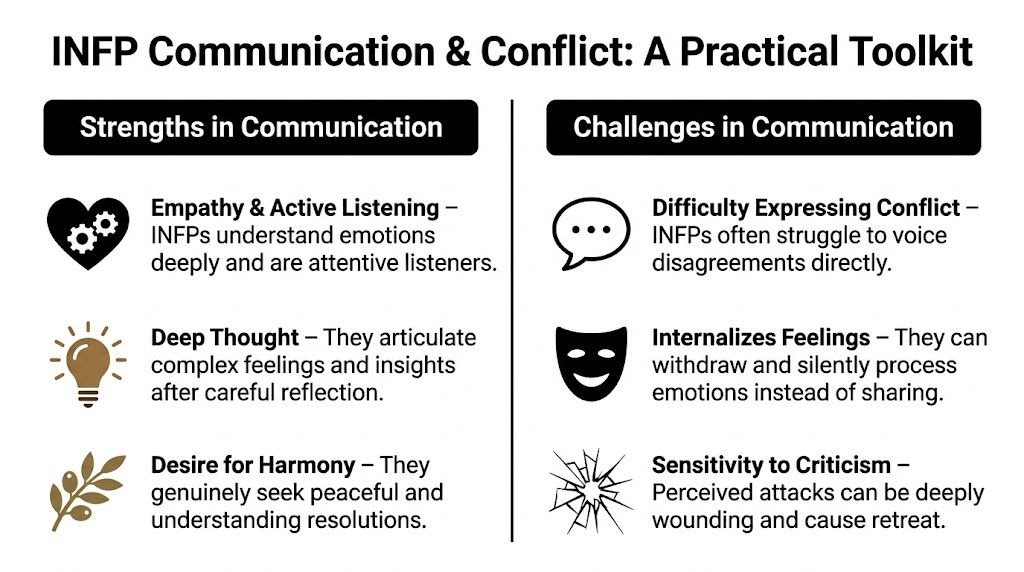
According to TraitLab’s analysis of INFP relationships , INFPs may express needs indirectly because of less-developed Extraverted Thinking, or Te , and conflict can drag on when the desire for harmony overrides clarity. That doesn’t mean they can’t communicate well. It means they often need a bridge from feeling to language.
Why Directness Can Feel Harsh
Te is the part of communication that likes structure, facts, clean statements, and efficient problem-solving. For an INFP, using that mode under emotional pressure can feel stiff or almost aggressive. So instead of saying, “I felt dismissed when you interrupted me,” they may say, “It’s okay, I probably wasn’t explaining it well anyway.” That sentence sounds polite. It also hides the underlying issue.
What the INFP Can Say Instead
Try these scripts. They’re direct without being cold.
Those scripts matter because they let the INFP stay kind without disappearing.
Here’s a useful companion resource if you want more general conflict tools beyond personality language. THERAPSY's guide to conflict resolution offers practical ideas that fit well alongside this kind of work.
What the Partner Can Say Instead
Many partners accidentally make an INFP shut down by coming in too fast, too logical, or too intense. The goal isn’t to walk on eggshells. It’s to lower the emotional threat level so honesty can surface.
Try phrases like these:
• “I’m not trying to win. I want to understand what this felt like for you.”
• “You don’t have to answer instantly. Take a second and then tell me the honest version.”
• “If you’ve been minimizing this to keep the peace, I’d rather hear your full experience.”
That last line can be surprisingly effective. It gives the INFP permission to stop performing calmness.
After you understand each other, the practical next steps become much easier. A broader walkthrough of communication repair can also help. This article on how to resolve relationship conflict pairs well with the INFP-specific approaches here.
Use the Pause and Process Method
INFPs often need a beat to sort emotions into words. If a conversation gets heated, use a simple structure:
| Step | What to do |
|---|---|
| Pause | Stop before the conversation turns sharp or muddy |
| Process | Each person names what they’re actually feeling |
| Return | Agree on a time to continue, not “sometime later” |
| Reflect | End by checking what each person understood |
That last step matters. A lot. Say: “Before we wrap this up, can each of us say what we think the other person meant?” That reduces the classic INFP problem of leaving a talk with unresolved emotional static.
This short video adds another layer to the communication side of infps in relationships.
What Not To Do?
A few habits reliably make things worse:
• Don’t demand instant precision: • The INFP may need time to translate feeling into language.
• Don’t mock emotional nuance: • Even if it sounds abstract to you, it’s real to them.
• Don’t accept endless vagueness either: • Compassion and clarity need to work together.
That’s the sweet spot. Soft tone. Clear words. Real timing.
INFP Compatibility Through the Lens of MBTI and Enneagram
Compatibility advice gets shallow fast. “INFPs match with intuitive types.” Fine. But that won’t help much if one partner craves emotional intensity, the other avoids hard conversations, and both think love should “just flow naturally.”

A more useful approach combines type patterns with motivation. MBTI describes style. The Enneagram describes core emotional strategy. Together, they explain why two INFPs can act very differently in love.
A major clue comes from the partner experience. 16Personalities’ article on Mediators in love notes that 88% of INFPs hide their true feelings to avoid upsetting others . That means compatibility isn’t only about chemistry. It’s also about whether both people can survive the communication gap without building a fantasy or a resentment story around it.
MBTI Patterns That Often Help
Some MBTI pairings tend to feel easier because they support the INFP’s wiring. The sources provided earlier note that INFPs often connect well with intuitive feeling types and may also pair well with types such as ENFJ and ENTJ. The reason is fairly intuitive. These partners may help the INFP bring values and dreams into clearer action, while still engaging the deeper meaning the INFP cares about.
Here’s a simple way to think about the partner experience:
| Partner style | What the INFP may enjoy | What can go wrong |
|---|---|---|
| Intuitive feeling partner | Shared meaning, emotional depth, easy symbolism | Too much idealism, not enough grounding |
| Structured intuitive partner | Vision plus direction | The INFP may feel steamrolled if tone gets too forceful |
| Highly pragmatic partner | Stability, consistency, realism | The INFP may feel unseen or emotionally lonely |
That last row matters. A practical partner isn’t automatically a bad fit. But if they dismiss nuance with “you’re overthinking,” the INFP often starts closing doors inside.
Why Enneagram Changes the Story
Now the useful twist. An INFP Type 9 and an INFP Type 4 may look similar from a distance. Both can be sensitive, creative, and introspective. In love, they often operate very differently.
INFP Type 9
This INFP usually prioritizes peace. They may merge with a partner’s preferences, delay hard conversations, and minimize their own anger. Their partner often experiences them as soothing, accepting, and easy to be around. Over time, that same partner may also feel frustrated because it’s hard to know what the INFP 9 wants.
A strong-willed partner, especially one who values bluntness, may think, “Why won’t you just say it?” The INFP 9 isn’t usually trying to manipulate. They’re trying to preserve the connection.
INFP Type 4
This INFP usually prioritizes authenticity and emotional significance. They may want intensity, depth, and a sense that the bond is unique. Their partner often experiences them as soulful and emotionally rich. The challenge is that they may also find it hard to reassure if the INFP 4 starts feeling misunderstood, unseen, or emotionally distant.
A very cheerful, surface-level partner may leave them starving. A more emotionally attuned partner may feel strongly bonded.
Other Possible Enneagram Overlays
You may also see patterns like these:
• INFP Type 2 tendencies: • Can overgive, then feel unappreciated.
• INFP Type 6 tendencies: • May crave reassurance and scan for relational uncertainty.
• INFP Type 1 tendencies: • May carry a private sense of how love “should” look, then feel disappointed when reality gets messy.
These aren’t boxes. They’re lenses. Compatibility gets much clearer when you stop asking only, “Who matches my personality?” and start asking, “What fear shows up when I feel close to someone?”
If you want a fuller breakdown of how these two systems differ, this guide to Enneagram vs MBTI offers a useful comparison.
The Partner’s Experience Matters as Much as The INFP’s
This is the piece many discussions skip. A partner doesn’t just date the INFP’s depth. They also date the INFP’s delays, hidden fears, and mixed signals. An assertive partner may feel shut out. A helper partner may accidentally enable overdependence. A peacemaker partner may create a relationship where neither person says the hard thing. A challenger partner may force honesty too abruptly and trigger withdrawal.
That’s why “best match” lists are only starting points. The deeper question is this: can both people tell the truth in a way the other can hear? When the answer is yes, infps in relationships can build something rare. Not just romance, but emotional authorship. A relationship where two people learn how to stop performing and start revealing.
Actionable Steps for Growth for INFPs and Their Partners
Growth is possible. Not in a vague “communicate more” way. In a practical, repeatable way.
One neglected pattern deserves special attention. As discussed in this video conversation about INFJ and INFP patterns , many INFPs may start acting as if their partner’s emotional state is partly their job. That can slide into over-responsibility, self-erasure, and codependent habits.
For the INFP
Start with boundaries that are small enough to practice.
• Name what is yours: • Try writing two lists after a hard interaction. “What I feel” and “what they feel.” Keep the lists separate.
• Use a realism check: • Once a week, ask, “What is this person doing, not just what I hope they mean?”
• Replace mind-reading with one sentence: • Say, “I’m noticing I’m making assumptions, so I want to ask directly.”
If your Enneagram pattern leans toward Type 9, your growth may involve speaking sooner. If it leans Type 4, your growth may involve checking whether pain is coming from the present moment or from an older wound that got activated.
For The Partner
Your job isn’t to become the INFP’s therapist. Your job is to help create conditions where honesty feels possible.
Try this rhythm:
That last question is gold with many INFPs. It lowers confusion on both sides.
A Shared Practice That Works
Create a short weekly check-in. Keep it simple. Ten to fifteen minutes can be enough.
Use prompts like:
• “Something I appreciated this week was…”
• “Something I didn’t say in the moment was…”
• “Something I need next week is…”
One practical tool for couples who want more structure is the Enneagram Universe assessment platform. It offers a free Enneagram test and comparative relationship insights, which can help couples distinguish personality style from deeper motivations before conflict gets personalized.
What Growth Actually Looks Like
It looks less cinematic than is generally assumed. It’s not one huge breakthrough. It’s the INFP saying the true thing one hour earlier than usual. It’s the partner staying calm long enough to hear it. It’s both people learning that closeness survives honesty.
That’s how trust gets built. Not by avoiding rupture, but by repairing it without abandoning yourselves.
Embracing the Authentic Connection
Loving as an INFP, or loving an INFP, asks more from a relationship than surface compatibility. It asks for honesty, patience, and the courage to translate inner experience into shared language.
The reward is unusual depth. INFPs often bring devotion, imagination, tenderness, and a fierce respect for meaning. Their growth edge is learning that directness doesn’t destroy love. It protects it. Their partner’s growth edge is learning how to invite truth without overpowering it.
When both people do that, INFPs in relationships stop feeling confused and start feeling grounded. Not less soulful. More real.
This kind of bond isn’t built by performing perfectly. It’s built by letting each other be known.
If you want to explore your own patterns further, Enneagram Universe offers tools for understanding core motivations, relationship dynamics, and the emotional habits that shape how you love. It’s a practical next step if you want language for what keeps happening beneath the surface.