INFP and Relationships: A Practical Guide to Love and Compatibility

For an INFP , a relationship isn't just about finding a partner; it's about finding a kindred spirit. They aren't looking for someone to simply share a life with—they're searching for a deep, almost spiritual bond with someone who truly gets them. If you're an INFP or love one, you already know that connection is everything.
Welcome to the World of INFP Relationships
Loving an INFP feels a bit like stumbling upon a hidden garden. It’s a space they’ve cultivated with incredible care, filled with deeply held values and a quiet, persistent yearning for a soulmate connection. For them, a relationship is a sacred ground where two people can grow side-by-side, without judgment or pretense.
Think of the INFP in your life as a gardener of the soul . They are far less concerned with the superficial "weather" of day-to-day squabbles and much more invested in nurturing the roots of a connection. They tend to the shared values, dreams, and emotional truths that allow a partnership to truly flourish. For example, they're the partner who remembers a throwaway comment you made months ago about a childhood dream and then finds a way to support it. This makes loving them a profoundly rewarding experience, but it definitely comes with its own unique instruction manual.

Understanding the INFP Blueprint
As the quiet dreamers of the Myers-Briggs world, INFPs are a rare find, making up just 4.9% of the general population . This means that while many of us might know an INFP, very few get to see the full depth of their inner world. They guard it carefully, which you can read more about in the INFP relationship dynamics on PersonalityData.org .
To truly connect with an INFP—and help them thrive—you have to understand what makes them tick. The table below offers a quick look at their core relationship blueprint. And while Myers-Briggs is a great starting point, you can explore how these traits intersect with other personality systems in our guide on the Enneagram vs. MBTI .
The INFP Relationship Blueprint at a Glance
Here’s a quick summary of the core traits INFPs bring to their relationships, highlighting their strengths, potential challenges, and what they value most.
| INFP Trait | Strength in Relationships | Potential Challenge |
|---|---|---|
| Deeply Idealistic | Sees the absolute best in their partner and envisions a beautiful future together. | Can place partners on an unrealistic pedestal, leading to disappointment. |
| Fiercely Loyal | Once committed, their devotion is unwavering and they champion their partner fiercely. | May struggle to leave a relationship even when it's unhealthy. |
| Values Authenticity | Craves genuine connection and creates a space where both partners can be their true selves. | Has a low tolerance for superficiality, phoniness, or emotional dishonesty. |
| Conflict-Averse | Prioritizes harmony and will go to great lengths to avoid arguments. | Can suppress their own needs, leading to simmering resentment over time. |
These traits create a beautiful but sometimes tricky dynamic. The INFP’s idealism fuels their incredible loyalty, but it can also set them up for a hard fall if reality doesn't match their dreams. For example, an INFP might stay with a partner who consistently lets them down, clinging to the idealized version of that person they fell in love with, rather than facing the current reality.
The Inner Compass of the INFP Heart
If you really want to understand what makes an INFP tick in a relationship, you have to look under the hood at their operating system. The whole thing runs on a powerful function called Introverted Feeling (Fi) . It’s not just a feeling; it’s a deeply personal, non-negotiable internal compass that constantly points toward their most sacred values.
While a lot of people look outside for cues on what’s right or wrong, an INFP’s first stop is always their own gut. This inner guidance system is their north star, and it dictates everything.
This is why an INFP can be in what looks like a picture-perfect relationship, yet feel a quiet, growing sense of dread. If their partner does something that fundamentally clashes with one of their core principles—like honesty, compassion, or authenticity—it creates an internal alarm that’s impossible to ignore. A practical example: an INFP's partner might boast about a dishonest business deal. To the INFP, this isn't just a difference of opinion; it's a seismic clash of values that makes them question the entire foundation of the relationship. Eventually, they’ll walk away, often leaving their partner completely baffled, just to stay true to that inner compass.
The Power and Peril of Idealism
This intense inner world fuels a powerful, almost magical idealism in their relationships. But let's be honest, it’s a beautiful, double-edged sword. On one side, it lets them see the absolute best in you, picturing a future so full of potential it feels like a movie scene. They are the ultimate champions of their partner’s dreams.
The flip side? That idealism can put you on a pedestal so high, the only way off is down. INFPs can fall head-over-heels for the idea of a person, painting a romanticized portrait in their mind and sometimes missing the real-life flaws or red flags that don't quite fit the picture.
I once knew a young American INFP graphic designer who, just weeks into a new relationship, poured his heart into creating a gorgeous, handmade scrapbook. It wasn’t about their past; it was a detailed map of their imagined future—the trips they’d take, the home they’d build, the beautiful life they’d share. It was breathtaking and pure INFP, a perfect example of their burning desire to build a life that feels as meaningful as their dreams.
This relentless search for authenticity is the signature of INFP and relationships , and it’s no surprise that it aligns with specific Enneagram types.
At the end of the day, loving an INFP means respecting their inner compass. You don’t win their heart with flashy, empty gestures. You win it by showing them you see, understand, and genuinely align with the values that are the very bedrock of their soul. When you do that, you'll find a partner whose loyalty and devotion run deeper than you can possibly imagine.
Decoding INFP Relationship Compatibility
So, what’s the secret sauce for a successful INFP relationship? Is there a "perfect" personality match? The truth is, love isn't a simple equation. But understanding how different personality types vibe can give you some seriously helpful clues about who you’ll click with instantly and which pairings might need a little more intention to build that spark.
For INFPs, the most effortless connections often happen with other Intuitive-Feeling (NF) types. It’s like you’re both tuned to the same secret radio frequency, one that values deep, soul-baring conversations and shared ideals over small talk. You just get each other.
This is all driven by the INFP's core motivations—that inner compass pointing toward an ideal version of themselves and the world, and the scrapbook of deeply held values they carry in their heart.
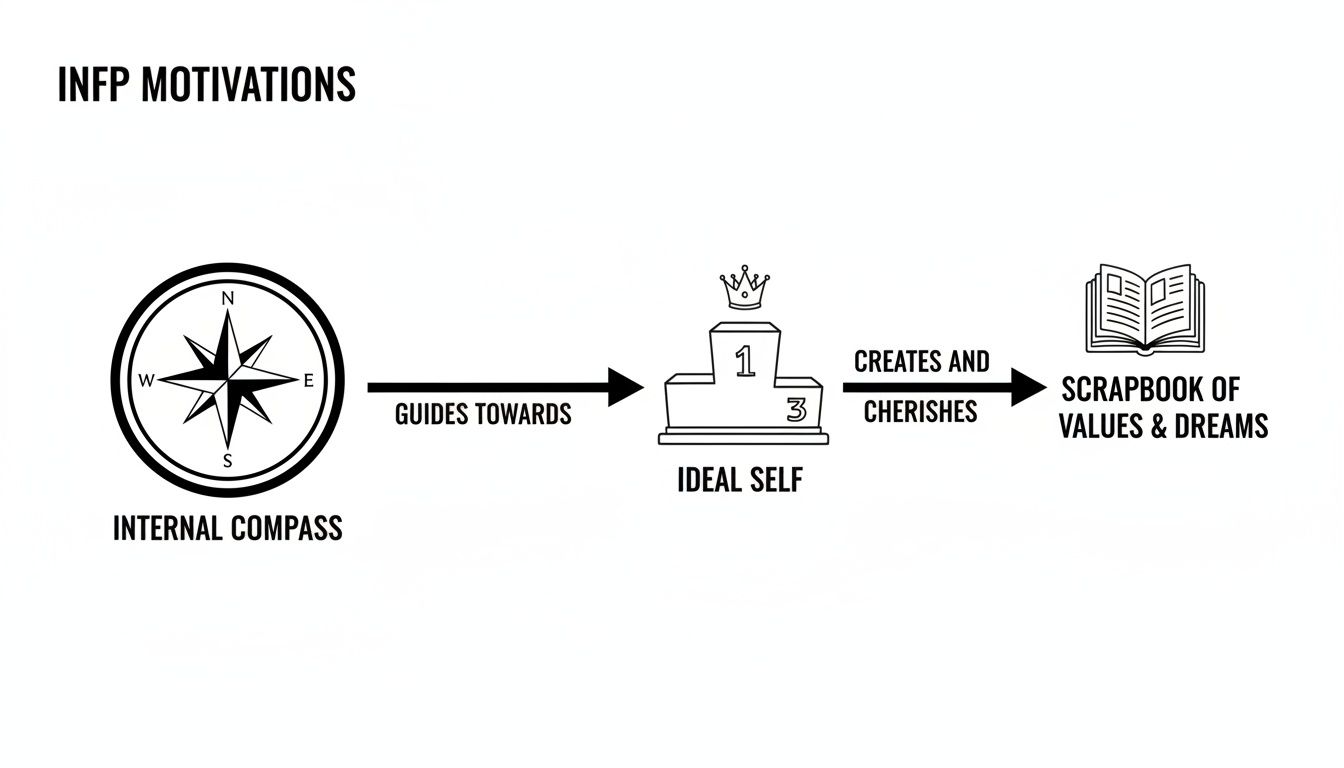
It’s this internal world that drives them to find partners who can share in their dreams, creating a collection of cherished moments and ideals together.
The NF "Come Home" Connection
Pairing up with an ENFJ, INFJ, or another ENFP can feel like a genuine homecoming for an INFP. There's an immediate sense of being seen and understood on a fundamental level, creating a powerful foundation of mutual respect.
Think about it: an INFP might have a notebook filled with a dozen beautiful, world-changing ideas but feel paralyzed when it comes to execution. Enter the ENFJ, a natural-born organizer. Suddenly, those daydreams get a to-do list, a structure, and a clear path forward. For instance, the INFP dreams of starting a community garden, and the ENFJ partner immediately starts researching local plots, organizing a volunteer sign-up sheet, and setting a budget. The INFP’s vision is not just respected; it's championed and brought into reality by the ENFJ’s get-it-done energy.
When Opposites Don't Just Attract—They Balance
While NF pairings feel like a warm hug, don't count out the "opposites attract" dynamic. A relationship between an INFP and a wildly different type can be surprisingly successful and create a beautiful sense of balance.
Take an INFP with an ESFJ, for example. The ESFJ’s focus on practical care and social harmony can be an incredibly grounding force for the INFP's dreamy, sometimes chaotic inner world. The ESFJ provides a stable anchor, reminding the INFP to tend to the here and now. In return, the INFP helps the ESFJ see a world of possibilities beyond the tangible.
It all comes down to appreciating what the other person brings to the table. You can dive deeper into how different personalities dance together in our guide on personality types in relationships .
Of course, some pairings face more natural friction. An INFP matched with a strong Thinking-Sensing (ST) type, like an ISTJ, can feel like they’re speaking different languages. For instance, an INFP might voice their hurt feelings over a canceled date, really just looking for a little emotional validation. Their ISTJ partner, wanting to be helpful, might immediately jump to logical problem-solving ("We can reschedule for Tuesday at 7 PM").
While the ISTJ’s intent is good, they completely miss the INFP’s need for empathy. This can leave the INFP feeling unheard and dismissed, turning a simple mix-up into a major emotional disconnect.
Navigating INFP Communication and Conflict
If there's one thing to know about INFPs, it's that they crave harmony. They’ll often walk on conversational eggshells just to keep the peace. Because their communication style is so deeply tied to their personal values, conflict doesn't just feel like a simple disagreement—it feels like an attack on their very soul. This makes any kind of direct confrontation feel incredibly high-stakes and stressful.
So, what do they do with all those little frustrations that pop up in any relationship? They tend to bottle them up. An INFP might tell themselves a small annoyance isn't a big deal, hoping it will just dissolve on its own. For instance, if their partner is consistently late, they might repeatedly say "it's fine" while internally feeling disrespected. But it doesn't dissolve. Instead, this pattern of avoidance creates a slow-burning resentment under the surface. Their partner might be sailing along, completely clueless that anything is wrong, until the INFP suddenly and completely withdraws.

This brings us to the infamous "INFP door slam," a hot topic in personality circles. It's often seen as a cold, out-of-the-blue rejection. But in reality, it's a desperate act of self-preservation. It’s the absolute last resort, a defense mechanism that only comes out after they feel their core values have been trampled on one too many times.
The Story of the Door Slam
Let's paint a picture. Imagine an INFP named Alex, who is close friends with Mark. For months, Mark has been making cynical jokes that chip away at Alex's deeply held beliefs about kindness and optimism. Each time it happens, Alex flinches internally but says nothing, absorbing the emotional sting and trying to convince themself it's "not a big deal."
Then one day, after a particularly harsh remark, Alex just… stops. They stop responding to Mark’s texts, stop answering calls. It’s not done out of malice. It’s a final, desperate move to protect an inner peace that has been worn down to a nub. The door slam is the quiet, final act of someone who feels they have no other way to make the pain stop.
For INFPs, learning how to handle disagreements is a non-negotiable skill for a healthy relationship. Exploring practical relationship conflict resolution strategies can help turn these painful clashes into powerful opportunities for connection and growth.
To keep things from ever reaching that breaking point, both the INFP and their partner have to learn a new way to talk to each other. The INFP has to get brave and voice their needs before resentment sets in. And their partner has to learn how to create a safe, judgment-free zone for them to open up. This is a journey, but you can find a great roadmap by improving relationship communication together.
INFP Communication Do's and Don'ts
Navigating these conversations can be tricky, but it's far from impossible. Here’s a handy cheat sheet for both INFPs and the people who love them, designed to make those vital talks more effective and a lot less scary.
| Scenario | Effective Approach (Do) | Ineffective Approach (Don't) |
|---|---|---|
| Bringing Up a Hurt Feeling | Use "I" statements to own your feelings. For example: "I felt hurt when that joke was made." | Accuse or generalize with "you" statements. For example: "You're always so insensitive and you never think." |
| Creating a Safe Space | Ask gentle, open-ended questions. For example: "I noticed you seem quiet. Is there anything on your mind?" | Demand an immediate explanation or show frustration. For example: "Why won't you just tell me what's wrong?" |
| Reading Subtle Cues | Pay attention to non-verbal signals like quietness or withdrawal and gently check in. | Ignore the signs or assume everything is fine just because they haven't complained out loud. |
Think of this table not as a set of rigid rules, but as a guide to fostering a more understanding and open dialogue. It’s all about building a bridge of communication before the chasm of resentment grows too wide to cross.
Of course, here is the rewritten section with a more human, natural, and expert tone.
Common INFP Relationship Pitfalls and How to Grow
If an INFP’s love life were a movie, they’d be the director, screenwriter, and casting agent all rolled into one. Their heart is a powerhouse of loyalty and idealism, but every hero has an Achilles' heel. For INFPs, their greatest strengths—that boundless imagination and deep desire for harmony—can sometimes lead them astray.
It’s all too easy for their powerful inner world to paint a beautiful mural right over some pretty obvious red flags. Their yearning for a peaceful connection can make them dodge conflict until it becomes an un-ignorable monster, poisoning the very relationship they tried so hard to protect.
This tendency to put partners on a pedestal is a classic challenge in INFP and relationships . They don't just fall for a person; they fall head-over-heels for the potential of that person. They craft this breathtaking vision of who their partner could be, and what their life together could look like. But when real life inevitably fails to live up to the fantasy, the fallout can be devastating for everyone involved.
The Idealization Trap
Picture this: an INFP is completely smitten with their partner's wild, artistic spirit. They're in love with the idea of this free-spirited wanderer, so much so that they conveniently ignore a glaring incompatibility. Their partner has absolutely no desire to put down roots, while the INFP is secretly sketching out blueprints for a cozy home and future family.
The INFP gets so swept up in their shared passion for indie films and late-night philosophical talks that they miss the giant, flashing neon sign that their fundamental life goals are on a collision course. It's not that they're being dense; it's their visionary superpower working a little too well. They become fiercely loyal to the dream they’ve built, sometimes more so than to the actual person standing right in front of them.
From Pitfalls to Growth
Spotting these patterns is the first step, and it’s a huge one. This isn't about killing the INFP's beautiful idealism—the world needs that light! It's about giving it an anchor in reality so it doesn't just float away. And this is where rolling up your sleeves and taking shared, practical action becomes a relationship game-changer.
For the INFP, growth means lovingly nudging yourself out of the daydream and into the "doing":
• Create a Shared Budget: • Seriously. Nothing grounds a relationship in reality faster than talking about money. It shifts the dynamic from abstract feelings to concrete, shared goals and responsibilities.
• Schedule 'State of the Union' Talks: • Set a regular, chill time to check in on how things are • really • going. This creates a safe, structured space for you to voice concerns before they have a chance to build up into resentment.
• Plan a Tangible Future Project Together: • Stop just dreaming about that trip to Italy and start a savings jar for it. Instead of just talking about moving in someday, spend a Sunday afternoon browsing apartment listings online. Make the dream real.
And if you’re the partner of an INFP, your role is to gently cheer on this growth. Never, ever mock their dreams. Instead, ask, "This sounds amazing, how can we start making it happen?" Frame these practical steps not as a buzzkill, but as the exciting, real-world adventure of building your life together, one brick at a time.
Your Practical Guide to a Thriving Relationship
So, you’re in a relationship with an INFP. Get ready for a beautiful, wild ride into a world of incredible depth, quirky daydreams, and fierce loyalty. The good news? You don’t need grand, complicated schemes to make it work. You just need to show up in a way that truly connects with their heart.
This isn’t about following a stuffy rulebook. It's about learning their language and building something real, together.

The secret to winning—and keeping—an INFP's love isn't really a secret at all. It’s all about two key things: radical authenticity and emotional validation . They need to feel, deep in their bones, that the person they are is not just tolerated, but genuinely cherished.
How to Nurture Your INFP Partner
The most powerful thing you can do is learn to appreciate your INFP in ways they can actually feel. It’s about seeing past the quiet exterior and celebrating the vibrant universe inside them.
• Don't Fix, Just Listen: • When your INFP shares a big, messy feeling or a wild idea, your first instinct might be to offer solutions. Resist! Cold logic feels like a dismissal. Instead, try saying, "Wow, I can totally see why you'd feel that way," or "Tell me more about that." This validation is like sunshine and water to their soul.
• Become a Fan of Their Art: • That sketchbook, Spotify playlist, or half-finished story isn't just a hobby—it's a piece of them. Showing genuine interest is huge. Instead of a generic "that's nice," ask, "What was going through your head when you made this?" You’re not just asking about their art; you're asking to see their world.
• Master the Art of "Alone-Together": • INFPs need a ton of alone time to process the world and recharge their batteries. When they retreat, don’t take it as a personal rejection. A practical example would be if they're quietly reading on the couch, you can just sit at the other end reading your own book. This shared quiet time provides connection without demanding interaction. A simple, "No rush, I'll be right here when you're ready to hang out again," gives them the space they need without making them feel guilty or disconnected.
At the end of the day, navigating INFP and relationships is about honoring their wonderfully sensitive and idealistic nature. Celebrate their depth, cheer on their dreams, and always meet them with your own authentic self. The reward is a partnership filled with a kind of beauty and devotion that most people only read about.
Frequently Asked Questions About INFPs in Love
Alright, let's pull back the curtain on some of the biggest questions people have about the INFP heart. Getting a straight answer can make navigating the beautiful, often confusing world of an INFP in a relationship a whole lot clearer.
Are INFPs Prone to Cheating?
Not a chance. In fact, it’s quite the opposite. INFPs are probably one of the least likely types to cheat on a partner. Their entire world is built on a deeply personal set of internal values ( Introverted Feeling ), and for almost every INFP, loyalty is a cornerstone of that foundation.
To an INFP, betrayal isn't just breaking a rule—it's like shattering their own soul. The act would go against every fiber of their being. They pour so much of themselves into creating a genuine, profound connection that the idea of a casual fling or deceit just feels… gross. It’s completely alien to how they’re wired.
How Do I Know if an INFP Likes Me?
You’ll have to become a bit of a detective, because INFPs rarely shout their feelings from the rooftops. They’re often shy and speak through actions, not grand declarations. The biggest clue? They start to unlock the door to their sacred inner world for you.
Look for these subtle, yet incredibly meaningful, signs:
• They’ll share a piece of their soul—a favorite song that feels like a diary entry, or a poem they’ve kept hidden for years.
• They listen with an almost startling intensity. They won’t just hear your words; they’ll remember the tiny details you’ve forgotten you even shared.
• They’ll show their affection creatively. Think of a man curating the perfect playlist just for you, or a woman who doodles a little sketch of something you mentioned you loved.
The ultimate tell? They trust you with their messy, vulnerable thoughts. This is a fiercely guarded space, and if they let you in, it’s the highest compliment they can possibly pay.
Can an INFP and a Thinker Type Have a Successful Relationship?
Absolutely! But it's not a "set it and forget it" kind of love. While pairing up with another Feeler (F) type might feel more intuitive, a relationship with a Thinker (T) can create an amazing, complementary balance.
The Thinker can provide a wonderful, grounding force for the INFP's dreamy nature, while the INFP can help the Thinker connect more deeply with their own emotional world. A practical example: the INFP partner is upset about a conflict at work. The Thinker partner's instinct might be to outline a 5-step solution. For this to work, the Thinker must first say, "That sounds incredibly frustrating. I'm sorry you had to deal with that." Only after validating the feeling can they gently offer, "If you want to brainstorm solutions later, I'm here." This small shift makes all the difference. The whole thing succeeds or fails on one golden rule: The Thinker must learn to validate the INFP's feelings , even when they make zero logical sense. In return, the INFP must learn to appreciate the Thinker's straightforward honesty without seeing it as a personal jab.
Ready to discover the core motivations that drive you and your partner? Take the free, scientifically-validated personality assessment from Enneagram Universe and unlock a deeper understanding of your relationship dynamics. Find your type and start your journey at Enneagram Universe .