How to Understand Yourself Better: A Practical Guide to the Enneagram Test

If you want to truly understand yourself, you have to dig into your core motivations, fears, and desires. A structured framework like the Enneagram is one of the best roadmaps I've found for this. It helps you decode why you think, feel, and act the way you do, getting way past surface-level traits to reveal your inner operating system. For example, it can explain why one person feels energized by a tight deadline while another feels paralyzed by it.
Your Journey to Self-Discovery Starts Here
Ever feel like you’re just going through the motions? Reacting to life on autopilot without a real grasp on the "why" behind your choices? You're definitely not alone. The whole quest to "understand yourself" can feel a bit vague and overwhelming, but it doesn't have to be. This guide gives you a practical path forward, using the Enneagram as a map to your unique personality.
Forget fuzzy advice. We’re about to get into the nitty-gritty of what actually drives you. The first real step is building some essential self-awareness skills —they’re the foundation for any genuine insight. By exploring your personality, you can finally connect the dots and figure out why some situations, like a lively party, light you up while others, like a quiet evening alone, leave you feeling completely wiped out.
This is a quick look at the path we're about to take.
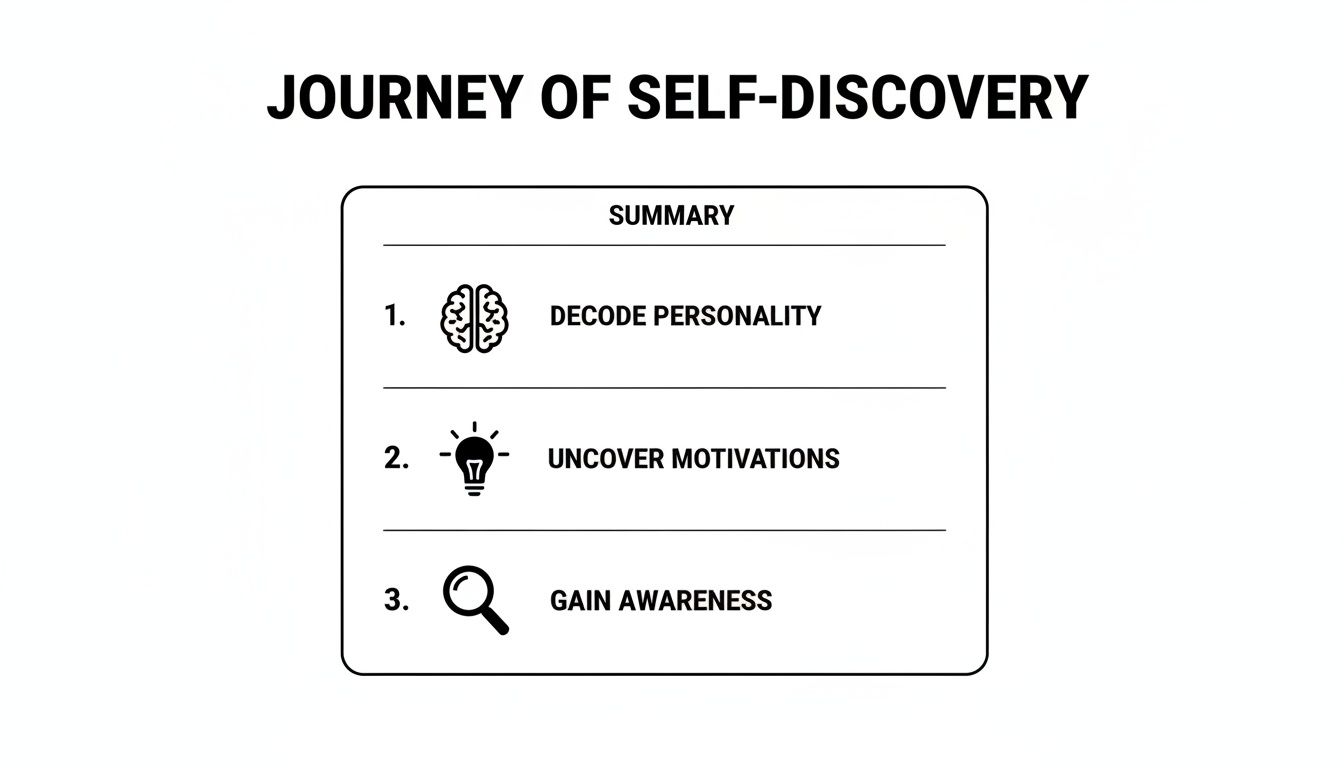
These three pillars—decoding your personality, uncovering your motivations, and gaining real awareness—all work together. They help you build a complete, honest picture of who you are.
Why a Personality Framework Matters
Let’s be clear: using a tool like the Enneagram isn't about slapping a label on yourself and calling it a day. It’s about getting a clear snapshot of your inner world. Think of it less like a box and more like a key to unlock yourself from those frustrating, repetitive patterns you can't seem to shake. For instance, you might realize your habit of over-apologizing isn't just politeness; it's a deep-seated fear of being unlovable, a pattern a framework can clearly identify.
The trick is to approach this with curiosity, not judgment. You’re an explorer here, not a critic. We have a whole article on how to cultivate this mindset, which you can read here: How to Become More Self-Aware: Tips for Self-Discove ry.
The Nine Enneagram Types At a Glance
Before we dive deep, it helps to have a quick lay of the land. The Enneagram outlines nine core personality types, each with a distinct way of seeing the world. Here's a cheat sheet of what fundamentally drives and scares each type.
| Enneagram Type | Core Desire | Core Fear |
|---|---|---|
| Type 1: The Reformer | To be good, to have integrity, to be balanced. | Of being corrupt, evil, or defective. |
| Type 2: The Helper | To be loved and wanted. | Of being unwanted or unworthy of being loved. |
| Type 3: The Achiever | To be valuable and worthwhile. | Of being worthless or without inherent value. |
| Type 4: The Individualist | To find themselves and their significance. | Of having no identity or personal significance. |
| Type 5: The Investigator | To be capable and competent. | Of being useless, helpless, or incapable. |
| Type 6: The Loyalist | To have support and security. | Of being without support or guidance. |
| Type 7: The Enthusiast | To be satisfied and content, to have their needs met. | Of being deprived and in pain. |
| Type 8: The Challenger | To protect themselves, to be in control of their own lives. | Of being controlled or harmed by others. |
| Type 9: The Peacemaker | To have inner stability and peace of mind. | Of loss and separation; of fragmentation. |
This table is just the starting point, of course. The real magic happens when you see how these dynamics play out in your own life.
For example, a massive survey of nearly 190,000 people found that Type 9, The Peacemaker, was the most common type at 16.2% . This just goes to show how many of us are driven by a deep, shared need for inner peace. Figuring out where you fit in this landscape can be a total game-changer.
So, You Want to Know Your Enneagram Type? Here's How to Actually Find It
To really get to the heart of who you are, you need a blueprint of your personality. That's where a solid Enneagram test comes in. Think of it less like a quiz and more like a tool to dig past your surface-level habits and tap into what truly drives you. This is the real starting line for your self-discovery journey.
Good, comprehensive assessments—like the ones we've developed at Enneagram Universe —are built with questions that are designed to peel back the layers. They don't just ask what you do, but why you do it. And that distinction is everything when it comes to getting an honest snapshot of your inner world.

Taking the Test (Without Sabotaging Your Results)
Here’s a pro tip: your mindset going into the test makes all the difference. Don't answer based on how you feel this week, or worse, how you wish you were. Be brutally honest. Think about your most consistent patterns over your entire life.
To get your head in the right space, mull over these big-picture questions as you go:
• Security vs. Adventure: • Have you almost always chosen the safe, predictable path, or are you the one constantly chasing new experiences and what-ifs? For example, did you stick with a stable but boring job for years, or did you quit to backpack through Europe?
• Logic vs. Emotion: • When the big decisions hit, do you instinctively reach for data and pro/con lists, or do you trust your gut and how the options • feel • ? Think about buying a car: did you research crash-test ratings for weeks, or did you just drive one and fall in love with it?
• Independence vs. Connection: • Are you most yourself when you’re standing on your own two feet, or do you thrive when you're connected with and needed by others? Do you prefer solo projects at work, or are you the first to volunteer for a team-based task?
Thinking in these broad, lifelong strokes helps the assessment zero in on your core programming, not just your current mood. When you're ready to find your starting point, you can get a better sense of what to expect and even take a free Enneagram test to get the ball rolling.
The point isn't to get a "good" type or the "right" answer. The goal is to get an honest one. Real self-understanding starts with radical self-honesty, even if the person staring back at you in the mirror feels a little unfamiliar at first.
Your Result Is a Doorway, Not a Box
Okay, you've got your result. Let’s say the test pegged you as a Type 3, “The Achiever.” Now what? This is where the real fun begins.
Your Enneagram type isn’t a label meant to box you in. It’s a key that unlocks a deeper understanding of your own operating system. It gives you a whole new language to talk about your inner world.
For example, instead of just saying, "I'm so stressed about this deadline," a Type 3 might suddenly realize, "I'm stressed because I'm terrified of failing and looking worthless to my team." See the difference? That shift—from just seeing a behavior to understanding the hidden fear driving it—is where the magic happens. Your type shines a light on the unconscious engine running your life.
This knowledge is your ticket to finally breaking those frustrating, unhelpful cycles. It gives you a clear road map for growth.
A Real-World Example: How It All Clicks
Let's talk about David, a project manager who always felt a little... all over the place. He was an absolute genius at kicking off new projects, drumming up excitement, and brainstorming big ideas. But halfway through, his focus would fizzle out as he got distracted by the next shiny new thing. His colleagues thought he was brilliant but flaky, and honestly, he just worried he was undisciplined.
Then David took an Enneagram test and discovered he was a Type 7, The Enthusiast.
It was like a lightbulb went off. His habit of bouncing between projects wasn't some deep character flaw. It was all driven by his type's core fear: being trapped in boredom and pain . His constant quest for new ideas was a subconscious strategy to keep his options open and never, ever feel stuck.
Armed with this insight, David figured out how to understand yourself better in a way that actually changed his career. He stopped beating himself up and started working with his nature, not against it. He began partnering with detail-oriented coworkers—the ones who love nothing more than seeing a project through to the finish line. This freed him up to do what he does best (innovate and inspire) while creating a support system to handle the follow-through. His whole team became more effective because of it.
So You've Got Your Enneagram Number. Now What?
Getting your Enneagram result is like being handed a surprisingly accurate user manual for your own brain. It's a fantastic starting point, but the real magic happens when you move beyond just knowing your number and start using it to make sense of your life. This is where we roll up our sleeves and turn that label into real, tangible insights that actually fuel your growth.
The first step is simply to start noticing. It's one thing to read that you're a Type 9, The Peacemaker; it’s a whole different ballgame to catch yourself agreeing to a project you absolutely dread, just to sidestep a slightly awkward conversation. True self-awareness sparks to life in those moments when you connect the dots between the description on the page and your everyday choices.

Uncover Your Patterns with Targeted Journaling
Your journal is your private, judgment-free zone to get brutally honest with yourself. But instead of just aimless writing, try using prompts designed specifically for your Enneagram type. This targeted approach is brilliant for illuminating how your core fears and desires are secretly running the show.
Here’s what I mean:
• If you’re a Type 4 ( • The Individualist • ): • "Describe a recent time you felt completely misunderstood. What was going on? What specific feelings did it bring up? Did you find yourself pulling away, or did you lean in to prove how unique you were?"
• If you’re a Type 9 ( • The Peacemaker • ): • "Think about the last time you dodged a conflict. What were you really afraid would happen if you just said what you thought? What did it cost you to keep the peace?"
This isn’t about beating yourself up. It’s about becoming a curious observer of your own mind. The more you notice your automatic reactions, the more power you have to consciously choose a different response next time.
Your Enneagram type isn't a life sentence or an excuse for bad behavior—it's an explanation. And once you have that explanation, you gain the power to write a new story for yourself.
It’s All About Your Health Levels
One of the most powerful (and often overlooked) parts of the Enneagram is the concept of Health Levels . Each of the nine types can show up in healthy, average, or unhealthy ways. This isn't a moral judgment of "good" or "bad"—think of it as a dynamic spectrum that shows your current level of emotional balance and self-awareness.
Understanding this spectrum is a game-changer because it gives you a clear road map for growth.
For instance, let’s look at a Type 5 (The Investigator) :
• A healthy Type 5 • is a wise visionary, generously sharing their brilliant insights with the world. For example, a healthy Type 5 professor might patiently mentor students, making complex topics accessible and exciting.
• An unhealthy Type 5 • , on the other hand, can become isolated and paranoid, hoarding information out of fear and detaching from reality. Think of a reclusive conspiracy theorist who cuts off contact with friends and family.
Seeing these different expressions shows you what your highest potential looks like and, just as importantly, what red flags to watch for when you’re feeling stressed or overwhelmed. It turns the Enneagram from a static label into a dynamic guide for your personal journey.
Little Steps Toward Your Healthiest Self
Awareness is where it starts, but action is what actually creates change. Once you’ve got a handle on your type’s patterns and health levels, you can build small, practical habits that gently nudge you toward your best self. This isn't about a massive personality transplant; it's about making tiny, consistent course corrections.
Let's make this real:
Diving deeper, the connections between personality systems can offer even richer insights. For example, data from Typology Central users reveals a massive overlap between Enneagram and MBTI types—a whopping 74% of INTPs identify as Enneagram 5s . This shows how different frameworks can shine a light on the same core truths from different angles. Platforms like Enneagram Universe use validated tests to map your Type, Wings, and Triads, helping you pinpoint specific strengths—like a Type 5’s innovative mind (a trait found in only 4.8% of some populations)—and put them to good use.
These small, intentional actions begin to rewire your brain over time. They are proof that you are not a prisoner of your patterns. By getting clear on your Enneagram core motivations , you can design a growth plan that works with your personality, not against it, paving the way for change that actually sticks.
Seeing Yourself Through the Eyes of Others
So far, we've been doing a lot of internal work—mapping your inner world with tools like the Enneagram and journaling. That's a huge piece of the puzzle. But let's be honest: you can't read the label from inside the jar.
Our self-perception is just one perspective. To get the whole picture, we need to understand how we actually land on other people. This is where we step outside of our own heads and invite a little external feedback.
I know, I know. Just the thought of asking for feedback can make your stomach do a little flip-flop. It sounds intimidating. But this isn't about sitting down for a scary, formal performance review. It’s about having a real conversation to shine a light on the blind spots we all have.
How to Ask for Feedback Without All the Awkwardness
The trick to getting honest, genuinely helpful feedback is to make the other person feel completely safe. You're not asking them to psychoanalyze you; you're just asking for their observations to help you on your growth journey. When people know you’re truly trying to get better, they’re almost always happy to help.
Here’s a simple script I’ve used myself and have seen work wonders. You can adapt it and send it in a quick text or email to a friend, family member, or coworker you trust.
"Hey [Name], I'm doing some personal development work right now to get a better handle on my own blind spots, and I'd really value your perspective. If you're open to it, could you share one way you think my approach to [teamwork/our friendship/solving problems] really works, and maybe one area where you think I could be more effective?"
This little script is gold for a few key reasons:
• It starts with a positive. • Kicking off by asking for a strength makes the whole thing feel balanced and constructive, not like an attack.
• It's super specific. • You aren't asking a terrifyingly vague question like, "What do you think of me?" You’re giving them a specific context.
• It’s totally low-pressure. • Phrases like "if you're open to it" give them an easy out and signal that you're receptive, not defensive.
The answers you get back can be a lightning bolt of clarity. A friend might say, "You're incredible at making sure everyone feels included, but sometimes you focus so much on keeping the peace that you forget to share what you actually want." For an Enneagram Type 9 , hearing that can change everything.
Become Your Own Anthropologist
While feedback from others is a game-changer, you can also gather incredible data just by paying closer attention to yourself. I want you to try something I call the "Pattern Spotter" exercise.
Think of yourself as a friendly anthropologist studying a fascinating new subject: you!
For one day, your only job is to notice your automatic reactions, your gut impulses, and your go-to habits. The key is to do it without an ounce of judgment. Just observe and take a mental (or physical) note. You're hunting for the real-world evidence of your Enneagram type's deep-seated drivers.
Here are a few things you might catch yourself doing:
• A Type 1 (The Reformer) • might catch themselves mentally rewriting a colleague's email to make it "better" before it's even sent. Classic inner critic, right there in action.
• A Type 6 ( • The Loyalist • ) • might realize they checked in with their boss three separate times for reassurance before sending off a big proposal. That's the core need for security playing out in real-time.
• A Type 7 ( • The Enthusiast • ) • might find themselves with four new browser tabs open, researching a fun weekend trip, right in the middle of a boring work report. A perfect example of escaping drudgery for a hit of stimulation.
When you start connecting these small, seemingly random daily actions to your type's core motivations, the theory suddenly becomes an undeniable reality. This isn't about beating yourself up; it's about gathering clear, objective proof of your patterns.
Once you can truly see a pattern for what it is, you finally gain the power to consciously choose a different response. And that, right there, is how you truly begin to understand yourself better .
Let's Talk About Other People: Using Your Enneagram Superpowers
Alright, so you’ve done the deep dive into your own head. You’re starting to see your own patterns, your triggers, and the weird little engine that drives you. But here’s where it gets really interesting. Once you understand your own programming, you start to see it in everyone else.
Suddenly, your boss’s blunt feedback or your partner’s need for constant reassurance isn’t just annoying—it’s a clue. You’re no longer just dealing with a person; you're interacting with a whole inner world, complete with its own rulebook of fears and desires. The Enneagram is basically your cheat sheet for navigating those worlds.
Every single interaction you have is a dance between two unique perspectives. Knowing the Enneagram helps you learn the steps, so you can stop stepping on each other's toes and start moving with a little more grace.
Just look at the data. A massive survey of over 88,000 people found some wild trends. For instance, 51% of Type 2s (The Helpers) reported being the happiest in their relationships. Meanwhile, Type 5s (The Investigators) topped the singles chart, with 65% flying solo. This isn't about being "good" or "bad" at relationships; it's a fascinating look at how our core wiring pulls us in different directions. You can see more of these juicy details in this breakdown of Enneagram types and their love lives .
Why You Keep Having That Same Fight
Think about a classic office drama. You have a Type 8 (The Challenger) boss—all action, no fluff—managing a Type 2 (The Helper) who thrives on connection and appreciation. It’s a recipe for disaster if they don't understand each other.
The Type 8 boss might march over and say, "This report is a mess. Do it again." To them, that's just efficient. Clear, direct, no time wasted. But to a Type 2, whose biggest fear is being unwanted or unloved, that same sentence lands like a personal attack. It feels like they are the mess.
The Type 2 might then scramble to fix things, saying, "Oh my gosh, I am so sorry, I'll do anything to make it right!" This well-intentioned response can look weak or wishy-washy to the Type 8, who values strength and conviction. It’s like one is speaking German and the other is speaking Portuguese—the intent gets completely lost in translation.
But with a little Enneagram awareness, everything can shift. The Type 8 can learn to tweak their delivery just a bit: "Hey, good start on this, but section three needs stronger data before we can send it up." The Type 2 can learn to hear direct feedback for what it is—a comment on the work, not a judgment on their worth.
The point isn't to become someone else. It's about understanding how your natural tendencies align with others, so you can communicate what you actually mean.
A Real-Life Love Story (That Used to Be a War Story)
Let’s talk about Maria and Ben. They were trapped in the dreaded "Chore War," an endless cycle of arguments about the state of their apartment.
Maria is a classic Type 1 (The Reformer). For her, an orderly home isn't just a preference; it’s a moral imperative. A sink full of dishes feels like a personal failure, a sign that she isn't good or responsible enough. The anxiety is real.
Ben, a chilled-out Type 9 (The Peacemaker), just wants harmony. He literally doesn’t see the mess that’s sending Maria into a spiral. To him, her constant reminders feel like nagging, and his default response to conflict is to withdraw and shut down. This, of course, makes Maria feel like she's doing everything alone, which cranks her frustration up to eleven. Sound familiar?
Their big "aha!" moment came when they stumbled upon the Enneagram.
• Maria’s Realization: • She saw that her anger wasn't really about the crumbs on the counter. It was her loud, relentless Type 1 inner critic telling her she was a failure if things weren’t perfect.
• Ben’s Realization: • He understood that his "laziness" was actually his Type 9 conflict avoidance running the show. He wasn’t ignoring her; he was trying to keep the peace in the only way he knew how.
This completely changed the game. Instead of launching into another fight, Maria could say, "Hey, my Type 1 brain is freaking out about the kitchen chaos. Can you help me calm it down?" Ben, now understanding the real need behind her words, was more than willing to help. They were no longer at war with each other; they were teaming up against their own worst instincts. Learning how to understand yourself better was the key that unlocked how to understand each other.
Got Questions About the Enneagram? You're Not Alone.
So you're digging into the Enneagram. Fantastic! It's a powerful tool, but let's be honest, it can kick up a lot of dust. Questions are a natural and good part of the process. This isn't about finding a neat little box to put yourself in; it's about starting a rich, and sometimes messy, exploration.
Let's tackle some of the common questions that pop up when you first start.
This whole thing is about getting clearer, not more confused. So let's clear up a few of the biggest head-scratchers so you can keep moving forward.

What if I Feel Stuck Between Two Enneagram Types?
First off, welcome to the club! This is one of the most common hurdles, and it’s actually a great sign. It means you’re not just skimming the surface. Usually, this tug-of-war happens between your core type and a strong wing, or maybe a type you’ve had to "put on" to get by in your life, especially at work.
For example, you might be a deeply creative and individualistic Type 4 , but your job as a sales manager requires you to be all about efficiency and hitting targets—classic Type 3 behavior. You're acting like a 3, but that doesn't mean it's who you are at your core.
The secret is to look past what you do and ask why you do it . What’s your deepest, most fundamental fear?
• A • Type 3 • is terrified of being worthless or without value apart from their accomplishments.
• A • Type 4 • is terrified of having no unique identity or personal significance.
See? Those motivations are miles apart. Here's a pro tip (that can feel a little uncomfortable): read the descriptions of both types when they're at their most "unhealthy." The one that makes you cringe and think, "Oof, that's a little too real," is almost always your true type. It's a brutally honest mirror.
How Can I Use My Enneagram Type for Career Growth?
Once you nail it down, think of your Enneagram type as your professional superpower. It gives you a crystal-clear map of your innate gifts and, just as importantly, the hidden tripwires that can sabotage you. This is pure strategic gold for your career.
Take a Type 7 (The Enthusiast) . They are absolute rockstars at brainstorming and kicking off new projects with a blast of infectious energy. But the nitty-gritty follow-through? Not so much.
Instead of beating themselves up about it, a smart Type 7 leans into their strength. They might team up with a detail-obsessed colleague or find a project management app that gamifies their to-do list. This frees them up to do what they do best: dream up the next big thing.
Or consider the Type 1 (The Reformer) . Their eye for quality is second to none, but they can easily drown in the quicksand of perfectionism, bringing everything to a screeching halt. A Type 1 focused on growth could start practicing "good enough" deadlines, deliberately pushing back against that relentless inner critic to keep the momentum going.
Your type isn’t your career destiny; it’s a strategic guide. Use it to find work that lights you up and to build a conscious game plan for managing the challenges that will inevitably show up.
Can My Enneagram Type Change Over Time?
This is a brilliant question because it gets right to the heart of what growth is all about. The short answer? No. Your core Enneagram type is considered fixed. It's rooted in your fundamental worldview and the coping strategies you developed as a kid.
But—and this is a huge but—your behavior, maturity, and level of self-awareness can and absolutely should change over time. In fact, that's the whole point of this work.
Think of your type as your basic bone structure; it’s not going to change. Your health, posture, and strength, however, can be completely transformed. An unhealthy Type 2 (The Helper) can become manipulative, using their "help" to make others dependent on them. But a healthy, self-aware Type 2 is a beacon of genuine empathy, empowering others freely without needing anything in return. For example, they might organize a fundraiser for a local charity not for the praise, but from a sincere desire to make a difference.
The journey isn't about becoming a different number. It’s about becoming the healthiest, most resourceful, and most vibrant version of the number you already are. This is how you really learn how to understand yourself better and create change that sticks.
Ready to stop guessing and start knowing? The journey to self-understanding begins with a clear, reliable starting point. At Enneagram Universe , our scientifically validated assessment is designed to give you that clarity, helping you uncover your core motivations and unlock your true potential. Take the free Enneagram Test and begin your journey today.