How to Manage Classroom Behavior: Proven Strategies for Teachers

Forget playing whack-a-mole with student behavior. The real magic happens when you build a classroom that practically runs itself, making good choices the easiest and most natural path for everyone. This isn't about being a strict disciplinarian; it's about being a brilliant architect.
When you shift from reacting to misbehavior to proactively designing a predictable, supportive space, you eliminate most problems before they even start. It all comes down to three foundational pillars: expectations, layout, and routines.
Build a Classroom That Manages Itself
Think of your classroom as a self-guiding system. When students know exactly what to expect, where to go, and what to do, they feel secure and can focus on learning instead of testing boundaries.
This isn’t just some pie-in-the-sky idea. Veteran teachers live by this, and the data backs it up. A 2018 study found a whopping 93% of lower secondary teachers in U.S. public schools felt confident in making their behavioral expectations clear. When you nail this from day one, you build a foundation of predictability that cuts way down on confusion and defiance.
Getting this right is a lot like understanding personality types—it gives you a roadmap to what motivates people. Getting a handle on the "why" behind student actions is a key part of many successful behavioral change strategies.
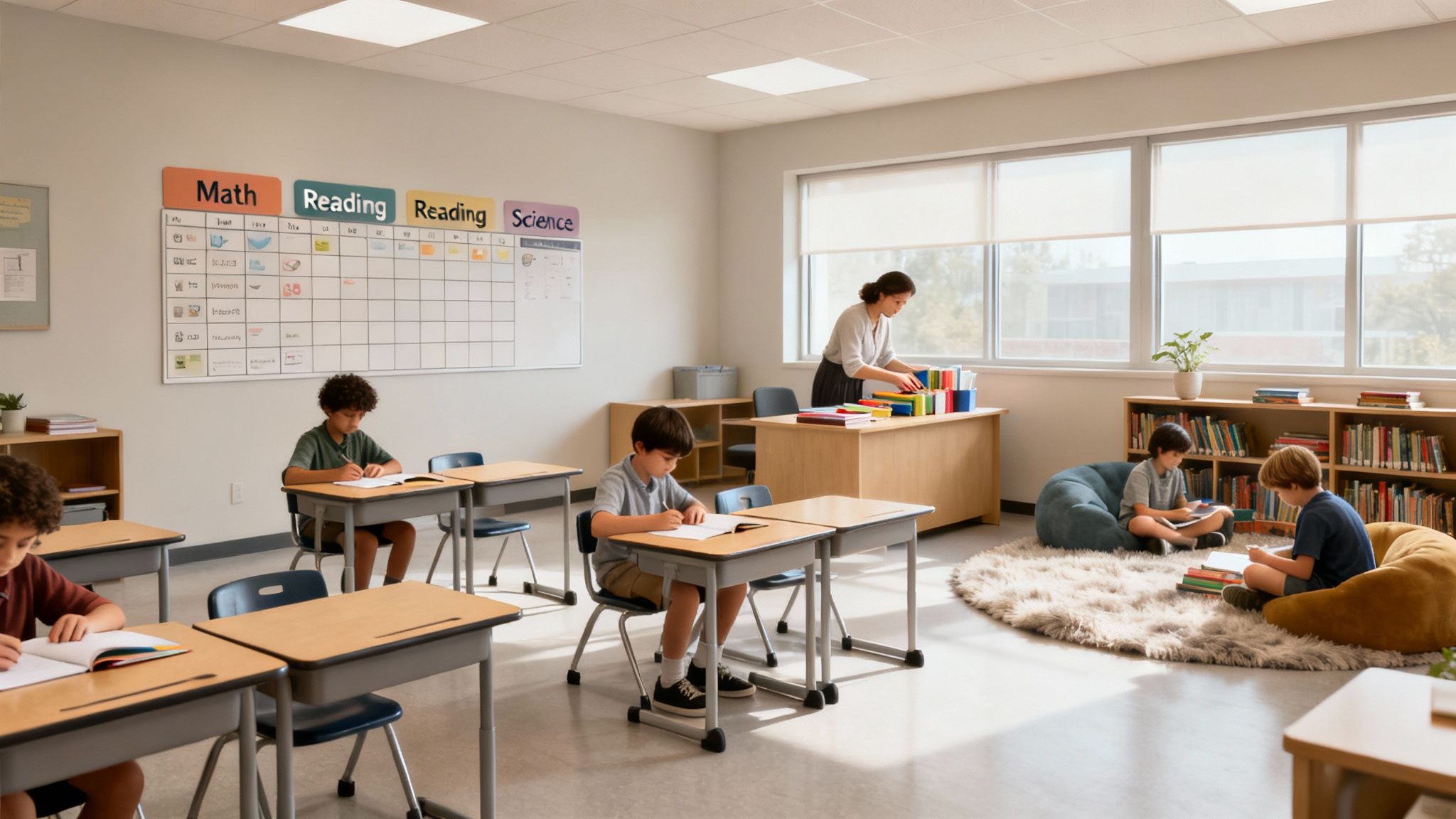
Here’s a look at how these three pillars work together to create a smooth-running classroom.
Core Proactive Behavior Management Strategies
| Strategy Pillar | What It Looks Like (Primary School) | What It Looks Like (Secondary School) |
|---|---|---|
| Clear Expectations | Co-creating 3-5 simple, positive rules like "Be Kind" and "Be Safe." Role-playing what those look like (using walking feet, sharing crayons). | Developing a "Class Constitution" or "Social Contract" together in the first week. Focus on principles like "Respect the Speaker" or "Critique Ideas, Not People." |
| Smart Layout | Designated "zones" for different activities (reading nook, art station, quiet corner). Clear, wide pathways to avoid bumping and tripping. | Seating arrangements that support the day's lesson (pods for group work, rows for direct instruction). Easy access to materials to prevent logjams. |
| Consistent Routines | A visual schedule on the wall. A specific song for cleanup time. A clear system for lining up at the door. | A "Do Now" or "Bell Ringer" on the board the second students walk in. Standardized digital and physical turn-in procedures. A non-verbal signal for asking a question. |
Building this proactive system frees up your time and energy to do what you do best: teach.
Establish Clear and Simple Expectations
Ditch the long laundry list of "don'ts." Nobody remembers them, and they just set a negative tone. Instead, work with your students to create three to five simple, positively-phrased expectations. This simple act of collaboration creates instant buy-in.
• Practical Example (1st Grade): • Instead of rules like "Don't run" or "No yelling," co-create a single powerful expectation: " • Be Safe • ." Then, act it out. Ask students, "What does 'being safe' look like with our feet?" (walking feet) and "What does it sound like with our voices?" (inside voices). This turns an abstract rule into a concrete action.
• Practical Example (8th Grade): • On day one, create a "Social Contract." Ask students to brainstorm answers to the question, "What do we need from each other to do our best work?" Common answers include "Don't interrupt" and "No put-downs." You can then reframe these into positive principles like " • Respect the Speaker • " and " • Critique Ideas, Not People • ," creating shared guideposts for the year.
Arrange Your Classroom for Success
Never underestimate the power of furniture. Your classroom's physical layout is a silent partner in behavior management. A smart setup minimizes distractions and naturally guides students toward productive work. For example, place the pencil sharpener and trash can in a low-traffic area to prevent disruptions.
Your classroom environment should be your co-teacher. Thoughtful design can prevent a significant number of common disruptions, such as talking during transitions or difficulty accessing supplies, freeing you up to focus on teaching.
Think about your space. Create clear zones for quiet work and separate areas for collaboration. Make sure you have unobstructed pathways to every student so you can offer quick, private support. For some students, especially those who need effective ADHD classroom accommodations , the right seating and workspace can make all the difference.
Create Predictable and Efficient Routines
Routines are the lifeblood of a calm, orderly classroom. They answer the universal student question, "What am I supposed to be doing right now?" This predictability eliminates the dead time and uncertainty where most misbehavior is born. Systematize everything.
Here’s how to put that into practice:
• The Moment They Arrive: • Have a "Do Now" or "Bell Ringer" on the board every single day. For example, a math class might have three review problems to solve, while an English class could have a journal prompt like, "Describe a time you felt brave." This focuses students immediately, giving them a clear task before the bell even rings and cutting out the morning chatter.
• Turning in Assignments: • Designate one specific, clearly labeled tray for each subject. This ends the chaotic wave of students asking, "Where does this go?" after every activity.
• Asking for Help: • Teach a non-verbal signal, like placing a red cup on their desk. This lets students ask for help without interrupting the flow of the class and gives you a quick visual of who needs you next.
Use Positive Reinforcement That Actually Motivates
Let’s be real for a second. That prize bin is full of plastic doodads? The sticker chart on the wall? It can all start to feel like a hamster wheel. You spend your own time and money stocking it, the kids get a fleeting thrill, and then you’re right back at square one. True motivation isn't about the prize; it's about building an internal drive and a classroom culture that just feels good to be a part of.
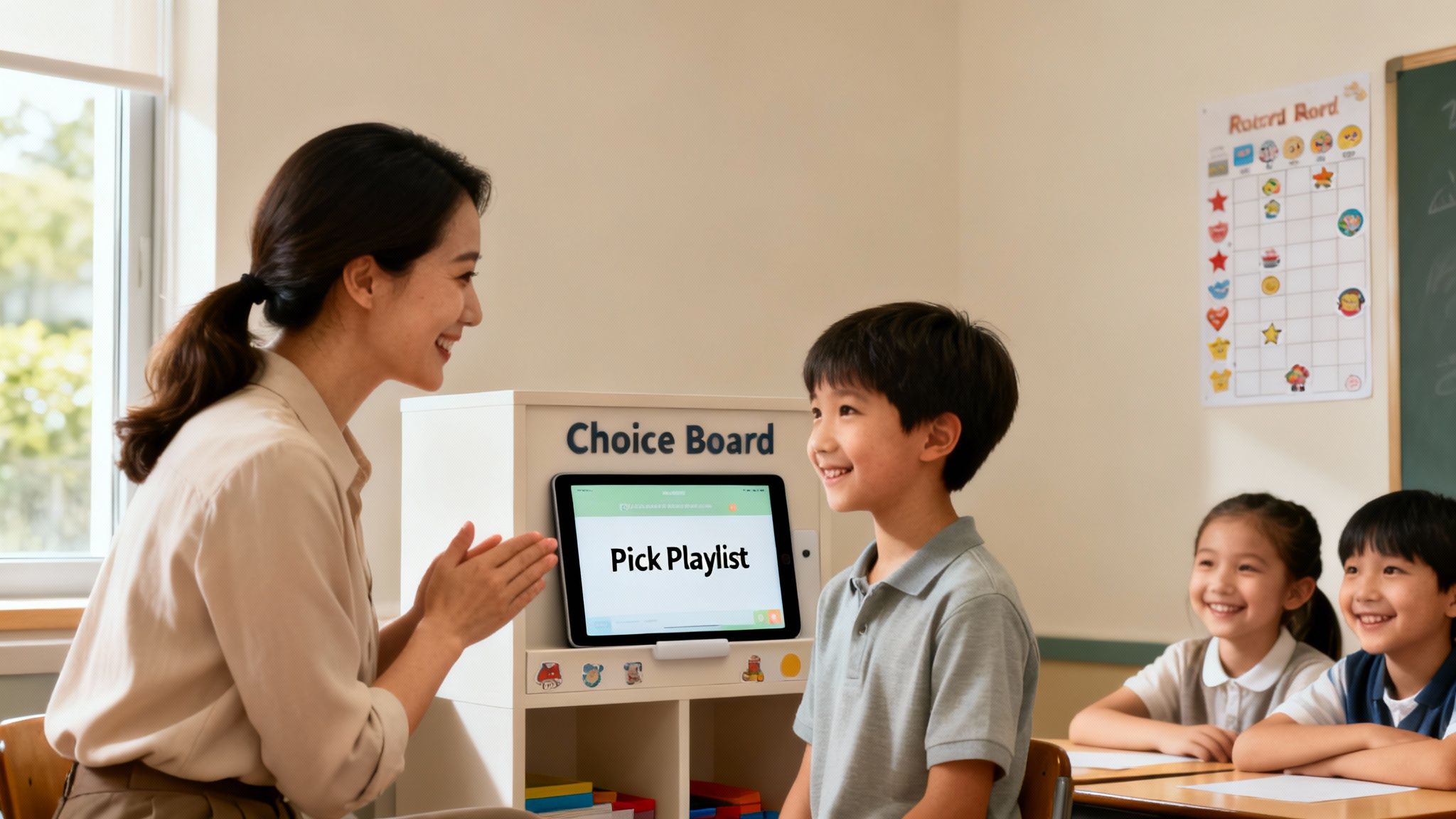
Flipping your focus from catching students being "bad" to celebrating them doing something awesome is a total game-changer. This isn't about ignoring problems. It’s about making positive behavior so genuinely rewarding that it becomes the new normal. We're aiming to move past temporary compliance and start cultivating real, honest-to-goodness self-motivation.
Go Beyond the Generic "Good Job"
The praise you give is one of the most powerful tools in your entire teaching arsenal, but only if you use it right. A vague "good job" just becomes background noise after a while. To make your words land and actually stick, they need to be specific, authentic, and laser-focused on the exact behavior you want to see again.
Think of yourself as a detective of good behavior. Instead of a blanket statement, pinpoint what a student did well.
• Practical Example (Before): • "Good job on your paragraph, Maria."
• Practical Example (After): • "Maria, I was blown away by how you used a simile to describe the storm. That one phrase painted a whole picture for me as a reader!"
See the difference? That small shift shows Maria you're really paying attention, and it gives her a clear blueprint for what excellence looks like so she can nail it again. Understanding what makes each kid tick is a huge part of this; you can dig deeper into this with our guide on how to motivate students to really tailor your approach.
Offer Rewards That Actually Resonate
As kids get older, those little tangible prizes can start to feel a bit childish and often lose their magic. I've found that the best rewards are often experiences or privileges that give students what they crave most: a little autonomy, some choice, and well-deserved recognition.
The most effective rewards aren't always things you can hold in your hand. They are often opportunities that build trust, grant responsibility, and acknowledge a student's growing maturity and unique interests.
Try mixing in some of these creative, non-tangible rewards. They work wonders, especially with middle and high schoolers:
• DJ for a Day: • The student who shows exceptional focus all week gets to create and play a school-appropriate playlist during independent work time on Friday.
• First-Choice Seating: • Let students who crushed a class goal pick their seats for the next unit. The power!
• "Teach the Teacher" Time: • Give a student who has totally mastered a concept 5 minutes to teach a mini-lesson to the class or a small group. You’ll be amazed at the confidence boost.
These rewards tap into social and personal drivers that are way more powerful than a piece of candy ever could be.
Gamify Good Behavior with a Little Teamwork
One of the most powerful ways I've ever found to boost positive behavior is to turn it into a team sport. This is where a simplified version of The Good Behavior Game (GBG) comes into play. It’s a research-backed strategy that transforms your class into a collaborative unit all pulling for the same goal.
The Good Behavior Game has been around since the 1960s and has an absolutely stunning track record. A rigorous 2008 trial showed it drastically cut down on aggressive and disruptive behavior. Get this—it even reduced the need for special education services by 50% by the time students hit eighth grade.
Ready to try it? Here’s how you can roll out a classroom-ready version tomorrow:
This simple game completely shifts the classroom dynamic. Instead of you being the only rule enforcer, students start encouraging each other, creating this awesome wave of positive peer pressure and shared accountability.
Master Calm and Effective Correction Strategies
Let's be real. Even if you’ve built a classroom that runs like a Swiss watch, with perfect routines and an endless supply of high-fives, you're still going to have to redirect a student. Kids are kids, after all. The magic isn’t in preventing every little misstep; it’s in how you handle it.
How you navigate these moments is everything. It’s the difference between a minor blip on the radar and a full-blown classroom meltdown that derails the entire lesson.
The goal is never to dominate, shame, or win a battle of wills. It’s to de-escalate, teach, and get everyone back to learning with as little friction as possible. To do that, you need a toolkit of strategies that are calm, respectful, and—most importantly—actually work.
The Power of Going Private, Quick, and Quiet
One of the fastest ways to turn a small problem into a big one is to put a student on blast in front of their peers. Calling a kid out from across the room is a rookie mistake. It’s embarrassing for them (which often triggers a defensive, "you're-not-the-boss-of-me" reaction) and slams the brakes on everyone else's learning.
This is where the "private, quick, and quiet" method becomes your absolute secret weapon.
Here's the play-by-play:
• Private: • Walk over to the student’s desk. Don't just loom over them—that’s intimidating. Kneel or squat down so you’re at their eye level. This simple change in posture transforms the interaction from a confrontation into a quiet conversation.
• Quick: • Keep it short and sweet. We’re talking a sentence or two, max. This isn’t the time for a lecture on life choices. The goal is redirection, and the longer you talk, the more you disrupt the class.
• Quiet: • Use a low, calm voice. Almost a whisper. This does two things beautifully: it preserves the student’s dignity by keeping the correction between you and them, and it keeps the rest of the class from getting distracted.
This little technique is a game-changer. It shows the student, "I see what's happening, I need you to make a change, and we're going to handle this together without making a big scene." It’s all about respect.
Word-for-Word Scripts for When You're Put on the Spot
Knowing exactly what to say when a student is off-task can be tough, especially when you’re trying to juggle ten other things. Having a few go-to scripts in your back pocket means you can respond calmly and consistently, without having to think on your feet.
The formula is simple: state what you see, then state what you need to see. No judgment, no emotion.
Let's walk through a couple of classic classroom moments.
Scenario 1: The inevitable student-on-their-phone situation.
• Don't say this: • "Kevin, put that phone away right now! I'm not going to tell you again!" (This is a direct challenge and practically begs for a power struggle.)
• Try this instead (Private, Quick, Quiet): • Casually walk over to Kevin's desk, get down to his level, and say quietly, "I see your phone is out. I need it to be in your backpack so you can focus on the lab. Thanks." Then, simply walk away. Give him the space to make the right choice.
Scenario 2: The chatty duo during independent work.
• Don't say this: • "Sarah and Emily, is it really that hard to understand what silent reading means?" (Sarcasm feels good in the moment, but it just breeds resentment.)
• Try this instead (Private, Quick, Quiet): • Approach their desks. "Ladies, I hear you talking. Right now is for quiet work. You’ll have time to chat when the timer goes off in ten minutes."
These scripts are direct, non-confrontational, and all business. They sidestep the battle of wills and put the focus back on the expectation.
"When addressing off-task behavior, acting sooner rather than later prevents negative feelings from festering. However, research shows that punishing students in front of their peers has limited value. A private conversation is almost always more effective."
Fine-Tuning Your Approach for Different Personalities
Here’s where the art of teaching really comes in. Just like a "one-size-fits-all" reward system falls flat, so does a generic approach to correction. The teachers who truly master their craft know that what works for one student might completely shut another one down.
You don't need a Ph.D. in psychology, but having a basic understanding of what makes different kids tick can be incredibly powerful. Thinking about their core drivers helps you frame your correction in a way they’re far more likely to hear and accept.
Here's a quick cheat sheet on how you might tweak your language:
| If Their Core Driver Is... | Try Framing the Correction Like This... |
|---|---|
| A need to be fair and good | Appeal to their integrity. "Your actions aren't matching up with the class agreement we all made. I need you to help us get back to our plan." |
| A need to be helpful and liked | Frame the behavior's impact on others. "When you call out, it makes it hard for your classmates to share their own ideas. Can you help me make sure everyone gets a turn?" |
| A need to be successful and valued | Connect the correction to their personal goals. "This distraction is getting in the way of you producing the awesome work I know you're capable of. Let's get refocused." |
| A need to be unique and understood | Acknowledge their feelings first. "I can see you're feeling frustrated right now. Let's take a quick break, and then we can tackle this assignment together." |
This isn't about manipulation; it's about connection. This nuanced approach shows students you see them as individuals, not just another name on a roster. It turns a simple correction into a moment of personalized coaching, guiding them back on track while actually strengthening your relationship. That's how you build a classroom where respect is the air everyone breathes.
Get to the “Why” Behind Behavior with the Enneagram
Do you ever feel like you're playing whack-a-mole with classroom behavior? You finally crack the code for one student, but the same strategy makes things worse with another. It’s maddening. But here's the thing: you're not failing. You're just working with kids who are wired completely differently.
Most of the time, disruptions aren't about a kid wanting to make your life difficult. They're about a deeper, unmet need or a core fear that's driving them to act out.
This is where a little personality insight can feel like finding a secret map. The Enneagram, a tool that outlines nine core personality types, is a fantastic way to start understanding the "why" behind what your students do. It’s not about labeling kids or stuffing them into boxes. Think of it as a lens that helps you see what truly motivates them, giving you the clarity to manage your classroom with more empathy and a whole lot more success.
Connect Actions to Core Motivations
The Enneagram framework suggests that each personality type is driven by a deep desire and a corresponding fear. For instance, a student who is a "Type Eight" is wired to be in control of their own world. When they challenge your authority, it's often not about disrespecting you—it's about protecting their own sense of autonomy.
On the flip side, a "Type Four" student's greatest fear is being insignificant or misunderstood. They might withdraw or seem completely disengaged if they don’t feel seen. For them, emotional connection is everything.
When you start to see these patterns, you can stop reacting to the surface behavior and start responding to the need that's fueling it. If you're new to this whole idea, you can get a great overview of what the Enneagram is and how it works to see how it can be a game-changer in your classroom.
This empathetic approach—understanding the why —is perfectly captured in how we should handle corrections.
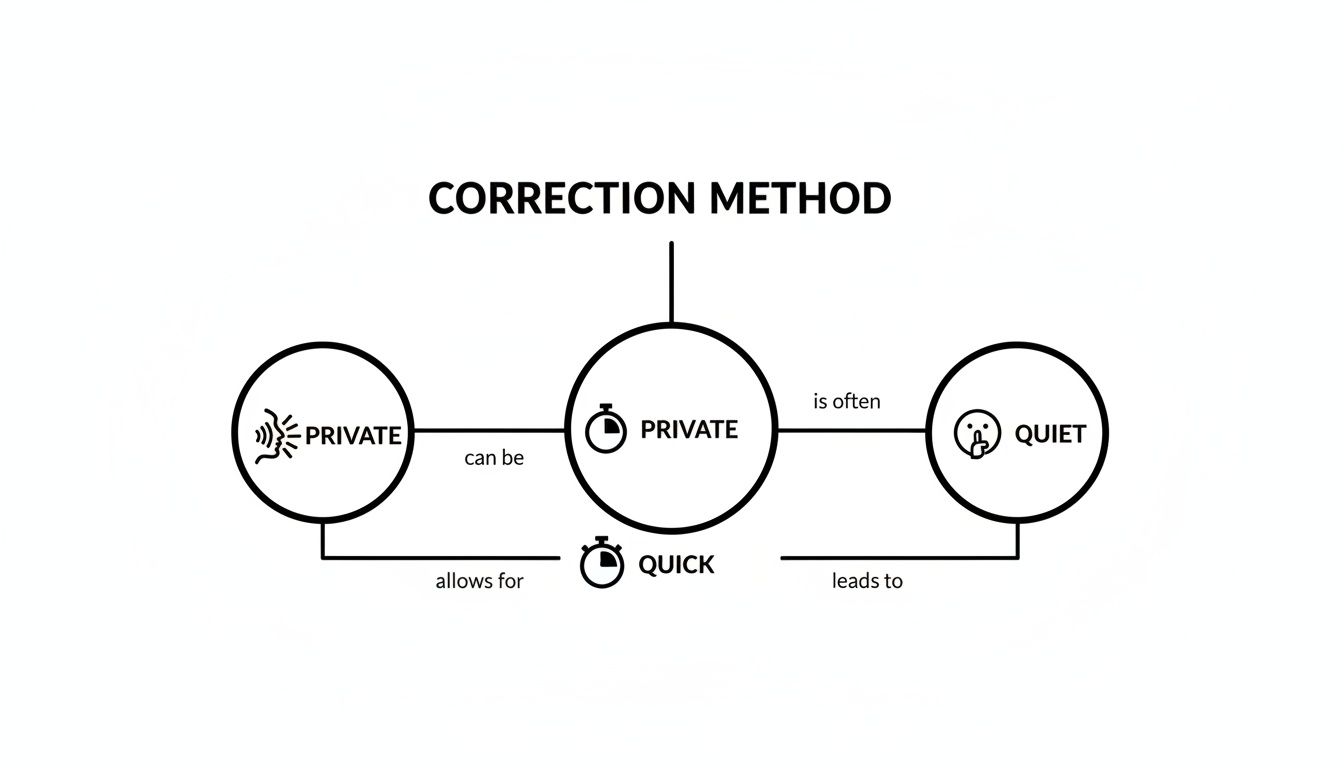
As the diagram shows, keeping corrections private, quick, and quiet is a universal strategy that preserves a student's dignity, no matter their personality type. It’s about correcting the action without crushing the kid.
Fine-Tuning Your Strategies for Different Kids
Once you start spotting these core motivations, you can move away from a one-size-fits-all discipline plan and start building something far more effective. You don't need to become an armchair psychologist overnight. It's about using these insights to build stronger relationships and guide students with more intention.
Understanding a student’s underlying motivation transforms behavior management from a power struggle into a partnership. When a student feels seen and understood, their willingness to cooperate and engage increases dramatically.
Let’s get practical. Here’s what this can look like in real life:
• Practical Example for the Quiet Investigator (Type Five): • This student’s big fear is being overwhelmed or incapable. Pushing them to speak up in a big group is their nightmare. Instead, give them a moment to process. Try saying, "Liam, I'd love to hear what you think about this after you've had a minute to jot down your ideas." This respects their need for preparation and gives them the space to shine.
• Practical Example for the Natural Helper (Type Two): • This kid is all about feeling wanted and appreciated. If they’re chatting with their neighbor, they might genuinely be trying to help them with the assignment. You can redirect that amazing impulse. "Ava, your energy is fantastic! Could you be my official materials manager for this activity?" You've given them a job that fulfills their need to be helpful • and • gets them back on track.
• Practical Example for the Anxious Loyalist (Type Six): • This student thrives on security and predictability. When they act out, it's often a sign of anxiety. Clear routines are their best friend. Reassuring them about what’s coming next can head off a lot of issues. A simple, "Don't forget, after this quiz, we have that fun review game we talked about," can ease their worries and keep them focused.
Enneagram-Informed Behavior Management Approaches
To get you started, here’s a quick guide showing how you might tailor your approach for a few common Enneagram types you’ll likely see in your classroom.
| Enneagram Type | Potential Challenging Behavior | Effective Management Strategy |
|---|---|---|
| Type 1 The Perfectionist | Becomes rigid, anxious, or critical of others (and self) when things aren't "right." | Praise their effort, not just the outcome. Frame mistakes as valuable learning opportunities to ease their fear of imperfection. |
| Type 7 The Enthusiast | Gets distracted easily, rushes through work, and may disrupt others to avoid boredom. | Build choice and variety into assignments. Use timers for short, focused work bursts followed by a brief, fun break. |
| Type 9 The Peacemaker | May "zone out," procrastinate, or become passive-aggressive to avoid conflict or pressure. | Use low-pressure check-ins. Ask, "What's one small step you can start with?" to help them get moving without feeling overwhelmed. |
A few types round out the picture:
| Enneagram Type | How It Can Show Up in Class | What Tends to Help |
|---|---|---|
| Type 3 The Achiever | Competitiveness, image-management, difficulty admitting they don't understand something. | Praise effort and honesty over just being right; give low-stakes ways to ask for help. |
| Type 4 The Individualist | Big emotional reactions, feeling singled out or misunderstood, disengaging when they feel "different." | Validate the feeling before redirecting behavior; give room for individual expression in assignments. |
| Type 8 The Challenger | Testing authority, pushing back on rules, taking charge of group work whether asked to or not. | Give them real responsibility and a say in decisions — resistance often drops when they feel respected, not controlled. |
This isn't about perfectly typing every student. It's about broadening your toolkit and remembering that there's always a reason behind the behavior—and when you find that reason, you've found the key to helping them succeed.
Build Strong Partnerships with Parents and Staff
Let's be real: you can't manage a classroom from an island. The teachers who truly master their craft know that their biggest asset isn't a new app or a fancy sticker chart—it's their network. When you, a student's family, and your school colleagues are all rowing in the same direction, you create a powerful, consistent environment where kids feel secure and can actually flourish.
This isn't just about making that dreaded phone call home when things go sideways. It’s about building a genuine team, and that takes effort.
Building this team means being proactive. Your goal is to lay down a foundation of trust and open communication before the first major issue pops up. Doing so turns a potentially tense conversation into a collaborative brainstorming session.
Start with the Positive
Here’s a golden rule I learned the hard way: make sure your first contact with a parent is a good one. Don't let their first-ever call from you be about a problem.
I make it a personal mission to send a positive note, email, or make a quick, happy phone call for every single student within the first month. It completely flips the script. It tells parents you see their kid—the whole kid, not just the misbehavior.
• Practical Example (Quick Email): • "Hi Mr. and Mrs. Davis, I just wanted to reach out and say what a joy it is to have Alex in my class this year. His creative approach to our science project today was fantastic, and he was so helpful to his teammates. I'm really looking forward to the rest of the year with him!"
Think of it as building up a "goodwill bank." When you eventually need to discuss a challenge, that parent already knows you're an ally, not just someone calling to complain.
Frame Conversations as a Partnership
When it's time to talk about a tough behavior, the words you choose are everything. Ditch any language that sounds like an accusation. The goal is to get them on your team, not put them on the defensive.
"Hi [Parent's Name], I'm calling because I've noticed [student's name] has been having a tough time with [specific, observable behavior], and I was hoping we could partner up to figure out how to best support them. You know them better than anyone, so I'd love your insight. Have you noticed anything similar at home?"
This approach immediately signals that you're in this together. Nailing down effective parent communication strategies is absolutely critical for turning these interactions into real wins for the student.
Loop in Your School Support Staff
Remember, you are not alone. Your school's counselor, social worker, and administrators are your built-in support crew. But to make their help count, you have to bring them more than just a vague complaint like, "Liam is being disruptive."
Get ready for those meetings by bringing concrete, objective information.
• Behavior Tracking: • Show them a simple data sheet tracking how often a behavior happens and when (e.g., "happens • 5-6 • times a day, mostly before lunch").
• Quick Observations: • Jot down what was happening right before and right after the behavior. Who was involved? What was the task?
• Interventions Tried: • Make a quick list of the strategies you’ve already used and what the result was.
Walking in with this kind of data shows you've done your homework. It helps your support staff spot patterns and suggest targeted, effective interventions right away. It transforms a frustrating dead-end into a strategic plan, ensuring that student gets the multi-layered support they truly need.
Answering Your Toughest Classroom Behavior Questions
Let’s be real. Even with the perfect system, teaching is full of curveballs. You’re going to have those days that leave you scratching your head, wondering, "Okay, now what?" This is your go-to guide for those moments. We’re tackling some of the most common, and toughest, questions I hear from teachers about managing classroom behavior.
"I'm a New Teacher and I'm Drowning. What's the First Step?"
If you're feeling completely underwater, take a deep breath and simplify. Forget trying to master twenty different strategies at once. Just focus on one thing: building positive relationships .
Seriously, that's it. Pick two or three students who seem a little distant or tricky and make it your personal mission to connect with them. Ask about their favorite video game, the music they're listening to, or what they did over the weekend. A simple, non-academic chat shows you see them as a person, not just a student. These small deposits of goodwill build a foundation of trust that makes every other management strategy 10 times more effective.
"What Do I Do About the One Student Who Derails My Class Every Day?"
We’ve all been there. When one student’s behavior consistently hijacks the learning environment, it’s time to put on your detective hat. The trick is to stop reacting to the disruption and start digging for the root cause.
Your best friend here is data. Start by quietly tracking the behavior with a simple ABC chart—it’s a lifesaver.
• Antecedent: • What was happening • right before • the disruption? (e.g., you asked the class to start independent writing, a tough math concept was introduced).
• Behavior: • What did the student • actually • do? (e.g., started drumming their pencil loudly, yelled out a random comment).
• Consequence: • What happened • immediately after • ? (e.g., classmates giggled, you gave a redirection, they got sent to the hallway).
More often than not, a clear pattern will emerge from your notes. Maybe the behavior is a cleverly disguised cry for academic help, a way to escape a task they find overwhelming, or just a bid for attention from their friends. Once you have a working theory, you can try a targeted intervention, like offering a pre-planned break before writing time or checking in with them just before a tricky assignment begins.
"When Is It Time to Call for Backup?"
Knowing when to escalate an issue to your admin is a critical skill, not a sign of failure. It's time to make that call when you've hit one of these three thresholds:
When you do escalate, bring your documentation. Walking into that meeting with your ABC charts, parent contact log, and a list of the interventions you’ve tried is a game-changer. It shifts the conversation from "I can't handle this student" to "This student needs a higher level of support than I can provide in my classroom alone."
And if you’re feeling like you need more support, you are far from alone. A 2022 Brookings survey found that only one-third of U.S. principals believe their teachers are adequately trained in classroom management. The same study revealed that a staggering 68% of teachers are asking for more behavior management training, showing a massive need for better tools and support. You can dive deeper into these findings on teacher preparedness to see the bigger picture. Answering these questions is a huge part of the ongoing mission to figure out how to manage classroom behavior for every single student, every single day.
At Enneagram Universe , we believe that understanding the 'why' behind behavior is the key to unlocking potential. Our scientifically validated Enneagram assessment helps you discover the core motivations that drive you and your students. Start your journey of self-discovery and build stronger, more empathetic classroom connections today at Enneagram Universe .