How to Fix a Codependent Relationship: Practical Steps to Reclaim Your Life

Before you can fix anything, you have to know what's broken. When it comes to relationships, codependency is one of those sneaky problems that often masks itself as love and devotion. The first, and honestly, the hardest step is learning to spot it in your own daily life. It’s about catching those moments where you sacrifice your own needs for your partner, feel an overwhelming responsibility for their feelings, and realize you've kind of... disappeared.
This is where you start rebuilding boundaries and fostering genuine, mutual respect .
Are You Stuck in a Codependency Trap?
Do you ever feel like you're navigating a minefield, constantly tiptoeing around your partner's moods? Or does their happiness feel like a full-time job you can never clock out of? If you just nodded along, you might be caught in the codependency trap. This isn’t about being "too nice"; it's a deeply ingrained pattern of self-sacrifice that, ironically, ends up suffocating the very relationship you're trying so hard to protect.
Let's ditch the clinical jargon for a minute and look at what this actually feels like through the eyes of a fictional American couple, Maya and Ben from Chicago.
A Day in the Life of Codependency
Maya’s been dreaming about her pottery class all week. It’s her one chance to get her hands dirty and her mind clear. But the second Ben walks through the door, looking like he wrestled a bear and lost, her plans vanish. One look at his slumped shoulders, and she’s already canceling. “He needs me,” she tells herself. “I can’t just leave him when he’s upset.”
Meanwhile, Ben is paralyzed by the task of choosing a new TV. He’s been researching for an hour, but he can’t pull the trigger without Maya. His thoughts are a frantic loop: “What would Maya want? I should just wait for her. I’ll probably pick the wrong one anyway.” He feels totally adrift without her stamp of approval, and she feels the crushing weight of being his designated decision-maker for everything.
This little snapshot shows how codependency chips away at your sense of self. It's not a simple one-way street of a "giver" and a "taker." It’s a tangled dance where both partners end up losing a crucial piece of who they are.
Key Takeaway: Codependency is often fueled by a quiet, internal script that says, "If I just try harder, they will be happy," or "I can't possibly function without their approval." This mindset is a direct line to anxiety and, eventually, a whole lot of resentment.
If any of this feels uncomfortably familiar, you're in good company. These patterns are incredibly common. Some experts estimate that up to 90% of Americans exhibit codependent behaviors to some degree. While minor traits are almost universal, a 1999 study found that nearly half of college students showed moderate to high levels of codependency. Often, these traits are rooted in childhoods where we learned that keeping others happy was the best way to keep the peace. You can dig deeper into the research with this analysis of codependent relationships .
Codependent Habits vs Healthy Support
It's easy to confuse codependent habits with genuine support, especially when you're in the thick of it. This quick comparison can help you start telling the difference.
| Codependent Pattern | Healthy Support Example |
|---|---|
| Canceling your plans whenever your partner is upset. | "I see you've had a rough day. Let's talk about it as soon as I get back from my class." |
| Feeling responsible for "fixing" their bad mood. | "I'm sorry you're feeling down. Is there anything I can do to support you?" |
| Needing their approval before making personal decisions. | "I'm thinking of buying this TV. What are your thoughts?" |
| Ignoring your own feelings to avoid conflict. | "I feel hurt when you say that. Can we talk about it?" |
| Making excuses for your partner's poor behavior. | "I don't like how you spoke to me earlier. It's not okay." |
Seeing the patterns on paper can be a real eye-opener. It’s not about blame; it’s about clarity.
The Most Common Warning Signs
Learning to spot these red flags is your first real superpower in this journey. The sooner you see them, the easier it is to stop them from becoming permanent fixtures in your relationship.
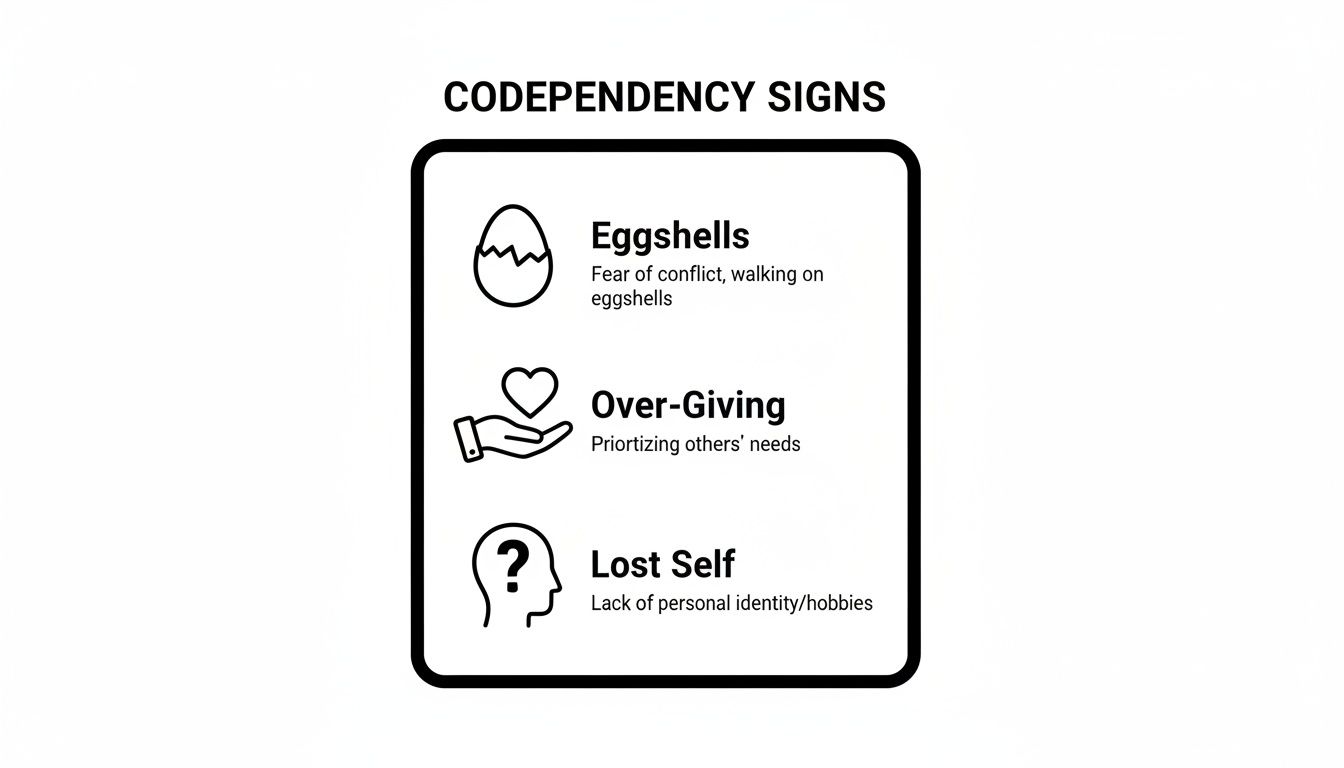
These signs aren't just quirks; they're symptoms of a dynamic that erodes your autonomy and turns your relationship into a source of stress instead of strength. Acknowledging them isn't an admission of failure. It's the "aha!" moment that finally opens the door to creating a healthier, more balanced connection—one where both of you can thrive, together and apart.
So, Why Are We Like This? Let’s Dig into the Past
Have you ever wondered why you feel this compulsive need to "fix" your partner's problems, even when it leaves you feeling completely drained? It’s like a magnetic pull. That intense urge to manage, control, and put yourself last isn't just a random personality quirk; it's almost always a behavior learned long ago. To really start fixing a codependent relationship, you have to play detective in your own life story and figure out where these patterns first took root.
Often, these habits are hammered into us during a tough childhood. If you grew up around addiction, chronic illness, mental health issues, or even just subtle emotional neglect, you might have been hardwired to be a caretaker. You learned, very early on, that your sense of safety depended on your ability to manage the emotions and actions of the people around you.

Your Relationship "Software"
Think of those early experiences as the original software programmed into your brain. This "emotional software" starts running your relationships long before you even realize you have a choice in the matter. Were you the responsible one? The peacemaker? The stand-in therapist for a parent? These roles felt necessary to survive back then, and now they've become your default setting in adult partnerships.
Let’s look at a practical example. We'll call them Sarah and Tom, a couple from Austin. Tom gets completely baffled by Sarah’s spiraling anxiety whenever he’s having a stressful day at work. She doesn't just offer a listening ear; she jumps into full-on "fix it" mode, dishing out unsolicited advice and getting genuinely upset if he doesn't take it. For Tom, it feels smothering. For Sarah, it feels like she’s showing love.
The source code for this behavior is buried in Sarah's childhood. Her father was an alcoholic, and as a little girl, she became an expert at reading his moods. She was the family's tiny emotional barometer, always trying to keep things calm and manage the chaos. Now, as an adult, Tom's everyday stress triggers that same old programming. She isn't just reacting to his bad day; she's re-living a deep-seated fear that if she doesn't control the situation, something awful will happen.
This isn't about blaming your parents or your past. It's about finally understanding why you do what you do. Once you get the "why," you can start making conscious choices to change the "how."
The link between family addiction and codependency isn't just a theory; the numbers are pretty jarring. One in-depth codependency study found that among women with codependent traits, 34.1% had a first-degree relative with alcoholism. That's a massive leap compared to just 1.7% in the general population. It’s a powerful reminder of how these patterns get passed down through generations.
Practical Ways to Explore Your History
Okay, so digging into all this doesn't have to feel like a heavy, daunting task. You can actually make it a process of discovery, something that builds empathy between you and your partner. The whole point is to connect the dots from your past experiences to your present actions.
Here are a few ways to get started, either on your own or together:
• Journal About Your Family "Job": • Spend 15 minutes just writing freely about the role you played in your family growing up. Were you the hero? The troublemaker? The invisible kid? The funny one? How did that role help your family function, and how is it popping up in your relationship today?
• Draw an "Emotional Family Tree": • Sketch out a simple family tree. Next to each person's name, jot down the main emotions you associate with them (e.g., "Dad - angry, distant," "Mom - worried, sad"). Talk about how the emotional weather in your home shaped how you show—or hide—your own feelings now.
• Share a Defining Memory: • Each of you can share one or two key memories from childhood that you feel really cemented your sense of responsibility. For example, you might recall a time you had to comfort your mother after a fight with your dad, feeling like it was your job to make her feel better. The goal here is just to listen, without judgment, and try to see the world through your partner's younger eyes.
Getting a handle on these deep-seated roots is a huge step forward. When Sarah understands why she feels that frantic urge to manage Tom's stress, she can finally start to separate her past fears from her present reality, she can learn to be supportive without taking ownership of his problems, finally breaking a cycle that’s been running on autopilot for her entire life.
Rebuilding Your Identity Outside the Relationship
So, we've done the detective work on your past. Now for the fun part—actually getting back in the driver's seat of your own life.
Here's a little secret about healing codependency: it has surprisingly little to do with changing your partner. It has everything to do with rediscovering you .
For what feels like a lifetime, your identity has probably been tangled up in being the "helper," the "fixer," or the designated "peacemaker." It's time to re-introduce yourself to the person you are when you're not auditioning for a supporting role.
This journey starts by getting really, really comfortable with boundaries.
The word "boundary" gets a bad rap. It sounds like you're building a fortress. I prefer to think of it as installing a front door with a doorbell. You still get to decide who comes in and when they can visit, but it's a lot friendlier than a moat. Learning the art of setting healthy boundaries to reclaim your life is the first, most crucial step toward creating a new, healthier dynamic.
Defining Your Personal Space
Boundaries aren’t just about the big, dramatic "no." They're subtle, and they come in a few different flavors. Getting familiar with them is the first step toward actually using them.
Let's break down the big three.
• Emotional Boundaries: • This is where you draw a line between your feelings and someone else's. It’s the powerful realization that your partner’s bad mood, anxiety, or frustration is • theirs • to manage, not yours to absorb and fix. You can be supportive without drowning alongside them.
• Time Boundaries: • Your time is your most precious, non-renewable resource. This is about fiercely protecting the things that fill your cup, whether that’s a weekly yoga class, a phone call with your sister, or just an uninterrupted hour to stare at the ceiling.
• Physical Boundaries: • This can be as simple as saying, "I need a little space right now," when you're upset or not in the mood for a hug. It’s all about honoring your body’s need for autonomy and comfort.
Let's look at a practical example. Mike's entire weekend used to be dictated by his partner Jessica's emotional state. If she woke up feeling down, his plans were toast. He was "Jessica's caretaker" before he was Mike.
Finally, he decided to set a small time boundary. He had always loved hiking in the nearby state park, but hadn't gone in years. He told Jessica, "Every Saturday morning, from 8 AM to noon, I'm going to be out on the trails. This is something I really need for myself."
The first couple of weekends were... tense. Jessica felt abandoned. But Mike held his ground, kindly but firmly.
And then a funny thing happened. Mike started coming home from his hikes buzzing with energy, more confident. He had stories to share that had nothing to do with their relationship. This one small act of reclaiming his time began to rebuild his sense of self, which, in turn, made him a more present and less resentful partner. He was becoming his own person again.
Scripts That Actually Work
Knowing you need a boundary is one thing. Finding the words in the heat of the moment is a completely different beast. The fear of rocking the boat is precisely what fuels people-pleasing. If that's a pattern you're ready to break, our guide on how to stop being a people pleaser has some great tools.
Having a few simple scripts ready to go can make all the difference. Think of them as pre-written text messages for your brain.
Boundary-Setting Scripts for Common Scenarios
Here are a few practical, word-for-word scripts you can borrow and adapt. The key is to be clear, kind, and firm.
| Scenario | What You Might Say (Your Script) |
|---|---|
| Your partner wants to vent for an hour right when you're about to start your workout. | "I really want to hear about your day, but I need to honor my commitment to myself right now. Can we talk in an hour when I'm done?" |
| They make a passive-aggressive comment about you seeing your friends. | "I feel hurt when you say that. My friendships are important to my well-being, just as yours are to you. My time with them doesn't take away from my love for you." |
| They ask you to handle a task they are fully capable of doing themselves. | "I have confidence that you can handle that. I'm focusing on my own projects right now, but let me know how it goes!" |
| They pressure you for an immediate decision on something important. | "I need some time to think this over before I can give you an answer. I'll get back to you by tomorrow evening." |
Keep these scripts handy. Practice them. The goal isn’t to win a fight; it’s to clearly communicate your needs.
Remember This: Setting a boundary isn't an act of aggression. It's an act of self-respect. You are teaching others how to treat you by showing them how you treat yourself.
Your Personal Identity Worksheet
Reconnecting with yourself is an active, hands-on process. It's time to get out a pen and paper and start sketching the blueprint of you, the one who exists completely independent of any relationship.
Use these prompts to get the ball rolling.
• What did you love doing as a kid? • (Think: painting, building LEGOs, exploring the woods, reading under the covers with a flashlight.)
• What's a topic you could talk about for hours? • (Classic films? Space exploration? Sustainable gardening? Your favorite band?)
• Who are three friends you've lost touch with? • (Seriously, pause right now and send one of them a text.)
• What is one small goal you can accomplish • for yourself • this week? • (Finish that book on your nightstand, try a new recipe, go for a walk alone.)
• What is one value you will not compromise on anymore? • (Maybe it's honesty, your need for quiet time, or kindness.)
Answering these isn't just a navel-gazing exercise. Each hobby you rediscover, each friendship you rekindle, and each personal goal you achieve lays another solid brick in the foundation of your identity.
This is how you truly fix a codependent relationship—by becoming so whole on your own that your partnership becomes a joyful addition to your life, not the source of your self-worth.
Learning a New Way to Communicate
Let's be honest: codependent relationships often run on a pretty toxic fuel mix. We're talking passive aggression, unspoken expectations, and a whole lot of quiet blame simmering under the surface. It’s an exhausting way to live, creating way more friction than actual connection. If you're ready to fix this, it’s time to ditch that old engine and install a new one—one that runs on clear, assertive, and honest communication.

This isn't about learning clever debate tactics to win every argument. Far from it. This is about creating a space where both of you feel safe enough to be vulnerable, seen enough to be understood, and respected enough to be honest. We’re building bridges here, not battlefields.
The Magic of "I-Statements"
One of the most powerful tools in your new communication toolkit is the "I-statement." It's a simple little language flip that can completely change the vibe of a difficult conversation, shifting the focus from blame to your own personal experience.
The basic recipe looks like this: "I feel [your emotion] when [a specific behavior happens] because [how it impacts you]."
This formula forces you to own your feelings instead of pointing fingers. The difference is night and day.
• Instead of: • "You never listen to me." (This is a classic accusation that immediately sends your partner into defense mode.)
• Try this: • "I feel unheard when I’m trying to share something important, because it makes me feel like my perspective doesn’t matter." (See the difference? You’re expressing • your • feeling about a situation, not attacking their character.)
Here’s another practical example. Instead of saying, "You're always late, you don't care about my time," try, "I feel anxious when I'm left waiting for 20 minutes because it makes me think you've forgotten about our plans." This provides information about your feelings rather than an attack on their character.
Key Insight: The goal of an "I-statement" isn't to make your partner feel guilty. It's to give them a clear, non-confrontational window into your emotional reality, making it so much easier for them to respond with empathy instead of defensiveness.
It's Not Just Talking—It's Active Listening
Communication is a two-way street, and what you hear is just as important as what you say. In codependent dynamics, we often listen with an agenda—we’re just waiting for our turn to talk, to defend ourselves, or to poke holes in their argument. Active listening is the complete opposite. It's the art of listening simply to understand.
This means you have to put your own thoughts and defenses on the back burner for a minute and give your partner your full, undivided attention. It’s about validating their feelings, even if you don't agree with their point. Remember, validation isn’t agreement; it’s just acknowledging that their feeling is real and legitimate for them .
A few simple phrases can work wonders here:
• "It sounds like you felt really frustrated by that."
• "I can see why that would make you feel hurt."
• "So what I'm hearing you say is..." (This is great for reflecting back to make sure you got it right.)
When your partner feels genuinely heard, their defensiveness just melts away. That's when you create an opening for real connection and problem-solving. This is such a crucial skill that many couples find exploring dedicated relationship communication exercises provides the perfect structure to get them started.
Give This a Try: The Five-Minute Check-In
All this theory is great, but real change happens when you put it into practice. The "Five-Minute Check-In" is a ridiculously simple, structured exercise that creates a safe space for both of you to share without interruption.
Here’s the game plan:
I'll be honest, this exercise can feel super awkward at first, but it works miracles. It trains on you both to speak your mind freely and to listen without a hidden agenda. You're rebuilding the simple, powerful habit of being present for each other—a skill that so often gets trampled in the chaos of codependency.
How Your Personality Shapes the Dynamic
Ever wondered why you and a friend can hit the same relationship bump, but you're the one lying awake at 3 AM replaying every conversation and worrying about your partner's mood? The answer is often buried deep in your personality. It's not a flaw; some of us are just wired in a way that makes us more likely to slide into the codependency quicksand.
This isn't about blaming yourself or your partner. Think of it as gaining insider information. When you finally understand the personality wiring that fuels your people-pleasing or anxiety-driven caretaking, you can stop fighting a losing battle against your own nature and start working with it.

The Usual Personality Suspects
Let's pull back the curtain on two major personality traits that often get a starring role in codependent dramas: neuroticism and agreeableness. Picture them as volume knobs on a stereo. When they're cranked up to 11, they can create some serious distortion in your relationship.
• High Neuroticism: • If this is you, you probably feel emotions like worry, anxiety, and sadness more deeply and frequently than others. In a relationship, this can quickly curdle into anxiety-driven caretaking. You're not just being helpful; you’re desperately trying to manage your partner’s emotions to quiet the frantic alarm bells going off inside your own head.
• Extreme Agreeableness: • Look, being agreeable is a good thing... until it's not. When it goes into overdrive, it becomes a chronic disease to please. You end up prioritizing group harmony and your partner's comfort so much that your own needs and boundaries evaporate into thin air.
Just knowing which knob is turned up too high is a game-changer. For example, if you recognize that you're prone to high anxiety (neuroticism), you can start learning to soothe your own nervous system with mindfulness instead of trying to control your partner's life to feel safe.
Tailoring Your Strategy to Your Type
Once you’ve identified these tendencies, you can craft strategies that are actually built for your brain. This is where digging into personality frameworks can be a massive help. Getting familiar with personality types in relationships can give you a surprisingly detailed map of your unique dynamic, showing you exactly where the pitfalls are.
Understanding your personality isn't an excuse for your behavior. It's an explanation that hands you the exact instruction manual you need to fix the machine.
This isn't just pop psychology, either. Research consistently shows the powerful link between personality and how we act in relationships. For instance, studies on relationships affected by addiction have found that certain personality traits can make a partner much more vulnerable to codependency. One study revealed that wives of men with addictions often had higher codependency scores, which were tightly linked to high neuroticism and low agreeableness . You can dive into the full findings of this personality-targeted therapy research yourself.
This isn't a life sentence. It just means that people with more balanced personality traits tend to be more resilient when relationship stress hits—the very stress that can trigger codependent patterns.
Putting Your Personality Insights to Work
Okay, so what do you do with this information? You turn self-awareness into action.
• If you're highly agreeable: • Your mission, should you choose to accept it, is to practice saying "no" to one tiny thing every day. It doesn't have to be a dramatic confrontation. It can be as simple as, "I can't talk on the phone right now, but I can call you back in an hour," or telling your partner, "I'd rather watch a different movie tonight." Start small and build that "no" muscle.
• If you're prone to anxiety: • The next time you feel that frantic urge to swoop in and "fix" your partner's bad mood, just pause. Ask yourself: "Is this my emergency, or theirs?" Before you do anything, take • 10 • minutes for yourself. Go for a walk, listen to a song, do some deep breathing. Get yourself calm • before • you react.
By getting to know your unique personality blueprint, you stop trying to use a generic key on a very specific lock. You finally get the right tools to build a relationship based on healthy interdependence, not just anxious need.
Your Burning Questions About Codependency, Answered
As you start untangling the messy knot of codependency, you're going to have questions. A lot of them. "What if this happens?" "Am I doing this right?" It's completely normal to feel a bit lost. You’re essentially rebooting the entire operating system of your relationship, and that’s a huge deal. Let's dig into some of the biggest sticking points people hit when they decide to overhaul their relationship for good.
Can a Codependent Relationship Actually Be Saved?
This is the big one, isn't it? The million-dollar question. And the short answer is a resounding yes, absolutely . But—and this is a big but—it takes two. This isn't a solo mission. A codependent relationship can absolutely blossom into a healthy, interdependent one, but only if both partners are willing to recognize the dynamic and commit to the hard work ahead.
Think of it like two people leaning against each other so hard that neither one is standing on their own two feet. If one person suddenly stands up straight, the other is going to wobble and probably fall over unless they learn to find their own balance, too.
The real transformation happens when both people start cheering each other on as they find that balance. This looks like:
• Celebrating solo adventures: • Being genuinely happy when your partner dives into a new hobby or has a great night out with their own friends.
• Respecting the "no": • Hearing a boundary not as a personal rejection, but as an act of self-care from your partner—which, by the way, ultimately makes the relationship stronger.
• Learning to self-soothe: • When you feel that familiar spike of anxiety or sadness, your first instinct becomes checking in with yourself instead of immediately demanding your partner fix it for you.
If one person is doing all the heavy lifting while the other digs their heels in, you're going to hit a wall. That's usually when you have to ask the really tough question: Is this relationship sustainable for my own mental and emotional well-being?
Why Do They Get So Mad When I Set a Boundary?
So you finally did it. You set a boundary. And you were met with a tsunami of anger, guilt-tripping, or the dreaded silent treatment. First off, take a deep breath. You didn't do anything wrong. In fact, that explosive reaction is all the proof you need that the boundary was essential.
Your partner is used to a well-worn path where their needs get met, often without question or negotiation. When you set a boundary, you've just put up a giant "Detour" sign on their favorite road. It’s jarring, and it’s deeply uncomfortable for them. For example, if you've always dropped everything to help them with work projects, and you suddenly say, "I can't tonight, I have plans," their anger isn't just about the project; it's about the entire system changing.
Their reaction is often a knee-jerk, subconscious attempt to pull you right back into your old role. The key is to hold your ground, calmly but firmly.
Validate their feelings, but not their demand. You could say something like, "I can see you're disappointed that I can't drop everything to help with your project tonight, but I'm going to stick to my plan of going to the gym."
Brace yourself, because this pushback might get a little more intense before it gets better. Psychologists call this an "extinction burst"—it's the desperate, last-ditch effort to make the old, familiar behavior work again. Consistency is your superpower here. The more you calmly and confidently enforce your boundaries, the faster you’ll create a healthier new normal.
When Should We Call in a Professional?
While you can make incredible strides on your own, sometimes you need a guide and a neutral referee. A good therapist can be a game-changer. It’s probably time to bring in a professional if you find yourselves in these situations:
Seeing a therapist isn't waving a white flag; it's a smart, strategic investment in your own well-being and the future of your relationship.
Ready to really understand the personality dynamics driving your relationship patterns? At Enneagram Universe , our free, scientifically validated personality test can give you the kind of deep self-awareness needed to finally break old cycles. Take the first step toward a more balanced you and discover your Enneagram type today .