Enneagram Personality Type Descriptions
If you want to know how many enneagram types there are and what each one means, carefully read this simple and complete enneagram type description.
What Are the 9 Enneagram Types?
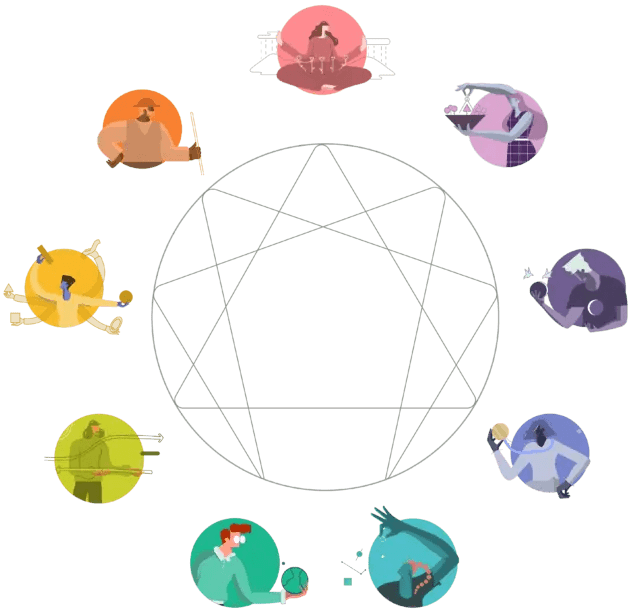
The Enneagram describes nine personality types, each shaped by a different core motivation. What separates it from most personality models is where it looks: not at how you behave, but at why. Two people can act almost identically and belong to different types, because the same behaviour can come from wanting to be useful, wanting to be admired, or wanting to avoid conflict.
Each type below is described through four things: the motivation that drives you, the fear underneath it, what you look like when you are thriving, and the growth edge that tends to open up next. As you read, notice which description makes you slightly uncomfortable — recognition often arrives as a flinch rather than a nod.
One note before you start: the Enneagram is a tool for self-understanding, not a diagnosis and not a limit on who you can become. No type is better than another, and no description will fit you perfectly. take the Enneagram test
Enneagram Type Descriptions Explained
Explore The 9 Enneagram Personality Types
Enneagram 1
The Reformer is the idealist and principled. The one who, self-convinced and justice-oriented, raises things up to their highest version.

Enneagram 2
In love of the love. The Helper is the one who loves to please and irradiate kindness by delivering themselves to others.
Enneagram 3
The Achiever is an Energic type with a lot of self-awareness that could turn into someone empowered. They are pure potential and determination.
Enneagram 4
The Individualist, Eternal Walker Of The Inward Halls, Who Can Create A Masterpiece And Has To Trespass Inner Currents To Reach The Natural Self.

Enneagram 5
The Investigator Of The Golden Source, The Tenacious Explorer Of The Human Mind That Grabs In His Hand Secretive Brilliance.
Enneagram 6
The Loyalist, Tenacious Guardians Of Their Values, Will Fight For Safety And Consistency. Friendly And Earnest. They Embody The Contradictions.
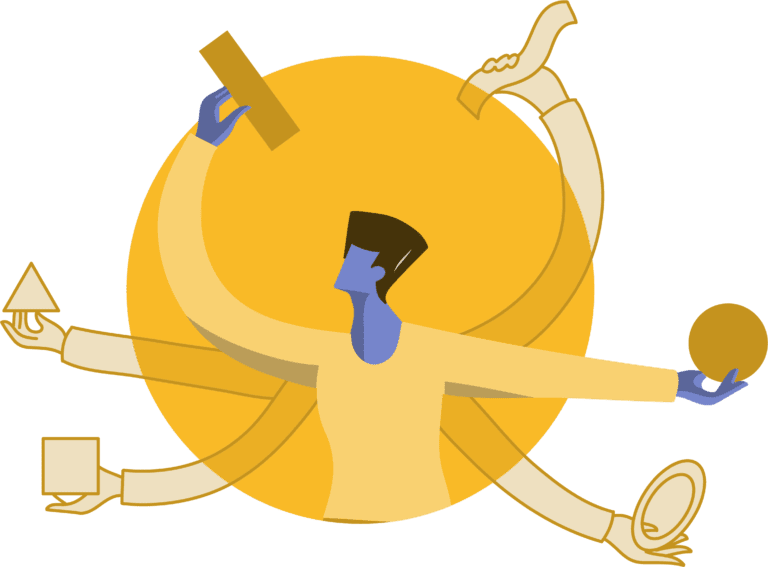
Enneagram 7
The Enthusiast, the Multitasker & Cheerful. The One Who Thinks Is Getting Late For Somewhere Or That Is Missing Something Important.

Enneagram 8
The Challenger, The Rampaging Spirit That Wants To Eat The World. Powerful & Self-Confident And Is Always On The Defense.
Enneagram 9
The Peacemaker The Reassuring Ones, Who Try To Keep Peace Of Mind And Serenity Whether Inside And Outside Of Them.
Enneagram Type 1: The Reformer
Principled, purposeful and quietly hard on yourself.
Core motivation: To live with integrity and get things right.
Core fear: Being corrupt, defective, or fundamentally in the wrong.
At your best: You are fair, discerning and genuinely useful — the person others trust to tell them the truth and to hold a standard when it would be easier not to.
Growth edge: Learning that the inner critic is not the same thing as your conscience. Rest is not a moral failure.
Enneagram Type 2: The Helper
Warm, generous and tuned to what other people need.
Core motivation: To be loved and genuinely needed.
Core fear: Being unwanted, or unworthy of love as you are.
At your best: You create the kind of warmth people relax into, and you notice what others need before they say it out loud.
Growth edge: Naming your own needs directly instead of earning care by giving it away first.
Enneagram Type 3: The Achiever
Driven, adaptable and focused on getting there.
Core motivation: To be valuable and worthwhile.
Core fear: Being worthless apart from what you accomplish.
At your best: You turn intention into momentum. You can see what a group is capable of and pull it forward with you.
Growth edge: Discovering that you are not your résumé, and letting people see the version of you that has not been polished.
Enneagram Type 4: The Individualist
Emotionally honest, imaginative and searching for something true.
Core motivation: To find and express who you really are.
Core fear: Having no identity, or no significance of your own.
At your best: You can stay present with feeling that other people flinch from, which makes you unusually good at honesty, creativity and comfort.
Growth edge: Noticing that the restlessness is not a flaw — it is the search for identity — and that what you are looking for is not only found elsewhere.
Enneagram Type 5: The Investigator
Perceptive, independent and happiest when you understand something properly.
Core motivation: To be capable and competent.
Core fear: Being useless, helpless, or overwhelmed by demands.
At your best: You see clearly and think originally, and you can stay calm and precise in situations that leave other people flustered.
Growth edge: Letting yourself participate before you feel fully prepared. Energy and confidence often arrive through engagement, not before it.
Enneagram Type 6: The Loyalist
Committed, quick-thinking and always aware of what could go wrong.
Core motivation: To have security and support you can rely on.
Core fear: Being without guidance, backup, or solid ground.
At your best: You are steady, loyal and unusually good at spotting real risk — the person who thinks ahead so the group does not have to.
Growth edge: Learning to trust your own judgement as much as you trust the doubts about it.
Enneagram Type 7: The Enthusiast
Curious, energetic and drawn to what is possible next.
Core motivation: To be satisfied, free and fully alive.
Core fear: Being trapped in pain, boredom, or deprivation.
At your best: You bring genuine appetite for life, and you can find the opening in a situation everyone else has written off.
Growth edge: Staying with one thing — including one difficult feeling — long enough for it to become depth rather than another beginning.
Enneagram Type 8: The Challenger
Direct, protective and comfortable with conflict.
Core motivation: To stay in control of your own life and protect what matters.
Core fear: Being harmed, controlled, or at the mercy of others.
At your best: You are decisive and hard to intimidate, and you use that strength to shelter people who cannot yet stand up for themselves.
Growth edge: Allowing vulnerability to be strength rather than exposure. Not every situation calls for armour.
Enneagram Type 9: The Peacemaker
Steady, accepting and easy to be around.
Core motivation: To have inner and outer peace.
Core fear: Loss, separation, and being pulled apart by conflict.
At your best: You see every side of a situation and make people feel genuinely accepted — the calm the room settles into.
Growth edge: Showing up for your own priorities. Going along with things is not the same as being at peace with them.
How Do I Find My Enneagram Type?
Most people narrow it down to two or three candidates by reading, then get stuck — which is normal, because types overlap heavily in behaviour and separate cleanly only in motivation. The useful question is not "which description sounds like me?" but "which fear do I organise my life around avoiding?"
Two things help. First, think about how you act under stress rather than at your best; motivation shows more plainly there. Second, ask someone who knows you well which of your shortlisted types they would pick — the gap between how you see yourself and how you come across is often exactly where the answer is. Take the free Enneagram test , then read the full description and check it against your own history.
Common Questions About the Enneagram Types
What is the rarest Enneagram type?
There is no settled answer, and it is worth understanding why. The estimates that circulate come from people who chose to take a test, not from population samples — and the types most drawn to self-examination are over-represented in exactly the surveys used to measure this. So treat any ranking as approximate. We go through the survey data and its limits here
Can your Enneagram type change over time?
The consensus within the framework is that your core type stays the same — what changes is how you express it. Under stress or in growth you take on qualities of other types, and a healthy Type 6 can look very different from a struggling one. If your test result changes between attempts, it usually means two types are close for you rather than that you have switched.
What is the difference between your type and your wing?
Your type is your core motivation. Your wing is the influence of one of the two types either side of yours on the Enneagram circle, and it colours how that motivation shows up — a Type 4 with a 3 wing looks more driven and image-aware than a Type 4 with a 5 wing, who looks more withdrawn and analytical. Explore all 18 wing combinations
Type Combinations
Which Enneagram Types Are Most Compatible?
Learn a new way to cultivate healthier relationships. Getting to know your Enneagram compatibility among different enneagram types can be of great help to provide more insight into a relationship and lead to new levels of health. Get to know your Enneagram compatibility with Others Enneagram Types