10 Advanced Workplace Communication Strategies to Master in 2026

In a world of constant pings, endless meetings, and misinterpreted Slack messages, effective communication is more than just a soft skill-it's a survival tool. Generic advice like "be clear" and "listen more" often falls flat because it ignores the most critical variable: human personality. What motivates one person to lean in might inspire another to shut down completely. This roundup moves beyond the obvious, offering a deep dive into powerful workplace communication strategies grounded in practical psychology.
We're not just rehashing old tips; we're giving your communication style a much-needed personality transplant. By understanding the core motivations that drive your colleagues, you can turn friction-filled feedback sessions, draining meetings, and tense conflicts into genuine opportunities for connection and growth. To truly master this approach, a strong foundation in understanding both your own and others' emotional intelligence in leadership is key, as it allows you to adapt with greater awareness and empathy.
Forget one-size-fits-all scripts. It's time to learn the specific dialects spoken by the different personalities on your team. This article provides a clear roadmap with 10 actionable strategies, complete with step-by-step instructions, real-world examples, and common pitfalls to avoid. Each point is designed to be immediately applicable, whether you're a manager aiming for better team cohesion or an individual contributor wanting to be heard. Let's explore the strategies that will finally make your messages stick.
1. Enneagram-Based Personality Communication
Ever felt like you and a coworker are speaking two completely different languages? You might be. This is where one of the most insightful workplace communication strategies comes in: understanding personality types through the Enneagram. Forget one-size-fits-all emails and generic feedback. This method helps you decode the core motivations, fears, and communication preferences of the nine distinct Enneagram types.
Imagine giving feedback to a Type 3 (The Achiever), like your marketing lead Sarah. She thrives on praise for her efficiency and success. A practical example would be starting a conversation with, "Sarah, the campaign's lead-gen numbers are fantastic. Let's talk about how we can replicate that success next quarter." Now, picture giving feedback to a Type 9 (The Peacemaker), like your customer support rep David. He needs a gentle, collaborative approach that avoids conflict. For him, you might say, "David, I'd love to get your thoughts on how we can make our team handoffs even smoother for everyone involved." Using the wrong approach can cause a total communication breakdown.
How to Make It Work for You
Ready to stop talking past your colleagues? Here’s how to put this into practice:
• Start with Yourself: • Before you analyze anyone else, discover your own type. A great starting point is a validated assessment. This self-awareness is the foundation for understanding others.
• Encourage, Don't Label: • Never guess or assign a type to someone. Instead, share resources and encourage voluntary team exploration. Frame it as a tool for better collaboration, not a personality test.
• Adapt to Stress vs. Health: • An employee’s communication style changes under pressure. A normally decisive Type 8 (The Challenger) might become withdrawn and secretive (moving to Type 5) under stress. Recognizing these shifts allows for more empathetic and effective support.
• Create Team Guidelines: • Once your team is familiar with the types, co-create a "communication playbook." This could include preferences like "Please give Type 4s time to process feedback creatively" or "For Type 1s, provide clear, logical reasoning for changes."
Companies from Google to smaller tech startups use the Enneagram in leadership programs and team-building workshops to improve dynamics and reduce friction. To dig deeper into how each type communicates in a professional setting, you can learn more about the Enneagram at work and begin building a more psychologically-aware team.
2. Active Listening with Type-Specific Awareness
We've all been told to practice "active listening," but what if you're only hearing the words and missing the entire story? This is where an upgraded version of this classic workplace communication strategy comes into play: active listening informed by Enneagram awareness. Instead of just nodding and paraphrasing facts, this approach teaches you to hear the underlying motivations, fears, and values that drive what a person is saying.

Think about a conflict resolution session. A Type 1 (The Reformer) might state, "The project timeline was not followed correctly." A standard active listener hears a process issue. A type-aware listener hears the deeper concern for integrity and doing things the "right" way. A practical response would be, "It sounds like maintaining our standard of quality is really important to you. Let's walk through where things went off track." This validates their core value far more effectively. Similarly, customer service teams can use this to understand if a customer's frustration stems from a Type 6's need for security or a Type 2's feeling of being unappreciated.
How to Make It Work for You
Ready to hear what your colleagues are really saying? Here’s how to put this powerful listening skill into action:
• Listen for Motivation, Not Just Data: • When a coworker speaks, ask yourself: what core Enneagram motivation is driving this? Is it a Type 5’s need for understanding, a Type 7’s desire to explore options, or a Type 8’s push for control? This adds a critical layer to your comprehension.
• Practice Type-Specific Validation: • Go beyond a generic "I hear you." Validate the underlying value. For a Type 4 (The Individualist), you might say, "It sounds like you feel the unique perspective you brought wasn't recognized." For a Type 9 (The Peacemaker), try, "I can see you're working hard to make sure everyone feels included and at ease with this decision."
• Minimize Distractions and Tune In: • This deeper listening requires your full attention. Put your phone away, close unnecessary tabs, and make eye contact. Pay close attention to the emotional cues and energy behind their words, which often reveal more than the words themselves.
• Ask Follow-Up Questions About Values: • Instead of just asking "What happened next?", ask questions that probe the motivation. Try "What was the most important principle for you in that situation?" or "What outcome would have felt most secure to you?"
This strategy, inspired by the work of Stephen Covey and Marshall Rosenberg and adapted by modern corporate coaches, helps turn routine check-ins into meaningful exchanges. To see a breakdown of the core principles of effective listening, watch this short guide.
3. Type-Aligned Feedback and Coaching Delivery
Ever had a feedback session completely backfire? You intended to be helpful, but your colleague walked away deflated, defensive, or just plain confused. The problem might not have been your message but your delivery. This is where type-aligned feedback, a powerful workplace communication strategy, comes into play. It moves beyond a one-size-fits-all performance review to a structured approach that resonates with an individual's core Enneagram type.
For a practical example, consider providing feedback to a Type 1 (The Reformer). They need to hear how a change aligns with principles and improves standards. You could say, "By adopting this new QA checklist, we can guarantee a higher quality product for our clients." Presenting the same feedback to a Type 7 (The Enthusiast) by focusing on dull policy will make them tune out; instead, you should frame it as an exciting new opportunity. For them, you'd say, "Mastering this new software will open up a lot of creative possibilities for our next big project."
How to Make It Work for You
Ready to transform your feedback from dreaded to developmental? Here’s a practical guide:
• Frame for Principles vs. People vs. Progress: • Start by identifying the recipient's core driver. A Type 2 (The Helper) needs feedback that acknowledges their value to the team and relationships. A Type 3 (The Achiever) wants to hear about measurable results and efficiency gains. A Type 8 (The Challenger) responds to directness focused on competence and impact.
• For Sensitive Types, Co-Create Solutions: • For types prone to taking things personally, like a Type 4 (The Individualist) or Type 9 (The Peacemaker), don't just deliver the feedback. Validate their perspective ("I understand why you approached it this way...") and then invite them to brainstorm solutions together. This fosters buy-in and reduces feelings of being criticized.
• Balance Data with Reassurance: • When giving feedback to a Type 6 (The Loyalist), who anticipates worst-case scenarios, pair your data with clear support. Provide specific examples of the issue, but also offer concrete next steps and reassure them of their role and security.
• Focus on Competency for Head Types: • For the intellectual types (5, 6, and 7), frame coaching around building mastery and gaining new capabilities. A Type 5 (The Investigator) will respond well to detailed information and resources that allow them to study and master a new skill independently.
Executive coaching firms and even Microsoft's internal leadership programs use these type-aware methods to create more effective and resonant development plans. To learn more about this coaching methodology, you can explore the work of pioneers like Russ Hudson and see how they apply these concepts to professional development.
4. Cross-Type Conflict Resolution Framework
Workplace conflict is inevitable, but explosions aren't. What if you could see a disagreement not as a battle of wills, but as a clash of core motivations? This is the power of the Cross-Type Conflict Resolution Framework, one of the most effective workplace communication strategies for turning friction into understanding. This approach uses the Enneagram to decode why a conflict is happening on a deeper, personality-driven level.

Here's a practical example: imagine a conflict between a rule-following Type 1 (The Reformer) project manager, John, and a free-spirited Type 7 (The Enthusiast) designer, Emily, over project deadlines. John sees chaos and irresponsibility, while Emily feels stifled and micromanaged. A manager can mediate by acknowledging John’s need for order ("John, I appreciate your commitment to quality and process") and Emily’s need for flexibility ("Emily, your creative energy is crucial here"), guiding them to a compromise that honors both.
How to Make It Work for You
Ready to defuse team tensions before they escalate? Here’s your guide to implementing this framework:
• Map Conflict Patterns: • Notice recurring tensions. Is it always the direct Type 8 (The Challenger) clashing with the sensitive Type 4 (The Individualist)? Recognizing these patterns is the first step. For instance, a Type 2's "helpful" suggestions might feel controlling to an independent Type 5.
• Reframe with Type Values: • Guide each person to state their needs using their type's core values. The Type 1 can say, "I need structure to ensure we deliver a high-quality product," not "You're being reckless." The Type 7 can say, "I need space to explore creative options," not "You're boxing me in."
• Address Stress Reactions: • Acknowledge when a conflict stems from a type's stress response. A normally helpful Type 2 might become aggressive and demanding (moving to Type 8) under pressure. Pointing this out gently ("I notice you're feeling a lot of pressure, how can we support you?") can de-escalate the situation.
• Co-Create Solutions: • Involve both parties in building a type-aware resolution. For a Type 1 vs. Type 7 issue, the solution could be setting firm "must-have" deadlines while building in "flex-time" for creative exploration. Document the agreement in a way that satisfies both, perhaps a clear checklist for the Type 1 and a visual mind map for the Type 7.
Organizational development consultants and mediation professionals use these exact techniques to resolve entrenched team issues. To see how these dynamics play out, you can explore more about Enneagram type compatibility and conflict styles and begin fostering a more resilient, understanding team.
5. Psychological Safety Through Type Understanding
Have you ever held back a great idea for fear of being shot down or stayed silent during a meeting because disagreeing felt too risky? That's a lack of psychological safety at play. This essential workplace communication strategy moves beyond just being polite; it’s about creating an environment where everyone feels secure enough to be vulnerable, make mistakes, and speak their mind without fear of humiliation or retribution.
The real insight here is that safety isn't a one-size-fits-all concept. What makes one person feel secure can make another feel exposed. For a practical example, a Type 6 (The Loyalist) like Mark in accounting feels safest when meeting agendas are sent out 48 hours in advance, giving him time to prepare for all possibilities. A Type 8 (The Challenger) leader, like CEO Anna, feels safest when her team challenges her ideas directly, as she sees it as a sign of strength and engagement. By layering Enneagram awareness onto the principles of psychological safety, pioneered by researchers like Amy Edmondson, you can tailor your approach to what each personality type truly needs to feel safe enough to contribute fully.
How to Make It Work for You
Ready to build a team where innovation and honesty can flourish? Here’s how to cultivate psychological safety with personality in mind:
• Define Safety for Each Type: • Don't assume. A Type 6 needs clear rules and leader support to feel secure, while a Type 8 feels safest when they can challenge ideas directly without backlash. A Type 4 needs their emotional expression to be validated, not dismissed as "too sensitive." Map out these needs as a team.
• Model Vulnerability: • Leaders must go first. Share a mistake you made and what you learned. Ask for feedback on your own performance. When a manager demonstrates that it’s safe to be imperfect, it gives the entire team permission to do the same.
• Decouple Disagreement from Disrespect: • Establish clear ground rules for debate. For example, "We challenge ideas, not people." This helps a conflict-avoidant Type 9 feel comfortable sharing a dissenting opinion and reassures a results-driven Type 3 that constructive criticism isn't a personal attack on their competence.
• Create Type-Aware Feedback Loops: • Structure check-ins to meet different safety needs. For a Type 5, provide data and questions in advance so they can process. For a Type 2, actively ask what support they need and create space for them to voice their own needs without feeling like a burden.
Companies that prioritize this see massive gains in creativity and problem-solving. To see how these principles were discovered and proven effective, you can explore Google's re:Work findings on psychological safety and start building a foundation of trust that unlocks your team’s true potential.
6. Strengths-Based Communication and Recognition
What if your company’s communication culture focused less on fixing weaknesses and more on amplifying what people already do brilliantly? This is the core of strengths-based communication, one of the most powerful workplace communication strategies for boosting morale and performance. Instead of a deficit-focused model, you identify and celebrate the unique contributions each team member naturally brings to the table.
This approach recognizes that every individual possesses distinct talents. For a practical example, your Type 6 (The Loyalist) analyst, Karen, has a knack for spotting potential risks in a project plan. Instead of seeing this as pessimism, a strengths-based manager would say, "Karen, your ability to foresee challenges is invaluable. Let's make sure you review every project proposal." Likewise, a Type 7's (The Enthusiast) endless stream of ideas isn't a distraction; it's a wellspring of innovation. Focusing on these inherent strengths makes recognition feel authentic.
How to Make It Work for You
Ready to build a culture of positive reinforcement? Here's how to get started:
• Identify Strengths, Don't Assume: • Use tools like Gallup's StrengthsFinder, often integrated with Enneagram insights, to give employees a vocabulary for their talents. This moves beyond guesswork and provides a solid foundation for discussion.
• Personalize Recognition: • Acknowledge contributions in a way that resonates with the individual. A public shout-out might thrill a Type 3 (The Achiever), but a thoughtful, private email detailing the impact of their work might mean more to a Type 5 (The Investigator).
• Integrate into Feedback: • Frame constructive feedback around strengths. For instance, instead of saying, "You need to be more organized," try, "Your creative vision is fantastic. Let's find a process that helps you channel that energy into a clear project timeline."
• Tailor Praise to the Type: • Make recognition specific to what each type values. Recognize a Type 1 for their integrity, a Type 4 for their authentic perspective, and a Type 8 for their decisive leadership in protecting the team's interests. This shows you see and value their core nature.
Companies that master strengths-based communication see a direct impact on retention and productivity. To learn more about identifying and applying these talents in a business context, you can explore the principles behind Marcus Buckingham's work and begin building a more empowered, high-performing team.
7. Vertical Communication Through Type Awareness
Ever notice how a message from the CEO lands differently with each team member? Or why your direct, data-driven report to a manager feels like it goes into a black hole? The answer often lies in the intersection of power dynamics and personality. Vertical communication, the flow of information up and down the organizational ladder, is notoriously tricky, but it becomes much clearer when viewed through the lens of Enneagram types.
This workplace communication strategy focuses on how different types prefer to give and receive information based on their position in the hierarchy. A practical example: a Type 8 (The Challenger) manager needs direct, confident updates. A monthly report for her should lead with a bolded, one-sentence summary of results. In contrast, a Type 2 (The Helper) leader responds best to communication that shows appreciation. For him, starting an email with "Thanks for your guidance on this, it's been a huge help" will make your message land much better.
How to Make It Work for You
Ready to make your upward and downward communication more effective? Here's a practical approach:
• Map Your Communication Chain: • Start by identifying the Enneagram types of your direct manager and your direct reports (if known and volunteered). This gives you an immediate roadmap for improving your most frequent vertical interactions.
• Adapt Your "Upward" Style: • When communicating with leadership, tailor your approach. For a Type 1 boss, present a logical, ethical case for your project. For a Type 5, come prepared with data and a well-researched appendix they can review independently.
• Refine Your "Downward" Style: • When leading your team, adjust how you delegate and give feedback. A Type 7 employee will be energized by framing a new task around growth and exciting possibilities. A Type 6 needs clear expectations and reassurance about support systems to feel secure and perform their best.
• Create Multiple Feedback Channels: • Recognize that not everyone is comfortable with the same method of giving upward feedback. A Type 9 (The Peacemaker) may never speak up in a group meeting but will provide thoughtful insights in a one-on-one or an anonymous survey. Offer various options to ensure all voices are heard.
Leadership coaches and organizational development professionals use this framework to build psychologically safe and highly efficient communication cultures. To get a better sense of how to apply this with your own team, you can explore detailed Enneagram leadership styles and start bridging the hierarchical gap.
8. Type-Aware Remote and Asynchronous Communication
Is your remote team's communication feeling a little... off? The same message that energizes one person leaves another feeling drained or confused. This is where a crucial workplace communication strategy for distributed teams comes into play: adapting your remote and asynchronous methods to individual personality types, particularly through the lens of the Enneagram.
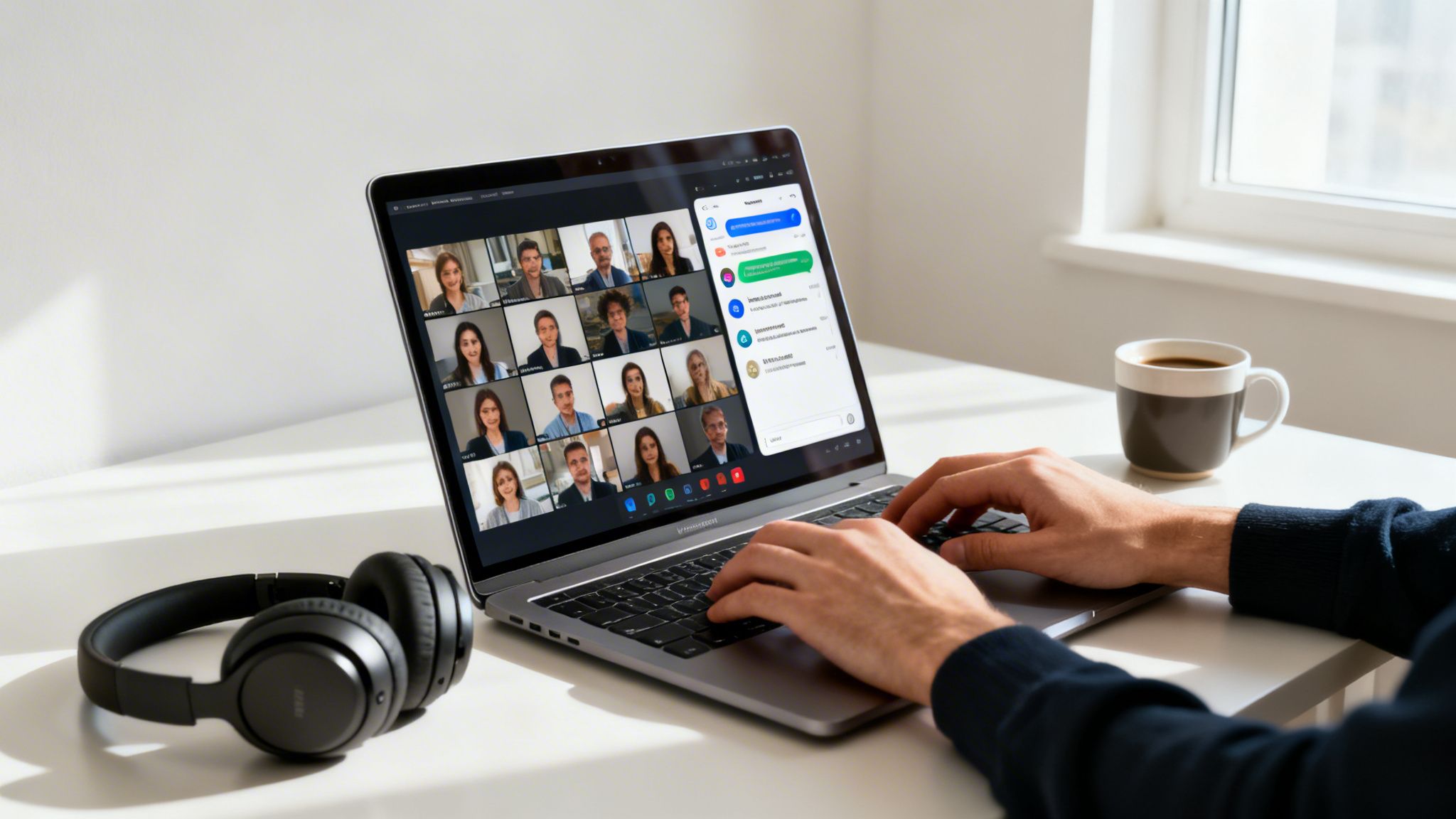
This approach moves beyond simply having the right tools; it’s about using them with psychological awareness. A Type 7 (The Enthusiast) might love spontaneous, high-energy video calls, but that same format could overwhelm a Type 5 (The Investigator) who needs time to process information alone. A practical solution is to make brainstorms "camera-optional" and always provide a written summary with action items afterward, satisfying both the need for interactive energy and quiet reflection.
How to Make It Work for You
Ready to fine-tune your team’s virtual interactions? Here’s how to get started:
• Offer Multiple Contribution Paths: • For any important project or decision, provide both synchronous (live meeting) and asynchronous (document comments, Slack thread) avenues for input. This gives everyone a chance to contribute in the way that suits them best.
• Create Type-Specific Guidelines: • Develop a team charter for virtual communication. For instance, "For Type 2s, we’ll create optional virtual coffee chats to build connection." Another rule could be, "For Type 4s, 'cameras off' is always an acceptable option, no questions asked."
• Be Strategic with Meetings: • Send detailed agendas and pre-reading materials well in advance, a practice that especially supports Types 5 and 6. For Type 8s, ensure meetings are decisive and action-oriented, not just for discussion.
• Actively Solicit Quiet Voices: • In a video call, a Type 9 (The Peacemaker) may not jump in. Directly and gently ask for their thoughts: "Sarah, we haven't heard from you yet, and we'd value your perspective on this." This creates the space they need.
Companies like GitLab and Automattic have built their success on async-first principles that naturally accommodate diverse work styles. By applying a personality-aware layer, you can make these powerful workplace communication strategies even more effective for your specific team.
9. Collaborative Problem-Solving with Type Diversity
Have you ever been in a brainstorming session where everyone seems to be stuck in an echo chamber, recycling the same ideas? This often happens when a team lacks cognitive diversity. This is where one of the most powerful workplace communication strategies emerges: intentionally building problem-solving groups based on Enneagram type diversity. This method moves beyond hoping for good ideas and instead architects a team where different perspectives are guaranteed.
The core idea is that each type approaches problems in a fundamentally distinct way. Here's a practical example: a team of Type 3s might create an incredibly efficient plan but overlook critical risks. A room full of Type 7s could generate a thousand exciting ideas but struggle to execute. An effective problem-solving group for a new product launch would include a Type 1 to ensure quality control, a Type 6 to identify potential issues, a Type 7 for innovative marketing ideas, and a Type 3 to drive the timeline forward.
How to Make It Work for You
Ready to stop groupthink in its tracks and start generating well-rounded solutions? Here’s how to put this into practice:
• Map Your Team's Strengths: • During a problem-solving kickoff, explicitly call on different types for their unique input. For instance, say, "Let’s start with our Type 6s. What potential pitfalls and worst-case scenarios should we be thinking about?" This validates each person’s natural inclination and frames it as a strength.
• Assign "Cognitive Roles": • You can formalize this process. A Type 1 could be the "Quality Guardian," a Type 4 the "Innovation Lead," and a Type 8 the "Action Driver." This ensures every critical angle is covered and gives people permission to lean into their type's strengths without apology.
• Balance the Room: • When forming a special project or innovation team, intentionally select members to ensure type diversity. An ideal mix might include a Type 5 for deep research, a Type 2 to analyze the people-impact, and a Type 9 to help find consensus among competing ideas.
• Create Multiple Input Channels: • Recognize that not all types contribute best in a loud, fast-paced meeting. A Type 5 may need to process information alone before sharing their detailed analysis. Provide a shared document or asynchronous channel for them to contribute their thoughts after the initial meeting, ensuring their valuable insights aren't lost.
Design thinking firms and corporate innovation labs use this approach to build teams that can tackle complex challenges from every angle. By understanding the cognitive gifts of each Enneagram type, you can build a more complete and effective problem-solving machine.
10. Development Coaching and Mentoring with Type Integration
Are your employee development plans feeling a bit generic? A one-size-fits-all approach to coaching often misses the mark because it ignores the unique internal wiring of each person. This is where a more personalized workplace communication strategy shines: integrating Enneagram knowledge into coaching and mentoring to supercharge individual growth. This method recognizes that a Type 7 (The Enthusiast) needs a different kind of support to follow through on projects than a Type 1 (The Reformer) does to embrace imperfection.
For a practical example, imagine mentoring a Type 5 (The Investigator) by pushing them into constant team-building activities; it would be exhausting and ineffective. A better approach is coaching them to share their research in a low-stakes, structured setting, like a short weekly update. Conversely, a Type 2 (The Helper) benefits from coaching that helps them practice saying "no" to non-essential requests, helping them establish boundaries and advocate for their own needs, not just serve others.
How to Make It Work for You
Ready to transform your coaching from a checklist item into a genuine catalyst for development? Here’s how to apply this approach:
• Customize Growth Paths: • Design development plans around Enneagram growth points. Coach a Type 8 (The Challenger) on embracing vulnerability for collaborative leadership, while guiding a Type 4 (The Individualist) toward practical action and tangible goal-setting to bring their creative visions to life.
• Match Mentors Mindfully: • When pairing mentors and mentees, consider their types. While a mentor of the same type can offer deep understanding, a mentor of a different type can provide a valuable, balancing perspective. The key is awareness, not perfect matching.
• Address Resistance with Insight: • When a team member resists feedback or stalls on a goal, use their type as a lens. A normally confident Type 3 (The Achiever) might be struggling with a fear of failure, while a Type 6 (The Loyalist) could be paralyzed by self-doubt. This insight allows for a more empathetic and effective conversation.
• Focus on Professional Application: • Frame coaching sessions around workplace challenges. Help a Type 9 (The Peacemaker) practice stating a clear opinion in a low-stakes meeting, or work with a Type 1 on delegating a task without micromanaging the process.
Many executive coaching firms now build programs around these very principles. Understanding the business side of coaching can also add value; for instance, seeing how external programs are built can be found in resources like a relevant Coaching Community Monetization Guide . To dive deeper into using these insights for personal development, you can explore more about Enneagram coaching for personal growth and start building a more self-aware, high-growth team.
10-Point Enneagram Communication Strategies Comparison
| Method | 🔄 Implementation Complexity | ⚡ Resource Requirements | 📊 Expected Outcomes (⭐) | Ideal Use Cases | 💡 Key Advantages |
|---|---|---|---|---|---|
| Enneagram-Based Personality Communication | High — organization-wide training and adoption | Medium–High — assessments, workshops, coach support | High ⭐⭐⭐⭐ — improved message reception, reduced conflicts | Org development, leadership programs, team building | Personalized messaging; tailored conflict resolution; motivates by intrinsic drivers |
| Active Listening with Type-Specific Awareness | Medium — practice and habit change required | Low–Medium — coaching, time investment per interaction | High ⭐⭐⭐⭐ — increased trust, engagement, fewer misunderstandings | 1:1s, customer service, conflict de-escalation | Builds psychological safety; deeper comprehension of motivations |
| Type-Aligned Feedback and Coaching Delivery | Medium–High — learning multiple feedback frameworks | Medium — manager/coach preparation and customization time | High ⭐⭐⭐⭐ — greater receptiveness, faster development | Performance reviews, coaching, talent development | Reduces defensiveness; accelerates skill improvement |
| Cross-Type Conflict Resolution Framework | High — needs skilled facilitators and nuance | Medium–High — mediator training, structured sessions | High ⭐⭐⭐⭐ — faster, more satisfactory resolutions; restored trust | HR mediation, team disputes, workshop interventions | Prevents escalation; creates empathy with type-tailored de‑escalation |
| Psychological Safety Through Type Understanding | High — culture change and leadership modeling | High — long-term programs, leadership commitment | Very High ⭐⭐⭐⭐⭐ — increased innovation, retention, collaboration | Org-wide culture initiatives, leadership development | Sustains idea-sharing; reduces fear-based behavior |
| Strengths-Based Communication and Recognition | Medium — redesign recognition and messaging systems | Medium — program design, manager coaching | High ⭐⭐⭐⭐ — higher motivation, morale, retention | Recognition programs, succession planning, engagement drives | Boosts motivation; aligns roles to strengths |
| Vertical Communication Through Type Awareness | Medium–High — coordination across hierarchy levels | Medium — channels, training, feedback mechanisms | High ⭐⭐⭐⭐ — improved information flow and upward feedback | Senior leadership, internal comms, hierarchical organizations | Improves decision-making; reduces miscommunication across levels |
| Type-Aware Remote and Asynchronous Communication | Medium — intentional protocols and norms | Medium — tech tools, guidelines, training | High ⭐⭐⭐⭐ — clearer async communication, inclusive remote teams | Remote/hybrid teams, async-first companies | Reduces tone misinterpretation; offers multiple contribution channels |
| Collaborative Problem-Solving with Type Diversity | Medium–High — facilitation to balance inputs | Medium — planning, facilitation, diverse team composition | Very High ⭐⭐⭐⭐⭐ — more comprehensive, innovative solutions | Design sprints, strategy sessions, cross-functional projects | Reduces blind spots; increases buy-in and solution quality |
| Development Coaching and Mentoring with Type Integration | Medium–High — personalized coaching frameworks | Medium–High — trained coaches, sustained mentoring time | High ⭐⭐⭐⭐ — accelerated growth, career satisfaction | Executive coaching, leadership pipelines, career development | Personalized growth paths; stronger mentor-mentee alignment |
From Theory to Transformation: Your Next Steps
And there you have it, a veritable smorgasbord of workplace communication strategies designed to turn your office from a collection of cubicles into a buzzing hub of connection and productivity. We’ve journeyed through ten distinct, yet interconnected, frameworks, from understanding Enneagram personality types in daily chatter to deploying that knowledge in high-stakes conflict resolution and remote work settings. But let's be honest, reading this article is the easy part. The real magic, the kind that actually makes Monday mornings feel less like a chore and more like an opportunity, happens when you close this tab and start doing the work.
Think of these ten strategies not as a rigid instruction manual but as a set of powerful ingredients. You don’t need to cook a ten-course meal tomorrow. Maybe this week, you just focus on one: Active Listening with Type-Specific Awareness . Instead of just nodding along in your next team meeting, you actively listen for the underlying motivations of your colleagues. Is your Type Seven teammate, Maria, pitching a dozen new ideas because she’s avoiding the tedious details of the current project? Is your Type One coworker, David, getting stuck on minor flaws because his core fear is making a mistake?
This quote perfectly captures the core challenge we’ve addressed. We all think we’re communicating, but often we’re just talking at each other, operating from our own set of assumptions and motivations. The Enneagram offers a decoder ring for these hidden languages. Mastering these workplace communication strategies isn’t just about getting fewer confused emails or having smoother meetings. It’s about building a foundation of genuine understanding.
Your Action Plan for Better Communication
So, where do you go from here? Staring at a list of ten new approaches can feel overwhelming. Let’s break it down into manageable first steps.
Ultimately, committing to better communication is an investment with incredible returns. It fosters psychological safety, where people like Michael from accounting (a Type Six) feel secure enough to voice concerns instead of staying silent. It fuels innovation, as you learn how to draw out the best ideas from your diverse team using Collaborative Problem-Solving with Type Diversity . It builds careers, your own included, by making you a more effective, empathetic, and respected leader, peer, and mentor. Don't let this be just another article. Let this be the start of your communication transformation.
Ready to move from theory to practice and discover the "why" behind your team's communication styles? The first step is knowing your own type and having a reliable resource to guide you. Enneagram Universe offers in-depth assessments and rich profiles that provide the foundational knowledge needed to implement these powerful workplace communication strategies. Start your journey of self-discovery today and unlock a new level of understanding in your professional life.