Discover What Motivates People at Work and Unlock Team Potential

Ever walked past one team's office and felt the buzz of creative energy, only to see another team just... going through the motions? The secret to what motivates people at work isn't just about bigger paychecks. It's about tapping into something deeper—a sense of purpose, a drive for growth, and a feeling of real connection.
Crack that code, and you can turn a disengaged, clock-watching group into a genuine powerhouse.
The Trillion-Dollar Question: What Really Motivates People?
Think of a motivated team like a killer band in perfect sync. Every musician is pouring their heart into their part, not just playing the notes but feeling them. The result is pure magic. An unmotivated team? That’s more like a middle school orchestra rehearsal where half the instruments are out of tune and nobody really wants to be there.
This isn't just a fun analogy; it's the reality playing out in offices everywhere.

The Staggering Cost of Getting It Wrong
There’s a massive, expensive gap between what leaders think motivates their people and what actually lights a fire in their bellies. This disconnect breeds disengagement—that soul-crushing state where employees are physically present but emotionally checked out. The spark is gone. Deadlines slip, great ideas never surface, and the whole vibe just turns sour.
The latest global workforce data tells a grim story. Picture this: only 21% of employees are genuinely engaged with their work. A whopping 60% are "quietly quitting"—doing the bare minimum—while another 19% are actively miserable. This isn't just bad for morale; it's a financial black hole costing the global economy an eye-watering $8.8 trillion every single year.
What's driving this? It's not rocket science. It's feeling treated unfairly, being buried under an impossible workload, and dealing with terrible communication. For anyone in a leadership role, this makes understanding motivation an urgent mission—both for your people and your bottom line. You can dig into the full global workplace findings to see just how big this problem is.
A motivated employee isn't just a happier employee; they are a strategic asset. Research shows that highly engaged teams see 20% better performance and that individuals are 87% less likely to leave their jobs.
To give you a quick cheat sheet, here’s a breakdown of the key factors we'll be exploring.
Key Workplace Motivators At a Glance
This table offers a snapshot of the internal and external forces that drive people at work. Think of it as a quick reference guide to the core concepts we're about to unpack.
| Motivator Type | Description | Workplace Example |
|---|---|---|
| Intrinsic | The internal drive to do something because it’s personally rewarding. | A graphic designer who spends extra hours perfecting a logo because they are passionate about creating beautiful, effective designs. |
| Extrinsic | Motivation that comes from outside forces, like rewards or punishments. | A salesperson pushing to hit their quarterly target to earn a large commission check. |
| Autonomy | The need to feel in control of one's own work and decisions. | A marketing manager having the freedom to design and execute their own campaign strategy without micromanagement. |
| Mastery | The desire to get better and improve skills in something that matters. | A junior developer spending their evenings learning a new coding language to level up their skills. |
| Purpose | The feeling of being part of something bigger than oneself. | An employee at a green energy company who feels their work is helping combat climate change. |
Understanding these different levers is the first step toward building a truly motivated team.
Why the Old Bag of Tricks Doesn't Work Anymore
For decades, the standard playbook for motivation was simple: dangle a carrot. Bonuses, promotions, and other perks were the go-to tools. And look, those things still matter. Nobody is turning down a raise.
But they often miss the point entirely because they don’t feed the deeper, intrinsic drivers that create lasting commitment. People want more than a transaction. They want to feel valued, see the impact of their work, and know they’re not just stuck in a dead-end job. For example, a year-end bonus might boost morale in December, but it won't motivate an employee in May when they feel their daily work is meaningless.
In this guide, we’re going to get past the surface-level fixes. We’ll dive into powerful psychological frameworks—from the classics to the deeply personal insights of the Enneagram—and give you practical strategies to finally unlock the incredible potential sitting in your team.
Decoding Intrinsic vs. Extrinsic Motivation
So, what really gets people out of bed and fired up for work? When you peel back the layers, you’ll find two core engines running the show. One burns from the inside out, and the other gets its power from the outside in.
Figuring out the difference is like knowing whether your car runs on a self-charging electric battery or needs a constant supply of gasoline. It’s a huge distinction.
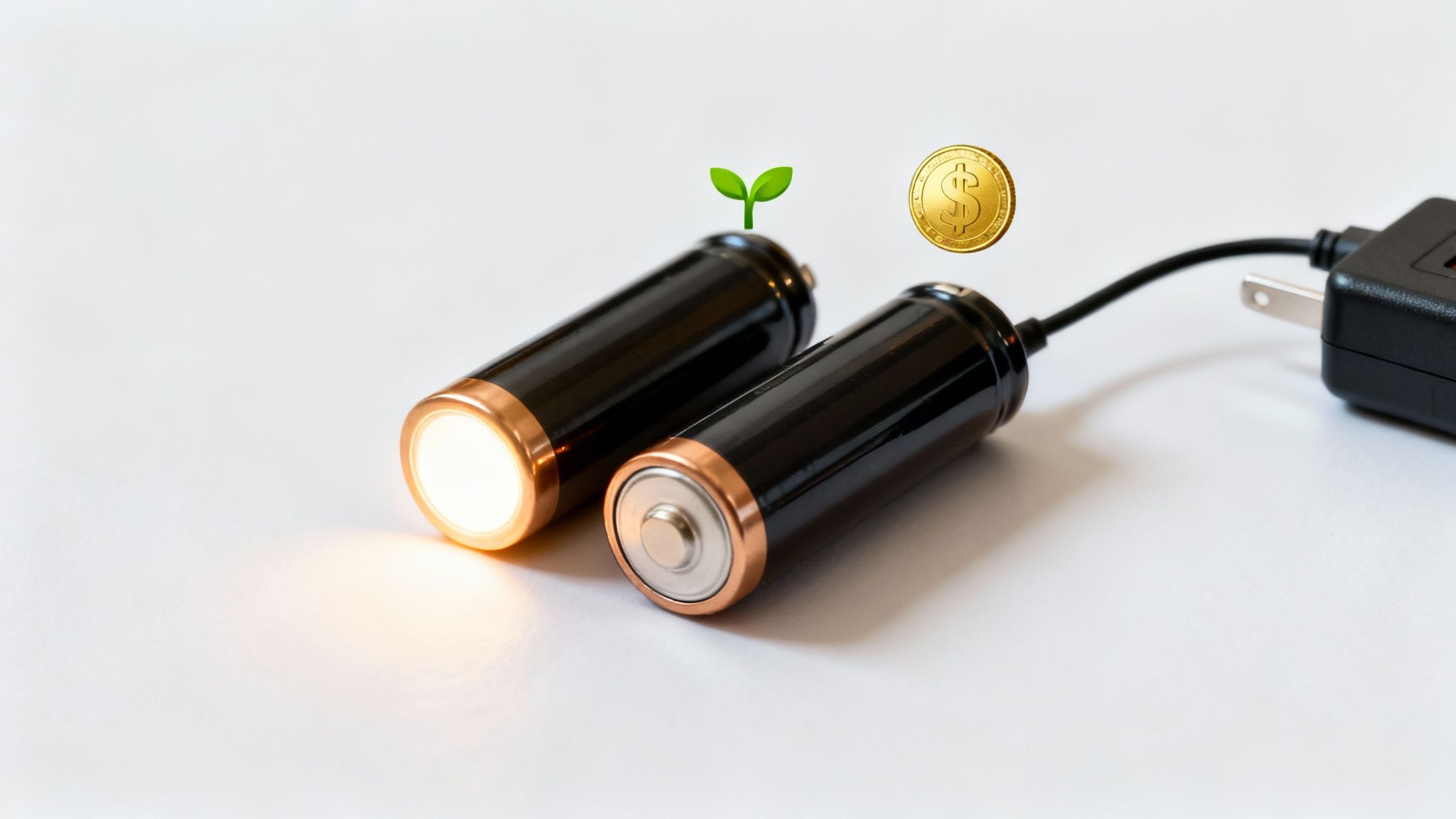
Relying on the wrong fuel source can cause motivation to sputter out right when you need it most. Let's break it down.
Extrinsic Motivation: The External Push
Extrinsic motivation is your classic "carrot and stick" deal. It’s any reason you do something other than for the pure joy of the task itself. Think of it as an external reward—or punishment—that nudges you into action.
This is the obvious stuff: a sales bonus, a promotion, a fancy plaque on the wall. But it's also the fear of missing a deadline or the simple desire for a pat on the back from your boss. If the payoff is separate from the work, it’s extrinsic.
These motivators can be great for straightforward, repetitive jobs. For example, a call center might offer a $50 bonus for every positive customer review an agent receives. This provides a clear, immediate reward for a specific action. The catch? The effect is often short-lived and can even backfire if it's the only thing driving people.
Intrinsic Motivation: The Internal Fire
Now for the other side of the coin. Intrinsic motivation is that deep, internal drive that comes from finding the work itself satisfying. This is the "self-charging battery" that runs on pure passion, curiosity, and a genuine love for the process.
Think of a software developer pulling an all-nighter to crack a complex piece of code. She isn't doing it for the overtime pay; she's in it for the thrill of finding the solution. That’s intrinsic motivation, right there. This kind of drive is far more sustainable and is tightly linked to creativity, engagement, and long-term job satisfaction.
To get a better handle on these deep-seated drivers, it's worth exploring the Enneagram core motivations , which shed light on the fundamental needs that shape our internal worlds.
The real magic happens when people aren't just working for a paycheck, but because the work itself fulfills a deeper need. This is where sustainable, long-term performance is born.
You can even see this dynamic at play in high-stakes job interviews. Many common consulting behavioral interview questions are designed specifically to find out what fuels a candidate—is it the internal puzzle or the external prize?
Fueling The Fire With Self-Determination Theory
Okay, so how do you actually cultivate that powerful internal fire in your team? This is where a neat little framework called Self-Determination Theory (SDT) comes in handy. It argues that all of us have three basic psychological needs. When work meets these needs, intrinsic motivation skyrockets.
Imagine you're managing a marketing team. You could foster relatedness with collaborative brainstorming sessions where every voice is heard. You could build competence by investing in advanced analytics training. And you could grant autonomy by letting a team member decide the best social media channels to use for a new campaign, trusting their expertise.
When you nail all three, work starts to feel less like a chore and a lot more like a calling.
Classic Motivation Theories for the Modern Workplace
Alright, let's blow the dust off some old-school psychology textbooks. While some motivational theories feel like they were carved on stone tablets, a few classic ideas are still shockingly good at explaining what gets people out of bed and into the office—or logged onto Slack—today. We’ll skip the dry, academic jargon and turn these into tools you can actually use.
Think of these theories less as rigid rules and more as different camera lenses. Each one gives you a new angle on your team, helping you see what really drives them. It's the difference between guessing what people want and actually understanding their internal wiring.
The Workplace Survival Pyramid
You’ve probably seen Maslow’s Hierarchy of Needs before—it’s that famous pyramid from Psych 101. The concept is simple: you can’t really worry about self-improvement if you’re worried about where your next meal is coming from. So, let’s rebuild it for the modern office.
At the very bottom of our "Workplace Survival Pyramid" are the essentials. This starts with Safety , which in the work world means a fair salary you can count on and an environment that feels physically and psychologically secure. If this foundation is shaky, nothing else matters. No one is dreaming up brilliant new strategies when they're anxious about paying the rent.
Once that's locked in, people start looking for Belonging . They want to feel like part of the tribe, connected to their colleagues, and accepted for who they are. For example, a simple team lunch or a dedicated Slack channel for non-work chat can significantly boost this feeling.
Climb another level and you hit Esteem . This is the deep-seated need for respect, recognition, and the feeling of being good at your job. It’s the "good job" from a manager that actually lands, or a public shout-out in a company-wide email for a project well done.
Finally, at the very peak, is Self-Actualization . This is the holy grail—the chance to chew on challenging projects, learn new skills, and feel like you're reaching your full potential. This is where true, lasting motivation lives.
Making Goals Magnetic with Goal-Setting Theory
Next up is Edwin Locke’s Goal-Setting Theory, which is refreshingly straightforward. The whole idea is that specific, challenging goals—when paired with consistent feedback—drive much higher performance than vague, easy ones. It sounds like pure common sense, but you’d be amazed how often it’s completely ignored.
Telling your team to "do your best" is like telling a ship's captain to "sail somewhere nice." It’s a pleasant thought, but it offers zero direction. It's a recipe for aimless effort.
A clear target, on the other hand, changes the entire game.
• Vague Goal: • "Let's try to improve customer satisfaction this year."
• Specific Goal: • "Let's increase our Net Promoter Score (NPS) by • 10 points • by the end of Q3 by slashing ticket response times to under 24 hours."
See the difference? The second goal gives everyone a finish line they can see. It tells the team exactly what they're aiming for, how it will be measured, and when it needs to happen. That kind of clarity is incredibly motivating because it turns a fuzzy wish into a winnable game.
"A goal is a dream with a deadline." — Napoleon Hill
This approach helps people focus their energy, push through obstacles, and feel a genuine jolt of accomplishment when they hit the mark. It’s one of the most powerful and direct ways to light a fire under a team.
The Simple Math of Effort and Reward
Finally, let’s break down Victor Vroom’s Expectancy Theory. It sounds complicated, but it’s really just about the simple mental calculation everyone makes before deciding to put in extra effort. It’s a three-part checklist running in the back of an employee’s mind.
Imagine a sales professional named Maria. She’s fired up to crush her quarterly target because she knows the formula works. She has Expectancy because she believes her extra calls will lead to more sales. She has Instrumentality because she trusts the company's commission structure is ironclad. And she has Valence because that bonus is earmarked for a family vacation she’s been dreaming about.
If any link in that chain breaks, motivation fizzles out. By understanding these classic frameworks, you can stop guessing and start diagnosing exactly where your team’s motivation might be hitting a snag.
Using the Enneagram to Find What
Really
Makes People Tick
If those classic motivation theories we talked about are a general city map, think of the Enneagram as your personal GPS. It doesn't just show you the neighborhood; it guides you straight to the front door of what truly drives each person on your team.
This is where we leave the one-size-fits-all incentives behind. Forget tossing out generic rewards and just hoping something resonates. The Enneagram gives you a peek into the unique internal wiring of each personality type, showing you exactly what gets them out of bed in the morning.
What fires up one person might completely extinguish another's motivation. This is how you stop guessing and start leading. When you understand someone's Enneagram type, you suddenly have a cheat sheet to their deepest desires, their biggest fears, and the core drivers that make them come alive at work.
Mapping Motivators to Enneagram Types
The Enneagram framework gives us nine core personality types, each with its own unique lens on the world and its own internal engine. A Type One , "The Reformer," is on a mission to be good, do things the right way, and make the world a better, more orderly place. On the other hand, a Type Seven , "The Enthusiast," is fueled by a desire for new experiences, freedom, and a deep need to avoid feeling trapped or in pain.
You can see how this plays out, right? Handing a meticulous, quality-control project to a Seven would feel like a prison sentence. But give that same project to a One? They might see it as the most meaningful challenge they've had all year.
Let’s look at a few quick examples:
• The Type 1 Reformer • is all about • quality and integrity • . Give them a chance to fix a broken system or bring order to chaos, and you'll see them light up.
• The Type 3 Achiever • runs on • recognition and success • . Public praise, a clear ladder to climb, and visible signs of their accomplishments are like high-octane fuel for them.
• The Type 7 Enthusiast • thrives on • fresh ideas and variety • . Keep them plugged in with brainstorming sessions, exciting new initiatives, and the freedom to chase down different possibilities.
To really get into the nitty-gritty of how all nine types show up in the office, check out our comprehensive guide on the Enneagram at work .
Enneagram Types and Their Core Workplace Motivators
To give you a quick reference, here’s a breakdown of what gets each Enneagram type excited in a professional setting. Think of it as a starting point for tailoring your approach.
| Enneagram Type | Core Motivator | How to Engage Them |
|---|---|---|
| Type 1 (The Reformer) | Purpose & Quality | Give them projects where they can improve systems and uphold high standards. |
| Type 2 (The Helper) | Appreciation & Connection | Acknowledge their contributions and show them how their work supports the team. |
| Type 3 (The Achiever) | Success & Recognition | Offer clear goals, public praise, and opportunities for advancement. |
| Type 4 (The Individualist) | Authenticity & Meaning | Allow them to bring their unique perspective to projects that have a deeper impact. |
| Type 5 (The Investigator) | Competence & Understanding | Provide them with complex problems and the autonomy to master them. |
| Type 6 (The Loyalist) | Security & Guidance | Create a stable environment with clear expectations and supportive leadership. |
| Type 7 (The Enthusiast) | Freedom & Possibility | Keep them engaged with new ideas, variety in their work, and brainstorming sessions. |
| Type 8 (The Challenger) | Control & Impact | Give them leadership roles and the authority to make decisions and protect their team. |
| Type 9 (The Peacemaker) | Harmony & Stability | Foster a collaborative, low-conflict environment where their calm presence is valued. |
This isn't about boxing people in—it's about speaking their language. A little bit of insight goes a long way toward building a team where everyone feels seen, valued, and ready to contribute their best.
What Demotivates Each Type (Before It Becomes a Resignation)
Knowing what motivates someone is only half the picture — the other half is noticing what quietly kills it, usually well before anyone says anything out loud.
| Enneagram Type | What Drains Their Motivation | Early Warning Sign to Watch For |
|---|---|---|
| Type 1 - The Reformer | Sloppy standards or work that feels pointless/wrong. | Increased nitpicking, or sudden disengagement from quality they used to care about. |
| Type 2 - The Helper | Feeling unappreciated or taken for granted. | Quietly doing less "extra," without ever asking for recognition directly. |
| Type 3 - The Achiever | No visible path to recognition or advancement. | Effort starts going toward external visibility instead of the actual work. |
| Type 4 - The Individualist | Feeling like just another cog, with no room for their own voice. | Withdrawal, or work that becomes noticeably more generic and less personal. |
| Type 5 - The Investigator | Constant interruptions, or being pulled into more meetings than focused work. | Going quiet in meetings they used to contribute to. |
| Type 6 - The Loyalist | Instability, or leadership they can't trust. | More questions, more need for reassurance, more second-guessing of decisions. |
| Type 7 - The Enthusiast | Repetitive work with no variety or new challenge. | Distraction, or visibly chasing side projects instead of the main one. |
| Type 8 - The Challenger | Feeling micromanaged or powerless. | Pushback increases, or they start going around processes instead of through them. |
| Type 9 - The Peacemaker | Conflict they're expected to manage, or constantly shifting priorities. | Going along with everything on the surface, while actual output quietly slows. |
Catching the early warning sign is almost always cheaper than fixing the resignation.
Real-World Stories: Meet Sarah and David
Let's make this concrete. Imagine Sarah, a project manager and a classic Type 2, "The Helper." Her entire motivation comes from feeling needed and appreciated. She's the person who remembers birthdays, offers to help a swamped colleague, and makes sure everyone feels included. A manager who only looks at her KPIs is missing the point entirely.
For Sarah, the most powerful incentive you can offer is a simple, heartfelt "thank you." When her boss pulls her aside and says, "Sarah, your support has been the glue holding this project together. I don't know what we'd do without you," she feels seen. That single piece of recognition will fuel her for weeks, far more than a generic bonus would.
Now, let's look at David, a data analyst and a Type 5, "The Investigator." David is driven by a need to be competent and to understand the world around him. He loves nothing more than getting a complex problem, shutting his door, and emerging hours later with a brilliant solution.
Forcing David into constant team-building exercises or a public-facing role would be his personal nightmare. The best way to motivate him? Give him a thorny data set, tell him "figure this out," and leave him alone. For David, the reward isn't the applause; it's the quiet satisfaction of cracking the code.
The classic theories give us a great foundation, but the Enneagram adds that crucial personal layer.
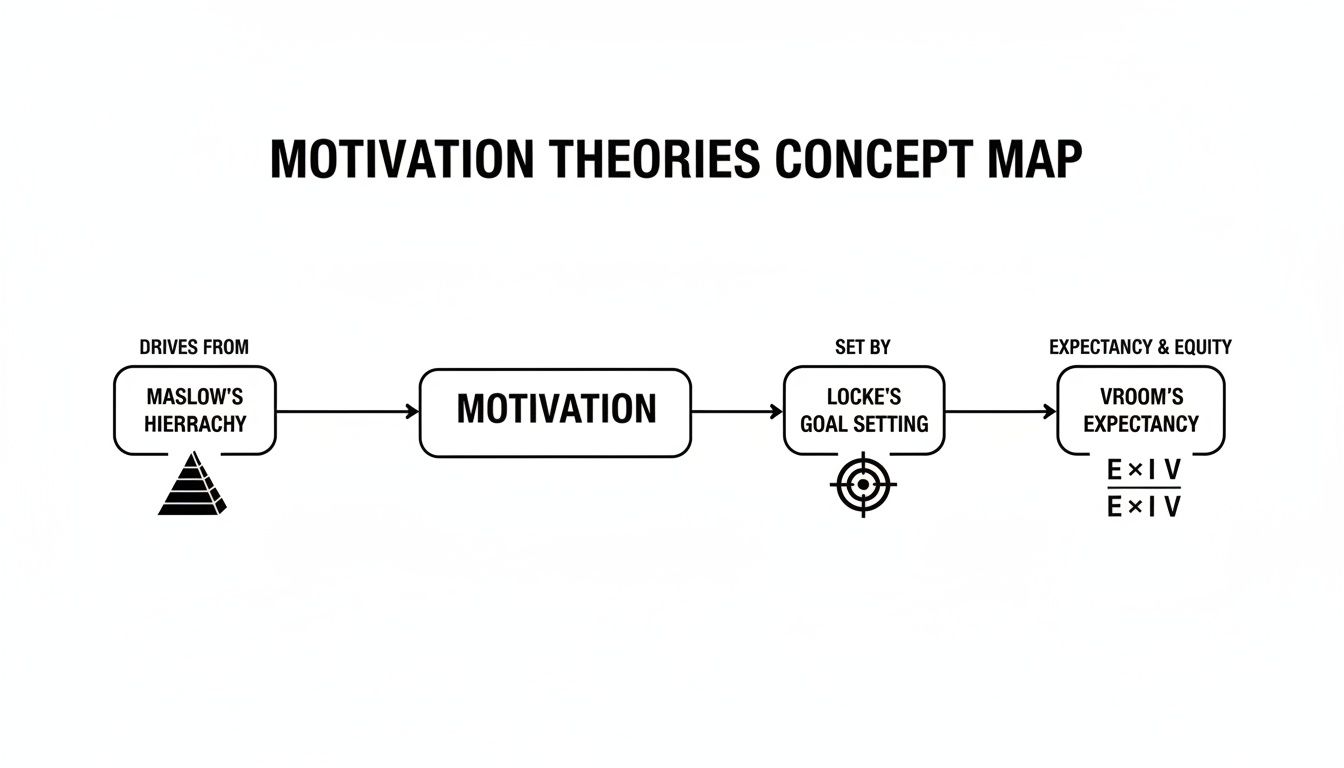
You can see how frameworks like Maslow's or Vroom's build the big picture, but the Enneagram helps us zoom in on the individual.
The Magic of a Personalized Approach
Understanding these individual drivers isn't about stereotyping people. It's about finding the right key for the right lock. When you know what genuinely fuels a person, you can align their work with their passions, speak to them in a way that truly connects, and build an environment where they don't just show up—they thrive.
Using a tool like the Enneagram isn't a shortcut to management; it's a road map to more meaningful and effective leadership. It honors the simple truth that every single person is a unique puzzle waiting to be solved.
This is the shift from generic incentives to tapping into the powerful, intrinsic motivators that create real, lasting engagement. It's the difference between trying to hammer a square peg into a round hole and taking the time to understand the shape of the person in front of you. The result? A happier, more innovative, and ridiculously more effective team.
Practical Strategies to Boost Team Motivation
Alright, let's get down to brass tacks. Understanding the theory is great, but putting it into practice is where the real magic happens. It’s time to shift from knowing what motivates people to actually doing something about it.
Think of these strategies as your manager's toolkit. You don't need a huge budget or a grand corporate initiative to make a difference. The most powerful changes often start with small, consistent actions that show your team you're actually paying attention.
Conduct Motivation Check-Ins
One of the most effective, low-cost tools in your arsenal is the humble one-on-one meeting. But let's ditch the dry, robotic checklist of tasks and deadlines for a moment. Instead, dedicate just a few minutes to a "motivation check-in." This isn't a performance review; it's a real conversation.
Try asking questions that get to the heart of what makes them tick:
• "What part of your work has you the most fired up lately?"
• "If you had the chance, is there a project you'd love to jump on?"
• "What's one skill you're itching to develop in the next few months?"
Imagine you're an American manager leading a remote team. You might say on a video call, "Hey, I noticed you really lit up when we were discussing the new design mockups. What about that process energizes you?" A simple question like that opens a door to understanding their core passions.
Delegate Based on Intrinsic Drivers
Once you start getting a feel for what truly fuels each person, you can begin delegating work with surgical precision. This is where your Enneagram insights become a secret weapon. Stop just assigning tasks to whoever has the bandwidth and start matching the work to the person’s core motivations.
Here’s how that looks in the real world:
• For the Type 1 Reformer: • Hand them the critical task of reviewing a project for quality control right before a big launch. Their natural drive for perfection and order makes this a deeply satisfying job.
• For the Type 3 Achiever: • Give them the floor to present the team's successful project results to senior leadership. That shot at visibility and recognition is a powerful motivator.
• For the Type 7 Enthusiast: • Task them with researching and brainstorming three wild, innovative approaches for an upcoming campaign. Their love for new ideas and possibilities will absolutely shine.
This approach turns delegation from a simple chore into a strategic act of engagement. You can find more ideas for this in our guide on using personality assessments for team building .
Prioritize Development Opportunities
If there’s one golden ticket to motivation, this is it. Study after study shows that opportunities for growth are a top driver of engagement worldwide. A 2025 analysis revealed the number one motivator is employees believing their company is a great place for their development. This is backed by other major studies, which confirm that when managers provide tactical feedback that’s tied to progress, it keeps motivation high and prevents performance from slipping. To dig into this topic further, check out valuable resources like 10 Proven Ways to Increase Employee Satisfaction for more ideas.
A critical finding from global workforce analysis is that job seekers now prioritize growth opportunities just as much as they prioritize pay. A manager who ignores development is ignoring a fundamental human need.
This doesn't always mean a formal promotion. It can be:
• Skill Mastery: • Sending your Type 1 to a specialized certification course.
• Visionary Challenges: • Letting your Type 7 lead a pilot program for a new service.
• Mentorship: • Connecting a junior employee with a senior leader who can guide their career path.
For instance, if a team member expresses interest in public speaking, a manager could arrange for them to present at a smaller, internal team meeting first to build their confidence. This small investment shows you're listening and committed to their growth. Read more about the global findings on workforce motivation to see just how big its impact is.
Take Control of Your Own Career Motivation
Let's be real for a moment. While a great manager can definitely set the stage for a motivating workplace, the true star of your career show is... you. Motivation isn't some magical pixie dust someone else sprinkles on your desk. It's something you build, you own, and you steer.
Taking charge of what gets you fired up is the first real step toward crafting a career that feels less like a grind and more like something you were meant to do. This isn't about sitting around waiting for the "perfect" project to fall from the sky. It's about getting under the hood, figuring out what makes your personal engine run, and using that insight to navigate your path.
When you know what truly fuels you, you stop waiting for things to get better and start making them better yourself.
From "I'm Bored" to "Here's the Plan"
The whole journey kicks off with a little honest self-reflection. When you understand your core drivers—whether it’s through a framework like the Enneagram or just asking yourself some tough questions—you suddenly have the words to describe what you need. Vague feelings of "ugh, another Monday" transform into concrete ideas you can actually discuss with your manager.
This kind of self-awareness is a game-changer. It lets you:
• Have Smarter Career Chats: • Stop saying, "I'm feeling a bit bored." Instead, try, "I've realized I'm a Type 7 who gets a huge boost from variety. Could I get involved in brainstorming the next product launch?" Now your manager has something solid they can actually help with.
• Snag the Right Projects: • You’ll start seeing opportunities everywhere. A Type 2 Helper might jump at the chance to mentor a new teammate, while a Type 5 Investigator could volunteer to untangle a gnarly research problem. You're no longer waiting to be assigned—you're raising your hand for the work that lights you up.
• Work Better with Others: • Understanding what makes your coworkers tick can smooth out so many rough edges. Realizing your colleague is a Type 9 Peacemaker helps you understand why they value a calm, collaborative process, not just a race to the finish line.
When you take this approach, you become the co-creator of your own career. You're in the driver's seat, not just along for the ride.
Your Motivation, Your Compass
At the end of the day, what motivates people at work is intensely personal. The secret is unlocking that knowledge and using it to guide your every move. The people who are most successful and, more importantly, most fulfilled are the ones who’ve managed to connect what they do every day with what they value most deeply.
Understanding your personal 'why' is the single most important step toward building a career that is not only successful but also deeply fulfilling. It’s the foundation for everything else.
Ready to figure out what truly drives you? A detailed assessment can be an incredible starting point. You can begin your own journey of self-discovery by taking the free, in-depth Enneagram Universe personality assessment. Think of it as the first tool for uncovering the core motivations that will point you toward a more satisfying career.
Got Questions About Motivation? We've Got Answers.
We've covered a lot of ground on motivation theories, but let's be real—the workplace is messy. Sometimes you just need a straight answer for a tricky situation. Here are a few of the most common questions that come up when the theory hits the real world.
"My Job Is So Repetitive. How Do I Stay Motivated?"
When your daily to-do list feels like a loop of the same old thing, it's easy to check out mentally. The trick is to stop looking for motivation from the task and start finding it within the task. Think back to the core drivers of Self-Determination Theory.
First, reclaim your Autonomy . Even in a rigid process, you can find small ways to make it your own. For example, a data entry clerk might create a new keyboard shortcut or a spreadsheet macro to speed up their process, giving them a sense of control and innovation.
Next, lean into Competence . Get ridiculously good at what you do. Challenge yourself to become the go-to expert on that one process. Track your own metrics—speed, accuracy, efficiency—and turn it into a personal game. Seeing your own improvement is a powerful motivator.
Finally, remember Relatedness . Connect the dots between your repetitive task and the team's success. How does your consistent, reliable work make someone else's job easier? For instance, an assembly line worker can find purpose by knowing that their flawless work ensures the safety of the final product for customers. Seeing your role as a vital cog in a bigger machine can transform a boring task into a meaningful contribution.
"Is Money a Good Long-Term Motivator?"
Let's talk about money. It's a fantastic motivator for getting someone to show up, and it's absolutely critical as a baseline. Not paying people fairly is one of the fastest ways to kill motivation. Think of it as a "hygiene factor"—you can't have a motivated team without it.
But here’s the catch: once people feel they're compensated fairly, the power of cash as a day-to-day motivator drops off a cliff. Relying solely on bonuses and raises can make work feel purely transactional, and that can actually suffocate the intrinsic passion that drives people to do great work. A practical example is a tech company that offers high salaries but has a toxic culture; they may attract talent, but they'll struggle to keep it.
The best approach is a blend. Fair pay gets people in the door and keeps them there. But it’s purpose, mastery, and a sense of belonging that makes them want to stay, grow, and give it their all.
"What's the Single Most Important Thing a Manager Can Do?"
If I had to pick just one thing, it's this: get to know your people as human beings. It sounds simple, but it’s the bedrock of all effective motivation. Move past the job titles and performance reviews to understand their individual strengths, their career dreams, and what genuinely makes them light up.
When you know what makes each person tick—and tools like the Enneagram are a fantastic shortcut for this—you can customize everything. Feedback lands better. Recognition feels more authentic. You can offer projects that actually excite them. For example, knowing an employee is passionate about environmental causes allows a manager to assign them to a new sustainability initiative, creating a perfect match between personal values and professional work.
Ultimately, building real trust and showing you're invested in their growth is the master key. It's the foundation that makes every other motivational strategy actually work.
Ready to unlock your own core drivers and build a more fulfilling career? The Enneagram Universe personality assessment is the perfect place to start. Take our free, in-depth test to get a clear picture of what truly motivates you.
Find your Enneagram Type now and start building a professional life that energizes you.