What Is A Personality Assessment? A Guide to Unlocking Your True Self

Ever feel like you’re a mystery, even to yourself? You react to something and wonder, "Where did that come from?" A personality assessment is like finding the decoder ring to your own life.
It's a structured tool, sure, but think of it less like a pop quiz and more like a mirror. It's designed to show you the consistent ways you think, feel, and act—not to judge them, but to help you finally understand the why behind what you do.
Your Personal User Manual

If only we came with a user manual, right? A little book explaining our factory settings, how to troubleshoot when we’re feeling stressed, and the best way to install new "upgrades." That's exactly what a good personality assessment gives you. It’s the key to your own operating system.
A scientifically-validated assessment doesn't just slap a label on you; it hands you a dynamic map of your inner world. It's the first real step toward building a more intentional life, whether that means finding a career that actually feels right or finally figuring out how to connect better with the people you love.
When you understand your own wiring, you finally get the power to change it.
More Than Just a Label
Let's be real. Saying you're an "introvert" is a bit like saying you own a car. It's a useful starting point, but it tells you nothing about the engine, how it handles on a sharp turn, or what makes it special. A quality personality assessment gets under the hood and shows you the specific mechanics of your personality.
It helps you get answers to the big questions:
• Your Core Motivations: • What’s the real fuel that drives your decisions and dreams?
• Your Core Fears: • What are the subconscious worries that secretly shape your reactions?
• Your Growth Path: • What specific, actionable steps can you take to become a healthier, more integrated version of yourself?
A personality assessment isn’t about putting you in a box. It’s about giving you the key to get out of the box you’re already in but might not even see.
This hunger for deeper self-awareness is why these tools are exploding in popularity. The personality assessment market was valued at USD 696.55 million in 2023 and is projected to skyrocket to USD 1,662.01 million by 2031. People and companies are catching on that these aren't just parlor games; they're powerful instruments for unlocking human potential.
Putting It All Into Practice
So, how does this actually work in the real world?
Let’s talk about a programmer from Austin, Texas named Emily. She’s a genius at writing code but feels drained and tongue-tied in team meetings. She can never figure out why. She takes a detailed personality assessment and has a lightbulb moment: her core fear is being seen as incompetent.
Suddenly, it all clicks. She realizes she clams up not because she's incapable, but because she’s terrified of saying the wrong thing and looking foolish. Armed with this knowledge, she can start tackling the real problem. She begins preparing a few talking points before meetings and reminds herself that her ideas have value, even if they aren't perfect.
The assessment didn't just give her a label. It gave her a roadmap for change.
Ready to start your own journey? You can begin right now by taking our free, in-depth Enneagram personality test .
Exploring the Four Flavors of Personality Tests
Personality assessments aren't a one-size-fits-all kind of deal. Think of them like different types of cameras. A panoramic camera captures a wide, sweeping landscape, while a microscope zooms in on the tiniest details. Each method for assessing personality offers a unique lens, capturing different facets of who you are.
They generally fall into four main categories, and understanding these "flavors" helps you see how experts piece together the puzzle of human nature.
You Are the Expert: Self-Report Inventories
The most common type you'll run into is the self-report inventory . This is your classic questionnaire where you answer questions about your own behaviors, feelings, and thoughts. You’re in the driver’s seat, sharing your own perspective on yourself.
These tests are popular because they're a breeze to administer and can gather a ton of information in a short amount of time. They often ask you to rate statements on a scale, like "I enjoy being the center of attention," ranging from "Strongly Disagree" to "Strongly Agree."
Practical Example: Sarah, a project manager from Chicago, feels her team isn't connecting with her leadership style. She takes a self-report inventory and discovers she scores off-the-charts in conscientiousness but low in agreeableness. This insight reveals she's been prioritizing deadlines over team harmony. She uses this to adjust her approach, starting each team meeting with a quick personal check-in before diving into business.
Beyond the big, well-known frameworks, other specialized tests dig into specific traits. For instance, some assessments measure things like your Empathy Quotient , which gauges your knack for understanding what others are feeling.
A View from the Outside: Observer-Rating Assessments
Let’s be honest: how we see ourselves isn't always the full picture. That’s where observer-rating assessments come into play. These work by asking someone who knows you well—a friend, family member, or coworker—to fill out a questionnaire about you.
Practical Example: Michael, a sales lead in Denver, sees himself as assertive and confident. He's surprised when his observer-rating report, filled out by a trusted colleague, highlights that his "assertiveness" sometimes comes across as "aggressive," intimidating quieter team members. This external feedback is the wake-up call he needs to soften his communication style.
This method provides an incredibly valuable external perspective, revealing how your personality actually lands with other people. It can be a fantastic way to shine a light on blind spots you never knew you had.
The real magic happens when you compare your self-report results with an observer's report. The gaps and overlaps between how you see yourself and how others see you are often where the most powerful growth opportunities lie.
Uncovering the Subconscious: Projective Tests
Next up, we have projective tests , which are a bit like psychological art projects. Instead of asking direct questions, they use ambiguous stimuli—like strange inkblots or vague pictures—and ask you to describe what you see.
The whole idea is that you'll "project" your unconscious thoughts, fears, and desires onto the neutral image, revealing hidden aspects of your personality that a straightforward question would never uncover.
Practical Example: In a clinical setting in New York, a patient struggling with unspoken anxiety is shown a picture of a person looking out a window. They describe the person as "trapped" and "longing to escape." This helps the therapist gently open a conversation about the patient's own feelings of being stuck, something they hadn't been able to articulate directly.
These tests, like the famous Rorschach Inkblot Test, are less common and need a trained professional to interpret the highly subjective results.
Personality in Action: Behavioral Assessments
Finally, behavioral assessments ditch the questions and focus on what you do . It's all about observing you in a specific situation, like a group problem-solving exercise or a simulated work task, to see how you react when the pressure is on.
Practical Example: A fire department in California is hiring new recruits. Candidates are put through a simulated emergency scenario. The assessors aren't just looking for physical strength; they're watching who stays calm under pressure, who communicates clearly, and who naturally steps up to lead. This is a behavioral assessment in its rawest form.
Think about sports coaches—they look for athletes who show discipline and coachability on the field, not just those who say they have it. It’s a direct way to measure traits like leadership, teamwork, and resilience when it really counts.
Separating Real Science from Pop Psychology
Let’s be honest. In a world overflowing with "Which Slice of Pizza Are You?" quizzes, it's easy to be skeptical about personality tests. But a scientifically-backed assessment is a whole different beast than a bit of online fluff. The real difference boils down to two critical, but surprisingly straightforward, concepts: reliability and validity .
Think of it like this: you buy a fancy new bathroom scale. If it's reliable , you can step on it five times in a row and it'll show you the exact same weight. It's consistent. A reliable personality assessment does the same thing—if you take it today and then again in six months, your fundamental results shouldn't wildly change.
But what if that scale consistently tells you that you weigh 10 pounds ? It’s reliable, sure, but it’s completely wrong. That’s where validity enters the picture. Validity asks, "Is this tool actually measuring what it claims to measure?" A valid scale shows your true weight. A valid personality assessment accurately measures what it's supposed to, like your core motivations or how you handle stress.
A random internet quiz has neither. A professionally developed tool is built from the ground up to be both consistent and accurate.
Why This Stuff Actually Matters
So, why get bogged down in these technical terms? Because you’re probably looking to use these insights to make real-life decisions about your career, your relationships, or your personal growth. You wouldn’t navigate a cross-country road trip with a map drawn on a napkin, so why would you navigate your inner world with a flimsy quiz?
A properly validated instrument gives you insights you can actually lean on. It provides a stable foundation for growth because it's showing you a true reflection of your inner wiring, not just a snapshot of your mood on a Tuesday morning. When an assessment has both reliability and validity, you can trust the results.
This is the line in the sand between entertaining pop psychology and a genuine psychometric tool.
"A personality assessment without proven reliability and validity is like a map drawn in disappearing ink. It might point you in a direction, but the path will vanish before you get anywhere meaningful."
Let's break down the scale analogy one more time:
• Reliability (Consistency): • The scale shows you weigh • 150 lbs • every time you step on it this morning.
• Validity (Accuracy): • That • 150 lbs • is your actual weight, confirmed by the hyper-accurate scale at your doctor's office.
A scale that’s just plain wrong is useless. And one that gives you a different number every second is just frustrating. A quality assessment has to be both.
How to Spot a Legit Assessment
As you explore what a personality assessment is, learning to tell the good from the bad is key. Real, high-quality assessments are transparent about how they were built. They are almost always the product of years of rigorous research, tested across large, diverse populations to make sure the results are statistically sound and the questions are crystal clear.
For example, a robust tool like the one we've developed at Enneagram Universe is painstakingly designed to reduce bias and deliver a profile that’s full of nuance. It doesn't just slap a label on you and call it a day. Instead, it illuminates the dynamic patterns of your personality—your strengths, your blind spots, and your unique path forward.
When you're ready to invest your time in an assessment, make sure it’s one built on a foundation of science, not just designed for clicks.
Comparing the Titans: Big Five, MBTI, and Enneagram
Alright, let's get to the main event. In the world of personality assessments, there are three heavyweights that everyone talks about, and each one offers a totally different way of looking at yourself.
Think of them like different kinds of maps for exploring your inner world. One is a super-detailed topographical map, another is a straightforward road map, and the third is a treasure map pointing you straight to the gold.
First up, we have the academic champion, the Big Five (also known as OCEAN). It’s the gold standard in psychological research, mapping out your personality across five broad behavioral spectrums.
Next is the corporate world’s darling, the Myers-Briggs Type Indicator (MBTI) . It’s famous for sorting people into one of 16 distinct "types," which is why you see it pop up in so many team-building workshops.
And finally, there’s the Enneagram —a dynamic system that digs way deeper than just your habits to uncover the why behind what you do. It zeroes in on your core motivations and fears, offering a clear path for real, meaningful growth.
Let's see how they stack up.
The Big Five: The Scientist’s Spectrum
The Big Five model doesn’t try to stuff you into a box; it places you on a continuum. It simply measures where you fall on five key traits, which you can remember with the acronym OCEAN:
• Openness: • How curious and imaginative are you, versus practical and cautious?
• Conscientiousness: • Are you more organized and disciplined, or spontaneous and easy-going?
• Extraversion: • Do you get your energy from being around people, or do you recharge in solitude?
• Agreeableness: • How compassionate and cooperative are you in your interactions?
• Neuroticism: • This measures your tendency toward emotional stability versus experiencing negative emotions like anxiety or stress.
Because it's highly reliable and valid, academics absolutely love it. The Big Five is fantastic at describing what your personality looks like from the outside.
Let's take David, a marketing executive from Seattle. A Big Five assessment shows he's high in Conscientiousness and Extraversion but low in Agreeableness. This perfectly explains his ambition and his stellar networking skills, but it also sheds light on why he sometimes butts heads with his team during high-stakes campaigns. It gives him a clear "what," but it doesn't really explain the "why."
The MBTI: The Corporate Organizer
The Myers-Briggs is probably the one you've already taken at a past job. It gives you a four-letter code, like INTJ or ESFP, based on where you land on four different pairs:
While it's incredibly popular, the MBTI often gets flak from the scientific community for not being as reliable or valid as the Big Five. Its rigid, black-and-white categories can feel a bit limiting, too.
Our exec, David, gets typed as an ENTJ ("The Commander"). This label neatly sums up his ambitious and decisive nature. It’s a handy shorthand for his team to understand his style during their annual planning retreat in Phoenix. But it doesn't reveal the deeper drives behind his "Commander" behavior.
Want a closer look at how these systems differ? Check out our article comparing the Enneagram versus the MBTI .
The Enneagram: The Motivational Map
This is where the Enneagram truly shines. Instead of just describing your behaviors, it illuminates the core engine that makes you tick. The Enneagram lays out nine fundamental personality types, but it's so much more than just a number. It uncovers your deepest fear, your ultimate desire, and how you cope when you’re stressed versus when you’re feeling secure.
David discovers he’s an Enneagram Type 3, "The Achiever." His core fear is of being worthless, and his core desire is to feel valuable. Suddenly, it all clicks. His relentless drive isn't just ambition—it's a deep-seated need to prove his worth through success. His impatience with his team isn't just a quirk; it’s rooted in his fear of failure.
The Enneagram doesn't just tell you what you do; it tells you why you do it. This shift from behavior to motivation is the key that unlocks genuine personal development.
It's no surprise that tools like these are being adopted left and right in the business world. North America holds over 40% of the global personality assessment market, and the U.S. market alone is projected to hit USD 3,285.61 million by 2025. This growth is fueled by AI-driven assessments that are changing how companies find and develop talent. The payoff is huge, with organizations using personality insights reporting 20-25% higher employee engagement.
This simple visual helps explain the difference between reliability and validity—two critical ingredients for any high-quality assessment.
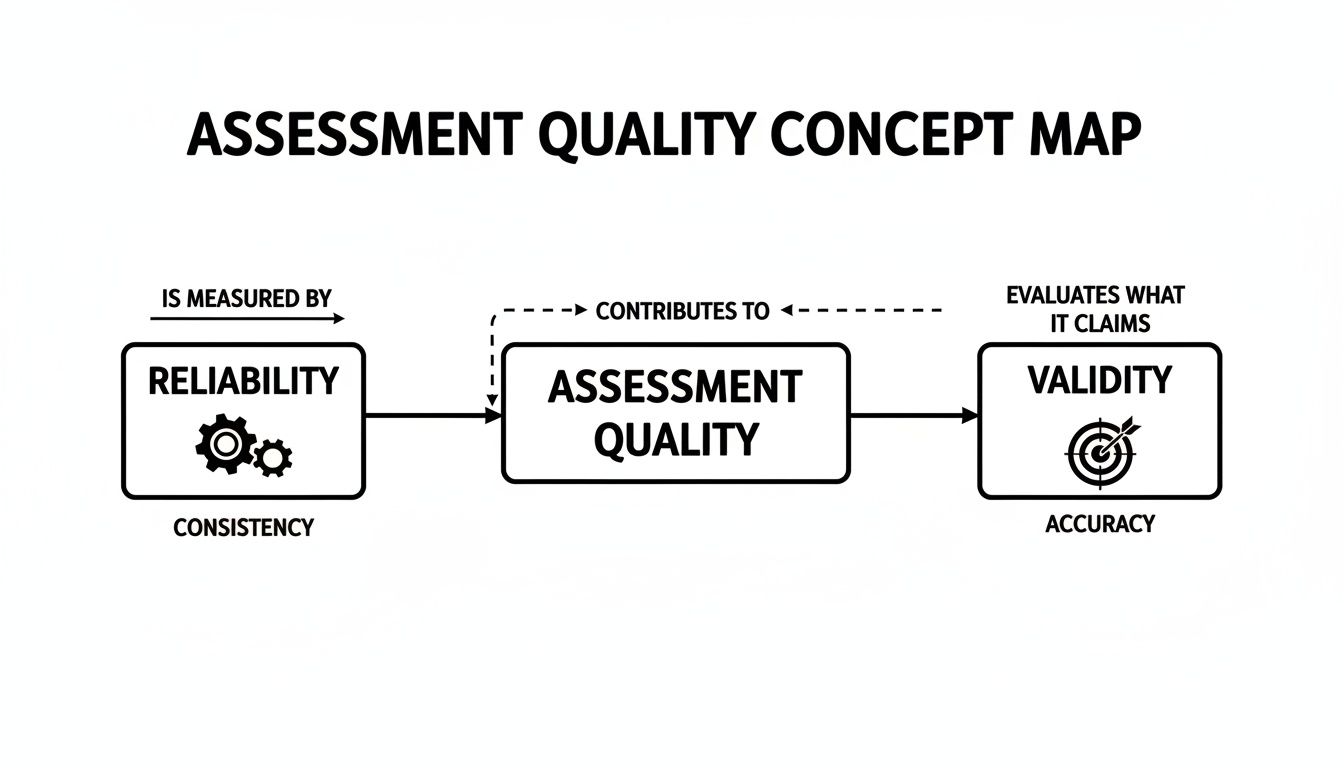
As you can see, reliability is about consistency (hitting the same spot over and over), while validity is about accuracy (hitting the bullseye).
At a Glance: Comparing Popular Personality Frameworks
This table breaks down the key differences between the Big Five, MBTI, and Enneagram to help you figure out which one might be the best fit for your goals.
| Framework | Focuses On | Primary Use | Scientific Standing |
|---|---|---|---|
| The Big Five (OCEAN) | Observable behaviors and traits on a spectrum. | Academic research, clinical psychology, broad personality description. | High (Considered the "gold standard" in psychometrics). |
| Myers-Briggs (MBTI) | How you perceive the world and make decisions, resulting in 16 types. | Corporate team-building, career counseling, general self-awareness. | Mixed (Popular but faces criticism on scientific validity). |
| The Enneagram | Core motivations, fears, and desires that drive behavior. | Deep personal growth, spiritual development, relationship dynamics. | Growing (Strong in therapeutic and coaching circles, with increasing validation). |
So, which map should you use? If you want a scientific snapshot of your traits, the Big Five is your go-to. If you need a simple framework for team dynamics, the MBTI can be a useful shorthand. But if you want to understand what truly drives you and unlock lasting personal growth, the Enneagram offers a map to the treasure.
Putting Your Personality Insights Into Action
So you've discovered your personality type. It’s a bit like getting the owner's manual to your own brain—fascinating stuff, right? But reading the manual is just the first step. The real magic happens when you start using that knowledge to fine-tune your life.
This is where the rubber meets the road. We're moving beyond the "what" and into the "so what?" The goal isn't just to label yourself but to use these insights to build a better career, stronger relationships, and a more fulfilling life.

Let's dive into how you can put these powerful insights to work.
Supercharging Your Career and Team
In the professional world, understanding personality is like having a secret weapon. When you know your own operating system—your strengths, your blind spots, your default settings—you can navigate your career with so much more skill.
It's a game-changer in job interviews, too. For instance, knowing what drives you makes it way easier to tackle common Behavioral Interview Questions and Answers with stories that actually land.
For anyone in a leadership role, these insights are pure gold. Imagine a manager in Silicon Valley, Tom, a classic Type 8 who's all about directness and getting results. He learns his top developer, Chloe, is a Type 5—someone who thrives on information and needs space to process.
Tom’s aha moment: His rapid-fire, "just get it done" style wasn't motivating Chloe; it was overwhelming her. So he pivoted. He started giving her detailed project briefs via Slack and scheduled weekly 1-on-1s, giving her the structure and autonomy she needed to do her best work.
The outcome? Chloe’s productivity shot through the roof, and the whole team felt the positive shift. That’s the power of personality-aware leadership. Tiny adjustments in communication can create massive wins. To explore this further, check out our guide on using personality assessments for team building .
Building Stronger Relationships
Let's be real—your personality patterns don't clock out when you leave the office. They're front and center in your personal life, shaping every interaction. Understanding them can be the key to breaking those frustrating, repetitive arguments and finally connecting on a deeper level.
Take Maria and Ben, a couple living in Florida. They were stuck in a constant battle over making vacation plans. Maria, a spontaneous Type 7, felt trapped by Ben's need to map everything out a month in advance. Meanwhile, Ben, a security-seeking Type 6, felt completely unmoored by her love for last-minute adventures.
Their assessment results changed everything. It clicked: They weren't trying to drive each other crazy. They were simply operating from two totally different core needs—Maria’s for freedom and Ben’s for security.
Armed with this new perspective, they cooked up a plan:
• A simple compromise: • They plan one weekend trip a month in detail (for Ben) and leave the other weekends completely open for whatever strikes their fancy (for Maria).
• A dose of empathy: • When they felt that old tension bubbling up, they could see it for what it was. Maria could now say with a smile, "Ah, I see your Six-ness is worried," and the frustration would just melt away.
Fueling Your Personal Growth
When all is said and done, the most profound use for any personality assessment is your own journey of self-discovery. It hands you a clear, compassionate language to make sense of your own inner world.
Once you can spot your core patterns, you can finally understand why you keep getting stuck in the same old ruts. You learn to catch your automatic stress reactions in the act, giving you the chance to consciously choose a better way. This is what real growth looks like—shifting from being a passenger in your own life to confidently grabbing the steering wheel.
How to Choose the Right Assessment for You
Alright, so you’re ready to jump in. Choosing a personality assessment can feel a lot like standing in front of a giant wall of TVs at an electronics store—they all look flashy, but which one is actually right for you ? The goal here isn't just to find something entertaining; it's to find a tool that gives you a clear, usable map for your own personal journey.
To find your perfect match, start with one simple question: What am I trying to figure out? Are you just looking for a quick snapshot of your behaviors for a work retreat, or are you ready to get to the bottom of the deep-seated motivations that make you tick? Knowing your goal is the fastest way to cut through the noise.
A Quick Checklist for Choosing Wisely
Let’s be real: not all assessments are built the same. Before you invest your time and energy, it pays to do a little recon to make sure you're getting the good stuff. A few minutes of upfront diligence can save you from getting flimsy results you can't actually use.
Run any potential assessment through this quick filter:
• Is it scientifically validated? • Look for any mention of reliability and validity. This is the single biggest difference between a serious psychometric tool and a fun-but-meaningless online quiz.
• Is the provider legit? • Stick with organizations that live and breathe this stuff. A good provider will back up their test with tons of easy-to-understand resources to help you make sense of your results.
• What kind of report will I get? • You want more than just a label. A high-quality assessment delivers a detailed, personalized report packed with specific, actionable advice for your growth.
Answering for Your Truest Self
So you've found a solid assessment. Now what? The accuracy of your results comes down to one crucial thing: your honesty . It’s so tempting to answer questions as the person you want to be—that perfectly organized, always-outgoing, super-adventurous version of yourself. But doing that just gives you a fuzzy, inaccurate picture.
For the most accurate and useful results, answer questions based on your most consistent patterns of behavior over time, not just how you feel today or who you aspire to be tomorrow.
Remember, your report isn't some final judgment or a label you're stuck with forever. Think of it as your starting line. It’s a completely non-judgmental snapshot of your inner world, designed to give you the self-awareness you need to kick off an exciting new chapter of growth.
The real adventure begins the moment you finish the test.
Got Questions? We've Got Answers.
Jumping into the world of personality can feel a bit like opening a big, mysterious box. It's only natural to have a few questions rattling around in your head. Let's tackle some of the most common ones that pop up.
Can My Personality Type Change Over Time?
This is the big one, isn't it? The short answer is: your core personality is pretty stable. Think of it like your home's foundation—it's solid, and it's not going anywhere. The deep-seated motivations and fears that define your type are pretty much baked in.
But here’s the good news: everything else is up for grabs. You can always renovate the rooms, swap out the furniture, or slap on a fresh coat of paint. This is what we call personal growth. A good assessment will often measure your "Health Level," showing how consciously you're living out the traits of your type.
So while you might always be a Type 2 Helper at your core, you can absolutely grow from someone who helps compulsively just to feel needed into a person who gives freely from a place of genuine love and abundance. That's a huge shift.
Are Personality Assessments Actually Accurate?
Ah, the million-dollar question. The accuracy of a personality test really hinges on two things: the quality of the test itself and how honest you are when you're taking it.
A scientifically validated assessment has been put through the wringer. It's been designed from the ground up to have high reliability and validity , which is just a fancy way of saying it consistently measures what it's supposed to measure, and it does it correctly.
But even the best test in the world can't read your mind. If you answer the questions based on who you wish you were, or who you think your boss wants you to be, your results will be a skewed reflection.
The secret to an accurate report? Answer from the gut. Be brutally honest about who you are right now, not who you aspire to be tomorrow. Think of it as a snapshot of your inner world—authenticity is the only way to get a clear picture.
How Are Personality Assessments Used in Hiring?
In the professional world, companies use these tools to get a fuller picture of a candidate, one that a resume just can't provide. It’s almost never about a "pass" or "fail" grade. Instead, it’s about understanding things like a person's natural communication style, how they handle pressure, and whether they’ll genuinely click with the team and company culture.
For example, imagine a fast-growing American tech startup in Boston hiring for a detail-oriented quality assurance role. They might use an assessment to find candidates who thrive in structured, methodical work—like a healthy Type 1 Reformer. It’s all about finding a fantastic match for both the person and the company, which ultimately leads to stronger performance and way higher job satisfaction. Everyone wins.
Ready to stop guessing and start knowing? The journey to truly understanding yourself is one of the most rewarding adventures you can take. At Enneagram Universe , we’ve poured our expertise into creating a scientifically validated assessment that gives you a clear, compassionate, and practical map of your inner world.
It’s time to discover what truly drives you and unlock your full potential.