What Is Personal Transformation? Definition, Stages, and How It Works

So, what is personal transformation, really? Let’s get one thing straight: it's not about slapping a new coat of paint on the house. It's about tearing the whole thing down to the studs and rebuilding from a new, stronger foundation.
This is the messy, profound, and conscious journey of becoming a more authentic version of yourself—not just better, but fundamentally different .
What Personal Transformation Really Means
We all love the caterpillar-to-butterfly analogy, and for good reason. The caterpillar doesn't just sprout wings; it literally dissolves into a primordial soup before re-emerging. That’s transformation. It isn’t about adding a few new skills or habits to your toolbox—that's just self-improvement.
Transformation is a complete overhaul of your internal operating system. It means putting your core beliefs, your identity, and your entire life under a microscope and asking, "Is this truly me?"
Going Beyond Surface-Level Changes
It's easy to confuse genuine transformation with its more popular cousins, self-improvement and personal development. While they're all related, they play in completely different leagues.
Let's break it down.
Transformation vs Improvement vs Development
| Concept | Core Focus | Process | Example |
|---|---|---|---|
| Self-Improvement | Adding or enhancing skills and habits | Additive (learning, acquiring) | Taking a public speaking course to get better at presentations. |
| Personal Development | Gradual growth and maturity over time | Evolutionary (unfolding naturally) | Gaining patience and wisdom as you navigate life's challenges. |
| Personal Transformation | A fundamental shift in identity and worldview | Reconstructive (shedding, rebuilding) | Realizing your career ambitions were based on others' expectations and completely changing your life's path. |
As you can see, chasing self-improvement can sometimes be a clever way our minds avoid the deeper, scarier work that real change demands. The market reflects our hunger for growth, with the global self-improvement industry valued at an incredible 46.1 billion** in **2025** and projected to nearly double to ** 90.9 billion by 2034 . This boom shows a massive global desire to understand our core motivations, fears, and desires.
A Practical Example of Transformation
Think of someone like Sarah, a sharp marketing executive in Chicago. From the outside, she was crushing it—great salary, slick apartment, a calendar full of social events. But on the inside, she was running on empty, feeling a nagging sense of being a stranger in her own life.
For years, Sarah threw self-improvement at the problem. She took productivity courses, read leadership books, and even switched high-powered jobs. Nothing worked. The emptiness followed her because the problem wasn't her job title; it was her very identity. She was living a version of success someone else had sold her.
Her real journey began when she stopped trying to "fix" her career and started asking who she was without it. This forced her to get radically honest about her values and purpose, setting the stage for a total internal shift. This is the heart of learning how to become more self-aware .
True transformation begins when the pain of staying the same becomes greater than the fear of change. It's a conscious choice to step into the unknown to find a more authentic way of being.
This inner work is where deep self-discovery tools shine. Frameworks like the Enneagram give you a map and a language for this territory, illuminating the core motivations and fears that run your life. Sometimes, people even find symbolic support in their environment, exploring concepts like the transformative power of Tanzanite gemstones . Ultimately, understanding your inner wiring is the first, essential step toward becoming the person you were always meant to be.
The Four Stages of Your Transformation Journey
Real, deep personal transformation isn't a single, dramatic lightning strike. It’s more like an expedition into a wild, uncharted territory—your own inner world. It's a journey that unfolds in four distinct acts, a cycle that's deeply personal but follows a surprisingly predictable path.
Knowing these stages is like having a map for that expedition. It helps you find your bearings when things get confusing and reassures you that the messy, chaotic moments are just part of the terrain. Instead of feeling lost, you can see yourself for what you are: an explorer navigating a known world.
Stage 1: The Awakening
This is where it all begins. The Awakening is that nagging feeling that something just isn't right. It’s a quiet whisper that grows into a roar, telling you that the life you’re living and the person you are have fallen out of sync.
This stage is often kickstarted by a big life event—a breakup, a layoff, a health scare. But sometimes, it just bubbles up from a profound sense of emptiness, that feeling of just going through the motions. A practical example is a successful American lawyer in his late 40s who, despite his achievements, finds himself staring out his office window every day, feeling completely hollow and questioning if this is all there is to life. The key feeling here is awareness . You're finally noticing the gap between the life you have and the life you want.
Stage 2: The Exploration
Once you're awake, you stumble into the Exploration phase. This is where you start pulling at the threads and questioning everything . Your career, your beliefs, your relationships, the expectations you've been carrying for years—it all goes under the microscope. Honestly, it can feel disorienting and messy, like you’ve been dropped in a foreign country without a GPS.
This is a time for pure curiosity. You might find yourself:
• Devouring books on psychology, philosophy, and spirituality.
• Starting a journal to try and make sense of the chaos in your head.
• Trying out new hobbies or traveling to places that push you out of your comfort zone.
• Using tools like the Enneagram Universe assessment to finally understand what makes you tick.
Think of it this way: David, a software engineer in Austin, built his entire identity around his high-powered tech job. When he was unexpectedly laid off, it triggered his Awakening . The "successful tech guy" costume suddenly felt hollow.
He dove headfirst into The Exploration , desperate for answers. He took our Enneagram test and discovered he was a Type 3, "The Achiever," driven by a core fear of being worthless. Boom. That single insight explained his entire life's pursuit of external validation. It showed him why the layoff felt like a complete failure of self, not just a career hiccup. That knowledge became his compass.
Stage 3: The Integration
The Integration stage is where you start piecing everything together. After the whirlwind of exploration, you begin connecting the dots and weaving all your new insights into a new, more authentic version of you. It's less about searching and more about building. You’re taking the raw materials you gathered and laying a new foundation.
This is a quiet, internal process of letting the old you go with compassion. For instance, an American who identified as a "people-pleaser" might start practicing saying "no" to small requests from friends, feeling awkward at first but gradually integrating the belief that their own needs are valid. You consciously start practicing new ways of thinking and behaving, even when they feel clumsy at first. It’s about putting the theory into practice.
This is where you really grasp the difference between simple improvement and true transformation.
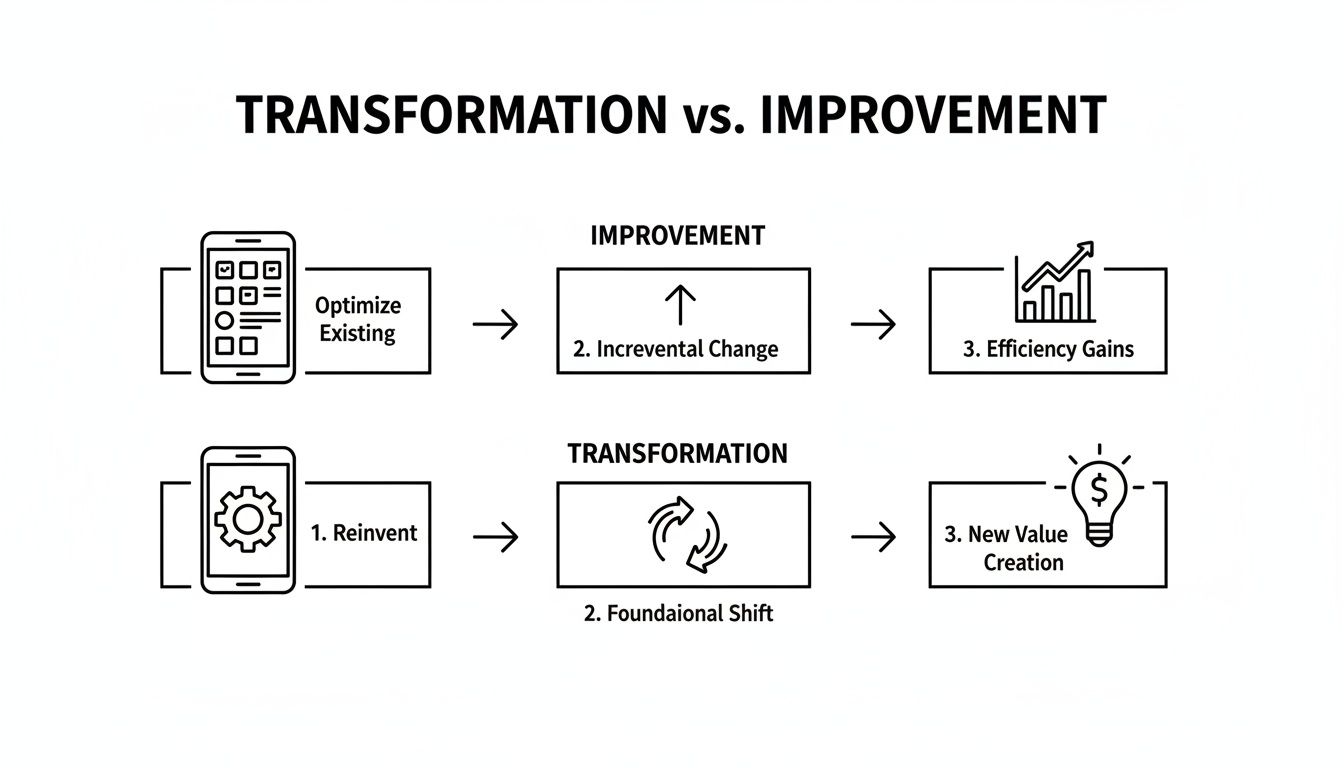
As the image shows, improvement is like adding a few new apps to your phone. Transformation is upgrading the entire operating system.
Stage 4: The Embodiment
And finally, we arrive at Embodiment. This is where your new reality becomes effortless. All those conscious efforts you made during integration are now second nature. Your actions align with your core values without you even having to think about it.
Embodiment is the shift from thinking about your new self to simply being your new self. It’s when your transformed identity becomes your lived, authentic experience.
You don't just know your values; you live them. For example, a formerly anxious American entrepreneur no longer needs a checklist to manage her stress; she instinctively schedules downtime and delegates tasks because self-care has become part of her core identity, not just a strategy. You don't just practice setting boundaries; you are a person with healthy boundaries. This stage isn’t some final finish line, but a new, more authentic starting point for the rest of your life. It's the beautiful, peaceful reward for all of your brave inner work.
Signs You're Already in the Thick of It
If you’re going through a real transformation, it almost never feels clear or heroic. It usually feels like you’re lost in a thick fog, completely disoriented. You can't see where you're headed, and the path you were on has vanished. It's confusing, a little lonely, and frankly, you might feel like you're losing your mind.
Here’s the secret, though: those messy, confusing feelings are the surest signs that you’re right in the middle of a profound internal shift. This isn’t just a new mindset; it's a deep-down rewiring of your entire being. Seeing these signs for what they are can help you feel less crazy and more like you're actually on the right track.

Your Social Life Gets a Shake-Up
One of the first and most jarring things people notice is a change in their friendships. The people and parties that used to light you up might suddenly feel like a chore. This isn't you becoming a hermit; it's your inner world changing, and your outer world is struggling to keep up.
Take Maria, a teacher from Miami who was always the life of the party. Her weekends were a whirlwind of big dinners and packed beach days. Lately, though, she’s been turning down invitations. It's not because she's sad; she just has this powerful urge for quiet.
A Saturday morning spent journaling or taking a long walk alone now feels more fulfilling than any social event. Her old friends don't really get it, and some of those connections are naturally fading. Maria is going through a classic phase of transformation: she’s shedding the social roles that no longer fit , creating space for the person she’s becoming.
"A significant part of the journey is realizing that some people were only meant to be a part of your story, not your destiny. Letting go isn't a failure; it’s making room for who you are becoming."
This often comes with a newfound craving for solitude. Don't mistake it for loneliness. It’s a necessary retreat to process all the inner changes and finally hear your own voice without everyone else’s shouting over it.
Your Core Beliefs Start to Crack
It’s not just your social life that gets rearranged. The very foundation of your beliefs might start to feel shaky. All the "truths" you built your life on—about what success looks like, what love means, what you owe your family—are suddenly on the negotiating table. It can feel like the ground is falling out from under you.
You might find yourself questioning everything:
• Your Career: • Is that corporate ladder you’ve been scrambling up even leaning against the right wall? A practical example is an American financial analyst who suddenly questions the ethics of his industry, a belief he never challenged before.
• Your Relationships: • Are your partnerships based on real connection, or just habit and a fear of being alone?
• Your Values: • What do • you • actually believe in, once you strip away what you were taught to believe?
This is the messy, gooey part of the process. You're like a caterpillar dissolving in its chrysalis—it's not pretty, but it’s the only way to grow wings. You’re taking apart the old instruction manual to write a new one that’s 100% yours.
Navigating the Obstacles to Lasting Change
If personal transformation was as easy as just deciding to change, we’d all be enlightened butterflies by now, right? The reality is a lot messier. The path is full of roadblocks—some are sneaky gremlins whispering in your ear, while others are very real pressures from the world around you. But here's the secret: figuring out what these obstacles are is the first, most crucial step to blowing right past them.
This journey isn't just about picking up new, shiny habits. It's about looking your own personal roadblocks square in the eye. And trust me, these challenges are a normal—and even necessary—part of the whole process.
The Internal Resistance to Change
More often than not, the biggest battles are fought inside our own heads. Our brains are hardwired for safety, for what’s predictable. Any kind of deep, meaningful change can feel like a five-alarm fire to our internal security system. This resistance usually pops up in a few classic, powerful ways.
• Fear of the Unknown: • Your brain would rather stick with a misery it knows than gamble on a joy it doesn’t. Stepping into a new version of yourself means leaving the old one behind, and that leap into the void can feel absolutely terrifying.
• Deep-Seated Limiting Beliefs: • We all have them. They’re the quiet, unconscious rules we live by—"I'm not smart enough," "I'll never get it right," "I don't really deserve to be happy." Real transformation demands that you drag these beliefs out into the light and dismantle them, which can feel like questioning your own reality.
• Imposter Syndrome: • Just as you start making progress, a little voice pipes up: "Who do you think you are, anyway?" That feeling of being a fraud is just your old identity trying to reel you back into the familiar comfort zone.
Let’s talk about Michael, an entrepreneur from Denver. He's a textbook Enneagram Type 3, "The Achiever," which means he's fueled by a need to look successful at all costs. His biggest internal obstacle? A paralyzing fear of failure. He’d come up with brilliant business ideas but would freeze up, terrified of making a single mistake that could smudge his perfect image.
When he figured out his Enneagram type, a lightbulb went on. Michael realized his fear wasn't just a business problem—it was woven into the very fabric of his identity. This awareness was everything. It allowed him to completely reframe what "risk" meant. Instead of seeing a potential flop as a final verdict on his self-worth, he started treating it like collecting data. That simple mental shift was all it took to get him unstuck, turning his biggest roadblock into rocket fuel.
External Pressures and Expectations
Of course, it’s not all in your head. The world around you can throw up some serious hurdles, making your personal growth feel like you’re trying to swim upstream against a powerful current.
The people and environments that supported your old self may not be equipped to support the person you are becoming. This isn’t a judgment—it’s a reality of growth.
These external hurdles often show up as:
• Unsupported Relationships: • Sometimes, friends, family, or even partners can feel confused or threatened by your new direction. A practical example: an American woman decides to leave her stable but unfulfilling corporate job to become an artist, and her parents express constant worry and disapproval, subtly pressuring her to return to her "safe" career.
• Societal and Cultural Expectations: • Society loves a good script—how we "should" live, work, and love. When you decide to go off-script to follow your own authentic path, you can expect a few critics in the audience.
• Workplace Demands: • The modern business world adds its own unique pressure. Deloitte's 2026 Global Human Capital Trends report found that • 70% • of leaders are now pushing for speed and nimbleness, demanding constant adaptation from their teams. This creates a fascinating link: companies filled with self-aware, adaptable people report being • 23% • more profitable. There’s a real, bottom-line cost to letting these personal obstacles win.
Getting through these challenges takes a combination of inner grit and a new set of tools. When you're facing resistance from others or from within, learning specific tactics for change can be a game-changer. You can discover effective behavioral change strategies that offer a practical playbook for exactly these moments.
So, How Do You Actually Start This Transformation Thing?

The whole idea of "personal transformation" can sound massive, right? Like you're supposed to scale Mount Everest in your sneakers. But here's the secret: every grand expedition starts with one small, intentional step. Forget the overwhelming destination for a moment. Let's focus on your first move.
Real change doesn't kick off with some dramatic, life-altering action. It begins with awareness. You can't get to where you're going if you don't know exactly where you're standing right now.
Step 1: Get to Know the Real You
Before you can shift anything, you have to understand what you're working with and why it operates the way it does. This is where a tool like the Enneagram isn't just helpful—it's a game-changer. It gives you a specific, surprisingly accurate language for your inner world, taking you from vague hunches to crystal-clear insights.
The Enneagram Universe assessment is your personal blueprint. Taking the test provides a detailed map of your personality, revealing the core mechanics of you.
• Your Type: • This uncovers your primary motivation—that deep, fundamental desire that secretly runs the show and shapes how you see everything.
• Your Wing: • Think of this as a "flavor" that adds a unique twist to your core type, showing which neighboring type you borrow traits from.
• Your Triad: • This points to your default emotional home base. Do you lead with your head (Thinking), your heart (Feeling), or your gut (Instinct)?
Getting a handle on these elements is like someone finally handing you the user manual for your own brain. It’s the non-negotiable first step in creating a change that's actually designed for you , not some generic self-help clone. These insights become the solid ground you'll build everything else on.
Step 2: Practice Ridiculous Self-Kindness
As you start uncovering your patterns, you’re going to meet the parts of yourself you've kept in the dark—your triggers, your knee-jerk defense mechanisms, your shadow. Your first instinct will probably be to cringe and judge yourself. Hard.
This is your moment to do the opposite. Practice radical self-compassion.
Remember, every single one of those patterns showed up for a reason: to protect you at some point. For example, an American man who discovers his anger is a defense against feeling vulnerable can practice saying to himself, "It makes sense that I got angry. That situation felt threatening. It's okay." Instead of shaming the anger, he gets curious. Ask, "What was this behavior trying to accomplish for me?" Being kind to yourself, especially when you’re staring at uncomfortable truths, is the only thing that makes lasting change stick. It's critical because without it, self-discovery sours into self-criticism, and growth grinds to a halt.
Step 3: Curate an Environment That Cheers You On
Your surroundings—both the people you're with and the space you're in—have a huge say in whether you'll succeed. You have to consciously build an environment that supports the person you’re becoming, not one that keeps you tethered to the person you were.
This might look like:
• A Social Media Detox: • Unfollow accounts that spark that ugly comparison bug or just make you feel • less than • . Follow people who inspire you to think bigger and learn more.
• Drawing Loving Lines: • Get comfortable communicating your needs to friends and family. This might mean saying "no" more often or unapologetically blocking out time just for you.
• Carving Out a "You" Corner: • Dedicate a small spot in your home for reflection. For example, an American in a small New York apartment might create a "you corner" by simply placing a comfortable cushion and a single plant by a window, designating it as a no-phone zone for morning meditation.
To make sure your new habits actually stick, it helps to learn about unlocking the secrets of success for personal goals . Taking this kind of proactive approach to your environment is what turns your transformation from a vague idea into a daily reality.
And as you get deeper into the work, you'll find that an expert guide can make all the difference. That's where something like Enneagram coaching for personal growth can become one of your most powerful tools.
True transformation isn't just about changing your mind; it's about changing your life. And your life happens in the environments you create and inhabit every single day.
Think about it: in a world where 92% of companies expect to overhaul their business models, our personal ability to adapt isn't just a "soft skill" anymore—it's essential. This is where personal transformation work pays off in the real world. Studies show that teams with high self-awareness see tangible results, like 29% boosts in sales and 34% jumps in productivity. For you, it means understanding your own motivations is the first step toward navigating all this change with confidence. You can read the full research on human capital trends at Deloitte to see just how crucial this is.
Burning Questions About Personal Transformation (Answered!)
Once you decide to really look inward, a million questions start bubbling to the surface. It's a messy, fascinating, and sometimes confusing path. So, let's clear up a few of the big ones you're probably already asking.
So, How Long Does This Take?
Ah, the million-dollar question. The honest answer? There's no finish line. Personal transformation isn't a 12-week challenge you can check off a list; it’s a lifelong commitment to showing up for yourself.
A better way to picture it is like a spiral staircase. You'll keep circling back to the same core lessons, but each time you'll be a little higher up, seeing them with fresh eyes and a deeper understanding. Some seasons will feel like a whirlwind of rapid change, while others will be quiet periods of letting it all sink in. The trick is to fall in love with the process itself and let go of the need for a deadline.
The real win is embracing the journey. Big breakthroughs are exciting, but it's the quiet, steady evolution that changes everything.
Is This Going to Hurt?
In a word, yes. And anyone who tells you otherwise is selling something. Real, lasting change isn't just about positive affirmations and vision boards. It demands that you open doors you've kept bolted shut for years and sit with the uncomfortable feelings you’ve become an expert at avoiding.
This is the heart of what's often called "shadow work" —facing the limiting beliefs, old wounds, and parts of yourself you'd rather ignore. It can mean outgrowing relationships that once felt like home or shedding identities you thought defined you. That stings. There’s a genuine grief in letting go.
But that discomfort is your compass. It's a sign that you're finally dealing with the root of the issue, not just the symptoms. Those are the growing pains of becoming who you were truly meant to be. The mess is a prerequisite for the clarity that follows.
Should I Get a Therapist or a Coach?
Great question. The right choice really hinges on a single idea: are you trying to heal your past or build your future?
Here's a quick way to think about it:
• See a Therapist to heal. • A therapist is a trained mental health professional who helps you navigate and process past trauma, difficult experiences, and conditions like anxiety or depression. Their work is often about helping you move from a place of surviving to a place of stable, healthy functioning.
• Hire a Coach to build. • A coach is your future-focused accountability partner. They're there to help you get crystal clear on your goals, map out a strategy to achieve them, and cheer you on. Coaching helps you move from being functional to becoming exceptional.
Honestly, for a truly deep transformation, you might find a combination of both is the magic formula. Self-discovery tools like the Enneagram hand you the map, therapy helps you patch up the wounds from old battles, and a coach acts as your strategist for the road ahead.
Where Does the Enneagram Fit Into All This?
If this whole transformation thing is an epic journey, think of the Enneagram as your personal, high-tech GPS. It cuts through all the generic self-help noise and gets right to the heart of what makes you tick.
Instead of just guessing at what to work on, the Enneagram gives you a clear and stunningly accurate blueprint of your inner world. It reveals:
• Your • core motivation • : The hidden engine driving your decisions.
• Your • deepest fear • : The trigger that sends your defenses into overdrive.
• Your unique and predictable • path to growth • : No more trial and error!
• The specific • blind spots • : The exact things tripping you up again and again.
Knowing your Enneagram Type makes the entire process so much more direct. You finally understand why you do the things you do, which allows you to work with your personality, not against it. It turns a vague goal like "I want to be happier" into a clear, actionable game plan made just for you.
Your path of self-discovery is yours alone, but you don't have to walk it blindfolded. The Enneagram Universe assessment is designed to give you that first, crucial map of your inner world. Find your type, discover your unique growth path, and start your journey with clarity by taking our free, in-depth Enneagram test today.