What Is “Personal Agency” and How Can You Build It?

Ever get that nagging feeling that you’re just a character in someone else’s movie? Is life something happening to you, not by you? If so, you've bumped up against the concept of personal agency .
Put simply, personal agency is the rock-solid belief that you are the one steering your own ship. It's that inner knowing that you can influence what happens next, make choices that matter, and carve out your own path instead of just getting swept along by the current. For example, it’s the difference between waiting for a promotion to be offered and actively building the skills and network to earn it.
Are You the Driver or the Passenger in Your Own Life?
Think of your life as a great American road trip. Are you gripping the steering wheel, map in hand (or, let's be real, GPS on the dash), deciding where to go and when to stop? Or are you slumped in the passenger seat, just watching the world blur by, totally at the mercy of the driver and whatever detours they decide to take?
That’s the difference between high and low personal agency in a nutshell.
When you’re operating from a place of strong personal agency, you feel like the protagonist of your story. You aren’t just a bystander getting knocked around by circumstance; you're an active, engaged participant. You truly believe your choices, actions, and attitude shape your reality.
On the flip side, feeling like a passenger is deeply frustrating. Life can feel like a string of random events you have no say in, leaving you feeling stuck, helpless, or like a victim of fate. It's easy to fall into a pattern of blaming outside forces—the economy, your boss, just plain bad luck—for where you've ended up. A practical example is blaming a failed job interview on a tough market instead of asking what you could have done to prepare better.
The Rise of Agency in a Chaotic World
This isn't just a self-help buzzword; it's a massive shift in how people are approaching their lives. In a world that feels increasingly chaotic and unpredictable, people are looking inward and grabbing the reins where they can.
It’s pretty telling that over 72% of people globally feel optimistic about their own lives , even while a mere 16% expect the world situation to stabilize. This shows a powerful pivot toward what we can actually control: ourselves. We're seeing this at work, too, with employee engagement on the rise as people feel more empowered to define their roles. You can dig into more of this fascinating trend in The Age of Agency report.
Personal agency is the shift from asking, "Why is this happening to me?" to asking, "What can I do about this?" It's the core belief that you can make things happen on purpose.
Let's break down what a life with high agency looks like compared to one with low agency.
Personal Agency at a Glance
This table gives you a quick snapshot of the two mindsets in action. Are you the Driver or the Passenger?
| Life Area | High Personal Agency (The Driver) | Low Personal Agency (The Passenger) |
|---|---|---|
| Decision-Making | "I choose my path." Proactive and intentional. | "Things just happen to me." Reactive and passive. |
| Mindset | Sees opportunities and solutions. Growth-oriented. | Sees obstacles and limitations. Fixed mindset. |
| Response to Setbacks | "What can I learn from this?" Takes ownership. | "It's not my fault." Blames external factors. |
| Goals | Sets and actively pursues meaningful goals. | Drifts without clear direction or purpose. |
| Relationships | Actively shapes healthy, supportive connections. | Falls into relationships by chance or convenience. |
Seeing it laid out like this makes the distinction crystal clear. Cultivating that "Driver" mindset is the bedrock of resilience, personal growth, and creating a life that actually feels like yours .
This journey toward agency is the foundation for everything else. It’s what allows you to build genuine self-awareness and live with intention. For those looking to take the wheel in their professional lives, learning how to become a thought leader is a masterclass in applying personal agency to build influence.
Tools like the Enneagram can be your personal GPS on this journey, showing you the "you are here" dot by illuminating your core motivations and unconscious habits. When you understand what drives you, you can navigate with so much more confidence. The first step is always recognizing what's going on under the hood, and our guide on how to become more self-aware is the perfect place to start.
Ultimately, it all begins with believing that you can, in fact, take the wheel.
The Four Ingredients of True Personal Agency
Personal agency feels like a single, powerful force, but if you look under the hood, you’ll find it’s really a combination of four distinct psychological parts. Getting to know them is the first step toward consciously building them up in your own life.
Think of it like this: if you want to bake a fantastic cake, you need flour, sugar, eggs, and butter. Leave one out, and you don’t get a cake—you get a mess. The same goes for agency. These four pillars—autonomy, self-efficacy, intentionality, and accountability—are the foundation of what it means to be the driver of your life, not just a passenger.
Let's break them down.
Autonomy: The Freedom to Choose Your Destination
First up is autonomy . This is your fundamental freedom to make choices that are true to you —your values, your desires, your gut feelings—without being shoved around by outside pressures. It’s the core ingredient that says, “I get to decide where this car is going.”
Imagine Maria, a graphic designer in Atlanta, stuck in a corporate job. Her parents are pushing for her to climb that ladder, get the promotion, and play it safe. But her heart is set on starting her own freelance business that works with sustainable brands. Her autonomy is what allows her to honor that vision and take the entrepreneurial exit ramp, even when others are telling her to stay on the highway.
It's the "what" and the "where" of your journey—your right to pick the destination.
Self-Efficacy: Your Confidence in Your Driving Skills
Next, we have self-efficacy . This is your deep-down belief that you have what it takes to get things done. If autonomy is choosing the destination, self-efficacy is the confidence that you can actually handle the drive, navigate rush-hour traffic, and even figure out how to change a flat tire if you get one.
This isn't just wishful thinking. It's a earned confidence, built brick by brick from past wins, hard-earned practice, and seeing other people succeed. Research shows over and over that a strong sense of self-efficacy fuels better performance and helps you bounce back from setbacks.
Take David, a startup founder in Chicago with a brilliant idea but no budget for a developer. Instead of throwing in the towel, he decides to learn to code himself. His self-efficacy is that voice inside saying, "This is going to be tough, but I'm capable of learning this." Every small bug he fixes and every line of code that works bolsters that belief, turning a little bit of confidence into real, tangible skill.
Intentionality: Knowing Your Route and Your Reason
The third ingredient is intentionality . This is all about doing things on purpose. It’s having a map, knowing why you chose this particular destination, and making deliberate moves to get there. Intentionality is what turns a random drive into a road trip with a purpose.
Without it, you might be behind the wheel, but you’re just wandering aimlessly. Intentionality means you’re not just reacting to whatever the road throws at you; you’re proactively planning your route. A practical example is choosing to go to a networking event to meet specific people in your industry, rather than just showing up and hoping for the best.
Here, you can really see how agency boils down to a clear choice: are you steering, or are you just along for the ride?
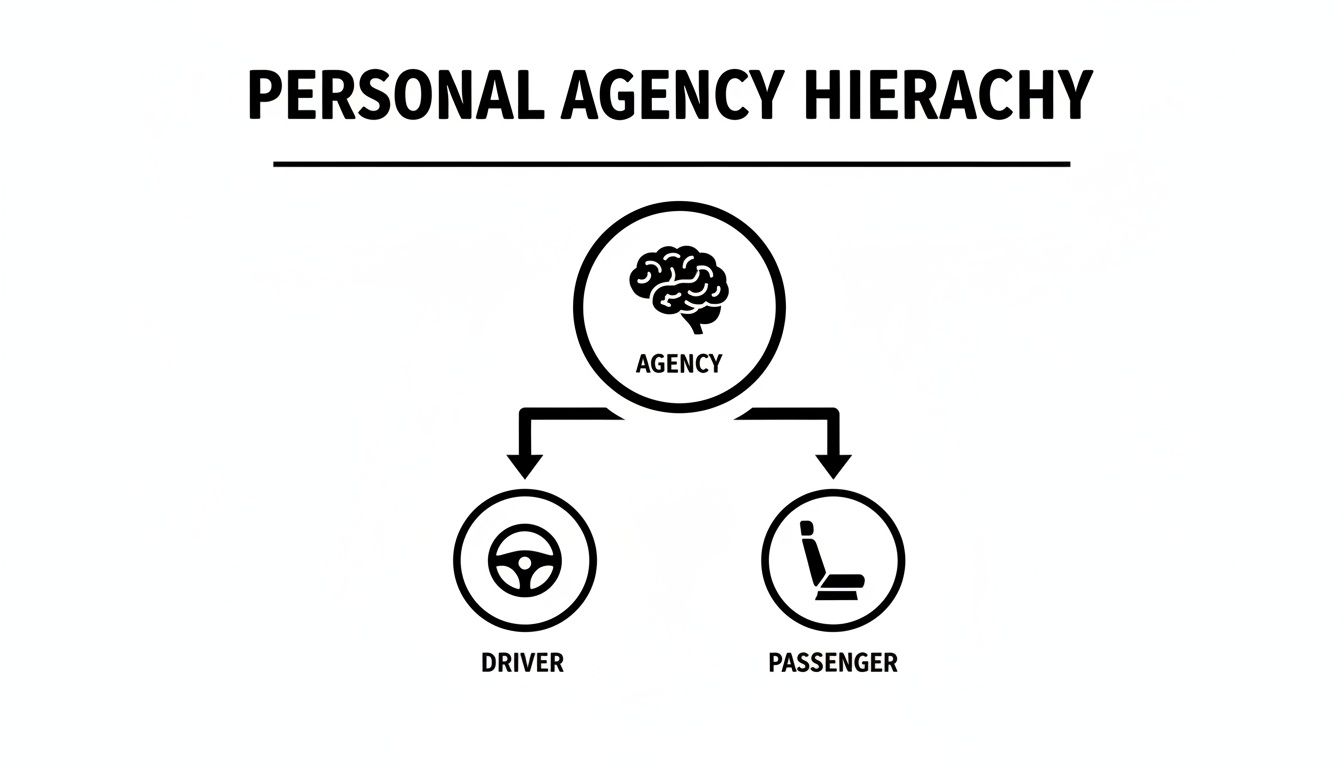
This simple diagram nails it. Agency isn't some fuzzy concept; it's the active decision to be the 'Driver' with your hands on the wheel, not the 'Passenger' dozing in the back.
A person with intentionality doesn't just "end up" somewhere. They arrive. They connect their daily actions to a larger vision, ensuring every step, big or small, serves their ultimate goal.
Accountability: Owning Every Turn You Make
And finally, we have accountability . This is the big one: the willingness to take full ownership of your actions and their outcomes, for better or for worse. It’s about owning your driving, whether you hit a pothole, take a wrong turn, or discover a beautiful scenic route completely by accident.
Accountability means you don't blame the GPS, the traffic, or the rain when things go sideways. Instead, you look at your own choices and ask, “What was my part in this, and what can I do differently next time?” A practical example is if you are late for a meeting, you don't blame traffic; you acknowledge you should have left earlier to account for potential delays. This is the secret sauce that ensures you learn from the journey and become a better, smarter driver over time.
When you mix these four ingredients together, you get true personal agency. You’re not just free to choose ( autonomy ), but you believe you can pull it off ( self-efficacy ), you act with a clear plan ( intentionality ), and you own your results ( accountability ). That powerful combo is what really, truly puts you in the driver’s seat of your life.
How High and Low Agency Plays Out in Real Life
Knowing the definition of personal agency is one thing, but seeing it in the wild is when the lightbulb really goes on. The difference between high and low agency isn't just some abstract psychological concept; it's a completely different way of walking through the world. It shows up everywhere—from how you handle a crisis at work to how you navigate the tricky territory of your closest relationships.
So, let's ditch the theory for a minute and get real. We'll follow two fictional folks from Texas, Sarah and Tom, as they run into the exact same life hurdles. Their wildly different responses will paint a crystal-clear picture of what it looks like to be the driver of your life versus a passenger just along for the ride.
The Career Setback: A Tale of Two Responses
Picture this: Sarah and Tom work at the same company in Austin. On a random Tuesday, they're both blindsided by the news that a massive project—one they've poured their souls into for months—is being scrapped. Budget cuts. It’s a gut punch for both of them.
Tom (Low Agency): Tom is completely deflated. He feels like a victim of circumstance, and his whole day spirals. He grumbles to coworkers, aimlessly scrolls through job postings on LinkedIn, and lets the bad news loop in his head. That evening, he tells his partner, "This is just my luck. I can't catch a break. There's literally nothing I can do." He's stuck, focusing only on what happened to him .
Sarah (High Agency): Sarah is just as disappointed, but her reaction is a world apart. She gives herself an hour to feel the sting, then she gets moving. She sets up a meeting with her boss to ask, "Since that project is off the table, what are the new priorities? Where can my skills do the most good right now ?" She then pings a contact in another department, letting them know she suddenly has some free time and would love to help with their upcoming launch.
She doesn't see a dead end; she sees a detour. And she knows she gets to choose her next turn . Tom is passive, waiting for things to get better. Sarah is proactive, building something new from the wreckage.

The Relationship Conflict: How Agency Shapes Connection
Now, let's bring it home. Both Sarah and Tom have been feeling a growing distance from their partners. The connection feels off, and tiny disagreements are starting to feel like major battles.
Personal agency is the shift from seeing relationship problems as something you just have to suffer through, to seeing them as puzzles you can actively solve—together.
Here's how they each tackle the same quiet crisis:
• Tom's Approach (Low Agency): • He completely ignores the elephant in the room. Tom just hopes it'll all magically fix itself. He might drop a few passive-aggressive hints about his unhappiness but would rather die than start a real conversation—he's terrified it'll blow up into a huge fight. His inner script is, • "If she really loved me, she'd just know something was wrong." • He's outsourced the entire responsibility for the relationship's health to his partner. This is a classic pattern for people-pleasers. If that sounds familiar, our guide on • • how to stop being a people-pleaser • • can help you find your voice.
• Sarah's Approach (High Agency): • Sarah is scared of conflict, too, but she decides her relationship is worth the risk. She gently tells her partner, "Hey, I've been feeling like we're a bit disconnected lately, and I really miss us. Can we find some time this weekend to just talk and get back on the same page?" She takes • accountability • for her own feelings and • intentionally • opens the door for a solution. She's not placing blame; she's inviting teamwork.
Sticking to a Personal Goal
Last one. Both Sarah and Tom decide they want to get in shape and commit to a new fitness routine.
Tom's Path (Low Agency): Tom gets a gym membership and is enthusiastic for about a week. Then a stressful day at work comes along, and he skips a workout. That one miss becomes the perfect excuse to throw in the towel completely. "See? I'm just not a disciplined person," he tells himself, chalking it up to a fixed character flaw instead of a simple choice.
Sarah's Path (High Agency): Sarah also has a crazy day and misses a workout. But instead of quitting, she gets curious. "Okay, trying to drag myself to the gym after a draining workday is clearly not working," she thinks. "What if I tried going first thing in the morning instead?" She adjusts her plan. She iterates. That's self-efficacy in action—the core belief that she can figure it out.
These stories show that personal agency isn't about having a perfect, problem-free life. Far from it. It's about how you choose to react when the inevitable problems pop up. It's the conscious, powerful decision to grab the steering wheel, especially when the road gets rough.
The Incredible Ripple Effect: How Taking Charge Changes Everything
Building your personal agency isn't like flipping a switch. It's more like starting a positive feedback loop that quietly begins to reshape every corner of your life. When you decide to grab the steering wheel, you don't just change your destination—you change the entire experience of the journey. This powerful shift is the catalyst for real, tangible benefits that ripple outward, touching everything from your mental health to your career and relationships.
When you start operating from a place of high agency, you stop just reacting to life’s storms and start actively building a more resilient ship. This proactive stance is a potent antidote to anxiety and stress. Instead of feeling overwhelmed and helpless, you begin to focus on what you can control, breaking down scary, enormous problems into small, manageable steps.
A Healthier Mind and a Stronger Spirit
Think about it. So much of our anxiety comes from feeling powerless in the face of uncertainty. When you exercise your agency, you shrink that chaos down to a manageable size. Setbacks stop feeling like proof of your inadequacy and start looking more like useful data points for your next move. For example, instead of spiraling into anxiety about a looming presentation, a person with high agency starts practicing their speech and preparing for potential questions.
This process builds incredible resilience. You genuinely start to trust your ability to handle whatever life throws your way, which is the very heart of emotional strength. It’s a complete game-changer for your overall well-being.
At its core, personal agency is the shift from "I hope things get better" to "I will make things better." It's the ultimate upgrade to your internal operating system.
And this is where knowing your Enneagram type can be a massive accelerant. Take a Type 6, for example, whose core fear is lacking support. Their default reaction might be to wait for others to provide reassurance. But armed with that self-awareness, a Type 6 can use their agency to proactively build their own security systems . They can create strong networks and reliable plans instead of just hoping for safety to show up. This single shift transforms their entire approach from reactive fear to empowered action.
Fueling Your Professional Success
This sense of ownership has a huge impact on your career. People with high personal agency don't just sit around waiting for a promotion to land in their lap. They actively seek out opportunities, ask for the projects that excite them, and deliberately build the skills they need to get ahead. They become natural leaders simply because they take initiative and own their results—good or bad.
The recent explosion in remote work really throws this connection into sharp relief. Agency is amplified when you have more control over your environment and schedule. A staggering 98% of agency employees now want permanent remote work policies , and it’s not hard to see why. Teams with this kind of flexibility are far more productive; 73% achieve four or more hours of deep work remotely , compared to just two hours in the office. Globally, only 21% of employees feel engaged, but those with agency—like many remote workers—see their thriving rates jump to 33%. The full story is in the 2021 Global Agency Productivity Report .
Fostering Deeper, Healthier Relationships
Finally, that ripple effect absolutely extends to your connections with other people. High agency allows you to set clear, healthy boundaries because you genuinely value your own needs and choices. You stop being a passive passenger in your relationships and start actively co-creating them.
What does that look like in practice? Better communication, way less resentment, and more authentic connections. You're able to articulate what you need and truly listen to what others need, working together to build something supportive and genuine. A practical example is saying "no" to a social event you don't have the energy for, instead of going resentfully and feeling drained afterward. It’s the difference between just drifting along in a relationship and intentionally building a partnership based on mutual respect and a shared sense of direction.
Using the Enneagram to Unlock Your Agency
To really build personal agency, you have to get honest about your own internal operating system. What’s behind your knee-jerk reactions? What hidden fears are secretly pulling the strings? The Enneagram is so much more than a personality type; it’s a dynamic map of your inner world, and it’s a powerful key for unlocking your own agency.
It shines a light on the hidden ‘why’ behind your choices, helping you move from living on autopilot to making conscious, deliberate moves. The Enneagram isn't about boxing you in—it's about showing you the box you're already in so you can finally find the door.
From Self-Awareness to Deliberate Action
Getting to know your core fears and deepest motivations is the first real step toward taking back your power. Enneagram Universe's scientifically validated, 180-question assessment is designed to give you a precise, actionable guide for this kind of deep self-discovery.
Once you know your Enneagram Type, Wings, and Levels of Health, you have a personalized strategy to break free from the patterns holding your agency hostage. It’s like someone finally handed you the user manual for your own mind.
Let's take a Type 3, The Achiever, for example. Their core drive is to feel valuable and worthwhile. This often pushes them to chase external validation—the next promotion, a flood of social media likes, an impressive job title. This becomes a low-agency trap, where their self-worth is constantly outsourced to others for approval.
But with Enneagram insights, a Type 3 can consciously shift their focus and build real agency. They can start defining success on their own terms, making sure their goals align with what they truly value, not just what gets applause. This is how they build a more sustainable and fulfilling life, one where they are the true author of their success.
The Enneagram helps you answer the single most important question for building agency: "What's really driving me right now?" When you know the answer, you can finally choose to take the wheel.
Agency in the Workplace: A New Perspective
This shift from unconscious reaction to conscious choice can be a game-changer, especially at work. Just look at employee engagement, which is often a great barometer for agency in the workplace. The numbers tell a story of massive untapped potential: globally, just 21% of employees feel engaged in their jobs.
But when self-awareness leads to real choice, everything changes. Scientifically validated assessments like ours reveal your core motivations, and when your role aligns with your core type, you can become up to 3x more engaged . That’s huge, especially when you consider that low engagement costs the global economy an eye-watering $8.8 trillion in lost productivity every year. The folks who build their agency are the ones who thrive. You can see more of these stunning workplace stats over at Archieapp .
Taking a comprehensive test to find your wings, triads, and desires gives you a clear roadmap to boosting your own agency and, in turn, your performance.
A Practical Roadmap for Every Type
Each Enneagram type has its own unique path to building stronger personal agency. The trick is to spot the core fear that creates the low-agency trap and then take a specific, often counterintuitive, action to break free. For a much deeper dive into finding your own profile, check out our guide on how to find your Enneagram type .
Here’s a quick look at how this plays out for different types.
Unlocking Agency with Your Enneagram Type
Understanding what trips you up is the first step toward freedom. Here’s a snapshot of how each type can turn their core fear into a superpower for agency.
| Enneagram Type | Core Fear (Low Agency Trap) | Agency-Building Action |
|---|---|---|
| Type 1 The Reformer | Of being corrupt, evil, or defective. | Intentionally embracing imperfection and practicing self-compassion when mistakes inevitably happen. |
| Type 5 The Investigator | Of being useless, helpless, or incapable. | Moving from analysis to action; sharing knowledge and engaging with the world before feeling "fully prepared." |
| Type 9 The Peacemaker | Of loss and separation; of conflict. | Asserting their own needs and opinions, even if it might create a little temporary disharmony. |
Once you understand your specific Enneagram blueprint, you can stop fighting against your nature and start working with it. You learn how to turn your greatest challenges into your most powerful assets for building a life driven by your own conscious choices.
Practical Exercises to Strengthen Your Agency Today
Alright, enough theory. Reading about personal agency is one thing, but actually building it is where the real change happens. Think of agency like a muscle—you can’t just read about getting stronger. You have to do the reps.
So, let's get our hands dirty. Here’s a toolkit filled with simple, powerful exercises you can start the minute you finish this section. These aren't just abstract ideas; they're daily practices designed to move you from the passenger seat of your life right into the driver's seat.

Clarify What You Can Actually Control
Feeling overwhelmed? The "Circles of Influence" exercise is a game-changer. It’s a dead-simple way to visually untangle what you can control from what you can’t, cutting through the anxiety and focusing your energy where it actually counts.
The whole point is to shift your energy and attention inward, to that center circle. That’s your power zone.
Uncover Your Hidden Power of Choice
We make countless choices every day, completely on autopilot. A "Decision Audit" yanks those unconscious decisions into the light, forcing you to reclaim your intentionality.
This isn’t about beating yourself up over past choices. It’s about waking up to how many choices you’re already making. That awareness is the first step toward making better ones on purpose.
Try this: for just one day, keep a running list of every single choice you make. Seriously, everything . Hitting snooze, what you wear, the tone you use in an email—write it all down. At the end of the day, look at your list and ask a simple question for each one: "Did this move me closer to the life I want, or further away?" You’ll be stunned to see how many small hinges swing very big doors.
Build Momentum with Tiny Wins
Self-efficacy—that rock-solid belief that you can do things—isn't built on wishful thinking. It's built on a mountain of evidence. The "Tiny Wins" method is how you start gathering that proof, one small piece at a time.
Pick one goal for today that is so easy it’s almost laughable. Not “run a marathon,” but “put my running shoes on and walk to the end of the driveway.” Not “clean the entire house,” but “put one dish in the dishwasher.”
Every tiny win is a little message to your brain that says, "See? I did it." It proves you're someone who follows through, and that creates unstoppable momentum. And if you're looking to build discipline in other areas, like learning, digging into some good online course tips can help you take charge there, too.
Frequently Asked Questions About Personal Agency
Once you start exploring the idea of personal agency, a bunch of questions usually pop up. It’s one of those concepts that feels familiar on the surface, but the more you dig, the more layers you find. Let's tackle some of the most common ones that come up when people start grabbing the steering wheel of their own lives.
Is Personal Agency Just Another Word for Independence?
Not exactly, but they're definitely related. Think of it this way: independence is about self-sufficiency—not needing to rely on others. You could be fiercely independent, living on your own and handling all your own affairs, but still feel like you’re just reacting to life, which is a sign of low agency.
Personal agency goes a step further. It's the internal conviction that you can actually influence what happens next, whether you act alone or rally the troops. A great leader, for instance, uses their agency to bring a team together. That's an act of interdependence , not just independence.
Can You Have Too Much Personal Agency?
It’s less about having "too much" and more about how you wield it. When someone plows ahead with their goals without a second thought for how it affects others, that’s not really high agency. It’s more like a distorted, unhealthy version of it—a bulldozer approach. For example, a manager with distorted agency might push their team to meet a deadline by working all weekend, ignoring the impact on their well-being.
True, healthy personal agency is always balanced with empathy and social awareness. It’s about being the author of your own life story, not trying to snatch the pen and write everyone else’s.
How Does Agency Relate to Motivation and Self-Control?
They’re like a three-person crew on a road trip.
• Personal agency • is the core belief that you’re the one who can actually drive the car.
• Motivation • is the fuel in the tank—the • why • behind your desire to get to a specific destination.
• Self-control • is the skill of keeping your hands on the wheel and navigating distractions, even when the journey gets boring or tough.
You really need all three to get anywhere meaningful. Agency without motivation is a car that can run but has nowhere to go. Motivation without agency is a full tank of gas in a car you don't believe you can drive. And without self-control, you’ll just keep pulling over for every shiny distraction on the side of the road.
Ready to uncover the hidden drivers shaping your sense of agency? It all starts with radical self-awareness. Enneagram Universe provides a scientifically validated assessment that gives you a clear, practical map of your inner world. Take our free Enneagram test and start your journey today.