What Is My Type?: An Entertaining Guide to the Enneagram

If you’ve ever caught yourself thinking, "What is my type?" you’re asking one of the most fundamental questions of all. You’re not just looking for a convenient label. You're trying to get to the heart of what makes you tick—your deepest motivations, your quirks, and your unique way of seeing the world.
This question is the starting line for a fascinating journey of self-discovery. And lucky for us, there’s a powerful map to help navigate it: the Enneagram.
Your Guide to Answering “What Is My Type?”
Forget those stuffy, one-dimensional personality quizzes that try to cram you into a box. The Enneagram is something different entirely. Think of it less as a label and more as a dynamic, living map of your inner landscape.
It’s a system designed to illuminate not just what you do, but the deep-seated why behind your actions. It gets to the core of your motivations, your hidden fears, and your most powerful desires. Essentially, it’s a framework that finally makes sense of those automatic patterns of thinking, feeling, and behaving we all fall into.

The Enneagram outlines nine fundamental personality types, and each one operates from a completely unique worldview. Getting to know your type can be a game-changer, unlocking profound personal growth, dramatically improving your relationships, and bringing a new level of clarity to your life's path.
The Nine Core Personalities
At the heart of the Enneagram are the nine distinct personality archetypes. Each type is a different strategy for navigating the wild ride of life. To get our bearings, let's take a quick look at the core desire that drives each one.
The Nine Enneagram Types at a Glance
This table offers a snapshot of the primary motivation behind each of the nine types. As you read through them, see if any of these resonate on a gut level.
| Type Number | Nickname | Core Desire |
|---|---|---|
| 1 | The Reformer | To be good, balanced, and have integrity. |
| 2 | The Helper | To feel loved and wanted. |
| 3 | The Achiever | To feel valuable and worthwhile. |
| 4 | The Individualist | To find their identity and significance. |
| 5 | The Investigator | To be capable and competent. |
| 6 | The Loyalist | To have security and support. |
| 7 | The Enthusiast | To be satisfied and content. |
| 8 | The Challenger | To protect themselves and control their own lives. |
| 9 | The Peacemaker | To have inner stability and peace of mind. |
Looking at this, you start to see how different people can be driven by completely different internal compasses. It's a powerful first step in understanding yourself and others.
Interestingly, a huge survey of 189,957 people found that Type 9 (The Peacemaker) is the most common type at 16.2% , with Type 6 (The Loyalist) a close second at 16.1% . This might explain why so many of us are deeply motivated by a need for harmony, security, and stability.
As you explore the Enneagram, it can be incredibly helpful to pair it with other self-discovery tools. For instance, learning to accurately find your love language can add another rich layer to your understanding of how you connect with others.
Ready to figure out where you fit in this map? Let’s dive deeper.
Meet the Nine Personalities on the Enneagram
Alright, let's get to the fun part. To really get a handle on what "your type" is, we need to do more than just read a list of traits. We need to meet these nine personalities out in the wild. Think of this as your field guide to the human psyche—a way to spot the hidden motivations that drive people, including the person staring back at you in the mirror.
Each of the nine types has a completely unique way of seeing and moving through the world. This worldview is shaped by a core desire they're always chasing and a deep-seated fear they're always running from. Let's see what that actually looks like.
The Heart Center: Types 2, 3, and 4
First up, let's meet the Heart types. These folks are all about feelings, relationships, and how they appear to others. They answer the question "Who am I?" by looking at their connections and their image.
• Type Two: The Helper • • Practical Example: • You know Sarah from the PTA, the one who organizes the annual bake sale and somehow remembers everyone's birthday with a handwritten card? That's a classic Two. She's driven by a powerful need to be loved and wanted, and she's terrified of being seen as useless or being cast aside. Her warmth is absolutely genuine, but it's also her go-to strategy for earning her place in people's lives.
• Type Three: The Achiever • • Practical Example: • Now picture Michael, the real estate agent who seems to know everyone in town. He's charming, impeccably dressed, and his LinkedIn profile is a masterclass in self-branding. Threes are wired to feel valuable and worthwhile, and their biggest nightmare is being perceived as a failure. For them, success • is • worth, which makes them incredibly driven, adaptable, and masters of presenting a winning image.
• Type Four: The Individualist • • Practical Example: • Over in a cozy, dimly lit coffee shop, you'll find Maya. She’s a graphic designer, a poet, someone who feels things deeply and is on a lifelong quest for her unique identity. Fours are terrified of having no significance or being fundamentally flawed. This fear fuels their drive to be authentic and special, cultivating a distinct style and expressing the beautiful, often melancholic, depths of their inner world.
The Head Center: Types 5, 6, and 7
Next, let's wander over to the Head Center. These types live in their minds, constantly thinking, planning, and analyzing. Their main game is managing anxiety and finding a sense of security in a world that can feel unpredictable and overwhelming.
The Enneagram isn't about boxing you in. It’s a dynamic tool that shows you the box you're already in and gives you the tools to step outside of it.
Spotting these patterns is the first real step toward breaking free from them. Each type's strategy is just a coping mechanism that's become an automatic, lifelong habit.
• Type Five: The Investigator • • Practical Example: • Meet David. He’s the brilliant but quiet software engineer who’d rather spend a weekend deep-diving into historical documentaries than go to a crowded party. Fives want to feel competent and capable, and they dread being helpless or overwhelmed. To counter this, they hoard knowledge and resources (like time and energy), often withdrawing into their minds to feel safe and prepared.
• Type Six: The Loyalist • • Practical Example: • Think of Maria, the project manager who has a contingency plan for her contingency plan. Sixes are amazing troubleshooters because their minds are always scanning for what could go wrong. They crave security and support and are deeply afraid of being without guidance. This makes them incredibly loyal and responsible, but also prone to anxiety and second-guessing everything.
• Type Seven: The Enthusiast • • Practical Example: • And who’s that planning a cross-country road trip and a weekend getaway at the same time? That's Ethan. Sevens are the ultimate optimists, always chasing the next exciting experience. They have a deep desire to be happy and satisfied, and their greatest fear is being trapped in boredom or emotional pain. So, they keep moving, planning, and dreaming to keep their spirits high and their anxieties at bay.
The Gut Center: Types 8, 9, and 1
Finally, we have the Gut types. These personalities operate from a place of instinct and impulse. They’re concerned with control and justice, and they relate to the world by either resisting it, shaping it, or merging with it to maintain their inner peace.
• Type Eight: The Challenger • • Practical Example: • Jessica, the startup CEO who isn't afraid to challenge the board and will go to bat for her team every single time? Total Eight. Eights are driven to protect themselves and control their own destiny. They can't stand being controlled or harmed by others. Their big, powerful energy and take-charge attitude are their tools for making sure they—and the people they care about—are never vulnerable.
• Type One: The Reformer • • Practical Example: • Remember the person at the homeowners' association meeting who has a perfectly organized binder and a clear vision for how things • should • be? That’s Mark, a classic One. He has a powerful inner sense of right and wrong, and he's on a mission to improve himself and the world around him. His deepest fear is being corrupt or defective, which fuels a relentless inner critic that pushes him toward perfection.
• Type Nine: The Peacemaker • • Practical Example: • And then there’s Tom, the guy everyone in the office loves. He’s easygoing, supportive, and can magically smooth over any conflict during a tense meeting. Nines want nothing more than inner stability and peace of mind. Their biggest fear is loss and separation, which often leads them to go with the flow and merge with others' agendas to keep the waters calm and avoid rocking the boat.
As you read through these little snapshots, you probably felt a flicker of recognition for yourself or people you know. That's the first step. To go deeper, you can learn more about the nine personality types and see which story truly feels like yours.
Adding Depth with Wings, Triads, and Health Levels
So you’ve found your core Enneagram type. Awesome! That's a huge first step. But it's a bit like finding your home state on a map—it tells you where you are, but it doesn't describe the unique landscape, the vibe of the neighboring towns, or what happens when a storm rolls in.
To get a real feel for your inner world and nail down the answer to "what is my type?", we need to add these layers of detail. This is where the Enneagram stops being a list of nine boxes and starts becoming a dynamic, living map of you.
Let’s dive into three concepts that bring your type to life: Wings , Triads , and the Levels of Health .
Your Personality Wings
Here's a secret: nobody is a "pure" version of their Enneagram type. We're all a blend, influenced by the two types sitting right next to ours on the Enneagram symbol. We call these your Wings .
Think of them as your personality's sidekicks. They add distinct flavors, quirks, and strengths to your core number, explaining why two people with the same type can seem so different.
For instance, let's look at a Type 9, The Peacemaker. They can have a wing on either side:
• A • 9 with an 8-wing (9w8) • often comes across as more grounded and assertive. • For example, • this could be a mediator who is calm and receptive (9) but also firm and direct when needed to resolve a conflict (8). They’ve got the chill, go-with-the-flow vibe of the 9, but they’ve borrowed some of the 8’s take-charge confidence.
• A • 9 with a 1-wing (9w1) • , on the other hand, tends to be more idealistic and orderly. • For example, • this might be a social worker who is patient and non-judgmental (9) but also driven by a strong ethical code to advocate for their clients (1). They mix the 9's easygoing nature with the 1's principled sense of right and wrong.
You’re influenced by both of your neighbors, but one wing is almost always stronger. Understanding your dominant wing is a game-changer. You can dig deeper into how Enneagram Wings shape your personality to see which one feels more like you.
This concept map shows how different Enneagram types—like the principled Type 1, ambitious Type 3, and adventurous Type 7—are all powered by completely different core motivations.
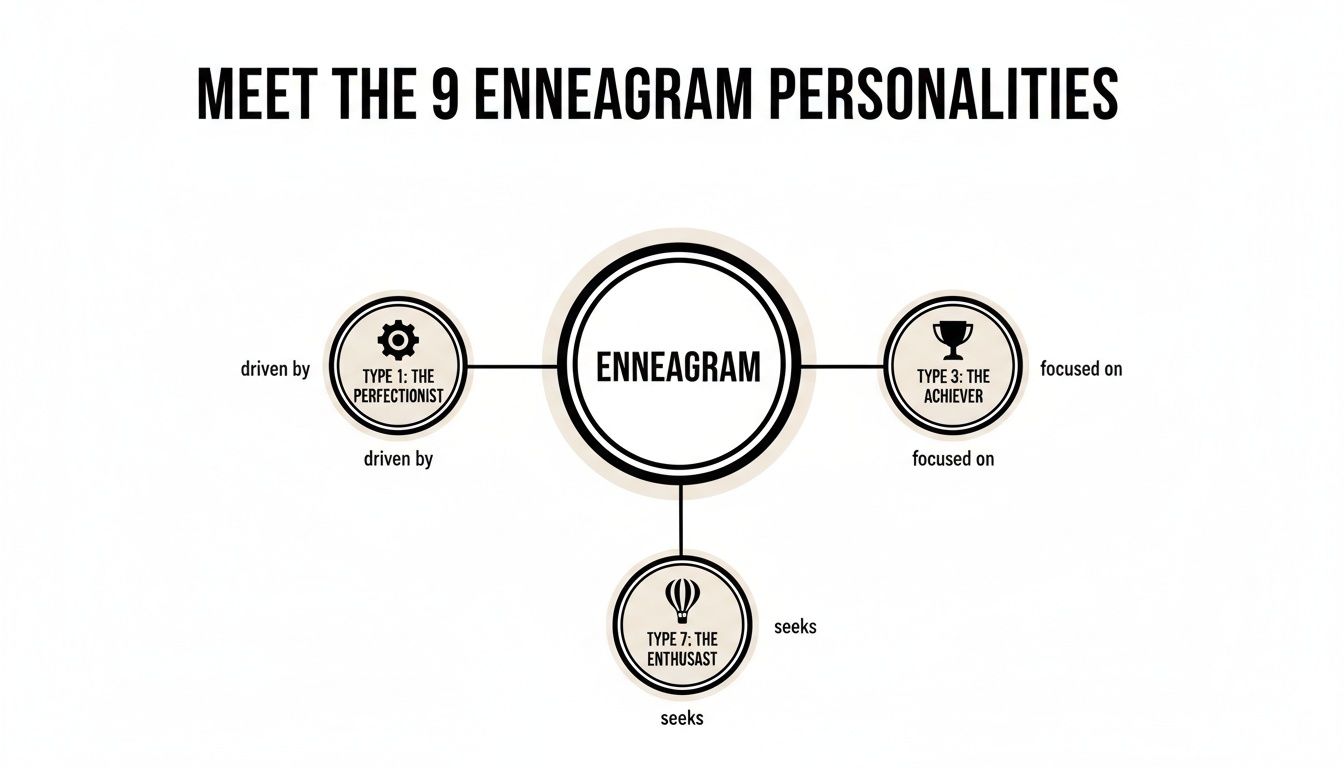
It’s a great visual reminder that while we all have different goals, we're all part of the same fascinating, interconnected system of human personality.
The Three Centers of Intelligence
The Enneagram also organizes the nine types into three groups of three, called Triads or Centers of Intelligence. Think of it as your default operating system: the Heart , the Head , or the Gut . Your triad tells you which center you rely on most and what core emotion is secretly running the show.
• The Heart Triad (Types 2, 3, 4): • These folks are all about feelings. They are deeply concerned with their image, how others see them, and creating connection. The emotion bubbling just under the surface for them is • shame • .
• The Head Triad (Types 5, 6, 7): • It's all about thinking for this group. They process the world through analysis, trying to find security and plan for the future. The emotion that drives them is • fear • .
• The Gut Triad (Types 8, 9, 1): • This triad runs on instinct. They are focused on control, justice, and their place in the world, making decisions from a visceral, intuitive place. Their core emotion is • anger • .
Knowing your triad is like finding the source code for your automatic reactions. A Type 3 business leader might filter a setback through the lens of shame ("How does this failure make me look?"), while a Type 6 colleague would process the exact same event through fear ("Oh no, what's going to happen next?").
The Levels of Health
Finally, and maybe most importantly, is the concept of Levels of Health . This shows that your personality isn't a fixed, static thing. It’s a dynamic scale that shifts depending on your self-awareness, stress levels, and personal growth.
A healthy Type 1 is wise, discerning, and fair. An unhealthy Type 1, however, can become rigid, punitive, and judgmental. The core type doesn't change, but its expression absolutely does.
This is the most hopeful part of the Enneagram. It’s not just a label; it’s a roadmap for becoming the best version of yourself. It shows you what your most empowered, brilliant self looks like and gives you a flashing red light for when you're slipping into stress.
By putting it all together—your wings, your triad, and your health levels—you move past a simple number and unlock a powerful tool for real, lasting personal growth.
How to Nail Down Your True Type
Alright, so you’ve met the nine types, and a few of them probably felt a little too familiar. But what if you feel like you’re a mix of several? That’s completely normal. The thing is, trying to find your type based on what you do is like judging a book by its cover—it’s the story inside that matters.
The Enneagram isn't about your behavior; it’s about the why behind your behavior. It’s all about the hidden motivation humming away beneath the surface.
Mistyping is incredibly common because different types can look alike from the outside. For instance, you might be super helpful and think, "Aha! I'm a Type 2!" But why are you helpful? Is it because you have a deep need to be loved and wanted (a classic Type 2 motivation), or is it because you're trying to keep everything calm and avoid conflict (hello, Type 9)? See the difference?
Cutting Through the Confusion
To get past the surface stuff, you have to play detective with your own psyche. It’s time for an honest-to-goodness internal audit. Before you can truly know your type, you need to cultivate deeper self-awareness ; this is the bedrock of the whole process.
Let's look at a few classic mix-ups. Read these and see what resonates.
• Ambition vs. Security: • Are you hustling for that promotion to feel valuable and earn admiration (Type 3)? Or is that drive really about building a solid 401(k) so you can finally feel safe (Type 6)?
• Recharging vs. Protecting: • Do you pull away from others after a party to journal and figure out who you are (Type 4)? Or do you retreat to read a book and protect yourself from being drained (Type 5)?
• Leading for Control vs. Leading for a Cause: • Do you jump into the driver's seat on a group project to stay in control and protect yourself from being vulnerable (Type 8)? Or is it because you have a burning need to make sure things are done the • right • way, according to your principles (Type 1)?
The right answer isn’t the one that makes you look good. It’s the one that makes you squirm a little. Your true type often lies in the motivation you don’t really want to admit to, even to yourself.
This kind of self-reflection can feel a bit raw. We all have a polished PR story we tell ourselves about who we are. The Enneagram asks you to peek behind the curtain.
The Litmus Test: Your Deepest Fear
If you’re still torn between a couple of types, try this. It’s a gut-check that rarely fails. Read the Core Fear for each of the types you’re considering. Don’t just skim them—sit with each one for a minute.
Which one makes your stomach clench? Which one feels so terrifyingly awful that you’d do almost anything to avoid it? That visceral, knee-jerk reaction is your North Star. It’s pointing directly at the fear that has been secretly calling the shots your entire life.
Of course, you don't have to go it alone. A solid, well-researched assessment can give you a massive head start. If you're ready to get some clarity, taking a quality free Enneagram test is a great next step to help narrow down the possibilities and get you on the right track.
Using Your Enneagram For Real-World Growth
Alright, you’ve done it. You’ve figured out your Enneagram type. It’s like being handed a ridiculously detailed, slightly terrifying, and incredibly accurate map of your own mind. But here's the thing about maps: they're not the destination. The real adventure starts when you actually use that map to go somewhere new.
The goal isn't just to slap a number on your chest and call it a day. The real magic happens when you take that newfound self-awareness and use it to build a more conscious, intentional life. It’s about catching yourself in those old, automatic patterns and choosing to do something different for a change.

This process looks completely different for everyone because, well, we’re all wired differently. What works for one type might be a total disaster for another.
Your Own Personal Growth Playbook
You know that generic, one-size-fits-all advice you see everywhere? It rarely works because it doesn't get to the heart of why you do what you do. A growth plan that energizes a go-getter Type 3 could feel like a nightmare to a peace-loving Type 9. The secret is to work with your personality, not wage war against it.
Let’s get practical:
• A • Type 7 (The Enthusiast) • , who lives in a constant whirlwind of future plans, can find incredible power in simply being • here • . Their growth work is about practicing • mindful presence • —maybe it’s just savoring a cup of coffee for five minutes without checking their phone, truly tasting it instead of just fueling up for the next big thing.
• A • Type 6 (The Loyalist) • , whose inner critic is always working overtime, needs to practice • trusting their own gut • . This could start small, like making a dinner decision without polling the entire family, and learning to sit comfortably with their own choice.
Understanding your Enneagram type allows you to see the box you've been living in. Growth is the act of learning how to open the door and step outside whenever you choose.
This kind of insight doesn't just change you; it transforms your relationships. Suddenly, you understand that when your Type 2 partner keeps doing things for you, it’s their way of asking for love, not a sneaky attempt to take over. You start to see your Type 8 boss’s blunt feedback as a sign of respect, not a personal attack. It's a total game-changer.
A Growth Path For Each Enneagram Type
Knowing your type’s core struggle is the first step. The next is taking one small, intentional action to move in a healthier direction. Here’s a quick-start guide to get you going.
| Type | Core Challenge | First Growth Step |
|---|---|---|
| 1: The Reformer | The relentless inner critic and fear of being "bad." | Intentionally do something imperfectly and let it be. Example: Send an email with a minor typo and resist the urge to correct it. |
| 2: The Helper | Needing to be needed; neglecting personal needs. | Say "no" to a request without giving a long explanation. Example: When asked to volunteer, simply say, "I can't this time, but thank you for thinking of me." |
| 3: The Achiever | Equating self-worth with success and image. | Share a failure or vulnerability with a trusted friend. Example: Tell a friend about a project at work that didn't go as planned. |
| 4: The Individualist | Getting lost in feelings of melancholy or deficiency. | Engage in a simple, physical activity to ground yourself. Example: Go for a 10-minute walk and focus only on the feeling of your feet on the pavement. |
| 5: The Investigator | Withdrawing to conserve energy; fear of being overwhelmed. | Share one interesting thought or feeling with someone. Example: Mention an interesting fact you learned from a podcast to a colleague. |
| 6: The Loyalist | Seeking external security and guidance; self-doubt. | Make a small decision based on your own judgment. Example: Choose a new restaurant for dinner without reading any online reviews first. |
| 7: The Enthusiast | Avoiding pain and boredom by chasing the next thing. | Sit with a difficult feeling for five minutes without distraction. Example: Instead of immediately planning something fun after a disappointment, just notice the feeling of sadness for a few moments. |
| 8: The Challenger | Needing to be in control and avoid vulnerability. | Actively listen to someone else's opinion without interrupting. Example: In a meeting, let a colleague finish their entire point before you formulate your response. |
| 9: The Peacemaker | Merging with others' agendas to avoid conflict. | State a personal preference, even if it's a small one. Example: When asked where to get takeout, say what you actually want instead of "I'm fine with anything." |
This table isn't about fixing yourself—it's about gently stretching the muscles that your type's automatic patterns have let atrophy.
Putting Your Knowledge Into Overdrive
This whole journey gets a lot more powerful when you don't go it alone. Platforms like Enneagram Universe offer scientifically validated tests that do more than just pinpoint your type. They hand you personalized growth plans and even let you compare results with a partner or your team, which can unlock some seriously deep insights into how you all relate.
And for the real nerds out there, seeing how the Enneagram overlaps with other personality systems can be incredibly illuminating. Did you know that statistical analysis shows over 60% of people who are ESFJs in the Myers-Briggs system are also Enneagram Type 2s? Or that ENTPs are almost always Type 7s? Seeing these patterns can shed light on everything from relationship dynamics to why you love (or hate) your job. You can dive deeper into these trends by checking out data on the most common Enneagram types .
Got Questions? We've Got Answers.
As you start poking around the Enneagram, a few questions always bubble to the surface. It’s a deep well, so feeling curious (and maybe a little confused) is a fantastic sign you’re getting somewhere good. Let's tackle some of the big ones.
So, Can My Enneagram Type Change Over Time?
This is the question I hear most often. The short answer? Nope. Your core Enneagram type is baked into your personality pretty early on. Think of it as the fundamental operating system you’ve been running your whole life.
But here’s the crucial part: how you express that type can change massively. With a bit of self-awareness and intentional work, you can shift from a reactive, unhealthy version of your type to a balanced, integrated one. You don't become a different number; you become the best, most liberated version of yourself.
What If I Feel Like a Mix of a Few Different Types?
First off, welcome to the club! Feeling a pull toward multiple types is not only normal, it’s practically a rite of passage. The reality is, we have a little bit of all nine types in us. Who hasn’t felt the ambition of a Three before a big presentation or the protective instincts of an Eight when a friend is in trouble?
Your core type isn’t about the behaviors you sometimes show. It’s about the one core motivation that’s always humming beneath the surface, and the one core fear that’s always whispering in your ear.
When you strongly resonate with other numbers, you're usually getting a sneak peek at your wings or your stress and growth points. This is exactly why a solid assessment is so valuable—it helps you tune out the behavioral static and home in on the foundational why that truly defines your type.
Are Enneagram Tests Actually Accurate?
Honestly, it's a mixed bag. The accuracy of any Enneagram test boils down to its quality. A quick, 10-question quiz you find on social media might be a fun distraction, but a high-quality, scientifically validated assessment is a whole different beast. The best ones are designed to uncover your core motivations, not just your habits.
Think of it like this: a great test isn’t a magic eight ball that spits out a final answer. It’s more like a wise guide that points you toward one or two likely destinations. The final confirmation always comes from you, after sitting with the detailed descriptions and seeing what truly clicks. A good test gets you to the right neighborhood; your own self-honesty is what leads you to your front door.
Ready to stop guessing and get a clear, insightful answer to the big question, "What is my type?" The scientifically validated assessment from Enneagram Universe is the single best next step you can take. It doesn't just give you a number; it hands you a detailed map of your inner world, complete with practical advice for your growth journey.