What Is My Enneagram Wing And How Do I Find It

So, you've figured out your core Enneagram type. But does the description feel... incomplete? Like it's 90% right, but missing that last little piece of you ?
That's where your Enneagram wing comes in. It’s the secret ingredient that explains the fascinating nuances of your personality.
Your Personality's Secret Sidekick
If your core Enneagram type is the main character in your life's movie, your wing is the scene-stealing sidekick. They’re the one who adds depth, unexpected plot twists, and a little extra spice to the whole story. Without the sidekick, the hero just isn't as interesting.
Your wing is the number right next to your core type on the Enneagram symbol. For example, a Type 9 can have either a 1-wing or an 8-wing . This neighboring number doesn't change who you are at your core, but it absolutely colors how you show up in the world.
What Exactly Is An Enneagram Wing?
Think of it like this: your core type is the main course, say, a perfectly grilled steak. It's the star of the show. Your wing is the sauce you choose to go with it—a fiery pepporn or a rich, earthy mushroom. The steak is still a steak, but the sauce completely changes the experience.
That's how wings work. They are one of the two numbers adjacent to your main type on the Enneagram circle. Your core fears and desires remain the same, but the wing brings in its own set of motivations and behaviors. It’s a blend, not a replacement.
Your wing isn't a second personality type you switch into. It’s more like a permanent filter that colors how your main type expresses itself.
Let’s look at a real-world example with the Enneagram Type 2 , The Helper, whose main drive is to feel loved and needed.
• A • 2 with a 1-wing (2w1) • infuses that helping nature with the structured, principled energy of the Type • 1 • . This is the friend who shows their love by helping you organize your finances, offering thoughtful, moral guidance, or tidying your chaotic kitchen before you've even asked.
• A • 2 with a 3-wing (2w3) • , on the other hand, mixes their helping drive with the ambitious, image-conscious charm of the Type • 3 • . This 2 might show love by being your biggest cheerleader, connecting you with influential people, or hosting a dazzling party to celebrate your success.
See the difference? Both are fundamentally Type 2s , but their wings create two very distinct expressions. This is why two people with the same core type can seem worlds apart. Digging into the nuances of “ Enneagram With Wings ” is what takes your self-awareness to the next level.
Quick Guide To Your Enneagram Wing
To make it even clearer, here’s a simple cheat sheet breaking down the concept of wings.
| Concept | What It Means For You |
|---|---|
| Your Wing Is | One of the two numbers right next to your main type on the circle. If you're a Type 9, you have a 1-wing or an 8-wing. |
| Your Wing Does | It adds a distinct "flavor" or "style" to your core type, influencing how you think, feel, and act. |
| Your Wing Is Not | A completely separate personality. It’s a secondary influence that enhances and sometimes complicates your core patterns. |
| Why It Matters | Understanding your wing is the key to unlocking a much deeper, more accurate picture of yourself and others. |
Think of this as the missing piece of the puzzle. Once you see it, the whole picture of who you are finally clicks into place.
How Your Enneagram Wing Fuels Personal Growth
Figuring out your Enneagram wing isn't just a quirky bit of personality trivia. It’s more like finding a secret key that unlocks a whole new level in the game of you. This is where the subtle pushes and pulls inside you finally make sense, transforming abstract self-help ideas into a real, practical roadmap for growth.
Think of your wing as the source of your most interesting internal conflicts. Picture a Type 9 , the easygoing Peacemaker, whose life mission is to keep things harmonious. Now, what happens when they have a strong 8-wing , the assertive Challenger? Suddenly, you have someone who desperately wants to keep the peace but also feels a deep, guttural pull to take charge and stand their ground. This inner tension is exactly why they might be the calm mediator one day and stubbornly refuse to budge the next.

From Taskmaster To Mentor: A Real-World Example
Let's talk about Mark, a project manager in the US and a textbook Type 3 Achiever . His entire world revolved around being valuable and worthwhile, which translated into a relentless, almost punishing, drive for success. He was crushing his targets, but his team was totally checked out. To them, he wasn't a leader; he was just a demanding taskmaster.
Frustrated, Mark dug deeper into his Enneagram profile. The lightbulb went off when he finally recognized his 2-wing , the Helper. This wing brought a quiet, genuine desire to be liked and to support others—a part of himself he had completely sidelined in his race to the top.
This one realization changed everything. Mark started to consciously lean into his 2-wing.
• Before: • He’d just assign tasks and hound people for updates, with his eyes glued to the deadline.
• After: • He began actively mentoring junior colleagues. He was still using his • Type 3 • ambition, but now it was to help • them • nail • their • goals (a classic • 2-wing • move). He started asking how they were doing, not just what they were doing.
By embracing his wing, Mark completely remade his leadership style. He was still a high-achiever, but his ambition was now filtered through a lens of connection and support. His team’s morale skyrocketed, and honestly, he found his job way more fulfilling.
Unlocking Your Potential In Your Career And Relationships
Mark’s story is a perfect example of how your wing is always there, quietly influencing everything from your career path to the way you handle a stressful conversation. Asking "What is my enneagram wing?" gives you a massive leg up.
Your Enneagram wing isn't just an abstract concept. It's a data-backed reality that colors your career choices, relationship dynamics, and reactions under pressure.
Massive studies on Enneagram types back this up with cold, hard data. For instance, a survey of over 189,000 people shows that certain wing combos gravitate toward specific jobs. The common Type 9w1 , mixing a peacemaker’s calm with a perfectionist’s integrity, is a natural fit for roles in mediation. On the other hand, the assertive 8w7 —a blend more common in men at 7.75% —thrives in executive positions that demand a tough, driving force. Ever since the first International Enneagram Conference at Stanford in 1994 , this kind of detailed insight has gone from a niche psychological tool to a mainstream way to grow, especially with platforms like Enneagram Universe making tests widely available. You can even dive into more fascinating stats about Enneagram types and their distribution at hipeople.io .
Ultimately, understanding this dynamic part of your personality lets you:
• Navigate Conflict: • Spot when your wing is yanking you in a direction that isn't helping.
• Improve Relationships: • Finally, get why your partner, who has the same core type as you, reacts so differently to things.
• Boost Your Career: • Learn to tap into the unique strengths your wing offers to become a more balanced and effective professional.
Your wing isn’t some optional add-on; it’s the missing link that connects who you are right now with the person you have the potential to become.
A Tour of All 18 Enneagram Wing Combinations
Alright, let's dive into the full cast of characters. If you think of the nine Enneagram types as families, the wings are the unique personalities within each one. Every core type has two potential wings, giving us 18 distinct flavors of motivation, fear, and behavior.
This guide is your field manual for all 18 combinations. We’ll give each a nickname that captures its essence and a quick snapshot of what makes it tick, complete with a real-world American character to bring it to life.
Ready to see which one resonates?
The Type 1 Perfectionist Wings
At their core, Type Ones feel a deep pull to be good, act with integrity, and make the world a better place. Their wing is what decides whether this drive turns inward toward quiet philosophy or outward toward hands-on compassion.
• 1w9 The Idealist: • This subtype blends the One’s principled nature with the Nine’s calm, receptive energy. They’re more detached and philosophical, acting as patient reformers. Think of Atticus Finch from the American novel • To Kill a Mockingbird • , who stands for justice with a quiet, unshakeable integrity rather than loud activism. He wants to perfect the world, but from a more serene, thoughtful distance.
• 1w2 The Activist: • When you mix a One’s drive for improvement with a Two’s people-focused warmth, you get The Activist. These folks are more hands-on, empathetic, and action-oriented. Picture Leslie Knope from the American sitcom • Parks and Recreation • —her mission to improve her town is fueled by a genuine love for its people, leading her to create color-coded binders and organize committees with relentless, caring energy.
Understanding the subtle difference between a 1w9 and a 1w2 is a perfect example of why wings are so crucial for self-discovery. If you're a Type 1, you might find our detailed breakdown of the 1w9 subtype especially eye-opening.
The Type 2 Helper Wings
Type Twos are all about the need to be loved and appreciated, which they express by helping and supporting everyone around them. Their wing dictates whether that help is more structured and dutiful or ambitious and charming.
• 2w1 The Servant: • This wing mixes the Two’s helpfulness with the One’s moral compass and sense of duty. They are principled, responsible, and committed to helping in the “right” way. A perfect example is Marge Simpson from • The Simpsons • , whose devotion to her family is unwavering, practical, and driven by a profound sense of moral obligation and duty.
• 2w3 The Host: • Blend a Two’s warmth with a Three’s charm and ambition, and you get The Host. They are incredibly outgoing, image-conscious, and natural networkers who know how to charm people to get things done. Imagine Dolly Parton, an American icon known for her immense generosity (a core Two trait) and her dazzling, charismatic stage presence (that Three wing).
The Type 3 Achiever Wings
Threes are driven by a need to feel valuable and worthwhile, often chasing success to prove their worth. Their wing determines if this ambition is channeled through helpfulness and charm or through creativity and authenticity.
• 3w2 The Charmer: • This is your classic “people person” achiever. The Three’s ambition is softened and made more relational by the Two’s desire to be liked. They’re charismatic, encouraging, and absolute masters of networking. Think Oprah Winfrey, who built a global empire on her ambition (Type 3) and her incredible ability to connect with and help millions (that 2-wing).
• 3w4 The Professional: • When a Three’s hunger for success meets a Four’s desire for authenticity and depth, you get The Professional. They are more introspective, sophisticated, and focused on creating work that is both wildly successful and uniquely meaningful. Think Beyoncé, an artist who relentlessly pursues excellence (Type 3) while simultaneously crafting a deeply personal and artistic identity (that 4-wing).
The Type 4 Individualist Wings
Fours are motivated by a need to find their unique identity and significance, often feeling fundamentally different from others. Their wings influences whether they express this search through artistic ambition or intellectual depth.
• 4w3 The Aristocrat: • This wing blends the Four’s desire for uniqueness with the Three’s drive for success and admiration. The result is someone who is dramatic, image-conscious, and wants to be recognized for their special talents. Think of Lady Gaga, who channels her deep, individualistic artistry (Type 4) into ambitious, show-stopping performances that capture the world’s attention (that 3-wing).
• 4w5 The Bohemian: • This combination pairs the Four’s deep well of feeling with the Five’s intellectual curiosity and need for privacy. They are more unconventional, introspective, and create from a place of quiet, intellectual exploration. Think of the late American musician Prince, whose one-of-a-kind identity (Type 4) was expressed through mysterious, complex, and intellectually rich music (that 5-wing).
This little map shows how our inner world can shift when we start using our wings for personal development.
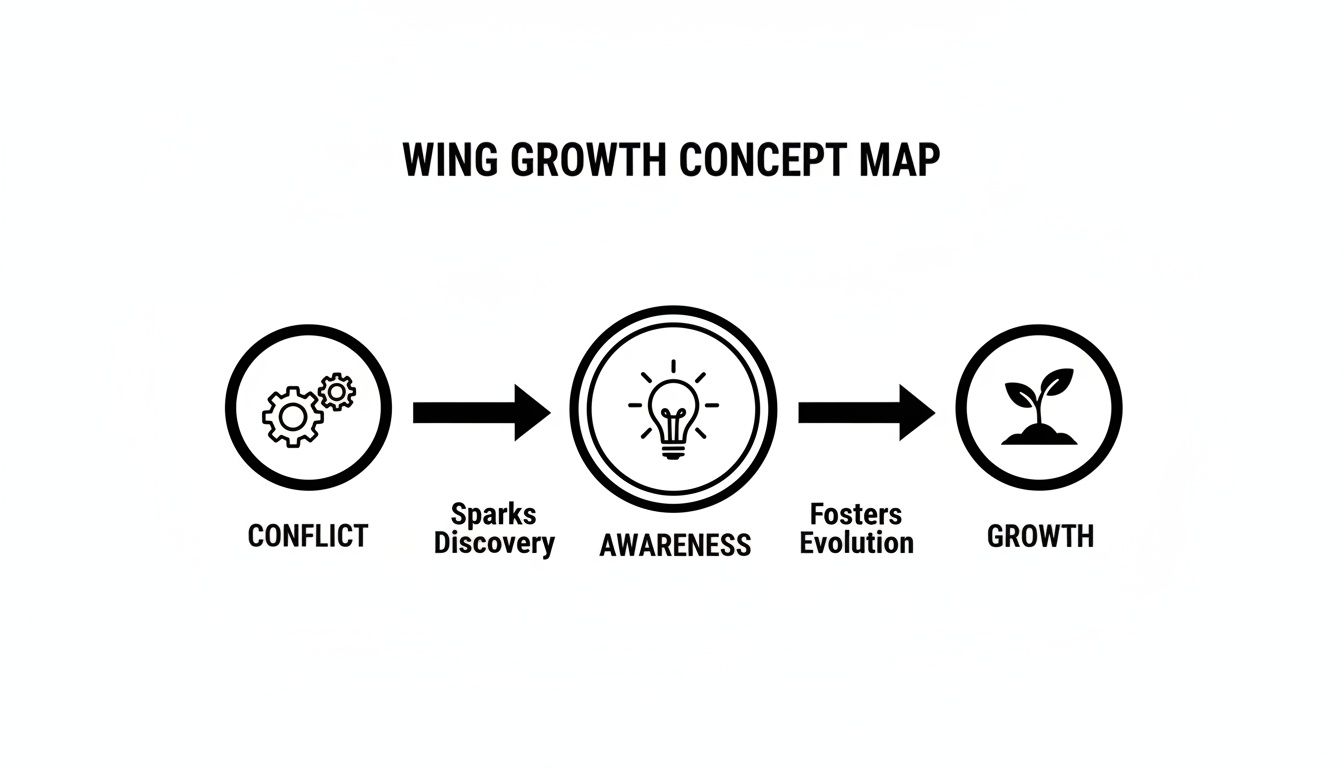
The journey often kicks off with some kind of internal conflict, which leads to a breakthrough of awareness and, ultimately, real personal growth.
The Type 5 Investigator Wings
Fives are motivated by a need to be competent and capable, often withdrawing from the world to observe and learn from a safe distance. Their wing determines if this intellectual pursuit is colored by a search for identity or a need for security.
• 5w4 The Iconoclast: • This blend pairs the Five’s intellectualism with the Four’s creativity and individualism. They are more artistic, unconventional, and fascinated by exploring the unknown. A great example is American film director Tim Burton, whose work is defined by its deep intellectual curiosity (Type 5) and its uniquely dark, individualistic aesthetic (that 4-wing).
• 5w6 The Problem Solver: • Here, the Five’s thirst for knowledge meets the Six’s need for security and loyalty. They are more practical, systematic, and focused on solving real-world problems with their expertise. Think Bill Gates, whose intense intellectual drive (Type 5) has been applied to building secure systems and tackling global issues through methodical planning (that 6-wing).
The Type 6 Loyalist Wings
Sixes are driven by a need for security and support, always scanning the horizon for potential threats. Their wings influence whether they find that security through intellectual certainty or through optimistic exploration.
• 6w5 The Defender: • This combination blends the Six’s loyalty with the Five’s analytical nature. They are more cautious, intellectual, and seek security by gathering knowledge and preparing for the worst. Think of Ellen Ripley from the American sci-fi series • Alien • . Her fierce loyalty to her crew (Type 6) is backed by intense vigilance and a problem-solving, analytical mindset (that 5-wing).
• 6w7 The Buddy: • When a Six’s need for security mixes with a Seven’s enthusiasm and love of new experiences, you get The Buddy. They are more sociable and fun-loving, managing their anxiety by staying positive and connected to others. Think Chandler Bing from the American sitcom • Friends • , whose loyalty to his group is expressed through quick-witted humor and a constant search for lightheartedness to deflect his underlying anxiety.
The Type 7 Enthusiast Wings
Sevens are motivated by a need to be satisfied and to avoid pain at all costs, constantly seeking new and exciting experiences. Their wing determines if their enthusiasm is grounded by a bit of caution or amplified by a dose of assertiveness.
• 7w6 The Entertainer: • This is the friend who plans an epic road trip, mapping out every exciting stop (Type 7) while • also • packing a first-aid kit and checking the car’s tire pressure (that 6-wing). They are more grounded and responsible, seeking fun while still being mindful of potential pitfalls. Think of Tom Hanks, whose enthusiastic and beloved public persona (Type 7) is balanced by a dependable and trustworthy quality (that 6-wing).
• 7w8 The Realist: • This wing blends the Seven’s love of freedom with the Eight’s assertiveness and drive for control. They are more pragmatic, ambitious, and aggressively pursue whatever they want out of life. Celebrity chef Anthony Bourdain is a perfect fit—he channeled his passion for new experiences (Type 7) with a commanding, no-nonsense intensity (that 8-wing).
The Type 8 Challenger Wings
Eights have a fundamental need to be in control of their own lives and destiny, protecting themselves from being controlled by others. Their wing influences whether their powerful assertiveness is expressed through expansive fun or quiet resolve.
• 8w7 The Maverick: • This is a highly assertive and energetic combination. The Eight’s powerful drive is mixed with the Seven’s love of adventure and new experiences. They are bold, entrepreneurial, and want to make a huge impact on the world. Think of former American president Franklin D. Roosevelt, known for his commanding leadership (Type 8) and his optimistic, forward-looking vision (that 7-wing).
• 8w9 The Bear: • Here, the Eight’s formidable strength is tempered by the Nine’s calm, receptive nature. They are more patient, steady, and protective leaders, often seeming more approachable—until a boundary is crossed. Think of Martin Luther King Jr., who led a powerful movement for justice (Type 8) with a steady, patient, and unifying presence (that 9-wing).
The Type 9 Peacemaker Wings
Nines are motivated by a need to keep their inner and outer worlds peaceful and harmonious. Their wing determines if they maintain that peace through gentle assertiveness or principled action.
• 9w8 The Referee: • This blend adds the Eight’s assertive energy to the Nine’s desire for peace. They are more grounded, direct, and surprisingly willing to step into conflict to mediate and find a fair resolution. Think of Barack Obama, whose calm, peacemaking demeanor (Type 9) is combined with the decisive and assertive leadership required of a president (that 8-wing).
• 9w1 The Dreamer: • This wing mixes the Nine’s easygoing nature with the One’s clear sense of right and wrong. They are more idealistic, orderly, and strive for a world where everyone can live in peaceful harmony. The beloved American television host Mister Rogers embodied this: he promoted kindness and inner peace (Type 9) with a gentle, principled structure (that 1-wing).
So, How Do I Figure Out My Enneagram Wing?
Alright, let's get down to it. You get the concept of a core type, but now you’re asking the million-dollar question: "What's my Enneagram wing?" This is where the real fun begins. Forget the confusion; we're going to get you that "aha!" moment. There are two great ways to figure this out, and they work even better when you use them together.
The first path is all about looking in the mirror—not just at your reflection, but at the motivations behind your actions.
The Self-Detective Method
Think of this as becoming a detective in your own life. Your wing isn't shouting from the rooftops; it’s more like a quiet collaborator, subtly influencing your gut reactions, your daydreams, and what really drives you when no one's looking. To spot it, you just need to know what clues to look for.
Start by noticing your automatic, unfiltered responses. Ask yourself some tough questions and go with your first, most honest answer—not the one you think sounds better.
Here are a few prompts to get you started:
• When you get knocked down by a big setback, what's your immediate impulse? • Do you feel a surge of defiance, ready to work twice as hard to prove you're successful (hello, 3-wing)? Or do you pull back to lick your wounds, analyze what happened, and find some deeper meaning in the mess (a classic 4-wing move)?
• Walking into a party or a new social setting, what’s your default mode? • Are you scanning the room for people who need help, eager to connect and be liked (that's the 2-wing talking)? Or do you hang back, observing the social chessboard and trying to figure out the rules before you make a move (a very 5-wing thing to do)?
• You're facing a major decision. What's the loudest voice in your head? • Is it the one focused on keeping the peace and making sure everyone feels comfortable and stable (shout-out to the 9-wing)? Or is it the one pushing you to take charge, act decisively, and make sure your own needs are on the table (a clear 8-wing trait)?
Your answers point to that consistent tilt, the specific flavor your wing adds to your core personality. It’s the secret sauce that makes you different from someone else with the same number.
The Assessment Shortcut
Self-reflection is gold, but let's be honest—sometimes we're too close to our own patterns to see them clearly. That's where a high-quality, well-designed assessment becomes your best friend. A good test can slice right through your blind spots and highlight the patterns you might otherwise miss.
Think of it like this: The self-detective method is like using a compass; it gives you a solid direction. A great assessment is like firing up the GPS—it gives you precise, data-backed coordinates.
When you’re waffling between two wings, a detailed assessment can be the perfect tie-breaker. It uncovers the dominant motivations that you might not even realize are running the show.
This is why a lot of people opt for a comprehensive test to get a crystal-clear answer. The best ones don't just ask what you do; they dig into the why . For example, the 180-question format used by Enneagram Universe delivers a much more nuanced picture. Instead of just picking A or B, you rate things on a scale. This allows the system to measure the strength of your various motivations and zero in on your dominant wing with impressive accuracy.
If you’re ready for that kind of clarity, you can take the complete Enneagram wing test and get a definitive result.
A Real-World Example: Sarah’s Wing Discovery
Let's talk about Sarah, a freelance graphic designer and a core Type Four. She was totally stuck between identifying as a 4w3 (The Aristocrat) or a 4w5 (The Bohemian). She felt the pull from both sides so strongly it was paralyzing.
On one hand, her Five-wing felt undeniable. She'd get lost for hours in obscure art history books and obsess over finding the perfect font to give her work intellectual weight. She craved her quiet, private studio time—a total hallmark of the withdrawn, cerebral Five.
But that Three-wing was loud, too. She had a burning desire for her work to be seen , admired, and celebrated. She'd spend forever crafting the perfect Instagram post and felt a genuine, electric thrill when one of her designs went viral.
So, what was the tie-breaker? It all came down to identifying her primary driver under pressure . When a huge project deadline was breathing down her neck, she realized her instinct wasn't to retreat and make the work more intellectually perfect (a Five concern). Instead, her energy shifted to making it more dazzling, more impressive, and more likely to get public acclaim (a Three concern).
She wanted public recognition more than she wanted private expertise . That was her lightbulb moment. Sarah was a 4w3 . The ambition and desire to shine was the dominant flavor coloring her creative, individualistic Four Core.
Oops! Common Mistakes People Make When Finding Their Wing
The path to discovering your Enneagram wing can be a bit like hiking a new trail—full of amazing views but also a few tricky spots where it's easy to get turned around. Let's clear up some of the most common myths that can send you in the wrong direction.
Think of this as your personal trail guide to make sure you find your true wing with confidence.

Myth #1: "I Have Two Wings!"
The Reality: Okay, let's get this one out of the way first. While you absolutely have access to the flavors of both numbers next to your core type, one is almost always your go-to. It’s a lot like being right-handed or left-handed. Sure, you can use your non-dominant hand, but which one do you instinctively use to sign your name or catch a ball?
Your dominant wing is just that—your default setting, the trusted sidekick that’s with you most of the time.
For example, Maria is a Type 7 (The Enthusiast) . She finds herself meticulously planning travel itineraries to ensure everything is safe and sound (a very 6-wing trait). But at work, she can be a bold, take-charge negotiator who makes decisive moves (hello, 8-wing ). After thinking it over, she realized that while her assertive side comes out in meetings, her instinct in 90% of life’s situations is to seek security and feel supported. Her dominant wing is Six.
Myth #2: "My Wing Is Just a Fixed Subtype."
The Reality: This is a big one. It's so easy to hear "I'm a 3w4" and think of it as a permanent, unchanging label. But seeing your wing as just another box to put yourself in misses the entire point! The term "wings" was chosen for a reason—they are meant to give you lift and help you fly out of the rigid patterns of your main type.
Your wings aren't just personality add-ons; they are active pathways for growth. Their real job is to help you break free from the limitations of your type and become a more whole, balanced person.
Instead of seeing it as a static definition, think of your wing as a resource. A Type 8 who consciously leans into their 9-wing can learn to be a more patient, receptive leader instead of just a commanding one. It’s all about developing flexibility, not just settling for a tidy label.
Myth #3: "My Wing Changes Over Time."
The Reality: Not exactly. Your core Enneagram type and your dominant wing are generally considered stable throughout your adult life. They're connected to deep-seated motivations and fears that formed early on and don't just shift with your mood or circumstances.
However, your relationship with your wings can definitely evolve. You might be called to develop your less-dominant wing during certain life chapters. A Type 5 Investigator with a strong 4-wing (making them more artistic and withdrawn) might need to consciously develop their 6-wing traits when they start a new job that requires teamwork and building trust. They aren't changing their wing; they're just stretching the other one for balance.
Myth #4: "My Wing Is the Same as My Stress Number."
The Reality: This is a classic Enneagram mix-up! Your wing and your stress/growth points are totally different concepts that operate in completely different ways.
Confusing them is like mixing up your best friend with that weird, frantic person you become after three shots of espresso on an empty stomach. They are not the same.
• Your Wing: • Think of this as a permanent flavor that’s always there, subtly coloring your core personality. For a Type 1, a 2-wing adds a consistent dose of warmth and helpfulness.
• Your Stress Point: • This is a • temporary • place you visit when you're under pressure. That same Type 1, when stressed, might suddenly take on the negative traits of a Type 4, becoming moody, withdrawn, and feeling misunderstood.
By busting these myths, you're building your self-awareness on solid ground. This clarity helps you identify your wing accurately and, more importantly, use that insight for genuine, lasting growth.

Putting Your Wing Into Action For A Fuller Life
Alright, so you've journeyed through the landscape of your core Enneagram type and met its secret sidekick—your wing. This isn't just a fun bit of personality trivia; discovering your wing is like finding a missing piece of the puzzle that is you . It’s your personal roadmap to living a more authentic and genuinely fulfilling life.
So, what now? Don't let this just be another interesting article you skim and forget. The real magic, the stuff that actually changes things, happens when you put these insights to work.
Your complete Enneagram profile isn't a static label to box you in. It's a living, breathing guide to help you navigate your inner world with more compassion and wisdom.
Your best next move is to get a crystal-clear picture of your full profile. Taking a comprehensive test, like the one offered by Enneagram Universe , is the most definitive step you can take. Its detailed results go way beyond just your wing, giving you crucial information on your Triads and Health Levels.
Make It Real
Once you have this deeper self-awareness, start watching for your wing in your everyday life. It’s like a fun little detective game.
• At Work: • How does your wing influence the way you lead or collaborate? A Type 8 with a 9-wing might realize they have a hidden talent for patient, steady leadership that they weren't consciously using.
• In Relationships: • Notice how your wing affects the way you talk to your partner or friends. A Type 2 with a 1-wing might finally understand why they feel a pull toward "doing the right thing" and can use that insight to set healthier boundaries.
This isn't about trying to fix or change who you are. It’s about embracing all of you—the core, the wing, and everything in between—to unlock your potential and build a life that feels truly your own.
Got More Questions About Your Enneagram Wings?
It's totally normal to have a few questions buzzing around as you try to nail down your wing. Let's tackle some of the most common ones that trip people up.
Can My Enneagram Wing Change Over Time?
Nope, not really. Think of your core Enneagram type and your dominant wing as the foundational wiring of your personality. They’re set in your younger years and tend to stay with you for the long haul.
That said, you can absolutely learn to access the traits of your other , non-dominant wing. For instance, a Type 5 who usually leans on their introspective 4-wing might have to consciously tap into their 6-wing to be more of a team player at a new job. That’s not your wing changing—that’s you growing as a person.
So, Is It Possible to Have Perfectly Balanced Wings?
Theoretically? Maybe. In reality? It's incredibly rare. Just about everyone has one wing they naturally lean on more than the other, giving their core type a distinct flavor.
If you feel like you don't have a wing at all, it's probably just a lot more subtle. Its influence might be more like a quiet hum in the background than a loud, obvious melody. A good, detailed assessment can often pick up on those consistent-but-quiet patterns you might be missing on your own.
How Is My Wing Different From My Growth or Stress Arrows?
Ah, the million-dollar question! This one confuses a lot of people, so let's clear it up. Your wing is like your permanent co-pilot; it’s always there, blending with and influencing your core type. Your growth and stress points (or arrows) are places you visit temporarily.
Your wing is your trusted sidekick on the journey. Your stress point is where you take a wrong turn when the map gets blurry.
Let’s take a Type 1 as an example. They might have a 2-wing , which makes them a warmer, more people-oriented perfectionist. But when that same Type 1 is under a mountain of stress, they take a detour to the unhealthy side of Type 4 , becoming withdrawn and moody. One is a permanent part of their personality blend; the other is a temporary state brought on by a specific situation.
Ready to stop guessing and get the real answer? The Enneagram Universe test can give you the clarity you're looking for. Our free, in-depth assessment will help you discover your dominant wing and get you on the path to some serious personal growth. Start your journey at Enneagram Universe .