What Is an “INFP”? Traits, Strengths & The Healer Personality

You take a personality test late at night, half curious and half hoping for relief. The result says INFP . Suddenly, parts of your life start making sense.
Maybe you care a great deal, dream vividly, and still wonder why ordinary life can feel strangely loud. You might be the person who notices the lonely coworker, writes long notes you never send, or leaves a practical opportunity because it feels empty inside.
That question, what is INFP , is usually not just about letters. It is really a question about identity. Why do I feel things so strongly? Why do I need meaning so badly? Why do I keep seeing possibilities that other people miss?
INFP is one of the personality types in the Myers-Briggs framework. It is often called the Healer or the Mediator , and those nicknames fit. INFPs tend to care about people, authenticity, imagination, and inner truth. They are often gentle on the outside and intense on the inside.
Are You an Idealist in a Pragmatic World
A lot of INFPs first recognize themselves in ordinary moments.
You are sitting in a meeting. Everyone else is focused on speed, profit, logistics, or the fastest route to the finish line. You are still thinking about whether the decision feels fair. Not efficient. Fair.
Or maybe a friend tells you a painful story, and hours later, you are still carrying it in your chest. Everyone else seems to move on. You do not. Not because you are weak, but because your inner life is built to register meaning.
That experience can feel lonely. It can also feel confusing when the world praises toughness, certainty, and visible productivity. The INFP often looks calm from the outside while running a whole ethical, emotional, and imaginative universe inside.
That is part of why the type feels so distinctive. The INFP personality type comprises approximately 4.4% of the U.S. population , and females make up 73.5% of all INFPs , making the type rarer overall and especially rare among males, where 1.5% of all men identify as INFP, according to Crown Counseling's Myers-Briggs statistics .
Being uncommon does not make INFPs better than other people. It does mean many INFPs grow up feeling like translators in a language they never chose. They sense beauty where others see fluff. They feel moral tension where others see a simple tradeoff. They crave work, love, and friendship that mean something.
What Does This Look Like in Real Life?
• At school: • You cared as much about whether a teacher was kind as whether they were competent.
• At work: • You might turn down an opportunity that looks impressive on paper because the culture feels cold.
• In friendship: • You want realness. Surface conversation can feel like chewing cardboard.
The point is not to put yourself in a tiny box. The point is to finally name a pattern. Once you can name it, you can work with it.
Decoding the INFP Cognitive Function Stack
The fastest way to understand what an INFP is to stop thinking of the type as a label and start thinking of it as a mental operating pattern.
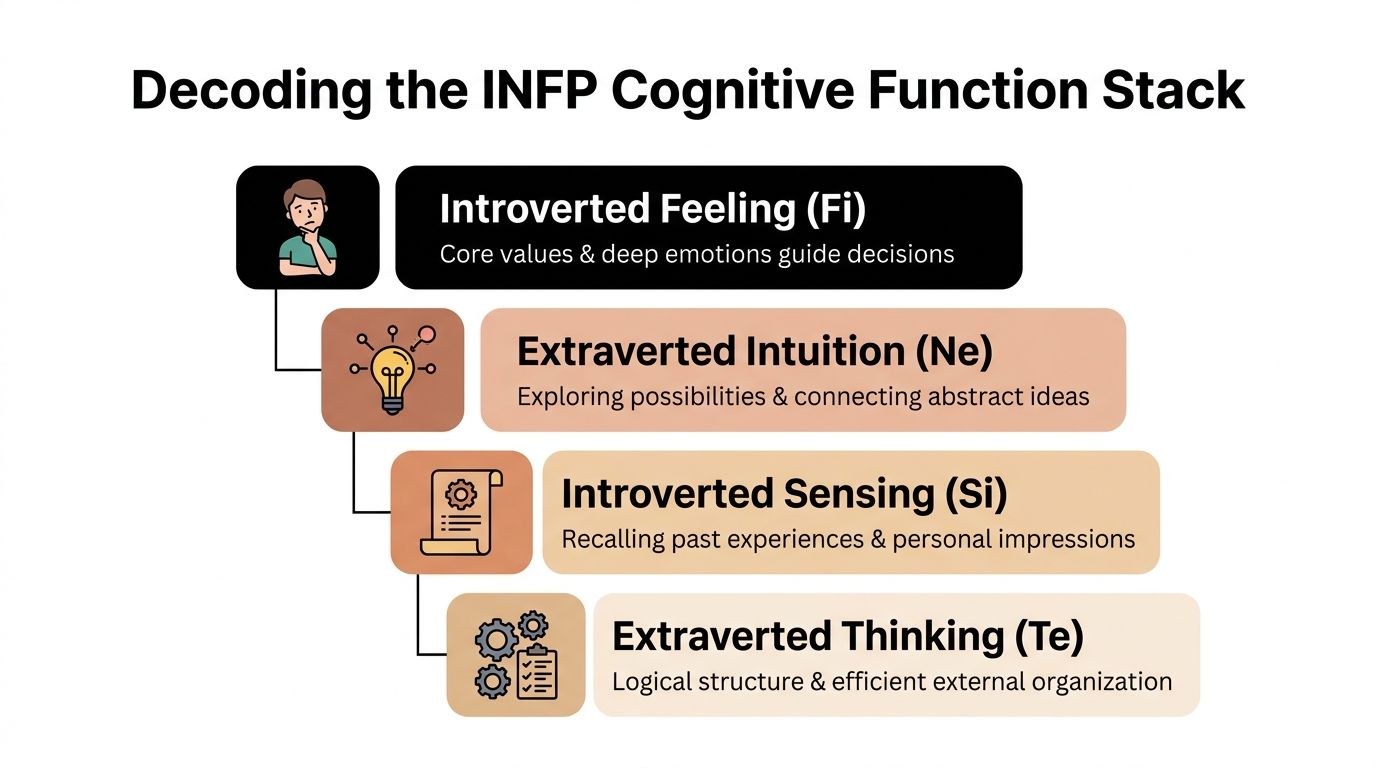
INFPs are often described through four cognitive functions: Fi, Ne, Si, and Te . Those terms can sound abstract, so let’s make them human.
Fi as the Inner Compass
The INFP’s dominant function is Introverted Feeling , usually shortened to Fi . This is the quiet center of the personality.
Fi asks, “Is this true to me?” It checks decisions against an internal value system. According to Metamorphoses on the INFP personality , dominant Fi drives decision-making through an internalized, subjective value system, while auxiliary Extraverted Intuition , or Ne , generates possibilities and patterns.
A practical example helps.
Two people get offered the same promotion. One says, “This is a smart career move.” The INFP might say, “I know it looks good, but I would hate the environment.” That is Fi at work. It does not ignore logic. It refuses to separate success from integrity.
Fi also explains why INFPs can seem private. Their emotions are real and personal, but they do not always display them on command. Many feel first, then share later, if at all.
Ne as the Web of Possibilities
If Fi is the compass, Ne is the fireworks.
Ne notices patterns, hidden meanings, unusual angles, and alternative futures. It is the part of the INFP that can turn one conversation into ten ideas, three creative projects, a life question, and a sudden urge to move across the country and become a ceramic artist.
This is why INFPs often seem imaginative even when they are not “artistic” in a formal way. Their mind naturally plays with possibilities.
Ne shows up when:
• A problem appears: • You generate several unconventional solutions.
• Someone tells a story: • You instantly pick up themes, motives, and unspoken layers.
• You start a hobby: • It can quickly become a philosophy, a side project, or a future identity.
Si as the Personal Library
The third function, Introverted Sensing or Si , works like a private archive.
Si stores impressions from the past. Not just facts, but emotional textures. It remembers how something felt, what mattered, and what a previous experience taught you. In an INFP, this can create strong nostalgia and a deep attachment to meaningful places, songs, rituals, and personal symbols.
An INFP might keep an old notebook because it reminds them of who they were becoming at that point in life. Another person sees clutter. The INFP sees memory with soul.
Te as the Reluctant Organizer
The fourth function, Extraverted Thinking or Te , is the part that handles external structure. Plans. Systems. Lists. Execution. Clear decisions.
Because it is less natural for many INFPs, Te can feel awkward or drained. The person with twenty beautiful ideas may still struggle to schedule them, prioritize them, or finish them in order.
This does not mean INFPs are incapable of structure. It means they often access it best when the task connects to something they care about.
How the Whole Stack Works Together
The stack makes more sense when you see it in motion:
| Function | Everyday role | Common expression |
|---|---|---|
| Fi | Personal values | “I need this to feel right.” |
| Ne | Possibilities and patterns | “What else could this become?” |
| Si | Memory and inner reference | “This reminds me of something important.” |
| Te | Structure and execution | “How do I make this real?” |
An INFP is not just emotional. They are values-led. Not just dreamy. Possibility-driven. Not just disorganized. Often selective about where they bring structure.
That difference matters.
The INFP Experience in Everyday Life
Knowing the function stack is helpful. Watching it show up in daily life is where the type becomes recognizable.
Take work. An INFP often struggles in environments that reward performance but ignore purpose. They might accept a role because it seems sensible, then feel increasingly flat, irritable, or detached. It is not laziness. It is misalignment.
A classic INFP move is choosing the job that feels meaningful over the one that looks impressive. One person picks the higher-paying role because it is the obvious next step. The INFP picks the community arts nonprofit, the classroom, the counseling program, or the quiet creative path because they can feel their own spirit in it.
Small Signs People Often Miss
Some INFP habits look subtle from the outside:
• They edit themselves less around sincere people. • Authenticity makes them relax.
• They can be gentle but stubborn. • Push against a core value, and the softness becomes steel.
• They often need recovery time after social intensity. • Even a good gathering can leave them drained.
Their communication style often reflects this mix. Many INFPs speak warmly and thoughtfully, but not always quickly. They may pause before responding because they are checking whether their words match what they really mean.
Everyday Scenes that Fit the Type
A friend group is arguing about where to go for dinner. Everyone else wants the fastest option. The INFP says, “Can we pick the place where Maya can eat something she likes?” They are not trying to control the group. They are tracking the human impact.
A team at work hits a problem. Several people suggest the obvious fix. The INFP offers three unusual alternatives, one of which solves the issue in a more humane way. That is values plus imagination.
A neighbor talks about a hard breakup for ten minutes. The INFP hears not just the story, but the longing underneath it. By the end of the conversation, they are wondering how to support the person, write about heartbreak, and rethink the way people hide pain in everyday speech.
Why does Daily Life Feel Intense?
For many INFPs, ordinary experiences are never only ordinary. A playlist can become emotional archaeology. A random conversation can trigger a major insight. A harsh comment can echo for days if it cuts against a tender place.
That same depth also fuels beauty.
They are often the ones who notice the person left out of the circle, the tension no one names, the hidden dream under someone’s practical plan. They may not always say it out loud, but they feel it.
The Healer’s Gifts and Burdens

A lot of INFPs grow up hearing two very different messages. One person says, “You are so caring.” Another says, “You take things too personally.” Both can be true at once.
That tension sits near the center of this type.
The Gift of Empathy
Many INFPs pick up emotional signals the way a sensitive microphone picks up background sound. They notice the pause before someone says “I’m fine.” They hear strain in a casual joke. They sense when a room looks calm on the surface but feels unsettled underneath.
That ability can make them unusually comforting. Friends often feel understood around them because the INFP is listening for meaning, not just words. In families, they may become the one who softens conflict, translates feelings, or notices pain before anyone names it.
There is a cost, though. Caring can slide into carrying too much. An INFP may leave a hard conversation and keep holding it for hours, sometimes for days. While caring is a strength, carrying everyone’s emotional load is unsustainable.
Learning that boundary often changes everything. If this is difficult for you, these relationship communication tools for expressing needs more clearly can help.
The Gift of Imagination
INFP’s imagination is rarely random. It usually serves a meaning. They often see hidden possibilities in people and situations. A small conversation becomes a story idea. A frustrating workplace problem sparks a more humane solution. A personal setback turns into insight, art, or a new sense of purpose. Their minds work like a studio full of sketches, symbols, and emotional patterns that keep connecting in surprising ways.
This is one reason many INFPs are drawn to writing, counseling, design, teaching, music, advocacy, or any role where inner vision can become something useful and human.
The Burden of Possibility Overload
That same imagination can make action slower. If your mind keeps generating richer versions of what something could be, choosing one imperfect draft can feel strangely painful. Some INFPs do not struggle because they lack ideas. They struggle because every idea comes with layers of feeling, meaning, and alternate directions. Finishing then feels less like a task and more like closing doors.
This situation makes self-knowledge more nuanced. MBTI explains part of the pattern. Enneagram work often explains the motive underneath it. One INFP delays because they fear failure. Another delay is because they fear being limited, judged, or disconnected from their ideals. That layered view gives the type more depth than a simple profile, which is part of why many readers later find Enneagram Universe useful for understanding their specific version of INFP patterns.
The Inner Burden People Miss
INFPs are easy to romanticize. Gentle, creative, thoughtful. Those words fit, but they can hide the strain of living with a very active inner world.
A sensitive person can look calm and still be exhausted from overthinking, disappointment, or emotional buildup. They may hold themselves to beautiful standards, then feel crushed when life, work, or relationships fall short. They may also hesitate to ask for help because they do not want to burden anyone else.
That is why growth for INFPs is rarely about becoming less feeling. It is about building stronger containers for feeling.
Rest helps. Clear limits help. Small finished actions help. Honest support helps. The healthiest INFPs keep their tenderness, but they pair it with structure. They protect their energy, put ideals into practice, and accept that a meaningful life does not need to be flawless to be real.
INFPs in Relationships and Careers
INFPs usually want the same thing in love and work. A sense that what they are giving comes from their authentic self.
That does not mean they need perfection. It means they need sincerity.

Relationships that Feel Alive
In relationships, INFPs often bring tenderness, loyalty, imagination, and emotional depth. They usually care less about social performance and more about whether the bond feels honest. Many would rather have one emotionally real conversation than ten polished but empty interactions.
They often thrive with people who:
• Respect inner depth: • They do not mock reflection, sensitivity, or big questions.
• Communicate gently and directly: • INFPs can struggle when tension simmers unspoken.
• Allow breathing room: • Closeness matters, but so does solitude.
One common challenge is conflict. Many INFPs dislike harsh confrontation, especially when the room feels emotionally unsafe. They may delay difficult conversations until resentment builds. Learning clearer communication helps a lot, especially in close partnerships. This guide on improving relationship communication is useful if you tend to shut down, over-accommodate, or hope the other person “just gets it.”
What Love Can Look Like for an INFP?
An INFP partner may remember the small detail you mentioned three months ago, write a note when words are hard to say out loud, or create rituals that make the relationship feel sacred.
They also need reassurance that they can be fully themselves. If they feel judged, rushed, or emotionally crowded, they may retreat into silence. That retreat is often misunderstood. It is not always disinterested. Sometimes it is self-protection.
Careers that Fit the Type
The careers often associated with INFPs make sense when you look at the pattern: values plus imagination plus human depth.
Good fits often include:
• Counselors or therapists work • because they can listen to emotions, meaning, and inner conflict.
• Writing and editing • because they often translate private feelings into language.
• Teaching and education • because they care about growth and individual potential.
• Design and the arts • because symbolism, emotion, and originality matter there.
• Advocacy or nonprofit work • because values can drive action.
A strong INFP career usually answers two questions. Does this matter to me? Can I bring something human and original to it?
Here is a short video that helps show how the type often operates in life and connection.
When Work Goes Wrong
The wrong environment for an INFP is often not “hard work.” It is work stripped of meaning. Repetitive politics, harsh competition, shallow metrics, or a culture that punishes individuality can leave them depleted fast.
That is why many INFPs do best when they can see the human view of what they do. They do not need every day to be magical. They do need some living connection between effort and purpose.
Distinguishing the INFP from Similar Types
Many people who ask what is INFP are really asking a second question underneath it. Am I an INFP, or something close to it?
The biggest confusion point is usually INFP vs INFJ .
That confusion is common enough that some people change their results after learning about cognitive functions. Data cited by UoPeople on the INFP personality suggests 30-40% of individuals who initially identify as INFP may later switch to INFJ after further education.
The Core Difference
At the center, the two types are led by different questions. The INFP is led by Fi , which asks, “Is this true to my values, my identity, my sense of inner rightness?”
The INFJ is led by Ni , which focuses more on insight, direction, and the deeper pattern of where things are heading. That means an INFP often shapes life from the inside out. An INFJ often senses a vision and then organizes around it.
INFP vs INFJ Quick Comparison
| Aspect | INFP (The Healer) | INFJ (The Advocate) |
|---|---|---|
| Core driver | Personal values and authenticity | Vision, insight, and future pattern |
| Main inner question | “Is this true to me?” | “Where is this leading?” |
| Emotional style | Personal, often private | Absorbs relational atmosphere more readily |
| Approach to structure | More flexible, open-ended | More inclined toward planning and closure |
| Expression | Individualistic, self-expressive | Guiding, interpretive, often mission-focused |
An easy everyday example helps. If both types walk away from a group decision feeling uneasy, the INFP may think, “That did not feel honest to me.” The INFJ may think, “That choice is going to create problems later.” Both are intuitive. Both care. The source of their concern is different.
What about INFP vs ISFP
This mix-up happens too, especially when someone is artistic or quiet. The simplest distinction is this: the INFP tends to live more in meanings, patterns, and future possibilities. The ISFP is often more grounded in immediate experience, aesthetics, and the present moment.
An INFP might write a song about what a relationship symbolizes. An ISFP might capture exactly how it feels in the room right now.
Your INFP Personality and the Enneagram
MBTI tells you a lot about how your mind tends to work. The Enneagram adds a different layer. It helps explain why you do what you do, especially around fear, desire, identity, and stress.
That is where many INFPs finally get the nuance they were missing.

Cross-personality studies cited by Truity’s article on the INFP personality show that approximately 40-50% of INFPs are Enneagram Type 4 and 20-30% are Type 9 .
When the INFP is a Type 4
The INFP Type 4 often feels like authenticity turned up louder. This person usually has a strong need to understand and express identity. They may be highly creative, emotionally nuanced, and drawn to beauty, symbolism, and personal meaning. They often ask, “Who am I, really?” and they can feel restless when life becomes generic.
A practical example: two INFPs dislike a bland corporate role. The Type 4 leaves because it feels like soul erosion. The identity cost is unbearable.
When the INFP is a Type 9
The INFP Type 9 often brings more softness, steadiness, and a desire for peace. This person may still care much about values and meaning, but they are often more likely to downplay themselves to keep harmony. They can seem easygoing until their own needs disappear into the background.
In practice, a Type 9 flavored INFP may stay too long in a draining friendship because they do not want to create conflict, even when their inner world protests.
Why do Both Systems Help?
MBTI might explain why you process life through values and possibilities. The Enneagram can explain whether your deeper growth challenge revolves more around identity, peacekeeping, achievement, security, or something else.
That makes the two systems complementary, not competitive. If you want a fuller picture, this explanation of enneagram vs mbti can help clarify what each system contributes.
For readers who want a next step, Enneagram Universe offers a free Enneagram assessment with 180 questions that measure core motivations, fears, and desires, along with results on Wings, Triads, and Health Levels. For an INFP who wants more than a four-letter label, that kind of detail can add useful context.
Actionable Growth Strategies for the INFP
INFP growth is not about becoming colder, louder, or more mechanical. It is about helping your ideals function in daily life.
Build a Bridge from Feeling to Action
Start small. If a project matters to you, break it into tiny visible steps. “Write my novel” is overwhelming. “Write for fifteen minutes before lunch” is doable.
Protect Empathy with Boundaries
You do not need to absorb every emotion to be loving. Limit how long you stay in draining conversations. Journal after intense interactions. Take walks without your phone.
Use the Structure Gently
Rigid systems often backfire for INFPs. Try light scaffolding instead. A notes app, a whiteboard, one calendar, or a simple weekly reset can support your ideas without suffocating them.
Let Purpose Become Practical
Many INFPs value meaning greatly. If that is you, exploring your soul purpose can help turn vague longing into a more concrete direction.
Pair Self-Knowledge with Practice
Reading about yourself feels good. Changing patterns feels better. If you want more grounded tools for habits, emotional regulation, and personal development, these self-improvement techniques are a useful follow-up.
The goal is not to erase your sensitivity. The goal is to help your sensitivity become livable, sturdy, and useful in the world.
If this article helped you recognize yourself, the next step is to add depth to that self-understanding. Enneagram Universe offers a way to explore your core motivations, fears, growth patterns, and relationship dynamics so your INFP insight becomes something you can use in daily life.