What Is “ENFP” Personality? Traits, Strengths, Careers

You may be here because someone called you “so ENFP” and you smiled politely while wondering what that means. Or maybe you took a personality test, got ENFP , and felt both seen and mildly exposed.
That reaction makes sense.
The ENFP personality is one of those types people recognize quickly in real life but often explain badly online. You’ll hear words like “bubbly,” “creative,” or “free spirit.” Those are not wrong. They are just incomplete. To really answer what is ENFP personality , you have to look at both the outer style and the inner engine.
An ENFP is often the person who turns a flat conversation into a lively one, spots potential where others see dead ends, and cares significantly about whether life feels meaningful, not just efficient. They can seem playful on the surface and intense underneath. They are usually drawn to people, possibilities, and purpose all at once.
Meet the ENFP The Charismatic Campaigner
At a party, the ENFP is often easy to find.
They are the one introducing two strangers because “you both would love each other,” then drifting into a totally different conversation about travel, purpose, startups, art, or why people become who they become. At work, they might be the person who hears a stale project update and suddenly says, “What if we stopped doing it that way entirely?”
That spark is why many people call ENFPs the Campaigner . The name fits because this type does not just want to experience life. They want to animate it. They rally people around ideas, causes, possibilities, and personal growth.

ENFPs are not rare. They make up approximately 8% of the general population worldwide , with a notable gender split of about 10% of women and 6% of men according to Personality Max’s ENFP overview . That helps explain why many people know at least one ENFP in their friend group, classroom, workplace, or family.
What do people notice first?
Many find the ENFP’s energy before they find the ENFP’s depth.
You might notice:
• Warmth in motion • . They often engage quickly and make people feel included.
• Idea fireworks • . One topic can become five in a minute, but somehow the thread still makes sense to them.
• Emotional honesty • . ENFPs usually want interactions to feel real, not scripted.
• A future-facing lens • . They naturally ask what something could become.
What gets missed?
The stereotype says ENFPs are nonstop social butterflies. That misses a lot.
Many ENFPs are reflective, private about their deeper feelings, and surprisingly serious about values. They may look spontaneous, but they are not random. There is usually a hidden pattern under the playfulness. They are scanning for meaning, connection, and possibility.
Decoding the ENFP Personality Code
The four letters in ENFP are a shortcut. They do not tell the whole story, but they do give you a useful map.
“E” means Extraversion
Extraversion does not mean “talks all the time” or “loves crowds every second.” It means a person tends to engage outwardly with life and often gains energy from interaction.
Think of the ENFP like a solar panel. Conversation, shared excitement, new people, and stimulating environments can charge them up.
This does not mean every ENFP is loud. Some are softer and more observant. But even quieter ENFPs often come alive around people, ideas, or shared enthusiasm.
“N” means Intuition
This is the letter that confuses many people. Intuition in MBTI language does not mean psychic ability. It means a preference for patterns, meanings, symbols, and future possibilities over concrete facts alone. If a sensing type sees the tree bark first, the ENFP often sees the whole forest, the weather around it, and what the forest could become in five years.
An ENFP hears a casual comment and starts connecting dots:
• “That reminds me of your old goal.”
• “This trend could change your whole career.”
• “What if the core issue isn’t the problem, but the system around it?”
They often live in the realm of “could,” “might,” and “what if.”
“F” means Feeling
Feeling is also misunderstood. It does not mean “emotional” instead of “smart.” It means the ENFP tends to evaluate decisions through values, human impact, and inner alignment. They often ask, “Does this feel right?” before asking, “Does this follow the cleanest logic?”
That can make ENFPs compassionate, encouraging, and thoughtful in relationships. It can also make them sensitive to whether something feels authentic or hollow.
A simple example:
• A thinking type might choose a job because the structure is efficient.
• An ENFP might choose based on whether the work feels meaningful and aligned with who they are.
“P” means Perceiving
Perceiving is about flexibility.
If judging types often prefer closure, plans, and early decisions, ENFPs usually prefer to keep the door cracked open a little longer. Their style is more like a jazz musician than a train conductor. They improvise. They adapt. They like room to respond to fresh information.
This brings freedom and creativity. It can also make rigid systems feel suffocating.
The four letters in plain English
Here is a simple way to translate ENFP:
| Letter | Plain meaning | Everyday example |
|---|---|---|
| E | Engages outwardly | Talks through ideas with other people |
| N | Sees patterns and possibilities | Spots hidden connections others miss |
| F | Decides through values and impact | Chooses what feels meaningful |
| P | Stays flexible and open | Adapts plans instead of locking them early |
If you want one sentence, it’s this: ENFPs are possibility-driven, people-focused, values-led, and flexible by nature.
Inside the ENFP Mind: The Cognitive Function Stack
The letters are helpful. The cognitive functions explain the machinery.
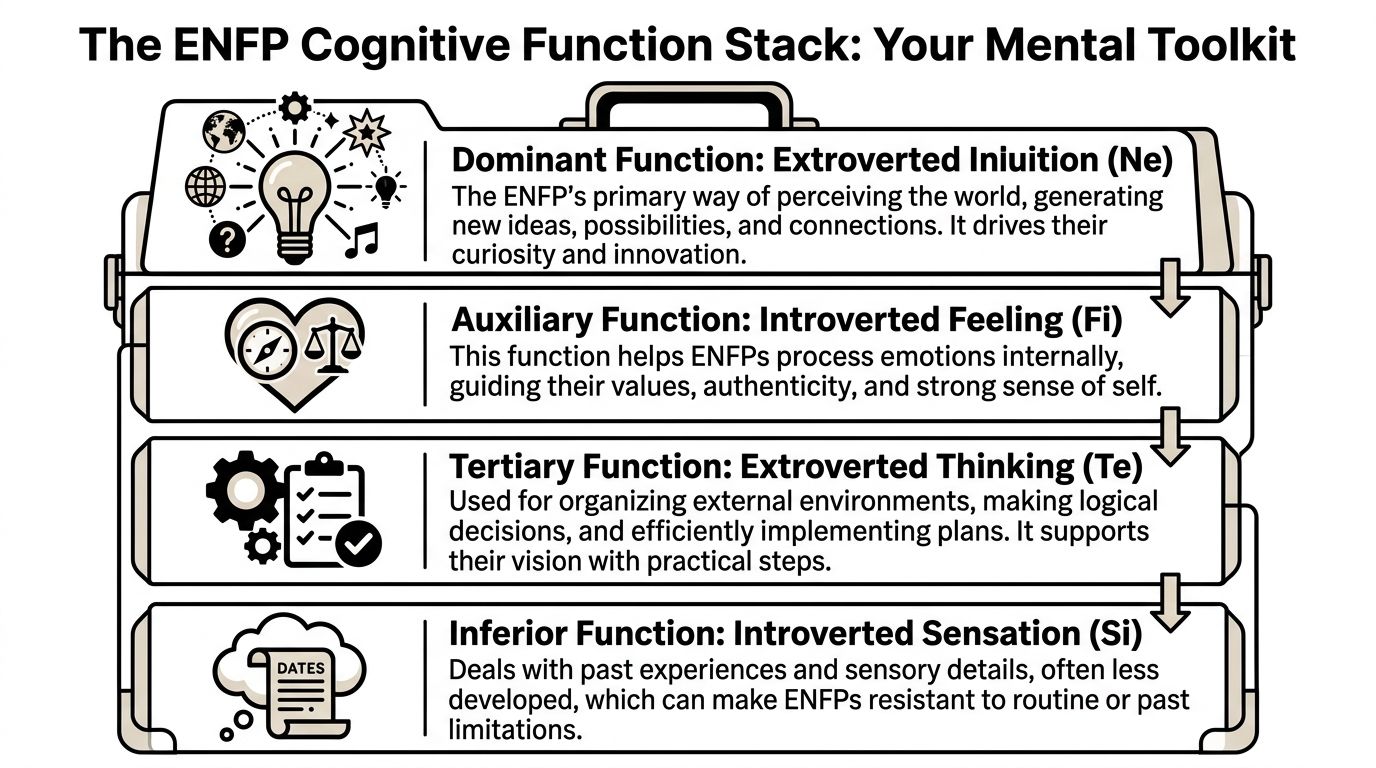
I like to describe the ENFP mind as a backpack full of mental tools. Some tools feel natural and effortless. Others are there, but harder to reach. The order matters.
For ENFPs, the stack goes like this: Extraverted Intuition (Ne) , Introverted Feeling (Fi) , Extraverted Thinking (Te) , and Introverted Sensing (Si) .
Ne the idea engine
Extraverted Intuition , often shortened to Ne , is the ENFP’s dominant function.
This is the part of the personality that generates possibilities at high speed. It sees patterns across totally different areas. It notices hidden links. It wants to explore what else might be true, possible, or worth trying.
A coworker says, “Customer engagement is down.”
The ENFP’s Ne responds with something like:
• “Maybe the issue isn’t the product. Maybe it’s the story.”
• “What if we changed the entire onboarding flow?”
• “Could we partner with another team and redesign the experience?”
Ne is why ENFPs often seem mentally alive. Their attention moves toward novelty, emerging patterns, and potential.
Fi the inner compass
Under all that outward energy is Introverted Feeling , or Fi .
Fi is personal, inward, and values-based. It helps ENFPs ask, “What matters to me?” and “Does this fit my real self?” This is why many ENFPs can seem socially open but emotionally selective. They may share lots of ideas before they share their deepest feelings.
Fi is also why ENFPs often care so much about authenticity. They dislike fake friendliness, manipulative behavior, or roles that force them to betray their values.
Two ENFPs can look equally lively on the outside and make very different choices because their Fi points them toward different convictions.
Te the growing organizer
Third in the stack is Extraverted Thinking , or Te .
This is the function that helps ENFPs organize, decide, structure, and execute. It is not usually their first instinct, but it becomes more useful as they mature.
Te is what shows up when an ENFP says:
• “Let’s make a checklist.”
• “We need a deadline.”
• “I have ten ideas, but this is the one we can ship.”
Young ENFPs often admire highly structured people because that style feels both foreign and useful. With practice, Te helps them turn inspiration into output.
Si the weak spot and growth edge
At the bottom of the stack sits Introverted Sensing , or Si .
Si deals with routine, memory, familiar reference points, and concrete details. For ENFPs, this area often feels effortful. According to Personality Junkie’s explanation of the ENFP function stack , this creates a real trade-off. Dominant Ne supports abstract pattern recognition, while inferior Si undermines detail-oriented tasks and often shows up as unfinished routine work or forgetfulness around obligations like bill payments or schedules.
That explains a classic ENFP contradiction. They can discuss life direction for an hour, then forget where they put the parking ticket.
How the stack works together
Here is the inner sequence many ENFPs experience:
That sequence creates the ENFP rhythm. It also creates the ENFP friction.
A relatable example
Say an ENFP wants to start a podcast.
Ne says, “This could become a platform, a community, maybe even a movement.”
Fi says, “Yes, but only if it feels honest and aligned with what I care about.”
Te says, “Fine. Buy a mic, name the show, record three episodes, put deadlines on the calendar.”
Si says, “Please do not ask me to maintain a weekly upload schedule, track invoices, archive audio files, and follow the same checklist forever.”
Why does this matter?
If you only learn the four letters, ENFP behavior can look random.
If you understand the stack, it starts to make sense. The ENFP is not flaky because they lack depth. They often struggle because the part of them that dreams is stronger than the part that maintains. Their growth path is not “be less you.” It is “support your gifts with better structure.”
The Unmistakable Strengths and Hidden Challenges
The traits people love most in ENFPs often come bundled with the struggles that confuse them.
That is the key to understanding this type. The strengths and challenges usually grow from the same root.

Strength and struggle are often the same feature
Take communication.
ENFPs are often described as excellent communicators , and Truity’s ENFP profile connects that to two things working together: sensitivity to conversational subtext through Ne and empathic resonance through Fi. In plain language, ENFPs often catch what people mean, not just what they say.
That can look like:
• reading the mood in a room quickly
• making others feel understood
• translating abstract ideas into energizing language
• helping tense groups reconnect around a shared purpose
But that same profile can make repetitive, detail-heavy tasks hard to sustain. The mind that comes alive in meaningful conversation often goes dim in routine maintenance.
A side-by-side look
| ENFP strength | Hidden challenge |
|---|---|
| Creative ideation | Too many ideas compete for attention |
| Emotional attunement | Conflict avoidance or over-absorption |
| Spontaneity | Weak follow-through on routine steps |
| Inspiring communication | Hard time with repetitive admin |
| Openness to possibility | Trouble narrowing choices |
What this looks like in real life
An ENFP manager might give a team fresh energy after a discouraging quarter. They help everyone remember the mission, spot a new angle, and rebuild morale.
Then the same manager may postpone the process document, ignore the spreadsheet until the last minute, or lose interest once the work becomes maintenance.
A student with ENFP preferences may shine in class discussion, write an original paper topic, and connect ideas brilliantly. That same student may struggle to submit the paper in the exact format, by the exact time, with the exact citation structure.
Neither example means the ENFP is incapable. It means the work style matters.
Common strengths people value
• They create momentum. • ENFPs often help stuck people and stuck teams move again.
• They humanize environments. • They remember that projects involve emotions, not just deadlines.
• They make room for possibility. • Where others see one path, ENFPs often see several.
• They connect across differences. • They can build quick rapport with many kinds of people.
If you want a practical next step in naming those gifts, this guide on how to find your strengths can help you separate natural talent from traits you only perform under pressure.
Common challenges that deserve compassion
Some ENFP patterns look careless from the outside but feel frustrating from the inside.
They may:
• overcommit because everything sounds meaningful
• delay boring tasks until stress forces action
• avoid direct conflict because harmony feels easier
• chase novelty when a project enters its less glamorous phase
Later in the section, it helps to hear another perspective on how these patterns show up.
The better way to support an ENFP
Do not tell an ENFP to “just be more disciplined” and expect that to solve much.
A better approach is:
• pair big ideas with visible deadlines
• break projects into shorter sprints
• let them talk through decisions out loud
• give honest feedback without flattening their enthusiasm
• assign them roles that involve people, innovation, or communication, then support execution with systems
ENFPs in Relationships and Careers
ENFPs bring the same core pattern into love and work. They want aliveness.
Not noise. Not drama. Aliveness.
They usually want relationships that feel emotionally real and careers that feel personally meaningful. If either one becomes too dead, too rigid, or too performative, they start to wilt.

How ENFPs love
In relationships, ENFPs are often curious, affectionate, expressive, and growth-oriented.
They tend to enjoy:
• deep conversation over surface routine
• partners who are honest about their inner world
• shared dreams, projects, or adventures
• space to keep evolving as individuals
An ENFP usually does not want a relationship that only looks good from the outside. They want one that feels alive on the inside.
That can be beautiful. It can also create tension.
If they idealize a partner too early, they may fall in love with potential and then feel disappointed by ordinary reality. If they fear conflict, they may act upbeat while inwardly storing resentment. If they feel emotionally boxed in, they may pull back suddenly.
Who often works well with ENFPs
Specific pairings vary by maturity and values, but ENFPs often appreciate people who do one or more of these things:
• ground their ideas without mocking them
• welcome emotional honesty
• respect independence
• bring steadiness without becoming controlling
A more structured partner can be a great match if they support, rather than suppress, the ENFP’s exploratory side.
Why certain careers click
The same themes show up in work.
ENFPs often do well in roles where they can connect with people, work from values, generate ideas, and avoid being trapped in repetitive maintenance. The verified data in the opening source notes that ENFPs often gravitate toward fields such as counseling, teaching, religion, journalism, and facilitation. That makes sense because those paths often reward meaning-making, communication, and human insight.
Career scenes that fit the type
An ENFP teacher may redesign a stale lesson so that students care.
An ENFP journalist may love the chase of finding a story, understanding people, and framing the big picture.
An ENFP counselor or coach may help someone name a hidden pattern and imagine a different future.
An ENFP entrepreneur may build a business around a mission, a community, or a belief that work should improve people’s lives.
Work environments that drain them
The issue is not that ENFPs “can’t handle responsibility.”
The issue is fit.
Many ENFPs struggle in environments that are:
• highly repetitive with little variation
• rigid and rule-heavy for no human reason
• emotionally flat
• disconnected from purpose
• focused only on maintenance, not improvement
If you are trying to find a job you love , it helps to look beyond job titles and ask sharper questions about the environment itself. Does the role involve people, ideas, change, storytelling, coaching, strategy, or creative problem-solving? Those clues often matter as much as the title.
For a deeper lens on how personality affects team fit and work style, this Enneagram at work guide adds another layer to the career conversation.
Bridging MBTI and Enneagram for Deeper Insight
MBTI tells you how a person tends to process life. The Enneagram helps explain why they do it.
That distinction matters.
Two ENFPs can both be warm, curious, and possibility-focused. Yet one may chase experiences to avoid pain. Another may chase authenticity because they fear being ordinary. Another may pour energy into helping because they need to feel needed.
That is where the Enneagram adds depth.
If MBTI describes your cognitive wiring, the Enneagram describes your motivational gravity. One system shows your preferred mental tools. The other points to the fears, desires, and coping patterns underneath them.
A fuller comparison lives in this article on Enneagram vs MBTI , but here’s the practical version for ENFPs.
ENFP and Enneagram Type 7
This is one of the most familiar pairings.
An ENFP with Type 7 energy often looks especially enthusiastic, future-focused, and novelty-seeking. The person may chase new plans, fresh starts, and stimulating experiences because being stuck feels unbearable.
The outside behavior might look like classic ENFP optimism.
The inner driver may be a wish to stay ahead of pain, boredom, limitation, or heaviness.
This ENFP often says yes quickly, starts a lot, and brings contagious excitement. Under stress, they may avoid stillness because stillness makes uncomfortable feelings easier to hear.
ENFP and Enneagram Type 4
An ENFP with Type 4 themes often appears more emotionally intense and identity-focused.
This person may still be imaginative and expressive, but the energy often turns toward questions like:
• Who am I, really?
• What makes me distinct?
• Am I being fully authentic?
The ENFP side brings possibilities and expressive flair. The Type 4 side adds a powerful concern with uniqueness, emotional truth, and identity. This version of ENFP may care less about being the most upbeat person in the room and more about being the most real.
ENFP and Enneagram Type 2
An ENFP with Type 2 energy often channels warmth into support, encouragement, and relational care.
This person may naturally uplift others, spot hidden potential, and enjoy being the one who helps, comforts, or connects. The ENFP communication style blends easily with Type 2 generosity.
But this combination can also slide into over-giving, blurred boundaries, or tying self-worth too tightly to being appreciated.
Why does this combined lens help?
Without the Enneagram, an ENFP may know their style but miss their motive.
Without MBTI, they may understand the motive but not the mechanics.
Together, the systems can answer richer questions:
• Why do I chase novelty?
• Why do I avoid conflict?
• Why do I light up around certain kinds of work?
• Why do I keep repeating the same relationship pattern?
That is much more useful than a flattering label.
A Growth Guide for the Ever-Evolving ENFP
Growth for ENFPs is not about becoming less imaginative, less warm, or less spontaneous.
It is about becoming more integrated .
A balanced ENFP still has ideas flying everywhere. They still care about meaning. They still notice people. The difference is that they learn how to land the plane, not just enjoy the takeoff.
Build a structure that feels alive
ENFPs usually resist systems that feel dead.
So do not build lifeless systems.
Use tools that feel visual, flexible, and satisfying to interact with. A Kanban board in Trello, a Notion dashboard with project stages, a Google Calendar with themed work blocks, or a voice-note capture app can help translate inspiration into movement.
The key is simple. Build light structure , not heavy cages.
Try:
• One home for ideas • so thoughts stop scattering across notes, apps, and paper scraps
• One weekly review • to choose which idea deserves effort
• One visible deadline • for anything that matters
Strengthen Te without becoming robotic
Your tertiary Te grows when you practice turning broad inspiration into concrete action.
A useful ENFP question is not “What do I feel like doing today?” It is “What is the next visible step?”
For example:
• idea: launch a workshop
• next step: draft the event title and outline
• next step after that: choose a date
• next step after that: invite five people
This sounds basic. That is the point.
Care for Si in small doses
Because Si is the weaker function, many ENFPs do better with tiny routines than grand discipline plans.
A ten-minute reset before concluding the day can help:
• check tomorrow’s calendar
• clear one surface
• review one list
• prep one needed item
These habits are modest, but they reduce the background chaos that drains creative energy.
Reality-test optimism before big decisions
One documented ENFP challenge is naive optimism . According to 16Personalities on ENFP strengths and weaknesses , ENFPs can start from a feel-good assumption and then use intuition to rationalize it, which can create confirmation bias in high-stakes choices.
This matters in love, money, health, and career.
Before a major commitment, pause and ask:
That process protects your idealism from becoming self-deception.
Support your emotional intensity wisely
ENFPs often carry a lot internally, even when they seem upbeat.
If anxiety, overthinking, or emotional flooding starts complicating your decisions, a grounded educational resource like this free anxiety education hub can help you understand what is happening without pathologizing your personality.
A better growth script
Do not tell yourself:
• “I need to stop being scattered.”
• “I need to be more like highly structured people.”
• “My enthusiasm is the problem.”
Try this instead:
• “My ideas need containers.”
• “My values need boundaries.”
• “My optimism needs reality checks.”
• “My gifts work best when supported by small systems.”
That is a much kinder and more effective path.
If you want to go beyond labels and understand the deeper motives driving your personality, take the assessment at Enneagram Universe . It’s a thoughtful next step for turning self-awareness into real growth.