What Is Emotional Awareness? Practical Ways to Build It Daily

Ever feel like you're just... off ? Like a storm is brewing inside, but you can't quite put your finger on what it is or why it's there? That's where emotional awareness comes in. It's your internal GPS, the ability to not just feel something, but to actually recognize it, name it, and get what it's trying to tell you.
Think of it as the first, most crucial step to navigating your inner world. Without it, we're just reacting on autopilot. With it, we can respond with intention.
Your Inner Compass: What Is Emotional Awareness, Anyway?
Imagine trying to find your way through a thick forest without a compass. You’d probably wander in circles, feeling lost and making decisions based on guesswork. That’s pretty much life without emotional awareness.
It's the core skill of tuning into your own frequency and understanding what’s really going on under the hood. You can't manage what you don't recognize. This is why emotional awareness is the absolute bedrock of emotional intelligence (EQ). It's like learning the alphabet before you try to write a novel—you have to know the individual letters first.
From Vague Feelings to Clear Insight
When we lack awareness, our emotions feel like a tangled, chaotic mess. You might just feel "bad" or "weird" after a tough conversation, and that vague feeling can hijack your whole day. Emotional awareness is what helps you untangle that mess.
Let's take a practical example. A project manager learns that a huge project she's leading is delayed.
• Without awareness: • She feels a hot wave of anger and frustration. She immediately starts blaming her team, feeling resentful and getting snappy with everyone for the rest of the week. Productivity tanks.
• With awareness: • She feels that same initial heat, but she pauses. She looks inward and identifies the primary emotion isn't just anger—it's sharp • disappointment • . She realizes this feeling comes from her own high standards and a deep fear of letting down the stakeholders.
That tiny shift from "I'm angry" to "I'm disappointed" changes everything. Instead of lashing out, she can address the real issue. She can communicate the delay clearly, manage her own perfectionism, and lead her team forward. The simple act of naming the emotion correctly gave her the power to act constructively.

A Skill in High Demand
In our hyper-connected, high-pressure world, it’s easier than ever to tune out our inner voice. A recent study revealed that in 2024, 37% of adults worldwide reported feeling a lot of daily stress, and 26% felt sadness —with many negative emotions trending higher than a decade ago.
This isn't just a "feel-good" skill; it's a critical tool for resilience. It’s the ability to understand your own emotions and see how they ripple out into your thoughts and actions.
If you're looking to build this muscle, there are fantastic resources that offer practical strategies for how to be more self-aware . For an even deeper dive, our own guide on how to become more self-aware is a great place to start.
The Real-World Payoff of Actually Understanding Your Emotions
Let's be real: emotional awareness isn't some fuzzy, abstract concept. It's one of the most powerful, practical investments you can make in yourself, period. Think of it as the secret ingredient that sharpens everything you do—from how you make decisions under fire to the genuine connection you build with the people you care about.
It's the bridge between what you're feeling on the inside and how you show up in the world.
Take Sarah, a whip-smart software engineer in the U.S. who was constantly on edge at work. Her default reaction was to blame her team for every missed deadline and garbled communication. It was their fault, right? But one day, instead of lashing out, she paused and did a quick internal check-in. What she found wasn't just run-of-the-mill frustration. It was a deep, bone-gnawing exhaustion.
Bingo. This wasn't a team problem; it was a burnout problem. Once she put the right name to the feeling, she could finally tackle the real issue. She took a much-needed break, put some firm boundaries in place, and came back with a completely fresh outlook. She ended up becoming a far more effective and collaborative leader, all because she stopped reacting and started understanding.
Level Up Your Performance and Well-Being
Sarah’s story isn’t a one-off. The skill of reading your own emotional dashboard has a massive ripple effect on your entire life. It’s the game-changing difference between flying off the handle and responding with intention.
The business world is catching on fast. Demand for emotional intelligence (EQ) skills is set to grow a whopping 6 times over the next 3-5 years . This makes perfect sense when you realize EQ already drives an incredible 58% of performance across all job types.
When you can tell the difference between anxiety and excitement, or between disappointment and outright anger, you reclaim control over your own actions. This unlocks some serious advantages:
• Smarter Decision-Making: • You learn to filter out emotional static from rational thought, leading to clearer, more sound choices—especially when the pressure is on. For example, instead of impulsively quitting a job after a bad day (driven by frustration), you recognize the feeling, analyze its source, and decide to address the specific issue with your manager the next day.
• Better Conflict Resolution: • By knowing your own triggers, you can walk into disagreements with less defensiveness and more genuine empathy. You start finding common ground instead of just creating more tension. For instance, if you know that feeling unheard triggers your anger, you can calmly state, "I feel like my point isn't being heard," instead of just getting louder.
• Less Chronic Stress: • Catching the early warning signs of stress means you can deal with the root cause before it spirals. This is huge for protecting your long-term mental and physical health. A practical example is noticing a clenched jaw and tight shoulders during the workday and realizing it's a sign of overload, prompting you to take a five-minute walk to decompress.
The Undeniable Link to Leadership and Success
The numbers don't lie. A startlingly low 36% of people are considered emotionally intelligent. Yet, look at the top of the food chain: a massive 90% of top performers in Fortune 500 companies have high EQ. And it’s not just individuals—companies that make these skills a priority are 22 times more likely to crush their financial goals compared to their competitors. You can dig into the full stats on emotional intelligence from ElectroIQ for more on this.
Getting good at this is a journey, not a destination, but it all starts with small, consistent steps. If you're ready to start building this muscle, our guide gives you some practical ways on how to increase EQ .
At the end of the day, emotional awareness isn't just about "feeling your feelings." It's about using those feelings as a powerful tool to build a more successful, fulfilling, and resilient life.
Common Signs You’re Running on Emotional Autopilot
Most of us cruise through life on an emotional autopilot, totally oblivious to the fact that our feelings are in the driver's seat. It's like driving a familiar route home and suddenly snapping to, realizing you don't remember the last five miles. Spotting these unconscious patterns is the first step to grabbing the steering wheel back.
This isn't about judging yourself. It's about having those "aha!" moments where the lightbulb goes on, and you finally connect the dots between what's happening inside you and how you're acting on the outside.

You’re Constantly Blindsided by How People React to You
Ever say something you think is totally harmless, only to get a surprisingly intense or hurt reaction? This is a dead giveaway you're on autopilot. When you aren't tuned into your own emotional state, you completely miss the subtext—the impatience, frustration, or sadness—that's leaking into your voice and body language.
For a practical example, imagine asking a coworker, "Is that report done yet?" Your words are neutral, but if you're feeling stressed, your tone might sound demanding and critical, causing your coworker to become defensive. You're broadcasting an emotion you aren't even aware of.
A fascinating study by organizational psychologist Tasha Eurich found a massive gap in how we see ourselves. While a whopping 95% of people think they're self-aware, the research suggests only 10-15% of us actually are. That disconnect is often why we’re so shocked by our own impact.
You Keep Having the Same Fights Over and Over
Feel like you’re stuck in a conversational groundhog day? Whether it’s with your partner, a coworker, or a friend, those recurring arguments are almost always powered by an emotion you haven’t named yet. You think you're fighting about who left the dishes in the sink, but the real engine behind the conflict is a feeling of being unappreciated or completely overwhelmed.
Take a practical example: a sales rep snaps at his family every night. He just writes it off as being tired from work. The real culprit? The gnawing anxiety he's been carrying all day about hitting his quarterly targets. His family is responding to his anger, but the true root of it all is an anxiety he hasn't even acknowledged.
Getting better at this means learning to tell different emotions apart, like truly understanding how anxiety really looks and feels versus just feeling "stressed." That distinction is everything.
Here are a few more clues you might be on autopilot:
• You can't name your feelings: • When someone asks how you are, is your go-to answer "fine," "busy," or "tired"? If you struggle to get more specific than that, you might be emotionally disconnected.
• You constantly feel misunderstood: • This often happens because you can't communicate your inner world clearly to others, because you haven't gotten clear on it for yourself first.
• You have random physical symptoms: • those mysterious headaches, that tense jaw, or a perpetually upset stomach? That could be your body screaming an emotion like stress or frustration that your conscious mind is ignoring.
Just starting to notice these signs is a huge step. It's how you begin to break free from the autopilot mode and build genuine emotional awareness.
Practical Exercises to Build Your Emotional Muscle
Think of emotional awareness less like a mystical gift and more like a muscle. You're not born with it fully formed; you build it. Just like hitting the gym strengthens your biceps, practicing specific exercises can bulk up your emotional fitness, making you stronger, more resilient, and way more in tune with your inner world.
The secret here isn't intensity, it's consistency. You don't need to spend hours meditating on a remote mountop (unless that's your thing). A few focused minutes each day is all it takes to forge a powerful new habit that pays off in big ways.
Start with a Three-Minute Check-In
This is the dead-simple, can't-mess-it-up starting point. It's a quick timeout that yanks you out of autopilot and reconnects you with what’s actually happening right now . You can do it anywhere—at your desk, in your car, or even waiting in line for your morning coffee.
Here's the drill:
That simple act of naming the feeling is a game-changer. It’s like being lost in a thick fog and suddenly someone hands you a compass.
Use an Emotion Wheel to Get Specific
Sometimes, a single word like "sad" or "angry" just doesn't capture the whole picture. Our feelings are way more complex than that. An Emotion Wheel is a brilliant tool for helping you find the precise word for what you're experiencing. It organizes feelings with core emotions at the center (like Fear ) and more specific variations branching out from there (like Insecure or Anxious ).
Practical Example: The next time a big feeling hits after a tense meeting, pull up an image of an Emotion Wheel. Finding the exact word—and realizing your "anger" is actually a blend of "frustration" and "disappointment"—is incredibly empowering. It gives you clarity and a much greater sense of control.
Connect Your Body and Mind with a Body Scan
Let's be real: our bodies are often screaming about our emotions long before our conscious minds get the memo. A body scan is your chance to finally listen to what your body has been trying to tell you all along.
Imagine a middle school teacher in Chicago. Every day, she leaves work feeling drained and irritable. She starts doing a quick body scan in her classroom before she heads home. As she mentally scans from her toes to her head, she gets to her jaw and realizes it’s clenched so tight it aches.
Bingo. In that moment, she connects the dots: the physical tension in her jaw is the raw, unprocessed stress from a day of managing a chaotic classroom. By simply noticing it, she can consciously relax her jaw, take a few deep breaths, and release some of that tension before it follows her home.
These are just a few ways to start tuning your internal radio. For more great ideas, check out these powerful self-awareness activities to keep flexing that emotional muscle.
Your Daily Emotional Awareness Workout
Feeling overwhelmed by the idea of adding another thing to your to-do list? Don't be. We've put together a simple, 5-minute-a-day plan to get you started. Think of it as a quick workout for your inner world.
| Time of Day | Activity (5 Minutes) | Goal |
|---|---|---|
| Morning | Three-Minute Check-In | Start your day with intention and clarity, not on autopilot. |
| Midday | Mindful Moment | Take 5 deep breaths, focusing only on the sensation of air. |
| Evening | Body Scan | Release the physical tension you've accumulated from the day. |
The key is to make it a habit. Stick with this routine for a week, and you'll be amazed at how much more connected you feel to your own emotional landscape. It's about progress, not perfection.
Common Roadblocks on Your Journey to Self-Awareness
Starting the journey to greater emotional awareness is a fantastic move, but let's be real—it's not always a walk in the park. Like any worthwhile adventure, it's got its share of classic bumps and potholes. Knowing what to watch out for can make all the difference, helping you turn frustrating setbacks into genuine "aha!" moments.
One of the biggest hurdles people face is intellectualizing their feelings instead of actually feeling them. This is when you analyze an emotion from a safe, logical distance without ever letting yourself sit with the raw sensation of it. It’s a sneaky little defense mechanism our brains deploy to dodge discomfort, but it traps us in our heads and disconnects us from our bodies.
The Trap of Analysis Paralysis
Picture a young entrepreneur prepping for a huge investor pitch. He's got that familiar knot in his stomach, and his heart is thumping. He tells himself, “Okay, I’m anxious. High-stakes pitch tomorrow, a lot is riding on this. It’s a logical stress response.”
He’s not wrong, but he's only identified the emotion intellectually. He hasn't let himself feel the anxiety—the tightness in his chest or the nervous energy zinging through his limbs. By explaining it away, he misses the chance to truly understand and work with the feeling itself.
It’s so easy to mistake thinking about an emotion for actually experiencing it. True emotional awareness asks you to drop out of your head and into your body, just observing the feeling without the frantic need to explain or fix it.
Another major roadblock is our habit of labeling emotions as "good" or "bad." We roll out the red carpet for happiness and excitement, but we shove anger, sadness, or fear out the back door like they're problems to be solved. This judgment just starts an internal war, making it impossible to hear what these so-called negative emotions are trying to tell you.
Every single feeling, from pure joy to bitter jealousy, carries valuable data. When you create a hierarchy, you’re basically choosing to listen to only half of your internal guidance system.
Getting Unstuck from Emotional Loops
Finally, it’s incredibly common to get stuck in an emotional loop , where you replay a feeling and its accompanying story over and over again. This kind of rumination feels productive—like you’re trying to figure it all out—but it usually just pours gasoline on the emotional fire without leading to any kind of resolution.
Breaking free from these hurdles means shifting your entire approach. Instead of analyzing or judging, try practicing non-judgmental observation. Greet each feeling with simple curiosity, asking, "What is this?" instead of "Why is this so bad?" Changing your internal dialogue from criticism to curiosity is a game-changer.
This chart illustrates a simple flow for building your "emotional muscle," a key strategy for navigating these common roadblocks.
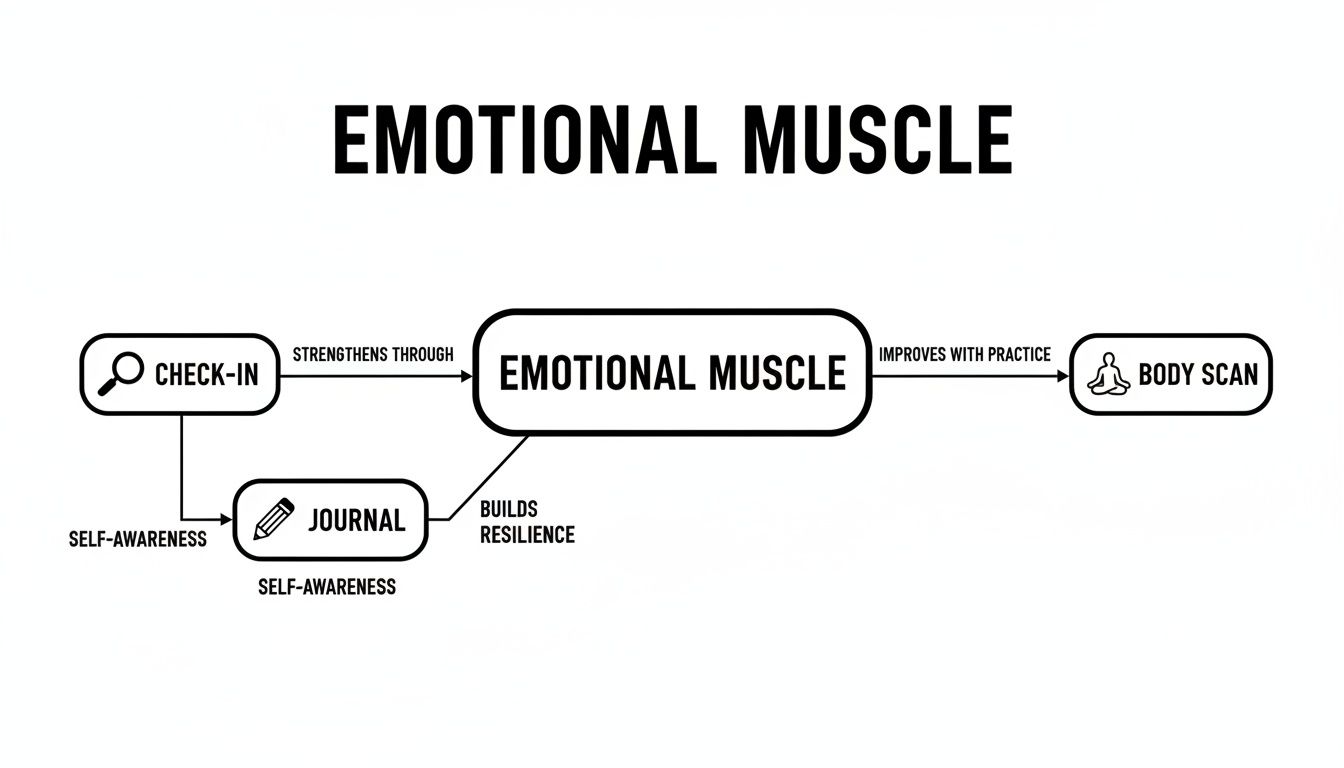
By consistently checking in, journaling, and doing body scans, you build the strength to sit with your emotions instead of just being yanked around by them.
Got Questions About Emotional Awareness? We've Got Answers.
As you start digging into this stuff, a few questions always seem to pop up. Let's tackle some of the most common ones head-on to clear up any confusion and keep you on the right track.
"Am I Just Being Overly Emotional?"
Absolutely not. This is a huge misconception. Being "overly emotional" is when your feelings are in the driver's seat, and you're just along for the chaotic ride. Emotional awareness is the complete opposite. It's you taking the wheel.
Think of it this way: being overly emotional is like being caught in a storm at sea, tossed around by massive waves. Emotional awareness is being the skilled surfer who sees the wave coming, respects its power, and chooses exactly how to ride it. You're in control, not the wave.
"Is It Possible to Be
Too
Emotionally Aware?"
It's less about having "too much" awareness and more about what you do with it. The real danger isn't awareness itself, but getting stuck in rumination —that mental hamster wheel where you replay feelings over and over without getting anywhere.
Healthy emotional awareness is about insight that sparks action. You feel it, you get the message, and then you do something about it. It’s not about getting lost in endless analysis. For instance, a student feeling anxious about a big exam uses that awareness to create a study schedule, not just to marinate in the worry.
"So, How Long Until I'm a Pro at This?"
Building emotional awareness is more like learning a martial art than running a race. There’s no finish line you cross; it’s a lifelong practice. That said, with consistent effort, you can feel a real, noticeable shift in just a few weeks.
The magic is in the small, steady habits—like those daily check-ins we talked about. Every time you pause and connect with yourself, you're doing another rep, strengthening that inner muscle. It all adds up.
Ready to stop guessing what's driving you and start knowing ? At Enneagram Universe , our free, in-depth assessment is your first step toward profound self-discovery. Uncover your Enneagram type and get the personalized insights you need to build powerful emotional awareness. Take the Enneagram Test today at Enneagram Universe .