What Is an ISFJ? “The Defender” Personality Uncovered

Have you ever met someone who just gets it? The person who remembers you take your coffee with oat milk after hearing it once, or shows up with a container of your favorite soup when you’re feeling under the weather. If so, there's a good chance you’ve met an ISFJ.
Defining the ISFJ personality goes way beyond a simple label. It’s about understanding the quiet, dependable, and warm-hearted people who are the true bedrock of our communities.
Meet the ISFJ: The Unsung Hero Next Door
Often called ‘The Defender’ or ‘The Protector,’ ISFJs are driven by a deep, instinctual need to care for others and maintain harmony. They’re not the ones chasing the spotlight or making a big fuss. Instead, they find genuine fulfillment in making things stable and secure for everyone else, usually from behind the scenes.
Think of the ISFJ as the world’s most reliable friend. They’re the one who texts to make sure you got home okay, the coworker who quietly organizes the messy shared drive to save everyone a headache, and the family member who never forgets a birthday. Their actions spring from a powerful sense of duty and a sincere concern for the people in their orbit.
What Makes an ISFJ Tick?
So, what's the secret sauce? At their heart, ISFJs operate on a powerful combination of compassion, unwavering loyalty, and an almost uncanny ability to remember the details that matter to others. This isn't just a quirk; it’s the very core of how they connect with the world.
• Genuinely Compassionate: • They feel a strong, tangible pull to help people in practical, hands-on ways. For example, they're the neighbor who offers to walk your dog when they see you're overwhelmed.
• Fiercely Loyal: • Once an ISFJ is in your corner—whether as a friend, employee, or partner—their dedication is unshakable. They will defend a friend's reputation even when that friend isn't present.
• Incredibly Observant: • They notice and store away tiny details about people and their surroundings, using that intel to offer thoughtful, personalized support. They're the one who brings you a decaf coffee in the afternoon because they noticed caffeine makes you jittery.
This unique mix of traits makes them a steady presence in so many of our lives. In fact, ISFJs are the most common personality type, making up an estimated 13.8% of the population . That means you almost certainly know and rely on several Defenders, even if you don't realize it. You can explore how this stacks up against other types by checking out these personality type statistics.
Before we dive deeper, here's a quick snapshot of what defines the ISFJ personality.
ISFJ at a Glance: The Defender's Key Traits
| Attribute | ISFJ Characteristic | What This Means in Practice |
|---|---|---|
| Primary Motivation | To protect and care for others | They find purpose in ensuring the well-being and security of their loved ones and community. |
| Core Value | Duty and Responsibility | If they say they'll do something, you can bet they will. Their word is their bond. |
| Key Strength | Meticulous & Observant | They remember small but important details that others miss, from favorite foods to past conversations. |
| Communication Style | Warm, supportive, and practical | They listen more than they talk and offer concrete help rather than abstract advice. |
| Approach to Life | Prefers structure and tradition | They thrive on established routines and find comfort in time-tested methods. |
This table gives you the highlight reel, but there's even more to their humble, yet powerful, approach to life.
This profound reliability makes them the glue in countless friend groups and workplaces. They're the person you can count on to follow through, every single time, bringing a sense of calm and order wherever they go. They prefer familiar routines not because they're boring, but because structure allows them to dedicate their energy more efficiently to what really matters: helping people. Their goal isn’t to be praised, but simply to be helpful.
Let's Get Inside the ISFJ's Head: The Cognitive Functions
Alright, to really get what makes an ISFJ tick , you have to look past the surface-level traits and peek at their mental operating system. We're talking about their cognitive functions: the four-part engine that drives their personality. These are Introverted Sensing (Si) , Extraverted Feeling (Fe) , Introverted Thinking (Ti) , and Extraverted Intuition (Ne) .
Think of them as the mental tools an ISFJ naturally reaches for to make sense of the world and make decisions. This is the wiring behind the scenes.
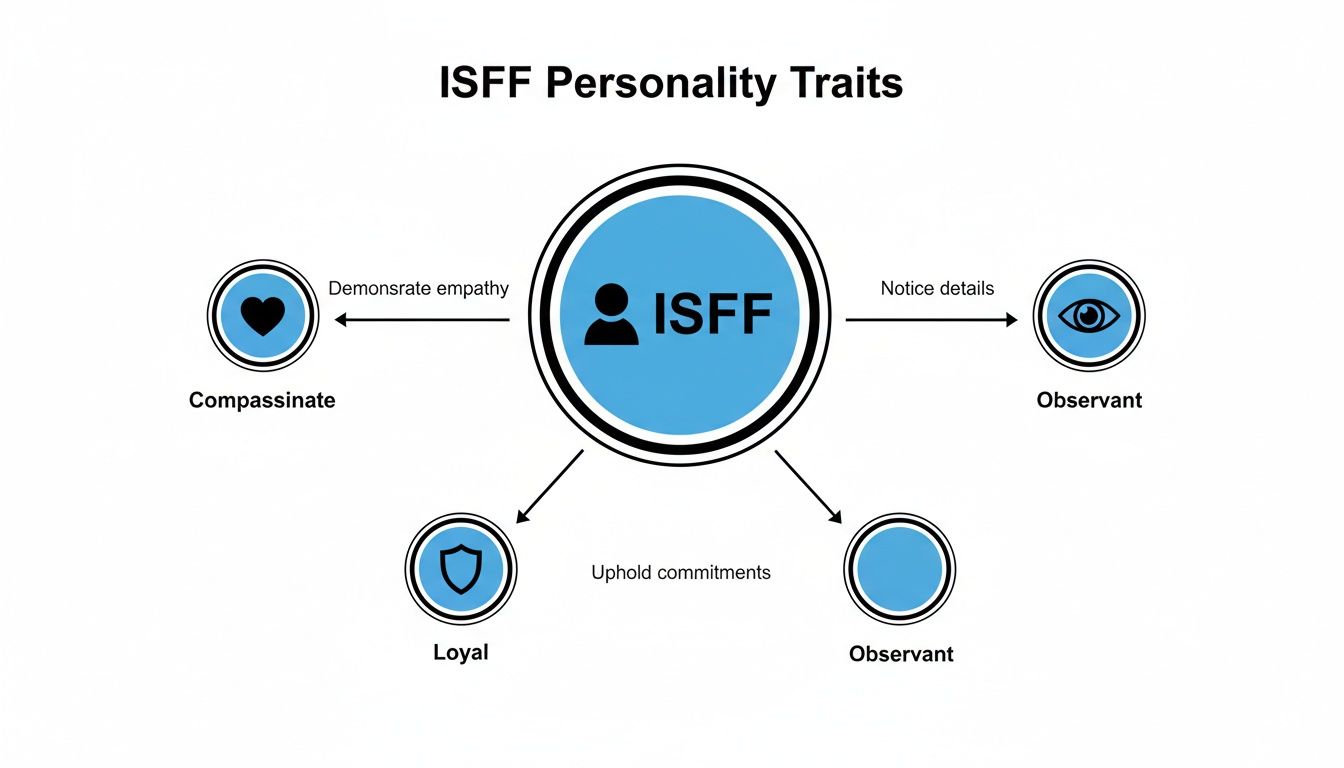
As you can see, those core ISFJ traits of compassion, loyalty, and sharp observation don't just come from nowhere—they're the direct result of this unique cognitive wiring.
Introverted Sensing (Si): The Mental Scrapbook
The star of the show for an ISFJ is their dominant function, Introverted Sensing (Si) . Imagine a hyper-detailed, high-definition mental scrapbook. That's Si. It’s not just about remembering facts; it’s about absorbing and storing rich, sensory impressions from past experiences.
This is why an ISFJ can recall the exact way you take your coffee after you told them once, months ago. They’re not just retrieving data; they’re re-experiencing the moment. This function builds a deep-seated respect for routines, traditions, and methods that have proven themselves reliable. Their inner scrapbook is filled with evidence of what works.
A real-world example: An American ISFJ is planning a 10-year anniversary bash for a major client. Her Si kicks in, recalling a tiny detail from an event she managed three years earlier—the CEO's wife offhandedly mentioned she adored gardenias. The ISFJ immediately adds gardenias to the floral plan. It's a small touch, but it’s precisely these personal, thoughtful details that make her work unforgettable.
Extraverted Feeling (Fe): The Social Thermostat
Next in command is Extraverted Feeling (Fe) , which works like a "Social Thermostat." This function is all about the world outside, constantly tuning into the emotional temperature of a room and the people in it. Fe's main job? To keep the peace and make sure everyone feels good.
This is what makes ISFJs so incredibly perceptive about others' feelings. They can walk into a meeting and instantly feel the tension, spot the person feeling left out, or know when a gentle, diplomatic voice is needed. Their choices are almost always filtered through the question, "How will this impact the people around me?"
Introverted Thinking (Ti): The Internal Troubleshooter
Sliding into the third spot is Introverted Thinking (Ti) , the ISFJ's personal "Internal Troubleshooter." While their Fe is busy with people, their Ti is quietly working in the background, making sure everything adds up and makes logical sense to them .
Ti is the part of an ISFJ that craves order and internal consistency. It helps them break down problems, spot flaws in a plan, and categorize information into a clean, logical framework. Ever see an ISFJ meticulously organizing a messy shelf or creating the perfect filing system? That's their Ti bringing a satisfying sense of order to the chaos.
• Logical Consistency: • Ti is the voice that asks, "Does this align with what I know to be true and fair?"
• Problem-Solving: • It’s the tool they use to take a big, messy problem and find a simple, practical fix. For example, if a team project is failing, the ISFJ's Ti might privately pinpoint the logistical flaw everyone else missed.
• Personal Framework: • Ti builds a private blueprint of how things ought to work for maximum efficiency.
While MBTI is a fantastic tool, it's just one piece of the personality puzzle. Many people find that pairing it with the Enneagram offers an even more nuanced view. To explore how they work together, you might find our guide on the Enneagram vs MBTI super helpful.
Extraverted Intuition (Ne): The "What-If" Brainstormer
Last and, frankly, least preferred is the inferior function, Extraverted Intuition (Ne) . For the ISFJ, this is their "What-If Brainstormer," and it's by far their trickiest tool to handle. Ne is all about jumping into the world of abstract possibilities, connecting random ideas, and brainstorming for the sake of it.
Because it's their weakest function, dealing with Ne can feel seriously uncomfortable for an ISFJ. Under stress, it often goes haywire, showing up as a tidal wave of anxiety about all the terrible things that could happen. Instead of a fun brainstorm, it becomes a parade of catastrophic "what-ifs." This just sends them running back to the safety and predictability of their dominant Si.
Over time, though, a mature ISFJ learns to get a better handle on their Ne. They can start using it to be more open to change, find creative solutions, and even enjoy a little bit of playful speculation—as long as it doesn't get too out of hand.
The ISFJ's Double-Edged Sword: Strengths & Struggles
Every personality type is a coin with two sides, and the ISFJ is no different. The very same qualities that make them the steadfast pillars of their families and workplaces can also become their personal stumbling blocks. These aren't just features and bugs; they're two sides of the same deeply caring coin.
Let’s get to know the amazing gifts ISFJs bring to the world, and then we’ll look at the common hangups that can get in their way.
The ISFJ’s Quiet Superpowers
An ISFJ's strengths aren't loud or flashy. They're the quiet, steady forces that create stability and warmth wherever they go, rooted in a powerful desire to make life better for the people they care about.
• Empathy with sleeves rolled up. • An ISFJ doesn't just feel for you; they • do • for you. Their compassion is an action verb. They’re the ones bringing you soup when you’re sick or helping you move on a Saturday, translating their empathy into real, tangible help.
• Rock-solid dependability. • If an ISFJ says they’ll do it, you can take that promise to the bank. Their profound sense of duty means they are some of the most reliable people on the planet, and they see their commitments through to the end.
• A hawk-eye for detail. • That powerful Introverted Sensing (Si) function acts like a high-definition camera, capturing and recalling small but important details others miss. This makes them incredibly thoughtful gift-givers and ruthlessly efficient in their work.
Here’s how it looks in real life: Think of a nurse named Mark. He’s an ISFJ. Not only does he administer every medication with meticulous precision, but he also remembers his elderly patient mentioned her daughter was stressed about a big exam. He makes it a point to ask about it, offering a small moment of genuine human connection. That’s classic ISFJ—blending flawless execution with heartfelt warmth.
The Defender's Common Hurdles
The very traits that make ISFJs so wonderful can also create a world of internal conflict. When their best qualities are pushed to the extreme, they can backfire. These aren't character flaws, but rather invitations for growth.
That deep-seated need for harmony (Fe) and reliance on what’s known (Si) can create a few predictable challenges.
This burnout often shows up in three key ways:
• Suffering in silence. • An ISFJ would much rather shoulder a heavy burden alone than feel like they’re bothering someone else. A practical example is an ISFJ parent who feels overwhelmed but continues to do everything for the family without asking for help, leading to exhaustion.
• Avoiding conflict like the plague. • For an ISFJ, arguments and tension feel physically and emotionally toxic. Their peacemaking drive (Fe) is so strong that they might agree to things they don’t want or let important issues slide, all to avoid a confrontation—sometimes at a great personal cost.
• Digging their heels in against change. • ISFJs thrive on routine and predictability. Sudden, out-of-the-blue changes can feel like a personal attack on the stable world they’ve worked so hard to build, throwing them for a loop.
And here's that in action: Imagine Sarah, an ISFJ office manager. Her boss suddenly announces a massive, unplanned overhaul of the entire company workflow. While others might be excited, Sarah feels a wave of panic. Her mind is frantically cataloging all the perfectly good systems that are about to be dismantled, and she's already worrying about how the chaos will impact her team's morale—all while maintaining a calm, supportive smile.
ISFJ and the Enneagram: Which Types Show Up Most Often
MBTI and the Enneagram measure different things — MBTI maps how you take in information and make decisions, the Enneagram maps why you do what you do, down to the core fear driving it. That's why they pair well: an ISFJ label tells you the "what," the Enneagram tends to fill in the "why."
ISFJs most often turn out to be Enneagram Type 2 (The Helper) , Type 6 (The Loyalist) , or Type 9 (The Peacemaker) — three very different core motivations that can all produce the same quiet, dependable, service-oriented ISFJ on the surface:
• An ISFJ • Type 2 • gives because being needed feels like being loved.
• An ISFJ • Type 6 • gives because loyalty and reliability feel like the safest way to belong.
• An ISFJ • Type 9 • gives because keeping the peace and merging with others' needs feels more comfortable than asserting their own.
Same outward behavior, three different engines underneath — which is exactly why two ISFJs can feel so different to be around once you get to know them. If you've recognized yourself in "The Defender" above, the free Enneagram test is a fast way to find out which of these is actually driving your ISFJ traits, and what that means for the "hurdles" section above.
ISFJs in Relationships, Work, and Friendships
So, what does all this theory look like out in the wild? The ISFJ personality isn't just a set of letters; it’s a living, breathing force of loyalty and care that shapes every interaction. They are the steady hands and warm hearts that others instinctively rely on, showing their affection not with grand pronouncements, but with quiet, unwavering support.

Their deep-seated need for harmony guides them, making ISFJs some of the most nurturing partners, devoted friends, and dependable colleagues you'll ever meet. Let's pull back the curtain on how they operate in the most important areas of life.
ISFJs in Romantic Relationships
When an ISFJ falls in love, they don't just fall—they build. Romance for them is about creating a shared life of comfort, security, and mutual care. Their love language is almost always acts of service . They’re the ones who bring you a hot meal after a brutal day at work or surprise you with that book you mentioned wanting weeks ago.
They crave genuine, long-term stability and are fiercely committed partners. For an ISFJ, a relationship is a precious responsibility, one they pour their heart and soul into maintaining.
Here’s a real-world snapshot: imagine an ISFJ named David whose partner, Sarah, is swamped by a massive work project. Sarah is stressed to the max. Instead of just saying, "You can do it!", David quietly takes over all the household chores for the week. He stocks the fridge with her favorite snacks and makes sure the house is a calm, peaceful sanctuary for her to work in. He shows his love by clearing away life’s practical burdens so she can shine.
The ISFJ as a Friend
In a friendship, the ISFJ is the anchor. They are the ultra-reliable confidant you can call at 3 AM, no questions asked. They’re the one who remembers every single birthday, organizes the perfect group gift, and offers a non-judgmental ear paired with genuinely helpful advice.
They tend to cultivate a small, tight-knit circle of friends rather than a sprawling network of acquaintances. They invest deeply in these bonds and, in return, value loyalty above all else.
If you find this fascinating, you might also enjoy exploring how different personality frameworks intersect. Our guide on Enneagram types in relationships offers another rich layer of understanding that pairs beautifully with the MBTI.
ISFJs in the Workplace
At work, the ISFJ is the secret ingredient that keeps everything running. Their meticulous nature and service-first mindset make them the quiet engine of the team. They thrive in structured environments where their incredible attention to detail and ability to follow through are seen as the assets they truly are.
Their main driver isn't glory or the corner office; it's being genuinely helpful and fostering a harmonious, productive team. They truly light up in roles where they can provide tangible support to their colleagues and the organization.
Where You'll Often Find ISFJs Thriving:
• Healthcare Professional (Nurse, Physical Therapist): • These roles are a perfect marriage of their desire to provide hands-on care and their knack for executing complex procedures flawlessly.
• Administrator or Office Manager: • Who better to create order from chaos? Their organizational genius makes them brilliant at keeping an office running like a well-oiled machine.
• Accountant or Bookkeeper: • This work demands the painstaking precision that is second nature to an ISFJ’s Si-dominant mind.
• Human Resources Manager: • Blending their talent for creating harmony (Fe) with a respect for established processes (Si), they excel at supporting employees and nurturing a positive company culture.
Whether they’re managing patient files or orchestrating a company-wide event, the ISFJ's goal is always the same: to do the job perfectly and make sure everyone feels supported along the way.
Best Career Paths for the ISFJ Personality
For an ISFJ, a job isn't just about the paycheck. It’s about feeling truly, undeniably useful. They have a deep-seated need to see the tangible results of their hard work and know that it made someone's life a little bit better. A career has to feel more like a calling, a place where their unique gifts can be put to good use.
When you blend a powerful memory for practical details ( Introverted Sensing - Si ) with a genuine desire to care for others and maintain harmony ( Extraverted Feeling - Fe ), you get a person who is practically built for roles that require both compassion and precision. It’s this special combination that makes certain career fields feel like coming home for an ISFJ.
Roles That Feel Like a Natural Fit
It’s no surprise that many ISFJs gravitate toward careers centered on practical service and organization. These are the jobs where their quiet, steady dedication isn't just a nice bonus—it's the very foundation of success.
• Healthcare: • Think about roles like a nurse, physical therapist, or dental hygienist. An ISFJ nurse doesn't just administer medicine on a perfect schedule; they're the one who remembers your favorite type of tea or that your grandchild is visiting tomorrow, providing a level of personal care that genuinely speeds up healing.
• Administration: • ISFJs are often the unsung heroes who keep an office from descending into chaos. As office managers, bookkeepers, or executive assistants, their talent for creating and maintaining orderly systems makes everyone else's job possible. They're the calm at the center of the storm.
• Education: • As an elementary school teacher or a librarian, an ISFJ’s bottomless patience and nurturing spirit create a safe, supportive space for learning. They have a real gift for breaking down complex subjects and building a student's knowledge one solid brick at a time.
Thinking Outside the Traditional Box
But don't fence the ISFJ in! Their incredible skills can shine just as brightly in fields that might seem less obvious at first glance. The core motivation is always the same—creating order and providing practical value—but the application can be wonderfully creative.
Take an ISFJ working as an interior designer , for example. They would listen with incredible focus to a client's wishes, using their detailed Si memory to recall every little preference. Then, their Fe would kick in to design a space that doesn’t just look good on Instagram, but feels harmonious, comfortable, and right for the people who will actually live there.
Here are a few other paths where an ISFJ can find that same deep fulfillment:
• Veterinary Technician: • This role is a perfect blend of medical precision and heartfelt compassion for both animals and their worried human companions.
• Museum Curator: • What better way to use a respect for the past (Si) and meticulous organizational skills than by preserving and presenting history for everyone to appreciate?
• Genealogist: • This is an ISFJ's dream job—a detailed, historical investigation that helps people connect with their own personal stories and family roots.
At the end of the day, any career that allows an ISFJ to roll up their sleeves and provide detailed, practical service will feel incredibly rewarding. While these roles are great starting points, you can always explore a broader range of various job roles to see what else sparks your interest.
How to Know If You Are an ISFJ
So, you've been reading this description, and things are starting to click. That quiet sense of duty, the rock-solid reliability, the deep-seated urge to take care of others—does it all feel a little too familiar? If you're starting to wonder if you might just be an ISFJ, let's connect the dots.
Instead of some dry, impersonal checklist, let’s talk about what it actually feels like to be a Defender. Answering these questions can bring a huge amount of clarity. This kind of self-discovery is a big first step for anyone looking to understand who they are at their core and maybe even rediscover yourself .
The ISFJ Gut-Check Questions
Take a breath and see how much these real-world scenarios resonate with you:
• Do you feel almost physically ill when people around you are fighting? • Most people dislike arguments, but for an ISFJ, that tension is like poison in the air. Your Extraverted Feeling (Fe) is hardwired for harmony, making any disruption feel deeply unsettling.
• Is there a special kind of satisfaction in checking off a to-do list for a project that helps someone else? • For an ISFJ, this is the sweet spot. It’s the perfect blend of your organizational drive and your fundamental need to be of service.
• Do you remember tiny, personal details about people that they've long forgotten telling you? • That's your Introverted Sensing (Si) working its magic. Your mind is like a detailed scrapbook, constantly recording facts that make you an incredibly thoughtful friend or colleague.
• Do you feel a quiet sting of resentment when your hard work goes completely unnoticed? • You're not looking for a marching band or a trophy. You just need to feel seen. When your consistent efforts are taken for granted, it can feel like a genuine personal slight.
If you found yourself nodding along—maybe even a little too enthusiastically—you’re probably on the right track. Many of these traits are quite common. For instance, roughly 49.3% of people identify as Introverts and 54.1% as Judging types, so ISFJs sit comfortably within some major population trends. You can discover more insights about personality statistics on crowncounseling.com for a deeper dive into the numbers.
Common Misidentifications: The ISTJ and ISFP Mix-Up
It’s incredibly easy to get confused, especially with personality types that share a few letters. Let’s clear up the two most common cases of mistaken identity for the ISFJ.
ISFJ vs. ISTJ (The Logistician)
This is the most frequent mix-up, and for good reason. Both types share Introverted Sensing (Si) as their primary way of operating. This means both of you value routine, hard facts, and what has worked in the past.
The real difference is how you make decisions.
Think of it this way: An ISFJ will bend a rule to preserve a relationship. An ISTJ will uphold the rule because it's the established, logical procedure.
ISFJ vs. ISFP (The Adventurer)
Here, both types are Introverted and have a "Feeling" preference, but the inner mechanics are totally different. The ISFJ’s world is built on reliable systems and the emotional temperature of the group (Si + Fe). The ISFP, on the other hand, is driven by deeply personal values and living in the moment (Fi + Se).
An ISFJ’s life is structured and service-oriented. An ISFP’s is spontaneous and focused on authentic self-expression.
If you're still piecing it all together, a formal assessment can offer a more tailored look. You might want to explore a comprehensive personality test to get another angle on where you land.
Common Questions About the ISFJ Personality
Alright, let's tackle some of the big questions that always seem to pop up when people are trying to wrap their heads around the ISFJ personality. If you're still curious about a few things, this should help paint a much clearer picture of what makes these wonderful "Defenders" tick.
Are ISFJs a Rare Personality Type?
Not even close! In fact, ISFJs are the most common personality type out there, making up a whopping 13.8% of the population. I can almost guarantee you know, love, and depend on at least a few ISFJs, even if you don't realize it.
They're the quiet, steady forces holding our communities together. Think of them as the unsung heroes working diligently behind the scenes, offering support without ever demanding a moment in the spotlight.
What Stresses an ISFJ Out the Most?
If you want to send an ISFJ into a tailspin, throw two things at them: sudden, out-of-the-blue changes and intense emotional conflict. Their deep-seated need for harmony (that's their Extraverted Feeling at work) and their reliance on predictable routines (courtesy of Introverted Sensing) make messy arguments and torpedoed plans feel incredibly personal and draining.
They also get incredibly stressed when they feel like their tireless efforts go unnoticed or when they've absorbed everyone else's problems without getting any support in return.
How Can I Best Support an ISFJ Friend or Partner?
Honestly, the most powerful thing you can do for an ISFJ is incredibly simple: notice what they do and say "thank you." They give so much of themselves to others, and just knowing that their hard work is seen and truly appreciated means everything to them.
Also, be the person who actively tells them to take a break and recharge. Give them a safe, judgment-free zone to vent their own worries, and always— always —give them a heads-up before you change a plan. These small acts of consideration show you respect their thoughtful nature more than words ever could.
Do ISFJs Dislike Being the Center of Attention?
Oh, absolutely. While they are some of the warmest people you'll ever meet, ISFJs are true introverts at heart. They get their energy and satisfaction from supporting others from the wings, not by standing under the floodlights.
Making a big, public fuss over them can often make them feel more awkward than appreciated. For an ISFJ, a heartfelt, one-on-one "thank you" will always land better than a booming shout-out in front of a crowd. They want to feel valued, not paraded.
Understanding your own personality is the key to building a life that feels authentic and deeply fulfilling. Here at Enneagram Universe , we've developed a free, comprehensive personality assessment to help you uncover your core drivers and unlock your true potential. Find out what makes you tick by taking our test today at Enneagram Universe.