What Is an Enneagram? Your Guide to the 9 Personality Types

So, what is the Enneagram, really? Imagine it as a psychological GPS for your inner world. It’s far more than just another personality test; the Enneagram digs deep to reveal the why behind how you think, feel, and act. It essentially maps out nine core motivations that are the engine for nearly all human behavior.
Your Inner Compass to Who You Are
Ever catch yourself wondering why your go-to stress response is meticulously cleaning the entire house, while your partner immediately starts brainstorming a dozen new projects? Or why one friend constantly needs reassurance, while another just plows ahead without a second thought? The Enneagram offers a surprisingly accurate explanation for these deep-seated patterns. It’s a dynamic system that illuminates nine fundamental personality types .

Here's what sets it apart from other personality tools: it doesn't just look at your outward behaviors. The Enneagram goes a level deeper. It isn't concerned with what you do, but the core motivation behind what you do . That’s the secret sauce that makes it such a powerful tool for genuine personal growth.
For example, you could have two people who are both incredibly organized. One, a Type One from Chicago named Maria, organizes everything out of a deep-seated desire to be good, right, and perfect. The other, a Type Six named David from Austin, organizes out of a core need for security, trying to prepare for any and every potential disaster. The behavior looks the same on the surface, but their internal worlds couldn't be more different.
The Goal Isn't a Label, It's a Map
It’s easy to look at personality systems and think their only purpose is to slap a label on you. That’s the exact opposite of the Enneagram's intention. It doesn't put you in a box; it hands you a detailed map of your own inner landscape.
This map helps you see:
• Your Home Base: • Your core personality type, complete with its unique gifts and worldview.
• Hidden Roadblocks: • The automatic, often unconscious, patterns that keep tripping you up.
• New Pathways: • Clear, actionable directions for growth, helping you shift from knee-jerk reactions to conscious, intentional choices.
Essentially, the Enneagram doesn’t just tell you where you are. It shows you where you can go.
Why Your Motivation Matters Most
Getting a handle on your "why" is the key to any real, lasting change. The moment you see the hidden fear or desire that’s pulling your strings, you suddenly have the power to choose a different response. You start catching your automatic impulses in the act, before they hijack your day.
The Enneagram's true value lies in revealing the unconscious motivations that shape our lives. It’s not just about identifying your type; it's about using that knowledge to become a healthier, more balanced version of yourself.
This is why discovering your type often feels like a massive "aha!" moment. A man from Seattle who spent his whole life thinking he was just "lazy" might discover he's a Type Nine. Suddenly, he sees that his inaction isn't about laziness at all—it’s a powerful, lifelong drive to maintain inner peace and avoid conflict. Armed with that insight, he can finally work with his nature instead of fighting against it, finding constructive ways to engage with the world without shattering his internal harmony.
That shift—from self-criticism to self-compassion—is where the real journey begins.
The Surprising History of the Enneagram
If you think the Enneagram is just another personality quiz that popped up on your social media feed, think again. Its backstory is less "self-help aisle" and more "secret society manuscript," weaving through ancient wisdom, clandestine spiritual schools, and some of the most innovative psychology of the 20th century.

The roots of the Enneagram run deep—far deeper than most people realize. Some threads trace all the way back to ancient Babylon around 550 B.C. The symbol itself seems to have ties to Pythagorean numerology and sacred geometry.
What's really fascinating is that for most of its history, this knowledge was intentionally kept under wraps, passed down quietly within spiritual communities. This oral tradition is why there’s no big, dusty book of Enneagram origins and why it didn’t really break into the public consciousness until the 1970s.
From Ancient Symbol to Modern Tool
For centuries, that iconic nine-pointed star wasn't about personality types at all. It was a diagram meant to represent cosmic laws and universal processes—the big stuff.
The person who first dragged this symbol into the modern Western world was George Gurdjieff , a truly enigmatic spiritual teacher in the early 1900s. Gurdjieff saw the Enneagram as a map for everything from the creation of the cosmos to the transformation of a single human soul. He used it as a tool for profound spiritual work, but he never linked the nine points to nine personalities. That groundbreaking leap came much later.
The modern Enneagram is a fascinating blend of ancient mystical geometry and contemporary psychological insight. Its journey from a hidden symbol to a mainstream tool for self-awareness is a testament to its enduring power.
Fast forward to the 1950s, and enter our next major player: Oscar Ichazo . A Bolivian-born spiritual leader, Ichazo was the first to connect the nine points with specific psychological patterns. He mapped them to what he called "ego fixations," "passions" (vices), and "virtues." He founded a school in Arica, Chile, where he taught this system to small, dedicated groups, keeping the tradition of guarded knowledge alive.
The Bridge to Modern Psychology
The final piece of the puzzle clicked into place thanks to one of Ichazo’s students, a Chilean psychiatrist named Claudio Naranjo . In the early 1970s, Naranjo took the framework he learned from Ichazo and did something brilliant: he synthesized it with his deep understanding of modern psychology. He eventually brought these teachings to Berkeley, California, where they began to spread throughout the United States.
He took the skeletal descriptions of the types and fleshed them out, creating the rich, nuanced, and eerily accurate personality portraits we know today.
While the Enneagram stands on its own, its development echoes concepts from other profound psychological traditions, like Jungian psychotherapy , which also focuses on inner healing and making sense of our unconscious drives.
Naranjo was the bridge. He connected the Enneagram’s esoteric past with observable, practical human psychology. It was through his work, and the work of his students, that the Enneagram finally stepped out of the shadows and into the worlds of therapy, business, and personal growth, becoming the powerful tool we have today.
A Deep Dive Into the Nine Enneagram Types
Alright, let's get to the good stuff—the people. The heart of the Enneagram is its nine distinct personality types. Think of these not as neat little boxes to cram people into, but as nine fundamental strategies we use to navigate the world. Each one is a complex, beautiful tapestry woven from a core desire we all want and a core fear we’re all trying to avoid.
As we walk through each type, try to see them as living, breathing worldviews. You'll almost certainly recognize the people in your life—your boss, your partner, your quirky aunt from Miami—and maybe, just maybe, you'll see a reflection of yourself.
Ready? Let’s meet the crew. You can find an even more detailed breakdown in our full guide to the nine Enneagram types .
Type 1: The Reformer
First up is the One. Imagine a non-profit manager from Philadelphia who doesn't just plan a fundraising gala; she crafts a flawless experience. From the font on the name tags to the timing of the keynote speaker, every single detail is meticulously planned and perfected. That’s a One.
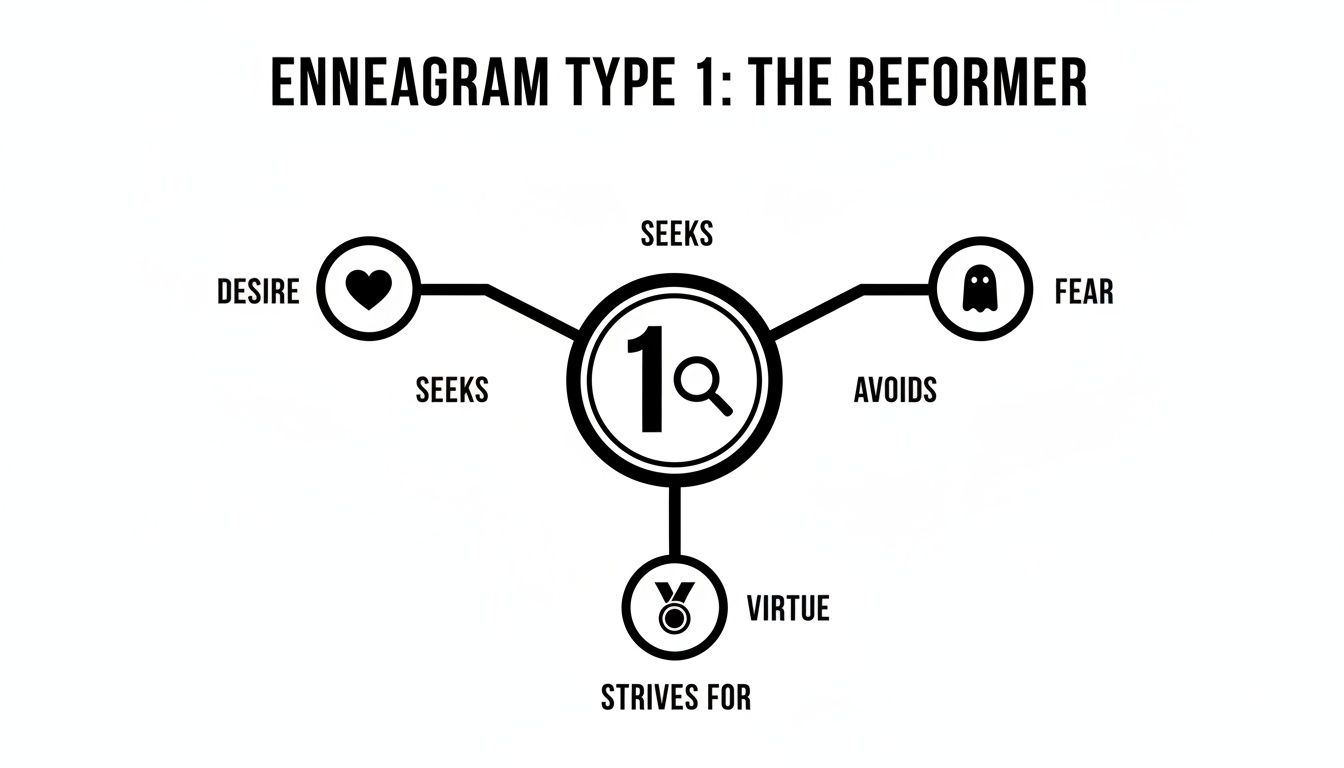
Ones are principled, purposeful, and self-controlled. They’re driven by a deep need to be good , to have integrity , and to make the world a better, more orderly place. Their internal landscape is dominated by a powerful inner critic, a voice that constantly points out how things should be, pushing them toward excellence.
Their Worldview: "The world is imperfect, and it's my job to fix it. I have to be good and right to justify my existence."
This relentless drive makes them incredibly ethical and reliable. But their core fear—of being corrupt, defective, or evil—can make them overly critical of themselves and everyone else when they're stressed. Their path to peace is through Serenity , the virtue of learning to accept the world (and themselves) with grace, imperfections and all.
Type 2: The Helper
Next, let's talk about Twos. Picture that high school teacher in Kansas who stays late to tutor students, remembers everyone’s birthday, and is the first person you call when you need a hand. They feel most alive and valued when they're needed.
Twos are the caring, generous, and people-pleasing heart of the Enneagram. Their core desire is to feel loved and wanted, and they accomplish this by intuitively sensing what others need and rushing in to provide it. They are the glue in their communities, building connections with warmth and support.
• Core Desire: • To be loved and wanted.
• Core Fear: • Being unwanted or unworthy of being loved.
• Defining Trait: • They focus on others' needs, often forgetting they have needs of their own.
The catch? Sometimes their help comes with unspoken expectations, born from that deep fear of being dispensable. The journey for a Two is to embrace Humility , which isn't about thinking less of themselves, but about learning to give their own needs the same loving attention they give to others.
Type 3: The Achiever
Meet the Three, the charismatic startup founder from Atlanta with sales charts plastering her office walls. She’s ambitious, energetic, and already planning the next product launch before the current one is even over. She thrives on success and the admiration it brings.
Threes are the adaptable, success-oriented chameleons of the Enneagram. Driven by a desire to be valuable and worthwhile , they are masters of presenting a polished, successful image. They are incredibly efficient and have a knack for motivating people to chase big goals.
Their Worldview: "The world values winners. To earn love and respect, I must be successful."
Their core fear is of being worthless. This can push them to prioritize work over their authentic feelings, sometimes losing touch with who they are behind the impressive facade. Their path to wholeness is through Veracity , or truthfulness—being honest with themselves and others about who they really are, independent of their long list of accomplishments.
Type 4: The Individualist
Now, let’s consider the Four. Think of the musician in Brooklyn who feels everything deeply and is on a constant quest for identity. He shuns the mainstream, curating a life that feels authentic and uniquely his, from his vintage clothes to his emotionally raw lyrics.
Fours are the expressive, dramatic, and self-aware romantics. Their core desire is to find themselves and their significance—to forge a unique identity . They are attuned to beauty, depth, and the bittersweet side of life, never shying away from intense emotions.
• Core Desire: • To be unique and have a stable identity.
• Core Fear: • Having no identity or personal significance.
• Defining Trait: • A tendency to feel different from others and a focus on what feels missing.
This feeling of being different can sometimes curdle into envy and melancholy. The growth path for a Four is to embrace Equanimity , the virtue of finding emotional balance and appreciating the simple, ordinary moments of life just as much as the extraordinary ones.
Type 5: The Investigator
Let's turn to the Five, the software engineer from Silicon Valley who feels most at home in the world of ideas. When faced with a new project or even a party, her first instinct is to pull back and learn everything she can before engaging. She sees her time and energy as precious resources to be guarded carefully.
Fives are the perceptive, innovative, and private observers. Their core desire is to be capable and competent . They believe the best way to handle the world is to understand it, so they stockpile knowledge to feel self-sufficient and prepared for anything.
Their Worldview: "The world is intrusive and demanding. I need to protect my resources and gain knowledge to be safe."
Their core fear is of being useless or helpless. This can cause them to withdraw from the world, becoming detached from their relationships and even their own feelings. Their journey is toward Non-Attachment , the virtue that allows them to engage freely with the world without the fear that it will drain them dry.
Type 6: The Loyalist
Think of the Six as the project manager in Denver who is a master of contingency planning. He’s already thought through every worst-case scenario to make sure his team is prepared for anything. He’s deeply committed to his family and company but often looks for reassurance before making a big move.
Sixes are the engaging, responsible, and security-oriented types. Their core desire is to have security and support . Their minds are wired to scan for potential dangers, which makes them excellent troubleshooters and incredibly loyal, dependable allies you want in your corner.
Their core fear is of being without support or guidance. This underlying anxiety often shows up as doubt, suspicion, or a need for outside validation. The growth path for a Six is to cultivate Courage —learning to trust their own inner authority and to act in spite of their fear.
Type 7: The Enthusiast
Now, picture the Seven: a travel blogger from Los Angeles whose calendar is a whirlwind of adventures and whose mind is a constant fireworks display of exciting new ideas. She lives to experience as much joy and excitement as possible, always looking forward to the next big thing.
Sevens are the busy, fun-loving, and spontaneous optimists. They are driven by a core desire to be satisfied and content , and to keep their options open. Their future-oriented energy is infectious, bringing a sense of possibility to any room they enter.
Their Worldview: "The world is full of amazing opportunities. I have to stay positive and avoid pain to have a good life."
Their core fear is of being deprived or trapped in pain. This makes them masters of avoidance, often by over-scheduling their lives to outrun negative feelings. Their journey is toward Sobriety , the virtue of being fully present in the moment—with all its joys and sorrows—and finding deep satisfaction in what is, rather than what could be.
Type 8: The Challenger
Let's meet the Eight, the decisive union leader from Detroit who is fiercely protective of his people. When he sees an injustice, he doesn't just notice it—he confronts it head-on. He has a powerful, larger-than-life presence and a bone-deep need to control his own destiny.
Eights are the powerful, assertive, and self-confident protectors. Their core desire is to protect themselves and be in control of their own lives. They have boundless energy and aren't afraid of a good fight, often using their strength to champion the underdog.
• Core Desire: • To protect themselves and control their own lives.
• Core Fear: • Being controlled or harmed by others.
• Defining Trait: • A strong, assertive presence and a resistance to showing vulnerability.
This need for control can sometimes look like intimidation or a refusal to let their guard down. The growth for an Eight lies in embracing Innocence , their virtue, which allows them to trust, let go, and engage with the world with an open and tender heart.
Type 9: The Peacemaker
Finally, there's the Nine. Imagine a librarian from Portland with a calm, reassuring presence and an amazing ability to see all sides of an issue. Her greatest wish is for everyone to just get along, and she’ll often go along with others’ plans just to keep the peace.
Nines are the easygoing, self-effacing, and receptive peacemakers. Their core desire is to have inner stability and peace of mind . They are naturally supportive and accepting, and they have a unique ability to merge with the agendas of others to maintain harmony.
Their Worldview: "The world is better when everyone is at peace. I must avoid conflict to maintain my inner calm."
Their core fear is of loss and separation. This can lead them to "fall asleep" to their own desires and opinions, becoming complacent just to avoid rocking the boat. Their journey is toward Action , the virtue of learning to assert their own presence and engage with life's challenges from a place of grounded, inner strength.
So You Know Your Number… What’s Next?
Just when you think you’ve got a handle on the nine types, the Enneagram throws you a curveball. It’s a beautiful, complex system, and your core type is really just the beginning of the story. Think of it as the main course of your personality—now it's time to add the side dishes and spices that make you, well, you .
This is where things get really interesting. We’re diving into Wings , Triads , and Levels of Health . These concepts are the secret sauce of the Enneagram, showing you not just who you are, but how you operate, connect with others, and most importantly, how you can grow.
Let's move beyond the basics and see what makes this system so powerfully insightful.
What’s the Deal with Wings?
Your Enneagram Wing is one of the two types sitting right next to your core number on the Enneagram symbol. If you're a Type 9, for example, your neighbors are Type 8 and Type 1. While your core type is always your home base, one of these adjacent types usually has a stronger influence, adding a distinct "flavor" to your personality.
Here’s a practical example: if your core type is vanilla ice cream, your wing is the chocolate or caramel swirl. It doesn’t change the fact that it's vanilla, but it sure adds a whole new dimension. A Nine with an Eight wing ( 9w8 ) will come across as more assertive and grounded, while a Nine with a One wing ( 9w1 ) will seem more idealistic and orderly.
This little addition makes a huge difference in how your core motivations play out.
As you can see, every type is built around a core fear and a core desire. Your wing subtly changes how you go about chasing that desire and dodging that fear. It adds nuance. You can learn more by exploring our in-depth look into how Enneagram wings work .
The Three Centers of Intelligence: Your Inner Engine
The Enneagram also groups the nine types into three sets of three, known as Triads or Centers of Intelligence . Think of these as the emotional engine running under the hood of your personality. Each triad is driven by a dominant emotional theme: anger for the Gut Triad, shame for the Heart Triad, and fear for the Head Triad.
Knowing your triad is like finding the master switch for your automatic reactions.
• The Gut Triad (Types 8, 9, 1): • These folks are all about instinct and are fueled by • anger • . They engage with the world through their gut feelings, focusing on control and resisting being controlled. Their core struggle is with willpower and personal boundaries.
• The Heart Triad (Types 2, 3, 4): • Driven by feelings and the emotion of • shame • , these types are deeply concerned with their image and how others see them. Their central focus is on their own identity and worth, constantly asking, "Who am I?" and "Am I valuable?"
• The Head Triad (Types 5, 6, 7): • This group is all about thinking and is motivated by • fear • . They process the world by analyzing, planning, and preparing for what’s to come. Their primary struggle is with anxiety and finding a sense of security in an uncertain world.
Let's say a conflict erupts at a PTA meeting in Dallas. A Type 8 (Gut) might jump in immediately to take charge and argue her point. But a Type 6 (Head) would likely hit the pause button, analyzing every possible threat and seeking reassurance from a friend before making a single move. Same situation, wildly different responses—all thanks to the underlying emotion driving them.
The Levels of Health: Your Path to Growth
Here’s where the Enneagram truly shines as a tool for personal growth. The Levels of Health show that your type isn't a fixed box you're stuck in. It’s a dynamic spectrum that reveals how you show up when you’re thriving versus when you’re just getting by… or completely falling apart.
Each type has nine levels, ranging from healthy to average to unhealthy.
The Levels of Health are the Enneagram’s most powerful tool for growth. They prove you are not your patterns; you are the one who can observe them and choose a healthier path.
When you're at your best (the healthy levels), you embody the most inspiring qualities of your type. You're self-aware, compassionate, and a true gift to the world. In the average levels—where most of us hang out—your ego's automatic patterns are pretty much running the show. At the unhealthy levels, your core fears have taken over completely, leading to destructive and compulsive behaviors.
Take a Type 7. A healthy Seven is joyful, present, and deeply appreciative of life. An unhealthy Seven, on the other hand, is scattered, escapist, and reckless, desperately trying to outrun their inner pain.
Recognizing where you are on this continuum is the first step toward moving into a healthier, more conscious, and more powerful version of yourself.
How to Reliably Discover Your Enneagram Type
Alright, so you’re ready to figure out your number. A quick search will show you the internet is practically drowning in free Enneagram quizzes, but let me offer a little friendly advice: be careful. Most of them are just clickbait in disguise.
They tend to focus on surface-level stuff—your habits and quirks—which is a surefire recipe for getting your type wrong.

Here's the thing: the Enneagram isn't about what you do; it’s about why you do it. A good test won’t just ask if you enjoy planning parties. It’ll dig deeper to figure out if you're planning that party from a Type One's deep-seated need for everything to be perfect, or from a Type Seven's FOMO-driven desire to engineer an amazing experience.
Look for Motivation-Based Assessments
The only tests worth your time are the ones designed to get at your core motivations, fears, and desires. These don't use simple "yes or no" questions. Instead, they’ll present you with a statement and ask you to rate how much it resonates with your inner world. That subtle approach is key to untangling your authentic self from learned behaviors or even just a bad mood.
Think of it this way: a cheap quiz is like a blurry, out-of-focus photo. You get a vague idea, but that's about it. A scientifically validated assessment, on the other hand, is like a high-resolution portrait, capturing all the tiny details that make you, you. The push for this kind of rigor really kicked off in the 1980s, when American pioneers like David Daniels and Helen Palmer co-founded the Enneagram Professional Training Program in 1988 to create more systematic, insightful methods.
The Test Is Just the Beginning
Now, for the most important secret to finding your type: no test can have the final say . That’s right. A well-designed assessment is an incredibly powerful starting point—think of it as a highly educated guess that points you in the right direction. It takes the nine possibilities and brilliantly narrows them down to maybe two or three.
Your test result is not a diagnosis; it's an invitation. The real confirmation comes from honest self-reflection and recognizing your own story in the detailed type descriptions.
Once you have your results, the real journey begins. This is where you roll up your sleeves and dive into the full descriptions of your top-scoring types. Read about their core fears, their deepest desires, their childhood patterns. The type that makes you feel profoundly seen—maybe even a little squirmy and uncomfortable—is almost certainly your home base.
For some extra help on this part of the journey, check out our step-by-step guide for beginners on how to find your Enneagram type .
Common Enneagram Questions Answered
Once you start digging into the Enneagram, you’ll find that a few questions tend to pop up again and again. You’ve got a handle on the types, the wings, and the triads, but now it’s time to tackle those nagging curiosities.
Let’s bust some myths and clear up the most common head-scratchers once and for all.
Can My Enneagram Type Change Over Time?
This is a fantastic question, and it really gets to the core of what the Enneagram is all about. The short answer? No. Your core Enneagram type is like your operating system—it’s the foundational strategy you developed early in life to make sense of the world, and it stays with you.
But here’s the crucial part: how you express that type can and absolutely should change. Think of your type as your bone structure. That framework doesn’t change, but your health, strength, and posture certainly do.
As you grow and become more self-aware, you move through different Levels of Health. A healthy Type 7 from Colorado who has learned to find joy in the present moment is a world away from an unhealthy one desperately chasing the next high. The goal isn't to change your number, but to become the most balanced and conscious version of it.
How Is the Enneagram Different From Myers-Briggs?
Ah, the classic personality tool showdown! Both are incredible, but they’re looking at you through different lenses.
The Myers-Briggs Type Indicator (MBTI) is brilliant at describing the "how" of your personality. It tells you how you prefer to gain energy (Introvert vs. Extrovert) or make decisions (Thinking vs. Feeling). It’s like getting the specs for your car's engine—you learn its mechanics and how it operates.
The Enneagram, on the other hand, gets to the "why." It digs deep into the core motivations, fears, and desires that secretly drive your behavior. It’s the GPS showing you where the car wants to go and why it’s on that particular road trip in the first place.
Imagine a marketing director named Sarah from Chicago. Her Myers-Briggs type is ENTJ, which tells us she's a decisive, strategic leader. The Enneagram adds another layer, revealing she's a Type 3. Now we know why she's so driven: her core desire is to feel valuable and worthwhile, and her ambition is the vehicle for that. Knowing both gives you a much richer, more complete picture.
Is There a Best or Worst Enneagram Type?
Let me be perfectly clear on this one: absolutely not. This is probably the most important thing to understand about the Enneagram. It’s a tool for compassion, not judgment.
The Enneagram is not a hierarchy to be climbed but a circle to be understood. Each type holds unique gifts, perspectives, and blind spots, and all are equally valuable.
The goal isn't to wish you were a different number; it's to become the healthiest, most self-aware version of your own type. A thriving Type 9 brings incredible peace and stability to the world. A thriving Type 8 offers fierce, protective strength. We need all nine expressions of humanity to be whole.
The "best" you can be is a conscious and compassionate you, pure and simple. If you're interested in digging deeper, you can explore other relevant articles that touch upon similar themes of personal growth.
Ready to stop guessing and start growing? Discovering your Enneagram type is the first step toward profound self-awareness. Enneagram Universe offers a free, scientifically validated 180-question test that goes beyond surface traits to reveal your core motivations. Find your true type today and unlock the map to your inner world at Enneagram Universe .