What Is a Personality Type and How Does It Define You?

Ever wonder why you're the life of the party while your best friend from Boston would rather be at home with a good book? Or why your co-worker’s desk in San Francisco looks like a hurricane hit it, yet they produce brilliant work? These aren't just random quirks; they're clues pointing to your fundamental personality type .
Think of a personality type as your personal "operating system." It’s the underlying code that runs in the background, shaping how you think, what you feel, and why you do the things you do. It's not about slapping a label on yourself, but about understanding the core motivations, fears, and desires that drive your behavior.
Your Personality Is a Blueprint, Not a Box
Trying to navigate your life, career, and relationships without understanding your personality is like trying to explore a massive city like New York without a map. You’ll get there eventually, but you're bound to take a lot of wrong turns and hit some frustrating dead ends.
A personality framework gives you that map. It illuminates the inner logic that guides your choices, showing you the paths you’re naturally drawn to and the destinations that truly light you up. It’s the key to unlocking a much deeper level of self-awareness.
What It Really Means
Getting to know your personality type isn't about boxing yourself in. It's the complete opposite—it's about freedom. It’s a powerful tool that helps you decode why you are the way you are.
Once you have this blueprint, you can start making real, meaningful changes:
• Build way better relationships: • When you understand how other people are wired, you can stop getting frustrated by the differences and start communicating with real empathy. For example, understanding your partner’s need for quiet time after a long day isn’t a rejection, but a way for them to recharge.
• Find work you actually love: • Aligning your career with your natural talents and motivations is the secret sauce for genuine fulfillment and success. A detail-oriented person might thrive as a financial analyst in Chicago, while a people-person might feel suffocated in that same role but excel in community management.
• Finally understand yourself: • Recognizing your own patterns is the first step. It lets you lean into your strengths and get a handle on your blind spots.
A personality type doesn't put you in a box—it gives you the blueprint to understand the box you're already in, and shows you the door.
Imagine a sales manager in Dallas who, after taking an Enneagram assessment, realizes his relentless drive comes from a need for security. Instead of burning himself out chasing every award, he focuses on creating a stable, high-performing team. He ends up happier, more successful, and a better leader.
To cut through the noise, it helps to be crystal clear on what a personality type is and what it definitely isn’t.
Personality Types: What They Are vs. What They Are Not
This little cheat sheet should help clear up some of the most common myths and misunderstandings.
| What It Is | What It Is Not |
|---|---|
| A dynamic blueprint for understanding yourself. | A rigid, restrictive label that defines you forever. |
| A tool for insight into motivations and fears. | An excuse for negative behavior or bad habits. |
| A framework for personal growth and awareness. | A definitive judgment of your character or worth. |
| A guide to improving relationships and choices. | A way to predict someone's every move with 100% certainty. |
Ultimately, personality typing is a starting point, not a final destination. It's a guide to help you on your journey, not a script that dictates your every move.
Diving Into the 3 Major Personality Frameworks
Alright, so we've established that a personality type is basically your internal blueprint. Now, let's meet the architects behind the most popular designs. Think of personality frameworks like different camera lenses. Each one captures the same subject—you—but from a totally unique angle, highlighting different details, shadows, and depths.
Some are wide-angle lenses, showing how you fit into the grander landscape of human traits. Others are powerful zoom lenses, getting right up close to the hidden motivations that secretly run the show. By exploring the big three, you can find the lens that brings your own personality into the sharpest focus.
This map here gives you a great visual for how it all connects—your inner blueprint, your core drives, and the things you actually do .
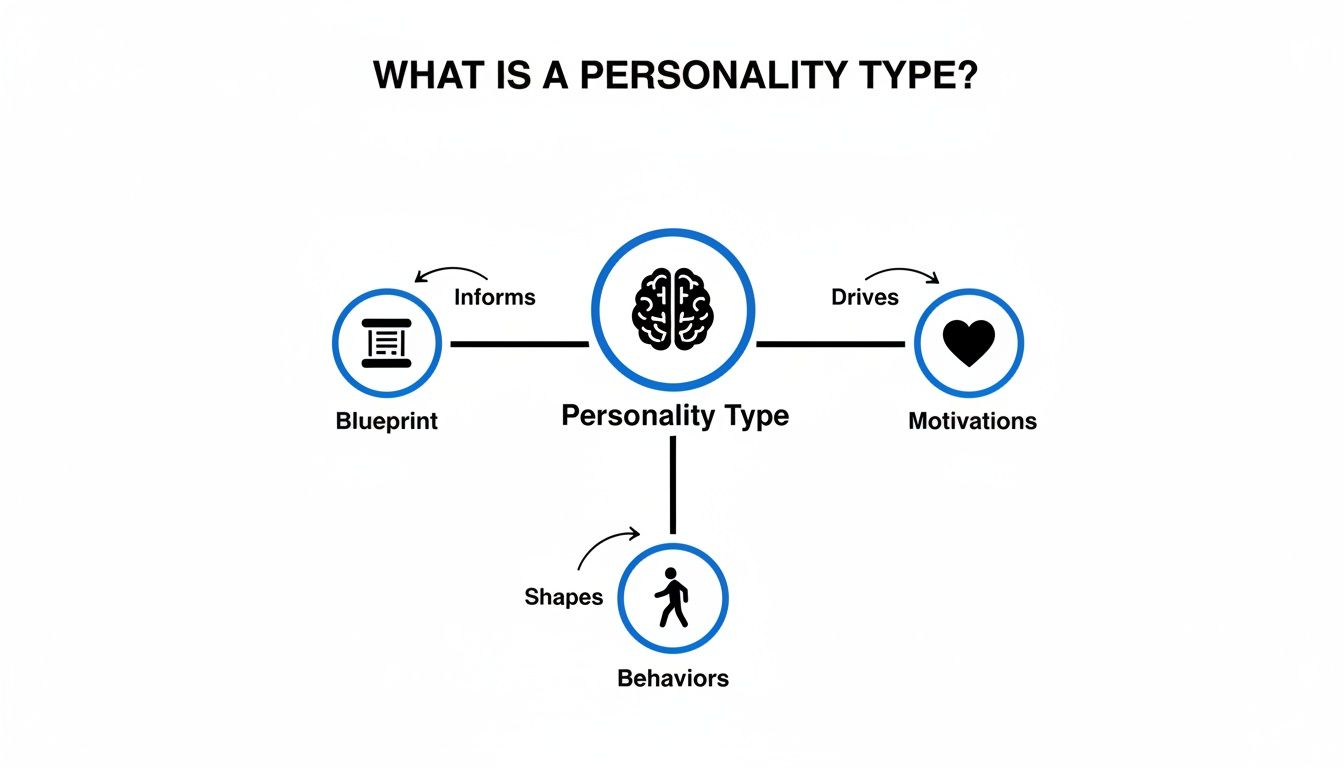
It’s a powerful reminder that to really get yourself, you have to look past the "what" (your actions) and dig into the "why" (your motivations).
Comparing the Top 3 Personality Frameworks
To help you find the right tool for your journey, here's a quick side-by-side look at how the Enneagram, MBTI, and Big Five stack up against each other. Each has its own strengths and is built for a different kind of self-discovery.
| Framework | What It Measures | Best For |
|---|---|---|
| The Enneagram | Core motivations, fears, and your fundamental worldview. | Deep personal growth, understanding your "why," and improving relationships. |
| MBTI | How you process information, make decisions, and direct your energy. | Career guidance, team dynamics, and understanding your cognitive style. |
| The Big Five (OCEAN) | Your position on five key trait spectrums (e.g., introversion to extraversion). | Academic research, broad personality assessment, and clinical psychology. |
Ultimately, the "best" framework is the one that gives you the answers you're looking for. Some people start with one and then add another to get a more complete picture.
The Enneagram: Uncovering Your Core Motivations
The Enneagram is the ultimate zoom lens. It breezes past surface-level behaviors to uncover the deep-seated, often unconscious, motivations and fears that shape your entire reality. It gets right to the heart of the matter, answering the one question that changes everything: "Why do I do what I do?"
This system maps out nine core personality types, each with its own distinct filter for seeing the world. For instance, a Type One (The Reformer) in Miami is driven by an intense desire to be good and do things right, terrified of being corrupt or defective. On the other hand, a Type Seven (The Enthusiast) in Los Angeles is motivated by a need for joy and satisfaction, constantly running from feelings of pain and deprivation.
The magic of the Enneagram is that it doesn't just tell you that you're a planner; it explains the deep-seated why behind your need for control and order. It’s the engine, not just the car.
The Myers-Briggs Type Indicator (MBTI): Mapping Your Mental Wiring
If the Enneagram is your "why," then the Myers-Briggs Type Indicator (MBTI) is your "how." Think of it as an X-ray of your mind, revealing your natural, built-in preferences for how you take in information, make decisions, and get your energy.
The MBTI assigns you one of sixteen types based on where you fall on four key scales:
• Introversion (I) vs. Extraversion (E): • Where you get your energy.
• Sensing (S) vs. Intuition (N): • How you perceive the world.
• Thinking (T) vs. Feeling (F): • How you make your choices.
• Judging (J) vs. Perceiving (P): • How you like to live your outer life.
An ISTJ (Introverted, Sensing, Thinking, Judging) is your classic, meticulous librarian in Philadelphia who trusts cold, hard facts. In stark contrast, an ENFP (Extraverted, Intuitive, Feeling, Perceiving) is often a spontaneous, big-idea startup founder in Silicon Valley who follows their heart and loves exploring possibilities. For a deeper dive, you can explore the key differences between the MBTI and Enneagram in our dedicated guide.
What's fascinating is how these two systems often play together. For example, it's no surprise that over 60% of ESFJs identify as Enneagram Type Two , as both types are known for their warm, people-first approach. These little overlaps are fun to discover and show how different tools can paint a richer, more cohesive picture of you.
The Big Five: Seeing Your Trait Spectrum
Finally, we have the Big Five (or OCEAN) , which is the wide-angle lens of the bunch. It doesn't sort you into a neat "type." Instead, it measures where you land on five broad personality spectrums. This is the model most loved by academic psychologists because it’s so statistically sound.
The five traits are:
• Openness: • Your curiosity and appetite for new experiences.
• Conscientiousness: • How organized, disciplined, and dependable you are.
• Extraversion: • How much you crave social stimulation.
• Agreeableness: • How compassionate and cooperative you tend to be.
• Neuroticism: • Your emotional stability and resilience to stress.
With this model, you aren't an "introvert," you just score lower on the extraversion scale. For a practical example, a graphic designer in Portland might be high in Openness and Extraversion but low in Conscientiousness—giving you a clear snapshot of a creative, social, but maybe slightly chaotic individual.
Which Framework Should You Actually Start With?
If you're new to all this, three frameworks can feel like homework instead of self-discovery. Here's a simple way to decide where to start:
• Want to understand • why • you do what you do • — the fear or motivation underneath your habits, not just the habit itself? • Start with the Enneagram • . It's built specifically around core motivation, which is usually the most useful starting point for actually changing something.
• Want a quick map of how you process information and make decisions • — more useful for things like communication style or work preferences? • MBTI • is a fast, easy entry point.
• Want the most research-backed, trait-by-trait breakdown • , less about a "type" and more about where you fall on several spectrums? • The Big Five • is your best bet, especially if you're academically minded.
None of these are mutually exclusive — plenty of people end up using all three together over time. But if you only have ten minutes today, motivation is usually the more useful thing to understand first, which is exactly why the Enneagram test is FREE and takes less time than picking a streaming show.
How Do They Figure Out Your Personality Type, Anyway?
So, how does a quiz on a screen manage to nail down the essence of who you are? It’s less about magic and more about smart, methodical science designed to spot the recurring patterns in how you think, feel, and act. If you really want to answer "what is my personality type," you first have to peek under the hood of these tools.
Think of it this way: a fun, ten-question "Which Disney Character Are You?" quiz is like a cheap home thermometer. It gives you a ballpark idea, but you wouldn't bet your life on its reading. A real, scientifically validated assessment, on the other hand, is like the high-tech equipment in a doctor's office—it's precise, detailed, and built to give you a result you can actually trust.
It's Not What You Do, It's
Why
You Do It
This is the big secret. The best personality assessments don't just clock your behavior; they dig for the motivation behind it. It's a critical difference. Most flimsy tests only look at surface-level actions, which can flip-flop depending on your mood, your job, or who you’re trying to impress that day.
For example, a guy might be the life of the party at his sales job in Atlanta—cracking jokes, shaking hands, and oozing confidence. But when he gets home, he’s quiet, reserved, and just wants to read a book. A test that only sees his work persona would completely miss the real him.
A truly great assessment gets past the "what" and straight to the "why." It uncovers your core motivations—the deep-seated fears and desires that are the real engine driving your life, no matter the situation. That's where genuine self-awareness starts.
This is exactly what well-designed tools, like a solid Enneagram assessment, are built to do. They bypass the temporary behaviors to give you a clear, stable picture of your personality's operating system.
The Nuts and Bolts of a Good Assessment
So, how do they pinpoint your type with such uncanny accuracy? It's not a shot in the dark. They use a few key methods to find the reliable patterns in the way you experience the world.
• You're the Expert: • These tests work because • you • are the ultimate authority on you. They are built on self-reporting. The whole thing hinges on your honesty—the more real you are with your answers, the more spot-on the results will be.
• Shades of Gray: • Forget simple "yes" or "no" boxes. You'll almost always see questions on a scale, like from "Almost Never" to "Almost Always." This is huge because it captures the nuance of who you are. Our traits aren't just on or off; they have a volume dial.
• Smart Algorithms: • In the background, a carefully designed algorithm is crunching your answers. It's not just counting points; it's looking for consistent themes that map directly to the known fears, desires, and worldviews of each personality type. It's this analysis that reveals your dominant type and even other important layers, like your wings.
For example, if you find yourself repeatedly agreeing with statements about avoiding conflict at all costs and wanting everyone to feel harmonious—like wanting to mediate an argument between two coworkers in your Denver office—the system flags that as a strong pattern for a particular type.
If you're curious to see this in action, you can take a quality, free Enneagram test and experience it firsthand. When you choose a well-built assessment, you're not just getting a label; you're getting a reliable starting point for a fascinating journey of self-discovery.
Putting Your Personality Type to Work in Real Life
Figuring out your personality type is like getting a user manual for your own brain. It’s way more than just a fun fact to share at a party; this is where the real magic happens. This knowledge becomes a seriously practical tool you can use to build a better career, cultivate deeper relationships, and kickstart your personal growth.
Knowing what is a personality type is the first step. But actually using that insight? That’s what changes the game. It’s how you take this stuff from an interesting idea and turn it into something real.

Your Personality and Your Career
Ever felt like a square peg in a round hole at work? Your personality type can explain why. It shines a light on the kind of work environments where you’ll naturally thrive and the ones that will drain you dry.
Let's say you're an Enneagram Type Seven, "The Enthusiast." You're all about new ideas, freedom, and spontaneity. A rigid, micro-managed corporate job in a Chicago high-rise with repetitive tasks would feel like a prison. You'd probably be miserable and bouncing off the walls.
But put that same Type Seven in a role that involves brainstorming, travel, or juggling multiple exciting projects, and they come alive. Suddenly, work isn’t just work—it's a playground.
The goal isn't just to find a job; it’s to find a career that feels like an extension of who you already are. For more on this, dive into our guide on using the Enneagram at work .
Your Personality in Relationships
In relationships, understanding personality types is basically the ultimate cheat code for empathy. It helps you stop wondering, "Why can't they just be more like me?" and start appreciating why your partner, friend, or family member ticks the way they do.
Imagine you're dating a Type Five, "The Investigator," in Seattle. You might get your feelings hurt when they need a ton of alone time after a party. But once you get that their core fear is being overwhelmed and their core desire is to feel competent, their retreat isn't a rejection—it's a survival tactic.
Knowing your partner's type doesn't just explain their quirks; it reveals their deepest needs. This little shift in perspective is the secret sauce for real connection and a whole lot less fighting.
This kind of insight is a game-changer for communication. When you understand your own default settings, you can get much better at things like active listening in communication and actually hear what the people you love are trying to tell you.
Your Personality and Personal Growth
Okay, this is maybe the most powerful part of it all. Your personality type gives you a roadmap for growth by showing you your greatest strengths and your most frustrating blind spots. It points directly to the ruts you get stuck in and gives you the awareness to climb out.
Take a Type One, "The Reformer," who has a relentless inner critic pushing them to be perfect. A practical example could be a young lawyer in Washington D.C. who stays up all night triple-checking a brief, convinced a single typo will ruin their career. Their whole life, they might wrestle with anxiety and self-doubt, always feeling like they're not quite good enough.
• The Blind Spot: • They think their perfectionism is a strength, not realizing it's the root of their stress and burnout.
• The Growth Path: • By understanding their Type One wiring, they can start to consciously practice self-compassion. They can learn to let small mistakes slide, celebrate progress instead of just perfection, and tell that inner critic to take a hike.
This isn't about trying to become someone else. It's about becoming the healthiest, most balanced version of your own type . It’s the difference between being yanked around by your personality's fears and being guided by its incredible strengths.
The Surprising Truth About Personality Distribution
Have you ever wondered if your personality type makes you a rare gem or part of the mainstream? It's a fun thought, and the answer is actually pretty fascinating. Just like you see in the natural world, personality types aren't spread out evenly. Some are incredibly common, forming the reliable backbone of our society, while others are much rarer, adding a totally unique flavor to the human experience.
Let's think of it like a massive potluck dinner in a small American town. The most common personality types? They're the ones who always show up with the crowd-pleasing staples—the mac and cheese, the perfect potato salad, the fried chicken. They bring comfort and stability, making sure everyone feels welcome and has something good to eat.
Then you've got the rarer types. These are the folks bringing the funky artisanal cheese, the spicy mango chutney, or some wild dessert no one's ever heard of but can't stop talking about. Their contributions might be less frequent, but they add a dash of excitement and depth that makes the whole meal truly memorable.
This distribution isn't just a random quirk; it tells a compelling story about human nature and what we need to function as a society. Understanding the answer to what is a personality type distribution helps us appreciate the different, yet equally important, roles we all play.
Who Brings the Main Dishes?
So, who's showing up with the casseroles? Extensive research involving nearly 190,000 participants has uncovered a clear pattern. The Enneagram Type Nine, "The Peacemaker," consistently ranks as the most common type, making up a solid 16.2% of the population. Their easygoing, steady, and harmony-seeking vibe makes them a foundational presence in any group. You can dig into the numbers yourself in the Enneagram population distribution report .
Right on their heels are a few other stabilizing forces:
• Type Six, "The Loyalist": • These are the planners and troubleshooters, valued for their commitment and uncanny ability to see what could go wrong. Think of the reliable neighborhood watch captain in a quiet suburb.
• Type Eight, "The Challenger": • You can count on them for their protective instincts, decisiveness, and no-nonsense directness. This might be the small business owner who fiercely advocates for their community.
These types often form the reliable core of our communities, families, and workplaces, keeping things running smoothly. Their prevalence really underscores our collective human need for stability, security, and peace. Without them, that potluck would be absolute chaos.
The Essential Rare Spices
On the other end of the spectrum, some types are far less common, bringing a specialized perspective that’s every bit as vital. The rarest of all is the Enneagram Type Five, "The Investigator," accounting for only 4.8% of people. These perceptive, analytical, and innovative minds—like a research scientist at a university in Cambridge, Massachusetts—offer deep insights and expertise that can challenge the status quo and push us all forward.
Just because they're rare doesn't mean they're less important—in fact, it makes their contribution all the more distinct. A society needs its deep thinkers and visionaries just as much as it needs its peacemakers and protectors.
Understanding personality distribution isn't about slapping "common" or "rare" labels on people. It's about recognizing that every single type, in its own unique proportion, is essential for a balanced and dynamic society.
This isn't just abstract theory; it's incredibly practical. Imagine you're a leader in Austin building a tech startup. Knowing this distribution is a huge strategic advantage. It’s a powerful reminder to not just hire for "cultural fit," which can easily lead to a team of clones. Instead, you can intentionally seek out those rarer perspectives.
Sure, a team full of agreeable Nines might feel nice and harmonious, but a well-placed Five could be the one who spots the fatal flaw in your code that everyone else politely overlooked. Appreciating this diversity is the real secret to building teams that are resilient, innovative, and truly unstoppable.
Ready to Dive In? Here’s Your Next Move
Alright, feeling that little pull of curiosity? That's your cue. It’s time to stop just reading about personality types and start using them to figure out what makes you tick. This is where the real adventure begins.
The best way to start is with a solid, well-respected assessment. Skip those bite-sized online quizzes that are more for fun than fact. You need something that gets beneath the surface, like a comprehensive Enneagram assessment. It’s designed to pinpoint the deep-seated motivations that are actually running the show.
How to Get Started
The process itself is simple, but the impact can be profound. The trick is to go in with an open mind and be kind to yourself. This isn't about getting a grade; it's about getting a roadmap.
This first glimpse is just the beginning of the story. To get the full picture, you can explore other facets of what makes you unique, like how you take in and process information. You might even want to discover your unique learning style to add another layer to your self-awareness.
Okay, I Have My Type... Now What?
Once you have a good idea of your Enneagram type, the fun really starts. Now you can explore the richer, more detailed parts of the system.
Remember, finding your personality type isn’t about slapping a label on yourself. It’s like being handed a detailed map of your own inner world, which helps you navigate it all with a lot more skill and a lot less frustration.
Start looking into these concepts to go deeper:
• Your Wings: • Think of these as the "flavors" on either side of your main type. They add nuance and specific tendencies to your personality.
• Your Triads: • The Enneagram is split into three centers of intelligence—Head, Heart, and Body. Figuring out your triad shows you your default mode for experiencing life.
• Levels of Health: • This is your roadmap for growth. It shows you what your type looks like at its absolute best and when under serious stress.
A little data can be surprisingly helpful here, especially if you're a leader. For instance, Type Five is the rarest type, making up just 4.8% of people, while Type Nine is the most common . Knowing that nearly one-sixth of your team might be Type Nines—who are natural mediators and peacekeepers—is a huge advantage. You can put them in roles where those skills will make a real difference. You can read the full analysis on personality distribution to see more of the breakdown.
Your Burning Questions About Personality Types, Answered
Got a few questions still rattling around in your head? Good. That means you're digging in. When you first start exploring what is a personality type , it tends to kick up more questions than answers. Let's tackle some of the most common ones we get.
So, Can My Personality Type Actually Change Over Time?
This is the big one, isn't it? The short answer is no, not really. Most experts agree that your core personality type—that foundational "operating system" you're born with—is pretty much set for life. It's like your bone structure. It's just there.
But here’s the crucial part: how you live out that type can, and absolutely should, change dramatically. Think of a young, raw Type 8, "The Challenger," from Chicago. They might come off as pushy, maybe even a bit of a bully. Fast forward a couple of decades, and with some real self-work, that same person can channel that powerful energy into becoming a protective, inspiring leader. They didn't stop being an 8; they just became a healthier, more self-aware version of one.
Your personality type is the theme of your life's story, but you are the one holding the pen. Growth isn't about becoming a different type—it's about moving from the reactive version of your type to its most wise and compassionate expression.
Okay, Be Honest. Are Some Personality Types Better Than Others?
Absolutely not. Not even a little bit. This is probably the most damaging myth floating around out there. Every single type has its own unique genius, its own specific gifts, and—yep—its own set of blind spots.
Think of it like a well-stocked toolbox. Is a hammer "better" than a wrench? Of course not. They're just different tools for different jobs.
A Type 2, "The Helper," has an incredible, natural talent for making people feel valued and cared for. A Type 5, "The Investigator," on the other hand, can cut through emotional noise with brilliant, objective analysis. That tech startup in Seattle needs both the heart of the Two and the brain of the Five to really thrive. It’s never about creating a hierarchy; it’s about appreciating what each person uniquely brings to the table.
How Accurate Are These Personality Tests, Anyway?
This is where it gets tricky, because the answer is: it depends entirely on the test. A ten-question quiz you stumble upon while scrolling social media? That’s just for fun. Treat it like a horoscope—entertaining, but you probably shouldn't make any major life decisions based on it.
A scientifically validated assessment, however, is a whole different ballgame.
Tools like the 180-question Enneagram Universe assessment are built from the ground up to be incredibly reliable. They use carefully crafted questions and smart algorithms to look past your day-to-day behaviors and get to the core of what truly drives you. A quality test like this isn't a magic eight ball, but it's an incredibly powerful and accurate map to begin your journey of self-discovery.
Ready to finally get the blueprint to your inner world? The Enneagram Universe assessment is the best first step you can take. Our scientifically validated test reveals the core motivations, fears, and desires that make you tick, handing you a roadmap for real, meaningful personal growth. Find your type and start your journey today .