What Drives Human Behavior: The Science Behind Our Thoughts, Emotions & Actions
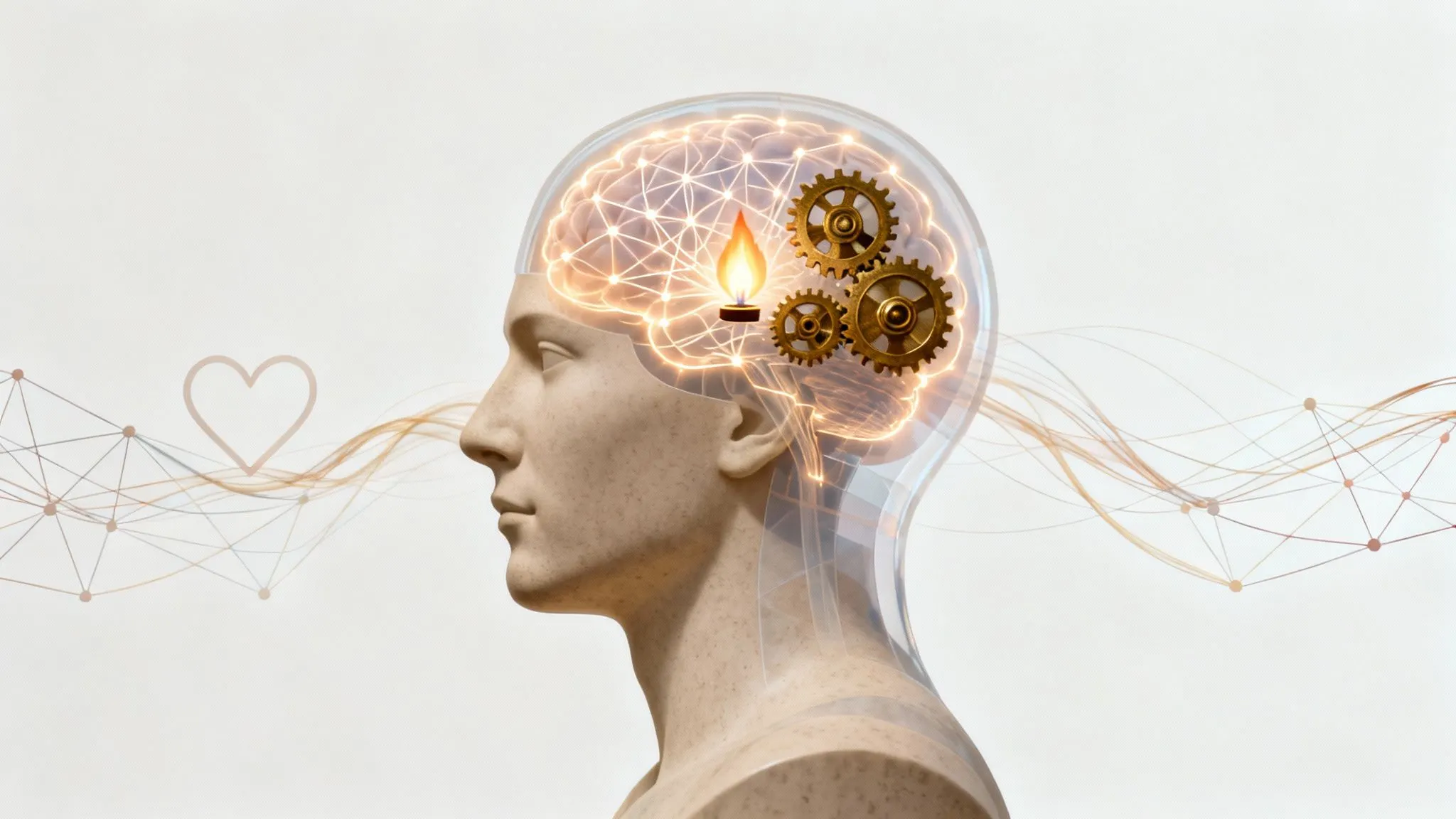
Ever get that strange feeling you’re just a passenger in your own body, watching yourself do things and wondering, “Why on earth did I just do that?” It’s a universal human experience. But the truth is, what’s steering the ship isn’t some deep, dark mystery.
It’s actually more like a rowdy boardroom meeting happening inside your head 24/7.
Why We Really Do The Things We Do
Let's ditch the stuffy textbook definitions for a second. Imagine you're the CEO of a company called 'You, Inc.' Every decision, from hitting the snooze button to making a major life change, doesn't come from a single, all-powerful boss. Nope. It’s the result of a negotiation between three very loud, very influential department heads.
Each one has its own agenda, and they're all constantly vying for your attention.
The Board of Directors Inside Your Head
The forces pulling your strings can be broken down into three main players. Get to know them, and you'll start to see their fingerprints all over your daily life.
• Biology: • This is the old-school, grizzled veteran of the board. It’s your ancient, hardwired programming focused on the bare necessities: food, safety, and passing on your genes. It operates mostly in the background, but when it speaks, its voice is loud and clear (think of the hangry monster that emerges when you skip lunch). For example, a sleep-deprived American parent might snap at their kids not because they're angry, but because their biological need for rest is screaming for attention.
• Psychology: • Meet the head of operations—your mind's internal software. This director is all about your thoughts, learned beliefs, emotional knee-jerk reactions, and all the mental shortcuts your brain takes to avoid working too hard. It’s the voice of your past experiences shaping your present choices. For instance, a manager in Chicago might micromanage a new employee because a past project failed, creating a learned belief that they must control every detail to avoid another mistake.
• Social Influence: • No one operates in a vacuum, and this director makes sure you never forget it. This is the powerful pull of culture, family expectations, what your friends think, and all the unwritten rules of the groups you belong to. It's the part of you that wonders, "But what will they think?" A college student from California might choose a specific major not out of passion, but to meet their parents' expectations for a prestigious career.
This little diagram is a perfect snapshot of how these three forces—your biology, psychology, and social world—are in a constant tug-of-war to run the show at 'You, Inc.'
As you can see, your behavior is almost never the result of just one thing. It's a messy, beautiful compromise hammered out between these powerful internal and external drivers.
The Core Drivers of Your Behavior At a Glance
Feeling a bit overwhelmed by the boardroom analogy? No worries. Here’s a quick cheat sheet that breaks down who's in charge of what.
This table gives you a snapshot of the primary forces influencing how you think, feel, and act every single day.
| The Driver | What It Controls | A Simple Example |
|---|---|---|
| Biology | Primal instincts, survival needs (hunger, safety), hormones, and genetic predispositions. | Grabbing a sugary donut when you're tired because your brain is screaming for quick energy. |
| Psychology | Thoughts, learned beliefs, past experiences, emotions, and mental shortcuts (biases). | Avoiding public speaking because you had a bad experience in a school play years ago. |
| Social | Cultural norms, peer pressure, family expectations, and societal rules (written and unwritten). | Buying a certain brand of phone because all your friends have one and you want to fit in. |
Understanding this constant negotiation is the first real step toward taking the wheel of your own life. Once you can identify who is talking in that internal boardroom, you can start making conscious choices instead of just reacting on autopilot.
Think about it this way: the endless scroll on your phone isn't just a "bad habit." It’s a behavior that has been masterfully engineered by people who deeply understand the psychological hooks behind social media addiction . They know exactly which buttons to push in your brain to keep you coming back.
At any given moment, your behavior is the outcome of a silent debate between what you want (psychology), what you need (biology), and what’s expected of you (social influence). Mastering self-awareness means learning to listen in on that conversation.
This guide is your field manual for eavesdropping on that debate. We’re about to dive deep into each of these drivers, from your brain’s ancient survival code to the complex mental software running your day-to-day. By the end, you'll have the insights you need to become a much more intentional and effective CEO of 'You, Inc.'
Your Brain's Ancient Survival Blueprint
Let's get one thing straight: deep down, you're still a caveman. Tucked away beneath all your modern-day sophistication and nuanced thoughts is a primal, instinct-driven part of your brain that’s still operating like it’s dodging saber-toothed tigers on the savanna. This "inner caveman" is hardwired into your DNA, a powerful and often unconscious force that’s still calling a surprising number of the shots in your daily life.
This is the biological driver of your behavior—your brain's ancient survival blueprint.

Think of your brain's reward system as an old-school video game designer. Its main goal isn't your happiness or career success; it's simply to keep you alive. So, it programmed a simple but brilliant game that our ancestors had to play every single day: find food, seek safety, stick with your crew, and make more humans.
To ensure we didn't wander off script, it offered the ultimate power-up: a jolt of dopamine .
This feel-good chemical is the prize you get for completing a "quest" your ancient brain thinks is important. That rush from a sugary donut, a 'like' on Instagram, or a warm hug? That's just the game designer handing you a reward to make sure you do it again. The quests have gotten a modern makeover, but the game mechanics are identical.
Your Inner Caveman at a Summer Barbecue
To see this ancient programming in action, just look at a classic American backyard barbecue. On the surface, it’s all about burgers and catching up with family. But if you look closer, it’s basically a safari into the primal instincts that still govern what drives human behavior .
There's Dad, Tom, proudly flipping burgers on the grill. That little puff of his chest isn't just about nailing the perfect medium-rare. It’s his ancient provider instinct kicking in. For our ancestors, securing and preparing high-calorie food was a big deal—a status symbol and a ticket to survival for the whole tribe. His brain is giving him a high-five for it.
Meanwhile, his daughter, Emily, is laughing with her friends. This isn't just idle chit-chat; it's a deep evolutionary drive for social bonding . Being part of a tight-knit group meant safety, shared resources, and better odds of finding a mate. Getting kicked out of the group was a death sentence. Her brain rewards this connection with a cocktail of oxytocin and dopamine, making her feel fantastic.
Our modern social gatherings are just a new stage for an old play. The props have changed from campfires to barbecue grills, but the script—seek connection, establish status, ensure safety—remains the same.
This primal blueprint explains so much of our seemingly bizarre behavior. It’s the invisible hand guiding our gut feelings and knee-jerk reactions.
The Survival Quests Still Running Today
Your brain is constantly scanning your world, asking ancient questions, and pushing you to act based on a survival rulebook written thousands of years ago. This programming influences pretty much everything.
• The Food Quest: • Ever wonder why you crave junk food? For most of human history, calories were hard to come by. Your brain is wired to hunt down the most energy-dense foods imaginable. A salad feels virtuous, sure, but a cheeseburger feels • deeply • satisfying because your survival-focused brain just hit the jackpot. A practical example is an American office worker reaching for a candy bar from the vending machine at 3 PM, not from true hunger, but because their brain is wired to seek quick, high-energy fuel during an afternoon slump.
• The Safety Quest: • A car backfires down the street, and you jump before you even know what the sound was. That’s your • amygdala • —the brain's smoke detector—hijacking your system for immediate action. This "fight or flight" response was essential for escaping predators, and it's still running the show today. The only difference is that modern "predators" often look like a stressful work email or a looming deadline.
• The Connection Quest: • Loneliness doesn't just feel bad; it's a biological alarm bell. Being isolated was incredibly dangerous for our ancestors. This profound need to belong is what drives us to build families, friendships, and communities. It's not a weakness; it's a survival strategy. You can see this in how a new student at an American college will actively seek out clubs or groups that match their interests, driven by an instinctual need to find their "tribe" in a new environment.
Understanding this ancient blueprint doesn't mean you're a slave to your instincts. It's the exact opposite. When you recognize these primal pulls, you can finally understand why you have a sudden urge to demolish a bag of chips when you're stressed or why you get butterflies in a room full of strangers.
This awareness is the first step. It lets you consciously choose your actions, working with your inner caveman instead of being unknowingly controlled by it.
The Mental Software Running Your Life
Think of your ancient biology as the factory-installed hardware you were born with. If that's the case, your mind is the powerful, complex, and sometimes ridiculously glitchy software running the show. This is your internal operating system—that tangled web of thoughts, feelings, and sneaky mental shortcuts that pulls the strings on your decisions, every single day.
What really drives us at this level is a fascinating mash-up of cold, hard logic and gut-wrenching emotion, of conscious choices and deep-seated, automatic programming.
Imagine your brain is a brilliant but incredibly lazy personal assistant. Its number one priority? Conserving energy. To do this, it cooks up mental shortcuts, what psychologists call cognitive biases , based on everything you’ve ever done or seen. These shortcuts are great for making snap decisions without overthinking, but man, can they lead you down some predictable and often illogical rabbit holes.

This mental software is where the real drama of life plays out. It’s the battleground where your logical brain dukes it out with your emotional heart, and where ghosts of past experiences whisper warnings about what might lie ahead.
The Career Change Conundrum
Let's watch this internal OS boot up in a classic real-world dilemma. Meet Sarah, a marketing manager in New York City who's staring down a massive career change. She's got a stable, well-paying gig, but she’s just been offered a spot at a risky-but-thrilling startup that speaks to her soul. Instantly, her mental software goes into overdrive.
Her brain, desperate to save energy and avoid danger, activates confirmation bias . It immediately starts hunting for any shred of evidence that supports staying put. Suddenly, she’s noticing all the little perks of her current job, fondly recalling praise from her boss, and doom-scrolling articles titled "Why Most Startups Fail." This isn't a rational process; it's her brain's lazy assistant trying to justify the path of least resistance.
At the exact same time, her emotional system ignites, creating a brutal internal tug-of-war.
• The Fear of Failure: • This emotion spins vivid horror stories of the startup imploding, leaving her jobless and drowning in regret. It’s a primal, protective feeling designed to shield her from threats.
• The Thrill of the Challenge: • But on the flip side, just thinking about the new role sparks a fire of excitement and passion. This feeling is a hell of a motivator, promising growth, fulfillment, and a reason to jump out of bed in the morning.
This is the internal conflict that defines so many of our biggest life choices—the timeless battle between the mind's craving for safety and the heart's yearning for purpose.
A 'gut feeling' isn't some mystical force. It's your brain running millions of lightning-fast calculations based on your entire life's data and spitting out the verdict as an emotion. Trusting your gut is really just trusting your own internal supercomputer.
The Director in Your Head
That constant stream of chatter in your head—your internal monologue—isn't just background noise. It's the director of your life's movie, narrating every scene and shaping how you see the world. If that inner voice is constantly whispering, "This is too risky, you're going to bomb," your actions will almost certainly follow that script.
This is also where personality patterns really come into play. Frameworks like the Enneagram are so valuable because they give us a map to these deeply ingrained patterns of thinking and feeling. Figuring out your core type can feel like finally getting the user manual for your own brain. In fact, you can gain even deeper insight by comparing different models; a great place to start is exploring the differences between the Enneagram vs. the MBTI to see which system clicks for you.
Ultimately, your thoughts and emotions don't just react to the world; they create it. They're the filter through which you experience everything, coloring what you notice, how you interpret events, and the moves you make in response. Learning to work with this mental software—to spot your biases, understand your emotional triggers, and consciously direct that inner monologue—is how you go from being a passenger to the pilot of your own life.
How Society And Culture Shape Your Choices
Ever heard the saying, "No man is an island"? It's a classic for a reason. While your biology lays the foundation and your mind writes the first draft of your personal operating system, the world you grow up in is what truly shapes the final product. Culture is the soil, the sunlight, and the weather that dictates how you grow. It's the powerful, often invisible, rulebook you’re handed at birth.
Think about it. You didn’t consciously pick the language you speak or the holidays you get excited about. You absorbed them. This social programming runs so deep that we often mistake our cultural norms for universal truths. It’s a huge piece of the puzzle in understanding what drives human behavior in such wildly different ways around the globe.
Navigating The Social Maze
For a perfect, cringe-worthy example, just picture a high school hallway in any American suburb. It’s a microcosm of our social world. When a teenager—let's call him Alex—gets dressed, he isn't just thinking about comfort. He's running a complex social algorithm in his head: What are the cool kids wearing? Will my friends roast me for this? Does this shirt put me in the skater camp or the jock camp?
What’s really happening is that Alex is being driven by a primal need to belong to a tribe. The fear of being cast out is a powerful motivator, a survival instinct hardwired into us from a time when getting kicked out of the group was a literal death sentence. The "rules" of his high school are his culture, and peer pressure is just the bouncer at the door.

This dynamic doesn't just disappear after graduation. It scales up, influencing our political views, our career goals, and even what we believe is right or wrong. We’re all constantly, and mostly unconsciously, scanning our environment for cues on how to act.
Culture is the collective programming of the mind which distinguishes the members of one group or category of people from another. It’s the lens through which we interpret reality, and most of the time, we don’t even realize we’re wearing it.
The Consumer Paradox
Nowhere is this social influence more obvious—and frankly, more entertaining—than in what we buy. We live in a world that screams "Be an individual!" yet our shopping carts end up looking suspiciously like our neighbors'. This creates a wild paradox where we try to express our unique selves by buying the same stuff as millions of other people.
We join digital tribes on social media, following influencers who subtly steer our desires for everything from skincare to smartphones. We aren't just buying a product; we're buying a membership card to an identity, a feeling of belonging with a group that gets us. For example, a young professional in Austin, Texas might buy a specific brand of electric car not only for its features but because it signals they belong to a tech-savvy, environmentally conscious social group.
Breaking Down The Invisible Strings
So, how do these social and cultural forces actually work? They aren’t magic; they operate through a few key mechanisms that pull our strings every day.
• Social Norms: • These are the unwritten rules of the road. Think about waiting your turn in line instead of bum-rushing the counter, or bringing a bottle of wine to a dinner party. We follow these to keep the peace and avoid getting the side-eye. A practical example is the American custom of tipping servers, a social norm so strong it feels like a mandatory rule.
• Conformity: • This is our tendency to match our beliefs and behaviors to the group's. It’s why fashion trends explode and why every office seems to develop its own unique, sometimes weird, culture. The pull to fit in is incredibly strong. Think of a corporate office in the U.S. where everyone starts wearing business casual because the new manager does, even with no official dress code change.
• Cultural Values: • These are the big-picture beliefs a society holds about what’s important. Is the focus on the community or on individual achievement? In the U.S., the strong cultural value of individualism drives behaviors like starting your own business or moving across the country for a dream job. These core values shape our life goals and what we define as a "successful" life.
Once you start seeing these invisible strings, you can’t unsee them. You start asking whether a choice is genuinely yours or just a line you’re reading from a cultural script. This isn't about rejecting your culture—it's about engaging with it consciously. It's about taking the power back to make choices that are truly aligned with who you are.
Uncovering Your Personal Motivation Code
So, what really gets you out of bed in the morning? Is it the quiet satisfaction of that first sip of coffee, the thrill of a new project, or the cold, hard pressure of a looming deadline? We’ve looked at the biological, cognitive, and social forces that set the stage, but motivation is the actual fuel in the tank. It’s the direct, unfiltered answer to the question, “Why even bother?”
To really get a handle on why people do what they do, you have to crack your own personal motivation code. This isn't just about what you do; it’s about the deep-seated "why" that powers it all. And it turns out, this fuel generally comes in two main flavors.
Two Sides of the Same Coin
Motivation isn’t some monolithic force. It’s better to think of it as a spectrum, with two primary types working together to get you moving.
• Intrinsic Motivation: • This is the good stuff that comes from the inside out. It’s when you do something just for the love of the game. The reward is baked right into the activity itself—the challenge, the curiosity, or the simple joy of doing it. For example, a hobbyist woodworker in their garage in Ohio spends hours on a project not to sell it, but for the pure satisfaction of creating something beautiful with their hands.
• Extrinsic Motivation: • This is the push (or pull) from the outside world. It’s when your actions are aimed at an external reward or avoiding a punishment. Think working for a paycheck, cramming for an exam to get a good grade, or hustling to hit a sales target for that sweet, sweet bonus. A clear example is a sales representative in Florida working late to win the "Top Performer of the Quarter" award and the cash prize that comes with it.
Both are incredibly powerful, and most of us are running on a blend of the two every single day.
An Entrepreneurial Tale of Two Motivations
Let's make this real. Picture two American entrepreneurs. First, meet Maria. She’s a phenomenal baker who opens a small artisan bread shop in Portland, Oregon. She gets up at 3 a.m. not just to earn a living, but because she’s obsessed with the feel of the dough, the smell of rising yeast, and the look on a customer’s face when they take that first perfect bite. Her business becomes a hit, but the real driver is intrinsic —a pure, personal passion for her craft.
Now, meet David. He launches a tech company in Silicon Valley after spotting a killer gap in the market. He’s brilliant and relentless, but his fuel is primarily extrinsic . David is fired up by crushing financial targets, landing investor funding, and earning the public recognition that comes with a big win. For him, the business is a machine designed to produce measurable success and security.
Neither person is right or wrong here. Maria’s intrinsic fire keeps her going when sales are slow, while David’s extrinsic targets create a crystal-clear roadmap for growth. The trick is knowing which fuel you burn hottest.
The Enneagram: Your Personal Motivation Map
So, how do you get a clear picture of your own unique motivational cocktail? This is where a tool like the Enneagram comes in handy, and it’s way more than just another personality test that sticks a label on you. It's more like a dynamic map of your inner world, showing you the core fears and desires that are secretly running the show.
The Enneagram doesn't just tell you what you do; it rips the cover off the hidden 'why' behind your gut reactions. It decodes the core motivation you’ve been acting on your whole life, often without a clue.
For instance, an Enneagram Type 3 , "The Achiever," is often wired with a deep fear of being worthless. That fear ignites a powerful desire to be seen as valuable and successful. It’s what pushes them to work harder, smash goals, and maintain a polished image. Their motivation isn't just a simple want for success; it’s a fundamental drive to avoid the feeling of failure.
On the other hand, a Type 9 , "The Peacemaker," is driven by a core fear of loss and separation. This motivates them to create harmony, sidestep conflict, and even merge with others’ agendas to keep everything calm and connected. Their easygoing nature isn't a weakness—it's a survival strategy to meet their deepest need for stability.
Learning about the Enneagram’s core motivations gives you a language for what’s really going on inside. It finally explains why certain situations totally drain you, why you always seem to clash with that person, and what you actually need to feel whole. This kind of self-awareness is the first step toward consciously choosing your actions, instead of just being a puppet of your oldest fears.
Putting This Knowledge to Work in Your Daily Life
Okay, so understanding the tangled web of biology, psychology, and social programming that makes us tick is fascinating stuff. But it’s not just for academics. Think of it like being handed the user manual for the human machine. It’s a game-changer, but only if you actually open it and start applying the principles.
This is all about shifting from autopilot to conscious action. It’s the difference between being a passenger tossed around by the currents of your own life and finally grabbing the steering wheel.

Rewiring Your Own Personal Growth
The most immediate place to start is right inside your own head. Let's be honest, a huge chunk of our daily stress comes from being yanked around by our own unconscious habits, biases, and emotional tripwires. Once you start recognizing these patterns, you can finally step in and do something about them.
Think about the last time you put off a big, important task. Did you call yourself lazy? Or, just maybe, was your brain’s ancient survival instinct trying to "protect" you from the potential sting of failure? The moment you can spot that cognitive bias in action, you can call its bluff. Just thinking, "Ah, there's my fear of failure talking again," drains its power and gives you the mental space to choose a different response.
Understanding your own programming is the key to debugging it. You can't fix a glitch you don't even know is there.
A great way to start untangling your emotional landscape is through self-expression. It's why so many people are discovering the practical art therapy benefits for mental health ; it provides a creative, non-verbal way to process feelings that are hard to put into words.
Transforming Your Relationships
This understanding becomes a true superpower when you turn it toward your interactions with others. It helps you look past someone's immediate actions and get a glimpse of the real motivations churning underneath. Let’s say your partner is fuming because you forgot to take out the trash. Is it really about the trash?
Or could their reaction be fueled by a deeper need for respect or a fear of feeling taken for granted? When you can decode what's truly driving them, you can address the real issue instead of getting bogged down in a pointless fight about garbage. This simple shift from judgment to curiosity is a powerful tool for defusing conflict and building real connection. For a deeper dive, our guide on how to become more self-aware offers some fantastic, actionable steps to build this skill.
A Smarter Way to Lead at Work
In the professional world, understanding what drives human behavior is a leader's secret weapon. Let’s imagine a manager, Jessica, who sees her team is completely burned out. The old-school playbook might suggest throwing a pizza party (a classic extrinsic motivator), but she knows that’s just a band-aid.
Instead, she taps into the powerful forces of intrinsic motivation:
• Autonomy: • She gives her star designer, Mark, total creative freedom on a new project he’s been excited about.
• Mastery: • She signs her junior developer, Chloe, up for an advanced coding workshop, investing in her skills and career growth.
• Purpose: • She takes the time to clearly link the team's day-to-day grind to the company's overarching mission, reminding them that their work has meaning.
The result? Engagement and morale go through the roof. Jessica moved beyond cheap rewards and cultivated genuine, lasting investment. It just goes to show you: the best leaders are often just good practical psychologists.
Your Questions Answered: Getting Real About Human Behavior
Alright, let's wrap this up by hitting some of the most common questions people have when they start digging into what makes us tick. Think of this as the rapid-fire round to lock in everything we've talked about.
So, What's the #1 Thing That Drives Us?
If only it were that simple! The truth is, there's no single "most powerful" driver. Human behavior is more like a complex soup than a simple recipe, and the main ingredient changes with every situation.
When you yank your hand back from a hot stove, that’s almost 100% biology in action—a pure survival reflex. But choosing a career? That’s a whole different story, a rich blend of your cognitive beliefs ("I need a stable job"), emotional needs ("I want to feel fulfilled"), social pressures ("My family expects me to be a doctor"), and your deepest personal motivations.
The real answer? Context is king. The driver that's in the front seat changes from one moment to the next.
Can People
Actually
Change Their Deep-Rooted Behaviors?
Absolutely. While you can't just delete your biological programming, you can definitely change how you act. The secret sauce is self-awareness .
Once you start understanding your emotional triggers, your sneaky cognitive biases, and what truly motivates you at your core (which is where tools like the Enneagram are gold), you create a tiny, powerful gap between a stimulus and your reaction. That little pause is everything. It’s where you get to consciously choose a different path instead of running on autopilot.
It’s less about fighting your internal wiring and more about learning to work with it.
"Between stimulus and response there is a space. In that space is our power to choose our response. In our response lies our growth and our freedom."
This quote nails it—awareness isn't just a concept; it's the actual tool that makes change possible.
How Does This Stuff Help in the Real World, Like at My Job?
Oh, this is where it gets fun. In a professional setting, understanding behavior is a massive advantage. For managers, it’s the key to building teams that are genuinely fired up, not just clocking in and out. For anyone in sales or marketing, it’s how you stop guessing and start knowing what your customers actually care about.
Even on a personal level, it transforms how you work with others. You'll communicate better, navigate conflicts with less friction, and actually understand why your coworker is so obsessed with a perfectly organized spreadsheet. You learn to see things from their side of the table.
Think about a manager who knows one of her team members is driven by autonomy. Instead of dangling a generic bonus, she offers them the freedom of a flexible schedule. That small, tailored move is infinitely more motivating and shows she's actually paying attention. That's putting this knowledge to work.
Ready to finally figure out what makes you tick? Your journey starts with the Enneagram Universe free assessment. It’s your map to discovering your core drivers and gaining a much deeper understanding of yourself. Take the scientifically validated test today at Enneagram Universe .