What Does ISTP Mean? A Guide to “The Virtuoso” Personality

Your friend’s phone dies. The laptop won’t connect to the projector. Someone mutters, “We’re doomed,” which is dramatic for a Tuesday morning.
Meanwhile, one person has already found the loose cable, restarted the adapter, and fixed the problem before the rest of the group finishes blaming Wi-Fi. That person often has classic ISTP energy.
If you’ve been searching what does ISTP mean , you’re probably trying to decode either yourself or that competent human who says little, notices everything, and knows how to repair a bike, troubleshoot a printer, and stay weirdly calm when things go sideways.
So What Does ISTP Mean Anyway
ISTP stands for Introverted, Sensing, Thinking, and Perceiving . In the Myers-Briggs system, it names one of the 16 personality types and is often nicknamed “The Virtuoso” or “The Detective.”
Here’s the plain-English version.
• Introverted • means they recharge internally. They may be friendly, but too much social noise can feel like having twelve browser tabs open with music playing in all of them.
• Sensing • means they trust what they can observe, test, touch, and verify.
• Thinking • means they make decisions by logic first, feelings second.
• Perceiving • means they prefer flexibility over rigid plans.
That combination creates a person who often looks cool-headed, practical, independent, and very hard to impress with buzzwords. If the room is full of theories, the ISTP usually asks, “Okay, but does it work?”
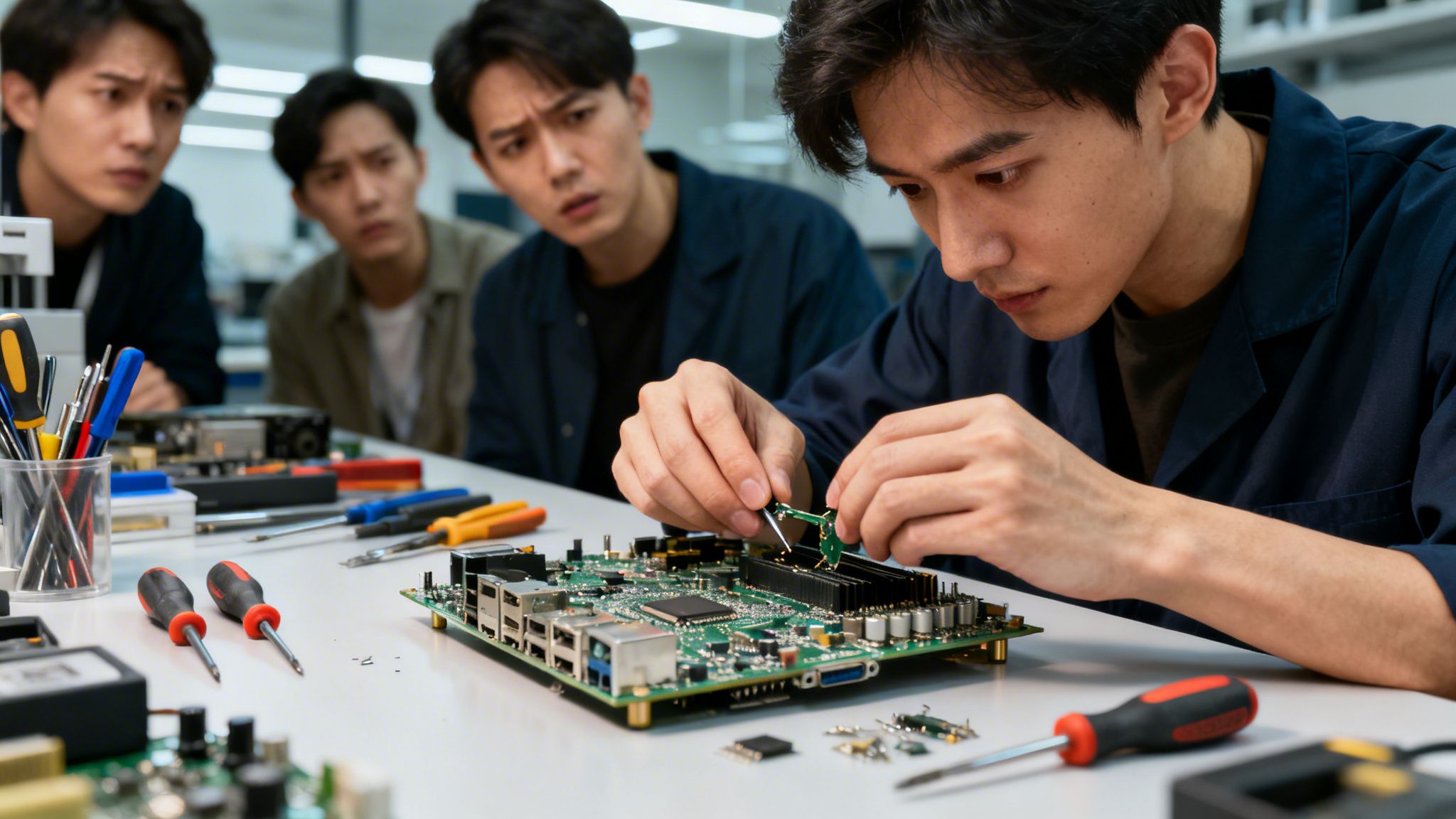
Why people misunderstand them
ISTPs are easy to misread because they do not always narrate their process out loud. They can seem detached when focused. They can seem blunt when they are trying to be efficient. They can seem private because, well, they are private.
According to Crown Counseling’s summary of Myers-Briggs Foundation data , ISTPs make up about 5.4% of the U.S. population . So their style is not wildly rare, but it is uncommon enough that many people grow up feeling a bit out of sync with more talk-it-out, plan-it-all, explain-everything environments.
If you’re also comparing systems, this quick guide to Enneagram vs MBTI helps clarify what each framework measures.
The four letters give you the label. The cognitive functions show the wiring.
For an ISTP, that wiring works like a compact mechanic’s toolbox. Each tool has a job. Each tool comes out at a different moment. If you know which one is in their hand, a lot of ISTP behavior stops looking mysterious and starts making practical sense.
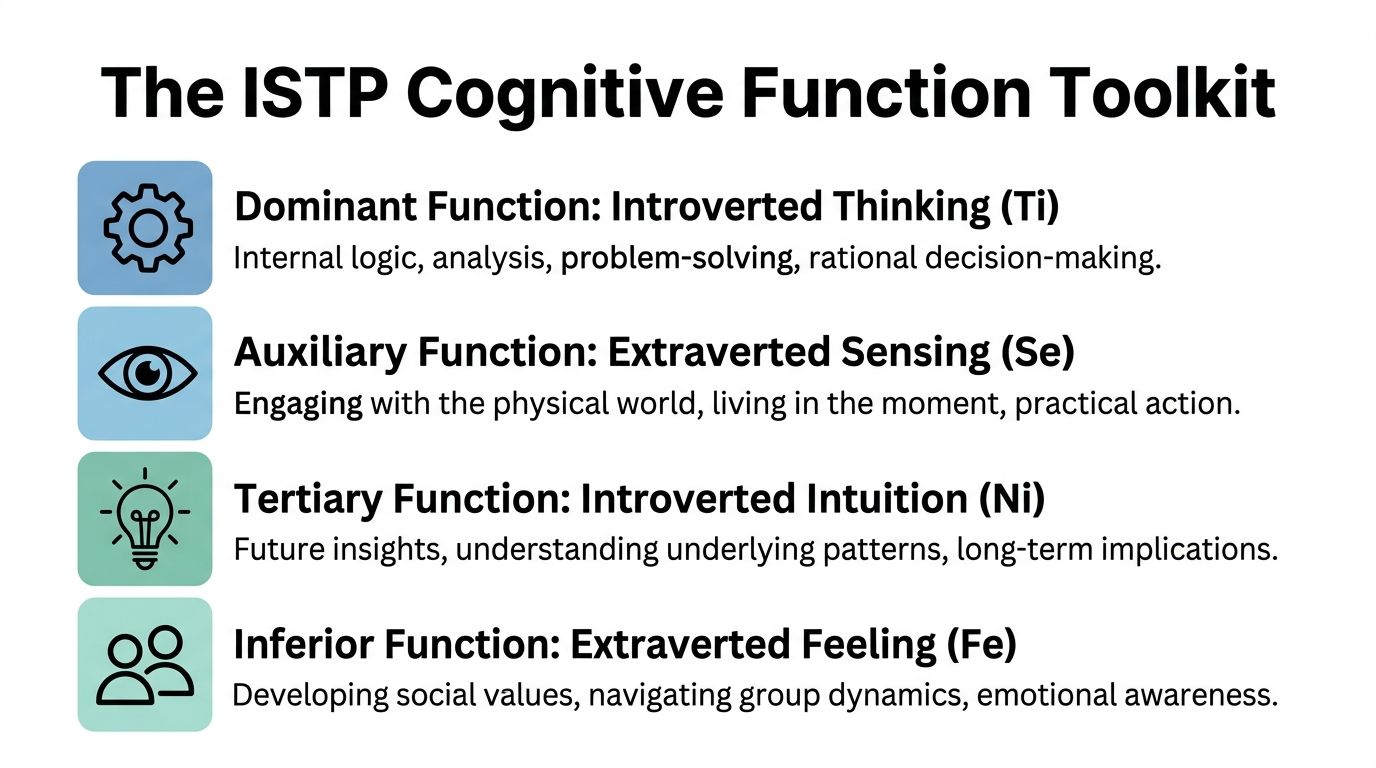
The classic ISTP function stack is:
| Function | Role | What it feels like in real life |
|---|---|---|
| Ti | Dominant | Internal logic, diagnosis, precision |
| Se | Auxiliary | Real-time awareness, action, hands-on response |
| Ni | Tertiary | Quiet pattern recognition, hunches about where things are going |
| Fe | Inferior | Social awareness, emotional expression, group harmony |
In plain English, ISTPs tend to lead with analysis, back it up with real-world data, add a quiet forecasting streak, and bring social smoothing in last. That order matters. It explains why an ISTP can solve a mess in five minutes and still sound awkward while explaining the fix.
Introverted Thinking , or Ti , is the ISTP’s primary tool. It wants clean logic and a system that makes sense all the way through.
A Ti-heavy mind keeps asking, “How does this work?” It checks for weak joints in an argument the same way a good mechanic checks for stripped threads. If the explanation is sloppy, the ISTP notices the wobble.
Here is what that looks like on the job. A team gets excited about a shiny new process. The ISTP says little at first, studies the moving parts, then asks one precise question that exposes the flaw. That is not contrarian theater. That is Ti doing quality control.
Extraverted Sensing , or Se , keeps the ISTP locked into what is happening in real time. It pays attention to concrete signals. Sound, timing, movement, physical details, changing conditions.
This is why many ISTPs are good in situations where theory alone is useless. Se catches the overheating smell, the odd vibration, the look on someone’s face before they say they are fine, or the fact that the problem is the loose hinge, not the whole cabinet.
ISTP profile notes the type’s strong practical, hands-on problem-solving style. That fits the Ti and Se combo well. Ti diagnoses the issue. Se reads the live environment. Together, they make ISTPs look calm in moments that scramble people who need more time to process.
Introverted Intuition , or Ni , is lower in the stack, but it still adds range. It helps ISTPs connect dots and sense where a situation is heading.
Ni often appears subtly. The ISTP may not narrate every mental step, but they can spot a pattern and call the outcome before everyone else sees it. “If we keep loading it that way, something is going to fail.” That comment can sound random until the failure shows up exactly where they predicted.
A good way to understand Ni in an ISTP is this: Ti checks the structure, Se watches the current conditions, and Ni shines a light a few steps down the road.
Extraverted Feeling , or Fe , handles social timing, emotional tone, and the needs of the group. For many ISTPs, it is the least natural tool in the box. It still matters a lot.
An ISTP may care intensely and show it in practical ways. They fix the shelf, bring the spare battery, help you move, or stay late to solve the problem no one else wanted. What they may struggle with is packaging that care in the warmest possible words.
That can create confusion. Other people hear bluntness and assume indifference. The core issue is often tool order. The ISTP reached for accuracy before tact.
That is the true value of cognitive functions. They explain the why behind the behavior. If you are figuring out your type, this is also where MBTI becomes more than a list of traits and starts becoming a map for growth, especially when you compare it with systems like the Enneagram that ask a different question: not just how you process, but why you react the way you do.
You usually recognize an ISTP less by what they say and more by how they move through problems.
An ISTP often wants room to figure things out alone. Hand them a task, a workbench, and a little trust. Hover over their shoulder and narrate every step, and you may watch their soul leave the building.
A day-in-the-life example: everyone else watches three tutorial videos before assembling a desk. The ISTP opens the box, looks at the parts, sorts the hardware, and starts building. Halfway through, they have already improved the manufacturer’s design in their head.
When stress hits, some people get louder. ISTPs often get sharper.
If a tire blows on a road trip, the ISTP is usually not the one yelling at the sky. They are on the shoulder checking the spare, reviewing the tools, and figuring out the fastest fix.
That practical calm can make them look fearless. Sometimes they are. Sometimes they are just busy.
ISTPs tend to communicate with the efficiency of a well-packed toolbox. If five words will do the job, they are not using fifty.
That can sound abrupt in softer environments. But their feedback is often brutally useful.
Example: a team debates a clunky process for twenty minutes. The ISTP finally says, “You have two steps doing the same thing. Remove one.” It is not poetry. It is also correct.
Many ISTPs learn best by interacting with tangible situations. They want traction, not just explanation.
Give them a camera, a motorcycle, a coding problem, a skateboard, a soldering iron, or a spreadsheet with a mess inside it. They often learn fastest by testing, adjusting, and trying again.
This one trips people up. Quiet does not mean blank.
An ISTP may have strong reactions, values, and loyalties. They do not always perform them publicly. Their emotional style can look like a locked garage door. There is plenty inside. You do not get the grand tour on day one.
• At home • they fix the wobbly table instead of discussing the philosophy of furniture.
• With friends • they show up when it matters, even if they forgot to text back for two days.
• Under pressure • they cut through noise and focus on what can be done now.
• When bored • they get restless fast, especially in repetitive systems with no room to improvise.
Friday, 6:12 p.m. The car will not start, your laptop is acting possessed, and dinner reservations are gone. The ISTP in your life may not give a stirring speech about togetherness. They will probably pop the hood, restart the router, and find a backup plan in ten minutes.

That is the relationship pattern in miniature. ISTPs often care by doing. If you only watch for verbal warmth, you can miss the whole repair manual.
The ISTP mental toolkit tends to filter life through internal logic first, then through what is happening in their immediate environment. In plain English, they usually want the clean version. What happened, what matters, and what needs fixing.
At work, that often makes them easy to collaborate with in a crisis and hard to impress with fluff. In close relationships, it can make them honest, calming, and refreshingly low-drama. It can also make them sound sharper than they intend.
A logical sentence can still hit like a socket wrench on a glass table.
An ISTP pulling back does not automatically mean anger, boredom, or lack of love. Quite often, it means they are troubleshooting internally. Their brain works a bit like a mechanic stepping away from the engine for a second so they can hear the actual rattle.
If you push for instant emotional processing, you may get a shutdown instead of a conversation. If you give a clear topic and a little time, many ISTPs come back with something more useful than a rushed answer.
That pattern shows up in romance, friendships, and team dynamics.
ISTPs often express affection through practical support, especially when life gets messy.
They might:
• fix your bike
• drive you to the airport
• troubleshoot your laptop
• replace the part nobody else noticed was failing
• handle the ugly logistics during a stressful week
Here, people sometimes get crossed wires. One person wants a heart-to-heart. The ISTP shows up with jumper cables, snacks, and a solved problem. Both are forms of care. They just speak different dialects.
The first snag is tone. ISTPs can be accurate and still sound cold. Their inner mechanic is focused on the fault in the system, not always on how the message lands on a nervous human.
The second snag is control. Micromanagement at work and emotional crowding in relationships tend to trigger resistance fast. An ISTP usually does better with a clear goal, room to operate, and feedback that sounds specific instead of theatrical.
Stereotypes add another layer. Because this type is often associated with bluntness, cool-headedness, and technical competence, people may misread ISTPs through gender expectations rather than actual behavior. The result is familiar. A woman may be called detached for the same trait that gets a man labeled capable.
Use the owner's manual, not wishful thinking.
• Say the actual thing. • “I need more help with the kids on Saturday” works better than “You should just know.”
• Set a response window. • “You do not have to answer right now, but can we talk tonight?” gives space without letting the issue vanish.
• Respect competence without making it weird. • Specific appreciation usually works better than grand emotional theater.
• Keep conflict private and concrete. • Calm one-on-one conversations usually go farther than public pressure or loaded group discussions.
If you keep having the same argument in different costumes, this guide on improving relationship communication can help both sides meet in the middle.
Mistyping happens a lot with ISTPs because several nearby types can look similar from the outside.
This quick comparison helps.
| Type | Similarity | Key difference |
|---|---|---|
| ISTJ | Both can seem reserved and practical | ISTJs usually prefer structure and procedure. ISTPs prefer flexibility and improvisation. |
| INTP | Both can be analytical and detached | INTPs often live more in concepts. ISTPs usually want direct interaction with their environment. |
| ESTP | Both can be action-oriented and adaptable | ESTPs tend to engage outwardly faster. ISTPs usually need more private recharge time. |
If you keep asking, “what does ISTP mean for me specifically,” that comparison is where things get useful. Type is less about your hobbies on paper and more about the mental route you use when making sense of life.
For many ISTPs, the biggest growth edge is not becoming less logical. It is learning how to make that logic easier for humans to receive.
Try these upgrades:
MBTI describes mental preferences. The Enneagram looks more at motivation, fear, and coping patterns. That is why two people can both be ISTPs and still feel quite different.
Some ISTPs resonate with Enneagram patterns such as:
• Type 5 • , the investigator flavor of independence and knowledge
• Type 9 • , the low-drama, steady, self-contained style
• Type 7 • , the freedom-seeking, experience-hungry version
If you want to compare those layers and confirm your broader pattern, you can explore it with this personality test .
The best answer to what does ISTP mean is not just a string of four letters. It is a style of being.
ISTPs tend to meet the world with sharp observation, practical logic, and a refusal to panic before the facts are in. They are often the people who can enter a messy situation, ignore the noise, and find the moving part that matters.
That does not mean every ISTP is a mechanic, adrenaline junkie, or silent action hero in a leather jacket. It means their mind often works like a finely tuned workshop. They diagnose. They test. They adapt. They build competence from direct contact with reality.
Their growth challenge is just as important as their strength. The sharper their logic becomes, the more powerful it is when paired with tact, emotional awareness, and deliberate communication.
A healthy ISTP is not less independent. They are more effective, more understood, and harder to misread.
If you want a fuller picture of how you work, not just how you think but what drives you, explore Enneagram Universe . It’s a practical next step for turning personality insight into better communication, stronger relationships, and real self-knowledge.