What Causes Fear of Rejection and How to Overcome It?

That little pang of dread you get when you’re about to ask for a raise, pitch a new client, or even just invite someone out for coffee? That's not just a fleeting emotion. It’s a primal survival instinct, an ancient alarm system hardwired into our DNA to keep us safe and sound within our social "tribe."
Your Brain's Built-In Rejection Alarm
Ever wonder why getting a simple 'no' can feel like a punch to the gut? It’s not just you being overly sensitive—it's your brain's ancient survival software kicking into high gear. For our prehistoric ancestors, getting kicked out of the group wasn't just embarrassing; it was a death sentence.
This fear is so deeply embedded that neuroscientists have discovered social rejection lights up the very same brain regions as physical pain. So yes, that sting is real. Think of it as your own personal 'social smoke alarm.' It’s not a bug; it’s a feature, designed to warn you of any threat to your vital connections with others.
Let's take Sarah, an entrepreneur from Austin, Texas, who had a brilliant business idea. She walked into a pitch meeting, but when a potential investor started asking tough, probing questions, her internal alarm went haywire. She nearly abandoned the whole project right then and there, convinced the scrutiny was a prelude to total failure. Her fear wasn't really about the business—it was about that all-too-familiar sting of personal rejection.
This is a fantastic breakdown of the core ingredients that cook up this fear.
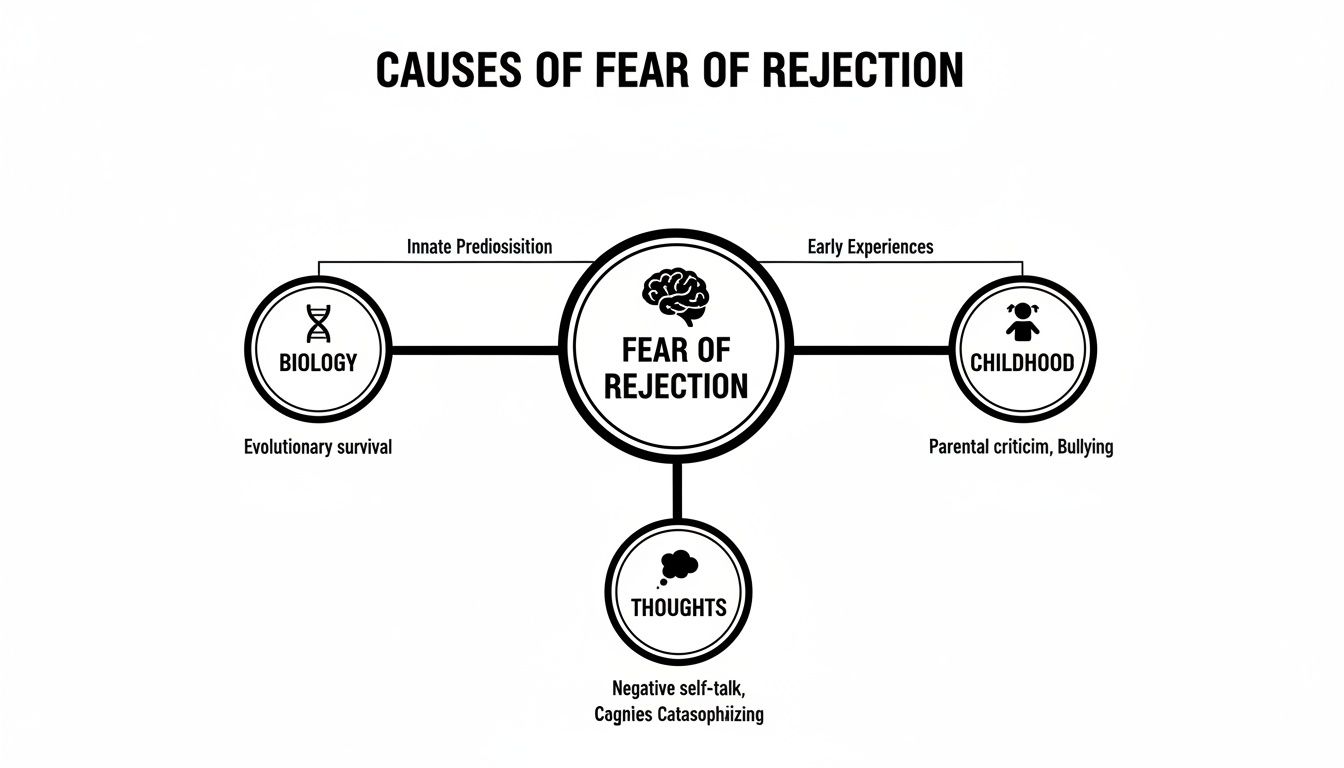
As you can see, what causes the fear of rejection is a potent mix of our biology, the events that shaped our early years, and the stories we tell ourselves. Getting a handle on this biological response is the first step to turning down the volume on that alarm.
The Deep Roots of Rejection Sensitivity
That social smoke alarm I mentioned? It gets calibrated in childhood. Experiences of being left out, teased, or excluded can fine-tune our emotional responses, creating a heightened rejection sensitivity that follows us right into adulthood.
"Rejection sensitivity is an anxious expectation of rejection in social situations. Individuals high in rejection sensitivity tend to interpret ambiguous social cues as signs of rejection, which can lead to self-sabotaging behaviors."
It's a phenomenon where you start seeing rejection around every corner, even when it isn't there. For example, a coworker in Chicago might give a brief, busy response in a meeting, and someone with high rejection sensitivity immediately assumes, "My boss hates my idea," instead of considering they might just be stressed. A delayed text message becomes "They're ignoring me."
The impact of this is huge. For instance, the U.S. Surgeon General's Report on youth violence revealed something stunning: 'weak social bonds' from social exclusion were the single strongest predictor of violence among teenagers—even more so than poverty or gang membership. That’s how fundamental our need for belonging is. You can learn more about the psychological responses to exclusion and how these sensitivity patterns develop.
To give you a clearer picture, this table breaks down the primary sources of rejection anxiety and how they show up in our daily lives.
The Core Causes of Rejection Fear at a Glance
| Cause | What It Looks Like In Real Life | Common Thought Pattern |
|---|---|---|
| Biology (Our Primal Brain) | Feeling physical symptoms like a racing heart or upset stomach when you have to speak up or ask for something. For example, your palms sweat before asking for a promotion. | "If this goes wrong, it's going to be a catastrophe." |
| Childhood Experiences | Constantly seeking approval or avoiding any situation where you might be judged, like a job interview in New York City or a first date. | "I have to be perfect, or they won't like me." |
| Negative Thoughts (Cognitive Distortions) | Over-analyzing a friend's text message, assuming their short reply means they're angry with you. | "They're probably thinking I'm so annoying." |
As we unpack these core causes—our biology, our childhood, and our thought patterns—you'll start to see how you can recalibrate your own social smoke alarm. The goal isn't to get rid of it completely (it's there for a reason!), but to stop it from going off every time someone just burns the toast.
How Your First Connections Shape Your Future
Picture this: your earliest relationships were like the architect's first draft of your emotional life. Those initial bonds with parents or caregivers essentially handed you a rulebook on what to expect from other people. It created a deep, often unconscious, pattern for how you seek connection and what you do when it feels threatened.
This internal map is what psychologists call your attachment style .
Understanding attachment theory is like finding the source code that runs in the background of your adult life. It quietly shapes how you react to a warm compliment, a sharp criticism, or the terrifying vulnerability of getting close to someone.
And believe me, this isn't just some abstract psychological concept. It plays out in very real ways at the office, on awkward first dates, and even in your oldest friendships.

The Four Relationship Blueprints
While everyone’s emotional blueprint is one-of-a-kind, they generally fall into four main categories. Figuring out your own is a game-changer for understanding why the fear of rejection hits you the way it does.
• Secure Attachment: • You see relationships as a safe harbor. You’re comfortable with intimacy, trust others, and generally believe you're worthy of love. For instance, if a date doesn't call back, you feel disappointed but assume they weren't the right fit, rather than seeing it as a reflection of your worth.
• Anxious Attachment: • You desperately want to be close to others but live with a nagging worry that they don't feel the same way. This can make you hyper-vigilant for signs of rejection and constantly seek reassurance. You might text a friend multiple times if they don't respond right away.
• Avoidant Attachment: • Independence is your kingdom. You might feel smothered by too much closeness and instinctively pull away to protect yourself. For example, you might end a promising relationship when your partner starts talking about the future.
• Disorganized Attachment: • This one is a confusing mix of the anxious and avoidant styles. You might crave connection one minute and push it away the next, leading to a pattern of chaotic and often confusing relationships.
Attachment Styles in Action
Let's make this real. Meet Alex, a sales manager from Chicago with an anxious attachment style. He’s a rockstar at his job, but after every single client presentation, he needs a pat on the back from his boss. If his manager takes too long to reply to an email, Alex’s mind immediately jumps to the worst-case scenario: he’s about to get fired. His internal blueprint screams that connection is unstable and can vanish without warning.
Now, consider Ava, a freelance graphic designer in Miami with an avoidant attachment style. She’s brilliant, but she keeps her romantic partners at a distance. The second a relationship gets serious or someone mentions the future, she feels an overwhelming urge to flee. Her blueprint taught her that real intimacy is a trap, and the only person you can truly count on is yourself.
Your attachment style is the lens through which you see the world of connection and disconnection. It doesn't just dictate your love life; it colors every professional interaction, friendship, and even the relationship you have with yourself.
These patterns are wired directly into our deepest fears. Take an Enneagram Type 2, whose core motivation is to be loved and wanted. Anxious attachment can pour gasoline on that fire, pushing their people-pleasing habits into overdrive as they scramble to earn their place in people's lives. If you want to dive deeper into these dynamics, our guide to building stronger relationship skills is a great place to start.
Recognizing your blueprint isn’t about pointing fingers or feeling ashamed. It’s about having compassion for the map you were handed so you can finally start drawing your own way forward.
The Lasting Echoes of Life Experience
Our earliest relationships lay down the blueprint, but it’s the specific, sharp moments in life that really teach us to brace for rejection. Think of these experiences as a sculptor's chisel, carving deep patterns into our psyche. What causes fear of rejection isn't one big event; it's the accumulation of these powerful lessons.
Maybe it was constant criticism from a teacher, the relentless sting of bullying in the schoolyard, or even just growing up watching a parent paralyzed by their own social anxiety. Our brains are incredible learning machines. They watch, they listen, and they diligently take notes on what the world deems "dangerous" to protect us later.
These aren't just fuzzy memories. They become the quiet, background operating system running our adult lives.

Learning Fear Firsthand
Take the story of Mark, a brilliant musician from Nashville. Growing up, one of his parents, thinking they were being helpful, drilled into him that his music just wasn't "good enough" for a real career. Every new melody he created was met not with applause, but with a sharp critique of its shortcomings.
Fast forward to today. Mark is a grown man who is physically incapable of performing in public. The very idea of stepping on stage sends him into a full-blown panic. His life experience taught him a simple, brutal equation: sharing his passion = painful judgment. He learned that lesson so thoroughly that now he avoids the "threat" entirely.
That kind of direct, personal experience is a heavy-hitting teacher. But it’s not the only way we learn to be afraid.
Learning Fear by Watching Others
We can also develop a potent, secondhand fear of rejection through something called social learning . This is the classic "learn from someone else's mistakes" scenario. We see someone else stick their neck out and get shot down, and we take detailed mental notes.
• You see a classmate get laughed at for asking a "stupid" question in your Ohio high school, so you learn to keep your mouth shut.
• You watch a coworker get publicly chewed out for pitching an innovative idea at your California tech firm, so you learn to stick to the tried-and-true.
• You witness a friend's heart get shattered after they were vulnerable in a relationship, so you learn to keep your own emotional walls bricked up.
Our brains are masters of efficiency. Why touch the hot stove yourself when you can watch someone else get burned? This vicarious learning writes a powerful, unspoken script in our minds about what's safe and what will get you hurt.
The fear of rejection is often a learned response, absorbed from our direct experiences and the observed experiences of those around us. It's a protective strategy based on past evidence.
Now, throw our core personality into the mix, and things get even more interesting. For an Enneagram Type 4 , whose deepest fear is of being defective and insignificant, criticism like what Mark received doesn't just sting—it feels like confirmation of their worst nightmare. It tells them, "See? You are fundamentally flawed." This makes the fear of future rejection feel almost catastrophic.
But here’s the most important takeaway: what has been learned can be unlearned. The moment you realize your fear is a programmed response to old data—not an unchangeable truth about who you are—is the moment you can start rewriting the code.
The Mental Traps That Turn a Spark of Doubt into an Inferno
While our past experiences and wiring lay the groundwork for fearing rejection, it’s our own mind that really fans the flames. The true sting of rejection isn’t the event itself—it’s the story we tell ourselves about it. These stories are shaped by sneaky mental habits called cognitive distortions .
Think of them like funhouse mirrors for your brain. They take reality and warp it, stretching a small worry into a monstrous, terrifying reflection of your deepest fears.
These distortions are the quiet puppeteers of your emotional world. They pull the strings on your reactions before you’re even consciously aware of what's happening. A simple, neutral event—like a friend not texting back right away—can get twisted into a full-blown narrative of social doom and personal failure.
For instance, you ask someone out and they say no. A rational thought might be, "Oh well, their loss." But a mind caught in a distortion trap immediately leaps to, "I'm going to be alone forever!" That's not logic; that's a classic case of catastrophizing , where you jump straight to the absolute worst-possible outcome. It’s the difference between a tiny speed bump and a five-alarm personal apocalypse.
Spotting the Sneaky Saboteurs in Your Head
The first step to escaping these mental traps is learning to spot them. They’re way more common than you think, and once you know their tricks, you’ll start seeing them everywhere.
• Personalization: • This is the "it's all my fault" trap. Your team's project gets some tough feedback, and your first thought is, "I messed this up. Everyone thinks I'm incompetent." You’ve just made yourself the sole cause of a negative event, even when countless other factors were at play. A practical example: your boss seems distracted during your presentation, and you immediately think, "I'm boring her," instead of considering she might have had a stressful morning.
• Mind Reading: • Here, you're a self-proclaimed psychic, but you only ever predict bad news. During a chat, the other person glances at their phone for a split second. Your mind instantly concludes, "They think I'm the most boring person on earth. I need to shut up." You’ve invented a whole negative narrative with zero actual evidence.
The stories we tell ourselves about rejection are almost always more painful than the rejection itself. The moment we start questioning those stories is the moment we take our power back.
These thought patterns aren't just harmless quirks; they have a real, measurable impact on our ability to bounce back from setbacks. As one study on the relationship between rejection and resilience confirms, the more we fear rejection, the harder it is to recover from it. It's a vicious cycle that can seriously wear down our confidence and social connections over time.
How Your Enneagram Type Lays the Trap
Our Enneagram type often primes us for specific kinds of distorted thinking. It’s like having a default setting for self-sabotage.
A Type 6, who is wired for security and worst-case-scenario planning, is practically a professional catastrophizer. A minor disagreement with a friend isn't just a simple conflict; it’s a flashing neon sign that the entire friendship is about to implode.
Then you have the Type 1, The Reformer, who lives with a relentless inner critic. This makes them incredibly vulnerable to personalization. When their work gets a critique, they don't hear helpful feedback. They hear a verdict on their personal worth and a confirmation of their deepest fear: that they are fundamentally flawed.
Getting familiar with your type’s go-to distortions is a game-changer. It helps you understand how to stop being defensive and start responding to life with a clearer head. When you can catch these thoughts as they happen, you can finally hit the pause button, question if they’re actually true, and break the cycle of fear.
Practical Strategies to Build Rejection Resilience
Alright, knowing what causes the fear of rejection is one thing—it’s like getting the blueprints to the haunted house. But now it’s time to actually go inside and turn on the lights. Let's move from theory to action. This is your toolkit for turning down the volume on that nagging inner critic and building the emotional muscle to handle a “no.”
The point isn't to become some kind of fearless robot. Not at all. It's about learning, deep in your bones, that you can face rejection, survive it, and even come out the other side stronger. Each strategy here is ready to be put into practice today, helping you build a more flexible, resilient relationship with yourself and the world.
Rewrite Your Rejection Story with Cognitive Reframing
Remember those mental traps we talked about earlier? Cognitive reframing is your escape hatch. Think of it as being a detective for your own mind. You catch the automatic negative thought red-handed and put it on trial instead of just letting it run the show.
It’s the conscious act of taking a distorted, catastrophic thought and challenging it with something more balanced, realistic, and frankly, more true.
Here’s how it plays out:
Imagine you pitched a big idea at work, and your boss gave it a hard pass.
• The Automatic Thought: • • "My idea was garbage. I'm obviously not creative, and now everyone in the meeting thinks I'm an idiot." • (This is a classic example of personalizing the feedback and assuming you can read minds.)
• The Reframed Thought: • • "Okay, that idea didn't fly. Maybe my boss has other priorities I don't know about, or maybe I fumbled the explanation. This isn't a final verdict on my entire worth; it's just feedback on a single idea. What can I learn from this?"
See the difference? That simple shift pulls you out of a shame spiral and puts you back in the driver's seat, moving you from a place of fear to one of curiosity and growth.
Practice Mindful Observation to Detach from Fear
Mindfulness is simply the practice of noticing your thoughts and feelings without getting swept away by them. Picture your fear of rejection as a big, stormy cloud. Instead of running out into the downpour and getting soaked, you learn to just watch it drift by from the safety of your porch.
This simple act of observation creates a sliver of space between you and your fear . In that space, you get to choose how you respond instead of just mindlessly reacting.
By observing your fear without judgment, you rob it of its power. You see it for what it is—a fleeting emotional signal—not an undeniable truth about your reality.
A ridiculously simple way to start is to just sit quietly for two minutes. Notice the physical sensations of your fear. Is your chest tight? Is your stomach in a knot? Just acknowledge these feelings with gentle curiosity, maybe saying to yourself, "Ah, there's that fear thing again," and then gently guide your focus back to your breath.
Start Small with Rejection Exposure
If you're afraid of something, the surest way to get over it is to face it. Rejection exposure is all about intentionally seeking out tiny, low-stakes rejections to prove to your nervous system that you can handle them. It's like a vaccine for fear—you introduce a small, manageable dose to build up your immunity over time.
• Ask for a 10% discount at a coffee shop in your hometown (the worst they can do is say no).
• Request an unlikely extension on a minor deadline at work.
• Ask a stranger in a park for directions to a place you already know how to find.
Each little "no" you collect becomes a trophy, a piece of hard evidence that rejection is not the soul-crushing catastrophe your brain has built it up to be. This resilience is especially useful in specific situations, like navigating the world of online dating for introverts , where the potential for anxiety can be high. If you want more ideas for strengthening your inner resolve, our guide on how to build confidence is a great place to start.
It's fascinating how this fear plays out in our digital lives, too. Research has shown that high rejection sensitivity is a major predictor of problematic social media use. The online world can feel like a safer, more controlled space for interaction, but this often leads to even more withdrawal from the real world. You can read the full study on the connection between rejection fears and social media for a deeper dive.
Common Questions About The Fear of Rejection
Alright, let's dig into some of the questions that probably popped into your head as you've been reading. Think of this as a rapid-fire round to clear up any lingering confusion and sharpen your understanding.

Is Fear of Rejection a Sign of a Mental Health Disorder?
Feeling a sting from rejection is completely normal—it’s part of the human package. But when that fear gets so big that it consistently derails your life, it can sometimes be a piece of a larger puzzle, like social anxiety disorder.
For example, if you avoid applying for jobs you're qualified for because the thought of an interview is too terrifying, or you turn down all social invitations for fear of saying the wrong thing, it might be time to talk to someone. If the thought of rejection feels paralyzing and makes you dodge important moments in your career or relationships, reaching out to a mental health professional isn't a sign of weakness. It's an incredibly brave step toward getting your life back.
Can I Completely Get Rid of My Fear of Rejection?
Here's the thing: the goal isn't to completely eliminate the fear. That instinct is baked into our DNA for a reason—it’s trying to keep us safe and connected to our tribe. The real mission is to turn down the volume so it’s no longer the loudest voice in the room.
You want to get to a place where you can hear the fear, nod at it, and then do what you need to do anyway. It’s about learning to let fear be a passenger in your car, not the one gripping the steering wheel and yelling about which way to turn.
Your Enneagram type is the key. It reveals the core fear that rejection pokes at, giving you a personalized roadmap for how you'll likely react and which tools will work best for you.
How Does My Enneagram Type Affect My Reaction to Rejection?
Think of your Enneagram type as a unique lens through which you see the world, especially when it comes to rejection.
For example, a Type 3 (The Achiever) , whose core fear is being worthless, might see a failed job interview as a final verdict on their competence and value as a person. But for a Type 9 (The Peacemaker) , who fears disconnection, even a minor disagreement can feel like a devastating crack in their sense of inner peace.
Knowing this about yourself is like having a cheat sheet for life's tough moments. It gives you the power to respond with wisdom instead of just reacting on instinct.
Ready to uncover the specific motivations that shape your fears and your greatest strengths? Take the free, scientifically validated Enneagram assessment at Enneagram Universe and start your journey toward profound self-awareness today. Find your Enneagram type now!