What Are Maladaptive Coping Mechanisms? Healthier Alternatives

Alright, let’s be real. We all have those go-to behaviors when life throws a wrench in our plans. But what happens when those "solutions" actually make things worse? That's where we get into the messy world of maladaptive coping mechanisms .
Think of them as your brain's version of emotional junk food. They feel good in the moment—a quick hit of relief from stress—but leave you with a bigger mess to clean up later. It's like finding a leak in your ceiling and just sticking a bucket underneath. Sure, you’ve stopped the puddle from spreading for now, but you haven’t done a single thing to fix the actual leak.
A Guide to Your Brain's Short-Term Fixes
When we’re hit with stress, pain, or just overwhelming feelings, our first instinct is to find a way to make it stop. Maladaptive coping strategies are the tools that seem to do the trick instantly but are fundamentally flawed. They’re the emotional equivalent of duct tape and prayer.
These habits don't come from nowhere. They’re sculpted by our personal history, our upbringing, and the survival tactics we learned along the way. They often run on autopilot, offering that sweet, sweet feeling of immediate relief by helping us sidestep or numb the hard stuff.
But here’s the kicker: they're called "maladaptive" because, in the long run, they do anything but help us adapt. They keep us stuck.

The Problem with Quick Fixes
The real trouble with these strategies is that they're all about avoidance. Instead of dealing with the source of our anxiety, they offer a shiny distraction or a temporary escape hatch. This can look a million different ways.
For one person, it’s putting off a massive work project because the fear of not doing it perfectly is just too much. For another, it might be starting a fight with their spouse to create a distraction from their own feelings of insecurity. For an American teenager in Chicago, it could be staying up all night playing video games to avoid studying for a test they're sure they'll fail. The behaviors are totally different, but the root cause is the same: running from the real problem.
The trap of maladaptive coping is that it mistakes temporary relief for a true solution. It's like taking out a high-interest loan on your future happiness—and trust me, the payback is brutal.
Seeing these patterns for what they are—worn-out defense mechanisms that have overstayed their welcome—is the first giant leap toward changing them. It's all about building that muscle of self-awareness. If you're ready to dig deeper into that, our guide on how to become more self-aware is a great place to start.
Maladaptive vs Adaptive Coping at a Glance
So, what separates a "bad" coping mechanism from a "good" one? It all comes down to where you end up. One path kicks the can down the road (where it gets bigger and rustier), while the other actually paves the road for a smoother journey ahead.
This little table breaks down the core difference.
| Characteristic | Maladaptive Coping (The Quick Fix) | Adaptive Coping (The Real Solution) |
|---|---|---|
| Primary Goal | Avoid, numb, or escape the stressor. | Confront and resolve the stressor. |
| Time Focus | Immediate, short-term relief. | Sustainable, long-term well-being. |
| Outcome | Often worsens the problem over time. | Leads to growth and resilience. |
| Example | Avoiding a difficult conversation with a coworker. | Facing the conversation with a clear plan. |
At the end of the day, it's a choice between a temporary band-aid and a strategy that truly heals the wound. Choosing the latter is where real, lasting change happens.
So, What Does This Look Like in Real Life?
Maladaptive coping skills aren't some big, scary monster that knocks on your door and announces its arrival. They’re far more subtle. They're masters of disguise, creeping into our lives dressed up as "just a bad habit" or "how I deal with things." They are the seemingly harmless choices we make every day simply to dodge a little discomfort.
Let's pull these behaviors out of the psychology textbooks and into the real world. Once you know what to look for, you'll start spotting these patterns everywhere—in friends, family, and, yes, even in the mirror.

Avoidance: The Art of "Not Dealing With It"
Avoidance is probably the most popular player in the maladaptive coping game. It's the simple act of steering clear of people, places, or situations that make you feel anxious or uncomfortable. It feels great in the moment—a sweet hit of relief—but it has a nasty habit of making the original anxiety ten times worse down the road.
Picture this: Meet David, a talented American programmer from Austin, Texas. He is absolutely terrified of performance reviews and any kind of feedback on his code. So, when his weekly check-in with his manager approaches, he suddenly finds "urgent" bugs to fix, pushes the meeting back, or just "forgets" to show up.
In the short term, mission accomplished. David successfully dodges the stomach-churning anxiety he associates with criticism. But long-term? His manager is getting frustrated, his projects are falling behind, and his professional reputation is taking a nosedive. The thing he was trying to avoid—the fear of negative feedback—has now snowballed into a full-blown career crisis.
This isn't just a "David problem." Studies show that a huge number of people with anxiety disorders rely on avoidance, a behavior that accidentally feeds the very anxiety it's meant to escape.
Numbing: Checking Out Emotionally
Numbing is the brain's attempt to drown out painful feelings by cranking up the volume on literally anything else. Think of it as putting on noise-canceling headphones to ignore your inner world, whether the "noise" is a substance or just a mindless activity.
Let's look at Maria , an American event planner in a bustling city like New York. She loves her job, but the constant schmoozing leaves her with a massive social hangover. The moment she walks through her front door, she collapses onto the couch and disappears into an endless social media scroll for hours.
That constant stream of TikToks and Instagram stories does the trick; it distracts her from the buzzing stress and feeling of being totally overwhelmed. But the "relief" is hollow. She’s left feeling empty, disconnected from her partner, and behind on everything else. She isn't relaxing—she's just digitally dissociating .
Self-Sabotage: Engineering Your Own Downfall
Self-sabotage is one of the weirdest and most frustrating coping mechanisms out there. It’s when you actively create the exact outcome you’re most afraid of. Why would anyone do this? It's often driven by a deep-seated, hidden belief that you aren't worthy of success or that failure is coming anyway, so you might as well control how it happens.
Take James , an American college student at a university in California, staring down the barrel of final exams. He's petrified of failing his history class. Instead of hitting the books, he tells himself, "I'm just not smart enough for this. I'm going to fail no matter what." So, he goes out with friends the night before the exam and barely even skims his notes.
When he inevitably gets a bad grade, he gets to say, "See? I knew it." This confirms his negative belief about himself but, in a twisted way, it protects him from a much deeper pain: the pain of trying his absolute best and still falling short. He has built a self-fulfilling prophecy that shields his ego from what feels like the ultimate proof of his inadequacy.
These behaviors—avoidance, numbing, and self-sabotage—are not character flaws. They are learned, protective strategies that have simply outlived their usefulness and are now causing more harm than good.
Once you start looking, you’ll see these patterns pop up in all sorts of ways:
• Emotional Eating: • Smashing a pint of ice cream not because you're hungry, but to quiet the feeling of loneliness after a long day.
• Excessive Shopping: • Filling an online cart to get a tiny dopamine hit and distract yourself from worries about your relationship or your bank account.
• Procrastination: • Putting off that one crucial task because the fear of not doing it • perfectly • is more stressful than the fallout from not doing it at all.
Seeing what maladaptive coping looks like in the wild demystifies it. It’s no longer some clinical, abstract term—it’s a set of observable, and therefore changeable , behaviors.
So, Why Do We End Up With These Habits in the First Place?
Let’s get one thing straight: nobody ever wakes up, stretches, and thinks, “You know what would be great today? A brand-new, unhealthy way to handle my stress!” Maladaptive coping mechanisms aren't logical decisions. They're survival tactics that have long passed their expiration date.
Our brains cling to them for one very simple reason: at some point, they actually worked .
These behaviors often take root in childhood or during periods of life that felt completely overwhelming. Picture your brain as a frantic firefighter trying to douse an emotional five-alarm fire. It’s not going to search for the perfect, state-of-the-art fire extinguisher. It’s going to grab whatever is closest—a bucket of sand, a wet blanket, a garden hose—anything to get the flames down right now . That’s your brain reaching for avoidance, numbing, or self-blame. The only goal is immediate relief.
What starts as a clever way to survive a tough spot can become our default setting. It becomes an automatic script that runs long after the original danger has passed. It's like having an ancient piece of software running in the background of your mind—it was useful back in the day, but now it just hogs all the memory and makes everything else crash.
When Good Intentions Go Wrong
The real kicker is that these habits stick around because they offer a powerful, if fleeting, reward. The brain quickly learns the pattern: Feeling overwhelmed by that big project? Hey, putting it off makes the anxiety vanish instantly! And just like that, a feedback loop is born. Stress triggers the behavior, the behavior brings a hit of relief, and the brain logs it as a roaring success.
This process is so sneaky and effective that it can take hold in even the most put-together people, especially when life turns up the heat. A pressure-cooker career, a family crisis, or a massive life change can push any of us toward short-term, "just get through the day" thinking.
The great irony is that your maladaptive coping mechanisms are your brain's best, most creative attempt to protect you from pain. They are a sign of past resourcefulness, not present weakness. The only problem is that they've expired.
Understanding this context is everything. When you grasp the why , the shame starts to melt away. You can finally see these patterns not as deep-seated character flaws, but as learned behaviors. And the best part about learned behaviors? They can be unlearned.
The Crushing Weight of High-Stress Environments
Nowhere is this dynamic more obvious than in high-stakes professions. The relentless, sustained pressure on American healthcare workers, for example, is a masterclass in how extreme conditions can force people to rely on whatever coping skills they can find, healthy or not.
And this isn't just a hunch. A study looking at nurses during the height of the pandemic found that a staggering 59% resorted to maladaptive strategies while working in grueling COVID-19 wards. The single biggest predictor was sheer psychological distress. Those working in high-intensity units like the ICU showed dramatically higher rates of these patterns. You can dive into the specifics in the study on nurse coping strategies .
This all points to a critical truth: maladaptive coping is often a perfectly rational response to an irrational situation. When you're running on fumes, your brain will choose immediate survival over long-term wellness every single time. It's a vital piece of the puzzle for any leader or coach trying to support their people—it’s not about fixing broken individuals, but about fixing the environments that break them.
How Your Enneagram Type Reveals Your Stress Patterns
Ever feel like you’re stuck in a frustratingly predictable loop when stress hits? If so, you’re onto something huge. Self-awareness is a superpower, and personality frameworks like the Enneagram are like an x-ray for your mind, showing you exactly why you gravitate toward certain unhealthy habits. This isn't about slapping a label on yourself; it's about getting a personalized map to your brain's default stress settings.
Think of the Enneagram as a guide that explains the motivation behind your actions. Each of the nine types is driven by a core fear and a core desire. When the pressure is on, our behavior often becomes a frantic scramble to avoid that fear and satisfy that desire. This is precisely where those unhelpful coping mechanisms we've been talking about sneak in, perfectly tailored to our personality's weak spots.
The visual below shows how this plays out, with past experiences and high stress often kicking off these damaging cycles.
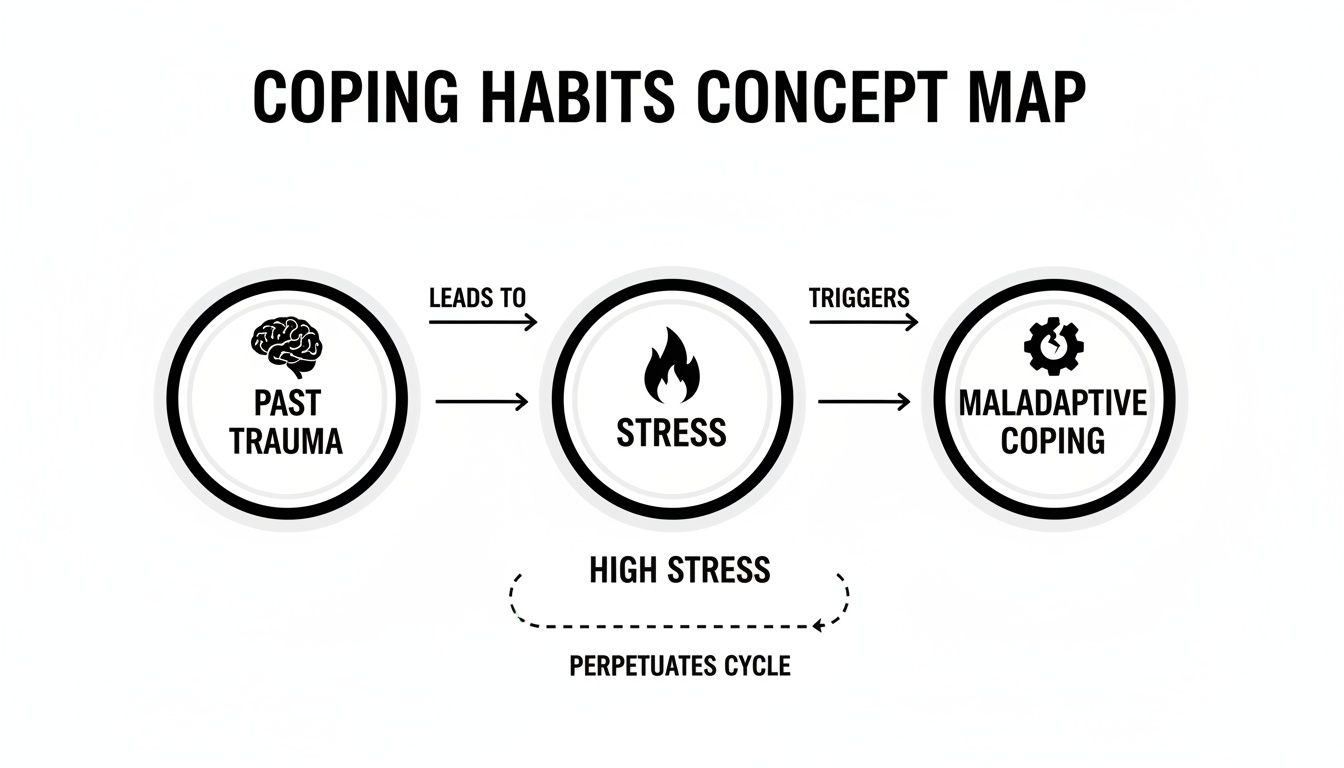
This map nails a common psychological pattern: unresolved trauma or intense stress can directly trigger maladaptive behaviors, creating a feedback loop that's hard to escape. Understanding this flow is the first crucial step toward interrupting it and finally choosing a different path.
The Signature Stress Moves of Each Enneagram Type
Let's dive into how this looks for each of the nine Enneagram types. We're all wonderfully complex, but you’d be surprised how often these patterns show up. You might just see yourself in one of these descriptions.
This table provides a quick look at the default tendencies for each type and the healthier direction they can move toward.
Enneagram Types and Their Coping Tendencies
| Enneagram Type | Common Maladaptive Tendency | Healthy Adaptive Alternative |
|---|---|---|
| 1 (The Reformer) | Self-Criticism & Overwork: Nitpicking every flaw and working to the point of burnout to avoid being "bad." | Self-Compassion & Flexibility: Accepting that "good enough" is okay and embracing imperfection. |
| 2 (The Helper) | People-Pleasing & Manipulation: Over-giving to feel needed, then feeling resentful when needs aren't met. | Self-Care & Direct Communication: Tending to their own needs first and asking directly for what they want. |
| 3 (The Achiever) | Workaholism & Image Management: Chasing success at all costs to avoid feeling worthless. | Authentic Self-Worth & Rest: Valuing themselves for who they are, not just what they accomplish. |
| 4 (The Individualist) | Emotional Amplification & Withdrawal: Dramatizing feelings to feel significant and pulling away from others. | Emotional Regulation & Connection: Observing feelings without over-identifying with them and staying present. |
| 5 (The Investigator) | Intellectual Detachment & Hoarding: Retreating into the mind and hoarding resources to feel capable. | Embodied Presence & Generosity: Engaging with the world and their emotions, sharing knowledge freely. |
| 6 (The Loyalist) | Anxious Fixation & Reassurance-Seeking: Getting stuck in worst-case scenarios and second-guessing everything. | Self-Trust & Grounding: Trusting their own judgment and finding security within themselves. |
| 7 (The Enthusiast) | Hedonistic Avoidance & Distraction: Chasing the next fun thing to escape difficult emotions. | Mindful Presence & Processing: Staying with discomfort long enough to process it and find true joy. |
| 8 (The Challenger) | Aggression & Control: Dominating situations and people to avoid being controlled by others. | Vulnerability & Collaboration: Using their strength to protect others and trusting them enough to be vulnerable. |
| 9 (The Peacemaker) | Self-Numbing & Disassociation: Zoning out with passive activities to avoid conflict and disruption. | Self-Assertion & Engagement: Showing up for their own needs and participating fully in their own life. |
Seeing these tendencies laid out so clearly can be a real "aha!" moment. It shines a light on the specific ruts we get stuck in when life gets tough.
By identifying your type's go-to stress reaction, you turn a vague feeling of being "stuck" into a concrete pattern you can actually work with. It transforms the Enneagram from a personality quiz into a practical tool for real-world change.
From Autopilot to Intentional Action
Okay, so recognizing your pattern is the first step. The real magic happens when you use that awareness to consciously choose a healthier response. This is all about shifting from an automatic, knee-jerk reaction to an intentional, thoughtful action.
When you can spot your Enneagram type's specific brand of maladaptive coping in real-time, you give yourself a fighting chance to do something different. For a Type Nine , that might mean noticing the urge to binge a show and instead asking, "What am I trying to avoid right now?" For a Type Two , it's catching themselves offering help they don't have the energy for and pausing to check in with their own needs.
If you’re reading this and aren't quite sure which pattern fits you best, no worries at all. The best way forward is to dig a little deeper. You can get a much clearer picture by checking out our guide on how to find your Enneagram type to get started. Once you understand your core motivations, you gain the incredible power to spot these unhealthy coping habits before they take the wheel.
A Practical Guide to Building Healthier Coping Strategies

So, you’ve put in the work and identified some of your less-than-helpful coping habits. That's a huge win. But awareness, while critical, is only the first step. The next part is where the real magic happens: moving from knowing to doing . It's time to roll up our sleeves and start rewiring those old circuits.
Breaking free from a maladaptive pattern isn't about fighting a war against yourself. It's more like becoming a clever strategist, gently outsmarting the autopilot script your brain has been running for years. To make this feel less like scaling a mountain and more like a series of manageable steps, let's break it down into a simple, three-part framework: Acknowledge, Interrupt, and Replace .
Step 1: Acknowledge the Trigger
First things first: you have to become a keen observer of your own mind. This means catching yourself in the act—or right before it—without an ounce of judgment. Picture yourself as a detective arriving at a scene. You’re just there to gather clues, not to lay blame.
The next time you feel that familiar tug toward your go-to strategy—whether it’s reaching for your phone to doomscroll or heading to the kitchen for a snack you don't really want—just pause.
Simply say to yourself, "Okay, I'm feeling that pressure in my chest about the deadline, and my first instinct is to open Instagram." That's it. No guilt trip, no self-criticism. Just clean, simple recognition.
This tiny moment of mindfulness creates a powerful gap between the trigger (the stressful feeling) and your usual, automatic reaction. In that space, a choice exists. And that's where change begins.
Step 2: Interrupt the Pattern
Now, let's introduce a secret weapon: the pattern interrupt . Our brains are wired for efficiency, so they love running the same old scripts. They're easy and familiar. Your job is to throw a tiny wrench in the works—something small enough to feel effortless but disruptive enough to snap you out of the trance.
An interrupt is a quick physical or mental action that pulls you out of the feedback loop. The goal isn't to solve the big problem in that instant; it’s simply to create enough breathing room to choose a different path.
Here are a few practical ideas you can try:
• Change Your Scenery: • Just get up. Walk into another room or step outside for • 60 seconds • of fresh air. A physical shift can do wonders for your mental state.
• Engage Your Senses: • Pop a sour candy in your mouth, splash your face with cold water, or sniff a strong essential oil like peppermint. The sudden sensory input is a great reset button.
• Move Your Body: • Do five jumping jacks. Stretch your arms high above your head. Tightly clench and then release your fists. This helps discharge all that pent-up nervous energy.
This step can feel almost laughably simple, but its effect is profound. You're essentially hitting the pause button on your emotional remote control, giving yourself a precious moment to ask, "What do I really need right now?"
Step 3: Replace with a Healthier Strategy
You’ve acknowledged the urge and interrupted the autopilot. Now for the final, most rewarding part: replacing the old habit with a new, genuinely helpful one. This is where you start building your personal toolkit of adaptive coping strategies.
Think of it as creating a "menu" of supportive actions you can choose from. For this to stick, the replacements have to be just as easy and accessible as your old habits.
Create a "Sensory Kit" or Go-To List:
Have a small box or a note on your phone ready with simple things that help soothe your nervous system. Your list could include:
Building healthier coping skills also means tackling the root causes of stress. Learning about regulating stress and anxiety for better sleep can be a fantastic way to do just that. If you're looking for more ways to make new habits last, check out these other behavioral change strategies . By consistently practicing this three-step process, you slowly but surely carve out new neural pathways, making healthy coping your new normal.
Knowing When to Seek Professional Support
While self-help is a powerful first step, trying to overhaul deep-rooted coping habits all on your own can feel like trying to perform surgery on yourself. It’s possible, sure, but it's messy, risky, and infinitely harder than it needs to be.
Knowing when to call in a professional isn't a sign of failure—it’s a smart, strategic move toward real, lasting change. It means you value your well-being enough to invest in an expert guide. So, how do you know when you've hit that point?
Clear Signs It’s Time for Professional Help
Sometimes, our go-to coping strategies start doing more harm than good, chipping away at our quality of life in ways both subtle and obvious. If any of the following sound painfully familiar, it might be the perfect time to reach out to a therapist or counselor.
• Your Health Is Suffering: • Are you sacrificing sleep to avoid your thoughts, only to feel exhausted all day? Maybe stress eating is causing digestive issues, or chronic anxiety is giving you tension headaches. When your body starts paying the price for your coping habits, that's a serious signal.
• Relationships Are Strained: • Do you find yourself picking fights to create distance, ghosting friends, or just feeling like you can't be your true self around the people you love? When your defenses start hurting your connections, it's a major red flag.
• Work or School Performance Is Declining: • Avoidance and procrastination can absolutely sabotage your responsibilities. If you’re constantly missing deadlines, your work quality is slipping, or you just feel buried under your to-do list, the coping mechanism has become the main problem.
• You Feel Stuck in a Cycle: • This is a big one. You see the pattern. You know it’s not helping. But you feel completely powerless to stop it, and despite your best intentions, you keep falling back into the same old habit.
The link between these coping strategies and mental health isn't just a hunch; it's backed by solid research. Studies consistently show that relying on maladaptive coping is significantly associated with higher levels of depression and a crippling intolerance of uncertainty.
This isn't just theory. One analysis found that very high levels of maladaptive coping increased the odds of depression by over 20% . It’s a stark reminder of just how critical breaking the cycle can be.
Making the Leap to Therapy
Honestly, deciding to seek help is the hardest part. The rest is just a conversation with someone trained to help you understand your own mind. A good therapist provides a safe, non-judgmental space to explore the why behind your habits. They won't just tell you what to do; they'll work with you to build healthier alternatives that actually fit your life.
If you think professional help is the right next step, knowing how to prepare for therapy sessions can make a world of difference in your progress.
Think of a therapist as a guide. They help you connect the dots between your past experiences and present behaviors, all while equipping you with proven tools tailored to your unique personality and struggles. The best part? You don't have to figure it all out alone.
Got Questions? We've Got Answers.
Let's tackle some of the common head-scratchers that come up when we start pulling at the threads of our coping habits. Sometimes, a straight-up answer is the best way to clear the fog.
Can a Coping Mechanism Be Both Healthy and Unhealthy?
You bet it can. This is probably the trickiest part of figuring out what are maladaptive coping mechanisms in your own life. Nothing is inherently "good" or "bad" on its own—it's all about context and consequence.
Think about it: kicking back with a funny TV show after a brutal workday is a fantastic way to let your brain cool down. For example, watching an episode of an American family sitcom like Modern Family can be a great stress reliever. But if that show turns into a nightly, multi-hour ritual to dodge a tough conversation with your partner or ignore a project that’s giving you anxiety, it’s officially crossed the line. The action is the same, but its purpose—and the problems it’s creating—are worlds apart.
It’s less about asking, "Is this a bad thing to do?" and more about asking, "Is this getting in the way of the life I actually want?" If the answer is yes, it's a sign to pay closer attention.
Seriously, How Long Does It Take to Ditch a Bad Habit?
Ah, the million-dollar question! The brutally honest answer? It depends. That old “21 days to form a habit” line is mostly a myth. Solid research shows it can take anywhere from 18 to 254 days for a new behavior to feel natural and automatic.
Picture it like this: your old, unhelpful habit is a superhighway—wide, paved, and easy to drive on. Your new, healthier strategy is a tiny dirt path you have to cut through a dense forest. It’s tough going at first. But every time you choose that new path, you clear it a little more. Over time, the superhighway gets overgrown from neglect, and your new path becomes the easier route. Consistency and a whole lot of patience are your trail guides here.
Do Certain Personalities Rely More on These Unhelpful Strategies?
They sure can. Our unique wiring and life experiences can definitely make us lean toward certain go-to, not-so-great coping skills. As we touched on with the Enneagram, each personality type has a deep-seated fear that, when poked, often triggers a very specific, almost predictable, maladaptive reaction.
For instance:
• The Worriers: • Anxious-leaning personalities, like Enneagram Type Sixes, might find themselves constantly seeking reassurance from their American friends or just avoiding scary situations altogether to quiet their inner alarm bells.
• The Perfectionists: • Folks like Enneagram Type Ones might use overwork and a harsh inner critic as their tools to maintain control and sidestep the horror of making a mistake.
This doesn't mean you're locked into a life sentence with bad habits. It just gives you a personalized treasure map to your brain's default shortcuts. Once you know where the traps are, it's a heck of a lot easier to spot them and consciously choose a better way forward.
Ready to stop guessing and start getting real answers about your own patterns? Here at Enneagram Universe , we give you the flashlight to explore your inner world. Take our free, scientifically validated personality test to pinpoint your Enneagram type. Self-awareness is the first step toward building coping strategies that actually work for you. Start your journey of self-discovery at Enneagram Universe .