What Are Defense Mechanisms in Psychology? A Simple, Fun Guide

Ever blamed rush hour traffic for being late when, really , you just hit snooze one too many times? Or caught yourself cracking a joke or laughing nervously in the middle of a super tense conversation?
If that sounds familiar, you’ve just had a run-in with your mind's secret security team. In the world of psychology, defense mechanisms are the unconscious tricks and strategies our minds use to shield us from feelings like anxiety, guilt, or stress that just feel too big to handle in the moment.
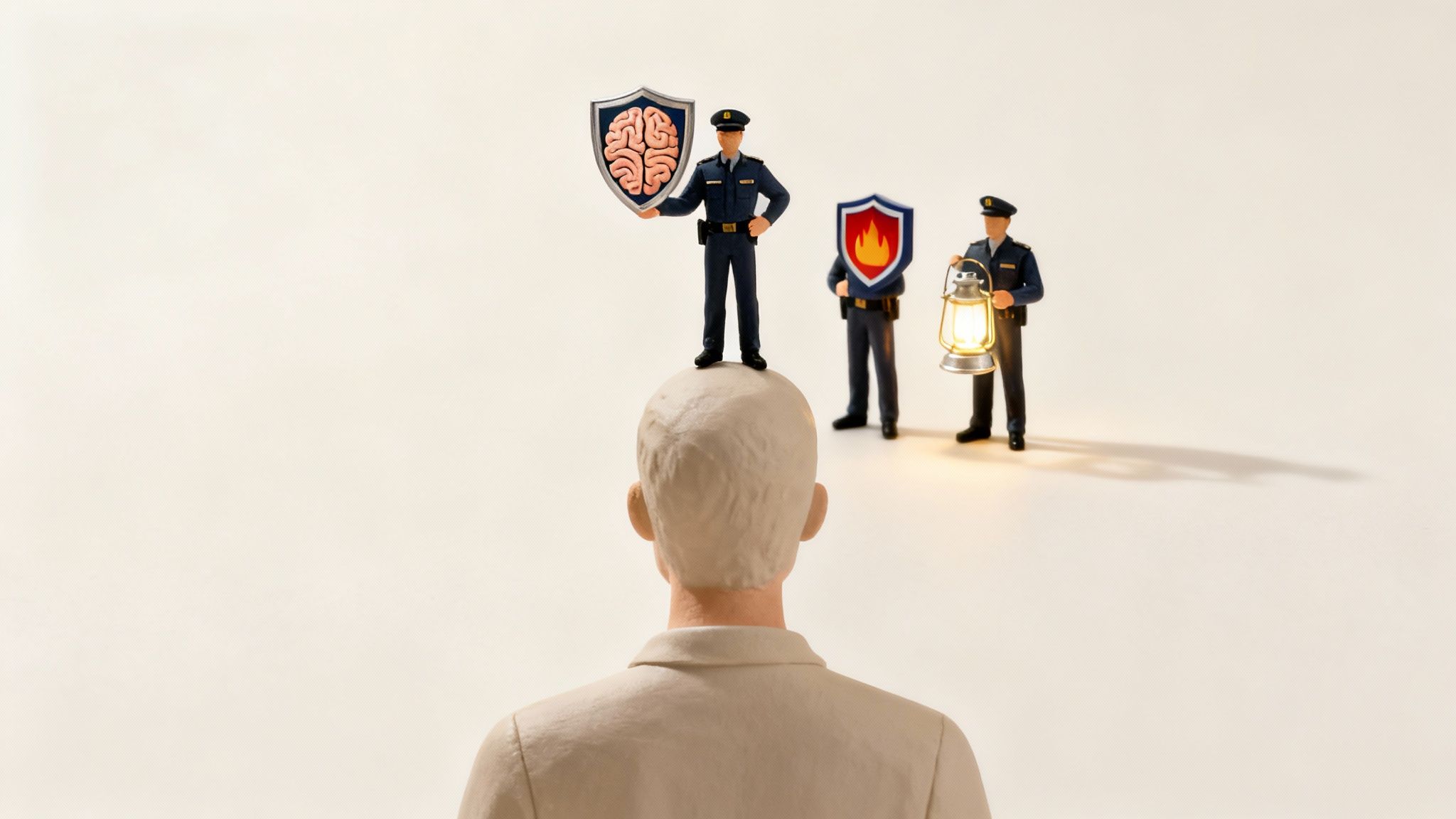
Your Mind's Secret Security Team
Think of defense mechanisms as your ego’s personal bodyguards. They’re on autopilot, jumping into action without you even realizing it to protect your sense of self from emotional pain or inner turmoil. They're a totally normal, universal part of being human—every single one of us has them. Far from being a sign of weakness, they’re a testament to how brilliantly our minds work to keep us stable and functioning.
Let's imagine your mind is a high-security building. When a threatening emotion—say, a tidal wave of shame or a jolt of pure terror—tries to storm the lobby, your internal security detail swoops in. These bodyguards don't actually eliminate the threat. Instead, they cleverly escort it to a different room, distract it with something shiny, or maybe even dress it up in a goofy disguise to make it seem less scary.
Why We All Need Mental Bodyguards
These mental shields aren't just for major, life-altering traumas. They pop up in tiny, everyday moments, helping us navigate the messy, complicated business of being alive. Honestly, without them, we'd be constantly swamped by a flood of raw, unfiltered emotions.
Take Mark, for example. He's a graphic designer from Denver, and he’s absolutely fuming at his boss for stealing credit for his big project. Confronting his boss could risk his job (a scary thought!), so instead, he heads straight to the gym after work and unleashes all that fury on a punching bag.
This is a classic case of sublimation —one of the more mature defense mechanisms. Mark’s socially unacceptable impulse (the desire to scream at his boss) gets channeled into a totally acceptable, even healthy, action (a killer workout). His mental bodyguards successfully redirected that negative energy into something constructive.
Getting a handle on these defense mechanisms is the first, crucial step toward deeper self-knowledge. They are the invisible puppet masters pulling the strings behind your reactions, your decisions, and even core parts of your personality.
Spotting them in action allows you to peek behind the curtain and see the deeper feelings they’re working so hard to protect. This kind of insight is pure gold for personal growth. If you're ready to start looking, a great first step is to learn how to become more self-aware and begin recognizing these automatic patterns in yourself.
To get us started, here’s a quick-and-dirty breakdown of the different "bodyguard" squads your ego has on call.
Your Ego's Bodyguards: A Quick Overview
| Category | Core Purpose | Example In a Nutshell |
|---|---|---|
| Mature | To channel difficult feelings into productive or helpful actions, leading to positive outcomes. | Feeling angry after being cut off in traffic? You go home and write a passionate song. |
| Neurotic | To temporarily push away uncomfortable thoughts or feelings, but often with a side of anxiety. | "I'm not worried about my big presentation, I'm just going to organize my sock drawer instead." |
| Immature | To distort reality or blame others to avoid facing painful truths, often creating more problems. | "It's not my fault I failed the test; the teacher from Boston just hates me." |
As you can see, not all bodyguards are created equal. Some are like highly trained special agents, while others are more like clumsy bouncers who end up making a bigger mess. Let's dive deeper into each category.
How Freud's Couch Gave Us a Map of the Mind
To really get what defense mechanisms are, we need to rewind to early 20th-century Vienna. There, you’d find Sigmund Freud, the original pioneer of psychoanalysis, listening intently while his patients spilled their deepest anxieties from his now-iconic couch. He was like a mental archaeologist, digging for clues others couldn't see.
Freud started noticing something fascinating. When his patients got close to uncomfortable truths or painful memories, their minds would unconsciously sidestep, duck, and weave. They weren't consciously lying; it was an automatic, self-protective reflex against emotional pain. He realized he was seeing the mind’s invisible security system in action—our first real look at what we now call defense mechanisms.
A Father's Idea, a Daughter's Legacy
While Sigmund stumbled upon this new territory, it was his daughter, Anna Freud, who drew the map. She took her father’s scattered observations about the ego’s tricks and organized them into a coherent framework. Her work wasn't just a sequel; it was a game-changer that made the whole concept usable.
Anna Freud didn't just list these defenses; she defined them, giving us a clear vocabulary to talk about the mind's protective toolkit. She turned abstract theories into a practical guide to the ego's survival strategies.
Think of it this way: Sigmund discovered a new continent of the mind, but Anna was the cartographer who charted its coastlines, mountains, and rivers. She identified specific defenses, gave them names, and sorted them in a way that therapists could actually use to help people make sense of themselves.
From Theory to Modern Science
For decades, these ideas were fascinating but considered hard to prove. After all, how do you stick a ruler on an unconscious process? But modern psychology and neuroscience have started catching up. Neuroimaging studies can now actually show us brain activity that lines up with certain defenses, adding a biological backbone to what Freud could only theorize.
Even better, decades of research have confirmed just how central these mechanisms are to our mental health. First dreamed up by Sigmund Freud and meticulously detailed by Anna in her 1936 book, 'The Ego and the Mechanisms of Defense,' these unconscious strategies are now understood as fundamental tools for managing anxiety. The systems they built, identifying everything from primitive defenses like denial to mature ones like humor, are still incredibly relevant. You can even read modern research that explores these associations to see how durable their work has been.
The Freudian Footprint on Therapy Today
So, why does a century-old history lesson matter now? Because the insights from that Viennese couch are still humming in the background of almost every modern therapy session. When a therapist guides a client to see how they rationalize bad habits or project their own fears onto a partner, they’re working directly with the Freuds' legacy.
Take Sarah, a marketing executive from Atlanta. She’s fiercely critical of her coworker's "shameless" ambition. A good therapist might help her realize this is a classic case of projection . Sarah is actually uncomfortable with her own ambition, having been told it’s not an attractive quality in a woman. Once she recognizes the defense mechanism, she can start to embrace her own drive in a healthy, conscious way.
This connection—from historical theory to real-life breakthrough—is what makes this stuff so powerful. Understanding where these ideas came from isn't just an academic exercise. It's the key to decoding the very patterns that run our lives, our relationships, and our emotional health today.
A Field Guide to Common Defense Mechanisms
Alright, now that we know where these ideas came from, let’s get to know the players. Think of your mind's defense mechanisms as a quirky cast of characters, each with a signature move for dealing with whatever life throws at you. Some are as elegant as a seasoned diplomat defusing a crisis. Others? Well, they’re more like a bull in a china shop—they get the job done, but things can get messy.
To make sense of it all, psychologists usually sort these strategies into three buckets, ranging from the most adaptive to the most problematic. We’ll call them the Mature, Neurotic, and Immature defenses. This whole framework didn't just appear out of thin air; it has a clear lineage.
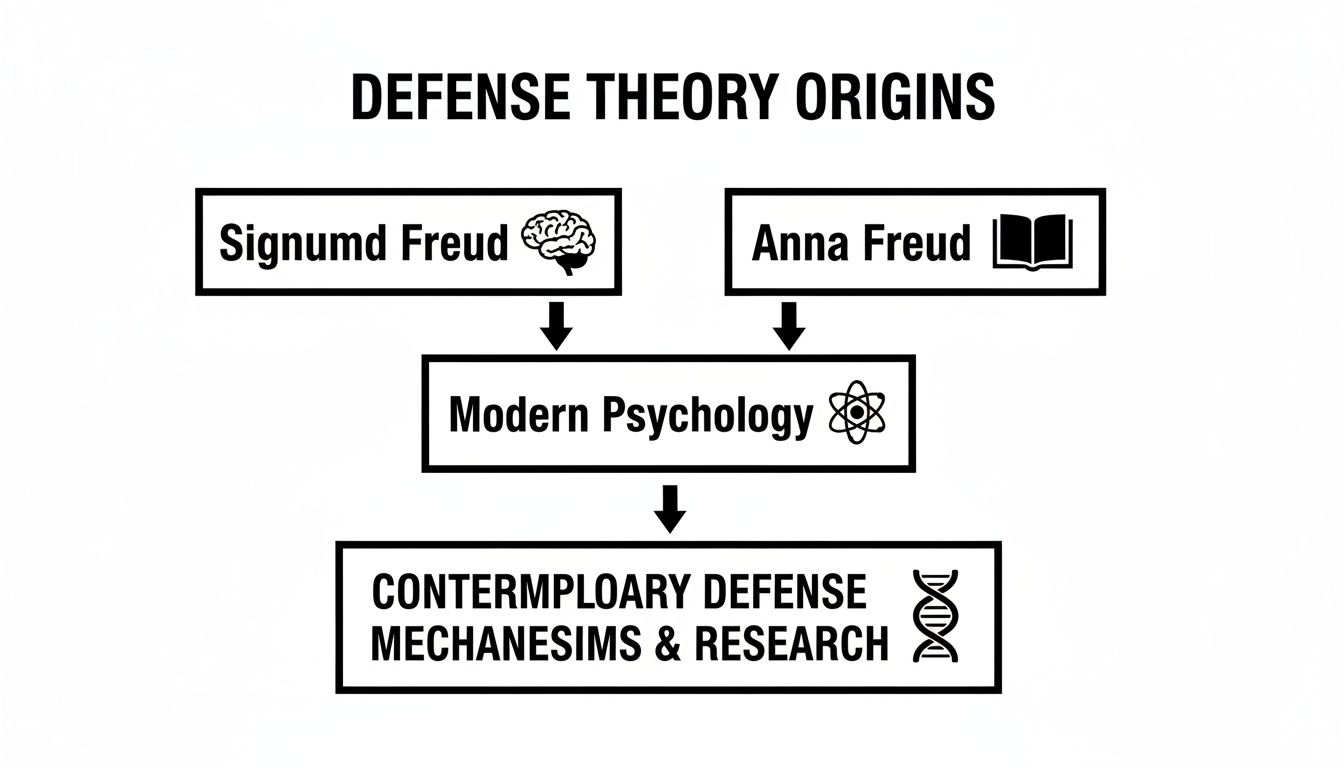
As you can see, there’s a direct line from Sigmund Freud’s early hunches, through his daughter Anna Freud’s more organized system, all the way to what modern science studies today. Let’s dive in and meet the characters in each group.
The Healthy Helpers (Mature Defenses)
These are the all-stars of your psychological toolkit. Mature defenses are considered the healthiest because they help you handle difficult feelings in ways that are actually constructive and socially acceptable. They don't just bury the problem; they transform it.
• Sublimation: • This is the art of turning a socially unacceptable impulse or a wave of bad vibes into something productive and positive. Think of it as emotional alchemy—turning lead into gold.
• Humor: • This is way more than just telling a good joke. As a defense, humor lets you find the absurdity or irony in a painful situation. It creates just enough emotional distance to make the unbearable feel a bit more manageable, all without completely ignoring the reality of it.
The Risky Responders (Neurotic Defenses)
These guys are a mixed bag. Neurotic defenses can get you out of an anxious jam in the short term, but they often come with a hidden cost. They don't actually solve the underlying problem, and if you lean on them too much, they can end up creating even more anxiety down the road.
• Displacement: • Ever had a terrible day at work and then come home and snapped at your partner over something tiny? That’s displacement. You take out your feelings (usually anger) on a safer, less threatening target than the person who actually caused them.
• Reaction Formation: • This one’s a fun psychological plot twist. It’s when you behave in the exact opposite way to how you actually feel, because your true feelings are too threatening or anxiety-inducing to admit.
The Trouble Makers (Immature Defenses)
These are the most primitive, reality-bending defenses in the book. Immature defenses are common in childhood and can pop up for anyone under extreme stress, but relying on them as an adult can seriously mess with your relationships and your grip on reality.
• Denial: • The most straightforward of the bunch. Denial is simply refusing to accept a fact or reality that’s too painful to handle. You just decide something isn't true, even when all the evidence says it is.
• Projection: • This is like playing emotional hot potato. You take your own unacceptable thoughts or feelings and pin them on someone else. Instead of owning your jealousy, for example, you accuse someone else of being jealous of • you • .
To give you a clearer picture, here’s a quick-reference chart to help you spot these defenses in the wild.
Defense Mechanism Cheat Sheet
This table breaks down some of the most common defenses, showing you what they do and how they might look in a real-life situation.
| Mechanism | Category | What It Does | A Real-Life Example |
|---|---|---|---|
| Sublimation | Mature | Channels unacceptable impulses into positive, socially acceptable actions. | A surgeon in Houston, Texas, channels aggressive urges into the precise, life-saving act of cutting. |
| Humor | Mature | Highlights the ironic or funny aspects of a stressful situation to reduce distress. | A patient in a Philadelphia hospital diagnosed with a serious illness starts making jokes about their medical treatments to cope. |
| Displacement | Neurotic | Shifts emotional reactions from the real target to a less threatening substitute. | After a terrible day at your job in downtown Seattle, you come home and start a fight with your roommate over nothing. |
| Reaction Formation | Neurotic | Behaves in a manner that is the extreme opposite of one's true, unacceptable feelings. | Someone from a conservative family in Alabama who secretly harbors homophobic feelings becomes an outspoken advocate for gay rights. |
| Denial | Immature | Refuses to acknowledge a painful or anxiety-inducing reality or piece of information. | A man in Las Vegas with a gambling problem insists he can "stop anytime he want" despite clear evidence of his addiction. |
| Projection | Immature | Attributes one's own unacceptable thoughts, feelings, or motives to another person. | A person from Los Angeles who is cheating on their partner constantly accuses their partner of being unfaithful. |
Recognizing which of these characters shows up most often in your life is the first step toward understanding your own psychological wiring. Once you can spot them in action, you can start to figure out what they’re trying to protect you from—and maybe, just maybe, start choosing healthier ways to handle things.
Are Your Mental Shields Helping or Hurting You?
Defense mechanisms are a bit like emotional bodyguards. When used correctly, they protect you from getting blindsided by life's punches. But when they get overzealous, they can lock you in a padded room, preventing you from ever truly living.
The real question isn't whether a defense is "good" or "bad." It's all about context. The right shield at the right time can be a lifesaver. The trouble starts when a temporary coping tool becomes a permanent, rigid part of your personality.
This is the critical difference between adaptive (helpful) and maladaptive (harmful) defenses. An adaptive defense helps you get through a tough spot without creating bigger problems down the line. A maladaptive one might offer a quick escape, but it ultimately stunts your growth and wrecks your relationships.
The Lifesaver Versus the Life Wrecker
Let's unpack this with a real-world example: denial .
Imagine Sarah, a woman from Arizona, gets a call with the shocking news that her father has died. Her immediate gut reaction is, "No, that's impossible. They've made a mistake." This is denial in its most adaptive form. It’s a psychological circuit breaker, preventing an overwhelming surge of grief from completely shorting out her system.
This initial shield gives her the breathing room she needs to process the trauma, make funeral arrangements, and just function for the next few hours. It's a temporary, protective buffer.
Now, let's jump ahead six months. Sarah is still acting as if her dad is just away on a long trip. She changes the subject whenever he’s mentioned, refuses to touch his belongings, and lashes out at anyone who tries to talk about her loss. The shield has become a prison. This long-term denial is now maladaptive, blocking her from healing and isolating her from the very people trying to support her.
The same defense mechanism can be a brilliant tool for short-term crisis management but a disastrous blueprint for long-term living. The key question is always: Does this shield help me face reality, or does it just help me avoid it?
When Defenses Fuel Distress
Relying too heavily on immature or neurotic defenses doesn't just keep you stuck; it can actively make things worse. While designed to protect, some shields create a vicious cycle of distress instead of relief. In fact, you can see how avoidance, a pervasive defense mechanism, can perpetuate distress and trap people in emotional quicksand.
The link between specific defense styles and mental health conditions is undeniable. Research has found that the prevalence of any pathological defense mechanism (like acting out or splitting) was 30.0% among individuals with no disorders.
That number jumps to a staggering 67.6% for those with mood disorders like major depression and 62.8% for those with anxiety disorders.
This isn't meant to scare you—it's meant to empower you. It shows that our coping patterns have a direct, measurable impact on our well-being. Once you can see these patterns, you gain the power to change them. Learning how to stop being defensive is a skill anyone can build with a little awareness and practice.
The goal isn't to tear down all your defenses and stand emotionally naked before the world. Think of it more like conducting a friendly audit of your internal security team. Are your bodyguards skilled professionals, or are they clumsy bouncers who keep breaking the furniture and starting fights? By honestly assessing your mental shields, you can start upgrading your toolkit for a healthier, more authentic life.
How the Enneagram Unlocks Your Default Defenses
So, what if you had a personalized map to the tricky, hidden parts of your own mind? It's one thing to understand what defense mechanisms are, but spotting your own go-to shields in the heat of the moment can feel like trying to catch smoke.
This is where a surprisingly powerful tool, the Enneagram, comes into play. It's so much more than just another personality test. Think of it as a dynamic system that shines a light on the deep-seated motivations, fears, and desires that secretly pull your strings. It gives you a blueprint for understanding why you do what you do—and that absolutely includes which psychological defenses you automatically throw up.
Your Enneagram Type as a Defense Mechanism Shortcut
You can think of your Enneagram type as a shortcut to some pretty profound self-awareness. Each of the nine types is built around a core fear and a core desire. Their primary defense mechanism is simply the unconscious strategy they use to run from that fear and chase after that desire.
Once you identify your type, you get a massive clue about which mental shield you’re most likely to grab without even thinking.
This gives you a clear, focused place to start your self-discovery. Instead of trying to keep an eye out for a dozen different defenses, you can zoom in on the one or two most common for your type. For a deeper look into what drives each personality structure, you can explore the Enneagram's core motivations .
Let's see how this plays out with a couple of real-life examples of American people.
• Type 1 The Perfectionist: • A Type One is terrified of being bad, corrupt, or defective. To handle the internal anger that simmers when things aren't "right," they often lean on • Reaction Formation • . Imagine a project manager from Portland, Oregon, who is secretly infuriated by her team's sloppy work. Instead of blowing up, she becomes overly polite and hyper-helpful, masking her frustration with a veneer of perfect control.
• Type 7 The Adventurer: • A Type Seven’s biggest fear is being trapped in emotional pain or boredom. Their classic defense is • Rationalization • . When a promising relationship suddenly ends, a Type Seven from San Diego might immediately say, "It's for the best. I wasn't ready to settle down anyway, and now I'm free to travel!" This intellectual spin lets them sidestep the genuine sting of rejection.
The Enneagram doesn't just put you in a box; it reveals the automatic patterns that run your life. It illuminates the unconscious habits that you’ve mistaken for your personality.
From Unconscious Reflex to Conscious Choice
Getting a handle on this connection is incredibly empowering. It takes the abstract idea of defense mechanisms and turns it into a personal, practical tool for growth. It shows you exactly where to look when you feel that old, familiar tug of anxiety or stress.
Take a Type 2 The Helper , whose core fear is being unwanted or unworthy of love. They often use Repression to shove their own needs and frustrations out of sight, which frees them up to focus entirely on others. When a Type Two from Charleston, South Carolina, feels utterly exhausted and unappreciated, she might genuinely tell everyone (and herself) that she’s "fine," having completely repressed her burnout to keep her helpful identity intact.
But by knowing she’s a Type Two, she can learn to watch for this very pattern. The moment she feels that knee-jerk impulse to say "I'm fine," she can hit the pause button and ask herself, "Hang on. Am I repressing something? What do I actually need right now?"
And that's the whole point. We want to move from unconscious reaction to conscious choice. The Enneagram hands you the map, but you're the one in the driver's seat, deciding which road to take. It offers a clear, actionable way to start noticing your mental shields, understanding why they’re there, and slowly, gently choosing healthier ways to navigate your world.
Upgrading Your Mental Toolkit for Healthier Coping
Just knowing your default defense mechanisms is a huge win. But the real transformation happens when you move from simply spotting them to consciously upgrading your entire coping toolbox.
This isn't about trying to "fix" something broken inside you. Think of it more like a personal growth project—one where you're building a more flexible, resilient, and honest way of handling life.

The idea is to graduate from automatic, often immature reactions to more mindful, mature responses. It’s the difference between snapping at your partner because your boss in Chicago annoyed you (classic displacement) and taking a deep breath to figure out what you're really feeling. Making that shift is how you break the cycles that keep you stuck.
Actionable Steps for Building Healthier Habits
Ready to get to work? These practical strategies can help you become the architect of your own emotional world, giving you the power to handle whatever life throws your way with more grace and skill.
Breaking the Link Between Stress and Distress
Leaning too heavily on immature defenses can create a dangerous bridge between everyday stress and serious mental health issues. A 2023 analysis of psychiatric outpatients, for example, found that 67.0% screened positive for depression and relied far more heavily on immature defenses.
In fact, those defenses were the primary link between negative life events and the severity of their depressive symptoms, predicting tougher outcomes. You can read more about these important findings on defense mechanisms and depression .
This really drives home a critical truth: how we manage our internal world directly impacts how well we weather external storms. Healthier coping isn't just a nice self-care tip; it's a non-negotiable part of mental wellness.
Beyond just identifying your defenses, it’s crucial to stock your toolkit with effective stress management techniques that do the job better. When you build these new skills, you’re not just coping—you're actively creating a more fulfilling and emotionally authentic life.
Got Questions About Defense Mechanisms? Let's Get Real.
Alright, let's dive into some of the most common questions that come up when people start learning about psychological defense mechanisms. This isn't about acing a pop quiz; it's about getting answers you can actually use.
So, Can I Just... Stop Using Them?
In a word? Nope. And honestly, you wouldn’t want to. Think of them as your mind's automatic security system—it’s a built-in feature of being human.
The real goal isn't to fire your entire security team. It's to get to know them, figure out which ones are overreacting, and maybe promote the more level-headed ones. The more you notice when you're using a less-than-helpful defense, the more power you have to consciously choose a better way to handle things. That's how you go from a knee-jerk reaction to a thoughtful response.
Are Some Defenses Just Plain Bad?
It’s not so much a "good vs. bad" situation as it is a "helpful vs. unhelpful" one. Context is everything. A tool that's perfect for one job can be a disaster in another.
Think about denial. Right after a major trauma, it can be a lifesaver, giving your brain a much-needed buffer to process the initial shock. But if that same denial sticks around for months and stops a grieving widow in Chicago from seeking support, it’s no longer helping; it's holding her back.
The key is flexibility.
How Do I Know If It's a Defense Mechanism or Just Me Making a Choice?
Great question. The biggest clue is the automatic, unconscious quality of a defense mechanism. It's a reflex, a gut reaction that happens before you’ve even had a chance to think. A conscious choice, on the other hand, is exactly that—a deliberate decision.
Here’s an example: Deciding to put a work problem out of your mind until Monday morning so you can enjoy your weekend is suppression (a mature, conscious choice). But automatically "forgetting" that dentist appointment you've been dreading for weeks? That's repression (an unconscious, neurotic defense). Spotting those automatic reflexes is the first step toward real self-awareness.
Ready to pull back the curtain on your own unconscious patterns? The journey starts with a single step. Enneagram Universe has a free, comprehensive assessment that can help you pinpoint the core drivers behind your automatic behaviors. Take the free Enneagram test today!