The Three Types of Empathy and How to Master Them

Empathy isn't a one-size-fits-all feeling. It’s more like a skill with three distinct channels you can tune into. The three types of empathy are Cognitive , Emotional , and Compassionate . Getting to know these different forms is the first real step toward building stronger, more authentic connections in every corner of your life.
Decoding the Three Types of Empathy
Think of empathy like a sound mixing board. You've got three main faders, and each one brings a different quality to the way you hear what someone is experiencing. Sometimes you need to listen to the lyrics to understand the story ( cognitive ). Other times, you need to feel the bass and the rhythm in your chest ( emotional ). And then there are moments when the music moves you so much you just have to help them find their dance floor ( compassionate ).
Most of us have a default setting—we naturally lean on one of these faders more than the others. But the real art is learning to slide between all three, dialing in the right kind of empathy for the right moment.
Your Quick Guide to Empathy
Let’s put this into a real-world scenario. Imagine your friend, Mark, an American software developer from Austin, tells you he was just laid off. He's clearly shaken up, worried about his family and what comes next. Here’s how the three types of empathy would kick in:
• Cognitive Empathy (The Thinker): • This is all about perspective-taking. You connect the dots intellectually. You think, "Okay, Mark just lost his primary income. He’s got a mortgage and two kids in school. He must be terrified about finding a new job in this competitive tech market." You understand his dilemma logically, without necessarily absorbing his panic.
• Emotional Empathy (The Feeler): • This is when you feel • with • someone. As Mark is talking, you feel a knot forming in your own stomach. His distress becomes your distress. It’s like his emotions are contagious, and you’ve just caught his anxiety and sadness. You're right there in the feeling with him.
• Compassionate Empathy (The Doer): • This type of empathy takes understanding and feeling and turns them into action. It’s the impulse to help. You hear Mark out and then say, “I am so sorry this is happening. Let me help. I know a few people at a tech company in Dallas; how about I send your resume over to them first thing tomorrow?” You’re not just feeling bad for him; you’re moved to do something about it.
This diagram helps visualize how these three streams flow from the single source of empathy.
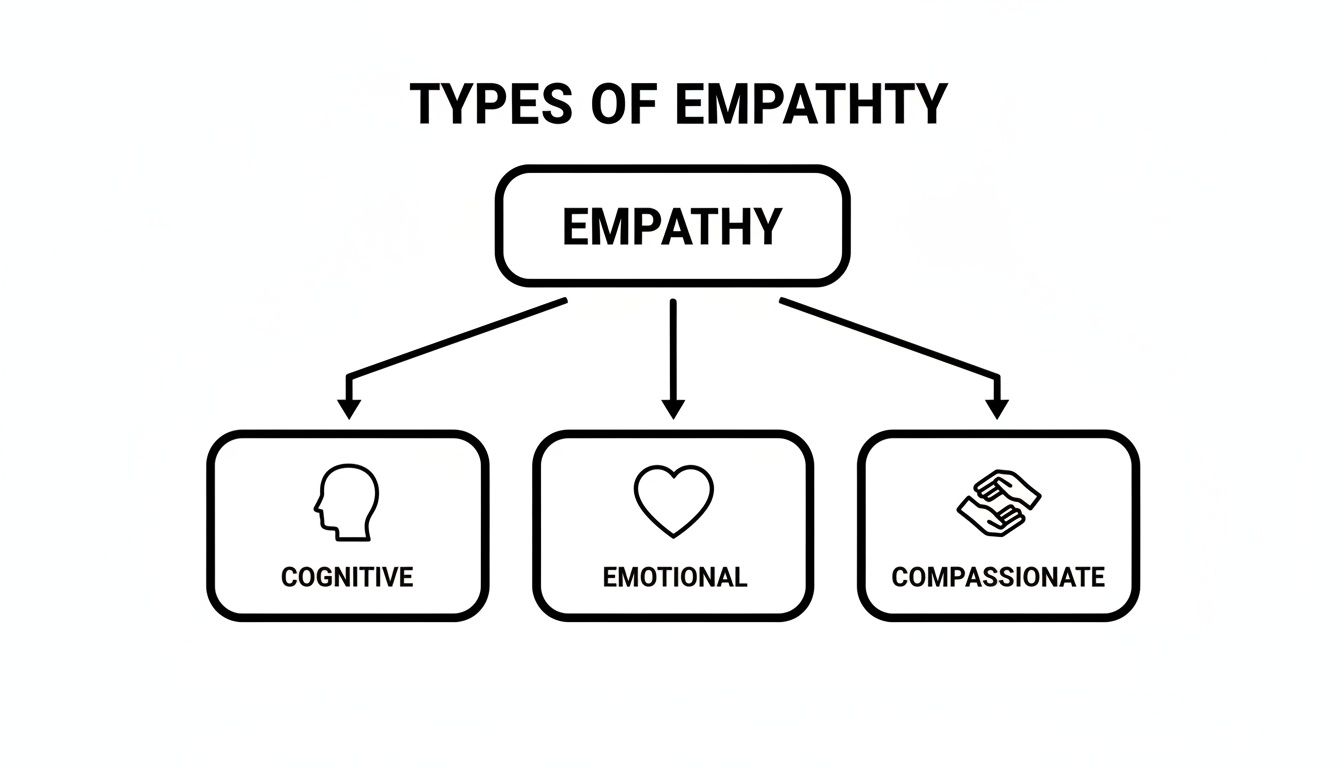
As you can see, the visualization neatly separates empathy into thinking (cognitive), feeling (emotional), and acting (compassionate). It's a great reminder that true, deep connection involves the head, the heart, and the hands. Each one plays a unique, yet totally interconnected, role in how we show up for each other.
The Three Empathy Types at a Glance
To make it even clearer, here's a quick cheat sheet that breaks down the core of each empathy type. Think of it as your field guide to understanding what's happening inside you and others.
| Empathy Type | Core Function | Key Phrase | Example Scenario |
|---|---|---|---|
| Cognitive Empathy | Understanding someone's perspective | "I understand why you think that." | A manager in Chicago listens to an employee's frustration about a new workflow and can articulate their point of view in a team meeting, even if she doesn't personally agree. |
| Emotional Empathy | Sharing someone's feelings | "I feel your pain." | You watch a sad movie about a family in rural Ohio and find yourself crying along with the main character, feeling their grief as if it were your own. |
| Compassionate Empathy | Being moved to help | "How can I support you?" | Your neighbor in suburban Florida is overwhelmed with a new baby, so you offer to bring them a home-cooked meal, unprompted. |
Keeping these distinctions in mind helps you become more intentional. Instead of just reacting, you can consciously choose which empathetic muscle to flex depending on what the situation—and the person—truly needs from you.
Understanding Through Someone Else's Eyes
Ever found yourself listening to a friend vent about their horrible day at work, and instead of just nodding along, your brain starts mapping out the entire situation? You can see all the players, you get the tricky office politics, and you understand exactly why they're so frustrated—all without getting sucked into their anger yourself.
If that sounds familiar, you've been using your cognitive empathy .

Think of it as the "mind's empathy." It’s one of the most practical tools in our emotional toolkit. This is your ability to intellectually understand someone's point of view—to see the world through their lens, even if you aren't feeling their emotions in your own gut. It’s less about feeling with them and more about thinking like them.
This skill is a quiet superpower in daily life. It helps you give genuinely useful advice, navigate tense negotiations, and lead a team with a clear head instead of emotional chaos. For example, a lawyer in New York uses cognitive empathy to anticipate the opposing counsel's arguments by understanding their legal strategy and client's motivations, allowing her to prepare a stronger case.
Putting Cognitive Empathy to Work
Let's see it in action. Imagine a manager, Sarah, who notices her team member, David, is completely stressed out by an approaching project deadline. Instead of absorbing David's anxiety like a sponge, Sarah taps into her cognitive empathy to figure out what's really going on.
She starts breaking down the situation in her head:
• David is already juggling a heavy workload from other projects.
• He's hit some unexpected technical snags with the software.
• Another department is breathing down his neck for results.
Because Sarah can grasp the reasons for David’s stress without getting stressed herself, she can offer practical, targeted solutions. Maybe she reassigns a small task to someone else or gets him the technical support he needs. The point is, she solves the problem instead of just worrying alongside him.
Key Takeaway: Cognitive empathy is all about perspective-taking, not emotional mirroring. That slight detachment is actually its greatest strength, allowing for clear thinking and effective problem-solving when emotions are running high.
This ability to step into someone else's mental shoes is the very heart of cognitive empathy. Research actually backs this up, showing that this skill directly fuels helpful behaviors. A 2022 study found that people with higher perspective-taking scores were 20-30% more likely to help someone anonymously. Why? The link was explained by an increase in gratitude. Simply put, understanding where someone is coming from makes us more grateful, and that gratitude makes us more likely to lend a hand.
Cognitive Empathy and the Enneagram
Within the Enneagram framework, some personality types just have a natural knack for this kind of objective understanding.
• Type 5s (The Investigators): • With their deep desire to understand how the world works, Fives are masters at detaching from emotion to analyze a situation from every angle. They can easily get inside complex viewpoints, which makes them brilliant troubleshooters and strategists. A Type 5 might excel in a debate by being able to perfectly articulate their opponent's argument before refuting it.
• Type 9s (The Peacemakers): • Nines have this uncanny ability to see and value all sides of an issue. Their talent for perspective-taking allows them to mediate conflicts beautifully because they genuinely understand where everyone is coming from, even when opinions are worlds apart. For instance, a Type 9 parent can settle a fight between siblings by explaining each child's point of view to the other in a way they both can understand.
For these types, cognitive empathy is home turf. Their growth edge, however, often lies in pairing this intellectual insight with a dose of emotional connection to build more well-rounded relationships.
How to Build Your Cognitive Empathy
The best part? Cognitive empathy is a skill, not a fixed trait. You can absolutely strengthen it, and you don't need to be a mind-reader to do it. You just need to be a more curious and intentional listener.
Ready to give it a try? Start with these simple exercises:
Truly understanding another person's world is a profound skill. To go deeper, it can be really helpful to explore practical guides on topics like supporting someone with autism, where consciously shifting your perspective is key. By practicing these skills, you’re building a bridge of understanding, one conversation at a time.
Feeling What Other People Feel
If cognitive empathy is all in your head, emotional empathy is a full-body experience. This is the gut-level, often instantaneous connection where you don't just get what someone is feeling—you actually feel a ghost of it yourself. It’s the "I feel your pain" frequency of human connection, tuned in and broadcasting live.
Ever found yourself wincing when a skateboarder takes a nasty spill on a video? Or felt a real, bubbly surge of joy when your friend calls from her college dorm in California, absolutely screaming with good news about landing her dream internship? That wince, that shared thrill—that's emotional empathy in action. It's the knot that forms in your stomach when someone you love gets bad news, a feeling that shows up uninvited, no conscious thought required.
This isn't just some fluffy, feel-good concept; it's hardwired into our brains. Scientists point to something called mirror neurons , which are incredible little brain cells that fire up not only when we do something but also when we watch someone else do it. So when you see a genuine, crinkly-eyed smile, your own "smile" neurons light up, creating a faint but real echo of that joy inside you.
This neural mirroring is the engine driving our ability to form deep, authentic bonds. It’s what makes us feel like we’re truly in it with someone else, sharing a piece of their emotional world.
The Double-Edged Sword of Feeling Deeply
As beautiful as it is, emotional empathy is a bit of a double-edged sword. When you're constantly soaking up the emotional states of everyone around you, it can be absolutely exhausting. This is especially true in high-stakes jobs, chaotic family dynamics, or for anyone who's just naturally a human sponge for feelings. A practical example is a nurse in a busy emergency room who, after a 12-hour shift, feels completely drained not just physically, but emotionally, from absorbing the fear and pain of dozens of patients.
Key Insight: Without a way to manage the flow, emotional empathy can quickly lead to emotional burnout or empathy fatigue . You can get so waterlogged with other people's stress, sadness, and anxiety that there's no room left for your own emotional well-being.
This is the razor's edge between empathy and codependency. Healthy emotional empathy means connecting with another's feelings to offer genuine support. Burnout happens when you start carrying their emotional baggage for them.
Emotional Empathy and the Enneagram
Some Enneagram types, especially those in the Heart Triad, might read this and think, "Yep, that's my default setting." They are born with their emotional radar on high alert.
• Type 2s (The Helpers): • Twos are masters at sensing what others need, often before the other person even knows it themselves. This emotional antenna fuels their drive to help and nurture, but they can easily burn out by absorbing too much of others' pain, completely forgetting to check in with their own feelings. For instance, a Type 2 might feel a friend's romantic heartbreak so intensely that they neglect their own responsibilities for a day.
• Type 4s (The Individualists): • Fours have an incredible capacity to sit with the entire, messy spectrum of human emotion—their own and others'. It allows for profound connection, but they also risk becoming emotionally flooded, struggling to tell where their feelings end and someone else's begin. A Type 4 artist might listen to a friend's sad story and then be unable to create for days because they are mired in that second-hand melancholy.
For these types, the goal isn't to feel less. It's about learning how to stand with someone in their emotional storm without getting swept away by the current.
How to Nurture Healthy Emotional Empathy
Learning to manage this powerful current is a skill, one that balances deep connection with essential self-preservation. It's about being a compassionate friend, not a human sponge.
Here are a few ways to start building that balance:
• Practice Mindfulness: • Being mindful helps you become an observer of your feelings. It creates just enough space to notice, "Oh, I'm feeling a wave of their sadness," instead of getting pulled under by the thought, "I am so sad."
• Do a Body Scan: • When you feel a sudden, strong emotional response to someone else, pause for a second. Where is it showing up in your body? A tight chest? A queasy stomach? Simply naming the physical sensation can anchor you back in your own skin.
• Set Emotional Boundaries: • It is perfectly okay to step back. You are not a bad person for needing a break. If a conversation or environment gets too intense, give yourself permission to excuse yourself. You can be supportive without having to absorb every last drop of someone’s pain.
3. Compassionate Empathy: The “Hands” of Empathy
So, you’ve grasped the situation with your head and felt a connection with your heart. What now? This is where the third, crucial piece of the puzzle clicks into place: compassionate empathy .
This is where understanding and feeling get up and do something . It’s empathy in motion.
Think back to that family who lost their home in a fire. Cognitive empathy lets you understand their logistical nightmare—insurance calls, finding a place to stay, replacing birth certificates. Emotional empathy makes your stomach clench with their fear and loss. But compassionate empathy is what gets you to pull out your wallet for their fundraiser or show up on Saturday to help them sift through the wreckage.

This active response is what truly closes the loop. It’s arguably the most constructive of the 3 types of empathy because it turns a passive feeling into tangible help, making a real, measurable difference in someone’s life.
Moving Past "Let Me Know If You Need Anything"
We’ve all said it. And we usually mean well! But that vague offer—"let me know what I can do"—can unintentionally put the burden right back on the person who's already drowning. They’re too overwhelmed to even know what to ask for, let alone delegate tasks.
Compassionate empathy cuts through that fog by inspiring you to make specific, actionable offers. You take the initiative and lighten their load in a concrete way.
It’s the difference between saying…
• "Let me know if you need anything."
• And saying: • "I’m making a giant lasagna tonight and I’m bringing you half. I'll drop it on your porch around 6 PM, no need to answer the door."
Or the difference between…
• "I'm here for you."
• And saying: • "I have a couple of free hours Tuesday afternoon. I can either watch your kids so you can make some phone calls, or I can run those errands you mentioned."
See the difference? Specific offers remove the mental gymnastics for the other person and provide immediate, practical relief. This is empathy made real, and it’s a non-negotiable skill if you want to build healthy relationships that last .
The Bottom Line: Compassionate empathy isn't just about feeling for someone; it's about doing for them. It leaps past good intentions to deliver specific, helpful actions that actually reduce another person's burden.
How Different Enneagram Types Show Up with Compassionate Empathy
Just like with the other forms of empathy, certain Enneagram styles feel a more natural pull toward this active kind of support. The action-oriented types, in particular, get a powerful urge to do something the second they spot a problem.
• Type 1s (The Reformers): • Driven by a powerful sense of right and wrong, Ones are often the first to step up to fix what's broken or correct an injustice. When they channel their need for improvement into serving others, their compassionate empathy becomes a force for practical good in the world. For example, a Type 1 might organize a neighborhood cleanup after noticing the local park is full of litter.
• Type 8s (The Challengers): • With a fierce protective instinct, Eights can't stand to see the vulnerable get trampled. They rush in to take charge when someone’s in trouble, using their assertive energy to provide safety, find resources, and bulldoze obstacles for the people they care about. An example is a Type 8 who immediately sets up a GoFundMe and organizes meal delivery for a friend who has received a difficult medical diagnosis.
For these types, putting their natural drive into action is a core expression of their empathetic nature. If you're curious to learn more, you can explore our other articles on how to start: Building Relationship Skills Guide: Proven Tips for Better Communication and Bonds .
When you finally combine the head (cognitive), the heart (emotional), and the hands (compassionate), you get the full picture—a powerful, complete empathetic response that not only connects you to others but actively makes their world a better place.
Empathy Fatigue: When Understanding Everyone Drains You
Empathy has a cost, and it isn't distributed evenly. If you're an emotional empath — think Type 2, Type 4, or Type 9 — you're not just noticing what other people feel, you're absorbing it. Do that for long enough without a way to set it down, and you get empathy fatigue: the point where caring stops feeling generous and starts feeling like being pulled under.
It shows up differently depending on the type doing the absorbing:
• Type 2s • keep giving past the point of depletion because stopping feels like abandoning someone who needs them.
• Type 4s • can get so immersed in someone else's pain that it merges with their own, making it hard to tell where the other person's feeling ends and theirs begins.
• Type 9s • go quiet and start withdrawing from everyone at once, rather than naming that they've hit a limit.
The fix isn't to feel less — that would undercut exactly what makes these types good at connection in the first place. It's building in a deliberate reset: a few minutes alone before responding to someone in distress, a check-in with yourself ("whose feeling is this, actually?"), or simply naming out loud that you're running low. Empathy that isn't refilled eventually has nothing left to give.
The Surprising Science Behind Your Empathy
Ever wondered why your friend can stay cool as a cucumber during a crisis while you feel every bit of stress in the room? Or why some people just seem born with an almost psychic ability to understand others? The answer isn't just about personality—it's woven deep into your biology, from the way your brain is wired to your unique genetic code.

Diving into the science behind the different types of empathy pulls back the curtain. It shows us that empathy isn't some magical, unattainable trait. It’s a tangible skill, rooted in real neurology and genetics, which means anyone can get better at it.
Your Brain on Empathy
When you truly connect with someone, your brain lights up like a complex switchboard. Different kinds of empathy activate distinct neural pathways, creating a full-spectrum response that pulls from both your thinking and feeling centers. It's a beautiful, intricate dance between various parts of your brain.
Take cognitive empathy, for example—the skill of simply understanding someone else's perspective. This one heavily involves your prefrontal cortex . Think of this as the logical, analytical CEO of your brain, the part responsible for planning and reasoning. It lets you mentally step into someone’s shoes to see their point of view, all without getting swept up in their emotions.
Emotional empathy, on the other hand, is a whole different ball game. When you feel what someone else is feeling, your brain’s limbic system —especially the anterior cingulate cortex and the insula—springs into action. These are the ancient, primal regions tied to emotional processing and gut feelings, creating that visceral sense of a shared experience.
This constant conversation between different brain functions is what allows you to both understand a friend’s problem intellectually and offer comfort that feels genuinely warm and sincere. Nailing this balance is also the secret to avoiding burnout, a critical skill we explore in our guide on how to measure emotional intelligence .
Are You Genetically Wired for Empathy?
While your brain's activity is a huge piece of the puzzle, your genes play a fascinating role, too. It might surprise you to learn that genetics are responsible for about 10% of the variation in our empathy levels. A groundbreaking 2018 study from the University of Cambridge analyzed the DNA of thousands of people and found a clear hereditary link.
This research confirmed what scientists had long suspected from studying twins—that our DNA gives some of us a slight head start in the empathy department. The study even found that certain genetic markers related to the oxytocin receptor—the gene linked to the "bonding hormone"—can boost empathic responses by as much as 20-30% .
Key Takeaway: Your genes might set your empathy baseline, but they absolutely do not define your ceiling. The vast majority of your ability to connect is shaped by your life experiences, your environment, and your own conscious effort.
This is incredibly empowering news. It means that no matter where you start from, you have the power to grow. For those of us who use the Enneagram, this science offers clues to our natural tendencies. For instance, a Type 1 might have a genetic nudge toward the cognitive empathy that fuels their inner reformer, which in turn highlights their growth path: learning to nurture their feeling, affective side.
How the Three Empathy Types Engage Your Brain
To really see how this works, let's look at how the different parts of your brain team up to create each type of empathy. This table is a simplified look at the neurological "who does what" behind human connection.
| Empathy Type | Primary Brain Regions Involved | Key Biological Factor | Main Function |
|---|---|---|---|
| Cognitive | Prefrontal Cortex | Higher-order thinking | Logically understanding another person's perspective and mental state. |
| Emotional | Limbic System (Insula, Amygdala) | Mirror Neuron System | Feeling a reflection of another person’s emotions; emotional resonance. |
| Compassionate | Prefrontal Cortex & Limbic System | Oxytocin Release | Integrating understanding and feeling to motivate a helpful action or response. |
Ultimately, understanding the science behind empathy grounds it in reality. This isn’t just a "soft skill"; it's a real biological process you can actively influence. When you recognize how your brain and genes are part of the story, you can be much more intentional about flexing those empathetic muscles and building stronger connections.
Your Practical Toolkit for Everyday Empathy
Knowing the different types of empathy is cool. Actually using them to make your life and relationships better? That’s where the magic is. Empathy isn't some fixed trait you're born with. It’s a muscle. The more you work it out, the stronger and more automatic it becomes.
So, let's get to the workout plan. Here are some simple, powerful exercises to bulk up each of your empathy channels. Practice these, and you’ll start building stronger connections and becoming a more tuned-in person in every corner of your life.
Sharpening Your Cognitive Empathy
This one is all about getting inside someone else’s head and seeing the world through their eyes. The best way to do that? Deliberately step outside of your own perspective, even if it's just for a few minutes.
Give the Five-Minute Perspective Switch a try.
It feels weird at first, kind of like writing with your non-dominant hand. But this little drill trains your brain to see the hidden architecture in other people's thinking, which is the bedrock of cognitive empathy.

Tuning Into Your Emotional Empathy
Emotional empathy is about catching someone else's feelings. But here's the catch: you can't tune into their frequency if you don't even know what your own station is broadcasting. It all starts with self-awareness.
This is where mindfulness comes in handy. It’s not about emptying your mind; it's about noticing what's already in there without judgment.
Try this simple daily practice: the Emotional Check-In .
• Pause and Scan: • A few times a day, just stop. Close your eyes and do a quick body scan. Are your shoulders up by your ears? Is your jaw clenched? Got a knot in your stomach?
• Name the Feeling: • Give that physical sensation a name. Is it anxiety? Frustration? Giddiness? Don’t get mad at it, just label it. "Ah, hello there, impatience."
When you get good at recognizing your own feelings, you create a clearer channel to sense what others are feeling without getting swamped by it. To go deeper on this, check out our guide on how to increase your EQ .
A Quick Tip: Feeling with someone is not the same as feeling responsible for them. Healthy emotional empathy is about sharing a moment, not shouldering their burden as your own.
Activating Your Compassionate Empathy
Alright, this is the "get off the couch" part of empathy. Compassionate empathy turns feeling into doing. The best way to build this muscle is through small, consistent actions that make helping people a habit, not a grand gesture.
Challenge yourself to do one Micro-Act of Kindness each day. The goal isn't to save the world; it's just to be intentionally helpful in a small way.
Need some ideas?
• Text a friend who's having a rough week, "Hey, just thinking of you." That's it.
• Leave a glowing online review for that local coffee shop you love.
• Offer a specific bit of help to a swamped coworker, like, "I'm running to get coffee, can I grab you one?"
These tiny gestures train your brain to automatically scan for opportunities to help. It's how you close the gap between feeling for someone and actually showing up for them.
Your Empathy Questions Answered
Alright, let's dive into some of the questions that always seem to come up when we start untangling the different types of empathy . Think of this as our final chat to clear up any lingering confusion.
Can You Have One Type of Empathy Without the Others?
You absolutely can. In fact, it's pretty normal to be a rockstar in one kind of empathy while another feels like a foreign language. Being an empathetic person isn't an all-or-nothing game.
Think about a brilliant negotiator. They might have sky-high cognitive empathy , letting them see right into their opponent's strategy and motivations. But they might keep their emotional empathy on a tight leash, so their own feelings don't get in the way of closing the deal.
The goal isn’t to get a perfect score in all three areas. It's about finding a healthy balance that lets you connect with people in a way that feels real to you and helpful to them.
Is Being an "Empath" the Same as Having High Emotional Empathy?
They're definitely in the same ballpark, but they aren't playing the exact same position. People often use the term "empath" to describe someone who soaks up the emotions and energy of others like a sponge, to the point where it can get completely overwhelming.
High emotional empathy is the clinical term for that ability to feel what someone else is feeling. An "empath" could be seen as someone with an extremely sensitive, and sometimes untamed, version of this trait. If this sounds like you, the real work is learning how to manage that incredible sensitivity so you don't burn out.
Which Enneagram Types Struggle Most with Empathy?
This is a great question, but the answer isn't as simple as pointing a finger. No Enneagram type is truly without empathy—it’s more about how each type’s default programming creates unique blind spots.
Here's a quick look at the patterns:
• Thinking Triad (Types 5, 6, 7): • These folks can get stuck in their heads, leading with cognitive empathy. They analyze and understand a situation perfectly but might struggle to drop down and actually connect with the feelings involved.
• Body Triad (Types 8, 9, 1): • These types sometimes build a wall around their own feelings to stay in control, which naturally makes it tougher to tune into what others are feeling.
It all comes back to self-awareness. Once you know your Enneagram type’s go-to moves, you can start consciously practicing the types of empathy that feel a little less automatic.
How Can I Practice Empathy If I Am an Introvert?
Empathy is not, I repeat, not an extrovert's-only party. Introverts can become incredibly empathetic people by playing to their strengths and respecting their own energy.
You don't have to wade into a crowded room to forge a connection. Instead, try this:
• Boost cognitive empathy • by getting lost in a good novel. Reading fiction is a fantastic way to live inside another person's head for a while.
• Practice emotional empathy • by watching character-driven movies. Pay close attention to the actors' facial expressions, body language, and the unspoken emotional currents of the story.
• Show compassionate empathy • through meaningful quiet actions, like donating to a cause that moves you or writing a deeply personal, thoughtful card to a friend going through a tough time.
Understanding your own wiring is always the first step. At Enneagram Universe , we're all about giving you the tools to see yourself with fresh eyes. Take our free, scientifically validated Enneagram test to uncover what truly drives you and start building deeper self-awareness and stronger connections today.