Your Guide to the Type Six Personality: “The Loyalist”

Do you ever feel like you're the designated lookout for your crew, constantly scanning the horizon for trouble? If your mind is always a few steps ahead, playing out worst-case scenarios to keep everyone safe, you probably understand the world of the Enneagram Type Six , affectionately known as The Loyalist .
Meet the Loyalist: An Introduction to the Enneagram Type Six Personality
Picture a seasoned ship's captain, binoculars glued to their eyes, perpetually watching the weather and the waves. Their job isn't just about steering; it's about anticipating the storm, securing the cargo, and making sure every soul on board gets home safely. That, in a nutshell, is the heart of a Type Six.
They are the ultimate planners, troubleshooters, and guardians, driven by a powerful need for security and support. For instance, a Type Six parent might research car seat safety ratings for weeks, not just to buy the best one, but to feel certain they've done everything possible to protect their child.
But don't mistake this constant vigilance for simple anxiety. It’s a profound expression of loyalty. A Six’s mind is a powerful engine, always working to protect the people, ideas, and institutions they’ve committed to. This makes them incredibly dependable friends and the kind of teammates you’d want in your corner when the chips are down.

What Makes a Type Six Tick?
At their core, Sixes are on a quest for security. This isn't just about physical safety; it's about finding solid ground in an uncertain world. This quest typically unfolds in a few key ways:
• Building Alliances: • They forge strong, trustworthy relationships, knowing that a reliable support system is their greatest asset. For example, a Six new to a city might focus on finding a "go-to" mechanic, a reliable doctor, and a close-knit group of neighbors before they even unpack all their boxes.
• Anticipating Problems: • Their minds are natural problem-solvers, spotting potential pitfalls from a mile away so they can prepare for them.
• Seeking Certainty: • They look for dependable systems, proven beliefs, and reliable authorities to bring a sense of stability to their decisions.
You've likely met more Type Sixes than you realize. According to a massive Truity study of over 54,000 people, the Type Six personality makes up about 10% of the population . This explains why their responsible, questioning nature is such a familiar presence in our workplaces and communities.
To truly get a handle on this committed and complex type, it helps to see their core traits laid out. (And if you're just starting your journey, our guide on what the Enneagram is and how it works is a great place to begin!)
Here's a quick cheat sheet that breaks down the Loyalist's defining characteristics.
Type Six at a Glance: The Loyalist's Core Traits
| Characteristic | Description |
|---|---|
| Basic Fear | Of being without support, security, and guidance. |
| Basic Desire | To have security and support. |
| Key Motivations | Wanting to feel safe, to have certainty, and to test the attitudes of others toward them. |
| Nickname | The Loyalist, The Skeptic, The Guardian |
| Greatest Strength | Loyalty, preparedness, and courage. |
| Potential Challenge | Anxiety, self-doubt, and skepticism. |
This table gives you the essential framework for understanding the Type Six. From here, we can dive deeper into what makes them so unique.
The Inner World of a Six: Fears, Desires, and the Inner Committee
If you really want to get a Type Six personality , you have to imagine what it's like to live inside their head. Spoiler alert: it's not quiet. It's a buzzing, whirring command center, constantly scanning the horizon for trouble. This entire operation is fueled by two powerful, competing forces—a deep, soul-level need for security and a nagging fear of being left high and dry without support.
This isn't just a casual concern. It’s the engine that runs the whole show. A Six’s mind is perpetually running "what if" scenarios and pre-mortems, all in an effort to find solid ground in what feels like a fundamentally shaky world. Their entire motivation is to build a life where they feel guided, safe, and prepared.
The Constant Search for Solid Ground
Let's make this real. Imagine you have a big presentation tomorrow. For a Six, prepping for that doesn't just mean making the slides. It means running a full-scale mental simulation of the entire event, trying to anticipate every single question, curveball, or Wi-Fi failure imaginable.
Meet Mark, a software developer from Austin. He’s got a project demo this Friday. It's only Tuesday, but he’s already mentally rehearsed his pitch three times. He's gamed out what his boss might ask, what the client could nitpick, and even what he’ll say if the projector bulb blows. This isn't about being a perfectionist. It's his strategy for making sure he's never caught flat-footed, without a plan.
This is the Six’s core desire in action: to have support and guidance. Mark’s mental troubleshooting is a direct reaction to his core fear of being alone and unprepared when things inevitably go sideways. To see how this plays out for all the other types, you can learn more about core motivations in our comprehensive guide .
Introducing the Inner Committee
Now, let's talk about one of the most classic (and exhausting) features of a Six: what we call the "inner committee." This isn't a single voice of self-doubt. Oh no. It’s a full-blown roundtable discussion happening in their head 24/7, with a whole cast of characters offering conflicting advice, dire warnings, and worst-case scenarios.
Think of it as a chaotic board meeting that never adjourns. A practical example: a Six considering a job offer will have their inner committee debate furiously. The Worrier frets about the new commute, the Skeptic questions the company's financial stability, and the Devil's Advocate imagines being laid off in six months. Meanwhile, a tiny Reassurer tries to mention the pay raise.
The members usually include:
• The Worrier: • "What if you totally bomb? What if your key argument has a fatal flaw?"
• The Skeptic: • "Are we • sure • that source is credible? Did you fact-check that statistic twice?"
• The Devil's Advocate: • "Okay, but let's just imagine for a second that this goes catastrophically wrong..."
• The Lone Reassurer (who is often shouted down): • "You've got this. You’ve prepared. It's fine."
This non-stop internal debate is why even a simple decision, like picking a restaurant for dinner, can feel like a high-stakes negotiation for a Six. Their committee is busy weighing every pro, con, and potential for food poisoning.
This constant mental chatter is precisely why Sixes often look for advice or a second opinion. They aren't necessarily trying to get someone else to decide for them. They're looking for a trusted external voice—a reliable sounding board—to help quiet the chaos in their head and confirm that they're on the right path.
Finding Your Flavor: Wings and Instinctual Subtypes
Ever met two people who both identify as an Enneagram Six, but they seem like they’re from different planets? You're not crazy. You’re noticing the beautiful nuance that makes the Enneagram so powerful. The core of a type six personality is always there, but two key ingredients—Wings and Instinctual Subtypes—are what give each Six their unique, personal flavor.
Think of your main Enneagram type as the main course. Your Wing is the side dish that totally changes the meal. It's one of the two numbers directly next to your type on the Enneagram symbol. For a Six, that means you're going to lean toward either a Five-Wing ( 6w5 ) or a Seven-Wing ( 6w7 ). This little blend creates two very different expressions of the loyal, security-seeking Six.
The 6w5: The Defender
When you mix the core Six drive for security with the intellectual, investigative nature of a Type Five, you get the 6w5 . We often call this subtype "The Defender." These are your more serious, self-contained, and analytical Sixes. They try to find security by knowing everything .
Picture a classic detective, poring over files and piecing together clues before they make a single move. That’s the 6w5 in a nutshell. They wrestle with their anxiety by becoming experts, operating on the belief that if they can just understand a system inside and out, they can control the outcome and keep everyone safe. They tend to be more introverted, preferring to hang back and observe before jumping into the fray.
For example, think of Sarah, a cybersecurity analyst from Seattle. She doesn't find comfort in big social circles; her security blanket is her deep, almost encyclopedic, knowledge of network vulnerabilities. She won't speak up in a meeting until she's researched an issue from every conceivable angle, armed with data and precedent. Her loyalty to her team is fierce, but she shows it through quiet competence and vigilance, not high-fives and pep talks.
This is a great little peek into the Six’s mental world, where that constant hum of anxiety fuels a search for security.
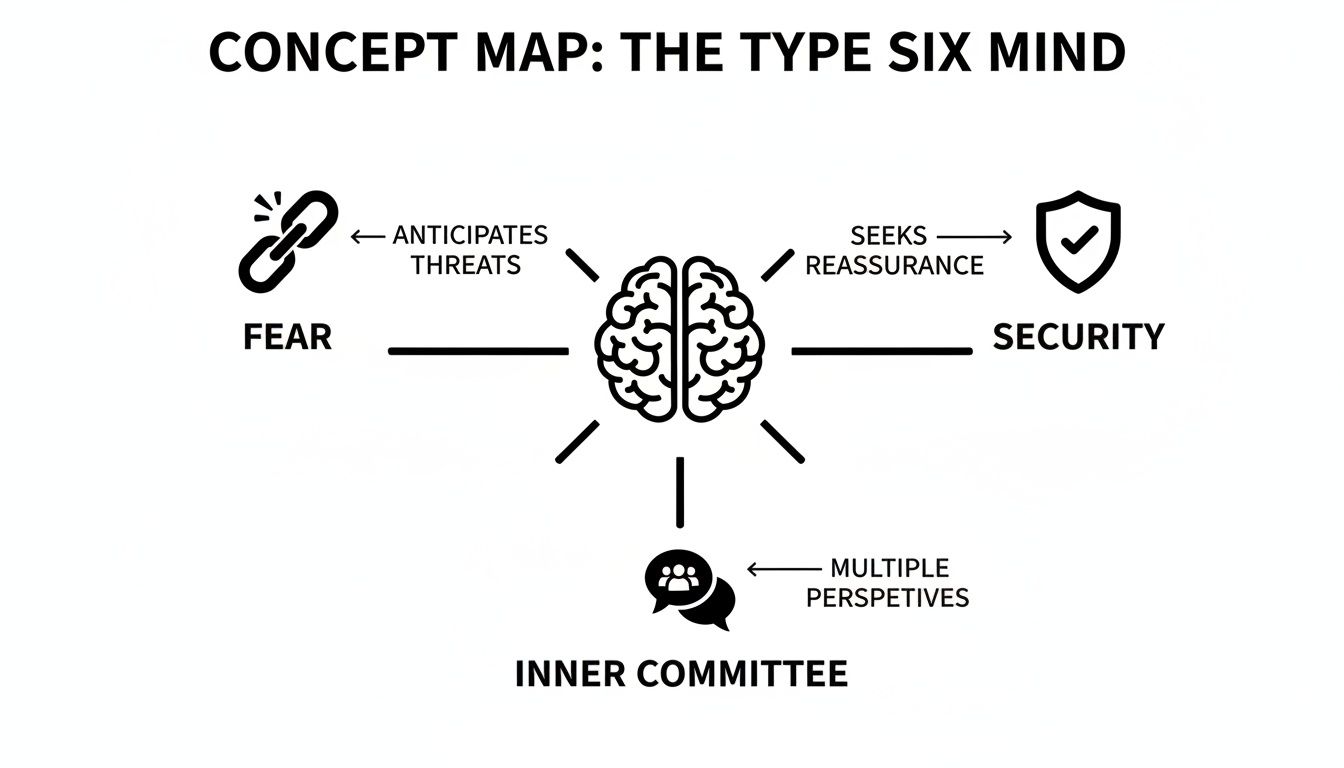
You can see how their mind is a constant feedback loop between scanning for threats (fear), creating safeguards (security), and debating it all with that notorious "inner committee."
The 6w7: The Buddy
Then we have the other side of the coin: the 6w7 , "The Buddy." This flavor of Six comes alive when you blend the Loyalist's core with the fun-loving, optimistic spirit of a Type Seven. These are your more extroverted, charming, and lighthearted Sixes. Their strategy for dealing with anxiety? Stay positive and gather your people.
Think of that friend from Chicago who's always organizing group trips but also has a detailed backup plan for rain, traffic, and a potential zombie apocalypse. A 6w7 builds security through alliances and good vibes. They're more likely to talk about their worries, but they'll often wrap them in a layer of humor, using their charm to build a solid network of people they can count on.
Take David, an event planner in Miami. He's a master at creating incredible parties, but his inner Six is always running background checks. He’s got backup vendors on speed dial, contingency plans for a sudden hurricane, and has already mentally rehearsed how to handle three potential problems with the venue. He feels secure by being the fun, dependable person everyone wants in their corner.
Your Instinctual Operating System
Okay, so if Wings are the flavor, Instinctual Subtypes are the internal "operating system" that directs a Six’s search for security. We all have three primal instincts— Self-Preservation , Social , and One-to-One —but one of them is running the show. This dominant instinct determines where you instinctively focus your energy to feel safe and grounded.
• Self-Preservation (SP) Six: • For this Six, security is all about physical and material well-being. They focus on having a stable job, a healthy bank account, a predictable home life, and taking care of their health. A practical example is an SP Six who meticulously tracks their budget, has a well-stocked emergency kit, and always knows the location of the nearest hospital.
• Social (SO) Six: • This Six finds safety in the tribe. They are incredibly attuned to group dynamics and feel most secure when they are part of a team, a community, or a shared cause. You'll see this in the Six who volunteers for their neighborhood watch, knows all the local politicians by name, and feels a deep sense of duty to their company or their country.
• One-to-One (1:1) Six: • Sometimes called the Sexual Six, this subtype looks for security through intense, reliable bonds with specific individuals. Their focus is on finding a strong partner, a trusted mentor, or an unwavering ally to face the world with. This is also where you find the famous "counter-phobic" Six energy—they often challenge authority and run toward fear to test their own strength and the loyalty of their chosen person.
How a Type Six Shines in Love and Work
When a type six personality commits, they are all in . It doesn't matter if it's a romantic partner, a high-stakes project, or their team at work. That constant hum of 'what if' in their head is precisely what makes them so incredibly loyal and prepared. They aren't just along for the ride; they become the steadfast guardians of the group's well-being.
This loyalty is the Six’s calling card. It's no surprise that Sixes often top the charts for altruism, making them some of the most generous and supportive friends you could ask for. They’ll often go to the mat for their people, their community, or their beliefs with a ferocity they rarely show for themselves.
The Six as a Loving Partner
If you want a partner who is your rock, find a Six. They are profoundly devoted and responsible, pouring their energy into creating a safe, stable world for the person they love. Their natural vigilance becomes a beautiful kind of attentiveness. They’re the ones who remember you have a dentist appointment, pack an extra bottle of water for the road trip, and just know when you need a listening ear after a brutal day.
But that deep-seated fear of losing support can bubble up in a behavior known as "testing." A Six isn't trying to be difficult; they're looking for a way to quiet their inner committee of doubters and confirm the relationship is as solid as they hope it is.
For example, you might hear a Six say something like, "You seem a little quiet lately, are we okay?" This isn't an accusation. It's a plea for reassurance, a request for a verbal anchor to help them feel safe and secure in the connection. For their partner, simply understanding this need is the secret to building unshakable trust.
The Six in the Workplace
On the job, Sixes are the ultimate team players and five-star crisis managers. Their knack for sniffing out problems before they happen makes them absolute gold, especially in roles that demand risk assessment or careful planning. They are the troubleshooters who see the potential landmines on the project map while everyone else is admiring the view.
Take Jessica, a project manager from Denver who was overseeing a huge software launch. While the rest of the team was high-fiving over hitting their deadlines, Jessica’s mind was already three steps ahead, running worst-case scenarios. She flagged three potential disasters nobody else saw: a server that could overload, a third-party API known for being flaky, and a blind spot in the customer support training.
She didn't just worry—she built contingency plans for all three. Sure enough, on launch day, the API crashed. Thanks to Jessica, a pre-planned solution was rolled out in minutes, saving the entire launch from going up in flames. This is the type six personality at its absolute best: turning that background anxiety into proactive, game-saving foresight.
Navigating Six Challenges
Of course, every strength has a shadow side. A Six's ability to see every angle can sometimes lead to analysis paralysis , getting them stuck in a "what if" loop that makes it impossible to move forward. They can also come across as skeptical of authority, not because they're defiant, but because they need to truly believe in the leaders and systems they’re committing to.
Here are a few ways to handle these common bumps in the road:
• For Sixes: • Feeling stuck? Give your brain a deadline. Allow your inner committee to debate for a set amount of time, and then make a call and stick with it.
• For Colleagues and Leaders: • Be transparent and act as a reliable sounding board. When a Six pokes holes in a plan, they're usually just trying to understand it completely so they can get behind it • 100% • .
• For Partners: • Offer consistent reassurance without showing frustration. A simple, heartfelt "We're solid. I'm here for you," can quiet a storm of anxiety.
By understanding these dynamics, Sixes and the people who love and work with them can transform potential friction into a powerful engine for trust and collaboration.
Your Growth Path From Anxiety to Inner Trust
If you're a Type Six, your life's work is learning to trust one person above all others: yourself. It’s a journey away from that constant, buzzing anxiety toward a quiet confidence that feels like coming home. This isn't about pretending you're never scared—it's about finding the courage to act even with fear in the passenger seat, slowly turning self-doubt into solid self-reliance.
Think of it like you have an internal "trust meter." When you're at your healthiest, that needle is firmly in the green—you feel grounded, brave, and ready for anything. In the average zone, it flickers with worry and second-guessing. At your unhealthiest, it plummets into the red, where suspicion and reactivity take over, and threats seem to be hiding around every corner. Your job is to learn how to keep that needle pointing toward trust.

The Enneagram gives you a map for this journey, showing you the shortcuts to growth and the warning signs that you're heading into a stress-fueled detour.
Your Direction of Growth Toward Nine
When you feel safe, supported, and can finally take a deep breath, you'll find yourself borrowing some of the best qualities of a healthy Enneagram Type Nine, the Peacemaker. This is your green light, your growth path. Moving toward Nine is what happens when the frantic brainstorming session in your head finally adjourns.
Suddenly, you're not agonizing over every single decision. You become more relaxed, more accepting, and you start to believe that things will probably work out just fine without you needing to micromanage the universe.
It’s a beautiful shift:
• From Skepticism to Trust: • You start taking people at their word and, more importantly, you start believing in your own judgment without demanding a second, third, or fourth opinion. A practical example is a Six in growth who accepts a compliment without internally questioning the person's motives.
• From Anxiety to Calm: • The mental static fades into the background, replaced by a sense of peace that lets you simply be present in the moment.
• From Reactivity to Steadiness: • You stop rehearsing worst-case scenarios and become more emotionally stable and easygoing.
A Six moving toward Nine can go on a spontaneous trip without a color-coded binder. They can hear a friend's opposing viewpoint and not feel like their own world is under attack. This relaxed, trusting state is your North Star—it's the sign you’re building security from the inside out.
Your Direction of Stress Toward Three
On the flip side, when the pressure mounts and you feel unsupported or overwhelmed, you can slide into the unhealthy habits of an Enneagram Type Three, the Achiever. This is your big red flag. Your core anxiety gets tangled up with a Three's fear of being worthless, creating a desperate, frantic scramble to look successful and in control.
Instead of seeking real support, they might start networking for status. A stressed-out Six will take on way too many projects, not from a place of loyalty, but to make themselves seem indispensable. As a practical example, a stressed Six might boast on social media about how busy they are, confusing frantic activity with genuine security.
Practical Steps for Building Inner Trust
Knowing your pathways is one thing, but actually walking them takes practice. Here are some real, actionable ways to guide yourself from anxiety toward courage.
1. Tame the Inner Committee
That loud, opinionated committee in your head loves to debate "what ifs." The only way to quiet them down is to bring them back to reality.
• Schedule a "Worry Session": • Seriously. Give your anxiety a dedicated • 15 minutes • each day to go wild. When a worried thought pops up at any other time, politely tell it, "Not now, we have an appointment at • 4:00 PM • ." This contains the chaos instead of letting it hijack your whole day.
• Fact-Check Your Fears: • When a catastrophic scenario starts playing in your mind, grab a pen. Write down the fear. Then, list cold, hard evidence for it and against it. You'll almost always find the fear is • 90% speculation • and maybe • 10% reality • .
2. Learn to Trust Your Gut
Sixes live in their heads, but their intuition is a powerful, often ignored, superpower. The challenge is learning to hear its quiet voice over the committee's shouting.
Start small. Really small. When picking a restaurant for lunch, what's the very first place that pops into your head before the pros-and-cons list begins? Go there. The more you prove to yourself that your gut won't lead you astray on low-stakes decisions, the easier it will be to trust it when it really matters.
3. Develop Embodied Courage
Anxiety isn't just a thought pattern; it's a full-body experience. Growth means learning how to soothe your own nervous system. For a Six, tools like meditation apps can be a game-changer, helping you get out of your head and into the present moment.
Another powerful trick is a simple "body scan." For just two minutes, sit quietly and notice where you're holding tension. Are your shoulders creeping up toward your ears? Is your jaw clenched? Take a breath and consciously let that area relax. You're teaching your body it's safe, which sends a direct signal to your mind that it can finally stand down from high alert.
Got More Questions About Type Six? You're Not Alone.
You've made it this far, which means you've waded through the fascinating, complex, and sometimes confusing world of the type six personality . If your head is still spinning with a few "what ifs" and "how comes," that's completely normal. In fact, it's very Six-like to want to nail down all the details!
Let's dig into some of the questions that come up most often.
How Can I Tell If I’m a Phobic or Counter-Phobic Six?
Ah, the classic Six question. This gets right to the heart of what makes this type so dynamic. The key isn't what you're afraid of—it's what you instinctively do about it.
Think of it like this: a Phobic Six sees a scary dog, and their first instinct is to cross the street, pull out their phone, and look up the local leash laws. They manage fear by preparing, avoiding risk, and looking for a reliable person or system to provide safety. They want to build a fence to keep the dog out.
A Counter-Phobic Six sees that same scary dog, and their gut reaction is to march right up to it and stare it down. They run from their fear to prove it can't control them. They might challenge authority, take dares, and look for all the world like a fearless daredevil. They want to tame the dog to prove they can.
And here's the kicker: nobody is 100% one or the other. It's more of a sliding scale. Most Sixes have a dominant style that kicks in when they're stressed, but you'll likely see flashes of your other side, too.
What’s the Biggest Misconception About Type Sixes?
Hands down, the most common and frustrating myth is that Type Sixes are just... weak. That they're simply walking bundles of anxiety, paralyzed by fear and indecision.
While anxiety is definitely a huge part of the Six's internal landscape, focusing only on that is like describing a rocket by only mentioning the fire. That fire isn't just a hazard; it's the engine. It's what gives the rocket its power.
That constant hum of "what if?" is exactly what makes them incredible troubleshooters, brilliant crisis managers, and masters of contingency planning. Their search for reliable support is what makes them the most loyal, committed, and ride-or-die friends you could ever hope for. For example, a Six friend isn't just "anxious" about your upcoming surgery; they are the one who researches the best surgeons, prepares a post-op care package, and offers to drive you to all your appointments. That's courage and loyalty in action.
A Type Six isn't defined by their fear. They're defined by the immense courage they show every single day as they face that fear to build a stable, trustworthy world for themselves and their people. To label them as just "the anxious one" is to miss their superpowers of bravery and dedication entirely.
Can a Type Six Be a Good Leader?
Not only can they be good leaders, they can be phenomenal ones. They just don't always look like the chest-thumping, "follow me!" stereotype we see in movies. A type six personality leads from a place of protection, collaboration, and unwavering stability.
Here’s what makes them such powerful leaders:
• They Build a Bunker, Not Just a Team: • A Six leader’s priority is the group’s well-being. This creates an incredibly secure and supportive work environment where loyalty thrives and people feel genuinely cared for.
• They’re Human Radar for Risk: • Their minds are naturally wired to scan the horizon for icebergs. This makes them masters of strategy and preparation, ensuring the ship is ready for any storm.
• They Create Trust from the Ground Up: • Healthy Sixes don't dictate from an ivory tower. They're in the trenches with their team, building consensus and leading by example.
A practical example is a Six manager who, instead of just announcing a new policy, holds a team meeting to discuss potential concerns and build a plan together, ensuring everyone feels heard and secure in the change. Their leadership style is less about top-down authority and more about creating a fortress of mutual support and shared purpose.
How Does the Enneagram Universe Test Help a Type Six?
For a mind that's constantly buzzing with doubt, the Enneagram Universe assessment is a welcome dose of clarity. Instead of a vague label, our detailed, 180-question test gives you a precise, nuanced picture of your unique personality structure.
For a Six, our test is a game-changer because it:
It's the perfect tool for any Six who's ready to trade self-doubt for rock-solid confidence.
Ready to stop second-guessing and start understanding the unique strengths of your personality? The Enneagram Universe assessment is your first step toward turning doubt into direction. Take our free, scientifically-validated Enneagram test today!