“Type A” Versus “Type B” Personality: The Ultimate Personality Showdown

Alright, let's settle the score. At its heart, the difference between Type A and Type B personalities comes down to how they handle the pressure cooker of life. Type A personalities are the driven, competitive, time-obsessed go-getters , while Type B personalities are the relaxed, creative, and remarkably patient souls . The real question isn't about which one is "better," but which one sounds more like you—and how you can make it work for you.
The Great Personality Showdown: Type A Versus Type B
Welcome to the main event! In one corner, we have the ambitious, clock-watching Type A, fueled by deadlines and double-espressos. In the other, the cool, calm, and collected Type B, who sees a deadline as more of a friendly suggestion. This isn't just about quirky labels; it's a classic way to understand behaviors that echo through your career, health, and relationships.
Believe it or not, this whole concept didn't come from a psychologist's office. It started with two cardiologists, Meyer Friedman and Ray Rosenman, back in the late 1950s . They had a hunch that personality could be a major player in heart health.
Their theory really took off with the Western Collaborative Group Study. This groundbreaking research followed men over an eight-year period and found that Type A men had roughly double the risk of coronary heart disease compared to their Type B peers. Suddenly, the link between personality and health was impossible to ignore. You can dive deeper into the origins of this theory to see how it all unfolded.
Defining the Core Differences
So, how does the whole type a versus type b personality dynamic play out in the real world? It's all about the approach.
Think of the manager who maps out her entire day in precise 15-minute blocks to squeeze every drop of productivity out of her time. That's pure, uncut Type A. Now, picture her teammate who rolls in with a "let's see what the day brings" attitude, happy to pivot when something new pops up. You're looking at a classic Type B.
This chart does a great job of laying out the fundamental vibes of each type.
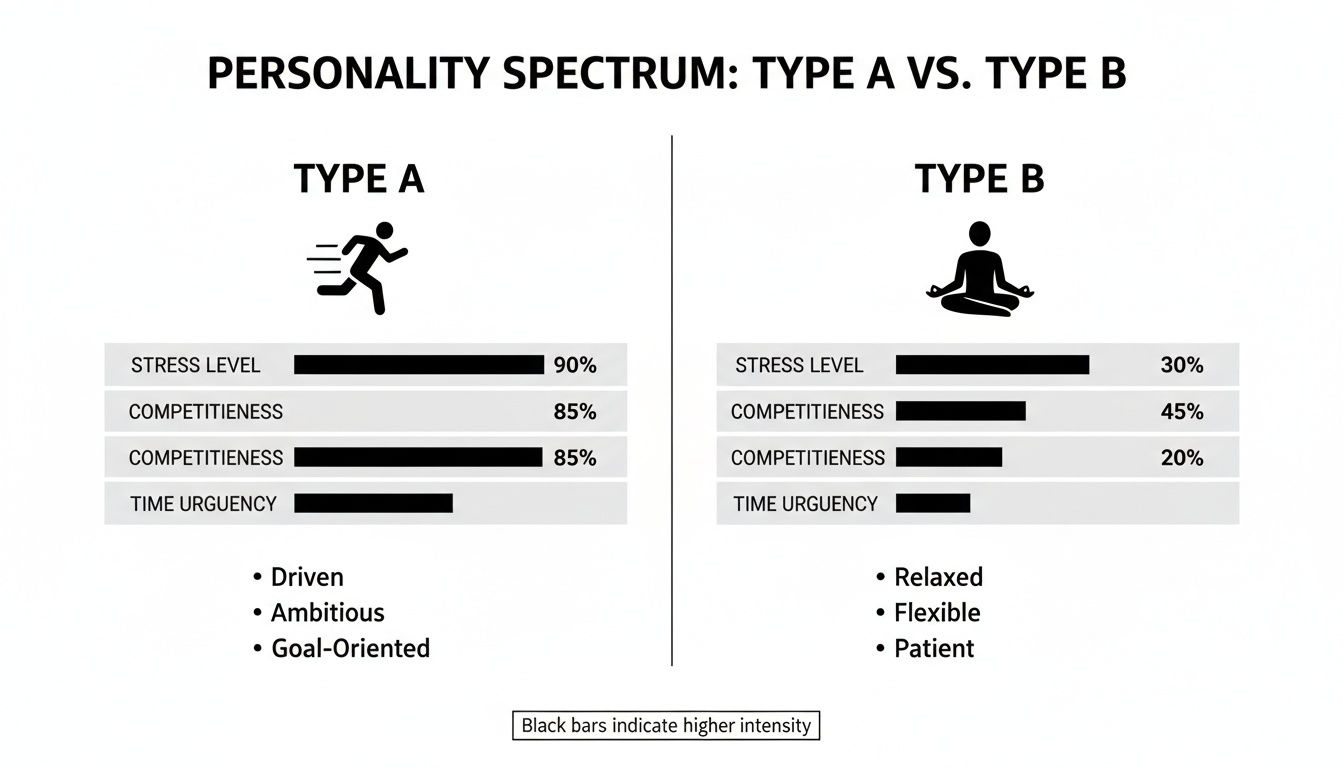
You can almost feel the difference in energy just by looking at it—the frantic, high-octane pace of Type A versus the steady, composed rhythm of Type B.
To really nail down these differences, let's put them side-by-side. This quick-glance table breaks down how each type tends to think, act, and react.
Type A vs Type B: At a Glance
| Characteristic | Type A Personality | Type B Personality |
|---|---|---|
| Pace of Life | Life's a sprint! Always in a hurry, with a constant sense of urgency. | Life's a marathon, not a sprint. Moves at a steady, unhurried pace. |
| Ambition | Intensely competitive and laser-focused on hitting goals. It's all about winning. | Ambitious, but finds joy in the process itself. Not driven by a need to beat others. |
| Stress Response | Easily stressed out. Prone to impatience, frustration, and a short fuse. | Low-stress and resilient. Tends to "roll with the punches" and stay calm under pressure. |
| Work Style | The master of multitasking. Obsessed with productivity and crushing deadlines. | Prefers to work steadily on one thing at a time, valuing quality over sheer speed. |
| Flexibility | Loves structure, plans, and predictability. Hates surprises and detours. | Highly adaptable and spontaneous. Sees change as an opportunity, not a threat. |
As you can see, the differences are pretty stark. One isn't inherently superior to the other; they're just two very different operating systems for navigating the world.
How Personality Traits Shape Your Daily Life
Ever wonder how the whole type a versus type b personality debate actually plays out in the real world? This isn't just theory from a dusty old textbook. It’s the invisible software running in the background of your life, directing how you handle everything from a traffic jam to a trip to the grocery store.
Let's get past the simple labels and dive into what these personalities look and feel like from the inside, from the moment your alarm goes off until your head hits the pillow.

The difference isn't just being busy versus being chill—it’s about the fundamental operating system you use to navigate your day.
The Type A Personality in Action
For someone with a Type A personality, life often feels like a game to be won, a schedule to be dominated, and a clock that’s always ticking a minute too fast. Their world is propelled by a potent cocktail of ambition, competitiveness, and a nagging sense of time urgency.
This isn’t just about wanting to do well. It's an internal furnace that burns with the need to be the fastest, the most efficient, and the best. They don’t just show up to play; they show up to win.
Here’s what that looks like on the ground:
• The Entrepreneur: • Think of a startup founder from New York City. For her, the stock market's opening bell is a starting gun. She’s already taken three calls before her first sip of coffee, and her to-do list is a meticulously crafted battle plan against wasted time.
• The Project Manager: • You know the one—the Chicago-based project manager who eats lunch at his desk, not because he has to, but to “optimize the hour.” He sees the 30 minutes his colleagues spend catching up as 30 minutes he can use to get a jump on tomorrow’s workload.
This constant awareness of the clock can lead to a state of “hurry sickness,” where even downtime gets optimized. A vacation will have a color-coded itinerary, and a relaxing jog is tracked by pace, splits, and heart rate zones instead of, you know, the scenery.
The Type B Personality Experience
Now, let's flip the coin and walk a mile in the shoes of a Type B personality. Their daily life is guided by a totally different compass, one oriented toward patience, adaptability, and the quality of the journey itself.
If Type A is a bullet train on a fixed track, Type B is more like a sailboat, expertly tacking and jibing to catch the wind. They seem to intuitively know that the straightest path isn't always the best one.
Here’s how this plays out in real life:
• The Creative Professional: • Picture a graphic designer in Portland, Oregon, completely lost in her work. She isn't ignoring the clock because she’s disorganized; she’s so immersed in the creative flow that time becomes irrelevant. The work will be done when it feels • right • , not just when the deadline hits.
• The Team Mediator: • Imagine a tense meeting where voices are rising. While others get agitated, the Type B team member from Atlanta stays cool. He listens, finds common ground, and gently guides the conversation back to a productive place. His low-stress nature is a magnet for collaboration.
This knack for adaptation is their superpower. A last-minute change of plans isn't a crisis; it’s just an unexpected plot twist. They thrive in roles that demand creative problem-solving and a human-first approach. They don't just go with the flow—they often help create it.
The Health Implications of Your Personality Style
Okay, so the whole Type A vs. Type B personality showdown is fun party talk, but here’s where it gets real. How you’re wired to handle life’s curveballs isn't just a quirky part of who you are—it’s a massive factor in your physical health, impacting everything from your blood pressure to your heart.
This isn't some new-age wellness theory. The whole concept was actually cooked up by cardiologists back in the day. They were trying to figure out why some of their patients were dropping like flies from heart disease while others weren't. They quickly noticed a pattern: the ones who were impatient, fiercely competitive, and quick to anger were far more likely to have heart problems. The mind-body connection has been front and center from the very beginning.
For many Type As, their internal engine is always revving in the red. This constant state of high alert does a number on the body. We're not just talking about "feeling stressed"—we're talking about a very real physiological storm. Your heart rate jacks up, your blood pressure climbs, and stress hormones like cortisol and adrenaline flood your system. Keep that up for years, and you're essentially wearing down your cardiovascular system.
The High Cost of Being Type A
Here's the kicker for Type A folks: the problem isn't the stress itself, but the overreaction to it. A slow driver, a typo in an email, a spotty Wi-Fi connection—these minor annoyances can trigger a full-blown "fight or flight" response. That simmering hostility and deep-seated impatience are the real villains here, sending health risks through the roof.
Picture the classic Type A executive from Los Angeles. She’s a genius, absolutely crushing her quarterly goals, but her doctor is nagging her about her blood pressure. Her solution? She schedules "meditation" into her packed calendar and gets frustrated when she doesn't achieve zen in five minutes. That's the Type A paradox in a nutshell—even their attempts to relax are competitive and goal-oriented.
This isn't just a hunch. High-stakes professions are magnets for Type A behavior. A study of 823 physicians found that a whopping 42.41% were identified as Type A, with only 23.94% falling into the Type B camp. The data clearly shows how these traits dominate demanding careers, especially for those working multiple jobs.
The Type B Advantage—And Its Blind Spots
On the other side of the coin, Type B personalities seem to have a built-in health advantage. Their knack for "rolling with the punches" means their bodies aren't constantly being slammed with stress hormones. This relaxed disposition is like a natural shield against things like hypertension.
But it’s not all sunshine and rainbows. The easy-going nature of Type B can have a downside. Their laid-back vibe can easily slide into procrastination, especially when it comes to boring but important stuff like scheduling a physical or getting a toothache checked out. For example, a man in Florida might think, "Eh, I feel fine. I'll book that appointment later," and we all know "later" can be a very long time.
This can lead to some predictable pitfalls:
• Potential Risk: • Ignoring preventative care because nothing feels urgent.
• Potential Risk: • Downplaying symptoms and just assuming they’ll go away on their own.
Personality and Well-Being Impacts
To really see how these tendencies play out, let's put them side-by-side. This table gives you a snapshot of how a strong Type A or Type B personality can affect different areas of your life, from your health to your career.
| Area of Life | Typical Type A Impact | Typical Type B Impact |
|---|---|---|
| Physical Health | Higher risk of cardiovascular disease, hypertension, and stress-related ailments. | Lower risk of stress-related illness, but potential to neglect preventative care. |
| Mental Health | Prone to chronic stress, anxiety, burnout, and impatience. | Generally lower stress levels, but can struggle with motivation or lack of drive. |
| Relationships | Can be seen as impatient, controlling, or competitive, straining personal bonds. | Often seen as easy-going and supportive, but may avoid difficult conversations. |
| Career | Highly driven and achievement-oriented, often leading to rapid career advancement. | Collaborative and steady, excelling in team environments and creative roles. |
Remember, these are just common patterns, not life sentences. The real power comes from understanding your natural inclinations and learning how to manage them.
Beyond these general impacts, it’s worth digging deeper into how your unique traits might influence other behaviors; for example, it can be revealing to understand if does your personality put you at risk for addiction . And if you’re ready for an even more nuanced look at your own patterns, check out our Enneagram health test to see how that system can shed light on your well-being. The key is knowing that your personality isn't your destiny—it’s just the starting point.
How Type A and Type B Personalities Navigate Work and Love
Okay, let's get down to the brass tacks. How does the great type a versus type b personality showdown actually look in the real world—in the office, at home, and everywhere in between? This is where theory gets real, and fast. These aren't just labels; they're operating systems that deeply influence how we build our careers and our relationships, creating moments of brilliant synergy and, well, some truly comical standoffs.
Let’s parachute into a few scenarios to see how it all plays out.

The Boardroom Battleground
Picture a high-pressure project at a tech company in Silicon Valley. The deadline is looming, the stakes are high, and the team is a textbook mix of personalities.
The Type A Leader: At the helm is Sarah. She's the project lead, a force of nature whose ambition is legendary. She lives by her color-coded calendar, views tight deadlines as an invitation to excel, and has a knack for motivating her team to hit impossible targets. With Sarah in charge, things get done.
The downside? Her relentless drive and sense of urgency can feel like a pressure cooker. She might steamroll over quieter voices. Burnout is a real occupational hazard on her teams.
The Type B Manager: Now, let’s hop over to Mark’s team in Denver, working on a parallel project. Mark is your quintessential Type B manager. He’s all about building a collaborative, psychologically safe environment. His team enjoys their work, and their creative solutions are fantastic.
But... that aggressive timeline? It's their kryptonite. Mark’s laid-back style means he’s not one to crack the whip. While his team is happy and innovative, they risk being lapped by hungrier competitors.
Any smart organization knows the dream team is a blend of these styles. You need Sarah’s fire to smash the goals and Mark’s supportive leadership to keep the team healthy and cohesive. Figuring out how different personalities can thrive together is a massive advantage. You can dive deeper into this and find ways to boost your own team's chemistry with our guide to using the Enneagram at work .
The Living Room Tango
Let’s bring these personalities home. Because the very traits that make someone a rockstar in their career can create some… let's call them interesting … dynamics in a romantic relationship.
The Classic Pairing Scenario: Meet Alex (Type A) and Jordan (Type B), a couple from Chicago planning a trip to Italy.
• Alex's Master Plan: • It’s • two months • before takeoff, and Alex has a glorious spreadsheet with flight details, hotel confirmations, and a minute-by-minute itinerary. Every dinner is researched, every museum ticket is pre-purchased. For Alex, the plan • is • the relaxation.
• Jordan's Go-With-the-Flow Vibe: • Jordan is just stoked to be going. When Alex asks about the • 2:00 PM • walking tour, Jordan shrugs. "Let's just see how we feel! What if we find an amazing cafe and just hang out?" This sends a jolt of panic through Alex’s organized soul.
You see it, right? It’s the timeless conflict of structure versus spontaneity .
Neither one is wrong! But their clashing approaches can easily cause friction. Alex might feel like Jordan is being lazy. Jordan might feel micromanaged.
The secret sauce here is compromise. The couples who make it work learn to play to each other's strengths. Alex makes sure they have a roof over their heads and don't miss their flight home. Jordan reminds Alex to put the map down and enjoy the sunset.
Alright, so you’ve figured out whether you’re a hard-charging Type A or a laid-back Type B. Now what? The point isn’t to wish you were the other type or to attempt a total personality transplant. That never works.
The real goal is to add a few more tools to your belt. It’s about building a little flexibility into your ambition or adding a dash of structure to your free-flowing creativity. Let’s get into some practical, non-cringey ways to find that sweet spot between drive and ease.

Unlocking Flexibility for the Driven Type A
If you're a Type A, the mere suggestion to "just relax" is probably enough to make your blood pressure spike. It feels like just another task on the to-do list you have to win. The secret is to introduce flexibility in a way that feels intentional, not like you're just slacking off.
I know a marketing director in Chicago, Sarah, who used to plan her weekends down to the minute. Unsurprisingly, she’d get to Monday feeling more exhausted than she was on Friday. Her game-changer was what she calls "scheduled spontaneity." She blocks out four hours on Saturday for one thing: "do something unplanned." This gives her the container of structure she needs, but it pushes her to actually wander into a new bookstore or try a coffee shop without reading 30 reviews first.
Here are a few more strategies you can try:
• Practice Productive Mindfulness: • Let's be real, sitting in a silent room can feel like torture. Instead, try a guided walking meditation or a body scan exercise. These give your brain a specific task, making mindfulness feel less like "doing nothing" and more like an active recovery session.
• Become a Master Delegator: • The Type A mantra is often, "If you want something done right, do it yourself." To break this habit, start small. Identify a low-stakes task and a colleague you trust. Give them crystal-clear instructions and a deadline, and then—here's the hard part— • walk away • . Let them do it. The goal is to build trust and reclaim your own mental energy.
• Embrace the Power of "Good Enough": • Your perfectionism is a double-edged sword. On your very next project, pick one or two things that you will • intentionally • let be "good enough" instead of perfect. This isn't about being sloppy; it's about strategically allocating your high-octane energy where it truly counts.
Igniting Action for the Easygoing Type B
For all my fellow Type B folks, the big hurdle is turning those brilliant, creative flashes into something real. Procrastination isn't a moral failing—it’s usually just a sign that a task is too vague, too big, or too soul-crushingly boring. The trick is to create just enough structure to spark action without killing your creative vibe.
Take Ben, a freelance developer in Austin, Texas. He had incredible ideas but was always blowing past deadlines. He created a project-based goal system for himself. Instead of a boring to-do list, he reframes projects as "missions" with built-in rewards. For example, once he finishes a homepage wireframe, he "unlocks" an afternoon at his favorite brewery.
Here are some proven ways to get moving:
• Live by the "Two-Minute Rule": • This one is simple but life-changing. If a task takes less than two minutes, do it now. Firing off that email, scheduling that appointment, clearing your desk—getting these done prevents the build-up that leads to that feeling of overwhelming dread.
• Get an Accountability Partner: • Find a friend or coworker (preferably one with a little Type A discipline!) to check in with. A quick five-minute call once a week is often all it takes to provide that gentle nudge you need to stay on track.
• Use "Idea Sprints" to Channel Your Focus: • Turn your work into a game. Set a timer for • 25 minutes • (this is the classic Pomodoro Technique) and go all-in on a single task. This creates a fun sense of urgency and makes work feel less like a draining marathon and more like a series of short, exciting sprints.
If you’re finding it tough to manage these tendencies on your own, working with professional counselling services can provide personalized strategies and support. It's fascinating how our environment shapes us; a study of medical students found that while 89.2% started out as Type B, their Type A traits grew stronger under academic pressure. This shows how easily we can adapt—sometimes in unhealthy ways. You can read the full research about these personality findings to see just how much pressure can mold our behavior.
Ready to Go Deeper? Let's Talk Enneagram.
So, you've figured out you lean Type A or Type B. That’s awesome. It’s like finally knowing whether you’re driving a zippy sports car or a comfortable sedan. But what if you wanted to pop the hood and see what kind of engine is making it all go? That’s where the Enneagram comes in.
The Type A/B model is fantastic for spotting your behaviors out in the wild—the what you do. The Enneagram, on the other hand, is all about the why . It uncovers the core motivations that fuel those behaviors, bridging the gap between what you do and who you fundamentally are.
Think of it as adding a new, richer layer to your self-awareness. Your Type A ambition or your Type B chill aren't just random quirks; they are deeply rooted in your personality's core programming.
Connecting Your 'What' to Your 'Why'
The Enneagram is a dynamic system of nine interconnected personality types. Each type is defined by a deep-seated fear, a driving desire, and a powerful unconscious motivation that shapes your entire worldview. The real lightbulb moment comes when you see how these hidden drivers map directly onto your Type A or Type B tendencies.
Let's imagine a classic Type A, a powerhouse attorney in Washington, D.C. known for her killer work ethic and a competitive streak a mile wide.
• Type A Behavior: • She's the first one in, last one out, chasing that partner track like her life depends on it. The ambition is palpable.
• Potential Enneagram Motivation: • What if she’s an • Enneagram Type 3 (The Achiever) • ? Her core fear isn't just losing a case; it's a profound fear of being worthless. Her core desire is to feel valuable and worthwhile. Suddenly, her relentless drive isn't just about success—it's a quest to prove her very value in the world.
Now, let's picture her friend, a quintessential Type B. He’s a Nashville musician who's so laid-back he's practically horizontal and would rather walk over hot coals than start an argument.
• Type B Behavior: • He’s patient, a great listener, and always prioritizes keeping the band together, even if it means his own great ideas get pushed aside.
• Potential Enneagram Motivation: • He could easily be an • Enneagram Type 9 (The Peacemaker) • . His core fear is experiencing loss and separation, and his core desire is to maintain inner stability and peace. His easygoing nature is actually a clever strategy to keep his world—and his mind—free of conflict.
This is where you get the power to make real, lasting changes. Once our Type 3 lawyer understands her ambition is tied to a fear of worthlessness, she can start finding that validation within herself, not just from her case record. And when our Type 9 musician recognizes that his conflict avoidance stems from a fear of disconnection, he can learn to speak his mind without fearing it will tear everything apart.
The Type A/B framework gives you a brilliant snapshot of your personality. But if you're ready to understand the "why" behind your hustle or your harmony, the Enneagram is your next adventure. Ready to start? You can discover your Enneagram type with our step-by-step guide for beginners .
Burning Questions Answered
Still wrestling with the type a versus type b personality concept? Let's clear up some of the lingering confusion. Here are a few of the most common questions I hear.
Can You Be a Mix of Type A and Type B?
Of course! In fact, most of us are. It’s rare to find someone who is 100% one or the other.
Think of it less like an on/off switch and more like a spectrum. You might lean heavily Type A at the office, hitting deadlines and leading meetings, but shift into a blissfully relaxed Type B mode the second you start a vacation. Our environment and what's expected of us often pull different traits to the forefront.
Knowing which side you lean on in different parts of your life is the real key to finding balance.
Is It "Bad" to Be a Type A Personality?
Absolutely not! That high-octane blend of ambition, organization, and drive is the engine behind some of humanity's greatest achievements. Many of the innovators and leaders who shape our world are running on a whole lot of Type A fuel.
The goal isn't to get rid of your ambition—it's to pair it with self-awareness and make room for rest.
How Is the Enneagram Different From the Type A/B Model?
This is a great question. The Type A/B model is brilliant for describing what you do—it paints a picture of your observable behaviors and gut reactions. Are you competitive? Are you patient?
The Enneagram, on the other hand, digs deeper to uncover why you do those things. It gets to the core motivations that are secretly running the show.
For instance, you could have two people who are classic Type A go-getters. The Enneagram might reveal that one is a Type 3, driven by a deep-seated fear of being seen as worthless. The other might be a Type 8, whose drive comes from a need to maintain control of their own lives. Understanding that "why" gives you a much richer, more personal roadmap for growth.
Ready to figure out the "why" behind your own patterns? Enneagram Universe has a fantastic, free personality assessment that can get you started. Find your type today and start exploring .