Type 5 Personality Traits Explained: Strengths, Fears & Core Motivations

If your mind operates like a high-security vault, meticulously cataloging every fact and observation, you might just be tapping into the world of an Enneagram Type 5. Known as The Investigator , these are the people driven by an insatiable need for knowledge, competence, and above all, self-sufficiency.
Meet The Investigator: An Introduction to Type 5
Have you ever known someone who seems to live almost entirely inside their own head? Someone who watches the world with a quiet, laser-focused intensity? That's your classic Enneagram Type 5. They aren't just thinkers; they're the master curators of their own private, mental museum. For them, life is about collecting, categorizing, and deeply understanding information before they ever step onto the stage.
This relentless pursuit of knowledge isn't just a hobby. It's a survival strategy. At their core, Type 5s are motivated by a profound desire to be capable and competent. Information is their armor, their primary tool for ensuring they can handle whatever the world throws at them without having to lean on anyone else.

The Core Fear and Desire
Every Enneagram type is animated by a deep-seated fear and its corresponding desire. For the Type 5, these two forces are the engine behind almost everything they do:
• Core Fear: • Being useless, helpless, or completely overwhelmed. They live in dread of being found incapable or unable to function independently when it counts.
• Core Desire: • To be competent and capable. This is the holy grail that fuels their endless quest for knowledge and mastery in their chosen fields.
Let's make this real. Imagine a new project kicks off at work. While others might dive headfirst into energetic brainstorming meetings, a Type 5 on the team—let's call him Alex, a software developer from Seattle—will probably retreat. Alex will spend the next few hours (or days) deep-diving into research, poring over case studies, and mastering any new code libraries required. He's not being antisocial. He's building his fortress of competence, brick by brick, so that when he does contribute, it's with absolute confidence.
"If The Investigator had a motto, it would be: 'I am safe once I have mastered this.' It’s not about ego; it’s about creating an unshakeable sense of inner security through pure understanding."
This whole dynamic explains why Fives are so fiercely protective of their resources—their time, their energy, and especially their personal space. These are the precious commodities they need to fuel their intellectual fire. Getting a handle on this core motivation is the key to unlocking the fascinating and complex world of Type 5 personality traits .
To really get inside the Investigator's head, you have to imagine a world that constantly threatens to be draining and intrusive. For them, things like big social events, unexpected emotional demands, and surprise requests can feel like a direct assault on their limited energy reserves. This is exactly why they often prefer to observe from a safe distance, gathering data from the sidelines instead of getting tangled up in the messy action.
If you're curious about how this fits into the bigger picture, you can explore the entire framework to see how all nine types develop their own unique lens on the world by learning what the Enneagram is and how the types connect.
This approach of building a mental model to feel secure isn't just an Enneagram concept; for a broader look at how personality is studied, diving into general psychology resources on personality can offer fantastic foundational knowledge. In the sections ahead, we’ll break down the specific traits that grow from this Investigator's unique worldview.
The Investigator's Blueprint
To quickly recap the essentials, here is a simple breakdown of what makes a Type 5 tick. Think of this as the schematic for The Investigator's inner world.
| Core Element | Description for a Type 5 |
|---|---|
| Basic Fear | Of being helpless, incapable, or overwhelmed by the world's demands. |
| Basic Desire | To be competent, capable, and knowledgeable. |
| Key Motivation | To possess knowledge and understanding, to master skills, and to be self-sufficient. |
| Inner World | A private, well-organized mental space where they can retreat to analyze and recharge. |
| Energy Focus | Conserving personal resources (time, energy, privacy) to avoid feeling depleted by external demands. |
| Nickname | The Investigator, The Observer, The Thinker. |
This table captures the foundational elements that shape their interactions, decisions, and overall approach to life. It’s the "why" behind their quiet observation and deep thinking.
The Defining Traits of a Type 5 Personality
So, what really makes an Investigator tick? If you peek behind the curtain of labels like "cerebral" or "observant," you'll find a fascinating and complex personality. These traits aren't just quirks; they're a carefully assembled toolkit for navigating a world that often feels overwhelmingly loud and demanding.
At the very top of the list is a relentless thirst for knowledge . And I don't mean casual curiosity—this is a deep, primal drive to understand the nuts and bolts of anything that catches their eye. A Type 5 doesn't just want to know what something is; they feel compelled to understand how and why it works. This is a direct defense against their core fear of being incompetent or helpless.

This intense curiosity shows up in very real ways. Picture a software engineer in Austin, Texas. She won’t just learn a new coding language for a project. She'll spend her entire weekend devouring its architecture, reading the original whitepapers, and mastering its most obscure functions—all just to feel truly competent. For her, genuine understanding is the ultimate security blanket.
A Preference for Observation
Another classic Five move is their role as the perceptive observer . You'll often find them on the sidelines, watching and analyzing a situation long before they ever jump in. This isn't about being shy. It’s a strategic data-gathering mission. They want to fully map the rules of engagement, the social dynamics, and the hidden agendas before they commit any of their precious energy.
This goes hand-in-hand with a powerful need for privacy and personal space . A Type 5's mind is their castle, and they need plenty of alone time to process what they’ve observed, get lost in their interests, and recharge their mental batteries. Constant interaction can feel incredibly draining, like a slow but steady leak in their most valuable resource: energy.
• Intense Focus: • When a Five is hooked on a subject, they develop a laser-like focus, shutting out the entire world to go deep. For example, a Type 5 chef from New Orleans might spend six months perfecting a single gumbo recipe, tracing its history back to the 18th century, just to master it. It’s this ability that allows them to become true experts in their chosen fields.
• Emotional Reserve: • Fives tend to put their feelings in a box to be analyzed later, preferring a logical approach over reacting in the moment. Outsiders might see this as coldness, but it's a self-preservation tactic to avoid feeling overwhelmed.
• Minimalism: • You'll often find that Fives lead a minimalist lifestyle. They instinctively shy away from accumulating things that might complicate their lives or create unwanted obligations, preferring their external world to be as uncluttered as their internal one.
The Logic of Detachment
The tendency toward detachment is one of the most misunderstood type 5 personality traits . Investigators use it as a tool for objectivity. By taking a step back from their own emotions and the heat of a situation, they believe they can see the truth more clearly, without the messy filter of feelings getting in the way.
Think of a historian in Boston who finds pure, unadulterated joy in the solitary quiet of archival records. The focused work of piecing together the past from primary documents is a perfect Type 5 paradise. He isn't just memorizing facts; he's building a complete, objective system of understanding, safe from the chaotic demands of the present. This intellectual sanctuary is where he feels most capable and alive.
"For the Investigator, emotional detachment isn't about a lack of feeling. It's about creating the mental space needed for clear, unbiased analysis. They believe the most accurate view is the one seen from a distance."
This drive for objectivity and expertise makes them natural specialists. Whether it's astronomy, ancient history, or the finer points of coffee roasting, a Type 5 will dedicate themselves to becoming the go-to source on the topic. Their confidence isn't built on applause but on the quiet, unshakeable knowledge that they have truly mastered their subject. Their inner world is rich, detailed, and meticulously organized—a fortress of competence built one fact at a time.
An Investigator's Strengths and Blind Spots
Every personality type has its superpowers and its kryptonite. For the Enneagram Type 5, this dynamic is crystal clear: their brilliant mind is the source of both their greatest gifts and their most frustrating hurdles. The same analytical engine that makes them exceptional thinkers can, if they're not careful, lead them straight down a rabbit hole of isolation.
Understanding this duality is everything. A Five's strengths aren't just skills they've learned; they're deeply ingrained ways of seeing and interacting with the world. On the flip side, their weaknesses aren't character flaws but genuine growth opportunities—areas where a little self-awareness can make a world of difference.
This kind of balance is a core concept in personality psychology. Even highly scientific models like the Big Five personality framework, which looks at traits like Openness to Experience, recognize that every trait exists on a spectrum. If you're curious about the science behind this, you can dig into the details of this widely recognized psychological model .
The Superpowers of the Type 5 Mind
Investigators are the undisputed masters of objective analysis. They have this uncanny ability to step back from emotional chaos and see a situation with breathtaking clarity. This makes them incredible strategists, researchers, and troubleshooters, gifted at spotting patterns and connections that fly right over everyone else's heads.
Let’s paint a picture. Imagine a marketing team in Chicago watching their biggest campaign of the year tank. Hard. Panic is rippling through the office, but Maya, the team's Type 5 data guru, is completely unfazed. While everyone else is caught up in the stress, she’s already pulling every scrap of data she can get her hands on.
She retreats to her desk and, for the next few hours, basically becomes a human supercomputer. She cross-references user behavior with ad spend, uncovers a tiny, overlooked demographic that's converting like crazy, and builds an entirely new, laser-focused strategy around them. She presents her findings with pure, undeniable logic. 48 hours later, the campaign isn't just saved—it's blowing past all its original goals.
That’s the Investigator in their element. Their most potent strengths include:
• Objective Analysis: • They can untangle facts from feelings, which lets them make clear-headed decisions, even when the pressure is on.
• Innovative Problem-Solving: • With their vast internal library of knowledge, they see the whole system and come up with truly creative and effective solutions.
• Perceptive Observation: • Fives notice • everything • . They are incredibly keen observers, often understanding the subtext of a situation long before anyone else even has a clue.
"The Investigator's greatest strength is their ability to transform chaos into order through pure understanding. They don't just solve problems; they dissect them until the solution becomes self-evident."
Navigating the Investigator's Blind Spots
Of course, no superpower comes without a catch. The very mental machinery that makes Fives so brilliant can also create some major roadblocks when it's left to run on autopilot. When overused, their greatest strengths can quickly morph into their biggest weaknesses.
Let’s jump back to Maya. The campaign is a huge win, and the team decides to head out for a spontaneous celebration. As her colleagues are laughing and high-fiving, a wave of unease washes over Maya. This unstructured, emotionally charged environment feels completely overwhelming. She struggles to join in, feeling more like an anthropologist observing a strange ritual than an actual part of the team. She was the hero in the crisis, but she feels totally lost in the celebration.
This is the classic Type 5 struggle. That powerful analytical mind, a massive asset when things go wrong, can become a barrier to simple, messy, human connection.
Here are some of the most common growth areas for a Type 5:
• Analysis Paralysis: • The deep-seated need to know • absolutely everything • before taking a step can trap them in a loop of endless research. For instance, a Type 5 might spend a year researching the perfect camera before ever taking a single photo.
• Emotional Detachment: • While fantastic for objectivity, their habit of walling off their feelings can make them seem cold or aloof, creating distance in their relationships. Honestly, they often struggle to connect with their own emotions, too.
• Isolation: • That powerful need for privacy and a preference for their own inner world can easily slide into social withdrawal, leaving them feeling lonely and disconnected from the very people who care about them.
For the Investigator, real growth is all about learning to bridge their rich inner world with the external one. It’s about knowing when it's time to analyze and when it's time to just participate —turning their incredible knowledge into wisdom that enriches not just their mind, but their entire life.
How Wings and Stress Shape a Type 5
No one is just one thing, and that's especially true in the Enneagram. While the core Type 5 personality traits give us the blueprint, the real nuance comes from their “wings.” These are the two types on either side of the 5 on the Enneagram symbol—Type 4 and Type 6—and they add a whole new layer of flavor to the Investigator's personality.
Think of it like this: if the core Type 5 is a strong, dark espresso, the wings are the splash of cream or hint of spice that changes the entire experience. It’s this blend that makes one Five feel like a solitary poet and another like a systems-building genius.
The Two Flavors: 5w4 and 5w6
Every Type 5 leans more heavily on one wing over the other. This creates two very distinct, yet equally fascinating, expressions of the Investigator.
• The 5-wing-4 • (The Iconoclast) • : • This is where the Five's deep-diving mind meets the Four's creative, individualistic soul. These Fives are often more introspective, artistic, and drawn to the beautifully strange and esoteric. They're less concerned with building a practical system and far more interested in uncovering a profound, hidden truth.
• The 5-wing-6 • (The Problem Solver) • : • Here, the Five's intellectual engine is fused with the Six's need for security and pragmatic focus. This subtype is more grounded, collaborative, and driven to solve tangible, real-world problems. They build intricate frameworks not just for the sake of knowledge, but to create safety and predictability.
To see this in action, imagine a reclusive artist who spends her days in a desert studio in Arizona, researching ancient mythology to inform her deeply personal and symbolic sculptures. She’s a classic 5w4—using knowledge to build her own unique universe of meaning. If you want to dive deeper into this fascinating mix, you can learn more about the 5w4 personality, also known as The Iconoclast .
Now, picture a cybersecurity expert in a bustling Silicon Valley tech hub. He spends his days meticulously building impenetrable security protocols, trying to anticipate every possible threat. He’s a classic 5w6—using his intellect to create order, safety, and reliability. Same core drive for knowledge, completely different mission.
From Healthy to Stressed
A Five’s behavior isn't static; it can shift dramatically depending on their level of emotional and mental well-being. This isn't about being "good" or "bad"—it's a dynamic continuum showing how their core traits can manifest in helpful or harmful ways.
When a Type 5 is feeling healthy, secure, and integrated, they start to look a lot like a healthy Type 8 (The Challenger). They become more confident, decisive, and surprisingly engaged with the world. Instead of just hoarding their knowledge, they step up as generous leaders and mentors, eager to use their wisdom to empower others.
At their best, Type 5s transform from detached observers into engaged and visionary thinkers. They learn that their true power lies not just in knowing, but in doing.
But when a Five is under stress, the script flips. They take on the scattered, frantic energy of an unhealthy Type 7 (The Enthusiast). They might jump from one idea to the next, starting a dozen projects but finishing none, all in a desperate attempt to outrun their feelings of being overwhelmed and incompetent. A practical example could be a graduate student facing a deadline, who suddenly starts learning three new hobbies instead of writing their dissertation.
This table gives a great snapshot of how those core traits show up—the good, the bad, and the in-between.
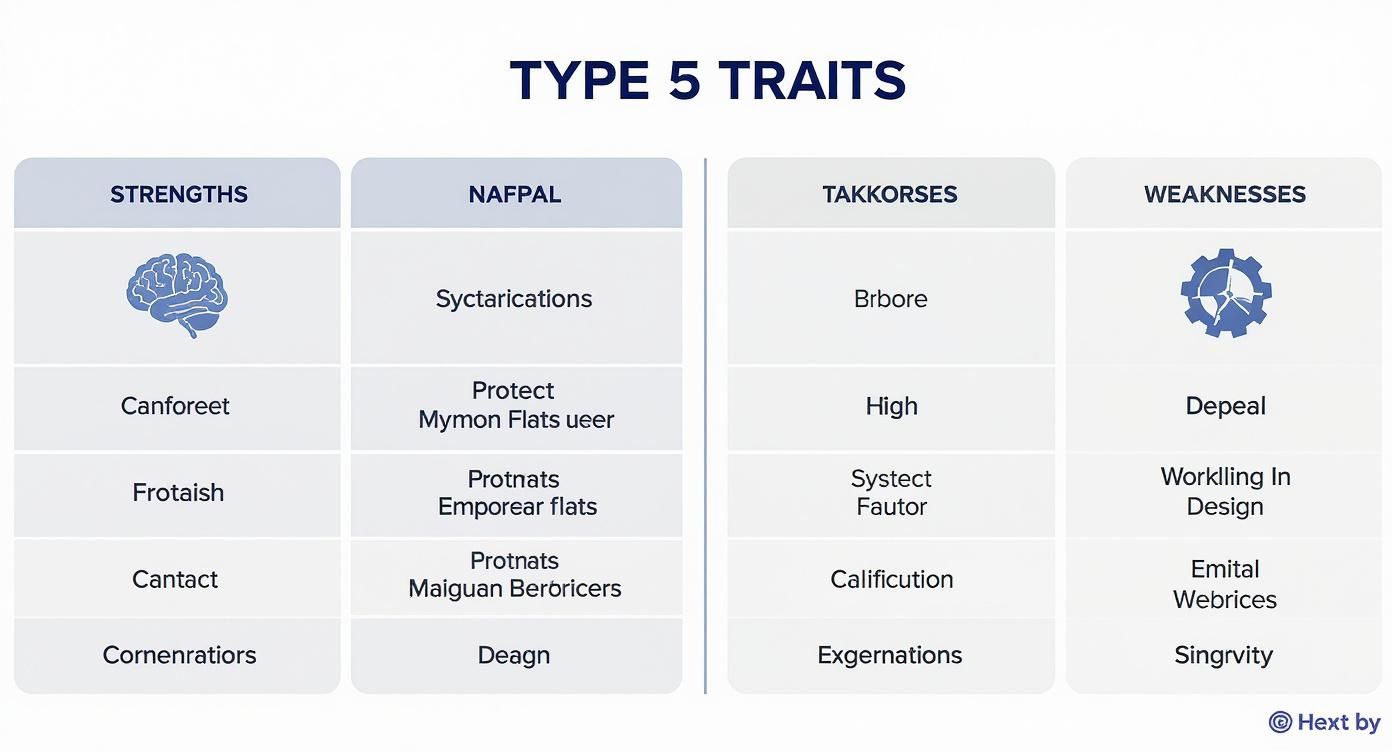
You can see how that incredible intellectual horsepower can either produce brilliant insights or get stuck in a loop of isolation and analysis paralysis.
In an unhealthy state, a Five retreats completely. They can become cynical, intellectually arrogant, and use their knowledge as a fortress to keep people out. By pushing everyone away, they inadvertently reinforce their deepest fear—that they are helpless and incapable. The real growth journey for a Type 5 is all about learning to bridge the gap between their rich inner world and the real, messy, beautiful world outside.
Making Sense of Work and Relationships as a Type 5
For the intensely private and cerebral Type 5, the outside world—with all its messy emotions and social demands—can feel like a puzzle to be solved from a safe distance. Thriving at work and in relationships isn't about faking it 'til you make it. It's about finding the people and places that genuinely respect their deep need for autonomy, expertise, and a whole lot of personal space.
Getting this right is the secret sauce for both Investigators and those who love them.
The Type 5 in Love and Friendship
If you're looking for grand romantic gestures or constant social butterfly energy, you're probably barking up the wrong tree. A Type 5's love language is much quieter, but no less profound. They show they care by sharing their most precious, carefully rationed resource: their inner world.
When a Five invites you into a deep-dive conversation about quantum physics or trusts you with a half-formed theory they've been mulling over for weeks, that’s the equivalent of a dozen roses. It's a huge act of intimacy. Their loyalty shows up as a steadfast, quiet presence and a willingness to offer their laser-focused, objective mind to help you solve a problem. The trick for partners and friends is learning to see these subtle invitations for what they are, without demanding an emotional performance the Five simply isn't wired to give.
For a Type 5, real connection means finding someone who respects the towering walls of their mental fortress but is still curious enough to learn the secret password. They need a partner who gets that solitude isn't a rejection—it's as vital as oxygen.
Want to get closer to the Investigator in your life? Try these on for size:
• Honor the "Do Not Disturb" sign. • Their need for alone time is not personal. It’s how they recharge their batteries. Give them that space freely, and they'll come back to you feeling safer and more ready to connect.
• Engage their brain. • Nothing builds a bond with a Five faster than showing genuine curiosity about what fascinates them. For example, if your Type 5 friend from Miami is obsessed with urban planning, ask them to explain the city's zoning laws to you—and actually listen. You'll have their attention.
• Keep it clear and logical. • When things get tense, emotional appeals will just make them retreat further into their shell. Approach conflicts with calm, direct communication. Logic is their native language.
Finding the Right Professional Fit
In the world of work, Investigators flourish in roles that celebrate deep expertise, autonomy, and mastery. They’re not built for jobs that revolve around schmoozing, office politics, or juggling a dozen superficial tasks at once. Give them a complex problem and the space to solve it, and they will shine.
This is why you so often find them excelling in fields like scientific research, data analysis, systems architecture, or academia. These careers give them the freedom they crave to go deep, untangling complex systems without the constant chatter of a busy open-plan office.
Think of a Type 5 researcher at a university in North Carolina, given the freedom to follow her intellectual curiosity wherever it leads. She spends her days happily immersed in data sets and theoretical models, and her innovative, objective insights make her an absolute powerhouse in her field. This is what happens when type 5 personality traits are put to work in the right environment. To see how other types find their groove, check out our guide to the Enneagram in the workplace .
Because they can be so reserved, Type 5s often find job interviews challenging. Learning how to answer the 'Tell me about yourself' question in a way that showcases their deep expertise without feeling boastful is a game-changer.
Of course, it's crucial to distinguish between a healthy need for solitude and extreme withdrawal. While these are common Five tendencies, it's worth noting that the global prevalence of any personality disorder is estimated to be 7.8% . This figure is a reminder of how important mental health awareness is within any personality framework.
A Practical Growth Path for the Type 5
For the Investigator, knowledge is a warm, cozy blanket. But real growth? That happens when you brave the world outside the library walls. The journey toward a richer, more fulfilling life isn't about cramming in more facts—it's about finally learning to live more. It means taking a deep breath and stepping out from behind that fortress of a mind to engage with the world, head-on.

This isn't some abstract philosophical quest. It's a very practical mission to balance that powerhouse intellect with the parts of yourself you've probably neglected: your emotions and your physical body. It’s time to turn all that stockpiled information into genuine, lived-in wisdom.
Bridging Thought and Action
First things first: we need to break the spell of "analysis paralysis." So many people with type 5 personality traits get stuck preparing for the big game that they never actually get on the field. The goal here is simple but not easy: consciously shift from observing to participating.
A great way to start is by scheduling dedicated "action hours." Imagine a young entrepreneur in Denver who spends weeks perfecting a business plan. She could block out two hours every single afternoon just for making calls and sending emails—no more research allowed during that time. That simple boundary forces her out of her head and into the world.
Another powerful move is to share your ideas before you feel they’re 100% complete . Pitching a concept that's only 80% baked can feel terrifyingly vulnerable, but it’s a shortcut to collaboration and breaks that lonely, endless cycle of refining everything by yourself.
Engaging with the Body and Heart
The next frontier for a Type 5 is the wild, internal landscape of feelings and physical sensations. Instead of immediately trying to dissect a feeling like a science experiment, the challenge is to just feel it. Let it be there without judgment. Think of it as a new kind of data-gathering, one you can't find in any book.
Growth for a Type 5 isn't about abandoning their intellectual gifts. It's about integrating them with the heart and hands, realizing that the richest understanding comes from lived experience, not just observation.
Here are a few tangible ways to start practicing this integration:
• Practice Embodiment: • Pick a physical activity that demands your full attention, like rock climbing in Colorado, dancing, or yoga. This yanks your focus out of abstract thought and grounds you firmly in the present moment.
• The Five-Minute Feeling Rule: • When a big emotion hits, set a timer for five minutes. Your only job is to sit with the feeling. Notice where it lives in your body. Resist that powerful urge to label or analyze it until the timer dings.
• Share a Personal Experience: • Make a point to share one small, personal story or feeling with a trusted friend each week. This slowly builds your emotional expression muscles in a safe, low-stakes way.
Your Burning Questions About Type 5s
Still trying to wrap your head around the enigmatic Investigator? Good. You're not alone. Let's tackle a few of the most common questions that pop up about the Type 5 personality.
Are All Enneagram Type 5s Total Introverts?
It’s one of the biggest assumptions, and for good reason—most Type 5s are introverts. Their fundamental need to feel competent means they guard their time and energy like a dragon hoarding gold, which is a classic introvert move. But it's not a 100% guarantee.
You can absolutely find extroverted Fives out in the world. Think of a brilliant marketing strategist in Chicago. She might be incredibly dynamic and engaging while presenting a data-heavy strategy she’s spent weeks mastering. But once the presentation is over? You can bet she's heading straight home to decompress, alone. Socializing isn't effortless for her; it’s a calculated expenditure from a limited energy budget.
How Can You Tell a Type 5 from a Type 1?
This is a super common mix-up. Both types can come across as logical, precise, and a bit perfectionistic. The real giveaway isn’t what they do , but why they do it. It all comes down to their core motivation.
• Type 1s (The Reformer) • are driven by a deep need to be • good and right • . They want to improve the world (and themselves) to match an internal standard of integrity.
• Type 5s (The Investigator) • are driven by a deep need to be • competent and capable • . They want to understand the world so they can feel self-sufficient and prepared for anything.
Picture them both looking at a new project plan. The Type 1 will immediately scan for what’s ethically wrong or could be done better . The Type 5 will hunt for factual errors and question whether the research behind it is solid enough.
So, Do Type 5s Even Have Feelings?
Oh, absolutely. They feel just as deeply as any other type, but their processing system is... unique. Instead of reacting to an emotion in the moment, a Five’s instinct is to mentally box it up and file it away to be dissected later, in the safety of their own mind.
To the outside world, this can look cold, aloof, or detached. In reality, it’s a powerful defense mechanism designed to keep them from feeling overwhelmed by a chaotic inner world.
For a Type 5, understanding an emotion is the first, non-negotiable step to actually feeling it. They need to put it under their mental microscope and figure out its origins, triggers, and implications before they can ever let themselves be carried away by it. It’s their way of staying in control when life feels intrusive.
Wondering where you fit in the Enneagram? The fastest way to move from "I think I might be a..." to "Aha, that's me!" is with a professional, validated assessment. Discover your unique personality blueprint with the free Enneagram Universe test and start your journey toward real self-awareness today. Find out your type at Enneagram Universe .