Type 5 Personality: Inside the Mind of the Enneagram Investigator

Ever met someone who seems to live almost entirely inside their own head? The quiet observer in the corner at a party, soaking everything in, but rarely jumping into the fray? If so, you might have just met an Enneagram Type 5, "The Investigator."
To really get a Type 5, you have to understand their internal world. They’re driven by a powerful, almost primal need to understand how things work, from the complexities of quantum physics to the subtle social dynamics at a dinner party. They value knowledge, competence, and self-sufficiency above all else, which is all tied to a deep-seated fear of being seen as helpless or incapable.
Decoding The Investigator
Think of the human mind as a vast, deep ocean. If that's the case, the Type 5's mind is a specialized research submarine, built to explore the darkest, most profound corners of that ocean. It’s not made for noisy, crowded harbors or splashing around in the shallows. It thrives in the silent depths where data, patterns, and big truths are waiting to be discovered.
But here’s the catch: this submarine has a limited power supply. Every single dive must be carefully planned, and every resource has to be meticulously managed. This is precisely why Fives guard their time, energy, and personal space so fiercely—it’s the fuel they need for their deep explorations. For example, a Type 5 might turn down a last-minute invitation not because they are antisocial, but because their "energy budget" for the day was already allocated to reading, and the unplanned social event feels like an unexpected, major expense.

Before we dive deeper, here’s a quick snapshot of what makes a Type 5 tick.
Enneagram Type 5 at a Glance
| Characteristic | Description |
|---|---|
| Basic Fear | Being useless, helpless, or incapable. |
| Basic Desire | To be capable and competent. |
| Nickname | The Investigator, The Observer |
| Key Motivation | To possess knowledge, understand their environment, and be self-sufficient. |
| Deadly Sin | Avarice (of knowledge, time, energy). |
| Virtue | Detachment (in a positive, non-attached way). |
This table gives you the CliffsNotes version, but the real story is in how these traits play out in their daily lives.
The Investigator’s Core Desires and Fears
At the very heart of the Investigator is a fundamental push-and-pull that shapes their entire world. It all boils down to two key drivers:
• Core Desire: To be Competent and Capable. • A Five feels secure when they have mastered their chosen subjects. This isn't about showing off or impressing others; it's about feeling fundamentally equipped to handle whatever the world throws at them. For example, before assembling a piece of furniture, a Type 5 will read the entire instruction manual cover-to-cover, ensuring they understand every step to avoid any mistakes.
• Core Fear: Of being Helpless or Useless. • Their biggest nightmare is being overwhelmed by life's demands without the internal resources or skills to cope. Hoarding knowledge and information becomes their primary defense against this deep-seated anxiety. A practical example is a Type 5 who, before a trip, will download offline maps, research local customs, and learn key phrases, all to avoid the helpless feeling of being lost or unprepared in an unfamiliar place.
This dynamic is what makes the Investigator one of the most intellectually curious types on the Enneagram. For instance, a Type 5 won't just try to fix a vintage watch; they'll spend weeks devouring books and forum posts about its intricate mechanics before even touching a screwdriver. This isn't procrastination—it's preparation.
The Investigator's primary motivation isn't to be the smartest person in the room, but to be the most prepared . They believe that with enough knowledge, they can remain independent and avoid being a burden on anyone.
This intensely private and preparatory approach makes them exceptionally rare. In fact, the Enneagram Type 5 is the second rarest personality type, making up just 5.8% of the population , according to a comprehensive study of over 11,000 individuals. You can learn more about these fascinating Type 5 statistics from the research at PersonalityData.org .
Their scarcity only adds to their enigmatic aura, making them one of the most compelling and, at times, misunderstood personalities to get to know.
The Secret Engine Driving a Type 5
To really get what makes a Type 5 tick, you have to pop the hood and look at the engine inside. It’s a powerful two-stroke machine, constantly firing between a deep, burning desire to be competent and a haunting, persistent fear of being inadequate . These two forces are locked in a dance, choreographing every thought, decision, and reaction.
Think of it like this: Imagine a master watchmaker about to assemble a priceless, incredibly complex timepiece for the first time. They wouldn't just jump in with a screwdriver. No way. They would spend days, maybe weeks, studying the schematics, identifying every tiny gear, and laying out their tools with surgical precision. The goal isn't just to build the watch; it's to master the entire system so they can navigate its complexities without a single misstep.
That's the Type 5's whole approach to life. To them, the world often feels like an intrusive, demanding, and chaotic place. Their prime directive? Gather enough knowledge and conserve enough energy to keep from being swallowed whole by it all.
The Fear: Being Useless and Overwhelmed
At the very core of a Type 5's being is a gnawing fear of being useless, helpless, or incapable . This isn't just a fear of looking stupid at a party or failing a test. It's a much deeper, almost existential dread of getting stuck in a situation where they don’t have the skills or information to cope. They genuinely believe their very survival hinges on what they know.
This is the key to understanding why they can seem so detached or reserved. They're not being cold; they're constantly observing, collecting data, and running mental simulations before they engage. A practical example of this is a Type 5 at a networking event. Instead of diving into conversations, they will stand back, observe the group dynamics, and identify the key players before deciding who, if anyone, to approach. If they can understand a system from the inside out, they believe they can anticipate and sidestep any unexpected demands that might drain their precious inner resources.
For a Type 5, the big question is never "How do I feel about this?" Instead, it's "Do I have the information and energy to handle this?" Preparation isn't just a good idea—it's their ultimate security blanket.
The Motivation: Becoming Capable and Competent
The only real antidote to this deep-seated fear is their core motivation: to be capable and competent . A Type 5 feels safe, valuable, and truly themselves only when they’ve achieved mastery over their chosen domain. And let's be clear, this has nothing to do with getting a round of applause or a pat on the back. It’s all about an internal sense of self-sufficiency.
This is the drive that turns them into such incredible experts and relentless learners. They will happily disappear for countless hours into their mental "workshop," taking apart complex subjects piece by piece until every single component is understood.
Here’s how this plays out in the real world:
• The Last-Minute Party Invite: • A Type 5 gets a text about a party starting in an hour. They almost always say no. It’s not because they're antisocial or don't like their friends. It’s because their mental energy budget for the evening was already allocated to reading a book on quantum physics, and a spontaneous social event feels like a sudden, massive, and threatening withdrawal from a very finite bank account.
• The Software Engineer: • An American software engineer is assigned a new project. For the first month, her boss might see almost no visible progress. Why? Because she’s not writing a single line of code. Instead, she's deep in the trenches—reading documentation, watching tutorials, and building tiny experimental apps until she feels she has completely mastered the new programming language. Only then will she start building, confident she can handle any problem that comes her way.
This whole pattern of hoarding knowledge, time, and energy is a brilliantly designed defense mechanism. Fives build a fortress of competence around themselves to stay safe from a world they experience as unpredictable and draining. Getting a handle on these core drivers is the first step to truly appreciating the unique inner world of the Investigator. You can dive even deeper into what makes each type tick by exploring all the Enneagram core motivations in our detailed guide.
How The Type 5 Investigator Shows Up In The Real World
Knowing a Type 5’s core fears and motivations is like having the schematic for a complex machine. But how does that machine actually run day-to-day? The Enneagram gives us a fantastic map for this, showing how a person’s behavior can shift dramatically based on their self-awareness and mental state.
A Type 5 isn't a static label; it's a dynamic spectrum. At their absolute best, they are visionary pioneers changing the world. At their worst, they retreat into a lonely fortress of isolation. By looking at these different health levels, we can see how the Investigator's core drive for competence can lead to either groundbreaking discoveries or a fearful withdrawal from life itself.
This concept map breaks down the forces pulling a Type 5 in opposite directions—from their deepest anxieties to their highest aspirations.
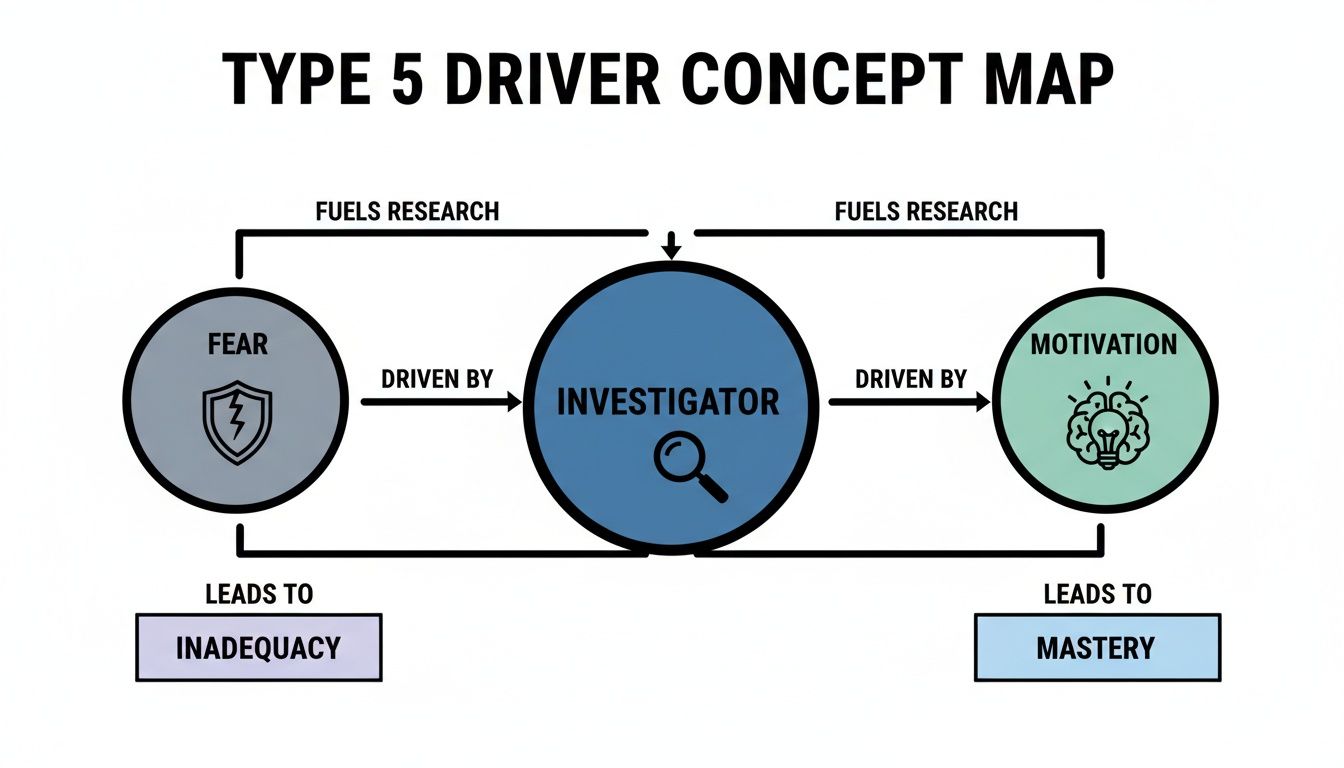
You can see how the fear of being incompetent and helpless pulls them toward isolation, while the desire for mastery and understanding rockets them toward becoming the insightful experts we so admire.
The Healthy Type 5: The Visionary Innovator
When a Type 5 is healthy and thriving, they are nothing short of brilliant. They’ve finally satisfied that deep need to feel competent, which gives them the security to step out from behind their mental fortress and share what they’ve learned with the rest of us. Their natural avarice for knowledge transforms into a generous desire to enlighten and empower others.
Picture a brilliant American astrophysicist. After decades of quiet, obsessive research, she’s pieced together a radical new theory about dark matter. Instead of hoarding her findings, she confidently presents them at a global conference in Chicago, publishes her papers, and takes young students from her university under her wing. She’s engaging, articulate, and surprisingly charismatic because her confidence flows from genuine mastery, not from her ego.
A healthy Type 5 moves past simply knowing things to applying that knowledge. They become innovators and thought leaders who can explain impossibly complex ideas with profound simplicity, making the world a smarter place for everyone.
The Average Type 5: The Detached Expert
Most of us hang out at the average level of health, and for the Type 5, this is the classic "Ivory Tower" academic. They are incredibly knowledgeable and competent in their chosen field but remain emotionally detached and fiercely protective of their time and energy. Their main goal is to conserve their inner resources and avoid any unexpected demands from the outside world.
Think of a reclusive American historian who is the world’s leading authority on the Civil War. He spends his days surrounded by dusty texts and artifacts in his Boston home, perfectly content in his intellectual bubble. When a colleague invites him to a lively dinner party, he’ll politely decline, preferring the predictable company of his books. He’ll happily give you a 20-minute monologue on the Flavian dynasty if you ask, but he’s not about to initiate small talk.
He isn't unfriendly; he’s just guarding his battery. He interacts with the world on his own terms, sharing his expertise but keeping his personal life and emotions safely behind a wall. This is where that stereotype of the aloof, intellectual Type 5 really comes from.
The Unhealthy Type 5: The Isolated Nihilist
When a Type 5 is under prolonged stress or becomes psychologically unhealthy, that core fear of being helpless and incapable completely takes the wheel. Their need for privacy skyrockets into extreme isolation. Their intellectual curiosity sours into eccentric, often dark, and nihilistic thought patterns that spiral inward.
Imagine an American freelance programmer in Silicon Valley who just lost his contracts. Instead of looking for new work, his fear of failure paralyzes him. He stops answering calls from friends and family, convinced they’ll make demands he can’t possibly meet. He spends his days falling down bizarre rabbit holes on obscure internet forums, getting sucked into wild conspiracy theories. He feels totally alienated from a world he now sees as hostile and meaningless, effectively trapping himself in the prison of his own mind.
This is where the Investigator’s greatest strengths—their detachment and intense focus—become their undoing when pushed to the extreme.
Growth And Stress: The Dynamic Shift
The true beauty of the Enneagram is that it’s a roadmap for growth. It doesn’t just tell you where you are; it shows you where you can go. For the Type 5, this movement is crystal clear. This is probably one of the most important things to understand about any Type 5 in your life.
The table below breaks down how their entire demeanor can shift from healthy to unhealthy.
Discover Your Health Status, for FREE! Click here.

The Type 5 Health Spectrum From Visionary to Isolated
| Health Level | Key Behaviors & Mindset | Real-World Example |
|---|---|---|
| Healthy (Integration toward 8) | Confident & Decisive. Shares knowledge freely, takes action, and engages with the world from a place of strength. They are visionary and grounded. | A tenured professor at a university in California who not only publishes groundbreaking research but also actively leads a department, advocating for her team and making impactful decisions. |
| Average (The Core 5) | Detached & Analytical. Hoards knowledge and energy. Observes from a distance and avoids emotional entanglement. Competent but private. | A systems analyst in New York who is a genius at his job but keeps to himself at the office, always eats lunch alone at his desk, and rarely speaks up in meetings unless asked a direct question. |
| Unhealthy (Stress toward 7) | Scattered & Escapist. The mind becomes hyperactive and unfocused. Jumps from one esoteric topic to another without purpose, seeking distraction from anxiety. | A researcher from Austin who abandons their major project to impulsively pursue dozens of trivial, unrelated hobbies, never completing anything and becoming increasingly agitated. |
As you can see, the Type 5 personality is not a box but a continuum of behavior. Recognizing where you or someone you know falls on this spectrum is the crucial first step toward moving from a place of fear-based observation to one of confident, world-changing action.
Let’s Talk Wings and Subtypes: The Many Flavors of Type 5
If you think you know what a Type 5 looks like, think again. Sure, the core motivation—that deep need for competence and the gnawing fear of being helpless—is always there. But that's just the starting point. To really understand a 5, you have to look at their wings and their instinctual subtype . These are the layers that add incredible depth and color to their personality.
Think of the base Type 5 as the core recipe for a dish. The wings are the secret spices that give it a completely different character. A Five doesn’t suddenly become a Four or a Six. Instead, they just borrow a little of that neighboring number's energy, creating a unique hybrid that sets them apart.
What’s the Deal with Wings?
Wings are a crucial piece of the puzzle, explaining why two Fives can seem so different. They show us how a Five channels their intense intellectual energy into the real world. If you want to get into the weeds on how this works for every number, we've got a whole guide on Enneagram wings you can check out.
The 5w4: The Iconoclast
Take a Type 5's analytical mind and blend it with a Type 4's craving for individuality and emotional depth, and you get the 5w4 . These Fives aren't just collecting facts; they're on a quest for profound, often strange, and beautiful meaning hidden within that knowledge. They are the "Iconoclasts," the ones who break the mold.
You'll find the 5w4 in the guise of a philosopher, an avant-garde artist, or a theoretical physicist who writes poetry on the side. They’re drawn to the abstract, the melancholy, and the beautifully complex.
Picture this: An American documentary filmmaker from Portland holes up in her studio for years, painstakingly researching an obscure historical event—that's her 5-drive in action. But she isn't making a dry historical record. She's crafting a visually stunning, emotionally charged film that completely upends the mainstream story. That’s the 4-wing's need for unique, personal expression. She's a master of her craft, but always feels like an outsider creating something deeply personal.
The 5w6: The Problem Solver
Now, let's swing the other way. When a Type 5 leans into the loyal, security-focused energy of a Type 6, you get the 5w6, "The Problem Solver." This is where deep analysis meets a pragmatic need for certainty. These Fives are less about exploring abstract possibilities and more about building reliable systems and squashing real-world problems.
The 5w6 is the systems engineer who can find a single bad line of code in a million, the meticulous researcher who triple-checks every single source, or the brilliant strategist who game-plans for every possible catastrophe. They use their knowledge to build a safer, more predictable world.
Here's an example: Think of a cybersecurity expert working for a government agency in Washington D.C. He’s completely at home in the labyrinth of digital systems, hunting for weaknesses and building impenetrable firewalls (classic 5). But what's driving him? A deep-seated need to protect the system from threats and create a stable, secure environment (hello, 6-wing!). He thrives on clear protocols and loves the feeling of making things safe.
The Three Instincts: Where a Five Puts Their Focus
If wings are the flavor, the instinctual subtypes are the environment where a Five feels most comfortable. They reveal where a 5 focuses their energy to feel secure, based on one of three dominant instincts: Self-Preservation, Social, or One-to-One.
Think of an instinctual subtype as the specific habitat where a Type 5's personality truly lives and breathes. It determines where they invest their intellectual energy to feel safe and in control.
Let’s break them down:
• The Self-Preservation (SP) 5 – 'Castle' • : This is your quintessential Investigator. Their world revolves around fiercely protecting their resources: time, energy, and personal space. They build a metaphorical "castle" around themselves, complete with a moat and drawbridge, to keep the draining demands of the outside world from getting in. This is the most withdrawn of the Fives, needing tons of solitude to recharge inside their private sanctuary.
• The Social (SO) 5 – 'Totem' • : This Five doesn't hoard knowledge for themselves; they use it to find their place within a tribe. They seek value and safety by becoming the go-to expert in a specialized field. They connect with people through a shared intellectual passion—the "totem"—whether that’s a scientific community, a niche fandom, or a professional guild. Their social life is built around these tribes of the mind.
• The One-to-One (SX) 5 – 'Confidant' • : Here's where things get interesting. This is the most emotionally intense of the Fives. They pour all their energy into finding one single, profound connection with another person—a "confidant" who can meet them on their intellectual and emotional level. They are searching for a partner to share a secret world of ideas and trust. This subtype can sometimes be mistaken for another type because their drive for an intense bond can temporarily override their need for total detachment.
How a Type 5 Deals with People (At Home and at Work)
For the intensely private Type 5, the social world can feel like a minefield. The constant demands of relationships and the collaborative buzz of a modern office can seem like trying to solve an impossible puzzle where the pieces keep changing shape. Their entire operating system is built on conserving energy and feeling competent, which often clashes with the messy, unpredictable nature of human connection.
But it doesn't have to be a source of constant dread. With a little insight, Fives can navigate these worlds without feeling completely drained.
When it comes to relationships, a Five often approaches them with the same intense curiosity they bring to a new field of study. They crave intellectual connection and clear, direct communication. Forget grand romantic gestures; they’re far more interested in a deep, nerdy conversation about a shared passion. Their love language isn't always spoken out loud—it's shown through steadfast loyalty, brilliantly insightful advice, and the rare, precious gift of their full, undivided attention.
Fives in Love: "Please, Just Give Me Some Space"
If there's one non-negotiable for a Type 5 in a relationship, it's personal space . This isn't a rejection of their partner; it's a fundamental need, like oxygen. It's how they recharge their mental batteries after being out in the world. A partner might find this need for solitude confusing or even hurtful, but pushing a Five for constant interaction is the fastest way to deplete their energy and send them scurrying back into their mental fortress.
Their communication style is another puzzle. Fives are absolute masters of logic and data, but they can be complete beginners when it comes to expressing feelings on the fly. They tend to process emotions internally, taking them apart and analyzing them until they can be articulated in a calm, rational way. This can be tough for partners who need immediate emotional feedback and reassurance.
For anyone loving a Type 5, remember this: Their silence doesn't mean they don't care. It usually means they're thinking—deeply—and will share their conclusions once they’ve pieced them all together.
If you’re trying to build a strong connection with a Five, a few practical tips can make all the difference:
• Schedule the "Big Talks": • Don't ambush them with a heavy conversation right after a draining day. Suggesting a specific time to talk lets them mentally prepare and budget the energy required. For example, say "Can we talk about our vacation plans after dinner tonight?" instead of "We need to talk now."
• Respect Their "Cave": • When they retreat, trust that they'll come out when they're ready. Trying to pry them out will only make them build thicker walls next time.
• Lead with Logic, Not Just Emotion: • When you have a problem, lay it out clearly. Framing your emotional needs in a way they can understand and solve is far more effective. You can learn more about how different types connect in our guide to • Enneagram relationships • .
The Type 5 at Work: The Resident Genius
In a professional setting, the Type 5 truly comes alive when they can play to their strengths: deep analysis, objective problem-solving, and out-of-the-box thinking. They are the ultimate specialists, thriving in roles that let them become the undisputed master of a complex subject while working with plenty of autonomy. They couldn't care less about the spotlight; they're on a quest for the truth buried deep within the data.
This makes them a natural fit for certain kinds of work.
Ideal Jobs for a Type 5:
• Data Scientist: • What’s not to love? Getting paid to dive into massive datasets and find hidden patterns is basically a Five's idea of heaven.
• Academic Researcher: • A whole career built on deep, focused study, far from the chaotic pressures of corporate life.
• Strategic Planner: • They can see the big picture, anticipate problems before they happen, and chart a logical path forward.
• Systems Engineer: • Mastering the intricate, complex inner workings of a system to make sure it runs like a well-oiled machine.
Where do they struggle? In highly collaborative, socially demanding, or politically charged environments. Endless group meetings, mandatory "fun" team-building events, and navigating office politics feel like an outrageous waste of their precious mental energy. A practical example would be a Type 5 programmer who dreads the daily "stand-up" meeting, viewing it as an inefficient interruption to their deep focus.
If you're managing a Type 5, the secret is simple: give them the right environment. Hand them a complex problem, the freedom to solve it their way, and clear, data-driven feedback. If you give them that trust, they will reward you with brilliant, meticulously researched solutions that everyone else completely missed.
Your Practical Growth Path as a Type 5
The growth journey for a Type 5 isn't about becoming a different person. Think of it more like stepping out of the vast, quiet library of your mind and blinking in the sunlight of the real world. It’s about moving from detached observation to confident, active participation.
Your path is one of integration—meshing your profound insights with tangible action. It’s about turning those brilliant theories into something the world can actually see and feel. This means intentionally bridging the gap between your mind and your body, and between your comfortable solitude and meaningful connection.
The real challenge? Learning to trust that you are already competent enough to engage, even when you don't have every single answer cataloged and cross-referenced.

From Observation to Action
At its core, your growth hinges on a simple, yet terrifying, idea: embracing action even when it feels premature. Your gut instinct is to retreat and gather more information, but the most valuable data often comes from just diving in. The key is to start small, experimenting with embodiment and engagement.
Here are a few practical exercises to get you out of your head:
• Share an 80% Idea: • Instead of waiting until a concept is polished to perfection, try sharing it with a trusted friend or colleague when it’s still a work in progress. For example, in a team meeting, you could say, "This is just a preliminary thought, but what if we tried X?" This directly challenges the fear of being wrong and opens the door for collaborative discovery you couldn't have managed alone.
• Practice Embodiment: • Get physical. Find an activity that forces you to be present in your body, not just your mind. Think hiking, martial arts, yoga, or even just dancing around your living room. The goal is to connect with your body's own form of intelligence.
• Schedule Social "Experiments": • Reframe social interaction as a research project. Put a low-pressure coffee meeting or a short phone call on the calendar. Afterward, observe your energy levels. What small interactions felt manageable? Which ones were even rewarding?
Growth for a Type 5 isn't about abandoning the mind. It's about recognizing that the body and heart provide equally valid, crucial data for understanding the world. True wisdom integrates all three.
For any Type 5 looking to make those social "experiments" feel a lot less intimidating, working to improve conversation skills can be a game-changer.
Embracing Your Healthy 8 Energy
Your path of integration naturally leads you toward the healthy, confident energy of an Enneagram Type 8, The Challenger. Don't worry, this doesn't mean you'll suddenly become domineering or aggressive. It's about tapping into the 8’s decisive, grounded, and protective qualities.
When a Type 5 integrates toward 8, they learn to:
Picture a brilliant American architect who has spent years perfecting her revolutionary designs on paper—that’s the classic Type 5 energy. When she taps into her 8 wing, she strides confidently into the boardroom in New York, defends her vision against skeptical investors, and personally oversees the construction crew to ensure her creation is built exactly as she imagined. She becomes a force of nature, seamlessly blending vision with execution.
Ultimately, a healthy type 5 personality offers the world a rare and powerful gift. You have the clarity to see what everyone else misses, the wisdom to understand incredibly complex systems, and the vision to pioneer a better future. By embracing action and trusting in your own inherent competence, you don’t just understand the world—you gain the power to change it.
Burning Questions About the Enneagram 5
So, you're still puzzling over the enigmatic Type 5? Good. They're a fascinating type, and it's totally normal to have a few questions lingering. Let's tackle some of the most common ones.
Are Type 5s Really Unemotional Robots?
Absolutely not. This is probably the biggest myth out there. A Type 5 personality isn't unemotional; they just have a radically different way of processing their feelings.
Instead of a big, outward reaction in the heat of the moment, they tend to pull back. They take their emotions home, so to speak, to dissect and understand them in private. From the outside, it can look like cold detachment, but trust me, there's a rich, complex emotional world bubbling just beneath the surface.
Think of it this way: after a tense meeting, a Type 5 might seem completely unfazed. Later that night, though, they're likely replaying the entire conversation in their head, meticulously sorting through every single feeling that popped up.
The biggest misconception about Type 5s is that they are arrogant because they’re quiet. In reality, their silence comes from a need to observe and understand before speaking, reflecting intellectual humility, not superiority.
How Do I Actually Support the Type 5 in My Life?
This is a great question, and the answer is simpler than you might think. It all comes down to respecting their core needs.
Give them space. Seriously. Their need for solitude isn't a rejection of you; it's how they recharge their batteries. A practical example is texting before you call, asking, "Is now a good time to talk?" This respects their need to prepare for interaction. When you do talk, get to the point. They appreciate direct, logical communication. And if you really want to connect, show genuine curiosity about their latest intellectual obsession.
On the flip side, avoid ambushing them with surprise visits or dragging them to huge, noisy parties without a heads-up. Letting a Type 5 engage with the world on their own terms is the ultimate sign of respect and the fastest way to build real, lasting trust.
Ready to discover your own Enneagram type? The Enneagram Universe test offers a deep dive into your personality, motivations, and growth path. Get your personalized results and start your journey of self-discovery today at Enneagram Universe .