The Enneagram Richard Rohr: A Spiritual Growth Guide

Maya sat in church, sang every word, and still felt numb. On the drive home, she realized her problem wasn’t a lack of effort. It was that she didn’t know what inside her kept hijacking her best intentions.
Finding Your Way When You Feel Spiritually Lost
Feeling spiritually lost rarely looks dramatic. It often looks like paying the bills, answering texts, showing up for people, and still sensing that something important is missing.
A lot of people reach that point and go hunting for a personality test. They want a tidy label. What they often need is a map.
That’s where the Enneagram Richard Rohr becomes interesting. Rohr didn’t treat the Enneagram like a party trick or a trendy identity badge. He treated it like a tool for noticing the patterns that keep us from living with honesty, freedom, and love.
Rohr’s version speaks to the person who says, “I keep doing the same thing. Why?” Maybe you overwork and call it responsibility. Maybe you help everyone and resent them internally. Maybe you avoid conflict so completely that you disappear inside your own life.
Those patterns can feel random until you see them as part of a deeper inner structure.

The Enneagram as a spiritual map
Rohr’s language can sound mystical at first, but the basic idea is simple. You have habits of heart. Those habits shape what you notice, what you fear, and how you protect yourself.
The Enneagram, in his hands, helps you ask better questions:
• What am I defending?
• What pain am I avoiding?
• What false story keeps running my life?
• Who am I beneath that pattern?
If that last question grabs you, this reflection on what you are truly hungry for pairs well with Rohr’s approach. It gets underneath surface cravings and asks what your soul is reaching for.
Where readers usually get stuck
Many people hear “Enneagram” and think, “So I’m just a number?” Rohr’s answer would be no. The number isn’t your identity. It’s more like the groove your ego keeps falling into.
That distinction matters. A label can trap you. A map can guide you.
If you’re still sorting out how self-knowledge works in practice, this short guide on knowing yourself better is useful: How to Know Yourself Better and Find Your Path.
Rohr’s invitation is gentle but demanding. Don’t use the Enneagram to admire yourself. Use it to see what you’d rather not see, and to discover the self that exists beneath performance, fear, and spiritual pretending.
Who is Richard Rohr and Why Does He Matter?
Richard Rohr matters because he acted like a translator. He took a symbol that many people experienced as abstract, esoteric, or hard to place, and brought it into plain spiritual conversation.
He is a Franciscan priest who was among the first to publish a book on the Enneagram in English. That mattered because it helped introduce and popularize the Enneagram within Christian communities in the United States during the late twentieth century, especially through The Enneagram: A Christian Perspective as described in this CAC overview of his work.
A bridge between worlds
Rohr learned the system through Jesuit connections tied to Oscar Ichazo’s school in Arica, Chile. He then reframed it for Christian spiritual formation.
That move changed how many readers encountered the Enneagram. Instead of seeing it as an odd symbol with hidden meanings, they met it as a language for:
• Discernment
• Addiction
• Relationships
• Vocation
• The False Self and the True Self
For many churchgoing readers, that was the breakthrough. Rohr gave them a way to use the Enneagram without feeling like they had to leave their faith at the door.
Why his version became so influential
Rohr did not merely say, “This system works.” He also connected it to Christian history and spiritual struggle. He linked it with themes people already knew, like sin, virtue, temptation, and transformation.
That gave his work a kind of theological weight. He presented the Enneagram as compatible with Christian faith and connected it with figures such as Evagrius Ponticus.
Here’s the plain-English version of why that landed so strongly:
| What people had | What Rohr offered |
|---|---|
| A hard-to-explain symbol | A spiritual framework |
| Personality curiosity | A path of repentance and freedom |
| Isolated type descriptions | A way to talk about grace and ego |
| Religious suspicion | A Christian contemplative lens |
He also taught it in accessible formats beyond books, including audio teachings. That widened his reach.
If you want background on how the system itself developed before and beyond Rohr’s work, this history overview is a helpful companion: History of Enneagram: Ancient Origins to Modern Psychology . His influence is easiest to understand this way. Some people preserve ideas. Rohr translated one. He made it speak in the language of confession, prayer, surrender, and the search for God.
Rohr’s Core Teachings: The Spiritual Enneagram
Rohr’s core teaching is not “learn your type and feel special.” It’s closer to “learn your type so you can stop being run by it.” That’s why his Enneagram feels different from many casual versions online. He uses it as a spiritual operating system . It shows the hidden code behind your reactions.
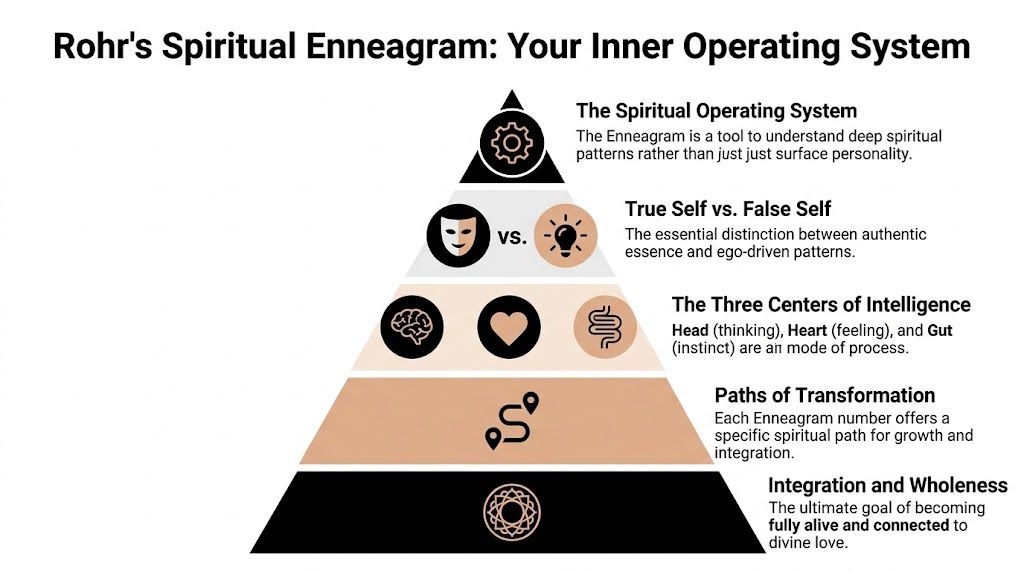
True Self and False Self
In Rohr’s language, the False Self is the version of you built around protection, image, control, and survival. It’s not fake in the sense of unreal. It’s fake in the sense that it isn’t your deepest identity.
The True Self is who you are in God. Not the polished version. Not the anxious version. Not the role you perform to stay safe.
A simple analogy helps. Think of your phone with too many apps running in the background. The battery drains fast, the system lags, and everything feels harder than it should. Rohr’s Enneagram helps you see which “background app” your ego keeps running.
For one person, that app is moral correctness. For another, it’s being needed. For another, it’s avoiding pain by staying busy or detached.
The three centers
Rohr organizes the nine types into three triads . He describes them as centers of false energy. In his framework, the Gut triad includes 8, 9, and 1 , the Heart triad includes 2, 3, and 4 , and the Head triad includes 5, 6, and 7 . He teaches that the Gut triad centers around anger , the Heart triad around shame , and the Head triad around fear , with transformation beginning when you recognize that core issue in yourself, as summarized in this meditation-based discussion of his teaching .
Here’s a practical way to picture the triads:
• Gut types • react from instinct. Their struggle often involves control, resistance, or suppressed force.
• Heart types • react through image and feeling. They often ask, “Am I lovable, valuable, seen?”
• Head types • react through anticipation and analysis. They scan for safety, certainty, or escape routes.
None of these is bad. They’re human. The trouble starts when a center becomes your whole strategy for life.
How this plays out in daily life
A Type 1 in Rohr’s framework might think, “If I stay good enough, disciplined enough, and right enough, I’ll be okay.” That can look admirable from the outside. Inside, it may be fueled by tight anger.
A Type 2 may become the person who always knows what everyone else needs. That sounds loving. It can also hide shame and a desperate need to be wanted.
A Type 5 may collect knowledge, privacy, and distance. That can look wise and self-contained. It may also be fear of wearing glasses.
Transformation, not self-improvement
Rohr’s spiritual Enneagram isn’t aimed at polishing your personality. It’s aimed at loosening your grip on the self you’ve constructed.
That’s why his work often resonates with people in recovery, spiritual direction, and serious inner work. He’s less interested in making you efficient and more interested in making you free.
The movement is simple to describe, even if it takes a lifetime to live:
That’s the heartbeat of Rohr’s teaching.
How Rohr’s Enneagram Differs from Other Views
Some Enneagram teachers sound like coaches. Richard Rohr sounds like a spiritual director. That difference affects everything, from vocabulary to purpose.

Two approaches to doing different jobs
A mainstream psychological Enneagram often asks, “What motivates this person?” Rohr’s version asks, “What has this person’s ego attached to, and how might grace undo it?”
That’s not a small shift. It changes how you use the tool.
| Focus | Rohr’s approach | Common psychological approach |
|---|---|---|
| Main concern | Spiritual transformation | Personality insight |
| Key language | False Self, sin, virtue, grace | motivation, behavior, patterns |
| Goal | Union with God, inner freedom | self-awareness, communication |
| Best setting | spiritual direction, contemplation | coaching, relationships, work conversations |
If you’re a pastor, spiritual director, or seeker in a season of inner honesty, Rohr’s lens can feel piercing in a good way. If you’re an HR leader trying to design team norms, his framework may feel profound but not specific enough for the task.
Why do people get confused?
Part of the confusion comes from using one version of the Enneagram for a job it wasn’t built to do.
Rohr’s model is excellent for questions like:
• Why do I keep repeating this soul-level pattern?
• What hidden attachment shapes my reactions?
• Where am I resisting surrender?
It’s less built for questions like:
• Which conflict style works best on my team?
• How do two types collaborate under deadline?
• What coaching structure improves communication at work?
That’s not a flaw. It’s a category issue.
This interview clip gives a feel for how spiritually toned many Rohr conversations are:
Think monastery and meeting room
A simple analogy helps. Rohr’s Enneagram belongs naturally in a monastery, a retreat center, a therapist’s office focused on meaning, or a quiet journal session after you realize your life isn’t working. A modern workplace assessment belongs in the meeting room. It helps people compare styles, discuss friction, and make practical adjustments.
You don’t have to choose one forever. You just need to know which question you’re trying to answer.
Applying Rohr’s Insights for Spiritual Growth
Rohr’s ideas become clearer when you watch them land in ordinary lives. Not in theory. In traffic, marriage, group projects, and long conversations, you keep postponing.

A Type 1 who can’t stop correcting
Daniel is reliable, principled, and exhausted. He notices every mistake in the office kitchen, every weak argument in meetings, and every shortcut in himself.
From Rohr’s angle, Daniel doesn’t just have standards. He’s organized around a deep inner pressure. His anger doesn’t usually explode. It hardens.
His practice might look like this:
One day that might mean letting a minor imperfection stay imperfect. Another day it might mean speaking truth without the extra heat.
A Type 4 who turns pain into identity
Elena feels everything intensely. She can spot beauty nobody else notices, but she also sinks into the thought that other people were handed a simpler emotional life.
Rohr’s framework helps her see that her melancholy can become a home she decorates instead of leaves. The feeling may be real. The attachment to it is the trap.
So Elena starts small:
• She journals the story she’s telling about what’s missing.
• She names the shame underneath the drama.
• She practices gratitude without forcing cheerfulness.
• She chooses one ordinary act of love instead of waiting to feel profound first.
That’s spiritual work, not mood management.
A strong companion resource for this kind of process is this reflection on finding your true identity in Christ . It puts words around the deeper identity question Rohr keeps pressing.
A Type 9 who disappears to keep peace
Marcus says he hates conflict, but the cost runs deeper. He loses contact with his own priorities, opinions, and energy. Rohr’s lens can help a Type 9 see that “peace” sometimes means self-erasure. The habit feels gentle. It can become a refusal to show up fully.
His growth might include one uncomfortable discipline. Speak before the meeting ends. Not a speech. Just one honest sentence.
Where Rohr helps, and where you may need more
Rohr’s teachings offer deep insight into individual compulsions and spiritual paths. At the same time, people often want to apply the Enneagram to teams, couples, and secular settings. One cited trend claims a 40% rise in workplace Enneagram adoption in 2025 to 2026 , while also pointing out that Rohr-focused resources usually don’t provide the kind of data-backed intertype guidance many workplaces want:

That gap is easy to feel in practice. Rohr can help Daniel understand why he becomes severe. He won’t necessarily give Daniel’s manager a structured workplace tool for conflict mapping.
That’s why many coaches blend spiritual insight with other practical frameworks. If you want a coaching-oriented next step, this guide offers a useful bridge: What Makes Enneagram Coaching Different From Everything Else.
Use Rohr for the inner diagnosis. Use practical tools for the external application.
Critiques and Caveats of the Rohr Approach
Richard Rohr’s work has helped many readers take the Enneagram seriously as a spiritual tool. That doesn’t mean every claim around it is equally solid.
The biggest caution is simple. Spiritual usefulness is not the same thing as scientific validation.
The validation question
A major critique of Rohr’s framework is that it doesn’t rest on peer-reviewed psychometric evidence for reliability or validity. The contrast often made is with modern assessments that aim for formal measurement. That concern matters most for therapists, coaches, and HR leaders who need data-backed tools for clinical or organizational decisions, as noted in this overview of the critique .
In plain language, Rohr’s system can be wise without being scientifically established in the way professional assessment users might require.
That distinction protects everyone.
• For spiritual seekers • , it prevents disappointment. You’re using a contemplative tool, not a lab instrument.
• For professionals • , it prevents overreach. You shouldn’t treat a spiritually framed typology as if it automatically meets clinical or organizational standards.
• For teachers and pastors • , it encourages humility. The Enneagram can illuminate, but it shouldn’t become a substitute for discernment, training, or evidence.
The history question
Another caveat concerns origin stories. Rohr’s work has often linked the Enneagram to Christian sources and themes. Critics question how directly those historical claims can be documented.
That doesn’t erase the value people find in the framework. It means readers should hold historical certainty with open hands.
A practical way to stay grounded
Here’s a healthy rule of thumb.
| If you need | Rohr may be enough | You likely need more |
|---|---|---|
| Prayerful self-examination | Yes | |
| Spiritual direction language | Yes | |
| Clinical assessment | Yes | |
| Workplace decision support | Yes | |
| Team compatibility guidance | Yes |
Rohr is strongest when you use him as a guide for inner honesty, surrender, and spiritual growth. If your work requires precise assessment, measurable consistency, or structured comparison across people, you’ll want a validated complement.
Your Path Forward with the Enneagram
Richard Rohr helped many people encounter the Enneagram as more than a diagram of nine personalities. In his hands, it became a way to notice the habits that keep us estranged from love, truth, and God.
That’s why the Enneagram Richard Rohr still matters. It speaks to the person who senses that their biggest problem isn’t a lack of information. It’s the stubborn pattern inside that keeps turning life into the same struggle.
Use Rohr’s wisdom for that inner work. Let it expose the compulsions of the False Self. Let it deepen prayer, confession, and compassion.
Then be practical. If you need something for coaching, therapy support, relationships, or workplace use, pair spiritual insight with a modern, validated assessment. Those tools don’t compete with Rohr’s vision. They answer different questions.
The healthiest path is often both. A map for the soul, and a clear instrument for applied self-knowledge.
If you want a practical next step, Enneagram Universe offers a scientifically validated assessment with 180 questions, along with guidance on wings, triads, health levels, and type dynamics for personal growth, relationships, and work. It’s a strong complement to Rohr’s spiritual lens when you want both depth and clarity.