Explore Your Inner World: Self-Discovery Personality Test

Some nights you close your laptop, replay one awkward conversation, and wonder why it hit you so hard. Other people seem to brush off criticism, ask for what they need, or move through conflict without turning it into a three-day inner documentary.
Maybe you’ve taken a few personality quizzes already. One told you you’re “the thoughtful one.” Another compared you to a fictional character. They were fun for five minutes, but they didn’t explain why you keep overcommitting, why certain people drain you, or why success sometimes makes you anxious instead of relieved.
That’s where a self-discovery personality test becomes useful. Not as a label maker, but as a flashlight. It helps you notice patterns that feel random when you’re living inside them.
The Search for You: An Introduction to Self-Discovery
A lot of people start this search when life feels slightly off.
You’re doing what you’re supposed to do. You answer messages. You work hard. You show up for people. But part of you feels like you’re following a script that almost fits, not one you wrote.

A teacher might notice she becomes patient with struggling students but strangely sharp with herself. A manager may look calm in meetings, then feel wrecked by one small sign of disapproval. A college student may keep changing majors, not because they’re lazy, but because they’re trying to find a life that feels like home.
Those moments don’t mean something is wrong with you. They usually mean something important is waiting to be understood.
Why do people look for answers?
Most of us don’t need more information about productivity hacks or morning routines. We need language for our inner world.
A solid self-discovery personality test can help you ask better questions:
• Why do I react so strongly to certain situations?
• What am I protecting when I get defensive?
• What do I need when I feel lost, angry, numb, or restless?
• Why do some relationships feel easy while others feel like translation work?
That’s the key appeal. You stop guessing.
A map, not a cage
Think of personality testing like mapmaking. A map doesn’t replace the journey. It just helps you stop walking in circles.
If you learn that you avoid conflict because you fear disconnection, that insight can change how you apologize, set boundaries, and choose relationships. If you learn that you chase achievement to feel secure, your work habits start making more sense. So does your exhaustion.
The point isn’t to become obsessed with your type. The point is to become more awake to yourself.
That’s why the best personality tools feel exciting. They don’t hand you a verdict. They give you a starting point.
More Than a Quiz: What a Real Personality Test Is
A random quiz asks, “Which category sounds most like you?” A real assessment asks, “What patterns show up consistently enough to reveal how you interpret the world?”
That difference matters.
The personality testing world is big. Personality assessment instruments operate within a $2 billion psychometric testing industry , yet validation remains a challenge, which is one reason some approaches use multiple models together instead of relying on just one framework.
A useful test goes below surface behavior
Behavior is easy to notice.
You talk a lot in meetings. You procrastinate. You take charge. You keep the peace. But behavior by itself can be misleading because two people can do the same thing for very different reasons.
One person works late because they love excellence. Another works late because they’re afraid of being seen as replaceable. One person avoids conflict because they value harmony. Another avoids conflict because they don’t know what they want.
A thoughtful self-discovery personality test looks for the why under the what .
The GPS analogy
For-fun quizzes are like asking a stranger for directions in a parking lot. You might get somewhere useful, or you might end up by a dumpster behind a grocery store.
A high-quality assessment is more like a GPS for your inner life. It doesn’t just say, “You are here.” It helps you notice recurring routes:
• Stress patterns • when you feel threatened
• Communication habits • when you need connection
• Decision styles • when choices carry emotion
• Blind spots • that keep repeating across work and relationships
That’s why serious tools often feel more nuanced than expected. Instead of giving you a cute identity badge, they show tension, contradiction, and complexity.
What separates a serious assessment from a novelty quiz?
A simple checklist helps.
| Question | Novelty quiz | Real assessment |
|---|---|---|
| Purpose | Entertainment | Self-understanding |
| Depth | Surface traits | Patterns, motives, tendencies |
| Result | Quick label | Interpretable profile |
| Usefulness | Brief amusement | Reflection and application |
If you want a practical comparison of stronger options, this guide to the best personality test is a helpful next read.
Why does this matter in daily life?
Personality insight can change ordinary moments.
You stop calling yourself “bad at relationships” and start noticing that you shut down when you feel misunderstood. You stop saying “I’m just unmotivated” and realize you’re frozen by perfectionism. You stop assuming your coworker is cold and realize they prefer directness over emotional processing.
That kind of clarity doesn’t solve everything. But it gives you a place to work from.
And that’s where meaningful change begins.
Mapping the Psyche Common Personality Frameworks Explained
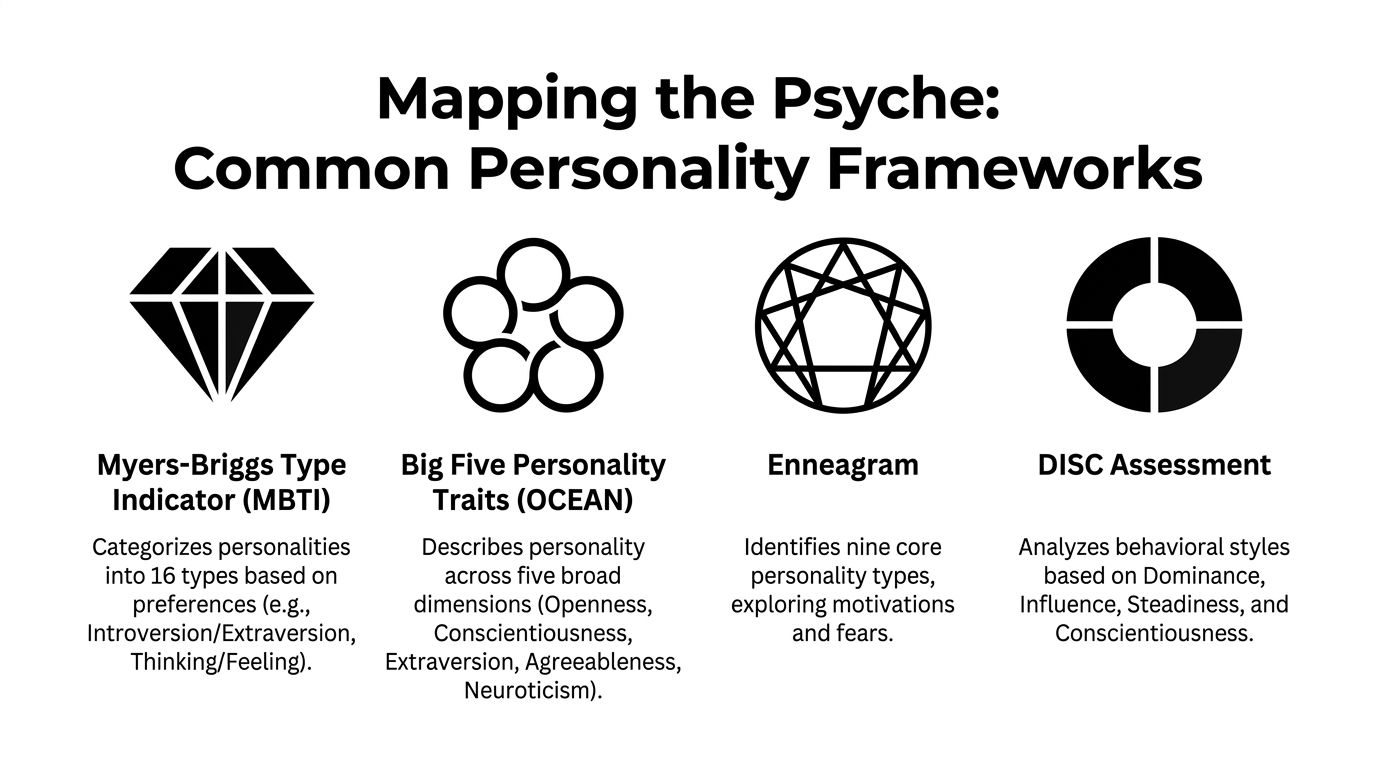
There isn’t just one map of personality. There are several, and each one highlights different features of the terrain.
Some tools focus on preferences. Some measure broad traits. Some dig into motivations. If you’ve ever felt confused because two tests seemed to describe you in different ways, that’s usually why. They weren’t asking the same question.
Enneagram for Motivation
The Enneagram asks a different kind of question. It looks at why you do what you do.
Instead of starting with visible traits, it points toward core motivations, fears, attention patterns, and coping strategies. That makes it especially useful when two people act the same on the outside but live from totally different inner drivers.
A few simple examples help:
• A person who seems highly responsible might be driven by a need to be good and correct.
• Another responsible person might be driven by anxiety and the need for certainty.
• A third might be responsible because they want admiration and respect.
All three may look organized. Their inner worlds are not the same.
That’s why many people find the Enneagram Test provides more profound change than description. It doesn’t just say, “Here’s your style.” It says, “Here’s the emotional strategy you learned to survive, belong, or feel safe.”
If you want a side-by-side comparison, this article on Enneagram vs MBTI helps clarify where each framework shines.
Myers-Briggs for preferences
The Myers-Briggs Type Indicator , first published in 1962, is taken by an estimated 2 million people annually , and over 89% of Fortune 100 companies have used it for leadership development according to this MBTI overview .
MBTI organizes people into 16 types using four preference pairs, such as Introversion or Extraversion, and Thinking or Feeling.
Why people like it:
• It’s memorable. • Many people can recall their four-letter type years later.
• It gives language to differences. • Teams often find it helpful when discussing communication or decision styles.
• It feels personal without being clinical.
Where readers get confused is this. MBTI describes preferences, not your full destiny. Two people with the same type can still look very different in life.
Big Five for traits
The Big Five , also called OCEAN, measures personality across five broad traits like Openness and Conscientiousness.
This model is often treated as the scientific benchmark because it measures traits on a spectrum rather than placing people into neat boxes. If your score is moderate on Extraversion, for example, that tells a different story than “you are an extrovert.”
Here’s the strength of the Big Five in plain language. It’s great for describing your personality with more precision. It’s less focused on inner narrative, core fear, or spiritual and relational growth.
A quick side-by-side view
| Framework | Best for | Main focus | Common use |
|---|---|---|---|
| Enneagram | Deep personal growth | Core fears, desires, and adaptive patterns | Self-awareness, relationships, coaching |
| MBTI | Understanding preferences | How you tend to process information and make decisions | Career reflection, team conversations |
| Big Five | Trait measurement | Broad personality dimensions on a spectrum | Research, assessment, coaching |
| DISC | Workplace behavior | Observable style in action and communication | Teams, management, training |
Why does the Enneagram often stick?
A self-discovery personality test becomes powerful when it explains recurring emotional patterns, not just visible habits.
The Enneagram tends to stick because it helps people recognize themselves in uncomfortable places. The achiever who can’t rest. The helper who gives to stay is needed. The loyal skeptic who scans for what might go wrong. The enthusiast who keeps moving so they don’t have to sit with pain.
That kind of recognition can sting a little. It can also feel like relief.
When a framework helps you understand your stress, your relationships, and the story you keep telling yourself, it stops being trivia. It becomes a tool for change.
Behind the Score: Understanding Validity and Reliability
Many individuals ask smart questions after taking any self-discovery personality test. Can I trust this? The answer depends on two ideas that sound technical but are simple: reliability and validity .
Reliability means consistency
Think about a bathroom scale.
If you step on it five times in five minutes and it gives you five wildly different numbers, the scale isn’t reliable. It may still look sleek in your bathroom, but it’s not helping.
Personality tests work the same way. A reliable test should give fairly stable results over time unless you’ve changed in meaningful ways or answered very differently.
The Big Five is often treated as the strongest benchmark here. Its meta-analytic test-retest reliabilities are 0.80 to 0.90 over 6-year periods , according to this Big Five overview .
Validity means accuracy
A reliable bathroom scale can still be wrong.
If it always adds ten pounds, it’s consistent but not valid. In personality testing, validity asks whether the test measures what it claims to measure.
That’s where weaker quizzes fall apart. They may feel relatable, but relatability isn’t proof. A result can sound poetic and still miss the mark.
Why do both matter?
A useful assessment needs both.
• Reliable enough • that your results aren’t random
• Valid enough • that the result reflects something real
• Clear enough • that you can use the result in life, not just admire it
A well-designed self-assessment can do more than entertain. A meta-analysis cited in the same Big Five source found a moderate positive effect on self-knowledge, with Hedges' g = 0.42 , when the tool is well designed and followed by reflection.
That last part matters. Reflection is part of the mechanism.
What To Look For As A Reader?
You don’t need a graduate degree in psychometrics to spot better tools. You just need a few grounded questions.
Ask these before trusting any result:
Where people get tripped up
Many readers expect a great test to feel perfectly flattering or perfectly final. It rarely does.
Sometimes the most accurate result is the one that makes you pause, laugh nervously, and say, “I don’t like how seen I feel right now.” That discomfort doesn’t automatically prove truth, but it often signals that the test is touching a real pattern.
A trustworthy assessment won’t replace your judgment. It sharpens it.
Turning Insight into Impact: Applying Your Results
A personality result becomes useful when it changes Tuesday afternoon.
Not when you screenshot it. Not when you announce your type in a group chat. When it helps you respond differently to stress, conflict, work, and love.
That’s the gap many personality articles leave open. They stop at self-awareness. But a major need in this space is the jump from insight to action, especially when people want help connecting personality insight to values, life purpose, and accountability, as described in this piece on behavior change after personality insight .

Personal growth in real life
The Enneagram is especially strong here because it points toward recurring patterns you can interrupt.
Take a person who identifies with Type 1 , often called the Reformer. Their growth work usually isn’t “become more responsible.” They already know how to do that. The deeper work is softening the inner critic.
A practical example:
• Before: • “If I relax, standards will drop.”
• After practice: • “Rest helps me act from wisdom, not irritation.”
That shift can lead to a tiny daily habit, like ending the workday by writing one sentence of self-respect instead of one sentence of self-correction.
Now consider Type 7 , often called the Enthusiast. They often bring energy, ideas, and possibilities. Their challenge is staying present when life gets dull, painful, or limiting.
A practical experiment for a Seven might be simple. Sit with one uncomfortable feeling for five quiet minutes before reaching for a distraction. That’s not flashy. It's profoundly impactful.
Coaching that connects insight to goals
Personality results get sharper when they meet a concrete goal.
Suppose a coach is working with a client who keeps saying yes to too many projects. The issue might look like time management. It may be identity management.
A coach might ask:
• What emotion appears right before you overcommit?
• What story do you tell yourself about saying no?
• Which value are you trying to honor, and which one are you abandoning?
That turns a personality insight into a decision tool.
For readers who want more ways to practice this kind of reflection, this guide on how to become more self-aware pairs well with any assessment result.
Team dynamics without the usual drama
Personality tools are also useful at work, especially when teams confuse differences with disrespect.
One employee wants direct, concise feedback. Another wants context and relational warmth. One starts tasks quickly and improvises. Another needs time to plan. If neither understands the other, both may invent unhelpful stories.
A few examples:
| Situation | Misread | More accurate read |
|---|---|---|
| Brief email | “They’re annoyed with me.” | “They prefer efficient communication.” |
| Detailed planning | “They don’t trust me.” | “They regulate stress through structure.” |
| Lots of ideas | “They’re scattered.” | “They think by exploring options.” |
Once people name these patterns, collaboration usually gets less personal and more practical.
A simple method for applying any result
If your test result feels interesting but fuzzy, use this four-part reflection:
That last step matters because insight fades fast without repetition.
From label to practice
A self-discovery personality test should eventually change your habits, not just your vocabulary.
That’s the ultimate win.
How to Choose a High-Quality Self-Discovery Test
By the time you start comparing assessments, it’s easy to get overwhelmed. Some tools promise precision. Others promise depth. Some are beautifully designed but thin on substance. Others are useful but hard to interpret.
A good choice usually comes down to a few simple filters.
What to check before you click start
Look for these qualities.
• A clear model: • The test should explain the framework behind the questions. If it can’t tell you what it measures, the result won’t mean much.
• Depth beyond behavior: • Some models focus on visible style alone. Tools like color-based systems can improve comprehension, but this • overview of Insights Discovery • notes that four-color approaches offer less granularity than systems like the Enneagram for relationship and workplace analysis.
• Actionable feedback: • A good report should help you do something different, not just admire your profile.
• Room for complexity: • You want more than a flattering summary. Look for nuance, tension, and growth guidance.
A quick decision table
| If you want... | Look for... |
|---|---|
| Simple language for team communication | A framework that explains style clearly |
| Scientific trait measurement | A tool grounded in established psychometrics |
| Deeper personal growth | A model that explores motivations, fears, and patterns |
| Relationship insight | Results that help compare dynamics between types |
One practical option
One factual example is Enneagram Universe , which offers a free, scientifically validated Enneagram assessment with 180 questions and reports on core motivations, fears, desires, Wings, Triads, and Health Levels. For people who want a self-discovery personality test that goes beyond surface behavior, that kind of detail can be useful because it gives more to work with after the result arrives.
A final gut check
Before you trust any result, ask yourself one honest question.
Does this assessment help me understand myself with more clarity and responsibility, or does it just give me a stylish excuse to stay the same?
That question cuts through a lot of marketing.
A strong test should leave you feeling seen, challenged, and equipped. Not boxed in.
Your Journey Begins Now
If you’ve read this far, you probably don’t want another throwaway quiz result. You want language for the parts of yourself that feel confusing. You want patterns to make sense. You want change that feels real, not performative.
That’s a worthy reason to begin.
A self-discovery personality test can help, but only if you treat the result as an opening. Not a verdict. Not a costume. Not a permanent excuse for every sharp reaction, every withdrawal, or every messy habit.
Keep your curiosity bigger than your label
Every personality framework has limits. You are always larger than a category.
Still, a good assessment can give you something precious. It can show you the patterns you couldn’t see clearly from the inside. It can help you understand why conflict stings, why praise feels necessary, why rest feels unsafe, or why closeness and independence tug on you at the same time.
That kind of knowledge can make you kinder.
Be kinder to your partner when they communicate differently. Kinder to your coworker when they need more structure than you do. Kinder to yourself when you notice that your so-called flaws may have started as survival strategies.
Let the result become a doorway
You don’t need to overhaul your life this week.
Start smaller. Notice one repeated pattern. Ask what it protects. Try one different response. Repeat. That’s how insight becomes character.
Self-discovery isn’t a one-time event. It’s a lifelong conversation between who you’ve been, who you are, and who you’re becoming.
If you want a practical place to begin, try Enneagram Universe . It offers a free Enneagram assessment built for deeper self-understanding, with results that focus on motivations, fears, and growth patterns so you can turn insight into meaningful change.