Relationships Are Give and Take: A Guide to Mutual Connections

We've all heard the old saying: relationships are give and take . But if you’re picturing a perfectly balanced 50/50 scale, you’re setting yourself up for a whole lot of scorekeeping and resentment. Real partnership isn't a transaction; it's a dance.
The Dance of Give and Take in Modern Relationships
Think of your relationship like you’re co-piloting a small plane. It’s not about both of you keeping one hand on the controls at all times. That’s just a recipe for chaos. It’s about knowing when to fly the plane and when to let your partner take the lead.
When you hit turbulence—a brutal project at work, a family emergency, or a personal funk—one of you might need to grab the controls and focus entirely on navigating. The other person’s job? To manage communications, offer support, and be a second pair of eyes. The roles might flip next week, but what really matters is that you're both working to land the plane safely together.
This is where so many people get it wrong. They expect perfect equality in every moment, which just isn't realistic. A strong partnership is built on the trust that the balance will work itself out over the long haul, not in every single interaction.

Beyond the Scorecard
True give and take is about showing up for each other with emotional support and mutual effort. This is the bedrock of a satisfying relationship. In fact, the Ipsos Love Life Satisfaction Index 2026 found that a whopping 82% of married or partnered individuals report being satisfied with their relationship. That kind of happiness doesn't come from keeping a tally; it comes from a shared commitment.
A healthy relationship isn't a transactional exchange where you give something to get something back immediately. It's a dance of mutual care, where you give freely because you care for your partner's well-being, trusting they will do the same for you when you need it.
Take a couple like Sarah and Tom. When Tom's dad got sick, Sarah instinctively stepped up, handling everything from household chores to emotional support for months on end. Later, when Sarah decided to chase a dream and go back to school, Tom became her number one fan. He worked extra hours and made sure dinner was on the table so she could bury herself in textbooks.
They weren't counting favors. They were simply responding to each other's needs at different times.
This dynamic can become especially important when navigating relationships during recovery, where the scales of give and take can shift dramatically. Learning to manage this fluid balance is a skill, and it starts with understanding your own tendencies. If you’re curious about strengthening these muscles, our guide on building essential relationship skills i s a fantastic place to start. This dance of trust and attunement is what ultimately creates a partnership that’s not just strong, but genuinely happy.
Why Reciprocity Can Feel So Difficult
Ever feel like you're the one carrying the emotional weight in your relationships? You're the one who always texts first, makes the plans, or offers a shoulder to cry on. If that sounds familiar, you know the quiet frustration of an unbalanced connection. We’re all told that relationships are give and take , but getting that balance right feels less like a simple see-saw and more like a tightrope walk.
It's rarely a case of one person being a selfish jerk and the other a selfless saint. Most of the time, the imbalance comes from a tangle of invisible forces.
One of the biggest culprits? Unspoken expectations. You might operate under the assumption that if you offer help, your friend will naturally do the same when you're in a bind. For example, you drop everything to help a friend move apartments, but a month later when you need help building a bookcase, they're suddenly "too busy." This mismatch is a classic recipe for resentment, where you end up feeling slighted for needs you never actually voiced out loud.
And even when you do try to talk, things can get lost in translation. Your version of a supportive chat might feel like an interrogation to your partner. When you think you're giving them healthy space, they might see it as you pulling away emotionally. It can feel like you're both speaking totally different languages.
The Hidden Motivations of Personality
To really get to the bottom of why give-and-take gets so messy, we have to dig deeper than surface-level actions. Our core fears, desires, and motivations are the puppet masters pulling the strings. This is where a framework like the Enneagram becomes a game-changer, revealing the hidden "why" behind what we do.
Let’s look at a classic example. Meet Mark and Jessica.
• Jessica is an Enneagram Type Two (The Helper): • Her entire world is built around a desire to be loved and needed. She shows affection by giving—cooking Mark's favorite dinner, planning elaborate date nights, and constantly asking how he's feeling. This is love, in her language.
• Mark is an Enneagram Type Five (The Investigator): • His core drive is to feel competent and capable. He dreads being overwhelmed by other people's needs and instinctively conserves his time and energy to feel safe and in control.
You can probably see where this is going. Jessica's constant giving feels suffocating to Mark, who retreats to protect his personal battery. His withdrawal then feels like a painful rejection to Jessica, who redoubles her efforts to "give" more, hoping to win back his affection. Neither of them is wrong , but their core wiring has trapped them in a cycle where they both feel perpetually misunderstood.
This dynamic reveals a powerful truth: Imbalance is often born from two well-meaning people trying to get their fundamental needs met in completely opposite ways.
The Fear of Being Needy
Beyond our personality type, a lot of us are lugging around a deep-seated fear of being a burden. This can make us over-give to "earn" our spot in a relationship or avoid asking for anything at all. In fact, research shows that people often fall into a trap of trying to "fix" their partners or take on all their problems, thinking it's the ultimate act of support.
A practical example is someone who always insists on paying for dinner, not out of generosity, but from a subconscious fear that if they don't, their friend won't want to hang out with them. This isn't really about being helpful, though. It's often an attempt to control the relationship's stability. If I'm always the giver, you can't leave me, right? But this isn't a sustainable strategy for a healthy partnership—it's a one-way ticket to burnout and bitterness.
True reciprocity requires the guts to not only give support but also to stick your hand up and ask for it when you need it. Figuring out your own tendencies is the first real step toward breaking these patterns and building connections that actually feel good.
How to Spot an Unbalanced Relationship

Everyone loves to say that relationships are give and take , but what does it actually feel like when yours has become a one-way street? An imbalance rarely announces itself. It’s a slow creep, sneaking in under the guise of small favors or one person just being "the planner." Then one day, you look up and realize you're carrying the weight for two.
That nagging feeling that something is off ? That’s your intuition talking. It’s that low-grade frustration after a phone call or the sense of exhaustion when you think about making weekend plans. But feelings can be fuzzy. Let's get specific and look at the real, observable signs that tell you where your relationship truly stands.
Red Flags in Your Everyday Interactions
A lopsided dynamic goes way beyond who picks up the check for dinner. It’s a pattern that weaves its way through your communication, effort, and emotional support. The biggest red flag of all is when one person is consistently doing all the "relationship work" while the other is just along for the ride.
Take a second and think about your last few interactions. Are you always the one who has to:
• Kick things off? • You send the first text, make the call, and suggest getting together. You have a sinking feeling that if you stopped, you might just drift apart.
• Be the social director? • From booking a table for date night to figuring out a fun Saturday activity, you’re the default event planner. Their only job is to show up.
• Do the emotional heavy lifting? • You’re their 24/7 sounding board and advice columnist. But when you need a shoulder to lean on, they suddenly get distracted, look uncomfortable, or pivot the conversation back to themselves.
This isn’t just about romance. This dynamic can pop up with friends, family, and even coworkers. When you've been unofficially cast as the "giver" and they’re the "taker," it’s only a matter of time before resentment starts to bubble up.
The Scoreboard You Never Agreed To
One of the sneakiest signs that things are out of whack is when you catch yourself keeping a mental tally. You start noticing you’ve hosted the last three hangouts, or that you’ve caved on every movie choice for the past two months. In a healthy, flowing relationship, things feel fair over time—no spreadsheet required.
When you start mentally tracking favors and compromises, it's a clear signal that the natural flow of reciprocity has been disrupted. This scorekeeping isn't petty; it's your subconscious alerting you to an imbalance that needs attention.
If you find your internal monologue is full of excuses for the other person—"Oh, they're just so busy right now," or "That's just how they are"—it's time for a gentle reality check. Sure, life throws curveballs, but a constant, unchanging state of imbalance points to a crack in the very foundation of the relationship.
Healthy vs. Unhealthy Dynamics: A Side-by-Side Look
Sometimes the best way to see the truth is to look at the black-and-white contrast. This little chart can be a powerful gut-check, helping you see clearly where your own connections fall.
Let’s break down what a balanced partnership looks like compared to one that’s seriously out of sync.
Healthy Reciprocity vs Unhealthy Imbalance
| Relationship Aspect | Healthy Give and Take (You Both...) | Unhealthy Imbalance (One Person...) |
|---|---|---|
| Communication | Initiate conversations and share openly about your feelings and needs. | Almost always initiates contact and has to pull information out of the other. |
| Effort & Planning | Share responsibility for making plans and contributing ideas for activities. | Does all the logistical work, from planning dates to remembering birthdays. |
| Emotional Support | Offer and receive comfort, listen actively, and are present during tough times. | Acts as the primary therapist, while their own needs for support go unmet. |
| Compromise | Find middle ground on decisions, from small choices to major life plans. | Consistently gives in to the other's preferences to avoid conflict or disappointment. |
| Appreciation | Regularly acknowledge and value each other’s contributions, big and small. | Takes the other’s efforts for granted, rarely offering a simple "thank you." |
Seeing these signs isn't about pointing fingers or declaring someone the "bad guy." It's about turning the lights on. Once you have this clarity, you're empowered to decide what to do next.
Small Actions That Restore Big Balance
Forget the grand, movie-style gestures. Fixing a lopsided relationship isn't about some dramatic, tear-filled confrontation or a surprise trip to Paris. Honestly, most of the time, those big moves just create more pressure. The real magic? It’s found in the small, almost-invisible adjustments you make every single day.
If you feel like the scales have tipped, the trick is to stop waiting for a big, defining moment to fix everything. Instead, start recalibrating your connection with tiny, intentional actions. This is how you actually build a relationship where give and take feels natural, not like you're keeping score. You're not starting a new scoreboard; you're just getting the rhythm back.
It all starts with something simple: paying attention. Really tuning in to the other person's world, not just your own. Are they sighing at their laptop every five minutes? Did they offhandedly mention a big deadline is looming? These are the quiet little flags letting you know their tank is running low. They might need to be the "taker" for a little while, and that’s okay.
Get Ahead of the Burnout
One of the most powerful shifts you can make is to stop reacting and start being proactive. Instead of waiting for your partner, friend, or coworker to hit their breaking point and finally ask for help, you can step in before the fire even starts. You don't have to be a mind-reader for this—just a good teammate.
Here are a few small but mighty ways to start doing that right now:
• Actually Listen: • When they're talking, put your phone face down. Don't just wait for your turn to jump in. Ask a real follow-up question like, "That sounds tough. What's the worst part of it for you?" It shows you're in it with them.
• Notice the Little Things: • A simple, "Hey, thanks for making the coffee this morning, I was dragging" can completely change the tone of a day. It’s not just about the coffee; it’s about seeing and valuing their effort.
• Offer Before They Ask: • See a full trash can? Just take it out. If they look completely fried after a long day, say, "You look exhausted. Why don't you go crash on the couch? I've got dinner covered tonight."
True reciprocity isn't about keeping score; it's about being attuned to each other's needs and responding with generosity. It’s the trust that when you need support, your partner will step up, just as you have for them.
A Real-World Example of Give and Take
Let’s picture a couple, Mike and Jenna. Mike’s getting absolutely crushed at work trying to hit a project deadline. He’s been coming home late, stressed out, and has the social energy of a rock.
In the past, Jenna might have felt a spark of resentment that he’s so checked out. Mike, in turn, would feel guilty but too swamped to do anything about it. But this time, Jenna sees the situation for what it is: a temporary "take" moment for Mike. So she gives . She orders his favorite takeout, keeps things quiet so he can decompress, and takes the dog out without making a big deal of it.
The next week, Jenna comes down with a nasty cold. Mike, remembering her quiet support, steps up. He takes over the weekend chores, makes a surprisingly decent soup, and basically orders her to rest. It’s not a transaction—it’s a partnership in motion.
This kind of daily dance is everything. In fact, research shows that while our satisfaction in a relationship can bounce around from day to day, those ups and downs are often synchronized between partners. That means one person's "give" can instantly cushion the blow of the other's bad day. You can see more of the fascinating science behind this in this relationship satisfaction research .
Mastering Give And Take With The Enneagram
Ever feel like your relationship’s give-and-take is… well, lopsided? You’re not alone. The truth is, that perfect balance we all crave is deeply personal, and the Enneagram is the perfect tool to figure out why . Think of it less like a personality quiz and more like a map to your own inner wiring—the hidden fears and desires that dictate how you show up for others and what you ask for in return.
After all, what we give and what we take isn’t random. It’s all tied to what we need to feel safe, valued, and loved. This is where the old saying " relationships are give and take " gets a major upgrade. When you know your Enneagram type, you can finally see the invisible scripts you’ve been following. Maybe you're a Type 2 who showers people with help to feel needed, or a Type 8 who "gives" by taking control. Perhaps you're a Type 7 who constantly "takes" new experiences to sidestep any potential boredom or pain.
Seeing the pattern is the aha! moment. From there, you can start consciously rewriting the script.
This whole process can feel complex, but it boils down to a pretty simple loop.
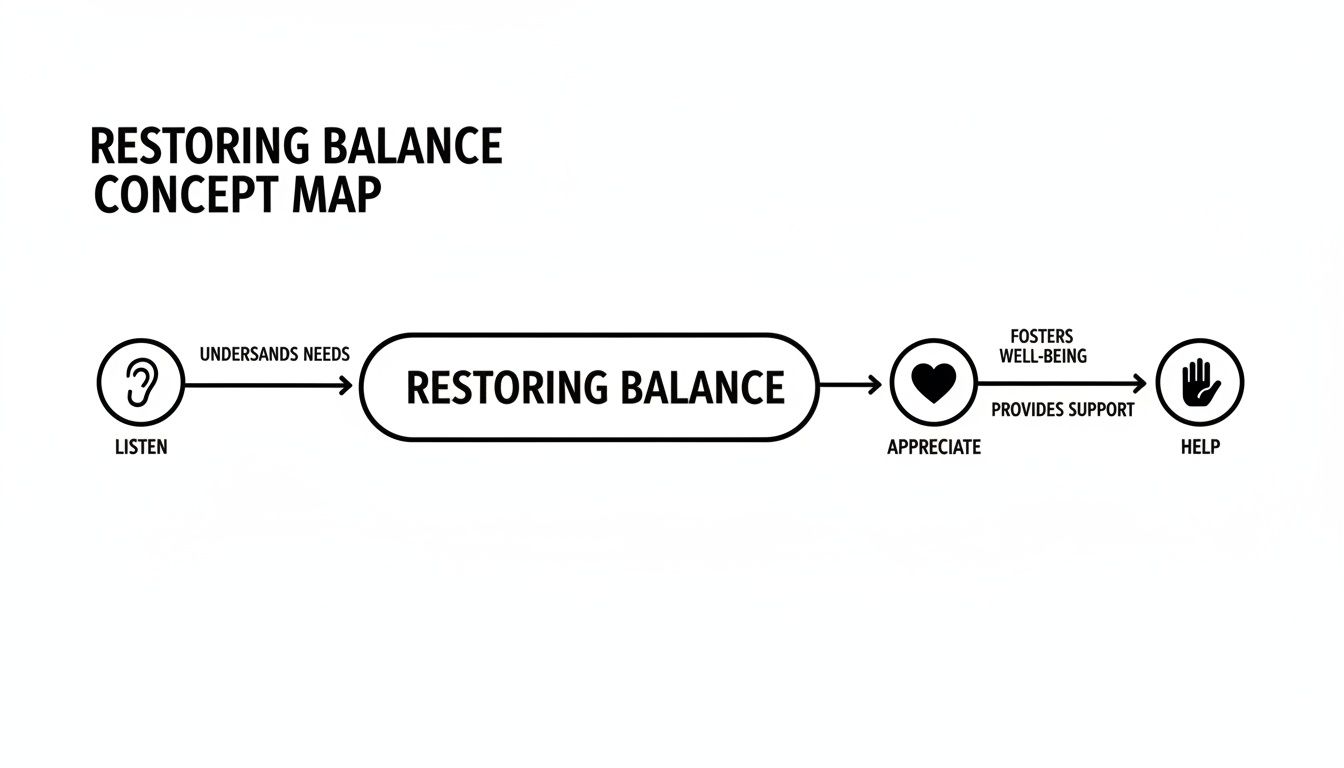
It all starts with genuine listening, which builds the appreciation needed to finally offer the right kind of help. This is the heartbeat of a healthy, reciprocal connection.
Your Enneagram Type And Reciprocity
Let’s be honest: each of the nine Enneagram types has its own unique flavor of imbalance. Our core motivations practically guarantee we’ll lean too far in one direction. The key is to know your go-to move so you can try something new.
Unpacking your Enneagram's give-and-take style isn't about judging yourself. It's about gaining the self-awareness to stop sleepwalking through your relationships and start choosing a more balanced way of connecting.
This is how you get off autopilot. You stop just reacting and start intentionally building connections that actually feel good for everyone involved. For a closer look at how these dynamics play out, check out the following: A Guide to Enneagram Types in Relationships .
Enneagram Guide To Balanced Give And Take
So, what does this look like in the real world? We've put together a cheat sheet that breaks down each Enneagram type's typical imbalance and one small, practical step you can take today to start tipping the scales back toward center.
| Enneagram Type | Common Give/Take Imbalance | Action for Healthy Balance |
|---|---|---|
| Type 1 The Reformer | Gives criticism and correction to "improve" things. Resists "taking" help, viewing it as a sign of imperfection. | Practice Taking: Consciously ask for help with a task you'd normally do yourself, accepting that it won't be done "perfectly." |
| Type 2 The Helper | Over-gives support, time, and energy to be loved. Struggles to "take" for themselves or admit their own needs. | Practice Taking: Say "no" to a request without guilt and schedule an activity that is just for you, with no one else to please. |
| Type 3 The Achiever | "Gives" an image of success and competence. "Takes" on tasks and projects to prove their value to others. | Practice Giving: Share a genuine moment of vulnerability or a recent struggle, giving others a chance to see the real you. |
| Type 4 The Individualist | "Gives" emotional depth and intensity. "Takes" things personally, feeling misunderstood or deficient. | Practice Taking: Accept a simple compliment or positive feedback without questioning its sincerity or reading into it. |
| Type 5 The Investigator | "Gives" information and expertise. "Takes" a lot of personal space and time to recharge, often withdrawing. | Practice Giving: Proactively share your time or energy by offering to join a friend for an activity, even if it feels draining at first. |
| Type 6 The Loyalist | "Gives" loyalty and commitment. "Takes" on anxiety, seeking reassurance and guidance from others constantly. | Practice Giving: Make a small but important decision without seeking external validation, giving yourself trust and confidence. |
| Type 7 The Enthusiast | "Gives" fun and positive energy. "Takes" experiences and opportunities to avoid missing out and feeling pain. | Practice Giving: Give your undivided attention by sitting with a friend's difficult feelings without trying to reframe them positively. |
| Type 8 The Challenger | "Gives" protection and control. "Takes" charge of situations to avoid being controlled or vulnerable. | Practice Taking: Intentionally follow someone else's lead on a project or plan, "taking" a backseat and trusting their process. |
| Type 9 The Peacemaker | "Gives" in to others' preferences to avoid conflict. Has trouble "taking" a firm stance or prioritizing their own desires. | Practice Giving: Give your honest opinion on a small decision (like where to eat dinner) even if it differs from the group's. |
By using these small, targeted actions, you’re not just trying a new behavior; you’re rewiring a lifelong habit. To keep things fresh, you could even find the perfect couple card game to create fun, low-pressure moments for practicing these new ways of being together.
What Happens When Stress Tips the Scale
Here's the twist: the give-and-take pattern in the table above isn't fixed. It's your baseline — but stress turns up the volume on it. When you're tired, overwhelmed, or feeling unsafe in the relationship, your typical "give" or "take" move doesn't just continue, it intensifies, often in ways that backfire.
Take a Type 2 who's already prone to over-giving. Under stress, that tendency doesn't ease off — it spikes. They'll take on more, hint less about what they need, and quietly keep score of everything they've done, until it all comes out sideways in a fight that seems to come from nowhere. Or a Type 5, whose baseline is withdrawing to recharge: under stress, that healthy need for space can turn into disappearing entirely, leaving a partner to wonder what happened. A Type 8's protective "I'll handle it" can, under enough pressure, shift into steamrolling the very person they're trying to protect.
None of this means you're broken — it means the pattern got louder before anyone had a chance to notice it. And that's actually good news, because a louder pattern is an easier one to catch.
Try this the next time you notice yourself in a stress spiral: pause and ask, "Is this my usual give-and-take move, just turned up too high?" Naming it out loud to your partner — even just "I think I'm doing the thing again" — does more to reset a tense moment than trying to power through it solo.
If you're not sure whether what you're seeing is your baseline pattern or a stress reaction, that's exactly the kind of thing a deeper look at your type can clarify — retaking the free Enneagram test is a quick way to check in on where you're at right now.
Remember, finding balance isn't about erasing your personality. It’s about stretching it—expanding your ability to both give freely and receive fully.
Conversation Starters That Actually Work
Alright, so you’ve figured out the give-and-take in your relationship is officially out of whack. Now what? Knowing there’s a problem is one thing, but actually talking about it without launching World War III is a completely different beast.
The fear is real. You don’t want to sound needy, demanding, or accusatory. So, you stay quiet. The resentment bubbles up, day after day, until one tiny thing makes you explode. Sound familiar? There’s a better way.
The magic trick is to stop pointing fingers and start sharing your own experience. When you use “I feel” statements, you’re not throwing an accusation; you’re opening a window into your world. It invites your partner to step inside and understand, rather than immediately putting up their defenses. It’s the difference between "You never help out!" and "Lately, I've been feeling totally swamped by everything at home." One is a battle cry, the other is a conversation starter.
This is the foundation of getting on the same page. When you own your feelings, you create a safe space for the other person to be honest about theirs, which is the only way you’ll find a real solution. If you want to dig deeper into this, we've got a whole toolbox of relationship communication exercises that can help.
For Your Romantic Partner
This is usually the conversation with the highest stakes, so a soft entry is everything. Your goal is to frame this as a "we" problem, not a "you" problem.
• The Script: • • "Hey, I've been feeling a bit disconnected lately, and I really miss feeling like we're a team. It feels like I'm handling most of our social planning, and I'd love to feel more like we're in it together. Could we find a time to brainstorm some fun date ideas?"
• Why It Works: • You’re leading with something you both value ("our team") and using "I feel" to express loneliness without an ounce of blame. The call to action is positive and collaborative, making it an invitation to reconnect, not an attack.
For a Close Friend
With friends, the big worry is making things awkward and ruining the vibe. The best approach is to be direct but warm, centering the whole conversation on how much you love the friendship.
• The Script: • • "Hey, I've been feeling a little distant lately because it seems like I'm usually the one reaching out to make plans. I really value our friendship and want to make sure we stay close. Is there a better way for us to keep in touch that works for both of us?"
• Why It Works: • You’re honest about the specific behavior (always being the one to initiate) but immediately cushion it with a positive emotion ("I value our friendship"). This gives them a chance to explain their side—maybe they've been slammed with work or just didn't realize it was happening.
Starting these talks isn't about winning an argument. It’s about being vulnerable enough to say, "Our connection matters to me, and right now, it feels off-balance. Can we fix it together?" This is the essence of a healthy give and take dynamic.
For a Coworker
In the office, you have to keep it professional. The conversation should be about the work, the deadlines, and the team’s success. Stick to facts and focus on a practical fix.
• The Script: • • "I've noticed the workload on our shared project has felt a bit uneven lately, and I’m concerned about hitting our deadline without getting burnt out. Could we take • 15 minutes • to review our task list and make sure we have a clear and balanced plan moving forward?"
• Why It Works: • This is all about the shared goal. By using neutral language like "uneven workload" and tying it to a common concern (the deadline), you turn a personal grievance into a logical, practical problem for the team to solve together.
Frequently Asked Questions
Alright, so we all know in our heads that relationships are give and take . But when you're in the thick of it, trying to fix an imbalance can feel like trying to solve a Rubik's Cube in the dark. It’s messy and frustrating.
Let's walk through some of the questions that come up time and time again when people are trying to get their connections back on solid ground.
What If My Partner Isn't Willing To Change Our Dynamic?
This is a heartbreaking spot to be in, and I’m not going to sugarcoat it. The toughest truth in any relationship is that you can't make someone else change. You just can't.
If you’ve laid your heart on the line—calmly, clearly, using those "I feel" statements we all know and love—and they’re still not willing to budge or even meet you halfway, then the ball is unfortunately in your court. You have a really difficult choice to make.
You have to ask yourself: If nothing changes, can I be truly happy in this relationship as it is, right now? It's a question that requires some serious soul-searching. Trying to drag someone toward change they don't want is a fast track to exhaustion and resentment for everyone involved.
Can A Relationship Survive If One Person Is Naturally a Giver?
Oh, absolutely! In fact, most relationships have a natural "giver" and someone who is more comfortable "receiving." It’s a common pairing. The dynamic only becomes a problem when it tips into a one-sided expectation, leaving the giver feeling like a constantly running tap with no one refilling the well.
For this to work beautifully, a few things need to happen:
• The "giver" has to get comfortable using their words and asking for what they need directly. No more hoping their partner develops mind-reading abilities overnight. A practical example: Instead of sighing loudly while doing the dishes, they could say, "I'm feeling really tired tonight. Would you mind taking over dish duty?"
• The "receiver" needs to make a conscious, loving effort to show they appreciate all that giving. They can also look for opportunities to give back, even if it feels a little unnatural at first. For instance, if their partner always plans date nights, they could take the initiative to book a reservation at a restaurant their partner loves.
The goal isn't to force a personality transplant. It's about both partners stretching just a little. The giver learns to graciously receive, and the receiver practices the art of giving. That’s where you find a beautiful, conscious balance.
How Does Financial Stress Affect Give And Take?
Money worries are like a magnifying glass for every crack in a relationship, especially when it comes to reciprocity. When finances get tight, everything can feel scarce—not just cash, but the time and energy for things that keep you connected, like a simple date night. It's incredibly easy for scorekeeping and resentment to creep in.
There's a real connection here. A Morning Consult analysis found that 71% of high earners said they were satisfied with their romantic lives. That’s a whopping 25 points higher than the 46% reported by low earners. It's not that money buys love, but financial breathing room certainly frees you up to invest more emotionally in each other. You can dig into the findings on romance and finances yourself.
When your budget is squeezed, your communication has to be rock-solid. You have to shift into "team mode," focusing on all the non-financial ways you can support each other to keep that give-and-take flowing.
Curious about your own personal style of giving and taking? The best way to start is by understanding your core motivations. Enneagram Universe offers a free, surprisingly deep personality test that can shed light on why you do what you do.
Discover your Enneagram type and get personalized strategies to build healthier, more balanced relationships. Start today at Enneagram Universe .