Problem-Solving Team Activities to Boost Collaboration and Innovation

Tired of the same old team-building exercises that promise breakthroughs but deliver only awkward silence and a shared sense of dread? We've all been there. You build a spaghetti-and-marshmallow tower, learn a fun fact about Brenda from accounting, and then... nothing really changes back at your desks.
In today's complex workplace, generic solutions fall flat. True innovation and effective collaboration require a deeper understanding of what makes your team tick. We're talking about the hidden motivations, fears, and unique cognitive styles that shape every single decision and interaction. To effectively unlock this potential, it's crucial to understand the foundational elements of fostering cohesion and engagement, which can be cultivated through well-designed high-impact corporate team building events . But for day-to-day challenges, you need something more ingrained.
This isn't just another list of games; it's a strategic toolkit of powerful problem solving team activities , grounded in the psychological depth of the Enneagram. We'll move beyond surface-level collaboration to unlock the innate genius within each team member, transforming friction into fuel and challenges into triumphs.
This guide provides a curated collection of actionable exercises, each with step-by-step instructions, facilitation tips, and even adaptations for different workplace scenarios. Get ready to discover how understanding personality isn't just a 'soft skill'. It's the ultimate competitive advantage for building a team that doesn't just solve problems, but actively seeks them out and crushes them with creative confidence. Let's dive in.
1. Enneagram Type-Based Role Assignment in Problem-Solving Teams
Forget randomly assigning tasks or letting the loudest voice dominate. This powerhouse technique turns team dynamics into a strategic advantage by assigning problem-solving roles based on each member's core Enneagram type. The idea is simple but profound: tap into your team's natural strengths, motivations, and perspectives to build a problem-solving machine where everyone is positioned to excel. This isn't about boxing people in; it's about setting them up for a spectacular win.
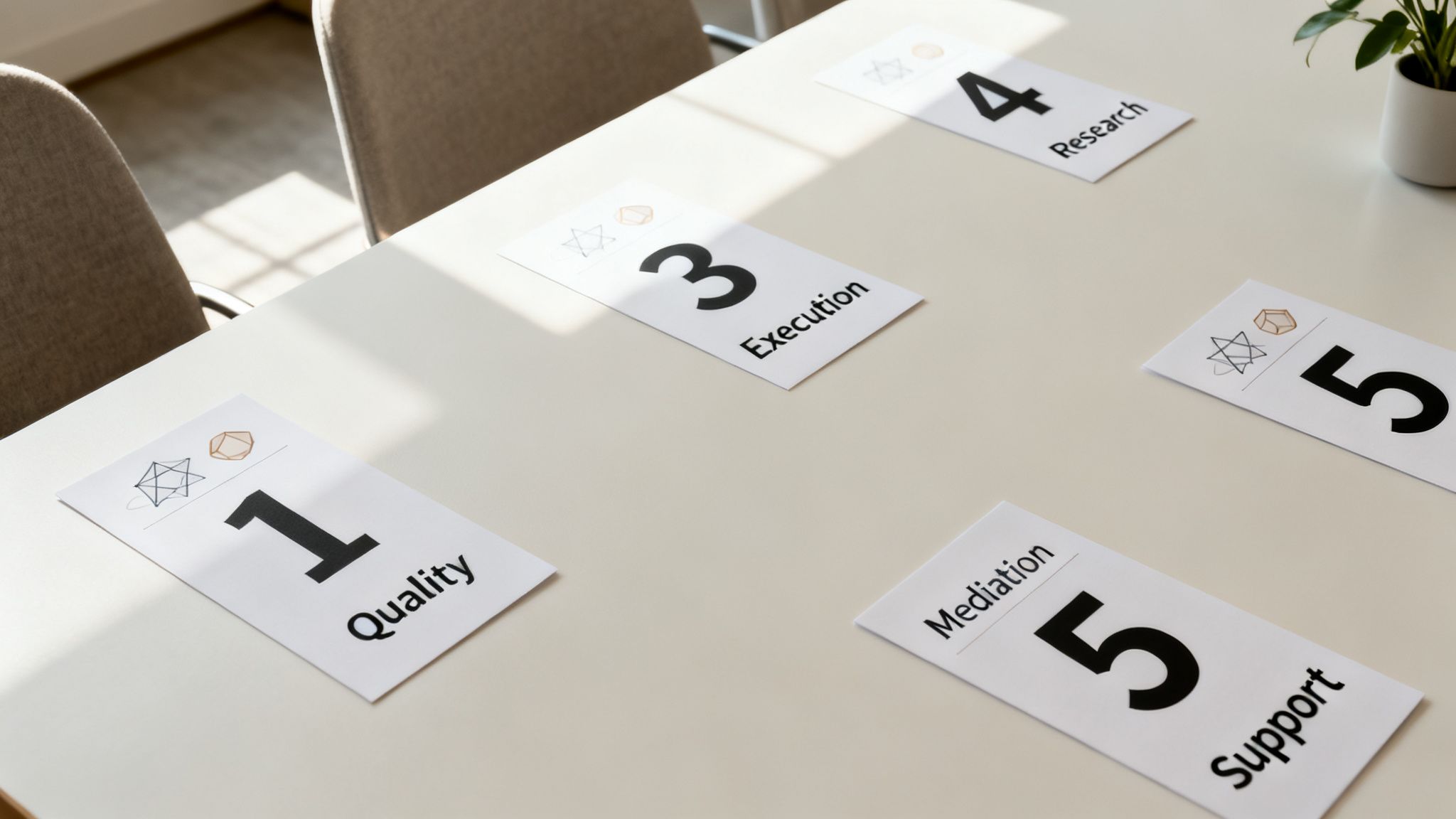
This method moves beyond generic roles and leverages the deep psychological insights of the Enneagram. Instead of just a "leader," you have a decisive Type 8 managing conflict or a goal-oriented Type 3 driving execution. A meticulous Type 1 naturally excels at quality assurance, while an innovative Type 7 is perfect for brainstorming wild, out-of-the-box solutions. It's one of the most effective problem-solving team activities because it honors individual differences and assembles them into a cohesive, high-functioning unit.
How to Implement It
This approach is championed by experts at the Enneagram Institute and is increasingly used by management consulting firms to build balanced client-facing teams. For a deeper dive into applying these concepts, you can explore more about the Enneagram in professional settings .
2. The Divergent-Convergent Thinking Exercise with Enneagram Wings
Stop your brainstorming sessions from turning into a chaotic free-for-all or a premature shutdown of good ideas. This exercise brings elegant structure to creative chaos by separating the problem-solving process into two distinct phases: divergent thinking (generating a wide array of ideas) and convergent thinking (narrowing down and selecting the best solution). The secret sauce is leveraging team members' Enneagram Types and Wings to lead the phase where they naturally shine.
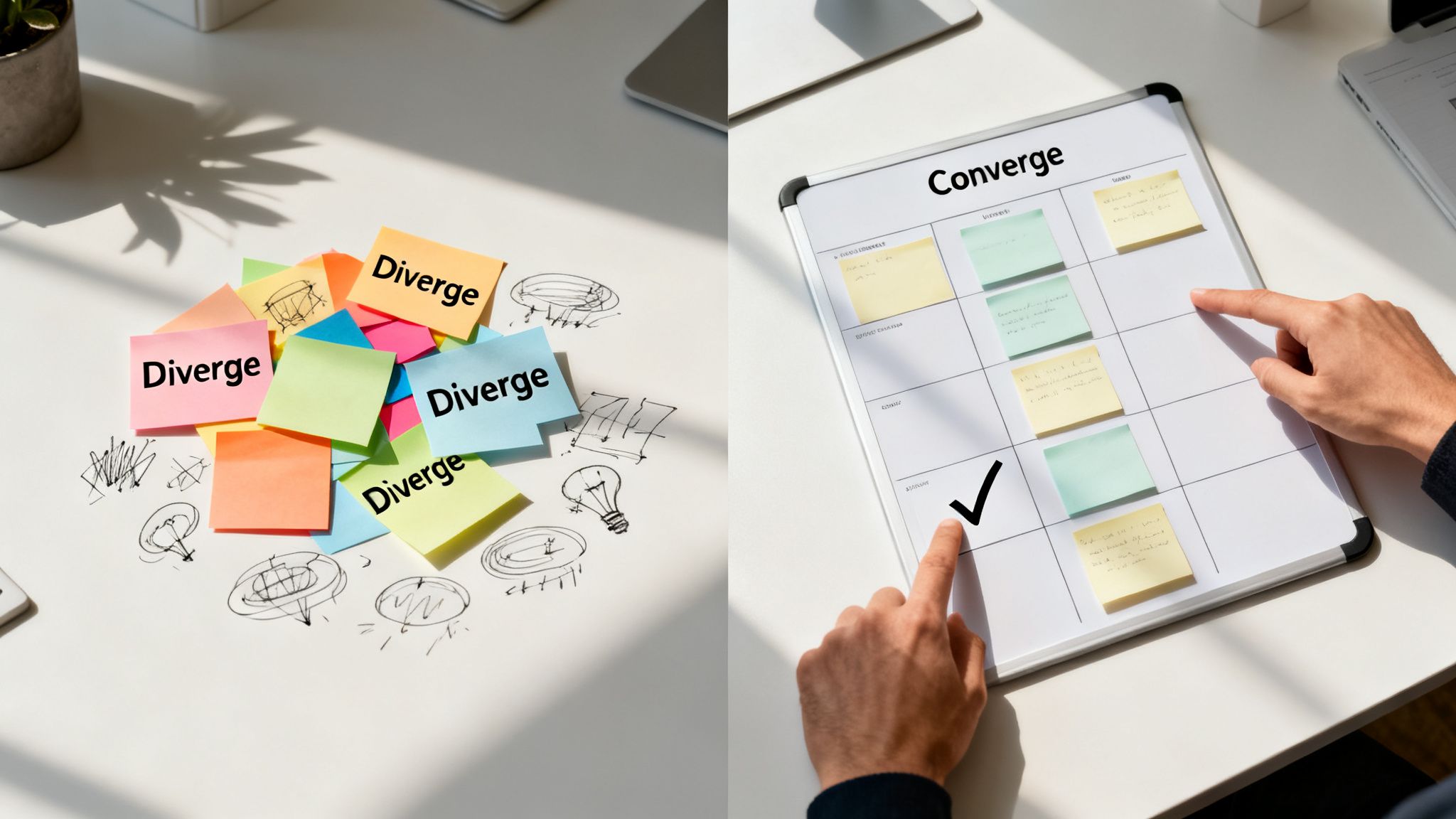
This method, inspired by the work of creative thinking pioneer Edward de Bono and adapted by modern Enneagram coaches, prevents the common pitfall where analytical minds critique creative ideas before they can fully form. During the divergent phase, you unleash your optimistic Type 7s, imaginative Type 4s, and open-minded Type 9s to generate possibilities without limits. Then, in the convergent phase, you call upon the decisive Type 8s, principled Type 1s, and results-oriented Type 3s to analyze, refine, and drive towards a final decision. This makes it one of the most effective problem-solving team activities for ensuring both creativity and execution are given their proper due.
This structured approach is used by top marketing agencies in the US to separate wild campaign ideation from strategic selection, ensuring both bold creativity and a clear path to execution. For more on the foundational concepts, explore the principles of lateral thinking .
3. Triad-Based Perspective-Taking Workshops
Stop looking at problems from a single, overworked angle. This brilliant workshop model splits your team into their Enneagram Triads: Head (Types 5, 6, 7), Heart (Types 2, 3, 4), and Body (Types 8, 9, 1). Each group tackles the same problem through its dominant lens, revealing a 360-degree view you’d otherwise miss. This isn't about creating division; it's about harnessing the power of diverse cognitive centers to build a truly robust solution.
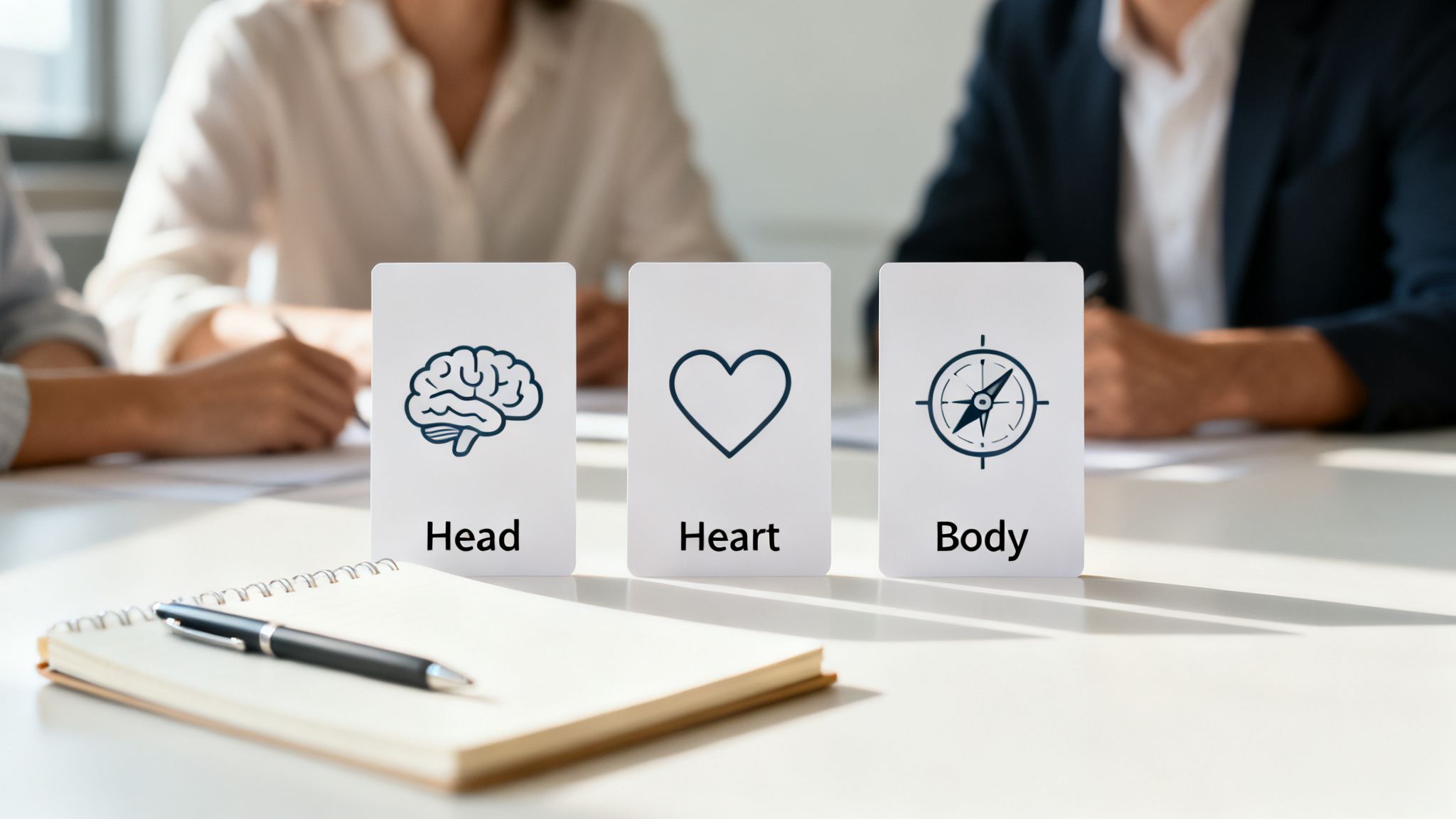
The magic lies in making unconscious perspectives conscious. The Head Triad will naturally dissect the problem with logic and future-oriented analysis. The Heart Triad will instinctively focus on the emotional impact and how the solution affects people. Meanwhile, the Body Triad will ground the discussion in practical, actionable steps and gut feelings about what’s right. By intentionally separating and then reintegrating these viewpoints, you transform potential conflict into comprehensive insight, making it one of the most holistic problem-solving team activities available.
How to Implement It
This method is championed by organizational psychologists and Enneagram experts like Russ Hudson. For example, a healthcare team might use it to balance analytical treatment plans (Head), patient emotional well-being (Heart), and practical implementation by staff (Body).
4. The Enneagram Integration Path Role-Play Exercise
Move beyond understanding your Enneagram type and step into who you can become under pressure. This dynamic exercise challenges team members to role-play from their "Direction of Integration," embodying the healthiest traits of another Enneagram type. A typically withdrawn Type 5 practices the confident decisiveness of a Type 8, while a rigid Type 1 adopts the joyful spontaneity of a Type 7. It's a transformative workout for emotional intelligence and collaborative strength.
This method, rooted in the work of Don Riso and Russ Hudson, turns psychological theory into hands-on practice. Instead of just reacting from their usual patterns, team members get to experience and model their highest potential. A conflict-averse Type 9 learns to embody the focused energy of a Type 3, driving solutions forward. This is one of the most profound problem-solving team activities because it doesn't just solve the problem at hand; it builds the team's capacity for future resilience and growth by creating new neural pathways for healthier behavior.
How to Implement It
This powerful technique is a cornerstone of advanced Enneagram coaching and leadership development programs.
5. Wing Perspective Blend Problem-Solving Sessions
If you think understanding core Enneagram types is a game-changer, wait until you unleash the power of the Wings. This sophisticated technique goes a level deeper, asking teams to solve problems by consciously blending each member’s core type with their dominant Wing influence. It's the difference between seeing your team in standard definition and upgrading to 4K: the nuances, subtleties, and hidden strengths become brilliantly clear, preventing one-dimensional, type-based thinking.
This method recognizes that two people of the same type can operate very differently. A Type 3 with a 2 Wing (3w2) brings a people-pleasing, relational drive to their ambition, while a 3w4 infuses their goals with creative individuality and a desire for authenticity. By explicitly incorporating these Wing perspectives, you access a richer, more complex pool of skills. A creative agency might leverage a 4w3 for marketable, artistic campaigns, while relying on a 4w5 for deeply researched, conceptual work. It’s one of the most insightful problem solving team activities for creating truly bespoke team roles.
How to Implement It
6. Stress and Growth Ladder Conflict Resolution Protocol
When conflict arises, it often sends team members spiraling into their worst habits. This protocol flips that script by using the Enneagram's stress and growth arrows to transform conflict from a destructive force into a powerful catalyst for personal and team development. Instead of just managing outbursts, you’ll be decoding the underlying stress patterns and guiding team members toward their most resourceful, integrated selves. It’s like having a psychological roadmap for navigating team friction.
The framework is based on a core Enneagram principle: under stress, we "disintegrate" toward the low side of another type, and in growth, we "integrate" the high side of a different type. For example, a normally helpful Type 2 might become controlling and aggressive (like an unhealthy Type 8) under pressure. This protocol doesn't just label the behavior; it provides a ladder to climb back toward health and integration. This makes it one of the most transformative problem solving team activities because it addresses the root cause of dysfunctional behavior, not just the symptoms.
How to Implement It
This approach is heavily influenced by the work of experts at the Enneagram Institute and is a cornerstone of many advanced leadership development programs. To build on this, explore these practical workplace conflict resolution strategies .
7. Cross-Type Communication Protocol Workshop
Stop talking past each other and start solving problems. This workshop tackles the root cause of team friction: mismatched communication styles. It’s a deep-dive training that teaches teams how to decode and speak the "language" of each Enneagram type, ensuring messages land with clarity and impact. The core principle is that effective communication isn't one-size-fits-all; it must be tailored to the listener.
This method transforms how teams interact by providing a practical framework for every conversation. Instead of triggering a Type 1’s inner critic with vague feedback, you learn to present it with precision and a focus on improvement. Rather than overwhelming a Type 5 with emotional appeals, you provide data and space for analysis. It’s one of the most powerful problem-solving team activities because it replaces assumptions and misinterpretations with intentional, empathetic communication, accelerating trust and decision-making.
How to Implement It
This strategic communication approach is championed by platforms like Enneagram Universe and is a staple for leadership coaches aiming to enhance executive presence. For a more detailed look at these concepts, you can explore resources on Enneagram communication styles.
8. The Healthy Organization Model: Creating Type-Balanced Teams
Move beyond single projects and think bigger: system-wide problem-solving excellence. This strategic model involves intentionally structuring entire teams and departments with a balanced distribution of Enneagram types. The goal is to build an organization where diverse perspectives are embedded at a foundational level, creating an ecosystem that naturally resists groupthink and fosters comprehensive analysis. It’s about architecting your company’s human architecture for peak performance.
This approach ensures you have a healthy mix of Head types (5, 6, 7) for analysis and innovation, Heart types (2, 3, 4) for emotional intelligence and motivation, and Body types (8, 9, 1) for action and grounded execution. Instead of hoping for synergy, you build it into the org chart. A tech company might ensure its product development teams aren't just stacked with innovative Type 7s but also include meticulous Type 1s for quality control and empathetic Type 2s for user experience. This makes it one of the most powerful systemic problem-solving team activities you can undertake.
How to Implement It
This model is championed by organizational development experts and firms like Enneagram Universe, who use it to help companies build resilient and adaptive cultures. For more on this strategic approach, you can explore resources on building balanced teams.
9. The Enneagram-Based Decision Matrix Framework
Move over, standard pros-and-cons lists. This sophisticated framework elevates decision-making by filtering choices through the unique lens of all nine Enneagram types. It's a structured approach that forces a team to consider a problem from every conceivable angle: integrity (Type 1), human impact (Type 2), efficiency (Type 3), data (Type 5), and control (Type 8), among others. This method prevents groupthink and ensures decisions are not just smart, but also holistic and resilient.
This tool is a game-changer for high-stakes choices. Instead of relying on one dominant perspective, the team systematically evaluates options against a full spectrum of core human motivations. A non-profit board, for example, could use it to assess a new program, ensuring it is both mission-aligned (Type 1), community-focused (Type 2), and financially sustainable (Type 3). This makes it one of the most robust problem-solving team activities for any leadership team aiming to make thoroughly vetted, defensible decisions that foster broad organizational buy-in.
How to Implement It
This framework is widely used by organizational development consultants and strategic planners. To explore similar structured approaches, you can find a wealth of information about various Enneagram-informed decision-making techniques .
10. The Enneagram Accountability Partnership Model
Forget letting great solutions wither on the vine due to a lack of follow-through. This model pairs team members with a complementary Enneagram type to create a peer accountability system that is both supportive and incredibly effective. The goal is to create dynamic duos where one partner's natural strengths cover the other's blind spots, ensuring that problem-solving moves from idea to implementation without a hitch. It's about building a human-centric support network right into your workflow.
This method transforms accountability from a dreaded management task into a collaborative growth opportunity. For instance, pairing a cautious, forward-thinking Type 6 with a decisive, action-oriented Type 3 creates a powerful alliance for project execution. The Type 3 helps the Type 6 move past analysis-paralysis, while the Type 6 helps the Type 3 anticipate potential risks. This makes it one of the most sustainable problem solving team activities because it fosters personal responsibility and deepens interpersonal connections, boosting both engagement and results.
How to Implement It
This model is frequently used in corporate coaching programs and project management teams to increase follow-through on complex initiatives. For those looking to build more robust peer support systems, the principles outlined by coaching communities like the International Coaching Federation offer valuable insights into structuring effective partnerships.
10-Point Comparison: Enneagram-Based Problem-Solving Activities
| Method | 🔄 Implementation Complexity | ⚡ Resource Requirements | 📊 Expected Outcomes | 💡 Ideal Use Cases | ⭐ Key Advantages |
|---|---|---|---|---|---|
| Enneagram Type-Based Role Assignment in Problem-Solving Teams | Moderate — needs assessments, role mapping, facilitator oversight | Assessment tools, training time, facilitator support | Improved engagement, complementary skills, reduced friction | Sprint teams, consulting projects, cross-functional squads | Aligns motivation with role; boosts accountability and psychological safety |
| The Divergent-Convergent Thinking Exercise with Enneagram Wings | Moderate — structured phases and facilitation required | Timeboxes, visual facilitation tools, facilitator familiar with wings | More ideas + improved selection quality; less premature judgment | Product ideation, marketing campaigns, curriculum design | Separates creativity from evaluation; leverages type+wing strengths |
| Triad-Based Perspective-Taking Workshops | Low–Moderate — simple groupings but needs triad education | Briefing materials, time for triad presentations and synthesis | Broader analysis; reduced conflict; greater empathy | Healthcare case reviews, legal strategy sessions, team planning | Ensures head/heart/body balance; validates multiple thinking styles |
| The Enneagram Integration Path Role-Play Exercise | High — deep Enneagram knowledge and skilled facilitation needed | Experienced coaches, prep materials, debrief time | Short-term modeling of healthier behaviors; increased resilience | Leadership development, conflict resolution, coaching cohorts | Promotes aspirational growth; builds psychological flexibility |
| Wing Perspective Blend Problem-Solving Sessions | Moderate–High — requires detailed typing (type + wing) | Advanced assessments, explanation time, facilitation | Nuanced contribution quality; reduced stereotyping | Creative agencies, sales strategy, HR placement decisions | Personalizes roles; captures subtler behavioral variation |
| Stress and Growth Ladder Conflict Resolution Protocol | High — complex training and ongoing practice required | Skilled facilitators, personal stress plans, coaching resources | Fewer escalations; practical re-grounding techniques | Executive teams, couple/organizational therapy, conflict programs | Predicts escalation patterns; normalizes stress responses |
| Cross-Type Communication Protocol Workshop | Moderate — needs full-type training and practice | Training materials, cheat-sheets, role-play sessions | Better message reception, fewer style-based conflicts | Corporate comms, leadership coaching, patient/staff interactions | Practical tools for immediate use; increases clarity and buy-in |
| The Healthy Organization Model: Creating Type-Balanced Teams | High — systemic effort and continuous maintenance | Org-wide assessments, HR processes, leadership commitment | Reduced groupthink; more resilient, comprehensive teams | Organization redesign, board composition, department structuring | Systematic prevention of homogeneity; stronger decision quality |
| The Enneagram-Based Decision Matrix Framework | Moderate — template creation and facilitation required | Decision templates, assigned type representatives, documentation time | More comprehensive decisions; clearer rationale and buy-in | Strategic planning, board decisions, program evaluations | Ensures multi-value evaluation; documents trade-offs clearly |
| The Enneagram Accountability Partnership Model | Low–Moderate — pairing setup and guidelines needed | Time for regular check-ins, partnership agreements, coaching | Higher follow-through, improved motivation, deeper trust | Coaching programs, project teams, personal development groups | Sustains behavioral change through mutual support and feedback |
Turn Insight Into Action: Your Next Move
You've just navigated a comprehensive toolkit of ten powerful, Enneagram-informed problem solving team activities . From assigning roles based on core strengths to using Stress and Growth Paths for conflict resolution, you're now equipped with strategies that go far beyond typical team-building exercises. These aren't just games; they are blueprints for building a more intelligent, resilient, and self-aware team.
The central thread weaving through every activity, from the Divergent-Convergent Thinking Exercise to the Enneagram Accountability Partnership Model , is the profound power of psychological diversity. A team composed entirely of action-oriented Eights might charge forward relentlessly but miss crucial details. A team of perfectionistic Ones might get stuck in analysis paralysis. True innovation happens when you harness the full spectrum of human personality, creating a symphony of perspectives rather than a monotone hum.
From Reading to Doing: Making It Real
Knowledge without application is just trivia. The real magic happens when you close this browser tab and bring these ideas into your next team meeting. The value of these exercises isn't in knowing them, but in doing them. You've seen how understanding an Enneagram Type Two's desire to help can reframe their feedback, or how a Type Five's need for information can be an asset in the research phase of a project. Now, it's time to put that insight into practice.
Here’s your action plan to get started:
• Start Small: • Don't try to implement all ten activities at once. Choose one that feels most relevant to your team's current challenges. Is communication a struggle? Try the • Cross-Type Communication Protocol Workshop • . Are you stuck on a complex problem? The • Enneagram-Based Decision Matrix • might be the perfect tool to create clarity.
• Create Psychological Safety: • These activities require a degree of vulnerability. As a leader or facilitator, your primary job is to create a safe space where team members feel comfortable sharing and exploring their personality types without fear of judgment. Emphasize that every Enneagram type brings invaluable strengths to the table.
• Invest in the Foundation: • The effectiveness of these strategies hinges on team members having a solid, accurate understanding of their own Enneagram type. Guesswork or free online quizzes can lead to misinterpretations and frustration. Investing in a reliable assessment is the critical first step to unlocking your team's true potential.
The Lasting Impact of Enneagram-Driven Problem Solving
By committing to these problem-solving team activities , you are doing more than just finding better solutions to business challenges. You are fundamentally upgrading your team's operating system. You’re building a culture where empathy isn't just a buzzword, it's a daily practice. You're creating an environment where a Type Nine's mediating skills are just as valued as a Type Three's ambition.
This journey transforms how your team navigates conflict, generates ideas, and supports one another. The result is a group of people who are not only more effective at their jobs but are also more connected to each other on a human level. They learn to see their colleagues not as obstacles or competitors, but as essential partners with unique gifts. That is the foundation of a team that can solve any problem thrown its way. Don't wait for the next crisis to hit; start building your problem-solving powerhouse today.
Ready to give your team the foundational self-awareness needed to excel with these activities? The Enneagram Universe assessment provides the deep, accurate insights necessary to unlock the full potential of every team member. Discover your team's unique strengths and start building a more collaborative and effective future at Enneagram Universe .