A Deep Dive Into Personality Type 5: The Investigator

Welcome to the fascinating, intricate world of the Enneagram Type 5, better known as 'The Investigator.' If you could peek inside a Five's mind, you'd find a vast, private library—meticulously organized and ever-expanding. They're on a constant mission to gather enough information before they feel truly ready to step out into the world.
Unlocking the Mind of The Investigator
Ever met someone who seems to live almost entirely in their head? The person who’d rather hang back and observe than dive right into the action? That’s the classic calling card of a Type 5. They are the information sponges, the deep-diving specialists, and the cool-headed thinkers of the Enneagram.
Their main goal isn't to chase fame or fortune. It's to achieve competence and, ultimately, understanding. (If you're new to the Enneagram, our guide on "What The Enneagram Is" is a great place to get your bearings).
Picture a software developer from Austin, Texas, who spends her weekend learning a new coding language just for the sake of mastering it, not for a specific project. Or think of a historian from Boston who finds more of a thrill in a dusty archive than at a loud party. These scenarios perfectly capture the Five's core drive: a deep-seated need to know , to take complex ideas apart, and to build self-sufficiency through knowledge.

Core Traits and Worldview
Type 5s belong to the Enneagram's "Head Center," which means they process life through a filter of logic and analysis, rather than gut instinct or emotion. This gives them a distinct set of characteristics.
They are typically:
• Perceptive: • Fives have a knack for spotting details and patterns that fly right over most people's heads. For example, during a team meeting, they might be the one to notice a subtle inconsistency in a financial report that everyone else missed.
• Analytical: • They can take a messy, complex problem and break it down into neat, manageable pieces. Think of an engineer who, when faced with a machine malfunction, methodically tests each component one by one instead of guessing.
• Independent: • Fives fiercely guard their autonomy and would much rather rely on their own resources. A practical example is a Type 5 who would rather spend hours learning how to fix a leaky faucet themselves than call a plumber.
• Reserved: • They are careful about where their energy goes, which can sometimes come across as being distant or aloof. For instance, at a large social gathering, they'll likely be found in a quiet corner having a deep conversation with one person rather than mingling with the crowd.
This all stems from a deep, underlying fear of being useless, helpless, or incapable. To keep that fear at bay, they retreat into the safety of their minds to stockpile knowledge and skills. It’s their way of feeling prepared and secure enough to handle whatever the world throws at them.
A Type 5 operates from a core belief that says: "To be safe in this world, I must be knowledgeable and competent." This inner script quietly directs everything they do.
The Rarity of the Investigator
It's also worth noting that Fives are one of the less common types you'll encounter. Large-scale studies analyzing Enneagram test results consistently show that Type 5s make up a surprisingly small slice of the pie.
Data from nearly 190,000 participants reveals that Fives account for only about 4.8% of the test-taking population , often making them the rarest type in these large samples. Of course, these numbers are shaped by who decides to take a personality test in the first place, but they still give us a fascinating glimpse into their prevalence. This rarity only adds to their unique and often misunderstood nature.
Personality Type 5 at a Glance
To wrap your head around the Investigator, here’s a quick-reference table that boils down their essential components.
| Attribute | Description for Type 5 |
|---|---|
| Basic Fear | Of being useless, helpless, or incapable. |
| Basic Desire | To be capable and competent. |
| Nickname | The Investigator |
| Key Motivation | To understand the environment, acquire knowledge, and defend against external demands. |
| Primary Virtue | Detachment (in the sense of objectivity and non-attachment). |
| Common Struggle | Withdrawing from others and hoarding resources (time, energy, knowledge). |
This table gives you the foundational blueprint of the Type 5 personality—a starting point for understanding their inner world.
The Core Motivations That Drive a Type 5
If you really want to get what makes a Type 5 tick, you have to look under the hood. It’s not about the stereotypical quiet, bookish exterior. It’s about the powerful engine of deep-seated motivations and fears that shape literally everything they do. At their absolute core, Fives are fueled by one burning desire: to be capable and competent .
This isn't some ambition to impress the boss or one-up their colleagues. It's a deeply personal, almost primal need for self-sufficiency. For a Five, true security comes from the quiet confidence that they possess the mental tools to figure anything out on their own, without having to lean on anyone else.
Picture a musician from Nashville who spends years meticulously deconstructing Bach fugues, not for a performance, but for the sheer, private joy of understanding the intricate system behind the music. That inner click of "I get it," that expansion of their own capability—that's the stuff that truly energizes a Five.
The Fear of Being Helpless
Just as a powerful desire pulls them forward, an equally powerful fear holds them back. The absolute worst-case scenario for a Type 5 is feeling helpless, useless, or inadequate . The very thought of being trapped in a situation where they don't have the knowledge or skills to cope is a special kind of horror.
This fear is the key to understanding one of their most classic behaviors: hoarding. But they aren't stockpiling cash or canned goods. Their prized resources are much more abstract:
• Knowledge: • They gather up facts, theories, and skills like a librarian preparing for an apocalypse. A practical example is a Type 5 who, before buying a new car, will spend weeks reading consumer reports, watching repair videos, and learning the schematics of the engine.
• Time: • A Five's time is sacred, walled off for thinking, reading, and processing. An unexpected visitor or a last-minute meeting can feel like a genuine home invasion. They might decline a spontaneous dinner invitation not because they dislike the person, but because it disrupts their planned evening of quiet research.
• Energy: • They see their personal energy, especially social energy, as a finite battery. They retreat into solitude to recharge, making sure they have enough juice for their own intellectual passions. A Five might leave a party after just an hour, not because they're bored, but because their internal "social meter" is in the red.
Don't mistake this for being selfish. It’s a survival strategy. By keeping their needs small and their resources protected, they build a buffer against a world that often feels chaotic, demanding, and overwhelming.
For a Type 5, knowledge isn't just power—it's security. Their inner world is a fortress, carefully constructed to keep the unpredictable outside world and their own fear of inadequacy at bay.
The Investigator's Internal Logic
This constant push-and-pull between desire and fear creates a very specific way of thinking. You could say their mind's prime directive is: "Analyze everything. Engage only when prepared." This internal rulebook governs how they approach everything from a work project to a first date.
For instance, if you're telling a Type 5 friend about a crisis, their first instinct might not be to offer a hug. Instead, they’ll listen intently, go away to research the legal, financial, or psychological angles of your problem, and come back with a detailed, multi-step plan. They show they care by offering competence, not just platitudes.
It’s the same in a social setting. You'll often spot the Five hanging back on the perimeter, silently observing the group dynamics. They're not being aloof; they're collecting data, figuring out the rules of engagement before they feel ready to jump in. This methodical, watch-then-act approach is the essence of a Type 5, ensuring they feel prepared and in control long before they ever take center stage.
Getting to Know the Wings: 5w4 vs. 5w6
Think of your core Enneagram type as your home base. But nobody stays home all the time, right? We all have a "neighbor" we tend to visit more often, and that's exactly what wings are. For a Type 5, your neighbors are Type 4 (The Individualist) and Type 6 (The Loyalist). You'll lean into one more than the other, and that creates a fascinating, unique flavor for your personality.
It’s the difference between being a scientist who is also a poet, versus a scientist who is also a master chess player. The core drive is the same, but the expression is worlds apart. It’s this nuance that makes the Enneagram so rich.
Regardless of which wing you favor, the fundamental engine of the Type 5 remains the same: a deep-seated need to be competent and a fear of being helpless or incapable. This drives the classic Five behavior of gathering knowledge and resources as a defense against a world that feels overwhelming.
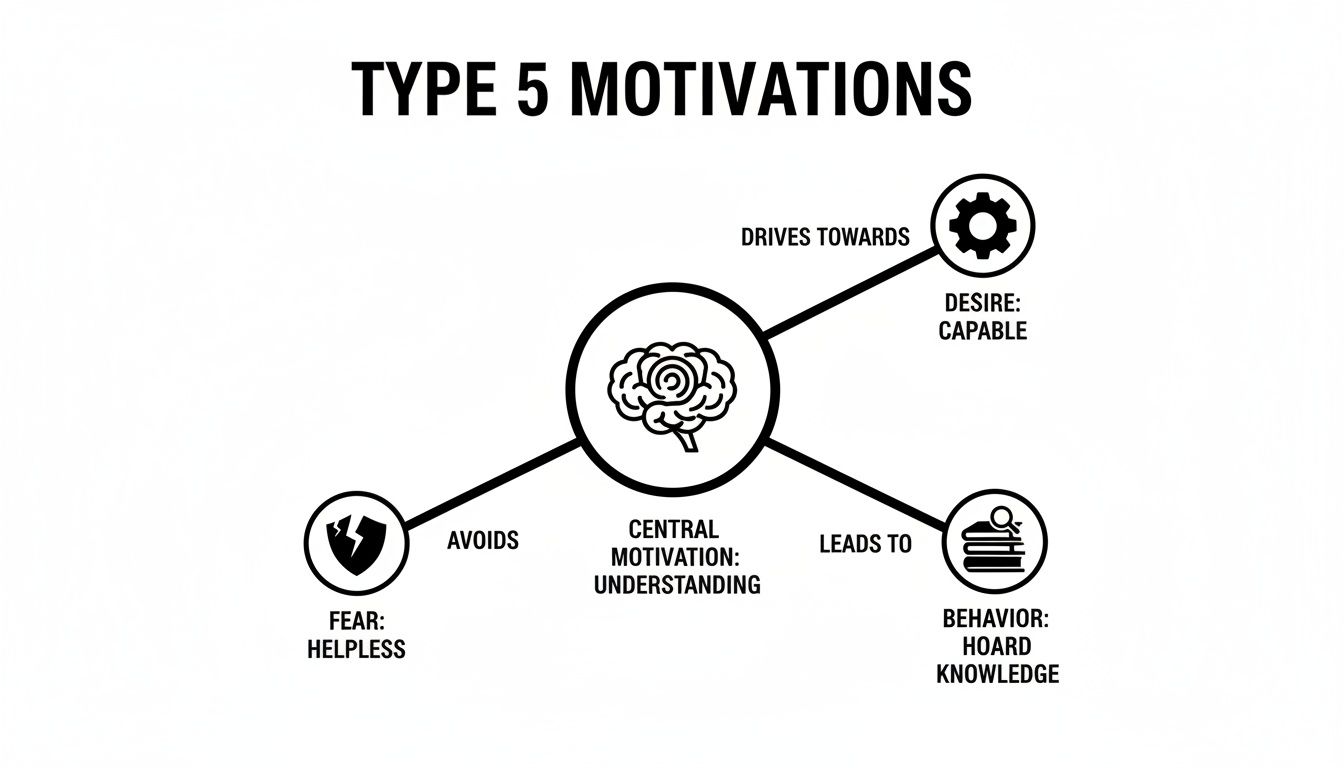
This blueprint—the drive for understanding and the fear of inadequacy—is the starting point. Now, let's see how the wings color it in.
Discover Your Enneagram Wing by taking this Free Test: Click Here!

The 5w4: The Iconoclast
What happens when the detached, analytical Five borrows a cup of sugar from the deeply expressive, creative Type Four? You get the 5w4, a subtype affectionately known as "The Iconoclast." This isn't just a researcher; it's a visionary.
The Four wing adds a splash of artistry, emotional depth, and a hunger for the unique. 5w4s aren't satisfied with just knowing the facts; they want to find the hidden meaning, the aesthetic beauty, the singular truth that no one else sees. They live at the intersection of logic and imagination.
Imagine a brilliant architect from Chicago who spends months researching ancient building techniques (the Five), not just to be an expert, but to design a building that feels like a living sculpture, a complete one-of-a-kind statement (the Four). This blend makes the 5w4 more introspective, philosophical, and drawn to the humanities and arts. They feel things more deeply and often retreat into rich, imaginative inner worlds.
Want to go deeper down this rabbit hole? Check out our full guide on the fascinating 5w4 wing .
The 5w6: The Problem Solver
Now, let's head to the other side of the neighborhood. When the cerebral Five is influenced by the loyal, security-seeking Type Six, we get the 5w6, "The Problem Solver." This wing pulls the Five's head out of the clouds and plants its feet firmly on the ground.
The Six influence adds a dose of practicality, caution, and a collaborative spirit. 5w6s use their knowledge not just for knowledge's sake, but to troubleshoot, anticipate risks, and create reliable systems. They are the ultimate troubleshooters, building intellectual fortresses to protect themselves and those they care about from what could go wrong.
Think of a cybersecurity expert working for a firm in Washington, D.C. Her Five nature drives her to understand a network's architecture down to the last bit of code. Her Six wing compels her to use that knowledge to find every potential vulnerability, build firewalls, and create a system so secure that her team can rely on it without a second thought. She's less interested in abstract theory and more focused on real-world application and safety.
Interestingly, you'll find a lot of Fives, particularly 5w6s, in STEM fields and identifying as Myers-Briggs types INTP or INTJ . They are the natural engineers, researchers, and analysts of the world. While some studies suggest a slightly higher prevalence of Type 5s in women ( 6.68% ) compared to men ( 4.32% ), what's clear is that any role requiring deep, systematic thinking is a magnet for this personality type.
Comparing Type 5 Wings 5w4 vs 5w6
Seeing them side-by-side really makes the differences pop. While they share the same core, their focus and fears manifest in distinct ways.
| Characteristic | 5w4 (The Iconoclast) | 5w6 (The Problem Solver) |
|---|---|---|
| Primary Focus | Weaving knowledge into a unique, personal vision. They want to create something original. | Using knowledge to build secure, reliable systems. They want to solve tangible problems. |
| Emotional Style | More in touch with their melancholy, artistic side. Prone to feeling like a misunderstood outsider. | More detached and anxious. Prone to analysis paralysis and worst-case-scenario thinking. |
| Interests | Humanities, philosophy, art, and abstract theory. The "why" is more interesting than the "how." | Science, engineering, technology, and troubleshooting. The "how" is everything. |
| Social Approach | Highly independent and private, withdrawn into their own imaginative world. | Can be surprisingly loyal and collaborative with a trusted few. Seeks out reliable allies. |
| Biggest Fear | Having no unique identity or original impact on the world. | Being unprepared, incompetent, or unable to handle a real-world threat. |
At the end of the day, both wings are just different strategies for coping with the same core desire: to be capable and competent. The 5w4 builds competence to create a unique worldview, while the 5w6 builds competence to create a safe and predictable world.
The Best Careers for a Personality Type 5
So, what happens when you drop the analytical, knowledge-hungry mind of a Type 5 into the 9-to-5 world? When a Five lands in the right role, they’re not just another employee. They become the quiet, indispensable brain of the operation—a wellspring of insight and expertise.
Their real magic lies in their ability to tune out the office chaos and focus with an almost superhuman intensity. Give them a complex problem and the space to solve it without a million interruptions, and they’ll come back with gold. They don’t just learn a subject; they master it.
Standout Strengths in the Workplace
A Five brings a unique and seriously powerful set of skills to the table. They have this uncanny calm when everything is hitting the fan, viewing a full-blown crisis as just another interesting problem to be solved with logic and good data. That objectivity is their superpower.
While everyone else is running around with their hair on fire, the Five is methodically gathering facts, weighing variables, and mapping out a rational path forward. They are the quiet anchor in any storm.
Think of someone like Maria, a data scientist at a tech startup in Silicon Valley. Her colleagues are drowning in terabytes of customer data, but Maria sees a beautiful, intricate puzzle. She can hole up for days, silently sifting and sorting until she uncovers a critical insight everyone else missed—a discovery that ends up steering the company’s entire marketing strategy for the next quarter. That's a Five in their element.
Navigating Professional Challenges
Of course, it’s not always a cakewalk. A Five’s intense need for privacy and their preference for solo deep work can easily be misread by coworkers. They might come across as aloof, uncooperative, or just plain uninterested in being part of the team.
And let’s be honest, office small talk and mandatory networking events can feel like a form of torture. For example, a Type 5 programmer might dread the annual company picnic, viewing it as a draining obligation rather than a fun team-building event. A Five might skip the company happy hour not because they dislike their colleagues, but because they’re desperate to decompress and recharge their mental batteries. This can make it tough to build the kind of social capital that often fuels promotions in more extroverted office cultures.
For a Type 5, the dream job is a quiet laboratory for the mind—a place where competence is the only currency that matters and intellectual curiosity is the ultimate reward.
Ideal Career Paths for The Investigator
Given their natural gifts, certain careers are practically tailor-made for a Type 5's brain. These are roles that prize deep expertise, objective analysis, and independent problem-solving over schmoozing and constant collaboration.
Here are some of the best career fits for a Type 5:
• Research Scientist: • A perfect match. This role basically pays them to indulge their insatiable curiosity and dive as deep as they want into a specific field.
• Software Architect: • Designing complex digital systems requires exactly the kind of systematic, big-picture thinking that Fives are hardwired for.
• Academic or Professor: • A life dedicated to mastering a subject and then organizing that knowledge for others? Yes, please. It's a Five's dream come true.
• Market Analyst: • Fives are brilliant at cutting through the noise, spotting trends, and making predictions based on cold, hard data.
• Technical Writer: • They get a deep sense of satisfaction from taking ridiculously complex information and structuring it into clear, logical, and precise documentation.
Ultimately, a healthy Five in the right role is an absolute force. Their professional journey is often a clear climb from novice to expert, marked by tangible achievements like patents, publications, or advanced certifications. You can actually trace this progression through the nine distinct levels of development , which show how a Five’s traits shine when they're thriving versus when they're under stress.
Practical Growth Strategies for the Type 5
Alright, so you’ve discovered you're an Enneagram 5. That's like being handed the architectural blueprint to your own mind—incredibly useful, but the real magic happens when you step out of the library of your thoughts and start building something in the real world.
Think of this section as your field guide. These are tangible, actionable strategies to help you stretch your wings and find that sweet spot of balance and health. We're moving beyond theory and into practice, gently nudging you from the role of a passive observer to an active participant in your own life.

From Thinking to Doing
For a Five, the mind is the ultimate comfort zone—a cozy, well-lit fortress. Growth, however, lives just outside those walls, in the physical world. The goal here is embodiment , which is just a fancy way of saying you need to shift from living entirely in your head to experiencing life with your whole body.
This doesn't mean you need to sign up for a marathon tomorrow. It’s all about small, intentional acts that bridge the gap between brain and body.
• Take a "Sensory Walk": • Go for a • 15-minute • stroll. The only catch? No phone, no podcasts. Your mission is simply to notice. Feel the breeze on your skin, listen to the distant sound of traffic, and watch how the light filters through the leaves on the trees. It's a surprisingly powerful way to ground yourself in the present moment.
• Whip Up Something New in the Kitchen: • Cooking is a fantastic sensory experience. The simple act of chopping an onion, smelling the garlic hit the hot pan, and tasting your creation forces you out of your head and into the moment. Try a simple recipe you've never made before, like homemade salsa or a basic pasta sauce.
• Build Something with Your Hands: • Assemble that IKEA bookcase that's been in the box for weeks or tackle a simple DIY project like planting a small herb garden. There’s a unique satisfaction in creating something tangible that provides a perfect antidote to getting lost in abstract thought.
Practice Low-Stakes Sharing
A Five’s knowledge often feels like a carefully curated collection of rare artifacts. Sharing it can feel risky, like you’re giving away your limited energy or exposing yourself to judgment. The secret is to start small with what I call "low-stakes sharing."
This is all about building your social muscle in a way that feels safe and manageable. The idea is to contribute without feeling like you've just run a social marathon.
For a Type 5, real growth comes from seeing vulnerability not as a weakness or a drain, but as a courageous act of participation. It's a sign of strength, not a threat to your competence.
Try challenging yourself to share just one interesting tidbit or idea each day. It could be in a team meeting, with a friend, or even in a text. The topic doesn’t matter as much as the simple act of putting something out there.
Imagine you're in a weekly work meeting. Instead of just absorbing information, you could pipe up and say, "That reminds me, I read a fascinating article on a new technique that might help with this." Boom. You've just shifted from observer to contributor.
Master Your Inner World
While the main goal is to engage more with the outside world, you can't ignore the internal landscape. That familiar pull toward anxiety and detachment is a powerful force, and building mental resilience is your best defense.
For Fives who want to cultivate a stronger inner fortress, diving into some of the best Stoicism books for beginners can be a game-changer. The philosophy's focus on logic and emotional regulation syncs up beautifully with the Five Mindset, offering practical tools to keep from getting overwhelmed.
On top of that, simply understanding how your mind works is half the battle. Exploring a few self-awareness activities can give you powerful techniques to observe your own thought patterns without judgment. This empowers you to choose your response instead of defaulting to your usual retreat.
Got More Questions About Enneagram Type 5?
Even after we've gone deep into the Investigator's world, a few questions always seem to surface. Let's tackle some of the most common ones to make sure you walk away with a crystal-clear picture of this fascinating mind.
How Do I Know If I’m a Type 5 or Just an Introvert?
This is a great question, and it gets right to the heart of the Enneagram. Several types value their alone time, but the secret sauce is always in the why .
Sure, Fours and Nines are often introverted, but their reasons for pulling back are worlds apart from a Five’s. A Five withdraws to hoard their precious energy and mentally chew on information, all driven by a core desire to feel competent and capable. For example, after a long day at work, an introvert might just feel tired, but a Type 5 feels a specific need to process the day's events and learn something new from them in solitude. A Type 4, on the other hand, retreats to sift through their rich inner world of feelings and build their unique identity. A Type 9 withdraws to keep their inner peace and sidestep conflict at all costs.
The real test is this: When you pull back from the world, is it mainly to think, analyze, and understand things on your own terms before you feel ready to engage? If you’re nodding your head emphatically, that’s a massive clue you might be a personality type 5.
What’s the Biggest Misconception About Type 5s?
Hands down, the biggest myth is that Fives are unfeeling, robotic, or just plain cold. Nothing could be further from the truth. In reality, a personality type 5 often feels things with incredible depth and intensity; they just don't process those emotions out in the open.
Fives are masters of compartmentalization. They can detach from their feelings to analyze a situation with laser-like objectivity, but this is a self-preservation tactic to avoid feeling swamped, not a sign that they don't have emotions. A practical example is a Type 5 who, upon hearing bad news, might first ask a series of clarifying questions to understand the situation fully, and only later, in private, allow themselves to process the emotional impact.
Think of it like this: they show they care through quiet loyalty, sharing what they've learned, and offering rock-solid support behind the scenes—not with big, flashy displays of emotion.
How Can I Best Support the Type 5 in My Life?
Supporting an Investigator is all about respecting their very specific needs. It's not about grand gestures; it's about understanding their unique wiring and what makes them feel safe and valued.
Here are a few pointers that will go a long way:
• Give them space. • Seriously. When they need to be alone, it's not personal. Their solitude is like oxygen—they need it to breathe and recharge. For instance, if your Type 5 partner comes home and immediately goes to their study, let them have that time without interruption.
• Value their knowledge. • Ask them about their passions and listen with genuine interest. Asking a Five to explain something complex—like how a particular stock market trend works or the history behind a movie they love—is one of the highest forms of praise you can offer.
• Be direct. • Don't drop hints or create emotional drama. Clear, logical, and straightforward communication is their love language. Instead of saying "You never want to go out," try saying "I'd like to go out to dinner on Friday. Are you available?"
• Invite, don't demand. • Gently invite them to things, but don't pressure them. Showing them you want them there while respecting their freedom to say no is the magic formula for a strong bond.
Ready to find out if you're a Five, or maybe another type entirely? The journey to self-awareness starts by understanding what truly drives you. Take the free, in-depth personality assessment from Enneagram Universe today to discover your Enneagram type and unlock a deeper connection with yourself. Start your path to growth at Enneagram Universe .