Unlocking Personality Type 3: The Ultimate Achiever Guide

Ever met someone who seems to have a Midas touch? Someone who effortlessly climbs the career ladder, charms every room they enter, and always looks like they just stepped out of a magazine? You’ve likely just met an Enneagram Type 3.
We call them The Achievers for a reason. They are the go-getters, the high-flyers, and the stars of the Enneagram. Their entire world is built around a powerful, driving need to be seen as valuable and worthwhile.
Meet Enneagram Type 3: The Driven Achiever

Think of that impossibly charismatic startup founder from Silicon Valley who can sell you an idea before they’ve even finished the prototype. Polished, energetic, and radiating success—that's the Type 3 in their natural habitat. For them, life is a stage, and they are here to put on a show-stopping performance.
At the very heart of a Three is a deep, persistent need to feel valuable. This isn't just about accumulating wealth or titles; it's about proving their worth—to you, to the world, and most importantly, to themselves. Their absolute greatest fear is the opposite: being perceived as worthless, a failure. That fear is the rocket fuel for their ambition.
The Engine of Ambition
This relentless drive makes Threes phenomenal achievers. They have an almost magical ability to set a goal, shapeshift to overcome any obstacle, and project an image of pure competence. Their energy is infectious; you can't help but feel a little more motivated just by being around them.
Picture an entrepreneur in Chicago launching a new brand. She's not just perfecting the product; she's obsessing over the marketing, crafting the perfect pitch for investors, and curating her public image on social media down to the last detail. She understands that perception creates reality. So, even if she's paddling furiously beneath the surface, all you see is a swan gliding effortlessly toward inevitable success. That’s a Three in the zone.
"The Achiever's mindset is geared towards one primary objective: to create and project an image of success that earns them the respect and validation they deeply crave."
Of course, this intense focus on image can be a double-edged sword. While it launches them to incredible heights, it can also cause them to disconnect from their own authentic feelings. They can get so good at playing the part that they forget who they are when the curtain falls, prioritizing what looks good over what truly feels right.
Where Do Threes Fit In?
The Enneagram is a fantastic map of the human psyche, outlining nine fundamental ways we see the world. Each type has its own unique set of motivations, fears, and internal wiring. Grasping these differences is a game-changer for personal growth and for building better relationships with everyone in your life.
To see how The Achiever stacks up against the other personalities, check out our guide to the nine personality types .
While every Three is unique, as a type, they are moderately common. Research suggests that around 10.5% of the population identifies as a Type 3. This makes them a significant, dynamic force in the world.
For a snapshot of what makes a Type 3 tick, here are their core characteristics at a glance.
Enneagram Type 3 At a Glance
| Core Trait | Description |
|---|---|
| Nickname | The Achiever |
| Core Desire | To be valuable and worthwhile |
| Core Fear | Being worthless or a failure |
| Core Motivation | To gain admiration and prove their worth |
| Key Adjective | Driven |
| Sin | Deceit (of self and others) |
| Virtue | Authenticity |
This table gives you the highlight reel, but getting to know the Type 3 is a journey into a world of incredible ambition, stunning adaptability, and a deep-seated search for inherent worth. By understanding what makes them shine, we can better appreciate their drive while supporting their quest for genuine self-acceptance.
What Makes a Type 3 Tick?
To really get what makes a personality type 3 go, you have to pop the hood and look at the psychological engine that gives them that incredible drive. It’s all about a constant tug-of-war between a deep-seated desire and an equally powerful fear. This push-and-pull is the secret sauce behind every goal they hit and every win they celebrate.
The Core Motivation of a Type 3 is to be valuable and worthwhile. This isn’t just a casual want; it’s a deep, burning need to succeed in order to feel worthy of love, admiration, and even their spot in the world. Their accomplishments are the hard evidence that they matter.
On the flip side, their Core Fear is of being worthless. The very idea of failing, of being seen as incompetent, or of their achievements adding up to nothing is their personal kryptonite. This isn't just about feeling a little disappointed; it's a gut-wrenching dread of being fundamentally without value.
The Achiever's Mindset in the Wild
This internal drama colors their entire view of the world. Think of a sales director from Dallas who relentlessly pushes their team to snag a national "Top Performer" award. On the surface, it looks like it's about the bonus or company bragging rights. But for a Type 3 director, that trophy is proof of their entire identity—it’s tangible validation that they’re a great leader and a valuable person.
This is where their focus on image becomes both a superpower and a potential weakness. Threes are absolute masters at crafting a polished, successful persona because that image is their armor against the fear of being worthless. They instinctively morph into whatever the situation demands for them to win.
The internal logic for a Type 3 is brutally simple: "I am what I do." Their value isn't a given; it's earned through a never-ending cycle of achievements and the applause that follows.
The trouble is, this constant performance can create a chasm between them and their true self. They can get so good at playing the part that they start to believe the mask is their face, losing touch with what they genuinely feel and want.
The Heart of the Matter: The Heart Triad
To go a level deeper, we have to talk about the Enneagram’s Triads. Type 3s are part of the Heart Triad , along with Types 2 and 4. This means their core operating system is run by feelings and emotions—specifically, the underlying emotion of shame .
Each type in this group has a completely different strategy for dealing with shame, that painful feeling of being flawed and unworthy of love.
• Type 2s (The Giver): • They push shame away by focusing on everyone else's needs, hoping to earn love and feel indispensable. For example, a Type 2 mom might bake cookies for every school event to be seen as the helpful, essential parent.
• Type 4s (The Individualist): • They pull shame in, convinced they are uniquely broken or different from everyone else. A Type 4 artist, for instance, might embrace their melancholy as proof of their unique depth.
• Type 3s: • They try to outrun shame by building an airtight image of success and value. They disconnect from feelings of inadequacy by becoming someone who • couldn't possibly • feel that way.
For a personality type 3, the best defense is a good offense. They combat the discomfort of shame by projecting an image so flawless that no one would ever guess there are insecurities hiding underneath. They manage their emotions by essentially putting them on mute, focusing instead on the next task, the next goal, the next win.
This strategy helps them operate at an incredibly high level, but the trade-off is often emotional authenticity. It's fascinating how the key traits of Type 3s—ambition, self-assurance, and that constant drive—pop up in different cultures and industries. If you're curious, you can explore more research on common Enneagram types to see how these patterns play out on a global scale.
What About the Wings? Meet the 3w2 and 3w4
No one is just one thing, right? Your core Enneagram type is like the star of your personality show, but the supporting actors—the "wings"—add all the interesting subplots. For a Type 3 , that means the core of who you are is all about ambition and getting things done. But the wings are where the real flavor comes in.
The wings are simply the two personality types on either side of yours on the Enneagram circle. For Type 3, your neighbors are Type 2 (The Giver) and Type 4 (The Individualist). You'll almost certainly find yourself leaning toward one of them, creating a unique personality blend that explains why you might be a very different kind of Three than someone else you know.
Curious to go deeper? You can get the full rundown on how Enneagram wings work and what they mean for you.

So, let's meet the two headliners for Type 3: the 3w2 and the 3w4.
The 3w2: The Charmer
When you take a goal-crushing Type 3 and add a dash of the helpful, people-oriented Type 2, you get the 3w2 , famously known as "The Charmer." These Threes don’t just want to win; they want to win everyone over while they’re at it. Success feels hollow if it isn't paired with a healthy dose of public admiration and positive relationships.
They are the ultimate networkers, the social glue in any room, effortlessly building rapport and making connections. The 3w2’s magic really happens in public-facing roles where their blend of infectious charm and relentless drive can take center stage.
Think of it this way: The Charismatic Politician Picture a rising political star from Washington D.C. on the campaign trail. They’re not just rattling off talking points from a teleprompter. They’re in the crowd, shaking hands, remembering names, and making every single person feel like the most important voter in the room. Winning the election is the Three's goal, but winning the hearts of the people? That's the Two's influence. It's a powerfully persuasive combination.
A 3w2's mantra might be: "Success is best when it's shared... and seen by everyone." They're fueled by the double-shot of validation that comes from both their impressive achievements and their undeniable likability.
The 3w4: The Professional
Now, what happens when a Type 3 leans toward the introspective, unique Type 4? You get the 3w4 , or "The Professional." This flavor of Three combines the classic drive for success with the Four’s deep need for authenticity, meaning, and distinction. They are every bit as ambitious, but they're less concerned with being the most popular person in the room and far more interested in being the most respected.
The 3w4 is more serious and introspective than their 3w2 cousin. They are deeply invested in the quality and originality of their work. They want their achievements to be more than just successful—they need them to be a testament to their unique talent and vision.
Think of it this way: The Visionary Architect Imagine a world-renowned American architect known for her innovative, artistic designs that break all the rules. The Three in her is driven to win the big contracts and collect the prestigious awards. But the Four in her is motivated to create a one-of-a-kind legacy. She isn't building a house; she's creating a masterpiece. The applause she craves comes from industry critics and her peers, not necessarily the general public.
Type 3 Wing Comparison 3w2 vs 3w4
Seeing them side-by-side really makes the differences pop. Here’s a quick breakdown of how these two wings color the core Type 3 personality.
| Characteristic | 3w2 (The Charmer) | 3w4 (The Professional) |
|---|---|---|
| Primary Motivation | To be admired and liked for their success. | To be respected and seen as unique for their success. |
| Public Image | Warm, sociable, and highly engaging. | Competent, sophisticated, and focused. |
| Emotional Focus | Outwardly focused on how others perceive them. | Inwardly focused on their own sense of identity. |
| Fear | Fear of being disliked or unappreciated. | Fear of being ordinary or without a unique identity. |
| Work Style | Collaborative, team-oriented, and excellent at networking. | Independent, task-oriented, and focused on expertise. |
Figuring out your wing is a huge leap forward in self-awareness. It shines a light on the subtle patterns in your behavior, helps you leverage your specific strengths, and puts your blind spots on the map. Whether you're a Charmer or a Professional, knowing your unique blend is the first step toward genuine growth.
How Type 3s Show Up at Work and in Love
For an Enneagram Type 3, life is a performance. And I mean all of life. The boardroom, the living room, the PTA meeting—they're all just different stages. This deep-seated drive for success and admiration is the engine that powers everything they do, but what does that look like when it comes to the messy, complicated worlds of love and career? Well, it's usually a wild mix of incredible highs and hidden heartaches.
Threes in a Relationship
In a relationship, a Type 3 can be your biggest cheerleader. Seriously. They are wildly supportive partners, and they genuinely want you to succeed. Why? Because your success is a reflection on them. They bring a contagious energy and optimism to the table, and their "we can do this!" attitude is often incredibly motivating and just plain fun to be around.
But here’s the catch: their non-stop focus on doing can create some serious emotional blind spots. They can get so wrapped up in achieving that they forget how to simply be with their partner. For a Three, being truly vulnerable can feel like admitting failure, so they often keep an emotional guard up, presenting a polished, "I've got this" version of themselves even in their most intimate moments.
A Classic Type 3 Love Story
Picture this all-American couple: Mark, a hard-charging Type 3 marketing executive, and his partner, Sarah. Mark is gunning for a huge promotion and has been pulling 70-hour weeks to make it happen. In his mind, this is the ultimate act of love—he's building a future and providing for his family.
Sarah, however, feels like she’s living with a ghost. Mark missed their son’s soccer game for a "can't-miss" client dinner and was so fried he couldn't even register what she was saying about her own tough day. He's showing his love through achievement, but she just feels his absence. This is the classic Type 3 relationship dilemma: demonstrating value through success versus being emotionally present.
For a Three to bridge this gap, they have to learn that their partner’s love isn't contingent on their latest win. Digging into frameworks like the 5 Love Languages can be a game-changer here, helping both partners understand what truly makes the other feel seen and valued.
The Type 3 in the Workplace
At work, the Type 3 is absolutely in its element. This is their arena. They are the charismatic leaders, the star employees, and the natural-born motivators who can rally a team around a goal with an enthusiasm that’s impossible to ignore. Their uncanny ability to read a room, adapt on the fly, and pitch an idea with unshakeable confidence makes them a shoo-in for leadership roles.
They are masters of efficiency and pragmatism, always sniffing out the most direct path to a win. This makes them absolute powerhouses in any organization, and you'll often see them scaling the corporate ladder at a dizzying pace.
A key workplace strength for a Three is their knack for embodying the desired outcome. They don't just talk about success; they project it, inspiring total confidence in clients, stakeholders, and their own team.
But that same relentless drive, if left unchecked, can cause some serious problems. A few classic blind spots for the Type 3 at work include:
• Workaholism: • That thin line between healthy ambition and outright obsession can get blurry, fast. This often leads to burnout for both the Three and anyone on their team.
• A Cutthroat Edge: • Their competitive streak can accidentally turn a collaborative brainstorm into a gladiator match, leaving colleagues feeling more like rivals than teammates.
• Image Over Substance: • Unhealthy Threes might chase the shiny projects that look good on a resume, sometimes cutting corners or overlooking real, lasting value just to maintain that flawless image of success.
This laser focus on efficiency over feelings can also kneecap their interpersonal skills. It's not just a hunch; data shows Type 3s often score lower on empathy measures. One study, for instance, found that Type 3 medical students had the lowest empathy scores of all nine types, likely because they've learned to suppress their own emotions to stay on top of their game.
For Threes to truly thrive long-term—and for those who work with them—the secret is creating an environment where authenticity is rewarded just as much as achievement. When you encourage them to share the whole story, struggles and all, and value their genuine contributions over a perfect facade, you help them grow into the kind of inspiring, sustainable leaders they were always meant to be.
When Achieving Becomes Exhausting: Type 3 and Burnout
The same drive that makes a Three excel is what makes them one of the types most likely to burn out quietly — because slowing down can feel, at a core level, like falling behind or losing value.
The warning signs often look like more success, not less: taking on one more project right as the last one wraps, measuring rest as unproductive time rather than recovery, feeling a flicker of anxiety on a day with nothing scheduled. A Three running on empty usually doesn't look tired from the outside — the image management that's core to the type often keeps functioning even as the tank runs dry underneath.
The way out isn't forcing rest through willpower (that just becomes one more thing to achieve at). It's smaller: noticing when the goal has quietly become "look like I'm handling everything" rather than the thing itself, and letting one task be genuinely, visibly unfinished without treating it as failure. For a Three, that's often more uncomfortable — and more useful — than any actual vacation.
The Growth Path for a Healthy Personality Type 3
For an Enneagram Three, the path to growth isn't about collecting more trophies or climbing another rung on the ladder. It’s a much deeper journey—a fundamental shift from chasing external applause to cultivating a solid sense of self-worth from within. It’s the difference between being a brilliant actor playing a part and becoming a genuinely inspiring person people are drawn to.
When Threes are at their best, they are absolute powerhouses of positive energy. They’re self-aware, authentic, and have a knack for motivating everyone around them. They finally realize their value isn't tied to their last big win, which frees them to channel their incredible drive toward goals that actually matter to them.
But on the flip side, unhealthy Threes can become deceptive and dangerously competitive. They're so desperate to maintain their "winner" image that they might start cutting corners, manipulating people, or completely losing themselves in a persona they think will impress others. This disconnect from their real self leaves them feeling hollow, anxious, and constantly terrified of being exposed as a fraud.
From Pretender to Authentic Leader
Let's paint a picture of this transformation. Imagine a fictional CEO from Atlanta, Alex, who for years was the poster child of an unhealthy Type 3. He was a master of appearances. He could dazzle a boardroom with a slick presentation and post quarterly numbers that looked amazing—even if they were a bit… inflated. His real goal wasn't building a great company; it was looking like a great CEO.
He'd push his teams to the breaking point, soaking up the credit for their successes while conveniently disappearing when things went wrong. His relationships were purely transactional, and his family life was a mess because he was always chasing the next accolade. Deep down, Alex was bone-tired and lived in constant fear that one misstep would bring his entire house of cards crashing down.
The wake-up call came when a major product launch failed, and failed spectacularly. It was a direct result of his cutting corners to hit a ridiculous deadline he’d set. The public humiliation was a gut punch, forcing him to stare into the void behind his polished facade. He finally started working with a coach who helped him see how his relentless hunt for admiration had cost him his integrity and his connection to anything real.
This diagram shows the two main arenas where a Three operates—work and relationships—and how their level of health impacts their performance in both.
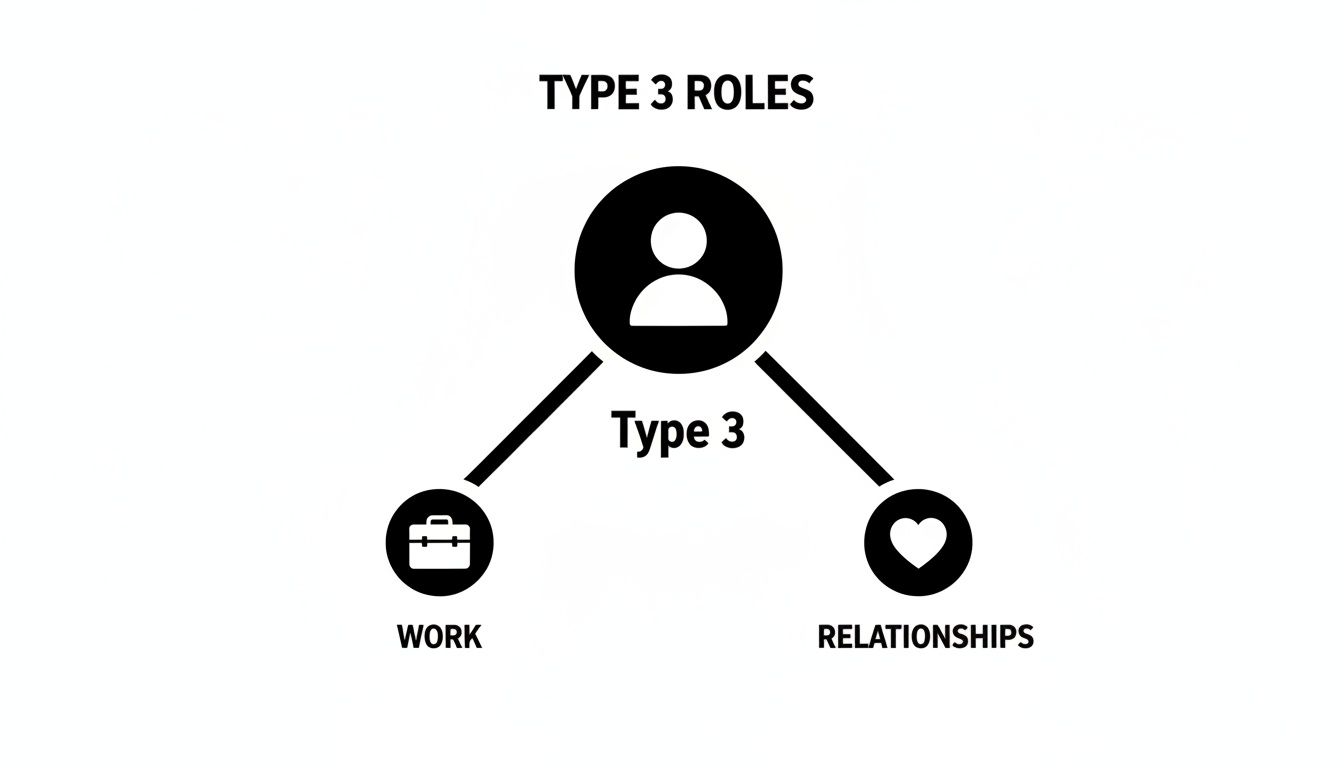
As you can see, a Three's energy is often split between their professional and personal roles. Real growth happens when they learn to bring their true self to both sides of the equation.
Actionable Steps for Genuine Growth
Alex’s journey back to health wasn't an overnight fix. It was a slow, deliberate process of unlearning years of bad habits. He started by redefining what "success" even meant to him, shifting from external praise to internal values. He even picked up mindfulness to get back in touch with his actual feelings, not just the emotions he thought he was supposed to show.
This is the real work for any Type 3 wanting to grow. It’s about moving your focus from performing to being present . Here are a few practical exercises that can help a Three get there:
• Practice "Failing" on Purpose: • Pick up a new hobby you know you'll be terrible at, like pottery, learning guitar, or even salsa dancing. The whole point is to get comfortable with being a beginner and to find some joy in the process, not just the final product. This literally helps rewire your brain to understand that your worth isn’t tied to being the best at everything.
• Keep a "For Your Eyes Only" Journal: • Spend just ten minutes a day writing down whatever is on your mind—no filter. Don't worry about grammar or how it sounds. This creates a safe, private space where you can be brutally honest with yourself without any pressure to perform for an audience.
• Redefine Your Idea of Success: • Grab a notebook and write down what a successful life would look like if nobody else were watching or judging. What would you do with your time? Who would you spend it with? This little exercise is a powerful way to untangle your real desires from the ambitions you’ve picked up just to impress others.
The ultimate goal for a healthy personality type 3 is to get their outer actions and their inner truth marching in the same direction. When they nail this, their ambition becomes an incredible force for good, inspiring people not with a perfect image but with raw passion and undeniable integrity.
Alex's transformation was astounding. He started admitting when he messed up in meetings and genuinely celebrated his team's wins. He blocked out non-negotiable time for his family and found he got more fulfillment from being a present dad than from closing one more deal. The funny thing is, the more authentic he became, the more his team’s loyalty and performance skyrocketed. They weren't just following a boss anymore; they were inspired by a real leader.
If you're looking to figure out where you are on this path, you can get personalized insights into your own patterns. Find out where you stand by taking a detailed assessment of your Enneagram Type 3 health . This journey from image to integrity is, without a doubt, the most rewarding achievement a Type 3 can ever pursue.
Common Questions About Enneagram Type 3
Once you start digging into the Enneagram, you’ll find questions popping up left and right, and the ever-ambitious personality type 3 is no different. Let's tackle some of the most common curiosities about The Achiever.
What Is the Biggest Misconception About Personality Type 3?
The most common—and unfair—stereotype is that Threes are just shallow, fake, or obsessed with image. It’s easy to see why people think that, especially when a Three is stressed out and trying too hard to impress.
But this completely misses the point. At their core, Threes are desperately trying to be valuable . That intense focus on looking good is often a deeply ingrained strategy to earn the love and acceptance they're not sure they’d get otherwise. It’s not about being empty; it’s about trying to fill a void.
A healthy, self-aware Type 3 is one of the most genuinely inspiring people you'll ever meet. They learn to channel that incredible drive into lifting others up, becoming role models who lead with passion and heart. Think of a team captain in the NFL who doesn't just win games, but also wins over the locker room with their vulnerability and authentic spirit.
A Type 3's focus on image is often a strategy to earn love and acceptance, not a sign of emptiness. Healthy Threes are incredibly inspiring, genuine, and use their drive to lift others up.
How Can a Type 3 Practice Authenticity?
For a Three, finding authenticity isn't a one-and-done deal; it’s a daily practice. It's about slowly, intentionally reconnecting with the person they are underneath the long list of achievements and accolades. The whole journey is about truly believing their value is inherent, not earned.
So, how do they get there?
• Journaling without a filter: • This means writing down their real, messy feelings without worrying about whether they sound successful or impressive.
• Sharing the "un-shareable": • Opening up to a trusted friend or partner about their actual fears and insecurities—not the polished "vulnerable" stories, but the real stuff.
• Pursuing joy, not trophies: • The real game-changer. This could be taking up a hobby—painting, hiking, learning an instrument—purely for the fun of it, with absolutely zero pressure to become the best at it.
Which Enneagram Types Are Most Compatible With Type 3?
Let’s be clear: any two healthy, self-aware people can make a relationship work beautifully. That said, some Enneagram pairings have a certain natural chemistry that helps balance each other out.
Type 3s often find a wonderfully grounding partner in a Nine (The Peacemaker) . Nines have a magical ability to help the high-octane Three slow down, breathe, and actually figure out what they want, not just what they think they should be achieving.
They also frequently form a "power couple" with a Six (The Loyalist) . The Six’s thoughtful, steady nature provides a rock-solid foundation for the Three’s big, ambitious dreams. It's a fantastic partnership built on both bold vision and unwavering security.
Ready to discover your own unique personality blueprint? The journey to self-understanding starts with a single step. Take the free, in-depth assessment at Enneagram Universe and unlock the insights that will guide your growth. Find your Enneagram type today!