Personality Test Leadership: How Personality Shapes Effective Leadership

Using a personality test for leadership isn't about slapping a label on you and calling it a day. It’s about getting a peek under the hood—seeing the wiring, the motivations, and the fears that are secretly running your leadership show. Tools like the Enneagram are a mirror, and that reflection is the starting point for a leadership style people actually want to follow.
Why Your Best Leadership Style Is Hiding in a Personality Test
Ever get that feeling you’re just winging it? You read the latest management guru’s book, try a new trendy framework, but something still feels off. Here’s the secret: your most powerful leadership style isn't out there somewhere. It’s already in you, just waiting for you to get properly introduced.
Forget all that corporate jargon about surface-level traits. A real leadership personality test, especially something as deep as the Enneagram, gets to the heart of the matter. It’s less about what you do and way more about why you do it—especially when the pressure cooker is on full blast.
Understanding Leadership Archetypes
Think about the best (and worst) leaders you've worked for. You’ve probably seen a few different flavors. There's the brilliant innovator who can see around corners and pivot the entire company on a dime. Then there's the rock-solid mentor who builds incredible loyalty just by making people feel genuinely heard.
Their styles are night and day, but both can be incredibly effective. Why? It all comes down to self-awareness.
Let's look at a couple of common archetypes through the Enneagram lens:
• The Decisive Innovator: • This leader is often driven by a core need to be competent and capable, like an • Enneagram Type 5 • . • For example, a tech company CTO who pores over data to make a strategic shift. They're brilliant at strategy and cutting through the noise. But they might accidentally steamroll the team's emotional needs during a high-stress launch because they’re so focused on the facts, forgetting to check in on burnout levels.
• The Empathetic Mentor: • Often a • Type 2 • , this leader is motivated by a deep desire to be helpful and needed. Think of a non-profit director who knows every team member's personal story. They create amazing psychological safety and a "we're all in this together" vibe. The flip side? They might dodge tough feedback—like telling a passionate but underperforming employee they aren't meeting goals—to keep the peace, letting performance slide as a result.
Neither of these is “right” or “wrong.” The magic happens when the Innovator realizes they need to intentionally check in on the human side of things. Or when the Mentor learns that direct, constructive feedback is actually a kinder, more helpful act than avoiding conflict. Want a deeper dive? You can learn more about using a personality test for business leaders to pinpoint and grow these strengths.
The real unlock here is moving from reacting on autopilot to responding with intention. It's the difference between a manager who barks orders and a leader who inspires a movement.
Let's make this real. Imagine a leader finds out they're an Enneagram Type 8, "The Challenger." Their entire world is driven by a need to be in control of their own destiny and protect their people. This makes them incredibly powerful and decisive—a fantastic asset. But under stress, that same drive can make them seem confrontational, intimidating, or dismissive of other ideas. For instance, in a budget meeting, they might shut down a colleague's suggestion with a blunt "That'll never work" without hearing them out.
Once they have that insight, everything changes. They can consciously build in a pause, actively invite different opinions, and learn to listen without immediately problem-solving. That's how a potential blind spot becomes a super-powered source of trust and respect. This isn’t fluff; it’s the real work of leadership transformation.
The 9 Enneagram Types as Leadership Archetypes
To give you a quick snapshot, think of each Enneagram type as a distinct leadership archetype. Each one brings a unique gift to the table, but also a unique challenge to watch out for. This isn't about stereotypes, but about recognizing the patterns that drive us.
Here’s a cheat sheet:
| Enneagram Type | Leadership Archetype | Core Strength | Primary Challenge |
|---|---|---|---|
| Type 1 | The Principled Reformer | Unwavering commitment to quality and integrity | Can be overly critical or rigid under pressure |
| Type 2 | The Supportive Mentor | Building deep, loyal, and supportive teams | Avoiding conflict; over-giving at their own expense |
| Type 3 | The Ambitious Achiever | Inspiring action and driving for results | Tying self-worth to success; can seem inauthentic |
| Type 4 | The Empathetic Visionary | Fostering authenticity and creativity | Can get lost in emotion or feel misunderstood |
| Type 5 | The Insightful Strategist | Objective analysis and expert problem-solving | Withdrawing emotionally; can appear detached |
| Type 6 | The Loyal Troubleshooter | Fostering collaboration and anticipating risk | Can be indecisive or overly anxious about threats |
| Type 7 | The Enthusiastic Innovator | Generating energy, optimism, and new ideas | Avoiding difficult tasks or negative emotions |
| Type 8 | The Decisive Protector | Taking charge and championing their people | Can be overly controlling or intimidating |
| Type 9 | The Inclusive Mediator | Creating harmony and consensus-building | Procrastination and avoiding necessary conflict |
Understanding your archetype isn't the finish line—it’s the starting gate. It gives you a language for your instincts and a roadmap for where you need to grow.
From Number to Nuance: Turning Your Enneagram Result into Leadership Gold
So, you got the email. Congratulations! You've officially got your Enneagram number. But staring at "Type 1" or "Type 8" can feel like getting a single puzzle piece with no picture on the box. What now?
Let's be real: the number itself isn't the prize. The true value of any decent personality assessment is learning how to read the entire map of you .
Your Enneagram number is just the headline. The juicy, actionable story is in the details—your Wings , your Center of Intelligence (or Triad), and the dynamic Levels of Health . Think of these as the modifiers that turn a generic label into a personal leadership compass, guiding your decisions, communication, and ultimately, your impact.
This is all about connecting your inner world to your outer actions. Your self-awareness and core motivations are the engine driving everything you do as a leader.
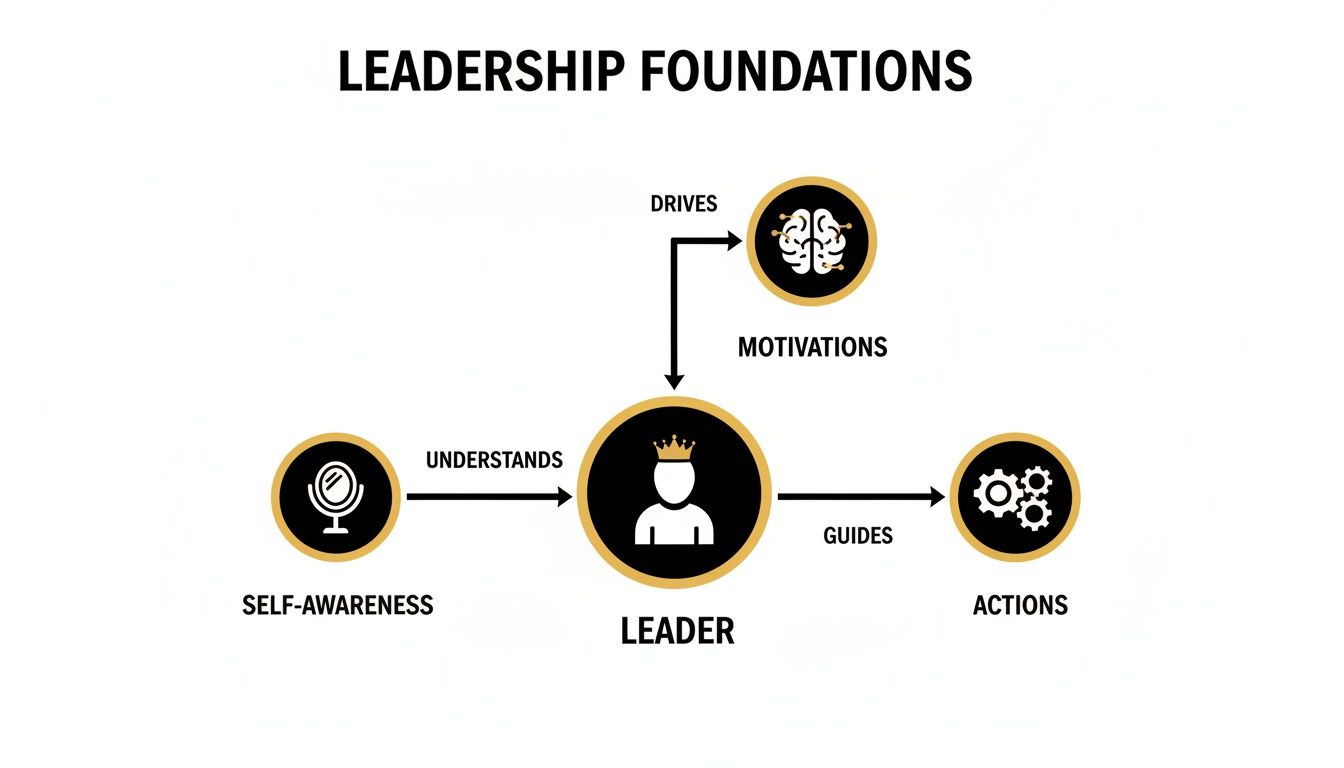
As you can see, great leadership isn't just about what you do; it's about deeply understanding the "why" behind your actions.
The Moving Parts: More Than Just a Type
To make this useful, you have to pop the hood and see how the engine works. Your core Type is the chassis of the car, sure, but these other parts determine how it handles on the road—especially when things get bumpy.
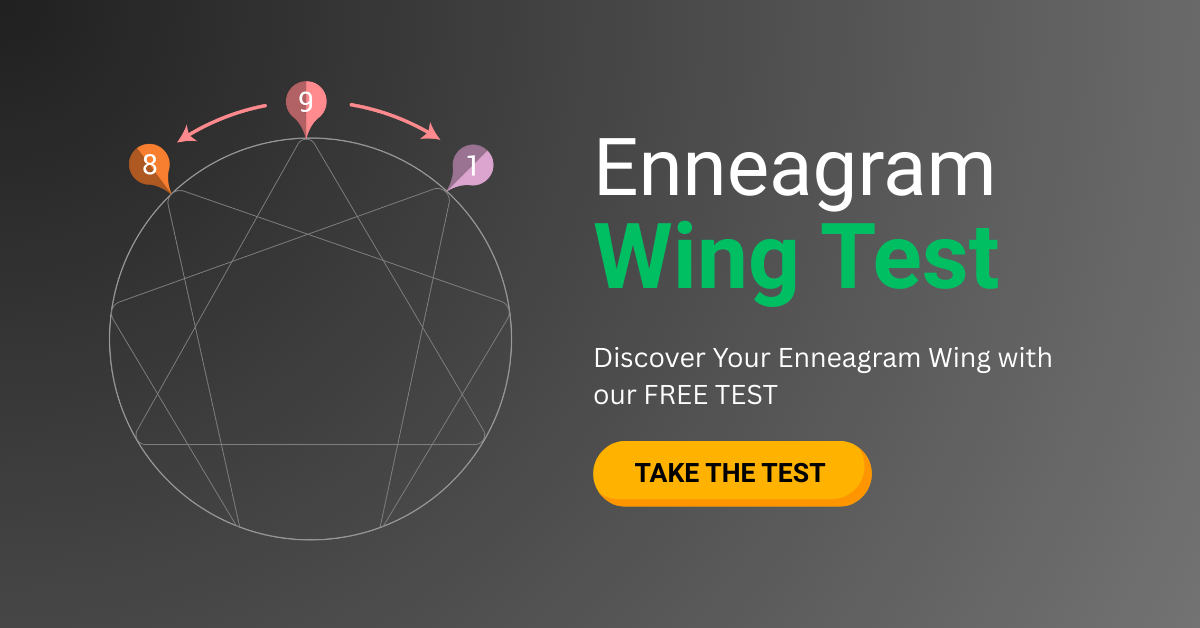
• Your Wings: • These are the two numbers on either side of your core Type on the Enneagram symbol. You'll lean more heavily on one, and it adds a totally different flavor to your leadership style. For example, a Type 9 with an 8 Wing (a 9w8) is more assertive and direct, while a 9 with a 1 Wing (a 9w1) is more orderly and idealistic.
• Your Triad (Center of Intelligence): • This is your default operating system for processing the world. Are you driven by your gut ( • Gut/Body Triad • : Types 8, 9, 1), your feelings ( • Heart Triad • : Types 2, 3, 4), or your thoughts ( • Head Triad • : Types 5, 6, 7)?
• Your Levels of Health: • This is the absolute game-changer. It shows how your personality shows up when you're thriving versus when you're completely underwater with stress. This is where the magic happens.
A personality test doesn't put you in a box. It shows you the box you're already in and gives you the tools to step outside of it when you need to.
Discover Your Enneagram Wing with our Free Test. Click Here!
Let's Meet Sarah: A Real-World Example
To make this less abstract, let's talk about Sarah. She's a project manager who just found out she's an Enneagram Type 1 with a 2 Wing (a 1w2) .
When things are going well, Sarah is the leader everyone wants. Her Type 1 drive for integrity and excellence means her projects are buttoned up and fair. Her 2 Wing adds a wonderful layer of warmth; she's genuinely helpful and wants her team to grow, often staying late just to help someone out. This is Sarah operating at a healthy level—a true mentor who champions quality.
But then, a high-stakes project gets a last-minute curveball. The scope changes, the deadline moves up. The pressure is on.
Suddenly, Sarah’s leadership style flips.
Her Type 1 perfectionism kicks into overdrive. What was a healthy desire for quality becomes a crippling fear of making a mistake. She starts micromanaging every single task on the project board and rewriting her team's emails to "get the tone just right." She's visibly tense and frustrated by anything less than flawless execution.
And her 2 Wing? That once-supportive energy now shows up as unsolicited "help" that feels completely controlling. In her mind, she's "rescuing" the project from disaster. To her team, it feels like she doesn't trust them to do their jobs. In this stressed state, her greatest strengths have become her biggest liabilities.
Cracking Your Own Leadership Code
Sarah’s story is a perfect illustration of how pressure reveals our automatic programming. For her, the big insight isn't just "Oh, I'm a perfectionist." The gold is in recognizing the feeling —that knot in her stomach—that signals she's shifting from a healthy, principled leader to a stressed-out, rigid micromanager.
It's also worth noting that while Sarah's Type 1 is common in roles needing precision, it isn't the most frequent type overall. In a global survey of nearly 190,000 people, the most common type was the Type 9 (The Peacemaker) at 16.2% . This just goes to show how many leaders out there naturally prioritize harmony and consensus, offering a completely different—and equally valuable—approach. You can dig more into the Enneagram population distribution to see how these patterns play out across the globe.
By understanding her full profile—Type, Wing, and stress response—Sarah can now catch herself before she goes down that rabbit hole. This self-awareness is the whole point. It's not about changing who you are; it's about becoming the most effective, resourceful version of yourself, no matter what the day throws at you.
Turning Insight Into Action: A Growth Plan for Every Enneagram Leader
Alright, you’ve got your Enneagram results. You’ve read the descriptions, nodded along, and maybe cringed a little at the accuracy. Now what? A map is just a pretty piece of paper if you never leave the house. This is where the real work—and the real magic—begins. It’s time to move from self-awareness to intentional, powerful action.
Let's get specific. No more vague platitudes. Here’s a practical "Try This / Avoid That" playbook for each Enneagram leadership style, designed to help you lean into your strengths and manage your blind spots.

Type 1: The Principled Reformer
Your commitment to excellence is legendary. You’re the leader who builds cultures of integrity and quality, holding high standards for yourself and everyone around you. But that fierce inner critic can be a double-edged sword, sometimes showing up as micromanagement or visible frustration when things aren’t “just right.”
• Try This: • Schedule a weekly 15-minute "good enough" check-in. Find a project and consciously identify where 85% is a perfectly fine outcome that allows the team to maintain momentum. For example, decide that an internal presentation draft doesn't need perfect formatting before sharing it for feedback.
• Avoid That: • The impulse to immediately jump in and "fix" someone's work. Bite your tongue and instead ask, “Can you walk me through your thinking here?” This gives you their perspective before you offer yours.
Type 2: The Supportive Mentor
You’re the heart of the team, creating incredible loyalty and psychological safety. People feel seen and supported by you, which is a massive driver of engagement. The tricky part? Your deep desire to be helpful can make you shy away from necessary conflict or tough feedback, sometimes at the cost of the team’s performance.
• Try This: • Use the "Situation-Behavior-Impact" model for giving feedback. For example: "In yesterday's client meeting ( • Situation • ), when you jumped in while they were talking ( • Behavior • ), it seemed to shut down the conversation ( • Impact • )." It keeps the feedback objective and focused on the facts.
• Avoid That: • Taking on your team’s tasks just to "help" them out. Letting them struggle a bit is how they learn and grow, and it’s absolutely essential for preventing your own burnout. For example, instead of finishing a report for a struggling analyst, offer to review their draft and provide guidance.
Type 3: The Ambitious Achiever
You are a motivational powerhouse, laser-focused on hitting big, audacious goals. Your energy is contagious, and you have a knack for getting things across the finish line. The challenge is when your self-worth gets too tangled up in success, leading you to prioritize image over substance or push your team to the brink.
• Try This: • At the end of each week, jot down one "failure" and the lesson you learned from it. Even better, share it with a trusted peer. For example, "We missed that Q3 target because I didn't account for summer vacations. Next time, I'll build in more buffer." This helps untangle your identity from your results and makes it safe for your whole team to learn from setbacks.
• Avoid That: • Rushing from one victory to the next without a moment's pause. Carve out just five minutes in your team meeting to celebrate the • effort • , not just the win.
Type 4: The Empathetic Visionary
Your gift is fostering authenticity and sparking creativity. You see the unique potential in people and projects, bringing a depth and meaning to work that others often miss. The catch is that your emotional depth can sometimes leave you feeling misunderstood or stuck in a feeling-loop when a clear, objective decision is needed.
• Try This: • When a business problem triggers a strong emotional response, grab a notebook. On one side, list the cold, hard facts (e.g., "sales are down 10%"). On the other, write down your feelings about it (e.g., "I'm worried this reflects poorly on our brand's integrity"). This helps you present your case with both passion • and • clear-headed reasoning.
• Avoid That: • Assuming people can follow your intuitive leaps. Verbally walk your team through your thought process from A to B to C so they can catch up to your vision and get on board.
Type 5: The Insightful Strategist
You’re the calm in the storm. People turn to you for objective analysis and brilliant problem-solving, especially when things get complicated. Your ability to detach and see the 30,000-foot view is invaluable. But that same detachment can sometimes be misread as aloofness, leaving your team feeling a bit disconnected.
• Try This: • Make it a rule to schedule five minutes of purely non-work-related chat at the start of your one-on-ones. Ask about their weekend, a hobby, anything. It might feel inefficient to you, but it’s a crucial deposit into the relational bank account.
• Avoid That: • Drowning your team in a sea of raw data. Synthesize your findings. Lead with the punchline—the key takeaway or recommendation—first. For instance, start with "My recommendation is we shift our marketing spend to Platform X," then offer the supporting data.
A personality test for leadership isn't about a personality transplant. It’s about learning to consciously dial up your strengths and manage your automatic reactions, especially when the pressure is on.
Type 6: The Loyal Troubleshooter
You are the ultimate risk manager and team guardian. Your foresight prevents countless fires, and your unwavering loyalty creates a stable, secure environment where people can do their best work. The downside is that this hyper-awareness of what could go wrong can sometimes tip into analysis paralysis or project-stalling anxiety.
• Try This: • For any reversible decision, like choosing a vendor for office supplies, give yourself a 10-minute time limit. Gather the essential data, then make the call. This builds your muscle for taking decisive action in low-stakes situations, making the big ones feel less daunting.
• Avoid That: • Seeking consensus on every single little thing. Identify which decisions are truly yours to make and practice communicating them with quiet confidence.
Type 7: The Enthusiastic Innovator
Your optimism and firehose of ideas are a powerful force for progress. You are a master at getting things started and getting people fired up about what’s next. The flip side? A tendency to avoid the boring-but-necessary tasks, negative emotions, or the meticulous follow-through needed to truly land a project.
• Try This: • Use the "first five minutes" rule. Dedicate just five minutes at the very start of your day to that one tedious task you’ve been dreading, like filling out your expense report. Often, just getting started is the hardest part.
• Avoid That: • Piling on new ideas when the team is already drowning. Before you introduce your next brilliant concept, ask them, "What should we • stop • doing to make room for this?"
Type 8: The Decisive Protector
You are a fierce advocate for your team, never shying away from a tough call or a necessary confrontation. Your directness cuts through the noise and drives immediate action. That same intensity, however, can come across as intimidating or controlling if it’s not balanced with genuine vulnerability and a willingness to listen. While Type 8s, the Challengers, make up a smaller slice of the population pie at 7-8% , their leadership impact is massive, often dominating executive roles.
• Try This: • Get comfortable with the phrase, "Tell me more about that." When you feel that knee-jerk urge to challenge an idea, use this phrase to force a pause and invite the other person to elaborate.
• Avoid That: • Making unilateral decisions on issues that directly affect your team's day-to-day. Instead of just announcing a new policy, frame it as, "Here’s the problem we need to solve. What are your initial thoughts on how we could tackle it?"
Type 9: The Inclusive Mediator
You have a true gift for seeing all sides and building consensus. You create harmonious, inclusive environments where every voice feels heard and valued. The main pitfall is that your deep-seated desire for peace can lead to procrastinating on hard decisions or avoiding healthy, necessary conflict.
• Try This: • This week, identify one low-stakes disagreement and make a point to voice your own opinion first, even if you suspect it differs from the group’s. A simple, "From my perspective, option B seems more efficient because..." is a great way to start.
• Avoid That: • Saying "yes" to every request just to keep the peace. Practice saying, "Let me check my priorities and get back to you." This gives you the space to honestly assess your capacity and say no when you need to.
To get an even clearer picture of how these tendencies play out, it's incredibly helpful to gather outside perspectives. Diving into some powerful 360 feedback examples can provide invaluable context.
And once you start making these small changes, you’ll want a way to track your progress. A structured plan keeps you honest. We've got a great guide on creating one right here: personal development plan template .
Building Smarter Team Dynamics with the Enneagram
Great leadership isn't a solo performance. It's about conducting an orchestra of unique, sometimes clashing, personalities. After you’ve had that “aha!” moment looking at your own personality test results, the next frontier is your team. This isn’t about slapping labels on people; it’s about unlocking a far more intuitive way to communicate, motivate, and collaborate.
An Enneagram-aware leader doesn't just manage tasks—they choreograph talent. They get that what fires one person up might completely shut another down. This insight is the secret sauce for building a team that’s not only effective but genuinely cohesive, where people feel seen and valued, not just managed.

A Tale of Two Teammates
Let me paint you a picture. Imagine a marketing team where the leader, Maria, feels more like a referee. Her two stars, David (a classic Type 5 investigator) and Sarah (a vibrant Type 7 enthusiast), are constantly at odds.
During brainstorms, Sarah is a firework, launching a dozen ideas a minute. She thinks out loud, riffing and building energy. On the other side of the table, David is a stone wall. Silent. When Maria prods him for input, he’ll say, "I need to think about it," which Sarah takes as a total shutdown of her creativity. You could cut the tension with a knife.
Then, Maria introduces the team to the Enneagram, and the lightbulb goes on. She realizes David’s silence isn't disinterest—it’s deep processing. As a Type 5 , he’s driven by a need for competence and understanding; he has to analyze the data before he can form an opinion. Sarah, a classic Type 7 , is fueled by possibilities and excitement. Her verbal brainstorming isn't chaos; it’s how she finds the brilliant idea in the noise.
So, Maria changed the game:
The result? The tension evaporated. Sarah felt creatively unleashed, and David felt respected for his thoughtful process. It was never a personality clash. It was a process mismatch.
Your job as a leader isn’t to make everyone the same. It's to create an environment where each person's unique operating system can run at peak performance.
Pairing People for Peak Performance
Knowing your team’s Enneagram types is like having a cheat sheet for project assignments. You can stop pairing people randomly and start creating dynamic duos built for success.
• Need a high-detail, zero-error project done? • Pair a meticulous • Type 1 (The Reformer) • with a risk-averse • Type 6 (The Loyalist) • . The One will ensure every detail is perfect, while the Six will poke holes in the plan until it's bulletproof. For example, on a financial audit project, the Type 1 ensures compliance while the Type 6 stress-tests for potential loopholes.
• Launching a bold, innovative new idea? • Combine an idea-generating • Type 7 (The Enthusiast) • with a goal-crushing • Type 3 (The Achiever) • . The Seven brings the "wow" factor for a new app concept, and the Three has the relentless drive to manage the launch campaign and hit the download targets.
• Building something that needs deep customer connection? • Team up a caring • Type 2 (The Helper) • with an authentic • Type 4 (The Individualist) • . For a brand storytelling project, the Two will intuitively grasp what the client needs to feel supported, while the Four ensures the final product is meaningful and emotionally resonant.
Mediating Conflict with Core Fears in Mind
When tempers inevitably flare, the Enneagram gives you a shortcut to the real issue lurking beneath the surface-level argument.
Let's say a Type 8 (The Challenger) and a Type 9 (The Peacemaker) are butting heads. The Eight is frustrated, seeing the Nine as dragging their feet on a decision. The Nine is overwhelmed, feeling the Eight is being pushy and aggressive in the team meeting.
Your typical "let's all get along" speech will fail. Instead, you need to understand their core fears:
• The • Type 8’s core fear • is being controlled. Their aggressive stance is a defense to maintain autonomy.
• The • Type 9’s core fear • is loss and fragmentation. Their passive approach is an attempt to avoid a conflict that feels threatening.
With this knowledge, you can reframe the conversation. To the Eight: "How can we push this forward while making sure everyone feels their autonomy is respected?" To the Nine: "What do you need to feel safe and heard so we can resolve this without fracturing the team?" Suddenly, you’re not just managing a disagreement; you’re speaking directly to their deepest anxieties.
For a fantastic breakdown of how these dynamics play out day-to-day, checking out resources on the Enneagram at work can provide even more practical wisdom.
Weaving Personality Insights into Your Company's DNA
So, you've seen how a personality test for leadership can be a game-changer for one person. But how do you scale that lightbulb moment across an entire organization? The trick is to treat it less like a corporate mandate and more like a shared language for growth.
This isn't about slapping a label on everyone and calling it a day. This is about building a sustainable practice that sparks real conversations and deepens empathy. If you're an HR leader, coach, or manager ready to make that happen, here's how you get it done right.
First Things First: Setting the Stage
Before a single person takes a test, you have to nail the rollout. How you frame this initiative is everything. It’s the difference between your team seeing it as a powerful tool for their own development versus a creepy new way for management to stick them in a box.
Get your communication locked down and be relentlessly clear on three non-negotiable ground rules:
• This is 100% voluntary. • Frame it as an invitation, not a requirement. The best, most honest insights come from people who are genuinely curious about themselves. For example, in your kickoff email, use language like, "We're offering a new tool for personal and professional growth, and we'd love for you to explore it with us."
• Results are confidential. • Period. An individual's detailed report is their property. It's up to them what they share, if anything. Break this trust, and you've torpedoed the entire program before it even starts.
• It’s for development, not evaluation. • I can't say this enough. This data should • never • touch a performance review, influence a hiring decision, or factor into a promotion. The second people think their "type" could cost them, they'll either game the test or justifiably resent the whole process.
Your core message needs to be simple and sincere: "We're investing in this to help you understand yourself better, so we can learn how to better support you."
Launch it With a Bang: The Kickoff Workshop
The best way to get this off the ground is with a team workshop. Ditch the sterile email blast and create a shared experience led by a skilled facilitator or a trusted internal coach. This immediately shifts the focus from individual scrutiny to collective understanding—from "me" to "we."
Here’s a rough sketch of a killer two-hour session:
Making it Stick: Weave it into Your Daily Rhythm
The workshop is just the spark. If you want this to catch fire and last, you have to integrate these insights into your existing coaching and development routines.
This is where managers become translators. Imagine you're coaching a Type 1 leader. You could frame feedback around your shared goal of "making this process even more effective and principled," which speaks directly to their desire for integrity.
Or what about a Type 7? During a one-on-one, you might say, "I know finishing up detailed reports can feel draining. Let's brainstorm a way to make the last 10% of this project more engaging so it doesn't feel like a total grind." You're acknowledging their need to sidestep boredom.
This isn't manipulation; it’s just good communication. You're learning to speak the motivational language of your people. And honestly, isn't that what great leadership is all about?
Got Questions About Using Personality Tests for Leadership? Good.
So, you're thinking about bringing personality assessments into your leadership world. And now the questions are bubbling up. Is this just corporate voodoo? Am I about to put my whole team in a box? How do I get my no-nonsense boss to even listen to this idea?
If you're asking these questions, you're on the right track. They're not just valid; they're essential. Let’s cut through the noise and tackle them head-on.
Are These Tests, Like the Enneagram, Actually Legitimate for Leaders?
Yes, but—and this is a big but—they are tools for development, not for hiring . Thinking that the Enneagram can predict who will be a great leader is like using a map to predict the weather. It's the wrong tool for the job.
The real magic of a system like the Enneagram is how it reveals the why behind a leader's actions. It uncovers their core motivations, their deepest fears, and the automatic habits they fall into under pressure.
It’s not about saying, "Type 8s are good leaders." It's about giving a Type 8 leader the self-awareness to understand why they steamroll conversations when a project is behind schedule. It's a mirror, not a crystal ball, and it’s a go-to for top executive coaches trying to build emotional intelligence.
While we're focused on developmental tools here, it can be helpful to understand where they fit in the broader landscape. Learning about the general process of professional assessments can give you a better sense of how different evaluation frameworks are used for different purposes.
How Do I Make Sure This Doesn’t Turn into a Stereotyping Nightmare?
This is the most critical question. Getting this wrong poisons the well for good. The goal is connection, not categorization .
The second you hear someone say, "Well, what do you expect? He's a Type 6," you've lost the game.
The right way to approach this is to treat the Enneagram as a language for empathy. It describes why people do what they do, not what they'll always do. A great leader uses it to get curious and ask better questions.
• Instead of thinking, "My Type 5 engineer is just being cold and distant again," you might ask, "Knowing you're a Five, would it be helpful if I sent you the project brief ahead of our meeting so you have time to think it over?"
• Instead of concluding, "My Type 2 project manager is getting overly emotional," you could wonder, "As a Two, I'm guessing you're picking up on some tension in the team. What are you sensing?"
Done right, it's a powerful way to dismantle the unconscious stereotypes we all carry around.
The Enneagram should never be a sword to judge others or a shield to excuse your own bad behavior. It’s a light to illuminate the path to better understanding for everyone.
How Can I Get Buy-In From Leaders Who Think This Is Fluff?
You'll never persuade a skeptic with abstract theories. You have to show them what's in it for them. The best way in is to focus relentlessly on practical, business-focused outcomes.
Start small. Run a pilot with your own team or a group of willing leaders. And for goodness' sake, don't call it a "personality test." Frame it as a "communication playbook" or an "operational effectiveness tool."
Share your own experience, and don't be afraid to be a little vulnerable. "I learned I'm a Type 3, which explained why I was so focused on hitting targets that I was burning my team out. I started building in time to recognize their work, not just the final result, and our morale has shot up."
When they see real improvements in things they actually care about—fewer arguments in meetings, faster decision-making, less friction between departments—their skepticism will turn into curiosity. Make it an invitation, not a mandate.
What’s the Single Most Important Thing to Remember?
If you forget everything else in this guide, remember this: this is all about self-compassion.
The Enneagram isn't another stick to beat yourself with. It’s a tool for self-awareness that holds up a mirror to your greatest gifts and your most stubborn challenges.
The point isn't to magically stop being your Type. It's to become the healthiest, most resourceful version of it. For a leader, that means learning to spot your automatic stress reactions in the moment and consciously choosing a better response. For example, recognizing that knot in your stomach as a sign of your Type 1 perfectionism kicking in, and choosing to ask for help instead of micromanaging.
It's about looking at your blind spots with curiosity instead of judgment, and using what you find to become the kind of leader your team truly needs.
Ready to discover the leadership style hiding in your personality? Enneagram Universe offers a free, in-depth personality assessment that goes beyond a simple number. Discover your core motivations, unlock your strengths, and start your journey to more intentional leadership today at Enneagram Universe .