Your Personality Test Career Path: A Guide To The Perfect Job

Trying to pick a career path using a generic map is a surefire way to get lost. Using a personality test for your career path is like upgrading to a satellite-guided GPS—it points you toward roles that actually resonate with your core being, not just your bank account. It’s about ditching the guesswork and using real insight to find jobs and environments where you'll not only succeed but feel genuinely alive.
Your Personality Is Your Best Career Compass
Ever feel like you're drowning in a sea of job descriptions, none of which feel quite right ? You're in good company. So many of us spend years climbing the wrong ladder, leading straight to burnout and a nagging sense of "is this it?" A personality test isn't just a fun little quiz; it’s a serious tool for self-discovery that can act as your personal compass in the wild world of work.
This guide is all about the Enneagram, a system that digs way deeper than surface-level traits. Forget just being an "introvert" or an "extrovert." The Enneagram gets to the why behind what you do—your deepest motivations and fears. When you understand what truly drives you, you can finally move past the cookie-cutter career advice and find a professional path that actually lights you up.
For example, a marketing manager in Austin, an American city known for its vibrant culture, discovers she's an Enneagram Type Seven, "The Enthusiast." Suddenly, her constant itch for new projects isn't just restlessness; it’s a fundamental need for variety and stimulation. Armed with that knowledge, she might pivot to specializing in high-energy campaign launches for tech startups instead of grinding through long-term account management for a single corporate client. It's a small shift, but it makes a world of difference in her day-to-day happiness.

Unlocking Your Professional Potential
Your personality is the invisible force shaping how you work, lead, and collaborate. Once you know your Enneagram type, you can stop reacting and start making deliberate, powerful career moves.
This kind of self-awareness is your secret weapon. It helps you:
• Identify Your Natural Talents: • You'll finally be able to name the skills that feel like second nature and find jobs that pay you for them. For example, a Type Two realizes their natural empathy makes them a brilliant user experience (UX) researcher. To dig deeper here, check out our guide on • how to find your strengths • .
• Recognize Stress Triggers: • Know exactly what situations and tasks suck the life out of you. An American project manager who is a Type One might realize that vague project scopes are a major source of stress, allowing her to create clearer briefs from the start. This isn't about avoidance; it's about smart management.
• Improve Workplace Relationships: • Get a clear picture of how you show up in a team, making you a far more effective collaborator and leader. A Type Eight leader understands their directness can be intimidating, so they learn to consciously invite feedback in team meetings.
The goal isn't to fundamentally change who you are. It's about finding a professional playground where your authentic self can flourish. You want to work with your nature, not wage a constant war against it.
The Nine Enneagram Types At A Glance
Before we dive in, let's get a quick snapshot of the nine types. Each is defined by a core motivation (what they move toward) and a core fear (what they run from). This is the engine that drives their behavior.
| Enneagram Type | Core Motivation | Core Fear |
|---|---|---|
| Type 1 | To be good, right, and have integrity | Of being corrupt, evil, or defective |
| Type 2 | To be loved and wanted | Of being unwanted or unworthy of love |
| Type 3 | To be valuable and worthwhile | Of being worthless or without inherent value |
| Type 4 | To be unique and find their identity | Of having no identity or personal significance |
| Type 5 | To be capable and competent | Of being useless, helpless, or incapable |
| Type 6 | To have security and support | Of being without support or guidance |
| Type 7 | To be satisfied and content | Of being deprived and in pain |
| Type 8 | To protect themselves (to be in control) | Of being controlled or harmed by others |
| Type 9 | To have inner stability and peace of mind | Of loss and separation; of fragmentation |
This table is just the starting point. Understanding these fundamental drivers is the key to unlocking how each type shows up at work.
Ultimately, using the Enneagram for your career is about creating a powerful alignment between who you are and what you do. When your work honors your core drivers, you unlock a new level of fulfillment. For more practical tips on this journey, this guide on how to find the career that’s right for you offers some great additional perspectives. Now, let’s get into the specifics of each type.
Finding Your Type and Making Sense of It All
Alright, let's talk about the moment of truth: taking the test. It can feel like a big deal, and you want to get it right. The secret to an accurate result is deceptively simple: be brutally honest with yourself.
This is where most people trip up. We have a tendency to answer questions based on the person we wish we were, or the polished professional we think our boss wants us to be. For example, you might answer "I am very organized" because you value organization, even if your desk is currently buried under a week's worth of coffee cups and old mail.
Forget all that. The goal isn't to get a "good" score; it's to get a real one. Find a quiet moment and try to answer from a calm, neutral headspace. Don't think about who you are on your most stressed-out Tuesday or your most blissful Saturday morning. Instead, reflect on your consistent patterns over the last several years. This isn't a test you can fail—it's just a mirror.
The most common mistake is answering aspirationally. If you value organization but your desk looks like a paper factory exploded, admit you’re messy. The test is trying to uncover your core wiring, not your New Year's resolutions.
Once the results are in, you'll have your dominant Enneagram type. But a single number is just the opening chapter. To really turn this into a powerful career tool, you need to dig into the nuances that create the full picture of who you are at work. If you want to go deeper into the discovery process itself, you can learn more about how to find your Enneagram type .
Unpacking Your Full Profile
Your main type is the headline, but the real story is in the fine print. The two most important pieces to explore next are your Wings and your Triad . These are what keep you from feeling like you've just been shoved into a one-size-fits-all box.
• Your Wings: • Think of these as a "flavor." They are the two types on either side of your main number on the Enneagram symbol. You'll almost always lean more heavily on one than the other, and it adds incredible dimension to your personality. For instance, a project manager who's a • Type Eight • (The Challenger) with a • Seven wing • is going to be a powerhouse of energy, assertiveness, and new ideas. But an Eight with a • Nine wing • ? They'll be a much steadier, more patient, and collaborative leader. Same core type, totally different vibe.
• Your Triad: • The Enneagram is split into three centers of intelligence—the • Gut Triad • (Types 8, 9, 1), the • Heart Triad • (Types 2, 3, 4), and the • Head Triad • (Types 5, 6, 7). Your triad points to your default operating system for processing the world. Do you react from instinct, emotion, or logic? For example, an American engineer in the Head Triad will likely try to analyze a problem logically first, while a manager in the Heart Triad might first consider how the team • feels • about the situation.
A Real-World Example
Let's look at Sarah, a sales director based in the US. Her test results peg her as a Type Three , The Achiever. No surprise there—she's incredibly driven, ambitious, and consistently crushes her targets.
But here’s where it gets interesting. Her results also show a strong Two wing . This means she isn't just a ruthless, deal-closing machine. She’s the one who genuinely connects with clients, remembers their kids' names, and actively mentors the junior reps on her team. That "Helper" wing is her secret weapon, making her far more effective and respected than a pure, goal-obsessed Three.
Finally, as a member of the Heart Triad , Sarah’s core motivation is tied to her image and being seen as valuable. Knowing this helps her understand that her intense fear of failure isn't just about money; it's about her identity, and it's what can drive her to overwork. Suddenly, she has a complete blueprint. Type Three, Two wing, Heart Triad —this is how a simple personality test career path transforms into a detailed, actionable roadmap for success.
Connecting Your Enneagram Type To Your Ideal Career
Alright, this is where the magic happens. You’ve got your Enneagram results in hand, and now it's time to translate that self-discovery into a concrete game plan for your career. This isn't about shoving your personality into a pre-defined career box. Think of it more like finding the perfect playground where your natural talents can run wild.
Ever had a job that felt like you were constantly swimming upstream? Or one that just… clicked? The difference often boils down to how well the work aligns with your core personality. Your Enneagram type isn't just a list of quirks; it’s a roadmap to the kind of work and environment that will leave you feeling energized, not completely drained.
Imagine a Type Four, the creative and individualistic soul, working in a fast-paced, innovative ad agency in New York City. They’d be in their element, fueled by big ideas and artistic expression. Now, drop that same person into a rigid, by-the-book corporate accounting department. It's a recipe for burnout. They'd feel misunderstood and creatively starved before their first coffee break is over. It’s not about skill; it’s about fit.
From Type To Title: What Careers Fit Best?
Let's get down to brass tacks. Each Enneagram type is driven by a unique set of core motivations, making them a natural for certain kinds of work. Grasping this is an absolute game-changer when you're scrolling through job listings or thinking about a major career change.
Take the Type Two, "The Helper," for example. Their incredible people skills and knack for building community aren't just soft skills; they're highly sought-after professional assets. It’s no surprise they thrive in people-first fields like nursing, human resources, counseling, or leading a nonprofit. For a practical example, an American Type Two might find incredible fulfillment as a university admissions counselor, guiding students through a stressful process and making them feel seen and supported. These roles don't just use their skills—they reward their innate desire to support and lift others up.
This flowchart gives you a great visual for breaking down the different layers of your Enneagram profile.
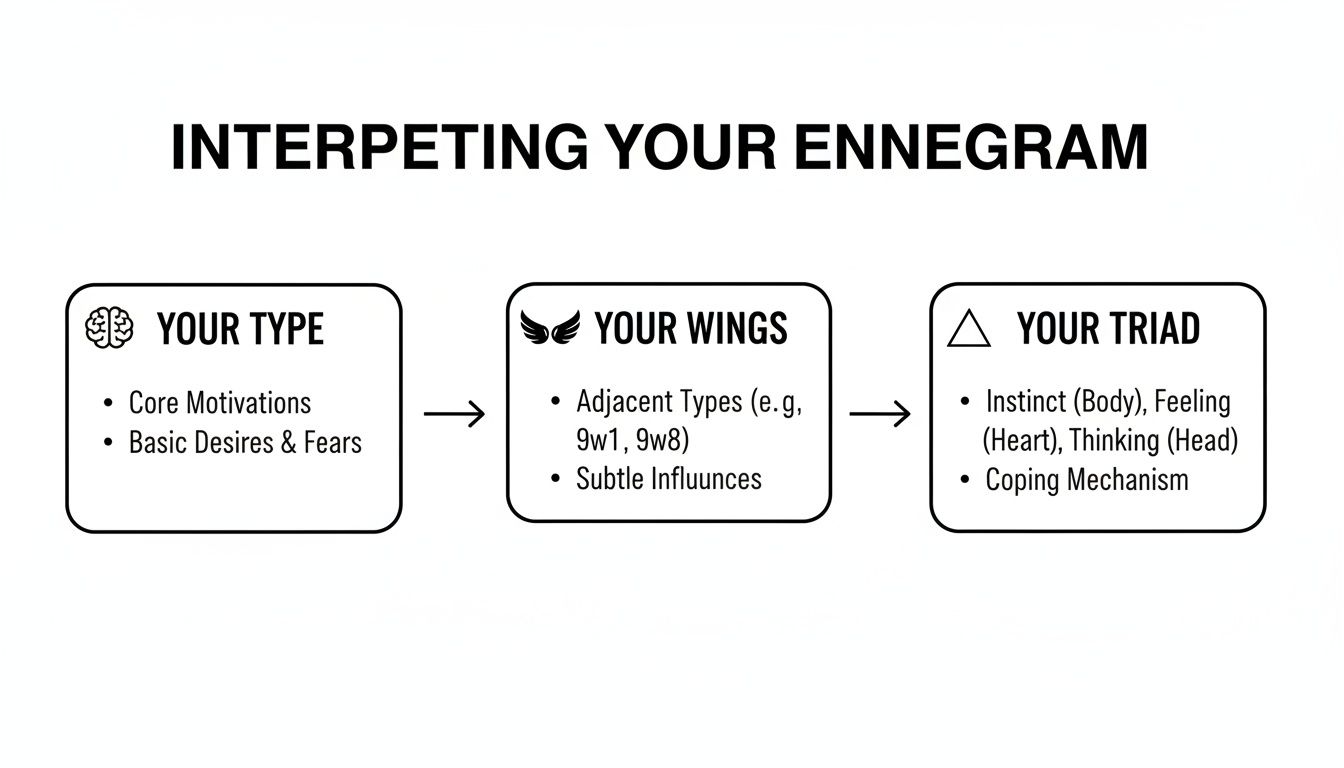
Seeing how your core type, wings, and triad all come together gives you a much richer, more complete picture of your professional identity. It’s so much more than just a single number.
Finding Your Ideal Work Environment
The perfect personality test career path is about more than a job title—the culture you’re immersed in every day is just as critical. A Type One, "The Reformer," is wired for order, quality, and high standards. They would feel right at home in a company that prizes precision and doing things the right way, like in quality assurance, law, or engineering.
On the flip side, a Type Seven, "The Enthusiast," would be climbing the walls in a role with repetitive, mind-numbing tasks. They need variety, excitement, and new horizons. They absolutely kill it in dynamic fields like event planning, startup business development, or travel consulting, where no two days are ever the same. An American Type Seven might thrive as a tour guide leading adventure trips in national parks, constantly meeting new people and exploring new places.
Think of it like this: your Enneagram type is your personal operating system. To run at peak performance without crashing, you need to find the right software (your job) and hardware (your company culture) that are fully compatible.
Let’s look at a few more quick examples:
• Type Five (The Investigator): • Flourishes when they can do deep, independent work and become the go-to expert. Think data science, academic research, or systems architecture. Give them autonomy and keep the office drama to a minimum, and they'll produce brilliant work.
• Type Eight (The Challenger): • A born leader who needs to be in the driver’s seat. They make powerful entrepreneurs, executives, or trial lawyers—any role where they can call the shots and make a tangible impact.
• Type Nine (The Peacemaker): • The ultimate team player who shines in collaborative, low-conflict settings. They are fantastic mediators, diplomats, librarians, and counselors, bringing a sense of calm and stability wherever they go.
Making these connections is incredibly empowering. Suddenly, you can filter job opportunities not just by salary and location, but by how well they sync up with who you fundamentally are. If you want to explore this further, check out our deep dive on how the Enneagram shows up at work .
Play to Your Strengths (and Keep an Eye on Your Blind Spots)
Alright, you've got your Enneagram type. Think of it as the ultimate "user manual" for your career. But a manual gathering dust on a shelf doesn't do anyone any good. It's time to actually apply this stuff and turn your personality’s built-in superpowers into your biggest professional assets.
Every single type comes with a set of innate strengths. When you lean into them, it can feel like you’ve found a cheat code for your career. A Type Nine’s natural ability to create harmony can instantly de-escalate a tense client meeting. A Type Six’s uncanny talent for spotting potential problems makes them the unsung hero of project planning. This is your home turf.
I once worked with an American software developer who was a classic Type Five. His drive to go deep, to understand complex systems inside and out, wasn't just a skill—it was his core motivation. His manager, thankfully, got it. They handed him a beast of a technical project and cut his meeting schedule in half. The result? He didn't just do a good job; he produced stunning, innovative work that nobody else could have. That’s what happens when your role and your strengths are in perfect sync.

Turning Weaknesses Into Wins
Now for the other side of the coin. With great power comes... well, a few quirks. Each type has its own set of "blind spots" or potential pitfalls that can trip you up if you're not paying attention. The secret isn't to pretend they don't exist; it's to get smart about managing them.
Your blind spots are usually just your greatest strengths pushed a little too far. That Type Five developer? His intense focus could easily turn into isolation, making him seem aloof or unapproachable to junior developers who needed his help. His growth edge wasn't to stop focusing, but to consciously schedule time for mentoring and collaboration.
Your weaknesses aren't a life sentence. They're simply signposts pointing you toward your next area of professional growth. The goal is progress, not perfection.
This kind of awareness is the entire point of using a personality test for your career path . It lets you see the potential friction points ahead of time and build a game plan to handle them.
Real-World Strengths and Struggles
Let's make this tangible. Take the Type Three, "The Achiever." Their ambition and drive to succeed are the stuff of legend. In fact, a major survey showed that Type Threes and Eights are way more likely to out-earn their peers. The income gap between the highest-earning Threes and the lowest-earning Fours was a staggering $35,146 per year. You can dive into the full research about these income findings if you're curious.
But here’s the catch: that same relentless drive can be their downfall. A high-flying Type Three sales exec in Chicago might be crushing her targets, but she's also on the fast track to burnout. Her blind spot is tethering her self-worth entirely to her latest win.
Here’s how a few other types can navigate this balance:
• Type Four (The Individualist): • A freelance graphic designer in Portland is in her element, creating beautiful, meaningful work. But her tendency to follow her creative muse wherever it leads can create a feast-or-famine financial situation. • Actionable Tip: • She could create a "Financial Friday" ritual—a non-negotiable block of time to send invoices and review her budget. This structure actually frees her up to be more creative the rest of the week.
• Type Eight (The Challenger): • A startup founder in Silicon Valley is a born leader, decisively pushing her vision forward. Her blind spot? She can be so focused on control that she accidentally steamrolls great ideas from her team. • Actionable Tip: • She can build the habit of pausing in meetings and asking, "What am I missing? What's the potential flaw in this plan?"
• Type One (The Reformer): • An editor at an American publishing house is revered for her ridiculously high standards. Her powerful inner critic, however, can also lead to "analysis paralysis," causing her to miss deadlines while chasing perfection. • Actionable Tip: • She could adopt a "good enough" mindset for first drafts, saving her perfectionist superpower for the final polish.
When you truly get a handle on both sides of your personality, you can start making conscious choices that lead not just to success, but to a career that actually feels good.
From Insight to Action: Building Your Career Roadmap
Alright, you've done the deep dive. You've stared your Enneagram type in the face, recognized your strengths, and maybe even winced a little at your blind spots. So... now what? All this brilliant self-awareness is just a fun fact until you actually do something with it. It's time to build your roadmap.
The whole point here isn't just to snag a job; it's about crafting a career that actually feels like you . A truly powerful action plan starts with goals that genuinely light you up, tapping into your core motivations—not just what you think looks good on a LinkedIn profile. Once you have a handle on your personality, you can grab a career goals template to give those ambitions some structure and direction.
Think about it. For a peace-loving Type Nine, a goal like "Become CEO of a Fortune 500 company" probably sounds like a special kind of hell, full of conflict and pressure. But what about a goal like, "Lead a collaborative team to build a stable, positive, and wildly successful work environment"? Now that plays right into their peacemaking superpower. It’s all in the framing.
How to Talk About Yourself (Without Cringing)
Your Enneagram type is your secret weapon for nailing resumes and interviews. It gives you the perfect language to describe your skills in a way that’s not just compelling, but deeply authentic. You can finally ditch the generic buzzwords and share real stories rooted in who you are.
Let’s say two Americans are up for a risk management job. One is a Type Six, the ever-vigilant Loyalist, and the other is a Type Seven, the fun-loving Enthusiast.
• The Type Seven might say: • "I’m great at brainstorming new solutions and I can pivot quickly when we hit a snag." This is fine, but a little generic.
• The Type Six can say: • "My brain is naturally wired to scan the horizon for potential problems. In my last role, I flagged three major risks in our project timeline that the team had overlooked. It let us build a contingency plan that saved us from a six-figure delay. I'm literally built to look for what could go wrong, which makes me exceptionally thorough."
See the punch? The Type Six isn’t just listing a skill; they’re explaining their innate wiring. That’s a story an interviewer remembers.
Your Enneagram type helps you tell a story about your value. It moves you from saying "I can do the job" to "I am built for this job."
Ditch the Sleazy Networking Tactics
Just hearing the word "networking" can make certain types want to fake their own death and move to a remote cabin. But building connections is part of the game. The trick is to do it in a way that doesn’t feel slimy or forced.
• You're a Type Two (The Helper)? • Forget cold-emailing executives. Lean into your natural talent for relationship-building. For a practical example, an American Type Two could volunteer to help organize a local industry conference. They'll naturally connect with speakers and attendees in a way that feels helpful, not transactional. Your genuine desire to support others is your networking gold.
• A Type Five (The Investigator)? • A crowded happy hour is your personal kryptonite. Instead, seek out smaller, knowledge-based events—a lecture, a niche workshop, a book club. You can connect one-on-one by asking the deep, insightful questions you’re already dying to ask. An American Type Five might attend a specialized tech meetup and build a strong connection with a CTO by discussing the finer points of a new programming language. Your powerful curiosity is your greatest asset.
Ultimately, building a career plan based on your personality test career path isn't about finding a shortcut. It’s about finding the right path for you. The one that aligns with your core self, making the whole journey feel less like a grind and a whole lot more like an adventure.
Got Questions About Using Personality Tests for Your Career? Let's Talk.
Jumping into a personality test to figure out your career can feel a little daunting. What if the results are totally off? Or worse, what if they're spot-on and you don't love what they have to say? It's natural to be skeptical, so let's clear the air and tackle the big questions right away.
The first thing people always ask is about accuracy. Are these things just a professional version of a zodiac sign? While no test can predict your future, a solid system like the Enneagram isn't based on star charts; it's rooted in deep-seated psychological patterns. Think of it less like a crystal ball and more like a mirror—it's a powerful tool for self-reflection, not a life sentence.
"I Think My Results Are Wrong..."
It happens. You get your results, read the description, and think, "Nope, that's not me." You might feel caught between two different types, or the whole profile just feels like a miss. Before you toss the results in the virtual trash bin, just pause for a second.
Consider these possibilities:
• Were you answering as the person you are today, or the person you • wish • you were? A practical example: an American professional might say they are "decisive" because that's a valued leadership trait, when in reality they agonize over decisions for days.
• Did you have your "work self" or your "home self" in mind? (They can be surprisingly different.)
• How's your stress level? When we're under pressure, we can sometimes lean into the less-than-healthy traits of a completely different type.
The goal here isn't to get a "correct" label. It's to spark some genuine curiosity about how you tick.
How Do I Talk About This in a Job Interview?
Alright, so how do you bring this stuff up with a hiring manager without sounding like you just came from a woo-woo retreat? Simple: translate the Enneagram jargon into tangible professional value.
Instead of saying, "As a Type Six, I'm a chronic worrier," you frame it as a superpower. Try this: "I have a natural talent for spotting potential problems early on and building out contingency plans." See the difference? Or, an American Type One could say, "I have extremely high standards for my work, which means I'm dedicated to delivering quality and precision in every project I manage."
This kind of self-awareness is gold in the workplace. It's also worth noting that some personality patterns genuinely face more career headwinds than others. A fascinating survey of over 81,000 adults revealed that Enneagram Type Fours (The Individualist) tended to report higher rates of unemployment and lower salaries. Knowing your profile is the first step to playing your hand strategically. You can dive deeper and discover more insights about these Enneagram career findings .
Your personality type isn't an excuse. It's an explanation. It gives you the power to lean into your strengths and get ahead of your challenges. Let it be your roadmap.
Ready to get that roadmap and find a career that actually feels right? The Enneagram Universe test is the perfect place to start. Pinpoint your core type, your biggest motivators, and your best-fit work style. Take our free, scientifically validated Enneagram test today!