Personality Relationship Tests: Discover Your Best Fit for Relationships

Ready to finally figure out what makes your partner tick? Personality relationship tests aren't just a fun distraction; they're like a roadmap to your relationship's inner world, offering a clear path to understanding each other on a much deeper level. This guide will walk you through the heavy hitters, from the soul-deep insights of the Enneagram to the hard science of the Big Five.
Finding the Right Personality Test for Your Relationship
Let's be honest, trying to understand your partner can sometimes feel like trying to assemble furniture with the instructions written in a language you don't speak. You see what they do , but the why behind their actions remains a total mystery. This is exactly where personality and relationship tests shine—they act as a translator for all those unspoken needs, hidden fears, and core motivations.
Suddenly, you have a shared language to talk about the tricky stuff. For example, a couple, Mark and Jessica, might constantly argue about their weekend plans. Mark wants to relax at home, while Jessica wants to go out with friends. A personality test could reveal that Mark is a classic Introvert who recharges with quiet time, while Jessica is an Extravert who gains energy from social interaction. This simple insight reframes the conflict from "He's boring" or "She's too demanding" to understanding each other's fundamental energy needs.

The point isn't to slap labels on each other or win an argument about who’s “right.” It's about shedding light on the fundamental wiring of your personalities. When you can see that blueprint, you can start appreciating your differences instead of fighting them, and build on the strengths you already share. It’s all about moving from confusion to clarity.
Why Self-Awareness Is the First Step
Here’s the thing: you can’t truly understand your partner until you understand yourself. So many of our relationship struggles come from our own blind spots—those knee-jerk reactions and deep-seated fears we don't even realize are running the show.
"Until you make the unconscious conscious, it will direct your life and you will call it fate."
This is why a solid assessment is such a game-changer. When you can see your own patterns clearly, you can show up to your relationship with a lot more compassion and a lot less blame. For example, realizing you’re an Enneagram Type 1 (The Reformer) might suddenly explain that relentless inner critic and your sky-high standards, which absolutely affects how you communicate with your partner about household chores. A great place to start is with a complete Enneagram test to get those detailed insights flowing.
A Quick Look at Popular Tests
With so many options out there, it's easy to get overwhelmed. To help you cut through the noise, here’s a quick rundown of the most popular systems people use for relationship growth. Each one offers a unique lens for looking at your dynamic.
Quick Comparison of Top Personality Relationship Tests
This table gives you a bird's-eye view of what each tool is designed for, helping you pick the right one for your specific goals as a couple.
| Assessment | Core Focus | Best For Couples Who Want To... | Scientific Rigor |
|---|---|---|---|
| Enneagram | Core motivations, fears, and desires. | Understand the "why" behind each other's behavior and find paths for personal growth. | Growing validation and strong correlation with established psychological models. |
| Big Five (OCEAN) | Quantifiable personality traits (Openness, Conscientiousness, Extraversion, Agreeableness, Neuroticism). | Get a data-backed, objective snapshot of their fundamental personality traits. | High; considered the gold standard in academic psychology. |
| MBTI | Cognitive preferences for how you perceive the world and make decisions. | Appreciate differences in communication styles and decision-making processes. | Moderate; widely used but criticized for its binary approach and test-retest reliability. |
| Attachment Styles | How early bonds with caregivers shape adult relationships (Secure, Anxious, Avoidant, etc.). | Identify and heal insecure patterns of relating to one another, especially around intimacy and conflict. | High; extensively researched and validated in clinical psychology. |
Think of these not as competing systems, but as different tools in your relationship toolkit. You might use one to understand your core fears (Enneagram) and another to work through conflict patterns (Attachment Styles). The best approach is the one that gives you the language to connect and grow together.
The Big Hitters in the Relationship Assessment World
Trying to pick a personality or relationship test can feel like you've been dropped in the middle of a massive library with no card catalog. You’ve got countless Buzzfeed-style quizzes floating around, but only a few frameworks actually deliver the goods—the kind of real, usable insights that can change the game for a couple. These are the models grounded in solid theory, built to do more than just kill a few minutes. They're designed to help you finally decode yourself and your partner.
Each of these major players offers a completely different lens. Some dig into your deepest motivations, others map out your observable behaviors, and a few are built specifically to tackle relationship landmines like conflict and intimacy. Figuring out what each one is really for is the first step to picking the right tool for what your relationship actually needs.
The Enneagram: Your "Why"
At its core, the Enneagram is all about uncovering the why behind what you do. It’s a dynamic system that maps out nine core personality types, each one driven by a fundamental fear and a matching core desire. It’s way less about what you do and much more about the deep-down, often subconscious, motivation pushing you to do it.
Take an Enneagram Type 2, "The Giver." Their whole world is powered by a desire to be loved and needed, which can make them unbelievably supportive partners. For a practical example, a Type 2 partner might be the one who always remembers anniversaries, plans surprise parties, and anticipates their partner's needs before they're even spoken. The flip side? This can also slide into people-pleasing or feeling totally crushed and unappreciated if their efforts aren't seen. The Enneagram is brilliant for couples who want to build some serious empathy by truly getting each other's foundational worldview.
The Big Five (OCEAN): The Scientific Snapshot
If you're looking for the gold standard in academic psychology, this is it. The Big Five model is all about the data. It measures you on five broad trait dimensions, which you can remember with the handy acronym OCEAN:
• Openness: • How much do you crave new experiences?
• Conscientiousness: • Are you the dependable, organized one?
• Extraversion: • Do you recharge by being around people?
• Agreeableness: • How cooperative and empathetic are you, really?
• Neuroticism: • How easily do stress and big emotions knock you off balance?
Unlike systems that put you neatly in a box, the Big Five scores you on a spectrum for each trait. It gives you a scientific, data-backed picture of your personality's architecture. This is incredibly useful for seeing exactly where you and your partner line up—or where you're on completely different planets. For instance, if one partner scores high in Neuroticism and the other scores very low, it can explain why one person feels anxious about upcoming changes while the other remains calm and unbothered.
The Myers-Briggs Type Indicator (MBTI): Your Cognitive "How"
You've almost certainly heard of this one. The MBTI is one of the most famous personality tests out there, sorting people into one of 16 four-letter types based on how they prefer to interact with the world. It looks at how you direct your energy (Introversion vs. Extraversion), absorb information (Sensing vs. Intuition), make choices (Thinking vs. Feeling), and organize your life (Judging vs. Perceiving).
The MBTI is a fantastic tool for getting a handle on your partner's communication and decision-making styles. It helps you realize their way isn't "wrong"—it's just a different operating system.
A classic example: A partner who leads with Thinking (T), like an INTJ, might come at an argument with pure logic, focusing on solving the problem efficiently. A Feeling (F) partner, such as an ENFP, is dialed into the emotional fallout and wants to ensure everyone feels heard and validated. Understanding this one simple difference can save you from a world of frustration.
The Specialists: Tools Built Just for Relationships
Beyond the big, all-encompassing personality models, some tests are laser-focused on the nitty-gritty of relationships. Attachment Theory , for instance, helps you figure out if you have a Secure, Anxious, or Avoidant attachment style, which massively affects how you deal with closeness and conflict. A practical example would be a partner with an Anxious attachment style who texts frequently for reassurance, which might feel overwhelming to a partner with an Avoidant style who needs more space.
Then you have things like Gottman-style inventories , which are specifically engineered to take a relationship's temperature. They look at communication habits, how you fight, and whether you're building a life of shared meaning. These specialized tools are perfect for couples who know exactly what recurring issue they want to fix.
A Head-to-Head Showdown of Personality Models
Picking the right personality test for your relationship can feel like trying to fix a Swiss watch with a socket wrench. It’s not about which tool is "best," but which one is right for the job at hand. You need to know what you're trying to fix before you open the toolbox.
This is where we go beyond the typical pro/con list and really dig into how these popular systems work in the real world.
The big secret? It’s all about understanding what each model is built to measure. Some get to the heart of why you do things, while others describe how you show up in the world. When you pair those insights, you and your partner get a much richer, more complete picture of what makes you both tick.
Enneagram vs. MBTI: The Why and The How
The biggest difference between the Enneagram and the Myers-Briggs Type Indicator (MBTI) is what they're trying to uncover. The Enneagram is like a deep-sea dive into your core motivations—the fundamental fears and desires that secretly pull the strings. It’s all about answering the question, " Why do I do what I do?"
The MBTI, on the other hand, describes your cognitive wiring. It maps out how you prefer to take in information, make decisions, and focus your energy. Think of it as your brain's default operating system.
Let's make this real. Meet Ben and Chloe, an American couple.
• Ben is an Enneagram 9 (The Peacemaker) and an ISFJ. • His deepest fear is disconnection, which drives him to maintain harmony and sidestep conflict like it’s his job. His ISFJ preferences mean he’s grounded in real-world details (Sensing), makes choices based on his values (Feeling), and likes his life organized (Judging).
• Chloe is an Enneagram 3 (The Achiever) and an ENTJ. • Her core desire is to feel valuable and worthwhile, fueling her ambition and laser focus on success. As an ENTJ, she's energized by interaction (Extraversion), thinks in big-picture strategies (Intuition), and makes decisions based on cold, hard logic (Thinking).
Without knowing both systems, Ben just sees Chloe as pushy and insensitive when she critiques his disorganized garage. Chloe sees Ben as wishy-washy and unmotivated when he avoids making a decision about their vacation. But when you layer the two, everything clicks. They can see that Chloe’s ENTJ drive for efficiency isn't a personal attack; it’s just her natural way of feeding her Type 3 need for validation. And Ben's ISFJ tendency to keep the peace isn't a weakness; it’s rooted in his Type 9 fear of the relationship falling apart.
This kind of layered understanding is what turns chronic friction into powerful synergy. Instead of fighting their programming, they can actually start to appreciate it. Chloe learns to value the steady ground Ben provides, and Ben gets inspired by Chloe's go-getter energy.
This powerful dynamic is exactly why so many couples find incredible value in exploring the deep connections between the Enneagram and MBTI .
Big Five vs. Enneagram: The Data and The Dynamics
Now let’s talk about the Big Five (also known as OCEAN). This one is the undisputed heavyweight champion of academic psychology. It’s all about empirical data. The Big Five doesn’t box you into a "type"; instead, it measures where you fall on five key spectrums: O penness, C onscientiousness, E xtraversion, A greeableness, and N euroticism. It gives you a scientific, quantifiable snapshot of your personality traits.
The Enneagram, while gaining more and more scientific validation, is more focused on the internal dynamics of your personality. It’s less about measuring fixed traits and more about revealing the fluid, ever-changing journey of personal growth, including how you act under stress and how you can become your best self.
A couple could use the Big Five to pinpoint exactly where their traits clash. For example, if one partner scores sky-high on Conscientiousness (loves planning, is very organized) and the other is way down at the bottom (prefers spontaneity, is messy), it immediately explains the constant arguments over who left the dishes in the sink. It's a fantastic diagnostic tool for identifying these trait-based gaps.
The Enneagram, however, tells them what to do about it. It offers a clear path forward, showing each person how to move from the unhealthy side of their type to a healthier, more balanced version. When you dive into the history of personality theories, you can't help but appreciate the incredible minds behind them, like Carl Jung and his timeless Carl Jung Sayings .
This image offers a great visual breakdown of what these three heavy-hitters are really focused on.
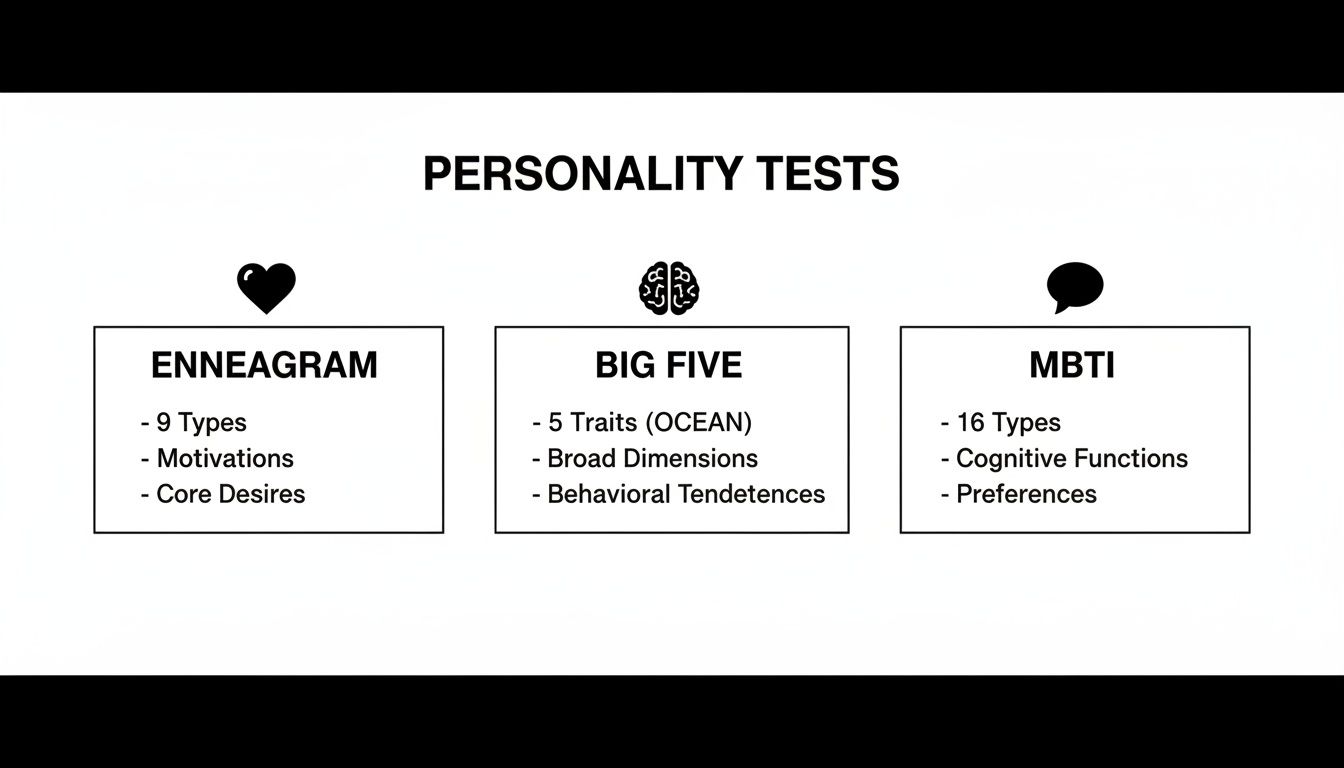
As you can see, the Enneagram gets to our core motivations (the heart), the Big Five measures our empirical traits (the brain), and the MBTI describes our cognitive styles (the speech bubble).
So, Which Model Should You Use?
There's no single right answer. The smartest move is often to use a combination, but where you start depends on what you're trying to solve right now .
• To Understand Deep Motivations: • Start with the • Enneagram • . If you're tired of having the same fight over and over and want to finally get to the root of things, this is your tool.
• To Fix Communication Breakdowns: • The • MBTI • is your best bet. It’s brilliant for couples who feel like they're speaking two different languages and want to learn how to translate for each other.
• For a Scientific Trait-Check: • Go with the • Big Five • . If you want an objective, data-driven look at your core personality architecture, this is the gold standard.
Interestingly, when you cross-reference Enneagram and MBTI data, some fascinating patterns emerge. From a pool of over 4,703 dual-typed profiles, Enneagram Type 2 is the most common at 16% , while Types 1, 3, and 8 are the rarest at just 8% each. This highlights how certain motivations are more prevalent than others. This aligns with MBTI distributions where Introversion sits at 50.7% and Sensing types make up a whopping 73.3% of the population.
At the end of the day, remember that none of these tests is a magic bullet. Think of them as maps, not crystal balls. The real magic happens when you use the insights to have better conversations, build a little more empathy, and create a shared language for navigating your life together.
So, You've Got Your Results... Now What?
Taking a personality test for your relationship is a bit like getting a super-detailed DNA report back for your partnership. It’s fascinating, a little revealing, and maybe even a tad shocking. But just like that ancestry breakdown, the real magic isn't just in having the data—it's what you do with it. Applying these fresh insights is how you turn interesting tidbits into a stronger, more connected relationship.
The first step is picking the right tool for the job. Not every assessment is designed to solve every problem. You've got to think about what you and your partner are actually trying to figure out right now.
Matching the Tool to the Task
Stuck in the same argument on repeat? Maybe you’re like Michael and Sarah, a couple from Chicago who were always at each other's throats about money. The thing is, their fights weren't really about dollars and cents. They were about Michael's deep-seated fear of scarcity (a classic Enneagram Type 6 trait) colliding with Sarah's need for freedom and spontaneity (hello, Type 7). A Gottman Method inventory could help with their conflict style, but the Enneagram gets to the core why .
Or maybe you’re a newer couple just starting out. For you, getting on the same page about core values is everything. In that case, the Enneagram provides a profound look into what truly drives each of you, building a solid foundation of mutual understanding from day one.
The point isn’t to find a test that proves you're "right" and they're "wrong." It's to find one that gives you a shared language to talk about what's really going on underneath the surface. It turns blame into genuine curiosity.
Of course, for these insights to stick, you need a validated tool. Those quickie online quizzes are fun, but they often lead to frustrating mistypes. Using a comprehensive, 180-question assessment like the one from Enneagram Universe ensures you’re building your growth on a solid, accurate foundation.
From Insight to Actionable Steps
Alright, you have your results. This is where the real fun begins. It's not about memorizing your type descriptions; it's about translating that knowledge into new behaviors.
The rarity of certain types can really shape a relationship. For instance, Enneagram Type 5 is one of the least common personalities, making up only 4.8% to 12% of the population. This means their innate need for intellectual space and independence can be easily misunderstood. You can find more cool tidbits about this and other Enneagram population trends .
To go even deeper into the nuts and bolts of relationship dynamics, consider grabbing a comprehensive Relationship Ebook .
Remember, these tests are maps, not rulebooks. They show you the terrain of your shared psychological landscape, pointing out potential mountains to climb and quiet valleys to rest in. The journey itself is still up to you two. By using the insights from these assessments, you're just giving yourselves a much better compass to navigate it together.
How Enneagram Universe Takes Your Relationship Insights to the Next Level
Let’s be honest. Most personality tests spit out a label and leave you hanging. You get a four-letter code or a catchy title, but no real game plan for what to do next. That's where the Enneagram shines, and it’s exactly why we built Enneagram Universe to go deep—way beyond a simple type description into the dynamic, messy, beautiful core of who you are.
It all kicks off with our 180-question assessment . This isn’t one of those five-minute clickbait quizzes that gets you completely wrong. We designed this to be thorough, measuring your core motivations, fears, and desires with a level of precision that gets to the heart of why you do what you do, not just what you do.
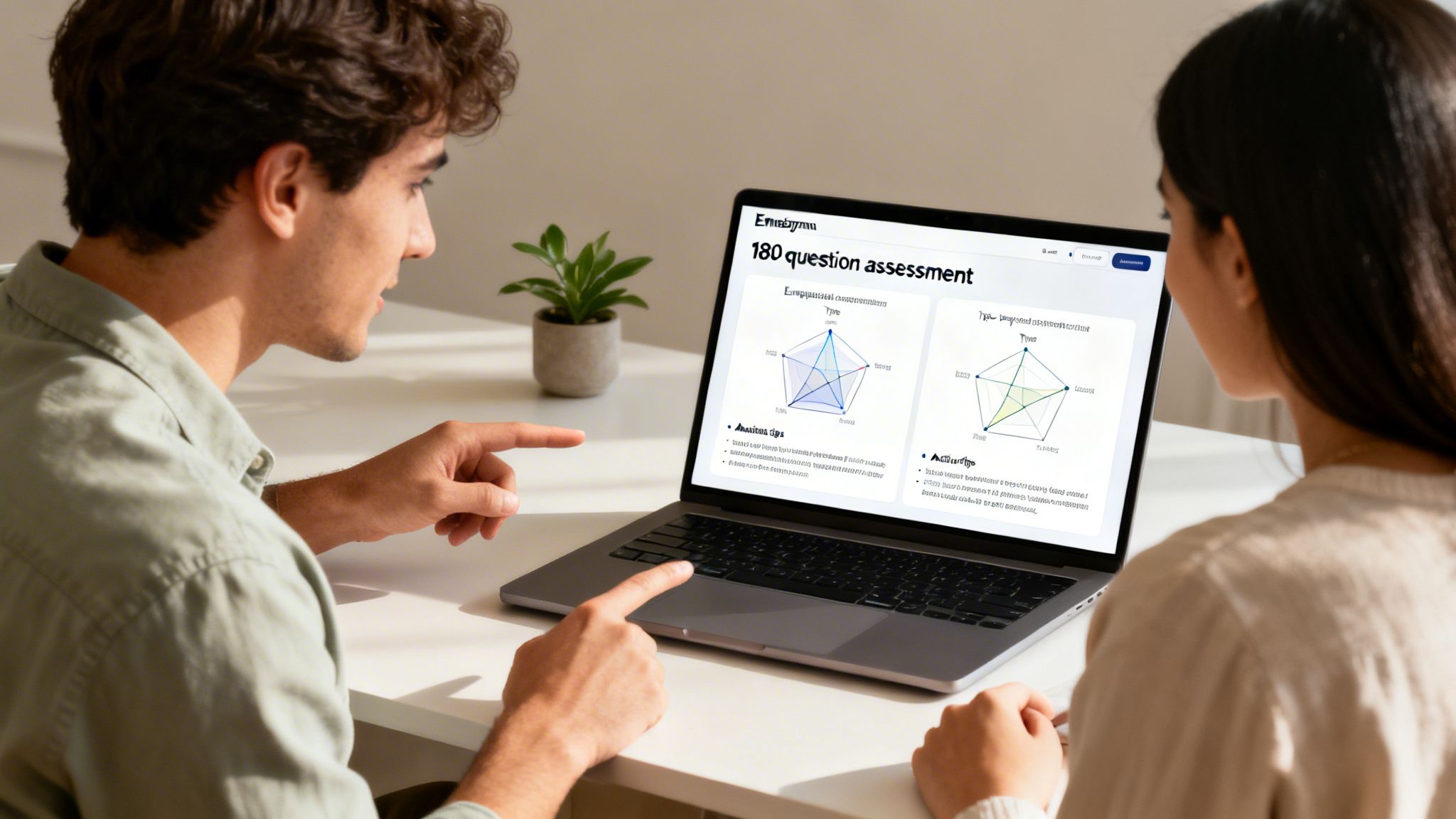
Think of it as building your house on solid rock instead of sand. A reliable foundation makes all the difference.
More Than Just a Number
Finding out you’re a Type 4 or a Type 8 is just the opening chapter. The real story unfolds when you start exploring all the fascinating layers that make you, you . Our platform is built to be your guide on this journey, giving you personalized feedback on the parts of your personality that show up every single day.
• Your Wings: • We’ll show you how the types on either side of yours add flavor and complexity to your personality. It’s the difference between being just "salty" and being "salty with a hint of lime and chili."
• Your Triads: • Are you driven by your Head, Heart, or Gut? This is a game-changer for understanding your knee-jerk reactions. We break down how your Center of Intelligence shapes your instincts in any given moment.
• Your Health Levels: • This is where the Enneagram becomes incredibly powerful for relationships. We help you see what you look like at your best (your growth path) and at your worst (your stress path), giving you clear signals for when you need to recalibrate.
This is the stuff that helps you move from just knowing your type to actually using it to become a better partner and a more whole person.
The Ultimate Comparison Tool for Couples
Okay, this is where the magic really happens. Our standout feature is a comparative tool that lays your personalities side-by-side, revealing the unique push-and-pull of your relationship dynamic. It’s designed to build bridges, not walls.
Let's picture a couple, Jake and Emily, from Austin, Texas.
• Jake is an Enneagram Type 1, The Reformer. • He’s all about integrity, order, and making things better. His way of showing love is to perfect things for Emily, from planning the "perfect" date night to organizing their finances.
• Emily is an Enneagram Type 7, The Enthusiast. • She craves new experiences, joy, and freedom. She shows love by bringing adventure and spontaneity into Jake’s structured world.
You can probably see the potential for a clash. Without insight, Jake’s meticulously planned vacation itinerary feels like a cage to Emily. And to Jake, Emily’s last-minute decision to go skydiving instead feels chaotic and irresponsible. They’re both speaking a different language of love.
With Enneagram Universe, they get a visual breakdown of this dynamic. The platform doesn't just point out the problem; it offers a new script. It suggests how Jake can see Emily’s quest for joy as a gift, and how Emily can see Jake’s need for structure as an act of profound care.
Suddenly, a major point of friction transforms into a complementary strength. They start to see each other’s worldview not as wrong, but as a vital part of their shared life. For a deeper dive into how different types connect, check out our guide on Enneagram Type compatibility .
Using Data to Make It Personal
The Enneagram is also a fantastic tool for spotting wider human patterns. For example, did you know that Type 9, The Peacemaker, is consistently the most common type across the globe? They often make up 15-20% of any given population, which explains why so many of us know someone who’s a natural mediator. Enneagram Universe uses these kinds of global insights to add another layer of richness to your personal compatibility reports.
In the end, Enneagram Universe doesn't just give you a report; it gives you a roadmap. By combining a hyper-accurate assessment with deep-dive analytics and a powerful comparison tool, we give you and your partner the language and framework you need to build a relationship rooted in real, compassionate understanding.
Got Questions About Personality Tests for Couples? We've Got Answers.
So, you're diving into the world of personality tests for relationships. It’s an exciting place, but it can also feel like you’ve just opened a door to a room full of new questions. That's a good thing! It means you're taking this seriously.
Let’s tackle some of the biggest questions that pop up when people start using these tools to build a stronger, more connected partnership. Getting these cleared up will help turn that curiosity into real confidence.
"Are These Tests Even Scientifically Legit?"
This is the big one, right? And the answer is a classic: it depends . The world of personality assessments is a wild mix, and not all tests are created equal.
On one end of the spectrum, you've got the Big Five (OCEAN) , which is pretty much the gold standard in academic psychology. It was built on decades of hardcore, data-driven research. Other systems, like the Enneagram, have earned their stripes through studies showing strong correlations with established frameworks like the NEO inventories.
Then you have tools that are more conceptual, like the 5 Love Languages . They’re wildly popular and fantastic for kickstarting conversations, but they aren't grounded in the same level of empirical science. The trick is to find a test that’s transparent about its homework. For instance, a platform like Enneagram Universe uses a scientifically validated, 180-question assessment. That level of rigor is crucial when you're using the results to make meaningful decisions in your relationship.
The most reliable personality relationship tests are the ones that can back up their claims. Look for tools that have been properly researched and cross-referenced with established psychological models. You want a trustworthy snapshot, not a fun-house mirror.
"Can a Test Tell Us if We're Going to Last?"
In a word: no. Let's be real—no multiple-choice quiz can act as a crystal ball for your relationship's future. That beautiful, messy, wonderful outcome depends on the timeless stuff: commitment, shared values, and whether you’re both willing to talk through the hard parts.
So, what’s the point then? Think of these tests less like a prediction and more like an incredibly detailed map of your shared world. A map can't tell you if you'll complete the journey, but it sure can show you the terrain ahead. It highlights potential conflict zones, reveals shared strengths you never even noticed, and—most importantly—gives you a common language to talk about what you both need.
A test might show a couple like David and Maria from California that his logical, thinking-first approach often bumps up against her more emotionally-driven style. That doesn't mean they're doomed! It just means they now have a map to navigate that difference with empathy instead of getting stuck in frustration.
"How Do We Use the Results Without Boxing Each Other In?"
This might be the most important question of all. The whole point of a good personality test is to open up insight, not to hand you a new set of labels to use as weapons. Nothing kills connection faster than pigeonholing your partner.
The secret is to treat the results as a starting point for a conversation, never an endpoint for judgment. You're building a bridge of understanding, not a box of limitations.
Here are a few ground rules to keep the focus on growth:
• Look at the 'Why,' Not Just the 'What': • Instead of saying, "Ugh, you're being such a critical Type 1," try something like, "I can see that your Type 1 need to get things right is really activated right now. How can we figure this out together?" This sees the motivation behind the behavior, which changes everything.
• Remember You're More Than a Number: • Great personality models, especially the Enneagram, are dynamic. They show you paths for growth and what you look like under stress, reminding you that you're not a static being. Your type is your home base, not a prison cell.
• Own Your Stuff: • Use • your own • results to explain your reactions. For instance, "When I feel my Type 9 desire for peace is threatened, my go-to move is to shut down. It's not that I don't care; it's just my default defense mechanism."
Ultimately, the best personality tests give you a deeper, richer understanding of each other's inner worlds. They give you the tools to finally say, "Ah, now I get what's happening for you," which is one of the most powerful and loving things you can ever offer your partner.
Ready to see yourself and your partner with fresh eyes? At Enneagram Universe , we provide a scientifically validated assessment and detailed reports designed to help you turn powerful insights into real-world action. Start your journey today.
Take our free, in-depth Enneagram test at Enneagram Universe