Your Guide to the Personal Agency Meaning

The simplest way to think about personal agency is this: it’s your ability to act independently and make your own choices. It's the gut-level belief that you are the author of your life story, not just a character reacting to the plot. Think of it as the profound shift from "things happen to me" to " I make things happen ."
Why Personal Agency Is Your Secret Superpower
Let's cut through all the dense psychological jargon for a moment. At its core, personal agency is the feeling of being in the driver’s seat of your life. It's that quiet, steady confidence that your decisions are what truly shape your destiny, freeing you from feeling like a victim of circumstance, your past, or what other people expect of you.
Here’s a great way to picture it: imagine you're the captain of a ship. With strong personal agency, you're the one at the helm, actively steering the vessel, trimming the sails to catch the wind, and charting a deliberate course toward the destination you've chosen. For example, if an unexpected storm (a sudden layoff) hits, you don't just panic; you immediately start checking your supplies, plotting a new course for the nearest safe harbor (updating your resume and networking), and guiding your crew (your family) through the turbulence.
Without it? You're just a passenger below deck, getting tossed around by the waves and just sort of hoping you’ll eventually drift somewhere pleasant.
This isn’t about trying to control every single thing that happens to you—that’s a recipe for madness. It’s about owning and controlling your response to those things. That’s where your power lies.

The Real-World Impact of Agency
Building a strong sense of personal agency isn't just some feel-good mindset exercise; it has a massive, direct impact on every corner of your life. It's the engine for personal growth, career success, and genuine fulfillment.
Here’s what that looks like in the real world:
• Career Advancement: • A professional with high agency doesn't just sit back and wait for a promotion to fall into their lap. They're out there identifying skills they need to build, proactively seeking out challenging projects, and making a clear case for their value. For example, instead of complaining about outdated software, they might sign up for an online course to learn the new industry standard and then propose a pilot program to their boss.
• Healthier Relationships: • Instead of blaming their partner for every ounce of their unhappiness, someone with agency communicates their needs directly, sets healthy boundaries, and takes responsibility for their own part in the relationship dynamic. For instance, rather than sighing loudly when their partner leaves dishes in the sink, they might say, "Hey, it makes me feel stressed when the kitchen is messy. Can we agree to load the dishwasher before bed?"
• Personal Well-being: • When faced with stress, they don't spiral into helplessness. They actively look for solutions, whether that means hitting the gym, talking to a therapist, or making a change in their environment. An American student feeling overwhelmed by college applications, for instance, would create a detailed schedule, ask a teacher for a recommendation early, and practice mindfulness exercises to manage anxiety.
At its heart, personal agency is the understanding that you possess the inherent power to influence your future. Grasping this concept is the first, most crucial step toward building a life that feels authentically and powerfully yours.
Your Unique Blueprint for Agency
But what if you could get a detailed map to your own internal "captain's quarters"? Imagine discovering that a simple personality framework like the Enneagram could unlock a profound sense of personal agency you never knew you had.
Historical data shows over 1,400,000 test results worldwide from just one trusted source, making it a leading international Enneagram assessment with a reliable algorithm that pinpoints a user's type with stunning accuracy. Those numbers aren't just stats—they represent over a million people finding the right tools to start steering their lives with real intention. You can explore the Enneagram test data and its impact for yourself.
When you truly understand your unique motivations, fears, and deepest desires, you gain the clarity to act deliberately. You start making choices that finally align with who you really are.
What High and Low Personal Agency Looks Like in Real Life
Theory is great, but what does personal agency actually look like day-to-day? It's not some lofty, abstract idea; it’s a real, tangible force that shapes your conversations, your career, and how you handle a Monday morning crisis.
To bring this concept down to earth, let’s meet two American project managers at the same company: "Proactive Priya" and "Passive Paul." Their stories perfectly illustrate how two people in the exact same role can build completely different realities, all because of their sense of agency.
Meet Passive Paul The Passenger
Paul feels like his career is stuck in first gear, and he’s got a whole list of reasons why. His boss is clueless about his talent, the company's software is a relic from the Stone Age, and the market is just impossible right now. You’ll often hear him say things like, "Well, what can you do?" or "That's just how it is here."
When a big project hits a snag because a vendor is late, Paul’s first move is to fire off an email to his team, making sure to CC his boss. The email carefully explains how the setback is 100% the vendor's fault. He sees his job as simply reporting the problem, not actually owning the solution. He's powerless, just waiting for someone else—his manager, the vendor, anyone—to step in and fix things.
His days are purely reactive. He’s a firefighter, constantly putting out flames started by others and feeling like he’s being yanked in a dozen directions by forces he can't control.
Meet Proactive Priya The Pilot
Priya deals with the exact same challenges. She’s got the same tricky boss, the same clunky software, and the same unreliable vendors. But her approach is a world apart. She doesn't see obstacles; she sees puzzles waiting to be solved.
When that same vendor delay threatens her project, Priya's instinct is to take command. She tells her team, "Alright, this is a curveball, but it's on us to find a new way forward." Instead of just pointing fingers, she gets the vendor on the phone to see if they can get creative. She's also researching backup suppliers and has already drafted a new timeline with three potential workarounds to show her boss.
Priya operates from a place of empowerment. She gets that while she can't control the vendor, she has 100% control over her response, her strategy, and her communication. That, right there, is the heart of high personal agency.
Her language is a dead giveaway. She’s always asking, "What can we try next?" or "Let's focus on what we can actually control." She carves out time to learn new skills, chats with people in other departments to understand the bigger picture, and keeps a running list of ideas to make her team’s processes better.
High Agency vs Low Agency Mindsets and Behaviors
The difference between Priya and Paul isn’t about their job title or how smart they are—it's about their internal operating system. One sees himself as being at the mercy of his environment, while the other sees herself as a powerful force within it.
This table really nails the key differences in how they think and act every single day.
| Characteristic | High Personal Agency (Priya) | Low Personal Agency (Paul) |
|---|---|---|
| Response to Failure | "What's the lesson here? How can I do this differently?" | "It wasn't my fault. The situation was rigged against me." |
| Language Used | "I will," "Let's try," "I choose to..." | "I can't," "I have to," "They made me..." |
| Career Growth | Actively seeks new skills, asks for feedback, and creates opportunities. | Waits to be promoted, complains about not being recognized. |
| Problem Solving | Focuses on finding solutions and changing the outcome. | Focuses on assigning blame and describing the problem. |
| Mindset | Sees themself as a powerful agent capable of creating change. | Sees themself as a victim of circumstances and other people. |
Looking at these side-by-side, you can start to see a pretty clear mirror for your own tendencies. Do you sound more like Paul, waiting for the world to deal you a better hand? Or are you channeling your inner Priya, ready to grab the wheel and steer toward the future you want?
Just recognizing where you are on this spectrum is the first, most powerful step toward building a stronger sense of personal agency.
How Your Enneagram Type Shapes Your Sense of Agency
Think of your Enneagram type as more than just a personality label. It's your personal power blueprint—a surprisingly detailed map showing how you're wired to act, decide, and make your mark on the world. Cracking this code is the secret to unlocking a more potent and genuine sense of agency in your own life.
For some, agency feels like taking the reins and steering with assertive control. For others, it’s about weaving connections and lifting up the people around them. There's no right or wrong way, but knowing your own style is a game-changer.
Your type’s core motivations and deepest fears are the twin engines that either propel your agency forward or sabotage it from within. Let's take a look at the unique agency blueprint for each of the nine types.
The Gut Triad: Types 8, 9, and 1
These types are all about instinct. They process the world through a gut-level knowing, and their sense of agency is tangled up with having control—over themselves and their surroundings.
• Type 8 (The Challenger): • For an Eight, agency is all about making a direct impact. They're in their element when they're protecting their crew, pushing their vision forward, and bending their environment to their will. • Example: • An Eight entrepreneur sees a gap in the market and, against advice, launches a disruptive new product, personally leading the charge. The catch? They can easily bulldoze right over people, mistaking raw control for true agency and accidentally creating enemies where they need allies.
• Type 9 (The Peacemaker): • A Nine’s agency is often quiet, almost behind-the-scenes. They feel most empowered when they’re smoothing over conflict, creating harmony, and protecting their inner calm. • Example: • During a tense family meeting, a Nine calmly listens to everyone's side and suggests a compromise that makes everyone feel heard. Their big hurdle is their tendency to shelve their own needs to keep the peace, which can lead to them giving their agency away without even realizing it.
• Type 1 (The Reformer): • Agency for a One is welded to their sense of integrity and purpose. They feel most effective when they’re making things better—improving themselves, their work, and the world—by living up to their own high standards. • Example: • A Type One community organizer in an American town meticulously plans a neighborhood cleanup, creating detailed checklists to ensure it's done "the right way." Their kryptonite is a ferocious inner critic that can freeze them with the fear of getting it wrong, bringing their forward momentum to a screeching halt.
The Heart Triad: Types 2, 3, and 4
Driven by emotion and a deep need for connection, these types see agency through the lens of relationships, image, and meaning.
• Type 2 (The Helper): • A Two feels a powerful sense of agency when they are indispensable to others. Their superpower is their almost psychic ability to see what people need and step in to help. • Example: • A Type Two parent anticipates their child is stressed about a school project and stays up late gathering supplies and offering encouragement. The risk, however, is that they can get so wrapped up in being everything to everyone that they lose sight of themselves, making their agency dangerously dependent on outside approval.
• Type 3 (The Achiever): • For a Three, agency is spelled S-U-C-C-E-S-S. They feel on top of the world when they’re crushing their goals and getting recognized for it. • Example: • A Type Three sales executive relentlessly pursues a major account, adapting their pitch on the fly and networking strategically to close the deal and win the "Salesperson of the Year" award. The danger here is getting so fixated on the • appearance • of success that they lose touch with what they actually want, chasing empty goals that leave them feeling unfulfilled.
• Type 4 (The Individualist): • Agency, for a Four, is the freedom to be utterly, authentically themselves. They feel most alive and powerful when their actions flow directly from their deepest feelings, creating something meaningful and unique. • Example: • A Four musician turns down a lucrative commercial jingle to finish their deeply personal album, feeling that creative integrity is more important than a quick paycheck. Their biggest challenge is getting swamped by their own emotional tides, which can keep them from taking the practical, steady action needed to bring their visions to life.
The Enneagram doesn't just put you in a box; it shows you the escape hatch back to your own power. Each type's core fear is the main roadblock to their agency, and their core desire is the rocket fuel.
This concept map breaks down the fundamental difference between a high-agency and low-agency mindset.
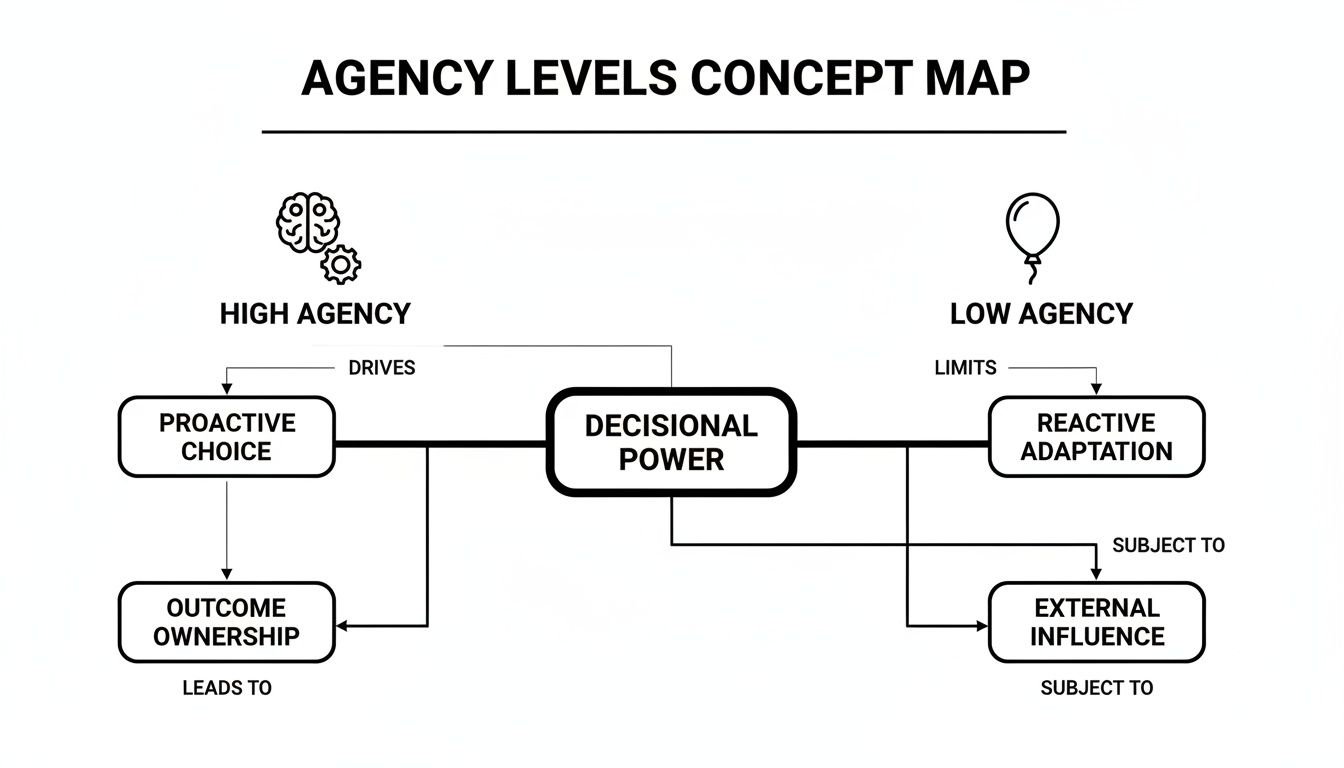
It’s a simple but powerful visual: one path leads to proactive choices and a sense of being in the driver's seat, while the other leads to a life of reacting and feeling like a passenger.
The Head Triad: Types 5, 6, and 7
These types navigate life with their minds, constantly analyzing and planning to find a sense of security in a chaotic world. For them, agency is built on a foundation of knowledge and foresight.
• Type 5 (The Investigator): • A Five feels agency when they feel competent. Their power comes from deep understanding and mastery over a chosen subject, allowing them to observe the world from a safe, knowledgeable distance. • Example: • Before buying a car, a Type Five spends weeks researching engine specs, reliability ratings, and depreciation curves until they are an expert. Their blind spot? The temptation to stay in the library forever, gathering just one more piece of information instead of stepping into the arena and actually • doing • something.
• Type 6 (The Loyalist): • For a Six, agency is about feeling prepared. They are at their best when they’ve scanned the horizon for pitfalls, planned for every contingency, and have a solid support system at their back. • Example: • A Type Six planning a trip to a national park will have backup routes, a first-aid kit, extra food, and will have checked the weather forecast five times. Their core fear, however, can unleash crippling self-doubt that makes them second-guess every move, looking for permission from others before they can trust their own gut.
• Type 7 (The Enthusiast): • A Seven feels their agency in the thrill of new possibilities and the freedom to experience everything life has to offer. They are absolute wizards at reframing negatives into positives and dreaming up exciting new plans. • Example: • When a concert is canceled, a Type Seven immediately pivots and says, "Great! Now we have a free night to try that new restaurant and go bowling!" The trap is their aversion to pain. When things get hard or boring, their instinct is to bolt, which can sabotage their ability to see important projects through to the end.
Getting a handle on these patterns is the first step to moving beyond them. By knowing your type's specific agency blueprint, you can start to play to your strengths while keeping a watchful eye on the blind spots that trip you up. To get a better sense of where you fit in, you can learn more about all nine Enneagram types in our detailed guide and deepen your self-awareness.
Actionable Steps to Build Your Personal Agency Today
Knowing what personal agency means is one thing. Actually living it? That’s where the magic happens. Think of your agency like a muscle—the more you intentionally work it, the stronger it gets. This section is your personal gym, packed with a few powerful exercises to start building that strength right now.
Ready to shift from theory to action? Let’s dive into three foundational strategies that put you back in the driver's seat of your own life, one small, deliberate choice at a time. Each one is simple enough to start today, no matter where you are on your journey.
Master Your Circle of Control
One of the fastest ways to feel powerless is to burn all your energy on things you simply can't change. The "Circle of Control" is a brilliant mental model that puts a stop to that. Picture two circles, one nestled inside the other.
• The Inner Circle (Your Control): • This is your domain. It contains everything you have direct command over—your actions, your reactions, your words, your mindset, and where you choose to focus your attention. This is where your agency truly lives and breathes.
• The Outer Circle (Your Concern): • This much bigger circle holds everything that affects you but that you • can't • directly control. Think: the weather, gridlock traffic, the economy, what other people think of you, or how a professor grades on a curve.
When you obsess over the Outer Circle, you leak power and start to feel like a victim of circumstance. But when you pour that same energy into your Inner Circle? You build an unshakable sense of agency.
Let's make it real: Sarah, a college student in the US, is completely overwhelmed by an upcoming final exam. Fretting about the tricky questions the professor might ask (Outer Circle) is just cranking up her anxiety. So, she shifts her focus. She pivots to her Inner Circle. She maps out a study schedule, rallies a study group, and books time during the professor's office hours. She can't control the exam itself, but she has 100% control over how she prepares for it.
This simple pivot changes the entire game. It turns you from a passive worrier into an active strategist—and that is the very heart of personal agency.
Harness the Power of Micro-Goals
Big, hairy, audacious goals are fantastic, but let's be honest, they can also be completely paralyzing. When a goal feels miles away, it’s easy to get discouraged and throw in the towel. This is where micro-goals become your secret weapon for building unstoppable momentum.
A micro-goal is a tiny, almost laughably easy step you can take toward that bigger objective.
The magic here is pure psychology. Every time you check off a micro-goal, your brain releases a little hit of dopamine, the "feel-good" neurochemical. This creates a positive feedback loop that makes you genuinely want to take the next tiny step, and the one after that.
How to Put Micro-Goals to Work:
These small wins are concrete proof to yourself that you can take action and make things happen. They are the bedrock of confidence and self-trust. Speaking of which, you can find more strategies on how to build confidence in our dedicated guide.
Practice Assertive Communication Scripts
A huge piece of the agency puzzle is being able to clearly voice your needs and protect your boundaries. If you're not used to it, this can feel terrifying. That's where simple communication scripts come in—they're like training wheels, giving you the words you need until speaking your mind feels like second nature.
Taking charge of your relationships by learning how to set boundaries with friends is a game-changing step in claiming your agency. It's not about being aggressive or confrontational; it’s about communicating your limits with clarity and respect.
A Simple Script for Saying 'No' Gracefully:
"I really value our friendship, and because of that, I need to be upfront. I can't [do the thing you're saying no to] right now because I need to protect my energy for [your priority]. I hope you can understand."
This little script does so much! It affirms the relationship, states your position calmly, and offers a simple reason without over-explaining or making excuses. Practicing these scripts helps you reclaim your time and energy, reinforcing the powerful belief that your needs are valid and you have every right to protect them.
Using Your Enneagram Type to Find Your Power
Let’s be honest: generic self-help advice often falls flat. True, lasting change doesn’t come from a one-size-fits-all playbook. It comes from understanding how you are wired.
This is where the Enneagram isn't just a personality test—it's a game-changer for building personal agency. When you know your type, you can stop fighting your own nature and start using it as your greatest asset.

Forget vague tips. We’re talking about targeted "agency accelerators"—specific, actionable steps designed to help you navigate your core fears and lean into your innate strengths. Think of it as your personal cheat code to living a life you actually control.
The incredible popularity of the Enneagram points to a deep, collective craving for self-understanding. Just look at the numbers: Truity sees around one million people take its Enneagram test every 30 days. This isn't just a trend; it's a movement. We want to know who we are so we can take the driver's seat.
Data from a massive 88,000-person survey shows just how much our type influences our life choices. For example, relationship-focused Type 2s report the highest happiness when in a partnership ( 51% ), while the fiercely independent Type 5s are happiest single ( 65% ). Both are exercising their agency, just in very different ways. You can dive deeper into these fascinating patterns in the full analysis of the Enneagram survey .
Agency Accelerators for the Gut Triad (Types 8, 9, 1)
Folks in the Gut Triad (also known as the Body Center) are all about instinct, control, and justice. They feel life in their bones. Their path to greater agency isn't about suppressing that powerful energy, but learning to aim it with more wisdom and less reactivity.
• Type 8 (The Challenger): Try Vulnerable Leadership. • Your power is your brand, but real influence isn't just about command and control. Try this: the next time you have a big decision to make with your team, ask for their input • before • you've made up your mind. Instead of declaring, "Here's the plan," try asking, "What am I not seeing?" It’s a subtle shift that turns a dictator into a true leader.
• Type 9 (The Peacemaker): Say One "Purposeful No." • Your gift for creating harmony is beautiful, but not when it means erasing your own needs. This week, identify one request that isn't essential and politely decline. You’re not rejecting the person; you’re protecting your energy for what truly matters to you. Try saying, "I can't take that on right now, as I'm focused on X." That's you, reclaiming your time and agency.
• Type 1 (The Reformer): Embrace "Good Enough." • Your biggest agency-blocker is that relentless inner critic demanding perfection. Pick one small, everyday task—firing off an email, finishing a slide—and deliberately spend • 20% less • time on it. Send it off when it’s • 80% • perfect and see that the world doesn’t end. You're building a tolerance for imperfection, which frees up massive energy to actually get things done.
Agency Accelerators for the Heart Triad (Types 2, 3, 4)
These types are wired for connection, feeling, and identity. They experience the world through an emotional lens. Their work is to ground their actions in a solid sense of self-worth, untethered from what others think.
• Type 2 (The Helper): Give Anonymously. • Your generosity is a superpower. To make sure you’re using it for • you • (and not for the approval), do one kind thing for someone this week with zero chance of getting credit. Pay for the coffee of the person behind you and drive away. It rewires your brain to find joy in the act itself, not the applause.
• Type 3 (The Achiever): Pursue a "Secret Goal." • Your drive is legendary, but is it always fueled by your own desires? Pick one small goal that you're genuinely excited about—learning a few chords on a guitar, trying a new recipe—and don't tell a soul. Accomplishing something just for you, without the audience, reinforces your internal compass.
• Type 4 (The Individualist): Put Creativity on the Calendar. • Inspiration is a powerful force, but it can be a fickle friend. So, stop waiting for the muse to strike. Block out 30 minutes in your calendar to write, paint, or just daydream. Treat it like a dentist's appointment—non-negotiable. This teaches you that action can summon feeling, not just the other way around.
Agency Accelerators for the Head Triad (Types 5, 6, 7)
These are the thinkers, planners, and visionaries of the Enneagram. They navigate the world by analyzing it, seeking security through knowledge and foresight. Their journey to agency involves bravely stepping out from behind their thoughts and into the world of action.
• Type 5 (The Investigator): Share One Half-Baked Idea. • Your mind is a treasure trove of information, but it can feel like a vault. This week, find a trusted friend or colleague and share one idea that isn’t fully formed yet. It’s a direct challenge to the fear of looking incompetent and builds agency through contribution, not just information hoarding.
• Type 6 (The Loyalist): Make One Small Decision, Fast. • Your brain is brilliant at spotting every possible pitfall, but that "what if" loop can lead to total paralysis. The next time you face a low-stakes choice (what to have for lunch, which movie to watch), set a 60-second timer and just pick. This is a workout for your decision-making muscle, building trust in your own gut.
• Type 7 (The Enthusiast): Do the Boring Part First. • Your love for new, shiny things is infectious! But it can also sabotage your follow-through. On your next project, pinpoint the most tedious, boring task and tackle it right out of the gate. Getting it over with builds the focus you need to see things through, long after the initial thrill is gone.
If you want to dig deeper into what makes you tick, our guide on how to find your strengths is a great next step.
Got Questions? Let's Talk Personal Agency.
We’ve covered a lot of ground, from what personal agency actually is to how your Enneagram type plays a starring role in your story. But chances are, a few questions are still rattling around in your head.
Let's clear the air. Think of this as the myth-busting, confusion-clearing part of our conversation, where we get straight to the point on the stuff that matters most.
"Isn't Personal Agency Just a Nice Word for Selfish?"
This is a big one, and I'm glad you asked. The short answer? Not even close.
Being selfish is all about a "me-first" attitude that often comes at the expense of others. It’s about taking what you want, consequences be damned. True personal agency, on the other hand, is about self-governance and taking radical ownership of your own life—your choices, your happiness, your mess-ups.
It’s about self-respect, not self-obsession. When you have a strong sense of agency, you know your own needs and can hold your own boundaries. This lets you show up in the world from a place of genuine strength, not from a place of neediness or desperation.
In fact, people with a high degree of agency often have the healthiest relationships. Because they value their own autonomy, they deeply respect the autonomy of others. This creates connections built on mutual respect, not control or codependency. It's about empowerment for all, not domination by one.
"I Feel Hopelessly Stuck. Can I Really Develop Agency Now?"
Yes. One hundred percent yes. This is so important to get: personal agency isn't some fixed trait you're born with. It's a skill.
Think of it like a muscle. If you've never used it, it's going to feel weak and flimsy. But with consistent, intentional practice, that muscle can become incredibly strong.
The secret is to stop trying to make some huge, dramatic leap overnight. That's just a recipe for getting overwhelmed and giving up. The real magic happens when you start absurdly small.
• Today: • Instead of scrolling social media on your lunch break, decide to take a 15-minute walk.
• Tomorrow: • The second your feet hit the floor, make your bed.
• The next day: • Politely say "no" to a small request you just don't have the bandwidth for.
Each of these tiny, intentional choices is like a single rep at the gym for your agency muscle. It sends a powerful signal to your brain: "Hey, I'm the one in charge here." These small wins build on each other, creating momentum that slowly rewires your identity from someone things happen to into someone who makes things happen .
"How Does My Enneagram Type
Really
Help With This?"
Think of it this way: knowing your Enneagram type is like being handed the owner's manual for your own mind. It takes you from fumbling around in the dark to knowing exactly which wires to connect.
Instead of trying a bunch of generic self-help advice that may or may not work for you, you get a precise roadmap. It shines a spotlight on the specific, often subconscious, patterns that are secretly undermining your sense of agency.
For example, a Type 6 who freezes up when making decisions might finally understand their hesitation isn't a character flaw—it's a direct result of their core fear of being without support. Armed with that knowledge, they can stop beating themselves up and start consciously working on trusting their own inner guidance, even when it feels scary.
The Enneagram makes the abstract concrete. It transforms a fuzzy goal like "be more proactive" into a targeted, actionable game plan built specifically for your unique internal wiring.
"What's the Single Best First Step I Can Take?"
If you do nothing else, do this: get crystal clear on what you're working with. You can't fix a car engine if you have no idea how it works. The same goes for your own mind.
Before you jump into action, commit to understanding your personal operating system. The fastest, most effective way to do that is to discover your Enneagram type. Taking a reliable, in-depth assessment gives you a detailed report on your core personality—your deep-seated motivations, your fears, and the exact places where your agency either shines or gets stuck.
This knowledge is the bedrock. It's the foundation you build everything else on. Once you know your type, you can come back to the strategies in this guide and apply them with laser-like precision, getting much faster and more meaningful results. It really is the ultimate shortcut to reclaiming your power.
Ready to discover your unique blueprint for personal agency? The Enneagram Universe assessment is your first step. Our scientifically validated test will give you the deep insights you need to stop guessing and start living with intention. Take the free test today .