People Skills for Managers: How to Lead, Motivate, and Get Results

So, you got the promotion. You were a superstar, the go-to person on your old team, and you absolutely deserved it. But here’s the thing no one tells you in the offer letter: the skills that made you an incredible individual contributor are almost the exact opposite of what you need to be a great manager.
The truth is, mastering the art of management is less about your own output and all about unlocking the potential in others. Those stellar people skills for managers aren't just a fluffy extra—they're the new core of your job description.
Why Your Technical Prowess Won't Cut It Anymore
Let's get real for a second. You probably didn't climb the ladder by being the office peacekeeper or the team's unofficial therapist. You were the best at what you did . The top coder, the ace marketer, the salesperson who couldn't miss. But now, your primary role has flipped. Your job isn't to be the best doer anymore; it's to build a team of them.
This is the pivot where so many sharp, newly-minted managers get stuck. They try to lead by being the "super-doer," and it backfires.

When people skills are on the back burner, the damage is swift and expensive. It shows up as:
• A team running on fumes: • When people don't feel seen, heard, or valued, they check out. You get compliance, not commitment. • For example • , a manager who only talks about deadlines and never asks about workload or challenges will soon have a burnt-out team.
• A revolving door of talent: • Great employees don't quit jobs; they quit bosses. If you can't connect, develop, and champion your people, they'll find someone who will.
• Projects stuck in the mud: • Simple misunderstandings fester, and unresolved conflicts create a sludge that brings momentum to a dead stop. • For example • , if two team members have different ideas about a project's direction and the manager ignores it, the project can stall for weeks.
The Bottom-Line Impact of the Skills Gap
This isn't just about hurt feelings. The pressure cooker environment for managers is real. Recent data shows a staggering 82% of middle managers report the highest daily stress levels—way more than any other group in the workplace. Much of that stress comes directly from the messy, unpredictable, and demanding work of managing other humans.
And it’s not just the managers feeling the strain. As of August 2025, a dismal 18% of employees worldwide reported feeling extremely satisfied at work. It's a clear signal that leadership is falling short. You can discover more insights into these workforce trends and see the bigger picture.
The great paradox of management is that your success is no longer about you. It's measured by the collective success, growth, and well-being of the people you have the privilege to lead.
This guide is your battle plan. No corporate jargon, just a practical, step-by-step approach to building the essential people skills you need to thrive. We’ll kick things off with an honest look in the mirror to see where you are right now. By the time we're done, you'll have a clear roadmap to becoming the kind of leader people actually want to work for—one who builds trust, sparks motivation, and gets incredible things done through their team.
Managerial Skills Self-Assessment Checklist
Before diving in, let's get a baseline. This isn't a test; it's a quick, honest gut check to see where you feel strong and where you have room to grow. Grab a pen and be real with yourself—no one's grading this.
| People Skill Area | Current Comfort Level (1-5) | A Recent Example Where I Used This Skill | One Area for Improvement |
|---|---|---|---|
| Active Communication | |||
| Empathy & Connection | |||
| Giving & Receiving Feedback | |||
| Conflict Resolution | |||
| Coaching & Development |
Once you've filled this out, take a look. The areas with lower scores aren't weaknesses; they're your biggest opportunities. This checklist will be your personal starting line as we move through the next sections.
How to Communicate with Clarity and Confidence
Of all the people skills a manager needs, communication is the absolute bedrock. It’s the lifeblood of a high-performing team. Yet, under pressure, it's often the first thing to crumble. We're not just talking about being able to speak clearly; we're talking about building a genuine two-way street where information flows, ideas are truly understood, and your people feel heard.

It’s so easy to fall into the trap of just giving top-down directives. But that’s how you end up with a team that's confused, disengaged, and quietly resentful. The real magic happens when you shift from just giving orders to actually starting a conversation.
Let’s look at a classic example. I once worked with a manager, we'll call her Sarah, who learned this the hard way. She’d end every project briefing with a breezy, "Any questions?" The silence that followed always felt like a win. But in reality, her team was scrambling, totally unclear on the real priorities, which led to a ton of rework and missed deadlines. Sound familiar?
Master the Art of Active Listening
The single biggest mistake in communication is just assuming it happened. The real foundation of getting your message across isn't about what you say—it's about what you hear. Active listening isn't just about nodding along while you wait for your turn to talk. It's about full-on concentration, tuning into what’s being said and, just as importantly, what’s being left unsaid.
Sarah started small, changing her one-on-ones. Instead of diving straight into a checklist of status updates, she started with a few open-ended questions:
• "What's one thing that went really well for you last week?"
• "Where are you feeling the most friction on this new project?"
• "What’s one thing I could do right now to make your life easier?"
This tiny change was a game-changer. Suddenly, her team was sharing real roadblocks instead of just giving the standard "everything's fine" line. She wasn't just hearing words anymore; she was finally getting the full picture.
Your job as a manager isn't to have all the answers. It's to create a space where the best answers can surface. That space is built on a foundation of listening.
Use Crystal-Clear Messaging
Once you truly understand what's going on with your team, your own instructions become a thousand times more effective. Vague directions are a recipe for anxiety and wasted hours. If you want to make sure your delivery is as sharp as your message, you might even explore specialized coaching, like accent reduction specifically for managers , to close any potential gaps.
One of the most powerful tools in your arsenal is the "repeat and confirm" technique. It’s a dead-simple, two-step process to squash misunderstandings before they can even take root.
Practical Example: A Project Update
Let's see how Sarah put this into action. Her old, vague directives got a serious upgrade.
• The Old Way: • "Hey Alex, I need that quarterly report done by Friday. Let me know if you have questions." (Translation: Good luck!)
• The New Way: • "Hi Alex, the goal for this quarterly report is to really showcase our client growth and project efficiency. I need the first draft by EOD Thursday, which gives me time to review it before the Friday leadership meeting. To make sure we're aligned, what are the key metrics you're planning to focus on first?"
See the difference? This new approach confirms understanding right out of the gate, clarifies the why behind the what, and empowers Alex to run with it. By putting active listening and clear, confirmable messaging together, Sarah didn't just improve her team's output—she built a culture of trust and clarity.
Developing Empathy and Emotional Intelligence
Let's be clear: empathy isn't about being "nice" or just feeling sorry for someone. That's sympathy. True empathy is a manager's secret weapon—it’s the ability to genuinely understand where your team members are coming from, what they're feeling, and why. It's the difference between saying, "Oh, that's too bad," and saying, "I can see why you're frustrated, and that makes total sense. Let's talk about it." One offers pity; the other builds a bridge.
In a workplace that’s constantly in flux, this is one of those people skills for managers that has gone from a nice-to-have to an absolute must.
How to Read the Room (Even the Virtual One)
Your first job is to become a better observer. When you're in the office, this is about picking up on the non-verbal stuff. Look past the words people are saying and tune into their body language, the energy in their voice, or a sudden lack of eye contact. Is your most energetic and vocal team member suddenly radio silent in meetings? That’s not just a quiet day; that’s a signal.
This gets a lot harder when your team is remote, but it's far from impossible. You just have to look for different clues.
• Changes in digital habits: • Is someone who's usually all over Slack suddenly taking hours to respond?
• The camera-on, camera-off dance: • If a colleague who is typically camera-on suddenly goes dark, it might be a subtle sign they’re struggling or just not feeling it that day.
• Tone shifts in text: • A person who usually sends detailed, thoughtful emails is now firing back one-word answers. Something’s up.
Think of these little observations as data points. They don't give you the full story, but they absolutely tell you where to start digging with genuine curiosity.
An Empathetic Manager in Action
Picture this: David, a manager, notices his top performer, Maya, has started missing deadlines and seems completely checked out.
The old-school, command-and-control manager might say: "Maya, your performance is slipping. You need to get back on track." That conversation is a brick wall. It’s a one-way ticket to resentment and disengagement.
The empathetic manager takes a completely different route. David sets up a one-on-one and opens with vulnerability and curiosity: "Hey Maya, I've noticed you seem a bit quieter lately, and I just wanted to check in. How are things?"
He doesn't interrupt. He just listens as Maya shares that she's completely swamped with a project that keeps changing scope while also trying to care for a sick parent at home. Instead of immediately jumping in with solutions, David asks questions that show he’s really hearing her:
• "Wow, that sounds incredibly stressful. From your side, what does your workload feel like right now?"
• "Which part of this project is creating the most friction for you?"
• "What would be the most helpful thing I could do to support you this week?"
See the difference? By leading with empathy, David didn't just 'fix' a performance problem. He built trust, got to the real root of the issue, and showed Maya she's a valued human being, not just a name on a performance tracker.
This kind of proactive, human-centered leadership is becoming table stakes. The World Economic Forum’s Future of Jobs Report 2025 noted that employers predict roughly 39% of core skills will shift by 2030, with leadership, empathy, and active listening skyrocketing in importance. You can read the full research about these evolving skill demands to see just how big this trend is.
And if you're ready to really dig in, check out our guide on how to increase your emotional intelligence . It's foundational to becoming the kind of empathetic, effective leader people actually want to work for.
Giving Feedback That Actually Helps People Grow
Let’s be honest. If the phrase “can I give you some feedback?” makes your stomach drop, you’re in good company. Most managers dread giving it as much as employees dread hearing it.
So, why is feedback so universally awkward? Because most of us are doing it wrong. We make it vague, we make it personal, and we save it up for one big, scary conversation. It's time to break that cycle. Giving truly great feedback is one of the most vital people skills a manager can have, and it can turn those uncomfortable chats into genuine moments of growth.

The secret isn't some complex psychological formula. It’s simply about being specific, staying objective, and focusing on behavior , not personality. The real goal is to make feedback a normal, continuous part of your team’s rhythm, not a once-a-year ambush.
Use the Situation-Behavior-Impact Model
Meet your new best friend for delivering feedback that lands perfectly: the Situation-Behavior-Impact (SBI) model. This simple framework strips out the ambiguity and emotion, grounding the conversation in a specific moment in time.
Here’s how it works:
• Situation: • Pinpoint the exact when and where. "During this morning's client presentation..."
• Behavior: • Describe what you actually saw or heard—no interpretations. "...when you walked through the project data..."
• Impact: • Explain the result of that behavior. "...it was incredibly clear and helped the client immediately grasp our value."
This structure is a game-changer for constructive feedback, too. By sticking to the facts, you prevent the other person from feeling attacked, which is the number one cause of defensiveness. When you deliver it this way, it stops feeling like criticism and starts feeling like you're solving a problem together. That's the core of real coaching skills for leaders .
The table below shows just how powerful this shift from vague to valuable can be.
Transforming Your Feedback From Vague to Valuable
| Ineffective Feedback (Avoid This) | Effective Feedback (Use This) |
|---|---|
| "You were a little aggressive in that meeting." | "(Situation) In the team meeting this morning, (Behavior) when you interrupted Mark mid-sentence, (Impact) it shut down the conversation and we lost his idea." |
| "Great job on the report!" | "(Situation) In the Q3 report you sent yesterday, (Behavior) the way you visualized the data with those charts (Impact) made a complex topic incredibly easy for the leadership team to understand." |
| "You need to be more of a team player." | "(Situation) When we were trying to hit the project deadline last Friday, (Behavior) you worked on your tasks alone instead of checking in with the rest of the team. (Impact) As a result, we duplicated some work and missed an opportunity to help Sarah, who was falling behind." |
| "You're not engaged enough during calls." | "(Situation) On the all-hands call today, (Behavior) you had your camera off and didn't contribute to the brainstorming session. (Impact) I'm concerned we're missing out on your perspective, and it might seem to others like you aren't dialed in." |
See the difference? One is a judgment call that invites an argument; the other is a clear observation that opens the door to a productive discussion.
Feedback is a gift, but only if it's wrapped correctly. Vague feedback is like getting a gift with no label—you don’t know what to do with it. Specific feedback is a gift with instructions.
Handling Defensive Reactions Gracefully
Even with a perfect delivery, you’ll eventually run into a defensive reaction. It’s human nature. The trick is to not get defensive yourself. Just stay calm, truly listen to their side, and gently guide the conversation back to the objective SBI model.
If you get pushback, try saying something like: "I can see you feel differently about it. My only goal here is to share how that specific action landed from my perspective. Can we walk through it one more time together?"
This simple phrase validates their feelings without backing down from the core issue. It keeps the focus on the behavior, not on who is right or wrong.
The truth is, most companies are failing to prepare managers for these tough conversations. Mercer’s Global Talent Trends report found that a whopping 66% of HR leaders see improving manager skills as a top priority. But there's a huge gap between saying it's a priority and actually providing the right training. You can read the full research on talent trends to see just how widespread this issue is. By learning how to navigate these conversations, you're not just improving your own skills—you're tackling one of the biggest weak spots in management today.
Turning Team Conflict into a Creative Spark
Let's get one thing straight: a little friction on your team isn't a red flag. In fact, silence is often way scarier. When people disagree, it usually means they care deeply and have strong, passionate ideas. The real magic of management isn't about stamping out every disagreement, but learning how to step into that tension and redirect it.
Let it fester, and you’ll have a full-blown morale wildfire on your hands. But guide it skillfully, and you'll find that conflict is often the messy, unpredictable birthplace of truly game-changing ideas.
You're the Mediator, Not the Judge
When two people are at odds, your first instinct might be to figure out who's "right." Resist it. Your job isn't to declare a winner. It's to create a space where both people feel seen and heard, and then guide them toward a solution they co-create. Playing judge and jury is the fastest way to leave one person feeling crushed and the other smug—a perfect recipe for future resentment.
Imagine Michael, a manager at a software company. He’s got two of his sharpest engineers, Anna and Ben, locking horns over the core architecture for a new feature. The tension is so thick you could cut it with a knife, and it's starting to stall every meeting.
Instead of putting them on the spot in a group setting, Michael pulls them into a private meeting. He bypasses the classic, "Alright, what's going on with you two?" and instead sets the stage for teamwork right from the jump.
"I wanted to get the two of you together because you're my go-to experts on this project. It's obvious you both have powerful, well-thought-out ideas for how to move forward, and that's exactly what this feature needs. My only goal here is to make sure we explore both perspectives and find a path that harnesses the best of your thinking."
That simple opener completely changed the dynamic. Suddenly, it wasn't a battle to be won. It was a complex puzzle; they were all there to solve it together .
A Simple Playbook for Finding Common Ground
Michael then walked Anna and Ben through a process you can borrow for just about any disagreement. It’s less of a rigid script and more of a framework for productive conversation.
• Rule #1: Set the stage. • Michael started with the basics: "Okay, we're here to give each other our full attention, no interruptions. We're going after the problem, not each other."
• Rule #2: Give each person the mic. • He let Anna lay out her entire approach first, while Ben's only job was to listen. Then they swapped. No rebuttals, just listening.
• Rule #3: Ask clarifying, not leading, questions. • Michael acted as a neutral guide. He’d ask things like, "Ben, can you walk me through the primary risk you see in Anna's plan?" and "Anna, what's the biggest performance gain you see in your approach?"
• Rule #4: Hunt for the common goal. • After listening, Michael connected the dots. "So, what I'm hearing is that you • both • agree that long-term scalability is non-negotiable. The disagreement is on how to guarantee system stability along the way. Did I get that right?"
The moment they both nodded, the tension just melted away. It was no longer Anna's idea versus Ben's idea. It was Anna and Ben versus the technical challenge of building a system that was both scalable and stable.
Once their egos were out of the way, the real collaboration began. They started cherry-picking the best parts of each other's plans, sketching out a hybrid solution that was far more robust than what either of them had cooked up alone. Michael didn't solve their problem; he simply created the conditions for them to solve it themselves. And that's a win that sticks.
Building Your Personal People Skills Action Plan
Look, all the theory in the world doesn't mean a thing if you don't actually do something with it. Now’s the time to roll up your sleeves and turn those insights into action. We’re going to build a tangible, 90-day plan.
The goal here isn't to boil the ocean or fix every weakness overnight. That's a recipe for burnout. Instead, pick one, maybe two, key areas where you want to see real, measurable progress.
Go back to that self-assessment you did earlier. What was your lowest-scoring skill? That’s your starting point. And let’s ditch the vague, fluffy goals like "I'll be a better communicator." We need to get surgical with this.
Set Your 90-Day Mission
Your plan should be all about small, consistent actions that build into new habits. The best people skills for managers aren't forged in a single, heroic moment; they're built through thousands of tiny, intentional efforts.
Let's break down what this looks like in the real world:
• If you’re working on Active Listening: • For the next • 90 days • , your mission is to dedicate the first five minutes of every single one-on-one to just listening. No interrupting, no problem-solving. Just ask open-ended questions and absorb what they're saying. After each meeting, jot down one key thing you learned from their perspective.
• If you’re tackling Giving Feedback: • Commit to using the SBI (Situation-Behavior-Impact) model at least once a week. This isn't just for tough conversations; use it for praise, too. Keep a private log to track when you did it and how it went. This keeps you honest.
• If Conflict Resolution is your focus: • The very next time a disagreement pops up, your goal is to be a mediator, not a judge. Resist the urge to pick a side. Instead, your job is to help the people involved find a sliver of common ground before you even • think • about solutions.
When conflicts do arise, it helps to have a simple mental framework. Don't just rush in to fix it.
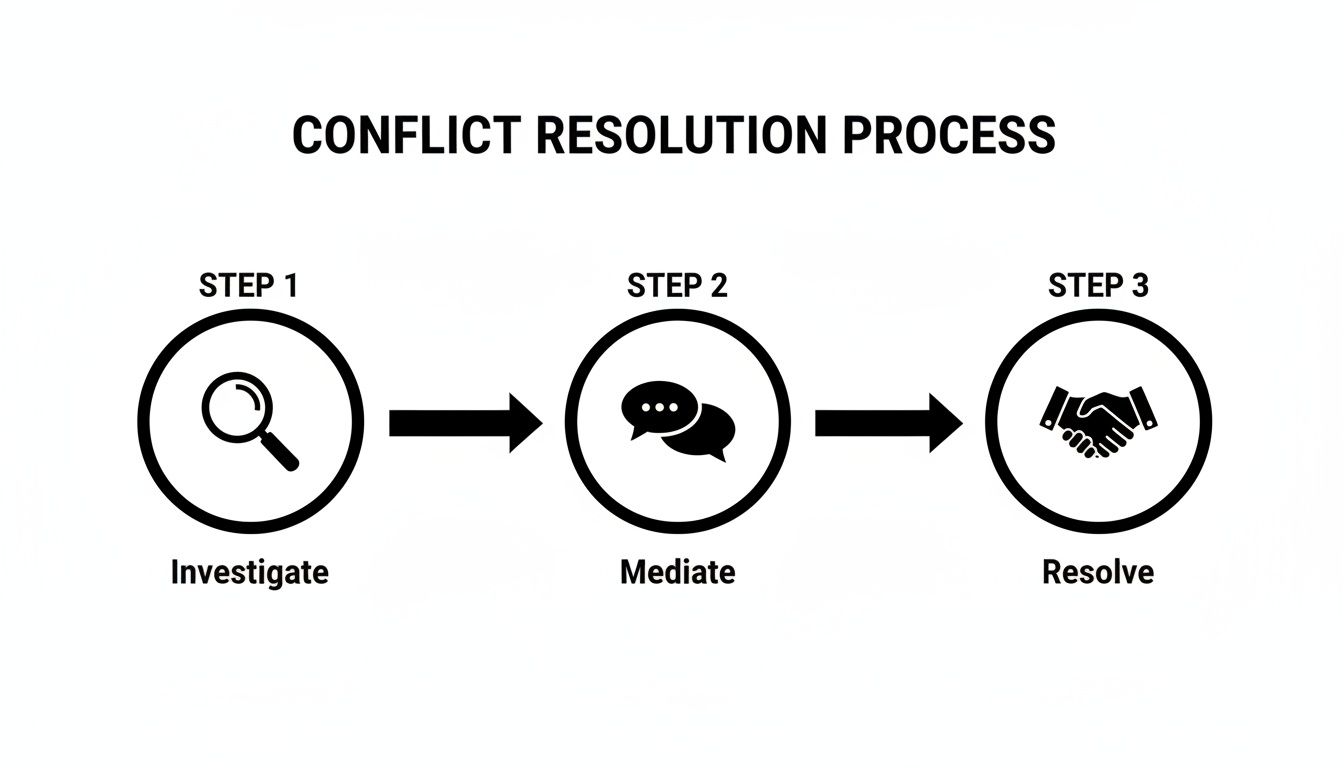
This process forces you to investigate and mediate before jumping to a conclusion, which is the secret to making sure everyone feels heard and respected.
Your leadership identity isn't defined by a single heroic moment. It's forged in the thousand small, intentional interactions you have with your team every single day.
If you’re serious about fast-tracking your growth, exploring business coaching can be a game-changer. Think of it as having a strategic partner dedicated to sharpening these very skills.
And for a real shortcut to understanding why you lead the way you do, check out our guide on using the Enneagram at work . Knowing your core motivations gives you a massive advantage. This plan is your roadmap—now go make those skills part of your leadership DNA.
Stuck on a Few Common Hurdles?
Look, every manager hits a wall with this stuff at some point. It's completely normal. Let's tackle a couple of the most common questions I hear from managers trying to level up their people skills.
"But I'm an Introvert! How Can I Be a 'People Person'?"
First things first, let's kill the idea that being an introvert is a managerial weakness. It's a superpower in disguise. You're probably a phenomenal listener and a much more thoughtful, reflective thinker than your extroverted peers.
Don't try to become the life of the office party. That's not you, and it'll just drain your battery. Instead, lean into what you do best.
Focus your energy on high-impact, structured interactions.
• Pour your effort into making your one-on-ones incredibly well-prepared and insightful. • For example • , before a one-on-one, an introverted manager might spend 15 minutes reviewing their team member’s recent work and writing down two specific, thoughtful questions to ask them.
• Use your keen observation skills during meetings to • really • understand the group dynamics, not just dominate the conversation.
The goal isn't to magically transform into an extrovert. It's about being an effective, authentic manager who builds deep, meaningful connections on their own terms.
"What's the Secret to Getting
Honest
Feedback?"
It’s all about trust. You can’t just walk up to someone and ask a huge, scary question like, "So, how am I doing as your boss?" That puts people on the spot, and they'll almost always give you a polite, useless answer.
You have to build psychological safety first. Start small.
Ask for specific, low-stakes feedback about a process, not about you personally. For example:
"Hey, I'm trying to make our weekly team meetings better. What's one thing we could change to make them more valuable for you?"
When someone gives you an idea, your next move is critical. Thank them, and then—this is the most important part— visibly act on their suggestion . When your team sees that their input actually leads to positive change, they'll start trusting you with the bigger, more candid feedback you're really after.
Here at Enneagram Universe , we know that exceptional leadership starts from the inside out. Gaining real self-awareness is the key that unlocks the people skills that will define your career.
Ready to start that journey? Take our free, in-depth Enneagram test today to discover your core motivations and learn how to lead your team with greater impact. Find out your Enneagram type at Enneagram Universe .