Organizational Culture Change Management: Frameworks, Tools & Best Practices

Let's be brutally honest: most corporate culture change initiatives are dead on arrival. That's not me being a pessimist; it's about facing reality so you can actually win. A successful organizational culture change management plan isn't about wishful thinking—it's about spotting the traps before you fall into them.
Why Most Culture Change Efforts Fail (And How Yours Can Succeed)
If you've ever been part of a big, splashy company initiative that quietly vanished a few months later, you know the drill. Real, lasting culture change is ridiculously hard. Too many leaders think a slick presentation and some new posters in the breakroom will do the trick. Spoiler alert: it never does.
The real reasons these efforts crash and burn are usually hiding in plain sight. They're the messy, human parts of the equation that get completely ignored in the frantic rush to roll out a new system or strategy.

The Real Reasons for Failure
A major culprit is the classic leadership disconnect. Executives can preach the gospel of change from their ivory tower, but if middle managers aren't bought in, the message dies right there. For example, a CEO might announce a new "customer-first" culture, but if a sales manager's bonus is still tied solely to hitting a new account quota, they will continue to prioritize quick sales over building long-term customer relationships. This creates a bottleneck where employees get mixed signals, leading to cynicism and confusion.
Then there's the communication—or lack thereof. It's not enough to tell people what is changing. You have to sell them, passionately and repeatedly, on why it matters. When people don't get the "why" behind the chaos, their default setting is resistance. Getting this right means tapping into the core principles of business psychology to connect with people on a level that actually resonates.
The single biggest problem in communication is the illusion that it has taken place. - George Bernard Shaw
Stacking the Deck in Your Favor
So, how do you avoid becoming another statistic? Start by staring those grim numbers right in the face. A mind-boggling 70% of organizational change initiatives fail , with only about 34% ever hitting their targets. That’s a tough reality, but knowing it is your secret weapon.
This guide is your playbook. We’re skipping the fluff and getting straight to the practical, boots-on-the-ground steps to steer your company's culture in a new direction. The first step is admitting that culture is all about people. You can dig deeper into how to improve workplace culture by understanding what truly drives your team.
We’ll cover everything from diagnosing what’s really going on in your organization to building a powerful coalition that will champion the change, making sure your hard work leads to real transformation, not just a brief moment of forced compliance.
First, Play Doctor: Diagnose Your Current Culture
Kicking off a culture change initiative without knowing where you really stand is a recipe for disaster. It's like a doctor prescribing surgery without running any tests. You might fix something , but chances are you'll miss the actual problem.
Before you can build the culture you want, you have to get brutally honest about the one you have. This isn't about running another bland employee survey; it's about becoming a cultural detective inside your own organization. The mission? To capture a true, unfiltered snapshot of your company's personality—the good, the bad, and the weird. This deep dive will show you which hidden strengths you can lean on and which toxic habits need to go.

Go On a "Culture Safari"
Let me tell you a secret: your real culture isn't written on that glossy "Our Values" poster in the lobby. It's alive. It’s in the casual chatter by the coffee machine, the body language in meetings, and the stories people share when they think no one is important to listening.
To see it, you need to get out of the boardroom and observe your people in their natural habitat. Think of it as a "culture safari." You’re not there to interfere, just to watch, listen, and learn what people do , not what they say they do. That's where the truth lives.
Field notes for your safari:
• Meeting Rhythms: • Who talks first? Is it always the same person? Watch who gets interrupted and whose ideas get ignored. Are decisions made together, or does the highest-paid person’s opinion always win?
• The Water Cooler Vibe: • Hang out in the breakroom. Are people laughing and swapping ideas, or is it dead silent? Are they complaining about work, talking about their weekends, or just grabbing their coffee and retreating to their desks?
• Reading the Walls: • Your office space is telling a story. Are the walls covered with team photos from the last company outing, or is it just a shrine to the top salesperson of 2017? What you celebrate visually says a lot about what you actually value.
Decode the Unwritten Rules of the Game
Every company runs on a set of powerful, unwritten rules. These are the "how we really do things around here" norms that new hires have to figure out the hard way. Getting a handle on these is non-negotiable for any real change.
I once worked with a company that proudly touted its "flexible work" policy. But the unwritten rule? If you weren't online after 7 PM, you clearly weren't a "team player." This kind of hypocrisy breeds cynicism faster than anything else and kills any chance of genuine culture change.
Your culture isn't defined by your aspirations. It's defined by the worst behavior you're willing to tolerate. If you ignore the unwritten rules, you're not seeing the whole picture.
To unearth these rules, you need to have candid conversations. I find one-on-ones with a mix of trusted veterans and newer employees work best. Ask them something like, "If you were giving advice to a new hire on how to actually succeed here, what would you tell them?" Their answers will hand you the keys to your culture's true operating system.
Get to the "Why" with the Enneagram
Okay, so observing behavior tells you what is happening. But it doesn't tell you why . And without the "why," you're just treating symptoms. Culture, at its core, is just a collection of human personalities, fears, and motivations all mashed together. This is where tools that go deeper can be absolute game-changers.
I've had incredible success using frameworks like the Enneagram . It’s not about sticking labels on people. It's about understanding the core motivations that drive their behavior, especially how they'll react to something as disruptive as a culture shift.
Let me give you a real-world example. A booming tech startup was famous for its "hustle culture." From the outside, it looked like a team of super-driven go-getters. But they were burning out. Fast. We ran Enneagram assessments and uncovered a powerful pattern: the team was packed with Type Threes (The Achievers) and Type Sixes (The Loyalists) .
• The • Achievers • were terrified of being seen as worthless, so they worked insane hours to prove their value.
• The • Loyalists • were driven by a deep need for security, so they hustled out of fear of being fired if they couldn't keep up.
That one insight changed everything. Their celebrated "hustle culture" was actually a "fear culture" in disguise. It wasn't passion driving them; it was anxiety. With this new understanding, the leaders could pivot their entire organizational culture change management approach. They stopped rewarding long hours and started celebrating smart innovation and genuine well-being, directly addressing the fears that were secretly running the show.
Aligning Leadership And Building Your Change Coalition
Let’s be honest. If your leaders aren’t genuinely on board, your culture change initiative is just expensive corporate theater. After you've diagnosed your culture, the next make-or-break phase is getting the right people in your corner. That mission starts at the very top.
Without a united leadership front, any momentum you build will fizzle out fast. A single, polished all-hands announcement isn't alignment; it's a memo. Real alignment is consistent, visible, and relentlessly reinforced. It's the CEO mentioning the new cultural values in a quarterly earnings call. It's the Head of Sales celebrating a team member for embodying a new collaborative behavior, even if it meant missing a target.
Closing The Leadership Perception Gap
I've seen it a hundred times: there’s often a massive gap between what executives think they're communicating and what employees actually hear. This disconnect can be fatal. Research actually backs this up, highlighting a critical perception gap where 74% of leaders claim they include employees when developing change strategies, but only 42% of employees feel involved. That's a huge disparity that breeds resistance, crushes morale, and explains why so many great ideas fail before they even start. Discover more insights about this organizational change disconnect .
To close this gap, you have to treat leadership alignment like an ongoing campaign, not a one-time event. This requires more than just getting nods of agreement in a closed-door meeting; it demands active, public championship from every single leader. Consistent messaging and unified actions are absolutely essential for building trust in a team , especially during times of uncertainty.
Building Your Volunteer Army
Once your leadership team is singing from the same song sheet, it's time to build your "change coalition." This is your volunteer army—a diverse group of influencers from every level and pocket of the company who will advocate for the change authentically. A top-down mandate can force compliance, but it will never, ever inspire belief.
This coalition is your secret weapon for unlocking grassroots momentum, which is just as crucial as executive sponsorship. And I’m not just talking about managers or your usual high-performers. They are the informal leaders people naturally turn to for advice and guidance.
Your change coalition gives your initiative a human voice. They translate corporate strategy into hallway conversations, making the abstract feel personal and achievable.
Identifying these key players means you have to look beyond the org chart. Who are the people everyone respects, regardless of their title?
• The Go-To Problem Solver: • The engineer everyone bugs when they're stuck.
• The Social Connector: • The person in marketing who knows everyone's name.
• The Respected Skeptic: • The veteran employee who tells it like it is but has earned everyone's trust.
By inviting these individuals into the process early, you give them a sense of ownership. You turn potential critics into your most passionate advocates.
An Example From The Factory Floor
I remember working with a mid-sized American manufacturing company that wanted to shift its culture from top-down command to one of frontline empowerment and continuous improvement. The executive team was completely aligned, but the initial rollout fell completely flat on the factory floor. The workers saw it as just another "flavor of the month" initiative from corporate.
The plant manager wisely hit the pause button. Instead of pushing harder, he identified the most respected line supervisors—the ones who had been there for 20 years and had seen it all. He didn't just brief them; he brought them into a "design team" for the change.
He sat them down and asked, "How do we make this actually work down here?"
These supervisors became the most effective change agents you could imagine. They helped redesign workflows, translated the corporate jargon into practical terms for their teams, and championed the new approach during their daily huddles. Because the message was coming from trusted peers, not a distant executive, the workforce bought in. The initiative went from a failing project to a massive success, proving that a powerful coalition is the engine of any lasting organizational culture change.
Designing New Behaviors, Rituals, and Communication Plans
Alright, this is where the rubber meets the road. All the leadership alignment and deep-dive assessments are great, but culture isn't built in a boardroom. It's forged in the thousand tiny moments that happen every single day.
A slick mission statement hanging in the lobby is just wallpaper. Real culture is what people do when no one is watching. It’s the conversations, the habits, and the unwritten rules of engagement. Now, we’re going to get our hands dirty and design the tangible, visible, and practical pieces that make your new culture come alive.
From Vague Values to Concrete Actions
Let's be honest, telling your team to "be more innovative" is about as useful as telling them to "be more awesome." It sounds good, but what does it actually mean ? Do they start challenging every idea in meetings? Do they get to spend Fridays on passion projects?
Without a crystal-clear picture of what you want, people will just nod politely and go right back to their old routines.
The trick is to translate your big, aspirational values into small, observable behaviors. These are the non-negotiable actions that scream, "Hey, things are actually different around here!" For instance, if you're trying to build a culture of psychological safety, what does that look like day-to-day?
• The Old Way: • A project goes south, and the first question is, "Whose fault is this?"
• The New Way: • A project goes south, and the leader kicks off a "blameless post-mortem" to figure out what the • system • can learn.
See the difference? It's a simple, teachable shift from a witch hunt to a learning opportunity. That’s a behavior you can model, measure, and build on. It’s about creating new, effective ways of working that are baked into your daily operations.
Mapping Old Habits to New Cultural Norms
To make this change stick, you have to explicitly identify the old behaviors you want to leave behind and define the new ones you want to encourage. This table shows how to replace common negative behaviors with specific, positive ones that support your new culture, along with practical ways to reinforce them.
| Old Undesirable Behavior | Underlying Fear or Motivation | New Desired Behavior | Supporting Ritual or Process |
|---|---|---|---|
| Hoarding information | Fear of losing power or relevance | Proactively sharing updates and insights | "Work Out Loud" channels in Slack; weekly team "Show & Tell" sessions |
| "Meeting after the meeting" | Fear of conflict or reprisal | Voicing constructive dissent during the meeting | Start meetings with a "round-robin" for initial thoughts; leader explicitly asks "What are we missing?" |
| Punishing failure | Fear of losing control or looking incompetent | Celebrating "intelligent failures" as learning | "Failure of the Month" award; project retrospectives that focus on lessons, not blame |
| Siloed decision-making | Need for speed; belief that "my team knows best" | Cross-functional input on key decisions | Mandatory "Peer Review" step for all major project proposals; create cross-departmental "tiger teams" |
By mapping it out like this, you give everyone a clear playbook. You're not just telling them what to do, but also helping them understand the outdated mindsets they need to let go of.
The Understated Power of Rituals
Humans are creatures of habit. Think about your morning coffee or your family's holiday traditions. These rituals ground us and give our lives meaning. Smart leaders hijack this natural tendency to build culture.
A ritual is more than just a process—it’s a process with a soul. It's a recurring activity that carries symbolic weight, strengthens social bonds, and embeds the norms you want to see.
"Rituals are the glue that holds a culture together. They're the visible, repeatable actions that turn abstract values into a lived reality for everyone in the organization."
Think about these real-world examples:
• For Collaboration: • A tech firm was struggling with siloed teams that never talked to each other. They launched a weekly "Demo Day." It wasn't a stuffy presentation; it was a loud, fun, all-hands meeting where teams showed off their work-in-progress, warts and all. It became a celebration of effort and sparked countless new ideas.
• For Recognition: • A hospital wanted to create a culture of deep gratitude. They kicked off every single leadership meeting with a simple ritual: each executive shared a story about a frontline employee who went above and beyond for a patient. It constantly reconnected the leaders to the company's core mission.
These aren't expensive, complicated programs. They are simple, consistent actions that make the new culture impossible to ignore.
Crafting a Communication Plan That Actually Works
Your communication plan is the story you tell about this change. And please, for the love of all that is good, don’t make it a series of sterile, corporate-speak emails. That’s the fastest way to get your message deleted.
People don’t connect with process changes and timelines; they connect with stories and emotion. You have to explain the why in a way that resonates with their own hopes, fears, and ambitions. And you have to be relentless. One email isn't a plan; it's a prayer.
Here’s what a killer communication plan looks like:
By designing specific behaviors, embedding them in meaningful rituals, and wrapping it all in a compelling story, you’re no longer pushing change onto people. You’re inviting them to build it with you.
Piloting, Scaling, and Measuring Real Progress
Let’s be honest: trying to change your entire company's culture all at once is a fool's errand. It’s like trying to teach a thousand people to dance the tango simultaneously in a crowded ballroom. It’s a recipe for chaos, bruised egos, and a whole lot of resistance. The "big bang" approach creates a lot of noise, but very little real movement.
A much savvier way to go about it is to think like a startup founder launching a new product. You start small, create a minimum viable product (in this case, a minimum viable culture ), test it with a friendly audience, and build unstoppable momentum from there.
This is where piloting your organizational culture change management plan becomes your secret weapon. You're creating a controlled experiment in a small, receptive corner of the business. This lets you test new behaviors, get some brutally honest feedback, and—most importantly—score some early wins that will make everyone else sit up and take notice.
Your Culture Change Greenhouse
Think of your pilot team as your culture greenhouse. You’re not looking for the most broken, dysfunctional department to "fix." That's a trap. Instead, you’re looking for the most fertile ground. The ideal pilot group has a leader who's genuinely fired up about the change and a team that’s generally open to trying new things. This isn't about ducking a challenge; it's about stacking the deck for an initial victory.
Let’s say a big hospital wants to shift its culture toward truly patient-centric communication. Instead of trying to retrain all 1,200 staff members at once, they pick a single surgical recovery ward for the pilot. Why? Because the ward manager is a known innovator, and her team is hungry to improve patient outcomes.
• The Test: • They introduce new communication rituals, like a 5-minute team huddle before each shift. The focus isn't just on medical charts, but on discussing each patient's emotional needs.
• The Feedback Loop: • The team gives daily feedback in a dedicated Slack channel. They quickly find the pre-shift huddle is a game-changer, but a proposed end-of-day debrief is just adding to their burnout.
• The Pivot: • Based on that real-world feedback, leadership scraps the end-of-day meeting and doubles down on making the morning huddle even better. A crucial lesson learned without disrupting the entire hospital.
This whole cycle—define, build, communicate—is the engine of a successful pilot. You can’t just have a great idea; you have to build the habits and then talk about them constantly.
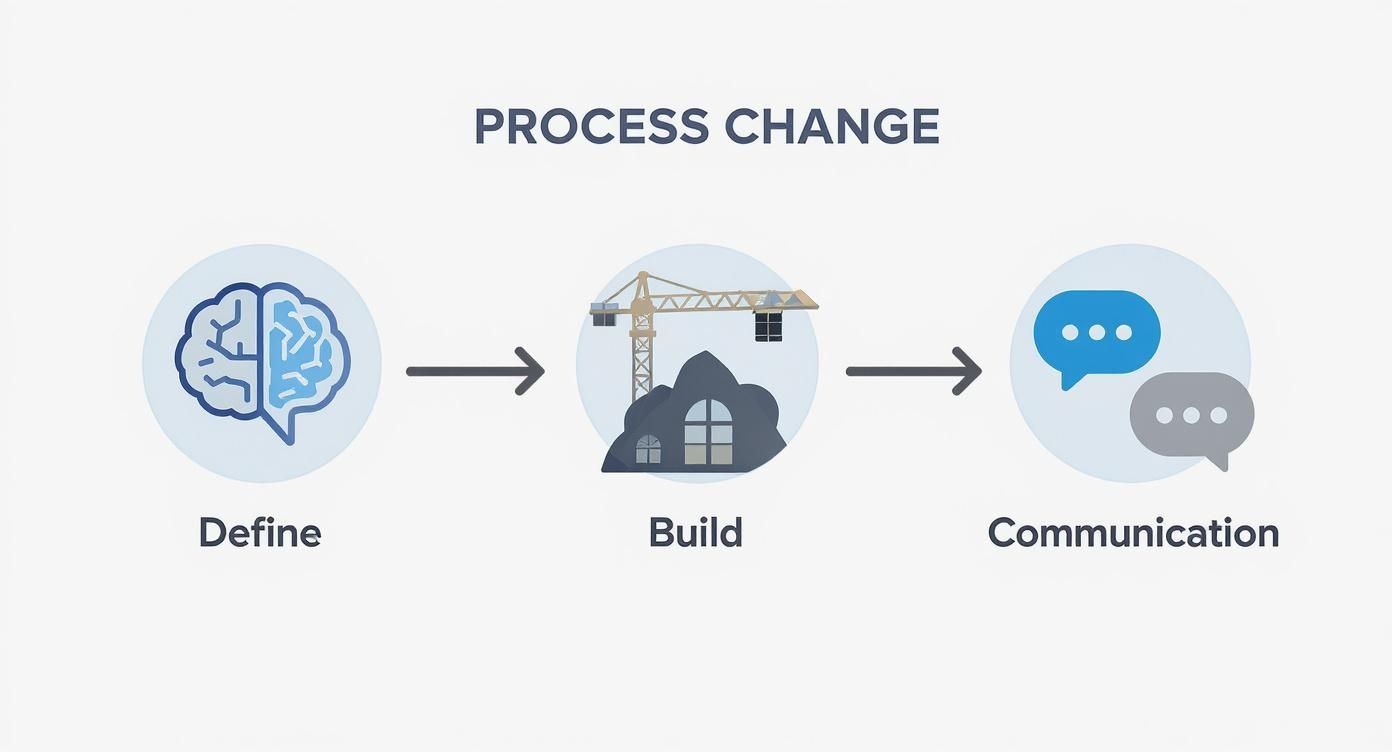
Within six weeks, the pilot ward’s patient satisfaction scores jump by 15% . Now that is a story. This single, powerful, data-backed success story becomes the best marketing tool you could ever ask for when it's time to roll the initiative out hospital-wide.
Measuring What Actually Matters
Okay, so your pilot was a hit, and you're starting to scale. Now you need to prove this thing is actually working. And please, for the love of all that is holy, forget the vanity metrics. Counting how many people showed up to a training webinar tells you nothing about whether they're behaving any differently.
Real measurement is about tracking the tangible business outcomes that this cultural shift is supposed to be driving. You need a mix of leading and lagging indicators that prove the new culture isn't just talk—it's taking root and making a difference.
"What gets measured gets managed. If you're not tracking the right data, you're just flying blind and hoping for the best. Solid data turns culture change from a fuzzy, feel-good concept into a legitimate strategic advantage."
Metrics That Show the Change is Real:
• Talent Magnetism: • Are fewer of your top performers leaving? Is voluntary turnover going down? Are pulse survey scores for things like psychological safety and belonging finally ticking upward?
• Decision Velocity: • How long does it take for a key project to get a green light? Are more decisions being made by the teams closest to the action instead of getting kicked up the ladder for approval?
• Frictionless Collaboration: • Are cross-departmental projects finishing faster and with fewer turf wars? You can even get nerdy and analyze meeting data to see if more diverse groups are speaking up and contributing.
By zeroing in on these kinds of metrics, you create a powerful feedback loop for continuous improvement. You can see which new behaviors are delivering the biggest bang for your buck and where you might need to adjust your approach.
To add another layer of insight, understanding your teams’ underlying motivations can provide crucial context for these numbers. Using a guide to team personality assessments can reveal what truly drives and stresses your people, helping you fine-tune your efforts. This data-driven mindset is what transforms organizational culture change management from a one-and-done project into a living, breathing engine for growth.
Overcoming The Inevitable Resistance And Pitfalls
Let's be brutally honest for a moment: resistance to change isn't a possibility . It's a guarantee. The second you even whisper about shifting your company culture, you're creating a ripple of uncertainty. Thinking you can dodge it is like planning a camping trip in Seattle without a tent—you're just being naive, and you're going to get soaked.
This is your troubleshooting guide for the messy, unpredictable, human side of transformation. People don’t dig their heels in because they're difficult or stubborn. They push back because change feels like a personal threat. It threatens their status, their comfort zone, and sometimes, even their whole identity at work.
The Real Reasons People Say "No"
Resistance is just a symptom, the tip of the iceberg. It's an emotional reaction, and if you try to solve it with a spreadsheet or a logic puzzle, you're going to fail. Every single time. The real work is getting curious about the why behind the "no."
More often than not, it boils down to a few core fears:
• Loss of Competence: • "I was a rockstar at the old way. Am I going to look like an idiot trying to learn this new system?"
• Loss of Status: • "My influence came from knowing the old process inside and out. Will I even be relevant anymore?"
• Loss of Connection: • "This whole thing might break up my team or mess with the work friendships I’ve built for years."
• More Work: • "Fantastic. Another thing to learn on top of my already overflowing plate."
Blowing past these very real anxieties is the fastest way to create an army of cynics who will quietly (or not so quietly) sabotage your every move.
Proactive Strategies to Turn Skeptics into Allies
The best defense is a good offense. Instead of bracing for the storm, build channels that let the pressure out in a controlled way. Don't try to shut down dissent—invite it in for a cup of coffee.
Here's a power move I've seen work miracles: identify your most vocal, respected skeptics and bring them into the fold. Seriously. Give them a seat at the planning table. This does two brilliant things at once: it shows everyone you’re not afraid of tough questions, and it often converts your loudest critics into your most dedicated champions. Why? Because now they have skin in the game.
Resistance isn't something to be steamrolled. It's data. It’s a goldmine of feedback from the very people who understand the real-world impact of your big ideas better than anyone in the C-suite.
You also need to create safe spaces for people to air their concerns without getting labeled as "not a team player." Think "Ask Me Anything" sessions with leaders (where they actually answer the hard questions) or anonymous feedback channels. When people feel genuinely heard, their resistance often melts away, replaced by genuine curiosity.
Navigating the Dreaded Change Fatigue
One of the most dangerous pitfalls in a long-term culture initiative is change fatigue . It’s the organizational equivalent of total burnout. Your people are just plain exhausted by the constant churn of new initiatives, new software, and new expectations.
And this isn't getting any easier. A staggering 96% of organizations are neck-deep in some kind of transformation, but the willingness of employees to get on board has tanked from 74% in 2016 to just 38% today. What's driving this? The numbers point to a deep mistrust ( 41% ) and a simple lack of understanding ( 39% )—both classic symptoms of change fatigue. You can dig into more of these eye-opening change management statistics on MoonCamp .
The only way to fight this is to pace yourself . Not every change is a five-alarm fire. Prioritize with a vengeance and make a big deal out of the small, stable wins. Give your teams breathing room to absorb new behaviors before you throw the next big thing at them. A culture shift is a marathon, not a sprint, and managing your team's energy is every bit as critical as managing the project plan.
At Enneagram Universe , we believe that truly understanding the core motivations and fears driving your team is the key to navigating change successfully. When you know why people react the way they do, you can lead with empathy and build a more effective strategy. Discover your team's Enneagram types by taking our free, scientifically validated assessment today at Enneagram Universe .