The 12 Best Organizational Assessment Tools to Use in 2026

Imagine your organization is a high-performance engine. It might look shiny on the outside, but how can you be sure it's running efficiently, consuming the right fuel, or that a hidden part isn't about to wear out? That’s the job of organizational assessment tools . They're the diagnostics that let you pop the hood to measure everything from company culture and employee engagement to team dynamics and leadership effectiveness.
But with a sea of surveys, platforms, and frameworks available, choosing the right one can feel like trying to find a specific wrench in a giant, disorganized toolbox. Are you trying to fix a specific issue, like high turnover, or are you aiming for a full cultural transformation? The right tool depends entirely on the job you need to do. Understanding how to measure a company often involves leveraging dedicated software, such as specialized staff performance management software , to track progress against goals.
This guide cuts through the noise. We'll explore 12 powerful and practical organizational assessment tools, from the personality-driven insights of Enneagram Universe to the rigorous data of the Gallup Q12. Forget generic marketing fluff; this is a hands-on manual for leaders ready to stop guessing and start diagnosing.
For each tool, you'll find:
• A quick summary with screenshots and a direct link.
• Honest pros, cons, and ideal use cases.
• Practical examples featuring American teams.
• Guidance on how to choose, deploy, and turn data into real change.
1. Enneagram Universe
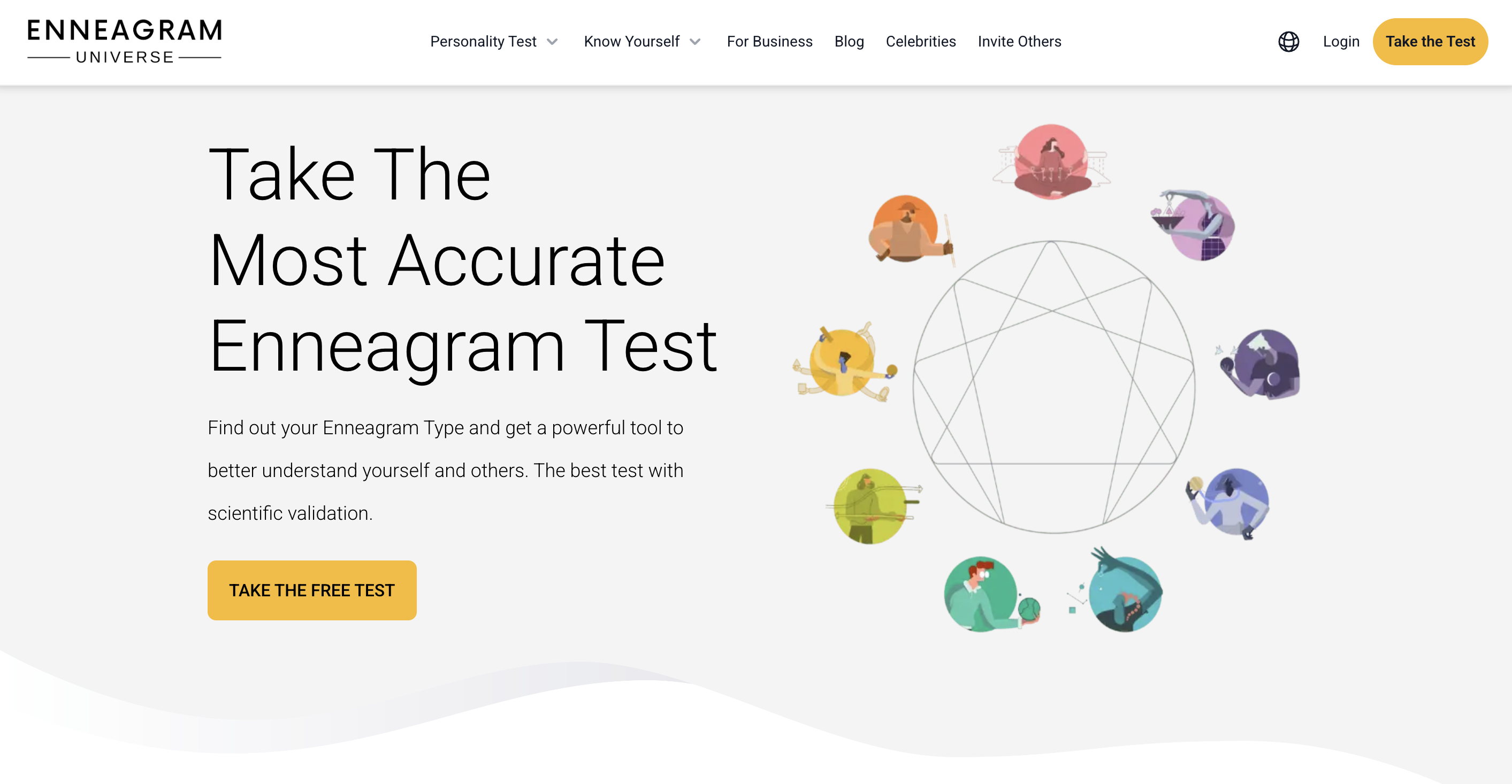
Enneagram Universe secures the top spot as a featured choice due to its remarkable depth, accessibility, and direct applicability to professional team dynamics. It offers a powerful, research-informed alternative to surface-level personality quizzes by providing a free, 180-question assessment that delivers genuinely nuanced insights. Unlike quicker, less reliable tests, this instrument is designed for users who want to understand the core motivations, fears, and behavioral patterns that drive team members, making it a standout organizational assessment tool.
The platform’s strength lies in its practical, actionable feedback. Results go beyond a simple number, offering a detailed analysis of your dominant Type, Wing, Triad, and, crucially, your Health Level. This layered approach helps managers and team leaders understand not just what a person’s personality type is, but how they are currently expressing it, showing whether they are in a state of resourceful flow or reactive stress. For example , a marketing team in Chicago might discover their leader is a Type 3 Achiever who is overly focused on metrics, causing friction with a creative team member who is a Type 4 Individualist. The tool provides specific language and strategies for these two types to bridge their communication gap.
Key Features & Why They Matter for Teams
• In-depth Assessment (180 Questions): • The thoroughness of the test (taking 30–40 minutes) leads to more precise and reliable typing. For an organization, this means you're building strategies on a solid foundation, not a flimsy "get-to-know-you" icebreaker.
• Team & Relationship Comparisons: • This is where Enneagram Universe truly shines for organizational use. You can invite team members to compare their profiles side-by-side. The tool provides specific insights into communication styles, potential conflict points, and areas of natural synergy between colleagues.
• Actionable Growth Strategies: • The platform doesn't just label people; it provides concrete, step-by-step recommendations for development. This transforms the assessment from a static report into a dynamic roadmap for improving collaboration and emotional intelligence. For a detailed guide on this, you can learn more about how to use the Enneagram at work.
• Free & Accessible: • The core assessment is completely free and available in multiple languages (English, Spanish, Portuguese, German), removing any budget or access barriers for teams wanting to get started.
Pros vs. Cons
| Pros | Cons |
|---|---|
| Deep, multi-layered feedback on Type, Wing, Health Level, and more for a complete picture. | Significant time commitment of 30-40 minutes may be a barrier for busy teams or those wanting a quick snapshot. |
| Practical team comparison tools that offer direct insights for improving collaboration and resolving conflict. | Relies on self-reporting, meaning accuracy is dependent on the individual's honesty and self-awareness during the assessment. |
| Completely free core test makes it a zero-risk tool for any organization to try. | Depth can be overwhelming for users unfamiliar with the Enneagram, requiring some guidance to fully absorb the insights. |
| Emphasis on growth and compassion frames results as development opportunities, not fixed judgments. |
Ultimately, Enneagram Universe is an excellent starting point for any organization ready to move beyond basic personality typing and into a more meaningful exploration of what drives its people.
2. McKinsey Organizational Health Index (OHI)
For organizations that want to go big or go home, the McKinsey Organizational Health Index (OHI) is the heavyweight champion of organizational assessment tools. This isn't your startup’s lightweight culture survey; it's a deep diagnostic backed by decades of McKinsey's research and a colossal global database. The OHI connects specific management practices to nine key health outcomes, showing exactly what behaviors drive top-tier performance.
What makes it stand out is the sheer force of its benchmarking power. Your results aren't just a snapshot in time; they’re compared against millions of responses from similar companies. This gives you a brutally honest look at where you stand. For example , a Texas-based manufacturing company might discover their OHI score for "Accountability" is in the bottom quartile for their industry. The OHI doesn't just flag this; it provides a playbook of specific interventions—like clarifying decision rights or implementing consequence management—that top-quartile companies in their sector have successfully used.
Key Benefit : The OHI provides a clear, evidence-based path from diagnosis to action. You’re not left guessing what to do with the data; you receive a playbook of targeted interventions tied directly to your results.
Pros & Cons
• Pro: • The evidence base is immense. Its connection between management practices and bottom-line outcomes is supported by one of the largest organizational datasets in the world.
• Con: • Access is its biggest hurdle. The OHI is almost always deployed as part of a larger McKinsey consulting engagement, making it inaccessible and costly for most small to mid-sized businesses.
The Bottom Line
This tool is ideal for large enterprises or well-funded organizations ready to make a serious investment in a major organizational change initiative. Gaining access requires contacting McKinsey directly for a custom quote, as there's no public pricing. Nonprofits may find a path through McKinsey.org’s dedicated programs.
McKinsey Organizational Health Index
3. Denison Organizational Culture Survey (DOCS)
If you believe culture isn't just fluffy stuff but a concrete driver of business performance, the Denison Organizational Culture Survey (DOCS) is your tool. It cuts through the noise by measuring culture across four scientifically validated traits: Mission, Consistency, Involvement, and Adaptability. This isn't about office perks; it's a diagnostic that directly links specific cultural behaviors to bottom-line results like profitability, growth, and customer satisfaction.
What sets Denison apart is its clear, graphical representation of your culture. Your results are plotted on a "circumplex" model, creating a visual profile that makes strengths and weaknesses immediately obvious. For example , a Silicon Valley tech startup might see high scores in Adaptability (pivoting to market changes) but alarmingly low scores in Consistency (lacking stable systems). This visual instantly tells leadership that while their ability to innovate is strong, their lack of process is creating internal chaos and hindering scalability.
Key Benefit : The model provides a direct line-of-sight between your cultural profile and key performance indicators. It translates abstract cultural feelings into a measurable, actionable business case for change.
Pros & Cons
• Pro: • The model is visually intuitive and supported by robust benchmarking data from over 1,000 organizations, giving you a clear sense of where you stand.
• Con: • Accessing the full survey, benchmarks, and support materials usually involves a services partnership with Denison or one of their certified consultants, which can be a significant investment.
The Bottom Line
This is one of the best organizational assessment tools for mid-to-large-sized companies committed to a data-driven approach to culture. It’s perfect for leaders who need to prove the ROI of culture initiatives. Pricing is customized and not publicly available, so you'll need to contact Denison Consulting directly for a quote.
Denison Organizational Culture Survey
4. Human Synergistics OCI + OEI (Organizational Culture Inventory and Organizational Effectiveness Inventory)
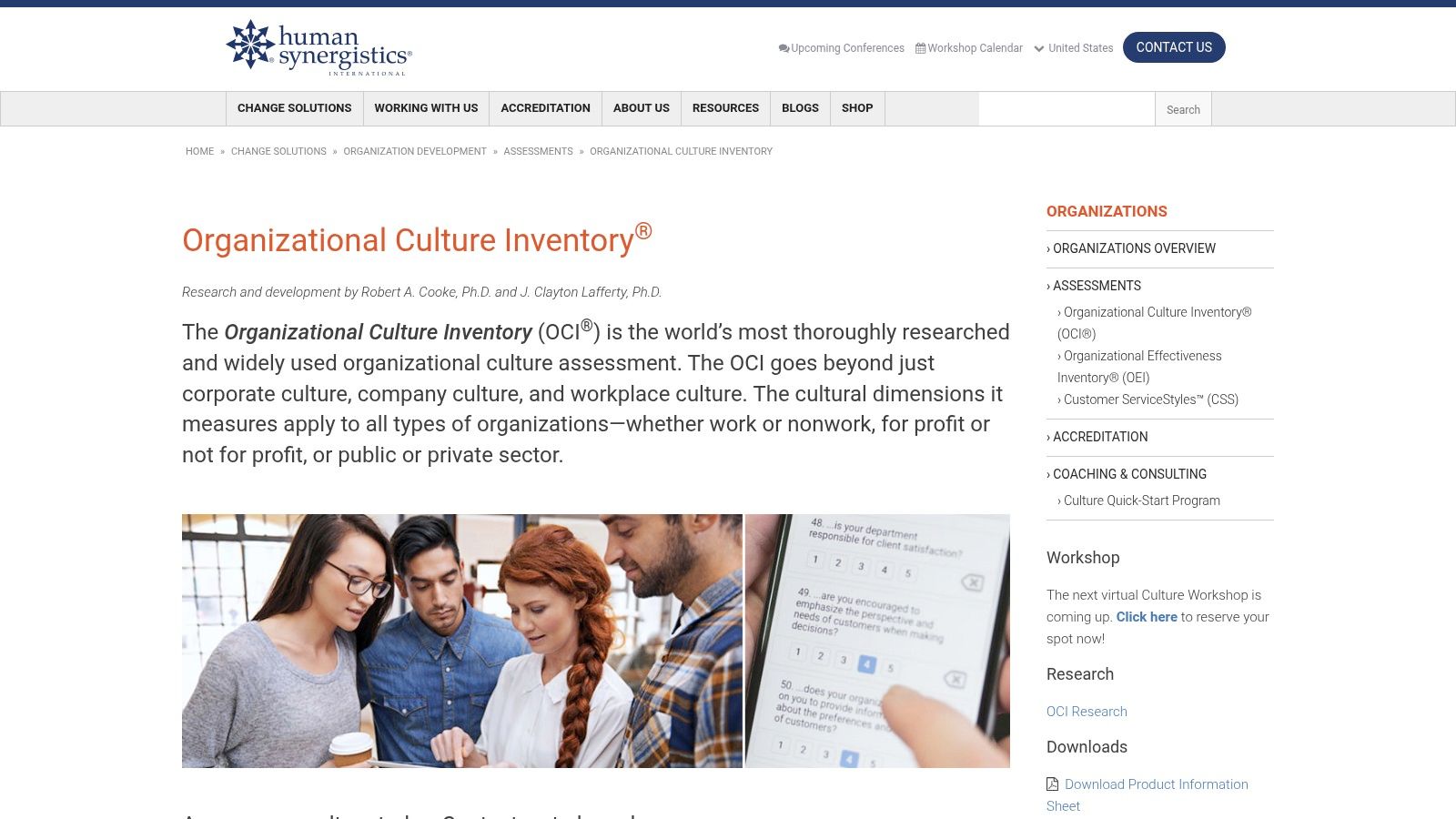
If you've ever wished for a GPS to navigate your company’s culture, Human Synergistics offers the closest thing with its paired OCI and OEI tools. The Organizational Culture Inventory (OCI) diagnoses your current culture, mapping it onto a beautifully clear circumplex model. This visual shows whether your team operates from a place of constructive collaboration, passive defensiveness (e.g., avoidance, dependence), or aggressive defensiveness (e.g., competition, perfectionism). The real power comes when you combine it with the Organizational Effectiveness Inventory (OEI), which pinpoints the specific systems and structures driving those behaviors.
What makes this combo so effective is its "cause and effect" approach. The OCI tells you what your culture is, and the OEI tells you why . For instance , a New York-based financial firm's OCI might reveal a deeply Aggressive-Defensive culture, characterized by internal competition. The OEI could then highlight that the company’s compensation and promotion systems are structured as a zero-sum game, rewarding individual top performers at the expense of team collaboration. This links the cultural problem directly to a specific HR policy that can be changed.
Key Benefit : The OCI/OEI provides a direct link between cultural outcomes and organizational systems. It moves the conversation from "we have a bad culture" to "our compensation structure is encouraging the exact behaviors we want to stop."
Pros & Cons
• Pro: • The circumplex visual is incredibly effective for getting executive teams on the same page. It’s hard to argue with a giant red pie slice showing your company leans aggressively defensive.
• Con: • These are not off-the-shelf tools. Proper administration, interpretation, and action planning almost always require working with an accredited consultant, which adds to the overall cost and complexity.
The Bottom Line
This is the tool for leadership teams committed to a deep, systemic culture change effort. It’s less of a quick pulse survey and more of a full-body diagnostic. Access requires engaging with Human Synergistics or one of their certified partners for a custom proposal, as pricing is not public and depends on the scope of the project.
5. Great Place to Work Trust Index Survey
For companies that want to turn their culture into a public statement, the Great Place to Work Trust Index Survey is more than just an internal diagnostic; it's a ticket to the big leagues of employer branding. This tool is the engine behind the famous "Best Workplaces" lists published in FORTUNE and other major outlets. It measures employee experience through its research-backed Trust Model, providing a clear picture of your workplace culture.
What makes it distinct is its dual function as both a diagnostic and a marketing asset. While other organizational assessment tools provide internal data, this one offers a direct pathway to public recognition. For example , a mid-sized software company in Austin, Texas, can complete the survey and analytics process. If they meet the threshold, they become "Great Place to Work-Certified™." This allows them to use the official badge on their career page and job postings, immediately signaling to top engineering talent that their culture has been externally validated, setting them apart from other local competitors.
Key Benefit : It provides a credible, third-party validation of your culture that can be a powerful magnet for attracting top talent. You're not just saying you're a great place to work; you have the badge to prove it.
Pros & Cons
• Pro: • The external credential is a recognized and respected benchmark, adding significant weight to employer branding and recruitment marketing efforts.
• Con: • The certification path introduces additional costs and can create employee skepticism about anonymity, especially if managers are perceived as pushing for high scores to "win" the award.
The Bottom Line
This tool is perfect for organizations that are confident in their culture and ready to use it as a competitive advantage in the talent market. Access involves purchasing a package that includes the survey, analytics, and certification pathway. Pricing varies by company size, starting from a few thousand dollars for small businesses and scaling up for enterprises.
6. Gallup Q12 Employee Engagement Survey
If the McKinsey OHI is the heavyweight champion, the Gallup Q12 is the surgical striker of organizational assessment tools. Famous for its brevity and potent connection to performance, this survey asks just 12 core questions that Gallup's research has proven link directly to business outcomes like productivity, profitability, and retention. It’s less about a full cultural teardown and more about providing a precise, manager-focused snapshot of team-level engagement.
The power of the Q12 isn't just in the questions, it's in the actionability. The results are designed to empower managers, not just inform HR. For instance , a nursing manager at a hospital in Cleveland might find her team scores low on the question, "In the last seven days, I have received recognition or praise for doing good work." The Gallup platform provides her with specific, actionable coaching tips, such as starting daily huddles with a "kudos" moment or implementing a peer-to-peer recognition system, turning abstract data into a concrete plan to improve her team's morale and performance.
Pros & Cons
• Pro: • Its simplicity makes it easy to deploy, understand, and act upon. The direct link between its 12 questions and tangible business outcomes is supported by enormous datasets.
• Con: • The survey is laser-focused on engagement, so it isn't a substitute for a broader culture or organizational climate assessment. Public pricing is limited; full access usually requires direct engagement with Gallup.
The Bottom Line
The Gallup Q12 is perfect for organizations that want to build a culture of accountability starting with frontline managers. While large enterprises will engage Gallup directly, smaller businesses can purchase a one-time survey package through the Gallup Store, making this powerful tool accessible without a massive consulting contract.
Gallup Q12 Employee Engagement Survey
7. Culture Amp
If you’re looking for the Swiss Army knife of employee experience, Culture Amp is it. This platform rolls engagement, performance, and development into one unified system, making it a go-to for modern HR teams. It’s less of a one-off diagnostic and more of an ongoing conversation with your workforce. It shines by turning complex data from engagement, onboarding, and exit surveys into clear, actionable insights for managers.
What makes Culture Amp a standout among organizational assessment tools is its focus on empowering managers. After a survey, a manager, say "Sarah" at a Boston-based tech company, doesn't just get a data dump. She receives a guided "Manager Playbook" suggesting specific actions. For example , if her team scores low on "recognition," the platform might suggest she start team meetings by celebrating a recent win, complete with talking points and resources. It closes the loop between feedback and action.
Pros & Cons
• Pro: • Its extensive library of survey templates and powerful benchmarking data allow you to get started quickly and see how you stack up against similar companies.
• Con: • Pricing isn't public, and the cost can add up as you include more modules (like performance or 360s). You must engage with their sales team for a custom quote.
The Bottom Line
Culture Amp is ideal for mid-market to enterprise companies that want a single platform to manage the entire employee experience lifecycle. It’s built for organizations committed to continuous listening and action, not just annual check-ins. Access requires scheduling a demo to receive a quote based on your company's size and desired features.
8. Microsoft Viva Glint
For companies already living and breathing in the Microsoft 365 universe, Microsoft Viva Glint is the logical next step for employee engagement. This isn't just another survey tool tacked onto your software stack; it’s woven directly into the daily workflow of your organization. Glint, now part of the broader Viva employee experience platform, provides a continuous listening and feedback mechanism that meets employees where they already are: in Teams, Outlook, and other Microsoft apps.
What makes it distinct is its focus on turning feedback into action within the ecosystem. A manager, say a sales director named John at a firm in Seattle, receives survey results showing his team feels disconnected from company goals. Instead of just getting a report, Glint can nudge him directly within Microsoft Teams with suggested learning modules from Viva Learning or prompt him to schedule a follow-up discussion. This "in-the-flow-of-work" approach to organizational assessment tools makes acting on data less of a chore and more of an organic habit.
Pros & Cons
• Pro: • The native integration with Microsoft 365 is seamless. Data from Viva Insights can enrich engagement analytics, and action items pop up in the applications employees use constantly.
• Con: • Its greatest strength is also its limitation. Organizations not heavily invested in the Microsoft ecosystem will find it clunky, and the initial admin setup and data integration often require dedicated IT support.
The Bottom Line
This tool is ideal for medium to large enterprises that have standardized on Microsoft 365 and are looking for a powerful, integrated employee engagement solution. Pricing is bundled into Microsoft Viva suite licenses, so there isn’t a standalone Glint price. You’ll need to contact Microsoft sales or a partner to get a quote based on your organization's size and needs.
9. Workday Peakon Employee Voice
If you believe that annual employee surveys are a relic of a bygone era, Workday Peakon Employee Voice is your megaphone for continuous listening. This platform moves past the once-a-year feedback scramble and turns employee sentiment into a real-time data stream. It’s built on the idea that you can't fix what you don't know is broken, providing a constant pulse on engagement, culture, and well-being.
What sets Peakon apart is its intelligent listening engine. Instead of carpet-bombing everyone with the same generic questions, it uses smart sampling to ask relevant questions to the right people at the right time. The platform’s real-time sentiment analysis and heatmaps show you exactly where problems are brewing. For example , it might detect a sudden drop in morale within the San Francisco-based engineering team after a project deadline, while the sales team in Atlanta remains highly engaged. It then offers up concrete, benchmark-driven action plans for the engineering manager, making it one of the more direct organizational assessment tools available.
Pros & Cons
• Pro: • The platform offers enterprise-grade analytics with strong confidentiality controls, making it a trusted choice for large, complex organizations. Its integration with the Workday HCM ecosystem is a significant plus for existing customers.
• Con: • The deepest value is often realized when it’s paired with Workday HCM, and its quote-based pricing can be a substantial investment, particularly for very large employee populations.
The Bottom Line
Peakon is ideal for large US enterprises, especially those already invested in the Workday ecosystem, that want to move to a continuous employee listening model. It’s less suited for small businesses or those seeking a simple, low-cost survey tool. Access requires getting a custom quote directly from Workday, as pricing is not public.
10. Qualtrics EmployeeXM
For organizations that need a powerful, endlessly configurable engine for employee feedback, Qualtrics EmployeeXM is the enterprise-grade solution. This isn't just a survey tool; it's a complete employee experience management platform that covers the entire employee lifecycle, from onboarding to exit. It’s designed to handle the complexity and scale of large, global companies that demand robust data security and granular control.
What sets Qualtrics apart is its ability to connect different feedback points into a single, cohesive narrative. For example , a national retail chain can use Qualtrics to see that low employee engagement scores in their Florida stores are correlated with high customer complaints from the same region and negative feedback in exit interviews about management. Its powerful text analytics can even analyze open-ended comments to pinpoint sentiment and emerging themes, turning qualitative feedback into actionable, quantitative insights that isolated tools would miss.
Pros & Cons
• Pro: • It is incredibly configurable and scales to meet the needs of the most complex, security-conscious organizations, including government agencies requiring FedRAMP compliance.
• Con: • The platform’s power comes with a steeper learning curve and a custom pricing model that can be complex and costly, making it less suitable for smaller businesses.
The Bottom Line
Qualtrics EmployeeXM is built for large enterprises and public sector organizations that need a highly secure, scalable, and all-in-one platform for managing employee experience. Access is by custom quote only, so you'll need to contact their sales team directly. Small companies or those needing a simple pulse survey tool will likely find it to be overkill.
11. Perceptyx (AI-Powered Employee Experience Platform)
When your organization's structure looks more like a sprawling family tree than a simple org chart, you need an organizational assessment tool built for complexity. Perceptyx is designed for large enterprises that need to not only listen to their employees but also make sense of the noise. It combines continuous listening, pulse surveys, and AI-powered analytics into a single platform that can handle the intricate hierarchies and divisional quirks of a Fortune 500 company.
What makes Perceptyx a go-to for major brands is its blend of a powerful platform with a consultative touch. Its AI can analyze thousands of open-ended comments and identify emerging themes. For example , a large American healthcare system might discover through Perceptyx's text analytics that nurses in its Midwest hospitals are consistently raising concerns about "new charting software," while those on the West Coast are more focused on "patient-to-staff ratios." This level of specific, AI-driven insight allows leaders to tailor their responses by region instead of applying a one-size-fits-all solution.
Pros & Cons
• Pro: • Its capability to manage custom programs and complex organizational structures is top-tier, making it a reliable choice for global enterprises.
• Con: • The platform is enterprise-oriented, so pricing is not publicly available and it may be more horsepower than a small or mid-sized business needs or can afford.
The Bottom Line
Perceptyx is ideal for large, multifaceted organizations that require a sophisticated employee listening and analytics engine. If you need a partner to help design, execute, and interpret large-scale assessments across diverse business units, this is a strong contender. Access requires contacting their sales team directly for a custom quote and consultation.
12. Official OCAI (Organizational Culture Assessment Instrument) – Cameron Institute
For leaders who believe culture isn't just a buzzword but the very operating system of their company, the official OCAI is a must-have. Developed by Dr. Kim S. Cameron, this tool is based on the robust Competing Values Framework, providing a clear, academic-backed method to diagnose and map organizational culture. It avoids fluffy metrics and instead focuses on plotting where your culture is now versus where your team believes it should be, offering an instant visual of the gap you need to close.
What sets this tool apart is its direct lineage to the source. You’re not getting a knock-off or a consultant's interpretation; you're using the validated instrument as intended by its creator. The output is a simple yet powerful quadrant chart showing the balance between four culture types: Clan, Adhocracy, Market, and Hierarchy. For example , a long-standing government agency in Washington D.C. might find its current culture is heavily weighted in the "Hierarchy" quadrant (control and process). However, the survey of its employees might show a strong desire to move toward the "Clan" quadrant (collaboration and people-focus). This gives leadership a clear, visual mandate for change and a shared language to discuss it.
Pros & Cons
• Pro: • You are using the authentic, validated instrument directly from its creator, which ensures the integrity of the methodology and results.
• Con: • It's a specialized culture tool, not an all-in-one employee engagement platform. Enterprise use or deep-dive analysis may require a separate consulting engagement, and public pricing is not available.
The Bottom Line
The OCAI is perfect for organizations of any size that need a clear, focused diagnostic to kickstart a culture change initiative. It’s particularly effective for leadership teams looking to align on a future cultural direction. Accessing the full tool for organizational use requires contacting the Cameron Institute directly through their website for a quote.
Top 12 Organizational Assessment Tools — Comparison
| Product | Core features | Unique selling points ✨ | Quality ★ | Target audience 👥 | Price/value 💰 |
|---|---|---|---|---|---|
| 🏆 Enneagram Universe | 180‑question validated Enneagram test; Wings, Triads, Health Levels; relationship comparisons | ✨ Deep, research‑oriented typing + side‑by‑side compatibility; multilingual; growth roadmaps | ★★★★☆ (research-backed) | 👥 Individuals, coaches, couples, teams, HR | 💰 Free core test; optional paid services |
| McKinsey Organizational Health Index (OHI) | Diagnostic across 9 health outcomes; global benchmarking; action playbooks | ✨ Massive benchmarking dataset + proven playbooks to link diagnosis→action | ★★★★★ | 👥 Large enterprises, exec teams, consultants | 💰 Custom/quote; consulting engagement |
| Denison Organizational Culture Survey (DOCS) | 48‑item culture survey; 4 traits & 12 indices; rollout toolkits | ✨ Clear trait→performance linkage; implementation guides & optional modules | ★★★★☆ | 👥 HR leaders, culture practitioners | 💰 Custom pricing; services often required |
| Human Synergistics OCI + OEI | Circumplex culture + climate diagnostics; gap analysis | ✨ Normed circumplex visuals + accredited consultant debriefs | ★★★★☆ | 👥 Orgs pursuing culture transformation, execs | 💰 Quote-based; consultant-led |
| Great Place to Work Trust Index Survey | Trust Index survey & analytics; benchmarking; certification path | ✨ Employer branding + public certification/lists | ★★★★ | 👥 Employers seeking certification & talent attraction | 💰 Survey fees + certification costs |
| Gallup Q12 Employee Engagement Survey | 12‑item engagement measure; benchmarks; manager coaching resources | ✨ Concise, manager‑friendly instrument with performance links | ★★★★ | 👥 Managers, organizations focused on engagement | 💰 Custom; small-org one-time option |
| Culture Amp | End‑to‑end employee experience platform; templates; action tracking | ✨ Broad feature coverage + rich content library & templates | ★★★★ | 👥 Mid-market & enterprise HR teams | 💰 Tiered/quoted plans; can be costly |
| Microsoft Viva Glint | Engagement & lifecycle surveys; narrative intelligence; Teams integration | ✨ Native Microsoft 365 integration and manager nudges | ★★★★ | 👥 Organizations using Microsoft 365 | 💰 Viva SKU guidance; enterprise pricing |
| Workday Peakon Employee Voice | Continuous listening; real‑time dashboards & benchmarks; confidentiality | ✨ Real‑time sentiment analytics; strong Workday integration | ★★★★ | 👥 Workday HCM customers, large enterprises | 💰 Quote-based; enterprise |
| Qualtrics EmployeeXM | Configurable surveys; text analytics; integrations & compliance (FedRAMP) | ✨ High configurability + enterprise security/compliance options | ★★★★☆ | 👥 Complex organizations, public sector | 💰 Custom/enterprise pricing |
| Perceptyx (AI‑Powered) | Continuous listening; AI text analytics; HRIS integrations | ✨ AI-driven driver analysis + consultative rollout support | ★★★★ | 👥 Large, matrixed enterprises | 💰 Quote-based; enterprise-oriented |
| Official OCAI – Cameron Institute | Validated OCAI current vs desired culture profiles; workshops | ✨ Creator's official instrument with training & change materials | ★★★★ | 👥 Culture consultants, HR teams | 💰 Custom; consulting engagements |
The First Step to a Healthier Organization Is a Clear Diagnosis
So there you have it, a veritable smorgasbord of organizational assessment tools, from the sweeping cultural X-rays of the Denison Model to the surgical precision of Gallup's Q12. Navigating this list can feel a bit like standing in a hardware store the size of a football field. You know you need to fix something, but the sheer number of gadgets, widgets, and doodads is overwhelming. Which one is the right one?
The secret is that you’re not looking for the best tool, you’re looking for the right tool for your specific problem. Think of it like this: you wouldn't use a sledgehammer to hang a picture frame, nor would you use a tiny screwdriver to demolish a wall. A tool like Microsoft Viva Glint might give you a fantastic, real-time pulse of company-wide sentiment, which is perfect for spotting burnout before it becomes an epidemic. But it won't necessarily tell you why your brilliant but prickly head of engineering (a classic Enneagram Type Five, perhaps?) keeps clashing with your people-pleasing head of sales (a quintessential Type Two).
From Data Points to Human Stories
The most common mistake leaders make is treating the output of these tools as the final answer. A low score in "psychological safety" from a platform like Culture Amp or Perceptyx is not a conclusion; it is an invitation to a deeper conversation. Data points are the start, not the end. The real magic happens when you pair the quantitative "what" with the qualitative "why."
Consider the power of combining different types of organizational assessment tools.
• Macro meets Micro: • You could run the broad McKinsey OHI to identify that "leadership" is a core weakness. Then, you could deploy an Enneagram-based assessment with your leadership team to understand the specific personality-driven conflicts and communication breakdowns causing the issue.
• Engagement meets Culture: • A Gallup Q12 survey might reveal that employees don’t feel their opinions count. You could then use the OCAI to diagnose a rigid, hierarchical culture that stifles feedback, giving you a clear target for change initiatives.
The goal isn't to get a perfect report card to frame on the wall. The goal is to get an accurate diagnosis so you can start the treatment.
Your Action Plan: From Diagnosis to Action
Choosing and using these powerful tools effectively is a journey, not a one-off event. It starts with brutal honesty. What is the one burning question keeping you up at night? Is it high turnover? Stalled innovation? Toxic team dynamics? Let that question be your North Star.
Once you have your question, review the tools we’ve discussed and ask yourself:
The best tool in the world is useless if the results are destined to gather dust in a forgotten folder. The success of any organizational assessment hinges on your commitment to action. It’s about creating a rhythm of inquiry, reflection, and intentional action. Your organization is a living, breathing system. The key to its health isn't finding a single cure, but committing to a lifestyle of continuous listening and improvement. Your journey to a more effective, engaged, and genuinely great workplace begins with the courage to look in the mirror and the wisdom to choose the right one for the reflection.
Ready to move beyond surface-level surveys and understand the deep-seated motivations driving your team's behavior? Enneagram Universe offers powerful, insightful assessments that reveal the "why" behind workplace dynamics, conflict, and collaboration. Start building a more self-aware and effective team today by exploring the tools at Enneagram Universe .