A Guide to the Nine Types of Personalities

Ever feel like you’re trying to solve a puzzle, but the missing piece is… you? If you’ve ever wondered what really makes you tick, you've come to the right place. This guide is all about the nine types of personalities as seen through the Enneagram—a surprisingly powerful tool for figuring out not just what you do, but why you do it.
Think of it as finally getting the user manual for your own mind.
Your Guide to the Nine Personality Types
The Enneagram isn't about stuffing you into a neat little box. Instead, it’s a dynamic map to your inner world that cuts through the fluff to get straight to your core motivations. It suggests that while we're all complex, we tend to lead with one of nine foundational personality styles.
Each of these nine types is driven by a powerful duo: a core desire and a corresponding core fear. This fundamental motivation is the engine that runs in the background, shaping how you handle stress, what you chase after in life, and how you connect with others. Knowing your type isn't a label—it's a key.
Understanding the Framework
Getting started is simple. Think of your journey into the nine personality types as a three-step adventure.
• Overview: • First, you get the lay of the land. This is where you meet the cast of characters—the nicknames and core traits of each of the nine types.
• Discovery: • Next, you turn the lens on yourself. Through a bit of honest self-reflection (and maybe an assessment), you start to pinpoint which type truly resonates with you.
• Action: • This is where the magic happens. You take what you've learned and start applying it to your life, building stronger relationships and kicking off some real personal growth.
This handy map gives you a visual of how these stages flow together, creating a clear path toward self-awareness.
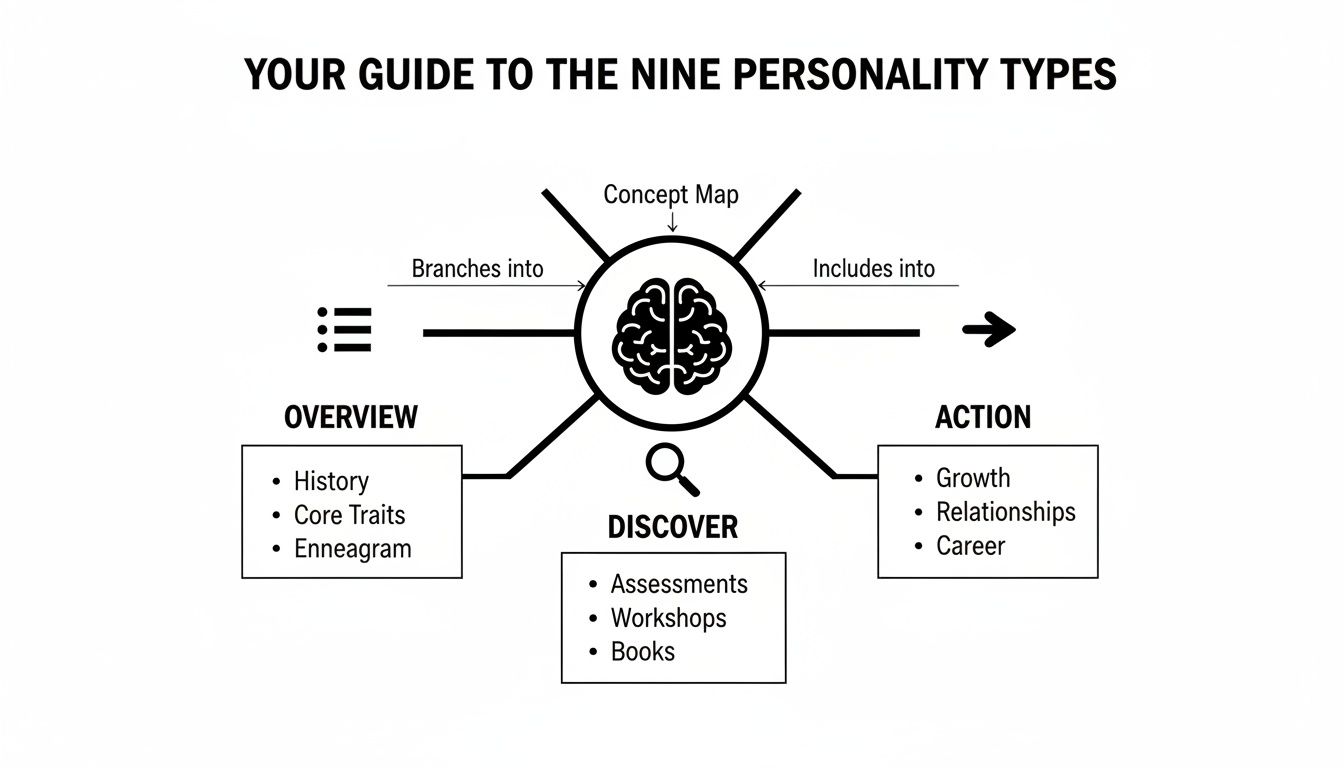
As you can see, learning the system is just the warm-up. The real win comes from putting that knowledge to work in your everyday life. And if you're curious to go even deeper into what makes people tick, exploring some of the best-selling books about psychology can open up a whole new world of understanding.
The goal isn’t to change who you are, but to become more of who you are at your best. By understanding your internal operating system, you can navigate life with more compassion for yourself and others.
So, ready to finally meet the real you? Let's dive in.
At-A-Glance Guide to the Nine Enneagram Personalities
Before we get into the nitty-gritty of each type, here’s a quick snapshot to get you oriented. Think of this as the "meet and greet" portion of our journey.
| Type | Nickname | Core Desire | Greatest Fear |
|---|---|---|---|
| 1 | The Reformer | To be good, to have integrity | Being corrupt, evil, or defective |
| 2 | The Helper | To be loved and wanted | Being unwanted or unworthy of love |
| 3 | The Achiever | To be valuable and worthwhile | Being worthless or without value |
| 4 | The Individualist | To find their significance | Having no identity or personal significance |
| 5 | The Investigator | To be capable and competent | Being helpless, incapable, or invaded |
| 6 | The Loyalist | To have security and support | Being without support or guidance |
| 7 | The Enthusiast | To be satisfied and content | Being deprived and in pain |
| 8 | The Challenger | To protect themselves | Being controlled or harmed by others |
| 9 | The Peacemaker | To have inner peace and harmony | Loss, separation, and fragmentation |
This table gives you a bird's-eye view of the core motivations that drive each of the nine personalities. As we explore them one by one, you'll start to see how these simple desires and fears create incredibly rich and complex human beings.
Discovering Your Personality Type
Okay, now for the main event. It's time to meet the cast of characters in the grand play we call life. As we walk through the nine Enneagram types , you’ll probably feel a jolt of recognition—seeing yourself, your quirky best friend, or that one particular coworker with startling clarity. This is where the real fun begins.
We're about to paint a picture of each type's inner world, digging into the unique motivations and fears that quietly steer their choices. Think of it as getting a backstage pass to the human psyche.

As we go, we'll also touch on a key concept called 'Wings.' The truth is, nobody is purely one type. Your wings are the personality types sitting right next to your core number on the Enneagram symbol, and they add a distinct flavor to your personality. For instance, a Type 9 with a Type 8 wing (a 9w8) looks and feels very different from a Type 9 with a Type 1 wing (a 9w1).
Get ready for some serious "aha!" moments. Let's jump in.
Type 1: The Reformer
First up, meet the person with an ironclad sense of right and wrong. The Reformer, often called The Perfectionist, is on a mission to be good, ethical, and live with integrity. They have a powerful inner critic that’s constantly measuring their every move against an incredibly high standard.
This isn't just about keeping a tidy desk—it's about making the world a better, more just place. Their deepest fear is being corrupt, defective, or fundamentally flawed. This fear is the fuel for their constant drive to improve themselves, everyone else, and the broken systems around them.
Practical Example: Imagine Michael, an American architect from Chicago who pores over every blueprint, not just for safety, but for its aesthetic and moral integrity. He feels a personal responsibility to create buildings that are beautiful, sustainable, and ethically built. His colleagues admire his commitment, but they sometimes get frustrated by his refusal to cut corners, even on the smallest details.
Common Wings:
• 1w9 (The Idealist): • This wing brings a calmer, more detached quality. A 1w9 is still principled but also craves peace, often working quietly behind the scenes to make improvements without rocking the boat.
• 1w2 (The Advocate): • The Helper wing adds a warmer, more compassionate flavor. A 1w2 is driven to fix things not just because it's "right," but because they genuinely want to help people.
Type 2: The Helper
Warm, generous, and always eager to please, The Helper is motivated by a core need to feel loved and wanted. They are masters at tuning into the needs of others and often build their self-worth on being indispensable. Their greatest fear? Being unwanted or unworthy of love.
This drive can make them the most supportive friends and partners you'll ever find. The flip side is that they often neglect their own needs, giving and giving until their own cup is completely empty.
Practical Example: Consider Sarah, a marketing manager in a hectic Austin startup. She’s the office go-to for everything—always ready to help a colleague, offer a listening ear, or organize a birthday party. While her team adores her, Sarah frequently stays late to finish her own work, leaving her feeling exhausted and secretly a little resentful.
Common Wings:
• 2w1 (The Servant): • This wing adds a sense of duty to the Helper’s giving nature. They help because it’s the right and proper thing to do.
• 2w3 (The Host/Hostess): • The Achiever wing makes this Helper more ambitious and image-conscious. They love being seen as both successful and generous, often thriving in public-facing roles.
Type 3: The Achiever
Meet the high-flyer. Success-oriented, charismatic, and endlessly driven, The Achiever has a deep need to feel valuable and worthwhile. They've learned to believe that their value comes from what they accomplish and how awesome others think they are. Their core fear is being seen as worthless.
Threes are the chameleons of the Enneagram, effortlessly adapting to project an image of success in any situation. They are the high-energy goal-setters who don't just meet expectations—they shatter them.
The core struggle for an Achiever is telling the difference between their authentic self and the successful persona they've crafted. Their growth lies in learning that their worth is inherent, not something they have to earn.
Practical Example: Think of Jessica, a real estate agent in the cutthroat Miami market. She has a polished social media feed, drives a fancy car, and is always the top seller at her agency. She’s a genius at networking and closing deals, but privately, she feels crushed by the pressure to keep up appearances, terrified that one slow month could destroy the successful identity she's worked so hard to build.
Common Wings:
• 3w2 (The Charmer): • This combo is incredibly people-oriented. They achieve success by building fantastic relationships and winning everyone over with their charm.
• 3w4 (The Professional): • The Individualist wing adds depth and a desire for authenticity. This Achiever wants to be successful, but they also need their success to be unique and true to their own vision.
Type 4: The Individualist
Sensitive, expressive, and deeply self-aware, The Individualist is on a quest to find their unique identity and personal significance. They often feel fundamentally different from everyone else, carrying a bittersweet sense that something is missing. Their greatest fear is having no real identity at all.
Fours live in their feelings—both the beautiful highs and the melancholic lows. They are masters at channeling their rich inner world into creative expression, valuing authenticity and depth above all else.
Practical Example: Meet Leo, a musician and barista in Brooklyn, New York. He spends his free time writing intensely personal songs and wears a curated vintage wardrobe that sets him apart. He scoffs at conventional career paths, believing it’s better to create something meaningful than to chase a big paycheck, even if that means a constant financial struggle.
Common Wings:
• 4w3 (The Aristocrat): • This wing blends the Four's depth with the Three's polish. They want to be unique, but they also want to be admired and successful for it.
• 4w5 (The Bohemian): • The Investigator wing adds an intellectual, withdrawn quality. This Four is more likely to retreat into their inner world to explore their complex feelings and ideas alone.
Type 5: The Investigator
Intense, cerebral, and perceptive, The Investigator is motivated by a powerful need to feel capable and competent. To them, knowledge is power. They believe the only way to handle the world is to understand it completely. Their deepest fear is being helpless, incapable, or overwhelmed by life's demands.
Fives are natural minimalists, fiercely protecting their time, energy, and resources for their intellectual pursuits. They’d much rather observe from the sidelines than jump into the middle of the action.
Practical Example: Consider Chloe, a software developer from Silicon Valley. She has a deep, almost obsessive, expertise in a niche programming language and prefers working remotely where she can focus without interruption. Her colleagues see her as brilliant but a bit aloof, as she rarely joins in on social chatter and gets visibly drained by long, unstructured meetings.
Common Wings:
• 5w4 (The Iconoclast): • This wing creates a more creative and unconventional Five. They're drawn to the weird, the beautiful, and the unexplored, combining intellectual depth with an artistic soul.
• 5w6 (The Problem Solver): • The Loyalist wing makes for a more practical and surprisingly collaborative Five. They use their knowledge to fix real-world problems and build security for their trusted few.
Type 6: The Loyalist
Committed, security-oriented, and surprisingly engaging, The Loyalist is motivated by a need for safety and support. They are always scanning the horizon for potential threats and running through worst-case scenarios in their head. Their greatest fear is being left without support or guidance.
Sixes are incredibly loyal to the people, beliefs, and systems they trust. But here’s the paradox: they can also be riddled with doubt, questioning authority one minute and seeking its protection the next.
Practical Example: Think of Brian, a project manager for a construction company in Denver. He is famous for his exhaustive risk assessments and contingency plans. Before a single brick is laid, he’s already thought through everything that could go wrong—from supply chain delays to sudden snowstorms—and has a plan B, C, and D ready to go. His team trusts him completely because they know he’s always looking out for them.
Common Wings:
• 6w5 (The Defender): • This wing adds an intellectual, self-reliant streak. They're more cautious and seek security by gathering knowledge and understanding the rules of the game.
• 6w7 (The Buddy): • The Enthusiast wing makes for a more sociable and fun-loving Six. They manage their anxiety by connecting with people and chasing positive experiences.
Type 7: The Enthusiast
Spontaneous, versatile, and allergic to boredom, The Enthusiast is motivated by a core desire to be satisfied and content. They are future-focused optimists, always on the lookout for the next exciting experience. Their biggest fear is being deprived, trapped in emotional pain, or missing out on something amazing (FOMO is their kryptonite).
Sevens are masters of reframing negatives into positives and can juggle a dozen interests at once. Their real challenge is learning to stay present and deal with difficult feelings instead of just escaping into the next adventure.
Practical Example: Imagine David, a Los Angeles entrepreneur who has launched three different startups in five years. Each idea thrills him at the beginning, but as soon as the day-to-day grind kicks in, he loses steam and jumps to the next shiny new venture. His friends admire his boundless energy but worry about his inability to commit.
Common Wings:
• 7w6 (The Entertainer): • This wing grounds the Seven’s frantic energy with a need for connection. They are more loyal and people-oriented in their pursuit of happiness.
• 7w8 (The Realist): • The Challenger wing gives the Seven a more assertive and pragmatic edge. They are more willing to go after what they want and are less afraid of ruffling a few feathers to get it.
Type 8: The Challenger
Powerful, self-confident, and decisive, The Challenger is driven by a need to protect themselves and control their own destiny. They are assertive, willful, and have a deep passion for justice. Their greatest fear is being controlled or harmed by others.
Eights have a huge presence and are not afraid of a good fight, often using their incredible strength to protect the vulnerable. Their growth path involves learning to embrace their own softer side and trust others. As you dig into your own personality, understanding concepts like the classic man vs self conflict can offer a powerful lens for seeing these internal battles.
Practical Example: Think of Maria, a nonprofit director from Philadelphia who fiercely advocates for underserved communities. When faced with bureaucratic red tape, she doesn’t just push back—she barrels through it. She is direct, commanding, and can be intimidating, but her team knows she will fight tirelessly for their cause.
Common Wings:
• 8w7 (The Maverick): • This wing adds a dose of charm, energy, and opportunism. These are the ambitious entrepreneurs and leaders who pursue their vision with unstoppable force.
• 8w9 (The Bear): • The Peacemaker wing creates a quieter, more grounded Challenger. They possess a calm strength and prefer a peaceful home life but will rise with terrifying force if their people are threatened.
Type 9: The Peacemaker
Easygoing, agreeable, and reassuring, The Peacemaker is motivated by a desire to maintain inner peace and outer harmony. They are natural mediators who can see all sides of an issue and have a real gift for defusing conflict. Their core fear is loss, separation, and fragmentation.
To keep the peace, Nines often merge with the desires of others, sometimes losing track of their own needs in the process. They can struggle with inertia, procrastinating on important things just to avoid creating any stress. It's fascinating that in a survey of nearly 190,000 people, Type 9 emerged as the most common of the nine personality types, representing 16.2% of participants. This suggests a widespread desire for harmony in the population.
Practical Example: Consider Tom, a human resources professional from a small town in Ohio. When two departments are at odds, Tom is the one who brings them together, patiently listening to each side until they find common ground. At home, he'll usually go along with his partner’s choice for dinner, not because he doesn't have a preference, but because keeping things pleasant feels more important.
Common Wings:
• 9w8 (The Referee): • This wing adds a surprising dose of assertiveness. They still want peace, but they are more willing to stand their ground and take action when pushed.
• 9w1 (The Dreamer): • The Reformer wing makes for a more idealistic and principled Nine. They are driven by a desire for a peaceful world that is also fair, just, and right.
Feeling like you've seen bits and pieces of yourself in these descriptions? That's a fantastic start. If you're ready to get a clearer picture and zero in on your number, check out our guide on how to find your Enneagram type .
Unpacking the Three Centers of Intelligence
If getting to know the nine Enneagram types is like meeting a cast of fascinating characters, then understanding the Centers of Intelligence is like finding out which family they belong to. Every type is part of one of three groups, known as Triads : the Head, the Heart, or the Gut. This isn’t just a random sorting system; it tells you the primary filter each type uses to make sense of the world.
Imagine you’ve got three American friends on a road trip through the national parks. One is glued to Google Maps, analyzing traffic patterns and planning the most logical route (Head). The second is more focused on the vibe of the group, checking in to see if everyone’s having a good time (Heart). The third is just driving, trusting their intuition to lead them somewhere interesting (Gut).
Figuring out which Center is your home base is a huge step in understanding your own knee-jerk reactions and motivations.

So, let's dive into these three core energy centers.
The Head Triad: The Thinking Center
Welcome to the home of Types Five, Six, and Seven . Life for them is processed through a filter of logic, analysis, and strategy. They’re constantly looking ahead, trying to anticipate what’s coming so they can feel prepared, safe, and secure.
At its core, this group is wrestling with fear . All that mental energy is really a tool to manage anxiety and pin down some certainty in a world that feels overwhelmingly unpredictable.
• Practical Example: • Think of Mark, a Type • 6 • from Atlanta, planning a simple weekend getaway. He’s not just booking a hotel; he’s cross-referencing reviews, creating a color-coded itinerary, and has a backup plan for rain. This isn’t about being a control freak—it's his way of calming the inner voice that’s worried about what • could • go wrong.
The Heart Triad: The Feeling Center
This is where you'll find Types Two, Three, and Four . Their world is fundamentally shaped by emotions and, crucially, how they believe others perceive them. They are hyper-aware of their image and are driven to connect with people in a way that makes them feel valuable and worthy.
The emotional undercurrent for this triad is shame . They’re constantly asking, "Am I good enough? Am I loveable?" Their actions are often aimed at crafting an identity that others will admire, desire, or see as unique.
• Practical Example: • Meet Emily, a Type • 3 • from Nashville, about to give a major presentation. She’s not just focused on the data; she’s meticulously rehearsed her delivery, chosen the perfect outfit, and designed slides that scream success. For her, the applause isn’t just for the project—it’s validation of her very worth.
The Gut Triad: The Instinctive Center
And finally, we have the Instinctive Center, populated by Types Eight, Nine, and One . These types navigate life from a place of intuition and impulse. Their focus is on the tangible world—asserting control over their environment and pushing back against being controlled by others.
The gut triad is fueled by a core struggle with anger . For an Eight, that anger might be explosive and external. For a Nine, it’s often repressed and ignored. And for a One, it’s turned inward, becoming a relentless inner critic.
Getting a handle on your Triad is like finding the source code for your personality. It pinpoints the core emotion—fear, shame, or anger—that’s quietly running the show, shaping your reactions before you even have a chance to think.
To really get to the bottom of this, it's worth exploring how the Enneagram Triads lay the groundwork for all nine personality types. This isn't just about what you do; it's the key to understanding the deep emotional logic of why you do it.
How We All Get Along (or Don't) in Love and Work
Ever wondered why some teams just click from day one, while others feel like a constant struggle? It's not magic. The Enneagram gives us a fascinating look under the hood at our relationship dynamics, showing us what’s really driving our interactions with each other.
The secret isn’t about finding a "perfect" match, because there's no such thing. It's about understanding why we connect with some people so easily and why others push our buttons. Once you see the hidden mechanics, you can build stronger, more honest relationships everywhere—from the boardroom to the living room.
High-Synergy Pairings
Some pairings just seem to have a natural chemistry, where one person's strengths perfectly complement the other's weaknesses. Think of it like a beautiful partnership where the whole is far greater than the sum of its parts.
• Practical Example - The Visionary and The Organizer (Type 7 & Type 1): • You've got the Type 7, a whirlwind of brilliant, game-changing ideas. They’re fantastic at starting things but not always great at finishing. Pair them with a meticulous Type 1 who can take that creative chaos and build a rock-solid, step-by-step plan. The 7 brings the spark, and the 1 brings the structure to turn that spark into a bonfire.
• Practical Example - The Go-Getter and The Supporter (Type 3 & Type 2): • The ambitious Type 3 is wired for success and recognition. The warm-hearted Type 2 finds deep fulfillment in helping others shine. Put them together, and you've got a powerhouse. The 2 provides the unwavering emotional fuel that keeps the 3 going, and the 3's success makes the 2 feel deeply valued and essential.
Common Conflict Pairings
On the flip side, some types can create sparks of a different kind if they aren’t aware of their core differences. These pairings often clash because they see the world through completely different lenses.
• Practical Example - The Challenger and The Individualist (Type 8 & Type 4): • A classic example is the no-nonsense, take-charge Type 8 Challenger and the deeply sensitive, emotionally attuned Type 4 Individualist. An 8’s direct, sometimes blunt, communication can feel like an attack to a 4, who craves emotional depth and understanding. At the same time, the 4's need to process their feelings might seem impractical or overly dramatic to the action-oriented 8. Our guide on • Enneagram type compatibility • dives much deeper into how these dynamics play out.
The goal isn't to avoid certain types, but to build a bridge of empathy. When you finally understand what your partner or coworker is afraid of , their frustrating behavior suddenly makes a whole lot more sense.
A Startup Example in the Wild
Picture a fast-growing American tech startup in Silicon Valley. At the helm, you have a bold Type 3 Achiever as a CEO, ready to scale at lightning speed and conquer the market. But her co-founder is a cautious Type 6 Loyalist , who spends his time poking holes in every plan, looking for what could go wrong.
This could easily lead to constant arguments. Instead, it becomes their greatest strength. The 3 provides the relentless drive to push forward, while the 6 acts as the brakes, ensuring they don't fly off a cliff. By respecting both the gas and the brakes, they build something that is both ambitious and incredibly resilient.
By the way, have you ever noticed how some personalities, like the quiet Type 5 Investigator , seem a bit harder to find in the wild? It's not just you. Comprehensive data from over 189,000 people shows that Type 5s make up just 4.8% of the population, making them the rarest of all nine types. This is a huge contrast to the much more common Type 9s ( 16.2% ) and 6s ( 16.1% ). You can discover more insights about personality type distribution on PersonalityMax.com .
When you encourage the people in your life to discover their own type, you’re not just sharing a personality quiz—you’re opening the door to a whole new level of understanding, compassion, and real connection.
From "Aha!" to Action: Your Real Enneagram Journey Begins
Figuring out your spot among the nine types of personalities is a huge "aha!" moment. It's like someone handed you the secret decoder ring to your own brain. But here's the thing: a map is just a piece of paper until you start walking the path. The real adventure starts now, turning that flash of insight into real, everyday change.
This is where we move from just knowing your type to actually using that knowledge to build a richer, more authentic life. The Enneagram doesn’t just tell you who you are; it shows you the full spectrum of who you can become.
Think of each type as having its own unique ladder. You’re not trying to hop onto someone else’s ladder—you’re just climbing higher on your own. As you climb, you learn to use your core gifts with more wisdom and less of the automatic, knee-jerk stuff.

Ready to start climbing? Let's get into the nitty-gritty of what growth actually looks like for each of the nine personalities.
Your Personal Growth Playbook
The secret to unlocking your potential is getting brutally honest about your type's specific blind spots. Growth isn’t about trying to erase your personality, but learning to steer it with a little more grace instead of letting it drive you into a ditch.
• Type 1 (The Reformer): • Your work is to make friends with imperfection. That relentless inner critic needs a new job description. • Practical Example: • When the impulse to fix, correct, or "improve" something (or someone) kicks in, just pause. Ask yourself, "What if this is good enough, right now?" Let yourself off the hook.
• Type 2 (The Helper): • Your growth path is all about learning to give to yourself with the same generosity you show everyone else. You can't pour from an empty cup! • Practical Example: • The next time someone asks for a favor, don't say "yes" right away. Instead, say, "Let me check my calendar and get back to you." Use that space to • actually • check in with your own energy and needs.
• Type 3 (The Achiever): • It's time to find your worth outside of the wins. Your journey is about discovering that you are more than your last success story. • Practical Example: • Intentionally schedule "unproductive" time. No multitasking, no goals—just • being • . It might be a walk without your phone or just listening to an album. It’ll feel weird. Do it anyway.
"The Enneagram does not put us in a box. It shows us the box we are already in and the way out." - Ian Morgan Cron
Climbing Toward Your Healthiest Self
Every type has a courageous move to make—a step directly toward the thing they fear most. That's where the magic happens.
• Type 4 (The Individualist): • Growth for you means finding the magic in the mundane, not just in the peaks of emotional intensity. • Practical Example: • Start a simple, daily gratitude practice. By intentionally looking for what's good and present, you start to counteract that nagging feeling that something is always missing.
• Type 5 (The Investigator): • Your challenge is to step out from behind the observation deck and onto the dance floor of life. Share what you know instead of hoarding it. • Practical Example: • Make it a point to share one thought or feeling with a trusted person each day, even if it feels unfinished or not perfectly articulated.
• Type 6 (The Loyalist): • The goal is to stop outsourcing your sense of security and start trusting your own gut. • Practical Example: • When anxiety hits and you want to text five people for reassurance, don't. Sit with the uncertainty for five minutes. Breathe. Trust that you can handle what comes next.
• Type 7 (The Enthusiast): • Your work is to stay for the whole movie, not just the fun parts. Growth means learning to sit with discomfort instead of immediately chasing the next shiny object. • Practical Example: • When you feel bored or restless, resist the urge to grab your phone or plan something. Just notice the feeling. See what's underneath it.
• Type 8 (The Challenger): • Your path forward involves embracing vulnerability and realizing that true strength includes tenderness and the ability to yield. • Practical Example: • Practice listening to someone's point of view without planning your rebuttal. Just let their words land. See what happens when you don't have to win the argument.
• Type 9 (The Peacemaker): • Your journey is about waking up and taking up space. It's time to believe that your own needs, opinions, and desires matter. • Practical Example: • Every day, find one small thing you want—what to eat, what show to watch—and state it clearly and calmly. Your voice deserves to be heard, starting with you.
These aren't one-and-done fixes; they are daily practices. Think of them as small reps at the gym for your soul, helping you turn your personalized Enneagram insights into a life that feels truly your own.
Got Questions About the 9 Personality Types? We’ve Got Answers.
Let’s be honest, getting into the nine types of personalities can feel a bit like trying to learn a new language. Once you start digging in, the same few questions always seem to surface. We're going to tackle them right here, right now, so you can move past the confusion and get to the good stuff.
Think of this as the essential FAQ for your personality journey. Nailing down these fundamentals is what separates people who use the Enneagram for real growth from those who just treat it like a party trick.
So, Can My Enneagram Type Change Over Time?
This is the big one, the question everyone asks. And the answer is a firm no. Your core Enneagram type is considered a fixed part of you, established early in life. It's tied to your deepest, most fundamental motivation—the core "why" that drives everything you do. That engine doesn't just swap out for a new one.
What does change, however, is your behavior, your awareness, and how you show up in the world. Think of your type like the operating system on your laptop. You’re not going to trade macOS for Windows, but you can definitely upgrade your software, delete old files, and run things much more smoothly. Growth within the Enneagram means you express your type in healthier, more conscious ways, not that you become a different number altogether.
What’s the Deal with Enneagram Wings?
Ever heard someone say they're a "Nine with a One wing"? Your "wings" are simply the two personality types that sit on either side of your main number on the Enneagram symbol. A Type 9 , for instance, has a wing in Type 8 and Type 1 . You can draw from both, but usually one is much more dominant, adding its own unique spice to your personality.
Practical Example: An American entrepreneur who’s a Type 7 (The Enthusiast) with a strong 8 wing (The Challenger) is going to be incredibly assertive, action-oriented, and probably a little bit ruthless in chasing their next big idea. On the other hand, a 7 with a 6 wing (The Loyalist) might be more anxious, collaborative, and likely to check in with their trusted advisors before making a huge leap. Same core motivation, very different flavor.
Is the Enneagram Actually… You Know, Legit?
While the Enneagram has its roots in ancient wisdom traditions, it's not some dusty, forgotten philosophy. Modern assessments have been developed to make it a reliable and powerful tool, and today it’s used by countless psychologists, coaches, and even business leaders to foster self-awareness.
It's important to know what it isn't . The Enneagram is not a clinical diagnostic tool like the DSM-5, used to diagnose mental health conditions. Instead, think of it as an incredibly insightful map of human motivation. When you use it correctly, it gives you a clear, compassionate roadmap for understanding why you do what you do—and how you can grow into a more whole version of yourself.
Ready to stop guessing and find out who you really are? The Enneagram Universe assessment is your next step. Our scientifically validated, 180-question test gives you a crystal-clear picture of your core type, wings, and unique path for growth. It’s time to get the clarity you’ve been looking for. Take the free Enneagram test at Enneagram Universe and start your journey today.