Myers-Briggs Extrovert vs. Introvert: Why Your Energy Works Differently

You leave a party, and two people have completely opposite reactions.
One is ready for tacos, a late-night phone call, and maybe another stop on the way home. The other had a great time, smiled the whole evening, and now wants silence, sweatpants, and a closed door.
Both can be warm, funny, and socially skilled. Both may even love people. But their energy systems are different.
That is the heart of M yers-Briggs extrovert vs. introvert . It is not a scorecard for confidence. It is not a polite way to say “talkative” or “quiet.” It is a clue to how a person charges up, spends energy, and recovers after life gets loud.
If you have ever thought, “I like people, so why do I need so much alone time?” or “I need action, so why do I feel flat when I’m by myself too long?” you are asking the right question.
This gets even more interesting when you add nuance. Many people do not feel like a pure extrovert or a pure introvert. They live somewhere in the middle, depending on context, stress, and role. That middle space matters a lot more than most basic personality guides admit.
Are You a Social Battery or a Solar Panel
Friday night. You meet friends for dinner, then someone suggests a birthday gathering, then a rooftop hangout after that.
Maya says yes to all three. By the end of the night, she is more animated than she was at 6 p.m. Her thoughts get sharper when she is around people. Conversation wakes her up.
Jordan also has fun. He tells stories, makes people laugh, and seems fully present. But when he gets home, he feels like his internal phone battery has dropped into the red. He does not dislike anyone. He just needs quiet to come back to himself.
That contrast captures more than “outgoing versus reserved.” It shows two different ways of handling stimulation.
One person tends to gain momentum from the outer world. The other tends to use energy in the outer world and recover inwardly. Same event. Same social skill. Different fuel source.
A lot of readers discover this topic after taking a type test, getting mixed results, or realizing their behavior changes depending on work, family, or stress. If that is you, a useful next step is a broader personality snapshot, like the Enneagram Universe personality test , which looks at motivation rather than just style.
The useful question is not “Am I good with people?”
It is closer to this: after a normal week, what restores me? Noise or stillness? Rapid exchange or reflective space? Group momentum or inner processing?
Those answers usually tell you much more than your volume level at a party.
The Core Concept: Energy, Not Social Skills
The cleanest way to understand this dimension is through two images.
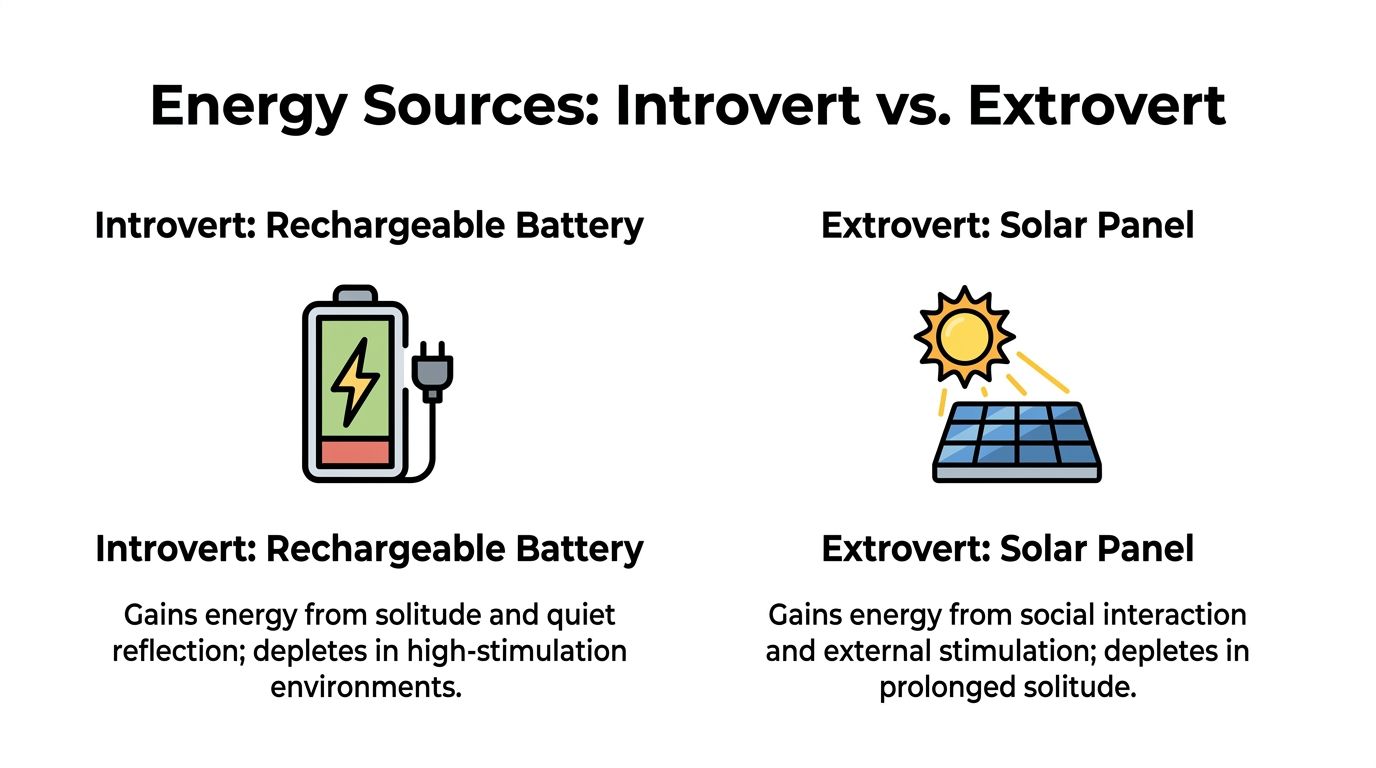
An introvert works a bit like a rechargeable battery . Energy gets restored through lower stimulation, privacy, and time to process.
An extrovert works more like a solar panel . Energy rises with interaction, movement, and contact with the outer world.
What the Letters Really Mean
In the MBTI framework, extraversion and introversion describe orientations of psychological energy. Extraverts direct energy outward toward people and stimuli, while introverts direct it inward toward thoughts and ideas. That same framework also notes that introverts report higher average stress in overstimulating workplaces, at 6.8 out of 10 compared with 5.9 for extraverts ( brainmanager.io on MBTI I vs E ).
That does not mean introverts are weak. It means some environments cost them more. It also does not mean extroverts are shallow. It means interaction often helps them think, decide, and feel engaged.
Myths Versus Reality
A lot of confusion comes from stereotypes. Here is the simpler version.
| Myth | Better explanation |
|---|---|
| Introverts are shy | Introverts may be shy or not shy. The key issue is energy recovery. |
| Extroverts always talk more | Some extroverts are quiet. They may still prefer outer engagement. |
| Introverts dislike people | Many introverts love people, but in smaller doses or calmer settings. |
| Extroverts cannot reflect | Many extroverts reflect well, but often through discussion and action first. |
Think of two coworkers in a meeting. One starts speaking before the idea is fully formed. Talking helps shape the thought. That is often an extroverted style.
Another listens, filters, and speaks once the idea feels finished. That is often an introverted style.Neither is smarter. They are processing differently.
Why This Matters in Daily Life
When people misunderstand this dimension, they often try to “fix” the wrong thing. An introvert may push themselves to be constantly available, then wonder why they feel fried. An extrovert may force too much solo work and lose focus, then assume they are lazy or distracted.
A better move is to respect your operating system. If you are battery-based, plan recharge time before you run flat. If you are solar-powered, build in contact, motion, and lively exchange before your motivation drops.
Beyond the Binary: The Extrovert-Introvert Spectrum
Many people read a basic MBTI description and think, “Some of that fits, but not enough.” That reaction makes sense. The extrovert-introvert split is often taught like a light switch. In real life, it acts more like a dimmer.
The Midzone is Real
The MBTI Step II assessment includes a midzone on the extroversion-introversion scale for people who do not show a strong preference in one direction. It also addresses the familiar “extroverted introvert” confusion. In the same discussion, recent 2025 studies on personality fluidity are described as showing 40% of professionals report E/I shifts in hybrid work environments ( People Leaders on MBTI Step II introvert extrovert team personality ).
That does not mean your personality changes every Tuesday. It means context matters. Role matters. Energy demands matter. A person can love public speaking and still need a silent afternoon afterward. Another can enjoy long weekends alone and still feel most alive in a collaborative office.
What the Middle Can Look Like
A few common examples:
• The selective socializer: • Loves deep one-on-one conversation, dislikes chaotic mingling.
• The situational extrovert: • Comes alive when hosting, teaching, or leading, but wants solitude later.
• The quiet initiator: • Looks calm from the outside, yet prefers a busy, interactive environment.
• The reflective performer: • Can shine on stage or in front of a class, then needs serious decompression.
If that sounds familiar, you are not “doing MBTI wrong.” You may live closer to the middle.
For coaches and therapists, nuance becomes useful here. A client may not need a firmer label. They may need better language for how their energy shifts across settings. If you want a broader comparison of systems, this guide on Enneagram and MBTI differences can help frame type, motivation, and behavior as related but distinct.
A Better Way to Self-Observe
Instead of asking, “Am I an extrovert or introvert?”
Try these questions:
Those answers reveal more than a stereotype ever could.
How Extroverts and Introverts Show Up at Work
Workplaces often reward visible energy.
The quick speaker gets noticed. The person who fills the silence looks decisive. The employee who can network for hours may look “leadership ready” even when someone quieter has a stronger idea.
That creates a mismatch.
Data from the UK shows introverts make up 47% of the general population but only 28% of senior leaders . The same guidance recommends energy mapping , with 40% to 60% solo reflection time for introverts in teams , and notes this can boost team output by as much as 22% in Myers-Briggs Company studies ( Myers-Briggs type dynamics overview ).
Different Strengths, Different Timing
An extrovert at work often looks energized by:
• Live brainstorming
• Fast-paced discussion
• Frequent check-ins
• Thinking aloud with others
An introvert often looks strongest when given:
• Time to reflect before responding
• A clear agenda
• Space for deep work
• Written follow-up after discussion
The mistake is assuming one style is more committed than the other. The extrovert may create momentum. The introvert may create precision.
Here is a helpful overview if you want a quick visual explanation:
Where Friction Usually Appears
Open-plan offices can drain people who need a lower-stimulation environment.
Meetings can also hide talent. A fast verbal exchange favors people who process externally. Someone with a strong idea may need ten extra minutes, not because they are uncertain, but because they are sorting carefully.
Then there is remote work. Some extroverts lose energy without live interaction. Some introverts love the quiet but still feel disconnected if communication gets muddy or nonstop.
A Simple Team Design Example
A product team has to solve a messy customer issue.
One useful rhythm looks like this:
• Start with a short live session for raw ideas.
• Pause and give everyone private reflection time.
• Collect written thoughts.
• Regroup to refine and decide.
That rhythm gives extroverts room for breadth and introverts room for depth.
It also helps the team hear more than the loudest voice.
Navigating Relationships as an Extrovert or Introvert
A lot of relationship conflict is not really about love. It is about pacing.
One partner wants a weekend packed with brunch, family, errands, and a last-minute cookout. The other wants one social plan, one free evening, and enough quiet to feel like a human again.
Neither person is wrong. They are protecting different energy needs.
Why this Pairing is so Common
In the U.S., the introversion-extraversion dimension is close to evenly split at 50.7% introverted and 49.3% extraverted , which means opposite preferences are very common in close relationships. The same source notes gender differences, with 61% of men and 62% of women identified as introverts in its figures ( Crown Counseling MBTI statistics ).
So if you are in an extrovert-introvert friendship, marriage, or family system, you are in familiar territory.
A Weekend Example
Take Lena and Chris.
Lena feels connected through activity. If the calendar stays too empty, she starts to feel flat and lonely. Chris loves Lena, loves their friends, and can be fully engaged at dinner. But if every open slot gets filled, he becomes irritable and distant.
Lena interprets that as withdrawal.
Chris interprets Lena’s constant invitations as pressure.
The argument sounds like logistics, but the core issue is energy translation.
Better Questions for Couples and Friends
Instead of asking, “Why are you like this?” try:
• What kind of social time gives you energy?
• How much recovery time do you need after a busy day?
• When do you want company, and when do you want calm?
• What does togetherness look like for you?
That last question matters. For an extrovert, togetherness may mean doing. For an introvert, it may mean being.
A walk, reading in the same room, cooking, or having a deep conversation can feel connected to someone who does not want nonstop interaction.
When Anxiety Gets Mixed In
This topic can get muddy because social anxiety and introversion are not the same thing. A person may need quiet because it restores them. Another may avoid social settings because they fear judgment. Sometimes both are present.
If that distinction is part of your story, this guide on how to cope with social anxiety can be a useful companion resource.
Once couples understand the difference between preference and fear, they stop trying to “correct” each other and start building a rhythm that fits both people.
Strategies for Growth and Better Communication
Knowing your preference is helpful. Using it well is better.
Growth does not mean becoming the opposite type. It means learning how to work with your own energy while staying flexible enough to meet life.
If you are an Introvert
A useful phrase is energy budgeting . Treat your attention like money. Spend it where it matters, and stop acting surprised when too many small withdrawals leave you exhausted.
A few practical moves:
• Ask for pauses in meetings: • Structured meeting pauses matter. In extrovert-biased meetings, introvert contributions can drop by • up to 30% without reflection time • , and • 62% of firms report lower introvert engagement in virtual settings • according to the cited workplace discussion ( • Team Leadership Culture on introversion vs extraversion • ).
• Prepare one point before the group discussion. • You do not need to dominate. You need one clear contribution ready to deliver.
• Use written follow-up: • If your best thinking arrives later, send the thoughtful email. Many strong communicators do exactly that.
• Protect recovery time after high-output days • Do not schedule your hardest people work and your hardest emotional work back to back.
If you are an Extrovert
Your growth edge is often not “talk less.” It leaves room for other processing styles .
Try this:
Extroverts often create warmth and movement. That is a gift. It becomes even more effective when paired with patience.
Tools that Support Both Styles
Some teams and couples use shared calendars, meeting agendas, or quiet blocks. Some people use journaling apps, voice notes, or a simple “green-yellow-red” energy check before plans.
If you want another lens on communication patterns and inner drivers, this article on improving relationship communication is a useful companion. Enneagram Universe also offers an assessment focused on motivations, fears, and patterns, which can complement MBTI-style energy insights.
Real growth is not acting against your nature all day.
It is learning when to stretch, when to rest, and how to explain your needs without apology.
Finding Your Authentic Energy Flow
The most helpful thing about Myers-Briggs Extrovert vs. Introvert is not the label. It is the permission.
Permission to stop confusing quiet with weakness.
Permission to stop confusing sociability with superficiality.
Permission to notice that you may live in the middle, shifting with role, context, and season.
Some people are clearly solar panels. Some are clearly rechargeable batteries. Many are a mix, with one side a little more natural than the other.
Your job is not to perform someone else’s energy style.
Your job is to understand your own pattern well enough to build a life around it. That means choosing rhythms, relationships, and work habits that help you stay present instead of depleted.
If you are exploring that path and want a resource that speaks directly to challenges around thriving as an introvert , that perspective can also add useful context, especially when attention and stimulation needs overlap.
Self-knowledge gets practical fast. You make cleaner plans. You communicate with less shame. You stop trying to win at a game built for someone else’s nervous system.
Frequently Asked Questions
Can your extrovert or introvert style change?
Your core preference may stay fairly steady, but how it shows up can shift with stress, role, maturity, and environment. That is one reason many people relate to the midzone idea.
What does ambivert mean in this context?
It usually means you show both extroverted and introverted qualities, often depending on the setting. In MBTI Step II language, this often overlaps with the idea of a midzone preference.
Is introversion the same as social anxiety?
No. Introversion is about energy. Social anxiety is about fear, especially fear of judgment or social discomfort.
How is MBTI different from the Enneagram?
MBTI focuses on preferences in perception, judgment, and energy direction. The Enneagram focuses more on core motivations, fears, and coping patterns.
If you want to go deeper into self-discovery, Enneagram Universe offers a personality assessment and educational resources that help you understand your patterns, communication style, and growth path in a more layered way.