What Is the Most Common Personality Type in the Enneagram?

Alright, let's get straight to the big question everyone asks: which personality type shows up most often? Drumroll, please... It's the ISFJ , affectionately known as 'The Defender.'
These folks make up a whopping 14% of the population . Chances are, you know and love several of them. They're the steady, caring, and surprisingly observant people who quietly hold our world together.
So, What's the Deal with the Defender Personality?
Think about that one person in your life who never forgets a birthday. The coworker who silently keeps the team from derailing. The friend who just knows you need a shoulder to cry on before you even say a word. Yep, you've probably just pictured an ISFJ.
These are the unsung heroes who bring a sense of stability and warmth wherever they go—be it at home, at work, or in their friend groups. They're not loud about it, but their impact is undeniable.
The Defender personality is a fascinating mix of practical, down-to-earth sense and deep, genuine compassion. Because they are introverted and tuned into the details, they notice and remember little things about people that most of us miss entirely. And for them, it’s not just about collecting facts; it's their primary way of showing they truly care.

The Defining Features of an ISFJ
What really makes an ISFJ tick is a powerful, almost unbreakable sense of duty and loyalty. They're wired to protect and provide for the people they love, which makes them some of the most dependable friends, partners, and colleagues you could ever ask for. This isn't just a feeling, either—it's backed up by a seriously organized and methodical way of doing things.
To give you a clearer picture, here's a quick look at the building blocks of the ISFJ personality:
• Introverted (I): • They get their energy from quiet time alone. While they're wonderfully warm, they thrive on deep, one-on-one connections rather than navigating a huge party.
• Sensing (S): • They live in the real world. ISFJs are grounded, focusing on concrete facts and what they've learned from past experiences to make sense of the here and now.
• Feeling (F): • Decisions are made with the heart. They weigh their personal values and how their choices will impact others, always striving for harmony.
• Judging (J): • They love a good plan. Structure, order, and knowing what's coming next give them a sense of peace and control.
To help you spot an ISFJ (or recognize these traits in yourself), here's a quick summary table.
ISFJ At a Glance: The Defender Profile
| Trait | What It Means | Common Behavior |
|---|---|---|
| Loyal & Committed | Deeply devoted to people and causes they care about. | Sticking by a friend through thick and thin, no matter what. |
| Observant | Notices and remembers small, important details about others. | Recalling your favorite coffee order or a story you told months ago. |
| Practical & Grounded | Focused on real-world needs and tangible solutions. | Excellent at managing daily tasks, budgets, and schedules. |
| Supportive | Naturally inclined to help and care for others' well-being. | The first person to offer help when someone is sick or struggling. |
| Hardworking | Possesses a strong work ethic and takes responsibilities seriously. | Meticulously completing a project to ensure it's done right. |
This unique combination creates a person who is both incredibly nurturing and wonderfully efficient. It's no surprise, then, that data from countless personality studies consistently puts the ISFJ at the top of the list.
Statistics show that this type accounts for about 13.8% of people in the United States and across the globe. If you're curious about the numbers, you can dive into more personality type statistics from Crown Counseling to see the complete distribution.
Your Personality's Four Key Ingredients
Ever see one of those four-letter personality codes and feel like you're trying to crack a secret message? It's way less complicated than it looks.
Think of your personality like a custom recipe. It’s built from four core ingredients, and for each one, you have two "flavor" options. The specific combination you end up with creates your unique personality type.
This whole system is based on the Myers-Briggs Type Indicator (MBTI). The point isn't to shove you into a box, but to shine a light on your natural, built-in preferences for how you see the world and move through it. Let's break down the four ingredient pairings to see how we get to ISFJ—the most common personality type—and all the others.

Ingredient 1: How You Recharge Your Battery
First up is your energy source. This isn't about being shy versus being the life of the party. It’s all about what truly recharges you.
• Introversion (I): • Do you feel like you come back to life after some quiet time alone with your thoughts? You probably get more out of a deep one-on-one chat than a massive party. That's the • I • in ISFJ.
• Extraversion (E): • Or do you get a buzz from being around people and diving into activities? If a lively social gathering leaves you feeling energized instead of drained, you’re likely an Extrovert.
Ingredient 2: How You Take In Information
Next, let’s look at how you prefer to gather information. Are you a "just the facts" person, or do you love reading between the lines?
Your personality is not just a list of traits; it's a complex web that determines how you think, operate, perceive, and interact with the world. Understanding these ingredients is the first step to seeing the full picture.
This is the fundamental difference between Sensing and Intuition, and it dramatically shapes how you see everything.
• Sensing (S): • You trust what you can see, touch, and experience with your five senses. You’re grounded in the here-and-now, focusing on practical details and relying on what’s worked before. This is the • S • in ISFJ.
• Intuition (N): • You’re more fascinated by the patterns, possibilities, and hidden meanings behind the facts. You’re a natural at connecting the dots and often find yourself thinking about the future.
Ingredient 3: How You Make Decisions
Okay, so you've taken in the information. What do you do with it? This ingredient is all about your decision-making compass: do you follow your head or your heart?
• Thinking (T): • You lead with logic. Making decisions is about objective analysis, weighing the pros and cons, and finding the most consistent, impartial solution.
• Feeling (F): • You lean on your personal values and consider how your decisions will impact the people involved. Empathy and maintaining harmony are your North Stars. This gives us the • F • in ISFJ.
Ingredient 4: How You Organize Your World
Last but not least, how do you like to live your life? Are you a planner who loves a to-do list, or do you prefer to keep your options open and see where the day takes you?
• Judging (J): • You feel best when you have a plan. You like structure, clear deadlines, and the satisfying feeling of making a decision and crossing it off the list. This is the final • J • in ISFJ.
• Perceiving (P): • You thrive on spontaneity and flexibility. You prefer to stay open to new information, adapting as you go and keeping things loose and less structured.
Combine one preference from each of these four pairs, and you get one of 16 possible personality types . For the most common type, ISFJ, the recipe calls for a mix of Introversion, Sensing, Feeling, and Judging. The result? A deeply caring, dependable, and wonderfully organized person.
So, Why Are Defenders Everywhere?
Ever notice how some people just seem to be the bedrock of a group? The quiet, reliable ones who keep things running smoothly? Chances are, you're thinking of an ISFJ, and there's a good reason they seem so common—they are.
But this isn't some random coincidence. The Defender's prevalence is deeply woven into the very needs of human society. Think of them as the social glue holding our communities together. They are the tireless gardeners tending to relationships, preserving traditions, and making sure everyone feels safe and cared for.
Their core traits are, frankly, social superpowers. At its heart, any functioning society needs cooperation, dependability, and mutual support. The ISFJ personality is practically engineered to deliver on all three, making them the unsung heroes in our families, workplaces, and communities.
The Human Superglue
What makes Defenders so indispensable is their unique combination of heartfelt empathy and a rock-solid sense of duty. They're naturally wired to create harmony and look out for the well-being of the people around them. This isn't just a casual preference; it’s the lens through which they see the world.
• Empathy with Legs: • ISFJs don't just feel for you; they're compelled to • do • something to help. They're the ones who notice a coworker is drowning in work and offer a hand, or who bring soup to a friend who's feeling down, often before anyone even thinks to ask.
• A Powerful Sense of Duty: • They take their commitments seriously, whether it’s hitting a project deadline or remembering a birthday. This profound reliability builds incredible trust and makes them the person everyone knows they can count on, no matter what.
• Keepers of the Flame: • Defenders have a deep respect for history and established ways of doing things. They're the ones passing down family stories, championing company culture, and ensuring that important customs don't just fade away.
This infographic paints a pretty clear picture of how many ISFJs are out there and where you’re likely to find them.
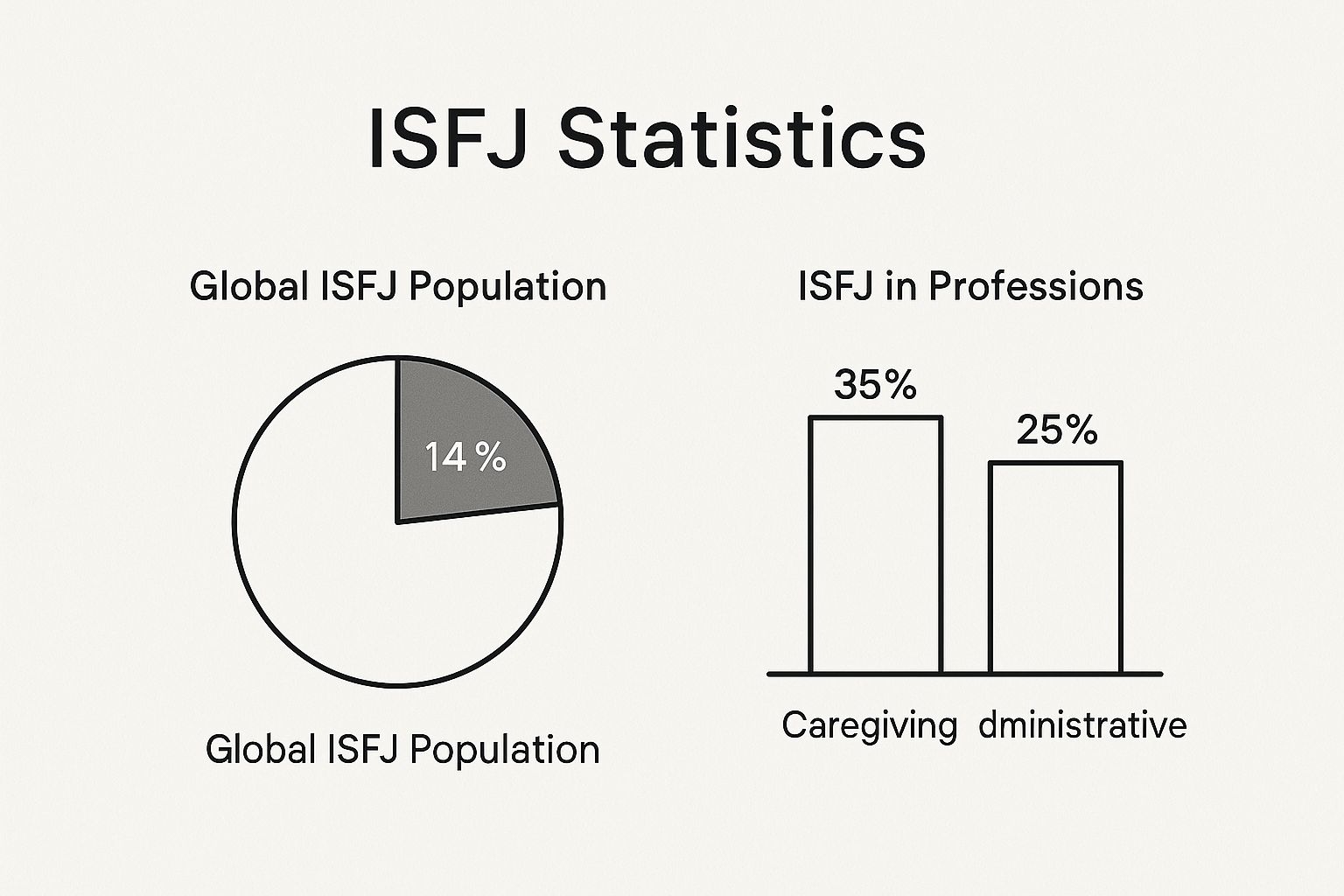
As you can see, a huge number of ISFJs gravitate toward caregiving and administrative fields—roles that perfectly align with their innate desire to support, organize, and help others.
A Recipe for Success, Encouraged by Culture
For centuries, societies all over the world have sung the praises of the very qualities that define an ISFJ. Think about it: loyalty, diligence, and humility are universally seen as virtues because they make for a stable, supportive community. This creates a powerful cycle.
When a society consistently celebrates dependability and compassion, it naturally encourages those behaviors. This reinforcement helps the Defender personality thrive and become more common.
Just look at the everyday heroes we admire—the dedicated nurse, the patient teacher, the devoted parent. These vital roles are often filled by ISFJs, and their quiet, consistent work is the foundation our world is built. Their goal isn't to be in the spotlight; it's to make sure the lights stay on for everyone else.
Of course, the Myers-Briggs system is just one lens for understanding ourselves. If you're curious about other frameworks, check out our guide comparing the Enneagram vs MBTI .
In the end, the ISFJ is the most common personality type for one simple reason: the world needs them. Desperately. Their practical, people-first approach creates the stability and warmth that allows every other personality type the freedom to create, innovate, and take big swings. They are the steady, essential heartbeat of our shared human experience.
Meet the Other Guardians of the Personality World
While the ISFJ Defender may wear the crown for the most common personality type , they certainly don't rule the kingdom alone. They're part of a larger, incredibly influential family known as the "Guardians" or "Sentinels."
Think of these types as the steady, reliable bedrock of society. They are the practical, community-focused personalities who bring order and stability to our world. Alongside the ISFJ, two other types stand out for their sheer numbers and shared sense of duty: the ESFJ and the ISTJ.

The Outgoing ESFJ Consul
Imagine the ISFJ's warmth and dedication, but turn the volume way up and point it outward. That's the ESFJ, or "The Consul." These folks are the social glue in any group, thriving on organizing community events, bringing people together, and making sure everyone feels included and cared for.
Unlike their introverted ISFJ cousins, ESFJs draw their energy from buzzing social interaction. They are the beloved hosts, the super-involved school parents, and the managers who somehow remember everyone's birthday. Their core drive is to build harmonious communities through active participation and enthusiastic support. They’re the cheerleaders of the personality world.
The Logical ISTJ Logistician
Now, take the ISFJ’s reliability and rock-solid work ethic, but swap their feelings-first decision-making for a razor-sharp focus on logic and facts. Meet the ISTJ, "The Logistician."
ISTJs are the quiet masters of order, integrity, and tradition. They build and maintain the systems society relies on, from complex legal frameworks to massive logistical operations. Where an ISFJ is motivated by protecting people's feelings, an ISTJ is driven by a deep commitment to upholding rules, facts, and what has been proven to work time and time again.
Together, the Guardian types—ISFJ, ESFJ, and ISTJ—create a powerful foundation of stability. It’s not just one personality that's common, but an entire mindset dedicated to service, responsibility, and structure.
It's a fascinating reality when you look at the numbers. The top four most common types—ISFJ, ESFJ, ISTJ, and ISFP—actually account for nearly half ( 46.5% ) of the global population. You can dive deeper into these Myers-Briggs statistics to see the full breakdown for yourself.
To really nail down the differences between these Guardian cousins, it helps to see them side-by-side.
Comparing the Top 3 Most Common Personality Types
This table breaks down the key distinctions between the ISFJ, ESFJ, and ISTJ. While they all share a sense of duty, their motivations and strengths lead them down very different paths.
| Personality Type | Core Motivation | Strengths | Common Professions |
|---|---|---|---|
| ISFJ (The Defender) | To support and protect others in a practical way. | Empathetic, detail-oriented, loyal, and reliable. | Nurse, Teacher, Social Worker |
| ESFJ (The Consul) | To create social harmony and support the community. | Outgoing, organized, conscientious, and warm. | Event Planner, HR Manager, Teacher |
| ISTJ (The Logistician) | To uphold traditions and maintain order with logic. | Responsible, honest, methodical, and dedicated. | Accountant, Inspector, Military Officer |
By getting to know these related types, you get a much richer picture of why a service-oriented mindset is so common. Each brings its own unique flavor to the Guardian family, proving there are many ways to be a pillar of the community.
If you're looking for another powerful lens to understand yourself, our guide on the nine personality types of the Enneagram is a fantastic place to start.
Connecting with the Defenders in Your Life
Chances are, you don’t just know an ISFJ—you probably rely on a whole crew of them. They’re the friend who remembers your coffee order, the coworker who catches the tiny error that saves the project, and the family member who makes a house feel like a home.
Figuring out that this is the most common personality type isn't just trivia for your next cocktail party. It's a powerful key to unlocking stronger, more meaningful relationships with the people who likely form the backbone of your life.
Speak Their Language: Appreciation and Stability
Want to know the express lane to an ISFJ's heart? Genuine, specific appreciation. These are the people working tirelessly behind the scenes, and so much of what they do flies under the radar.
A simple, “Hey, thank you so much for organizing that meeting agenda. It made everything run like a well-oiled machine,” will land a thousand times better than a generic "good job." They crave knowing that their specific efforts made a real difference.
Beyond that, ISFJs thrive on stability. Chaos is their kryptonite. Last-minute plan changes, unpredictable schedules, and general upheaval can send their stress levels through the roof.
To make an ISFJ feel truly seen and secure, give them a heads-up. If plans have to change, letting them know as soon as possible isn't just a courtesy—it's a profound sign of respect for their peace of mind.
This doesn't mean you have to ditch spontaneity forever, but simply being mindful of their need for a little structure shows you care. It builds a kind of trust that they deeply value.
A Quick Cheat Sheet for Getting Along
When it comes down to it, building a great bond with the Defenders in your world is pretty straightforward. Here are the dos and don'ts to keep in mind.
How to connect with an ISFJ:
• Acknowledge Their Efforts: • Don't just see what they do—say it out loud. Pointing out the thoughtful things they do validates their very reason for being.
• Show Loyalty: • Be in their corner. For an ISFJ, loyalty isn't just a nice quality; it's the gold standard of any real relationship.
• Keep it Calm: • They're built for gentle, harmonious chats, not bare-knuckle debates. Approach sensitive topics with a soft touch.
What to avoid with an ISFJ:
• Public Criticism: • Calling them out, especially in front of other people, is just about the most mortifying thing you can do. It's a wound that can take a long time to heal.
• Dismissing Tradition: • They find comfort and meaning in routines and history. Casually brushing off something they hold dear can feel like a personal attack.
• Ignoring Their Feelings: • Don’t mistake their practical nature for a lack of emotion. They feel things deeply, and brushing past their feelings is the fastest way to build a wall between you.
At the end of the day, connecting with an ISFJ is about seeing them for who they are: people of quiet strength and incredible dedication. They rarely ask for the spotlight, but showing them you see and cherish their steady, supportive presence is the best gift you can possibly offer.
Alright, let's unpack what all this really means. You now know the ISFJ is the most common personality type out there. Cool fact for a trivia night, but what's the actual point? The goal isn't just to slap a label on people. It's about using this knowledge to build better relationships and, most importantly, to understand yourself a little better.
Think of personality frameworks like the Myers-Briggs not as rigid boxes, but as surprisingly useful roadmaps. They offer a starting point, a clue, for decoding why you and the people around you do the things you do. Armed with that knowledge, you can build some serious empathy and forge stronger connections.
So, You're an ISFJ?
Finding out you have the most common personality type can feel like coming home. Seriously. You’re part of a huge, global community of quietly dependable people who are the glue holding so much of the world together. Your loyalty, your attention to detail, your nurturing spirit—those aren't just quirks, they're your superpowers.
But, and this is a big but, your journey of growth is all about learning to point some of that incredible care back at yourself.
• Learn to Say No (and Not Feel Bad About It): • Setting boundaries isn't selfish; it's smart. Your energy is finite, so stop giving it all away. Protecting it means you can show up with 100% for the people and projects that truly light you up.
• Put Your Own Needs on the To-Do List: • You have a sixth sense for what everyone else needs. It's time to turn that superpower inward. Go ahead and block out time for • your • hobbies and passions, guilt-free.
If You've Got an ISFJ in Your Life
Aha! Now you have the inside scoop. Understanding the ISFJ mindset can completely change how you interact with the loyal, hardworking "Defenders" you know. You now hold the key to connecting with them on a deeper level.
Start by noticing their quiet contributions and offer genuine, specific praise—it means the world to them. And for the love of all that is good, give them a heads-up before you change plans. They thrive on stability, and respecting that is a surefire way to show you care.
Acknowledging what makes each personality tick is where the magic happens. It's the shift from a frustrated, "Why are they like that?" to an enlightened, "Oh, that's how they see the world."
At the end of the day, learning about the most common personality type isn't just about the ISFJ. It's a fantastic reminder of the beautiful, messy, and fascinating diversity of human nature. It's about looking at the people around you—and the person in the mirror—with a little more clarity, a lot more compassion, and a genuine curiosity for what makes us all tick.
Burning Questions & Quick Answers
Alright, you've taken in a lot of information. It's totally normal for a few questions to be rattling around in your head. Let's tackle some of the most common ones that pop up.
So, What's the Rarest Personality Type?
If the ISFJ Defender is the most common, who's on the other end of the spectrum? Meet the INFJ , "The Advocate." These folks are the unicorns of the personality world, making up less than 1% of the population .
They're a fascinating mix of deep, quiet idealism and a get-it-done attitude. Finding an INFJ is a rare treat, as they have a unique way of seeing the world and a powerful drive to make it better.
Can Your Personality Type Actually Change Over Time?
This is the big one, isn't it? The short answer is no—your core type is pretty much set for life. Think of it like being right-handed or left-handed. You're born with a natural preference, and while you can get really good at using your non-dominant hand, your go-to will always be your go-to.
But here's the crucial part: how you express your type can change dramatically. Life throws things at you, you mature, and you consciously work on your weak spots. This is what growth is all about. You're not changing your core recipe; you're just becoming a much more skilled and versatile chef.
Your personality type is your starting point, not your destiny. Real growth isn't about becoming a different person, but about becoming a more complete version of yourself.
Do More Men or Women Have Certain Personality Types?
Absolutely. The statistics show some pretty clear patterns here. For instance, the nurturing ISFJ Defender is more common in women, while logical "Thinking" types like the ISTJ Logistician show up more frequently in men.
Now, this doesn't mean a guy can't be an ISFJ or a woman can't be an ISTJ—not at all. These are just broad statistical trends. They're likely shaped by a complex cocktail of societal roles and natural wiring, not rigid rules.
Wondering where you fit into this picture? Our in-depth personality assessment can help you connect the dots.
Ready to really get to know yourself? At Enneagram Universe , we're all about giving you the tools for that "aha!" moment of self-discovery. Take our free, scientifically validated personality test today at Enneagram Universe .