Mediator Personality Type (INFP): Traits, Strengths, and Challenges Explained

Ever feel like you’re tuned into a different frequency than most people? Like you can see the hidden beauty, the quiet magic, and the unspoken feelings that everyone else just walks past? If so, you might just be a Mediator.
The Mediator personality , known in the Myers-Briggs world as the INFP , is the quiet dreamer, the gentle idealist, and the person always ready to champion a cause they believe in. They’re guided by a strong inner moral compass, always pointing toward what feels right.
Welcome to the World of the Mediator
Let's ditch the boring textbook definitions. Think of the Mediator as the "Dream Weaver" of the personality types. These are the folks who can see a glimmer of good in just about anyone and have a special knack for nurturing that potential until it blooms. For example, a Mediator teacher might spot a shy student's hidden talent for art and spend extra time encouraging them, seeing a future artist where others just see a quiet child.
Their inner world isn't just a place of thoughts; it's a vibrant, sprawling landscape of imagination and emotion. This makes them some of the most genuinely creative and deeply empathetic people you could ever hope to meet.
The Mediator personality comes from a specific mix of traits in the Myers-Briggs Type Indicator (MBTI) system. Of course, the MBTI is just one lens to view yourself through. If you're curious about how it stacks up against other popular systems, we've got a great breakdown on the Enneagram vs. MBTI that you might find fascinating.
To get a clearer picture of what makes a Mediator tick, let's pull back the curtain on their core traits. The table below gives a quick snapshot of their defining characteristics.

The Mediator (INFP) At a Glance
| Core Trait | What It Looks Like in Real Life |
|---|---|
| Idealistic | Always believes in the best-case scenario and people's potential for good. For example, they're the friend who insists that a cynical coworker is "just misunderstood." |
| Creative | Expresses themselves through art, writing, music, or just innovative problem-solving. They might spend a weekend rearranging their living room to create a more harmonious "flow." |
| Empathetic | Can genuinely feel what others are going through, making them amazing listeners. When a friend is upset, they don't just offer advice; they feel a shadow of that sadness themselves. |
| Value-Driven | Their life decisions are guided by a powerful internal sense of right and wrong. They'd rather take a pay cut than work for a company whose values they don't respect. |
| Reserved | Tends to be quiet and thoughtful, saving their true self for people they trust. At a party, they're more likely to be in a deep one-on-one conversation in a corner than in the center of a large group. |
| Flexible | Prefers to go with the flow and keep their options open rather than stick to a rigid plan. They might book a flight for a vacation but leave the hotel and activity plans completely open to spontaneity. |
This combination of idealism, creativity, and empathy is what makes Mediators so unique. They are driven by a deep desire to understand themselves and their place in the universe while helping others along the way.
Decoding the INFP Traits
So, what do those four letters—I, N, F, and P—actually mean in the real world? Each one represents a core preference that shapes how Mediators experience life.
• Introverted (I): • This isn't about being shy! It's about where they get their energy. Mediators recharge their batteries with alone time. A practical example: After a day of meetings, an INFP needs an evening with a book or a quiet hobby, not a happy hour, to feel human again.
• Intuitive (N): • Forget the nitty-gritty details. Mediators are big-picture thinkers who live in a world of possibilities and abstract ideas. When planning a project, they're excited about the "why"—the overall vision and impact—but can get bogged down by the "how" of spreadsheets and timelines.
• Feeling (F): • When making a choice, their heart leads the way. They weigh decisions based on their personal values and how the outcome will affect people, placing harmony over cold, hard logic. For instance, they might choose not to lay off an underperforming employee if they know the person is going through a tough family crisis.
• Perceiving (P): • Structure? Rigid plans? No, thanks. Mediators thrive on flexibility and spontaneity, preferring to keep their options open and adapt as they go. This is why they might rearrange their whole weekend schedule at the last minute, simply because they "feel like" going for a hike instead.
Put it all together, and you get someone who is both a thoughtful idealist and a passionate creative. Think of the friend who just knows how to patch up a disagreement between two people, or the colleague who quietly comes up with the most brilliant, human-centered solution to a tough problem.
The Mediator's superpower is their ability to fuse a rich imagination with deep compassion. This allows them to not only dream of a better world but to inspire others to help build it.
This special blend of traits means you won't find a Mediator on every street corner. In fact, they’re one of the rarer personalities, making up just 4.4% to 4.6% of the population. This often sets them apart from the more common, pragmatic types like ISFJ ( 13.8% ) and ESFJ ( 12.3% ), whose practical, down-to-earth approaches tend to be more visible in society. If you're interested in the numbers, you can find more about personality type distributions on OurMental.Health .
What Makes a Mediator Tick?
So, what actually gets a Mediator out of bed in the morning? Sure, a steady paycheck is nice for anyone, but for this personality type, it’s rarely the main event. What truly fuels the Mediator is a deep, almost spiritual quest for two things: authenticity and harmony .
Think of it like an internal compass that doesn't point north, but instead swings relentlessly toward their core values. This isn't just a flowery metaphor; it's the fundamental operating system for an INFP. Every big decision gets filtered through one simple, powerful question: "Does this feel true to who I really am?"
This is the engine behind everything they do. It's why they can't just "phone it in" when their actions don't line up with their beliefs. It’s what pushes them to champion causes, create soul-stirring art, and build relationships that go far beyond surface-level chit-chat.
The Driving Forces: Authenticity and a Sense of Purpose
At the very heart of the Mediator is a non-negotiable need to live an authentic life. When they're pushed into situations that clash with their principles, it’s not just uncomfortable—it’s physically and emotionally draining. This isn’t stubbornness; it's a deep-seated need to protect their personal integrity.
Picture a gifted American graphic designer, a classic Mediator, who gets a dream offer from a massive corporation notorious for its shady environmental record. The money is fantastic, but the work feels… wrong. She'll likely be tormented by the decision, ultimately turning it down for a lower-paying gig at a non-profit she actually believes in. For an INFP, a life without purpose is just going through the motions.
This burning need for purpose shows up in a few key areas:
• Meaningful Work is a Must: • They’re drawn to careers that make a difference, whether that's helping people directly, bringing a creative vision to life, or fighting for a cause. For example, an INFP would find more fulfillment as a low-paid social worker than a high-powered, cutthroat corporate lawyer.
• Creativity as an Outlet: • Art, writing, music—these aren't just hobbies. They are essential tools for an INFP to make sense of their rich inner world and share their unique point of view with others. A Mediator might keep a private journal of poetry not to be published, but simply to process their complex emotions.
• Connections That Matter: • Superficial friendships feel hollow and pointless. Mediators are on the hunt for friends and partners who see them, truly see them, on a soul-deep level. They would rather have one friend they can talk to for hours about life's big questions than a dozen friends for casual nights out.
The Shadow Side: What a Mediator Truly Fears
Just as their motivations are intense, so are their fears. And really, their fears are just the flip side of their core desires. The thought of living a life that betrays that inner compass? That's what keeps them up at night.
A Mediator’s biggest fear isn’t failing at a job or a project. It's the spiritual failure of living a life that feels like a lie. It's the terror of looking back one day and realizing they never showed up as their true self.
This core anxiety branches out into a few specific fears that guide their behavior. They're often terrified of causing discord, because conflict shatters the harmony they try so hard to create. For example, they might agree to go to a restaurant they dislike just to avoid an argument with their friends. The thought of living a life without a clear purpose can send them spiraling into an existential crisis, questioning every choice they've ever made.
And finally, the fear of betraying their own values can be paralyzing. It's why corporate environments that put profits before people, or demand cold logic over empathy, can feel utterly soul-crushing to them. This intense internal world is the "why" behind their uniquely thoughtful and sometimes hesitant approach to life. It explains their passion, their creativity, and their never-ending search for a world that feels as beautiful and kind as the one they carry inside them.
The Mediator’s Double-Edged Sword: Strengths and Blind Spots
Every personality type has its superpowers and, let’s be real, its own special brand of kryptonite. For the Mediator, this duality is often front and center. Their greatest gifts can cast long shadows, creating challenges that are tangled up with the very things that make them so unique.
This isn’t about good versus bad. It's about seeing the whole picture—the brilliant and the tricky—to build some serious self-awareness. Think of it like a coin: one side holds the incredible strengths that make Mediators the artists, healers, and quiet visionaries of the world. Flip it over, and you find the potential blind spots that can make life in a pragmatic world feel like an uphill battle.
The Mediator's Superpowers
Mediators are walking, talking bundles of creativity, empathy, and idealism. These aren't just fluffy concepts; they're the practical tools INFPs use to leave their mark on the world, often in quiet yet profound ways.
Their creativity seems to have no off-switch, allowing them to spot possibilities where everyone else sees a dead end. This imaginative spark isn't just for painting or poetry—it makes them fantastic problem-solvers, especially when a situation calls for a deeply human touch. A practical example is an INFP HR manager who, instead of using a standard corporate memo, devises a creative, compassionate way to announce a difficult company change.
And their empathy? It's legendary. A Mediator is the friend you call at 3 AM because they won't just feed you clichés. They'll climb into that emotional foxhole with you and genuinely feel what you're feeling. They can read the emotional temperature of a room like a psychic, making them natural peacemakers and trusted confidantes.
• Radical Empathy: • They don't just understand feelings; they • absorb • them. This makes them incredibly supportive partners, friends, and colleagues.
• Unleashed Creativity: • Their minds are playgrounds of possibility. This makes them natural storytellers, artists, and innovators who live outside the box.
• Fierce Idealism: • They carry an unshakeable belief in the good of humanity and are driven by a deep-seated need to make the world a kinder place.
This inner world is guided by a powerful moral compass, constantly pointing toward what feels right, harmonious, and true.
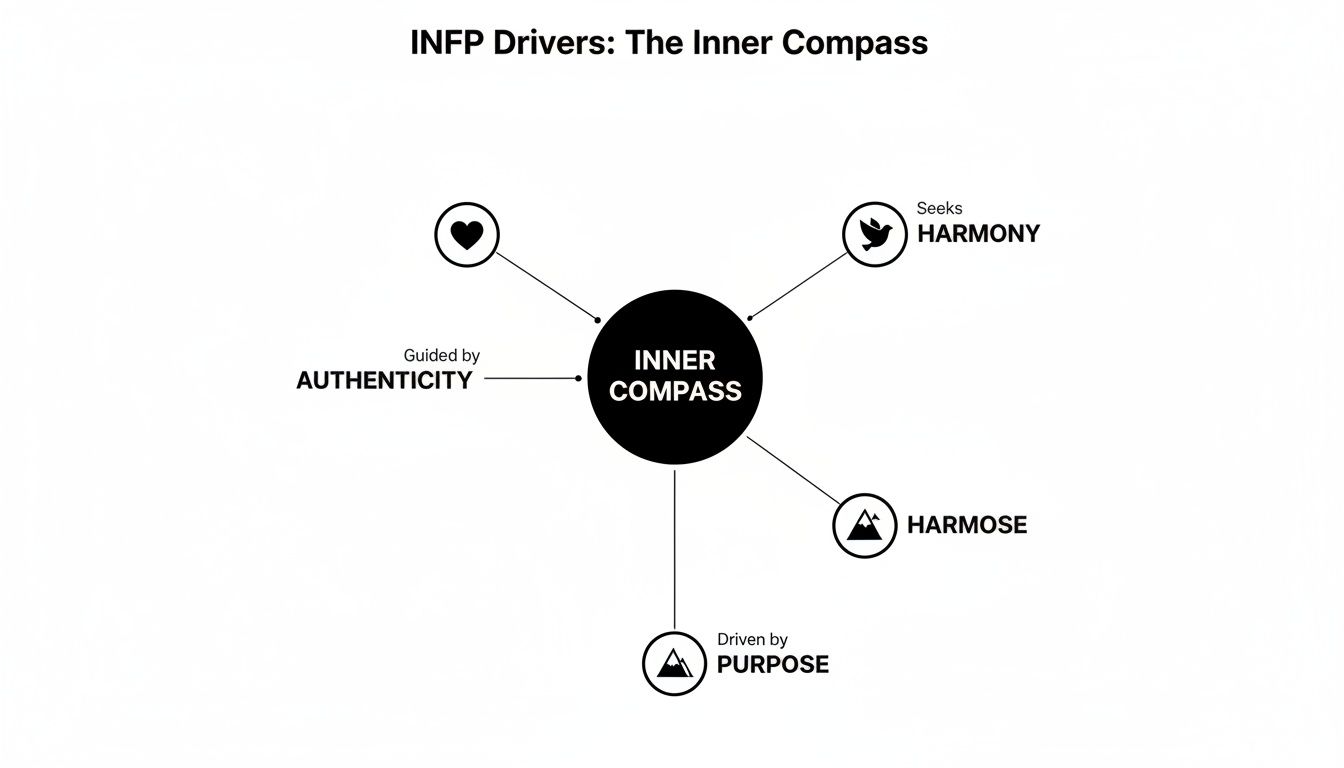
As you can see, everything traces back to their core drivers: living an authentic life, creating harmony, and finding a sense of purpose.
Navigating the Potential Blind Spots
Okay, let's flip that coin. The same qualities that make Mediators so inspiring can trip them up. That powerful idealism, for instance, can sometimes veer into impracticality, setting them up for disappointment when messy reality fails to match their beautiful inner vision. A real-world example: an INFP might organize a community cleanup day and feel crushed when only five people show up, instead of the hundreds they envisioned.
The Mediator's challenge isn't to become less sensitive or idealistic, but to build a sturdy bridge between their rich inner world and the often-chaotic outer one.
Their deep empathy also means they take criticism straight to the heart . A piece of constructive feedback that another type might shrug off can feel like a deep, personal wound to an INFP. For instance, a manager's comment like "this report could be more concise" might be interpreted by the INFP as "you're a bad writer and your thoughts are messy." This makes it tough to separate their work from their self-worth, turning competitive or blunt environments into an emotional minefield.
Finally, their "big picture" focus can make them allergic to mundane details. They come alive brainstorming a grand, world-changing idea, but can lose all momentum when it's time to create the spreadsheets to actually execute it. This is why so many brilliant INFP projects sadly remain half-finished.
Mediator Strengths vs Potential Blind Spots
To really get it, it helps to see these traits side-by-side. Notice how each strength, when pushed to an extreme or left unchecked, can morph into a significant challenge.
| Core Strength | Potential Blind Spot |
|---|---|
| Deep Empathy | Overly Sensitive to Criticism (Takes feedback personally) |
| Passionate Idealism | Impracticality (Prone to disappointment when reality falls short) |
| Rich Inner World | Dislikes Dealing with Data & Details (Can lose interest in execution) |
| Values Harmony | Conflict-Avoidant (May let issues fester to keep the peace) |
| Flexible & Open-Minded | Indecisive (Can get stuck in "analysis paralysis" on important choices) |
This isn't a list of flaws; it's a roadmap. Understanding that your aversion to conflict comes from your love of harmony, or that your struggle with spreadsheets is tied to your creative vision, is the first step. It transforms frustrating patterns into opportunities for real, compassionate growth. Recognizing these connections is the key to unlocking the Mediator’s full potential.
Mediators in the Workplace and Relationships
A Mediator's rich inner world of values and emotions isn't just for navel-gazing; it completely shapes how they show up at work and at home. To really get what makes them tick, you have to look at how they handle the day-to-day grind of a job and the messy, beautiful reality of a partnership. This is where you see where they truly shine—and where they might stumble.
For the Mediator personality type , both a career and a relationship have to feel right. A job is never just a job, and a partnership isn’t about convenience. They have to be genuine extensions of who they are at their core.
Finding a Career with a Calling
You can forget those generic "best jobs for INFPs" lists. Sure, roles like writer, counselor, or artist pop up all the time, but the real secret for a Mediator is finding the right environment and a sense of purpose . They don't just need a paycheck; they need a mission.
Mediators come alive in workplaces that champion creativity, freedom, and a people-first mission. Stick them in a rigid, micromanaged corporate cage where profit is king, and you'll watch their spirit wither. But give them a role where they can see their work making a real, positive difference in someone's life? That’s like coming home.
Imagine a Mediator working as a graphic designer. They’d likely be miserable churning out ads for some soulless corporation with questionable ethics. But that same person would happily work twice as hard for half the pay at a small non-profit, feeling totally energized because their skills are serving a cause they actually believe in.
It's not about the perfect job title for a Mediator. It's about finding a role where their work is a direct channel for their deepest values. Autonomy and purpose are their professional rocket fuel.
This unique drive makes them quiet but mighty contributors across many fields. In the U.S. alone, there are an estimated 7-8 million female INFPs, and you can see their mark on sectors like education and the arts, where empathy is a crucial ingredient in over 60% of roles. What’s more, with 42% of self-identified neurodivergent people falling into intuitive personality types, Mediators often bring a supercharged creativity and a knack for seeing things differently. From tech visionaries to Hollywood's best storytellers, Mediators are often the quiet force behind truly meaningful work. You can dive deeper into these trends with personality type distributions and their impact on BrainManager.io .
The Mediator as a Partner
When it comes to relationships, Mediators are all in. They aren't looking for a casual fling or a temporary fix. They're on a quest for a soulmate—someone who can see into their complex inner world and shares their hunger for a deep, authentic bond.
As partners, they are fiercely loyal, incredibly supportive, and almost psychically empathetic. This is the person who will listen to you for hours, who just knows when something is wrong without you saying a word, and who would move heaven and earth to make you feel loved and understood. A practical example: if their partner had a bad day at work, the INFP won't just ask about it; they'll cancel their own plans, make their partner's favorite meal, and create a comforting space for them to unwind and talk.
But this beautiful idealism has a flip side. A Mediator's powerful imagination can sometimes spin up a fantasy version of their partner, hoisting them onto a pedestal no real human could possibly stay on. When reality inevitably kicks in, and their partner proves to be, well, human, the fall can feel absolutely crushing.
Their other big struggle? A deep-seated aversion to conflict. Because they treasure harmony so much, they’ll often swallow their own needs or concerns just to keep the peace. For instance, they might be quietly upset about their partner's habit of leaving dishes in the sink but will say nothing for weeks to avoid a confrontation. This can lead to a slow burn of resentment simmering just below the surface, which is way more toxic in the long run than a single, honest, and maybe uncomfortable conversation would have been.
A healthy, thriving relationship for a Mediator boils down to a few key things:
• Deep Emotional Intimacy: • They need to go beyond "how was your day?" and dive into dreams, fears, and feelings.
• Shared Values: • A partner who respects and aligns with their core principles is absolutely non-negotiable.
• Space for Individuality: • As much as they crave connection, they also need a partner who gets their introverted need for solitude to recharge their batteries.
For a Mediator, building a life that feels good on the outside—in their career and relationships—starts by honoring the beautifully complex world they carry on the inside. When they find that alignment, they don't just get by; they truly flourish.
How to Know If You’re a Mediator
Ever feel like you’re operating on a slightly different wavelength than everyone else? If you’ve been nodding along while reading about the Mediator personality type , seeing glimpses of yourself in the descriptions, let’s figure out if this is more than just a coincidence.
Think of this less as a rigid diagnostic and more as a gut check. We’re just holding up a mirror to see if the reflection feels right.
A Quick Self-Check
Let’s start with a few questions. Do any of these internal monologues sound a little too familiar?
• Dreaming vs. Doing: • Do you have a beautifully crafted, ten-year vision for your life but are still not quite sure what you’re doing next Tuesday?
• Authenticity Radar: • Does it make your skin crawl when you see someone being fake or insincere? Like, you can almost physically feel the disconnect?
• The Weight of the World: • Do you walk into a room and immediately absorb the emotional temperature, feeling other people’s joy or stress as if it were your own?
• The Unfinished Masterpiece: • Is your creative space a graveyard of half-finished projects—that novel, that painting, that song—that you were once wildly passionate about?
If you found yourself saying "ouch, yes" to a few of these, you're definitely in the right neighborhood. These aren't just random quirks; they’re the classic fingerprints of a mind that runs on idealism, authenticity, and a deep well of creative passion.
At its core, the question for a potential Mediator is this: Is your life guided more by a deep-seated inner compass of what feels right and true, or by external logic and what society expects?
It’s worth noting that the Mediator (INFP) personality is relatively uncommon, making up only about 4-5% of the global population. Think about that for a second. With around 70% of people being Sensing types who are grounded in concrete facts, the Mediator’s intuitive, feel-it-out approach is genuinely unique. In the United States, the number is similar, around 4.4% . For more fascinating numbers, check out these personality type statistics on CrownCounseling.com .
Official Assessments vs. Online Quizzes
Okay, so you have a strong hunch. The natural next step is to google "personality test," right? While those free online quizzes are fun, it’s crucial to understand what they are—and what they aren’t.
Think of it like this: a free quiz is like asking a friend for their opinion on your style. It’s quick, easy, and can give you a general idea. A validated assessment, like the official Myers-Briggs Type Indicator (MBTI), is like consulting with a professional stylist who analyzes your lifestyle, goals, and what truly makes you shine. Both have their place, but only one gives you a deeply structured, reliable picture.
If you want to add another layer to your self-discovery, taking a comprehensive personality test from a different framework can also offer incredible insight into your core motivations.
The Group Trip Test: A Real-World Scenario
Let's bring this to life. Imagine you’re planning a group vacation with friends.
A more pragmatic, logistics-focused friend might immediately whip up a spreadsheet. We're talking a minute-by-minute itinerary, color-coded budget lines, and every single reservation confirmed and double-checked. Their goal? Flawless execution.
Now, how does the Mediator plan the trip? They’re less concerned with the spreadsheet and more focused on the vibe . They’ll be the ones asking, "What kind of memories do we want to make?" or "How can we make sure everyone feels included and gets to do something they’ll really love?"
They might be the ones to suggest ditching the packed tourist-trap schedule for a whole afternoon just to wander through a local market, soak up the atmosphere, and see what happens. For the Mediator, the trip’s success isn’t measured by how many sights they checked off a list, but by how connected, authentic, and harmonious the whole experience felt for everyone.
Growth Strategies for the Idealistic Mediator
Look, being a Mediator is a beautiful thing. But let's be honest—trying to fit your deep, idealistic soul into a world that often feels pragmatic to a fault can be exhausting. The goal isn't to squash that incredible spirit. It's to build a solid, reliable bridge between that rich inner world of yours and the nitty-gritty of everyday life. These strategies are all about helping you flourish on your own terms.
If you're a Mediator, you probably know what it's like to get lost in your own head. It's a gorgeous, sprawling landscape of ideas and what-ifs in there! But to bring those dreams into the real world, you first need to get grounded. It’s all about reconnecting with your body and your surroundings to quiet the endless internal chatter. A practical example would be taking a 10-minute walk without your phone, focusing only on the feeling of your feet on the pavement and the sounds of your neighborhood.

From Dreamer to Doer
So, how do you turn those brilliant, world-changing ideas into something you can actually see and touch? You need a gentle framework—something that adds a little structure without suffocating your creative fire.
Here's a simple system to get you started:
• Capture Everything: • Keep a notebook or a notes app handy. Whenever an idea pops into your head—big, small, weird, whatever—write it down. No judging, no filtering. Just get it out.
• Pick One Thing: • Now, look at your list and choose just • one • idea that truly lights you up at this very moment. This is crucial. The classic Mediator trap is trying to do everything at once, which is a fast track to overwhelm.
• Define the First Tiny Step: • What's the smallest possible action you can take? I'm not talking "write a novel." I mean "open a new document and write one sentence." This tiny bit of friction-free progress is what builds unstoppable momentum.
As you start building these new routines, some well-designed habit tracking apps can be a fantastic ally, helping you stay consistent without feeling policed.
Handling Criticism with Grace
For a Mediator, your work is a direct extension of your values. Because of that, even the most well-intentioned feedback can feel like a direct hit to the heart. The trick is learning to reframe it. You need a way to separate the feedback from your identity .
The next time someone offers criticism, just pause. Take a breath before you react. Then, ask yourself this question: "Even if the delivery stung a little, is there one nugget of truth in here that could help me grow?" This simple shift in perspective moves you from a place of feeling hurt to a position of power and growth. For instance, if a professor critiques your essay's structure, instead of thinking "I'm a terrible writer," try thinking "Okay, I can learn how to organize my arguments more clearly."
The world desperately needs the Mediator’s voice. Your empathy, creativity, and unwavering belief in a better future are not weaknesses; they are essential forces for positive change.
Learning to ground yourself, give your creativity structure, and process feedback are skills that don't just protect your sensitive core—they amplify your impact. Think of these practices as part of a much bigger adventure in self-discovery. If you're ready to go deeper on that journey, you can read our article on how to become more self-aware . Never, ever forget that your unique, compassionate way of seeing the world is a gift.
Got Questions About Mediators? We've Got Answers.
You're not alone in being curious about the fascinating (and often misunderstood) Mediator. Let's clear up a few of the most common questions people have about this personality type.
Are INFPs Really That Rare?
You bet. Making up just 4-5% of the population, INFPs are definitely one of the less common types. This is a big reason why they can sometimes feel like a square peg in a round world—their deeply idealistic and creative approach isn't exactly the default setting for most people. But that rarity is what makes their perspective so incredibly valuable.
Can a Mediator Actually Be a Leader?
Absolutely, but they won't look like your typical, hard-charging boss. INFPs shine in roles that call for servant leadership . They don't command; they inspire.
A practical example is an INFP manager of a small non-profit. Instead of barking orders, they would facilitate a group meeting where every team member's voice is heard, ensuring the final plan is a collaborative vision that everyone feels passionate about. They're the kind of leader who rallies a team around a shared vision, listens with genuine empathy, and builds an environment where everyone feels safe, seen, and motivated by a common purpose. Think inspiration, not intimidation.
What’s the Biggest Myth About Mediators?
The most common misconception? That they're fragile, weak, or "too emotional" because of their sensitivity. This couldn't be further from the truth.
That sensitivity is actually their superpower. It's the engine behind their incredible empathy, their razor-sharp intuition, and their almost magical ability to read the emotional undercurrents of a room. Their feelings aren't a liability; they're the source of their deepest insights and greatest strengths.
Ready to turn that same deep understanding inward? Here at Enneagram Universe , we've built a free, in-depth personality assessment that will help you uncover what truly drives you.
Find your Enneagram type and kickstart your own journey of self-discovery today at Enneagram Universe .